
Interview Transcript
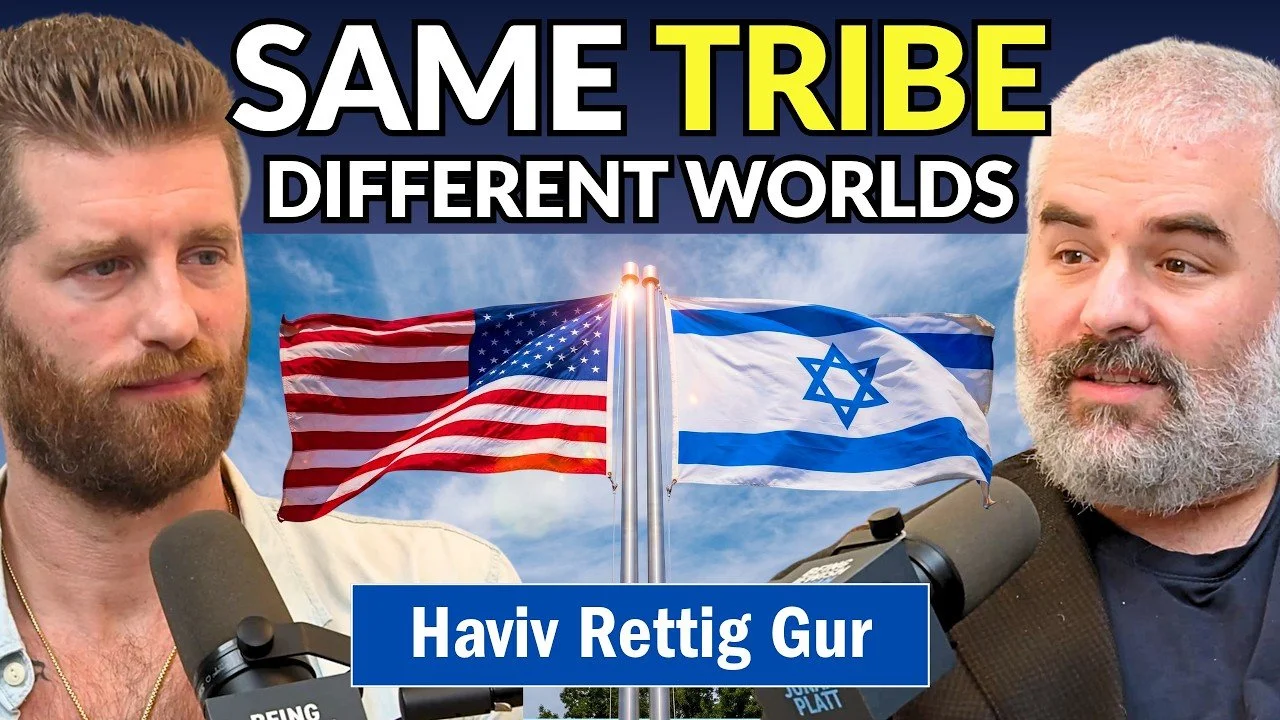
American Jews & Israeli Jews: Why We Don’t Understand Each Other! Haviv Rettig Gur
Two Jews survived the 20th century, the Hebrew speaker and the English speaker, and they survived with opposite strategies, and they don't know that about each other.
Mm.
So the reason a young American Jew today can decide that they're anti-Zionist is because they're the most ignorant Jew who has ever lived.
It's the most Jewishly ignorant generation that has ever lived.
That's another crisis.
We're talking here what the Israelis are doing wrong.
I just want to clarify, I also think American Jews occasionally are- We'll, we'll get there.
We'll get there … they're these deeply ignorant kids who don't know the Israeli Jewish experience.
Well, guess what?
The Israelis don't know yours.
Yeah.
If they learn yours, they will respect American liberal politics in a way that they can't possibly if they have no idea where it comes from.
It's just adorable naivete by rich, safe people who, who live their lives online and feel feelings.
One of the foundational pillars of what it means to be Jewish is speaking our language, Hebrew.
But wanting to speak Hebrew and actually doing it are two very different things.
That's where today's sponsor, Citizen Cafe, comes in.
They have completely reimagined learning Hebrew.
No textbooks, no memorization, no waiting until you know enough grammar to start speaking.
From day one, their teachers get you talking naturally and with confidence.
At a time when most learning has been relegated to an app or an algorithm, Citizen Cafe has built something deeply human, thousands of Hebrew learners connecting across more than 25 countries, sharing a single beautiful Jewish experience.
Citizen Cafe, not just Hebrew you learn, Hebrew you actually live in.
To schedule your free intro session, click the link in our show notes or go to citizencafetlv.com.
Today's episode is sponsored by one of the most talked about books of the season, Moonshots For Israel: 12 Big Ideas for a Small Nation by Judah Tab, a book recommended by fellow podcaster Dan Senor when he was on my show last season.
A National Jewish Book Award nominee, Moonshots For Israel, published by Wicked Sun, is an Israel Hayom and Amazon bestseller.
Find it wherever you buy your books today.
Bruchim habaim, banot ve-banim, and welcome to Being Jewish, your home for deeply candid conversations on Jewish identity, culture, and current events.
I'm your host, Jonah Platt, and I am first here to remind you to hit that subscribe button so you don't miss a single episode as amazing as this one is about to be.
Because my guest today is one of the most trusted Jewish voices in the world.
His analyses of Israeli and Jewish history, politics, sociology are as informed as they are informative, as bold as they are brilliant, as honest as they are engaging.
He will challenge your assumptions, reform your opinions, and still have you coming back for more.
He's got his own successful pod that seemingly produces thousands of episodes at all times, yet he also appears on every other podcast that exists, including, finally, this one.
Just like his beard, he's a little bit salty, a little bit peppery, and softer than he looks.
Straight from the Holy Land, ask him anything, please welcome Haviv Rettig Gur.
Hello.
Hello, and welcome.
That was quite an introduction.
I have to live up to it, the humorous parts and the, uh, teaching parts.
I have no doubt of your abilities here.
It's an honor to be here, and- Thank you.
The honor is mine you came, you came on my podcast.
It was a great episode, so thank you for that.
I did.
Thank you.
And now after a couple of fits and starts, you are here in America ready to rock.
Let's do it.
So obviously, Haviv, you could talk about- Many topics under the sun.
The one I want to focus on with you today is the evolving social contract between Israelis and Jews in the diaspora.
And I want to start by grounding the conversation in the 1950 Ben-Gurion-Blaustein Agreement, this post-statehood deal, uh, on what the American-Israeli relationship should look like between the first Prime Minister of Israel, David Ben-Gurion, and then AJC, American Jewish Committee, President Jacob Blaustein, which basically had Blaustein saying on behalf of the Americans, "Our allegiance is to America first.
You Israelis, you don't speak for all Jews, and we are not living in exile.
We've got our own lives here, but we will continue to support you politically and financially." So knowing that that's where we started, give me the temp check now.
Where, where have you seen that relationship evolve where, where we are today?
I think at that time, you could conceivably argue that there was such a thing as an American Jewish leader, and you could conceivably argue that there was such a thing as an Israeli leader who, in a deeper sense than just elected position, really represented Israeli society in a profound way.
And you can't say that anymore.
There isn't… You know, if you, you walk into a room, and you say to a bunch of American Jews, very involved, very knowledgeable, "Who are the leaders?" By the way, not just institutional life.
Who are the religious leaders- Right … now?
Who, who would that be?
Who would that actually be?
It's not that there aren't heads of organizations, heads of institutions, but y- you used to say, "I want to know what it means to be a Jew." I crack open a book by Rav Soloveitchik.
Right.
Or I, you know, I- Abba Hillel Silver in his day was genuinely the serious, major… These, they're these figures that Jews looked at, looked to.
And, and that has long, long passed by the wayside, and, and it simply doesn't exist.
And there's a, you know, I- does that mean that American Jewish society itself is weakening in some profound, subtle ways?
I don't know.
I, I truly don't know what it means.
But you could have a conversation like that- Yeah … between Blastene and Ben-Gurion.
Imagine that conversation today.
Who would that be?
Right.
In what sense would Netanyahu be said to represent Israeli soc- He represents significant parts of Israeli society politically.
Does he represent them in some kind of historic, cultural, sociological, social, their identities, in all the ways that Ben-Gurion could be said to be nation-building.
There really isn't an Israeli leader like that for generations now.
Yeah.
So what is the relationship?
I have one, one clever trick, and it sees me through everything.
Okay.
Ordinary people.
Like the movie?
No.
Okay.
Uh, it's, it's funny you would go right there.
What do ordinary people feel?
What are they going through?
What do they think?
If you go to ordinary Israelis and you say to them, "What do you think about the Jews of the diaspora?" They'll say to you, "The antisemites are coming for them, and they're eventually gonna collapse, and we'll be there for them.
Don't you worry." And they think they've said something beautiful.
Right.
In saying it's a solidarity and a commitment.
And Israeli teenagers will say that.
You poll any Israeli Jewish high school, it's not, it's, it's a whole different conversation obviously in the Arab community.
Right.
But you poll any Israeli Jewish high school, and you will get a majority of kids saying, "Yes, I will defend the Jews in the diaspora." And then you say to them, "98% of the Jews of the diaspora today live in democracies.
What are you gonna defend them from?" Well, this Israeli grandchild of a refugee from a non-democracy isn't quite sure.
But whatever bad things happened to Jews that turned them into Israelis, it, it's for sure coming, right?
What, it's not coming?
That's not how history works.
And so they're ready to defend.
And then you do, go to an American, um, Jew, an ordinary American Jew, and you say to them, you know, "What's your relationship with Israel?" And it's kind of the news cycle It's kind of the news cycle.
So they love Israel as a anchor of their own identity until Israel becomes something they kind of don't like.
It's politically against them.
The Gaza War, you know, they, they, they might hate the Gaza War, and they'll respond to these things that are in the last three, fi- years, five years.
You know, is Israel, is Israel part of my political world?
Is Israel part of my… And that's the general answer that you get from American Jews.
And so I think that the relationship, what's interesting about those two answers, and I'll just finish with that, is- Yeah … they're talking about themselves.
An Israeli is not talking about American Jews when an Israeli talks about American Jews.
What the Israeli's talking about is, "What it means to be Israeli is that I am ready to protect, uh, my brothers in, uh, the wrong place 'cause they're over there." And the American Jew is saying, "I have spent a century being this liberal, beautiful thing that accepted me and took me in in a way no Jewish community had ever experienced in history.
This really is home." Right?
So what is Israel?
Well, it's either part of my own personal story, 'cause everything in America is individualistic, or it's not part of my personal story.
And so I think these two communities are much farther apart than even the ones-- than they realize, and they're always finding ways to talk to each other and about each other, but they're always actually talking kind of to themselves about themselves.
As usual, that's really well put.
The one caveat that I'll, I'll toss onto the end of one of your ideas is, you know, you articulated Israelis saying, "We'll protect our brothers over there." I find it's, "Well, once you come over here, we'll protect you," but sort of what you do over there is sort of your, like, sucks to be you.
Like, Israel's over here.
If something bad's over there, just leave.
Like, we're the insurance policy as opposed to- Right, but that's protecting, right?
When you… If you, if you flee to Israel from the last Jews of Yemen- When you flee, we're gonna be here for you we're gonna spend a lot of money on you.
We're gonna take care of you no matter what social problems you bring with you from whatever weakened place in the world, whether it's former Soviet Union or Ethiopian.
You come in poverty, you come in wealth, it do- none of that matters.
We take you in.
So there's a sense that that's still protecting you.
But no, you know, there, there used to be a… There was a poll, uh, 15 years ago I saw a poll, so I hope I'm getting it right, of Israeli high schoolers, where they said, "Would you go, you know, would you fly in a plane and parachute into the place that needs to, and rescue Jews at risk of life and limb, Jews that live on the other side of the world that you've never met and know nothing about?" And it was, like, 90% of the teenagers asked to, asked this question said yes.
That's really interesting.
I wonder what that looks like today for th- the reality of American Jews, right?
Like, we don't need parachuters, but we need support in other ways.
And do you feel that Israelis should feel, the answer may be yes, the answer may be no, any sort of responsibility for what Jews in the diaspora are experiencing in their home countries beyond that, you know, final judgment day when it's their, they, you know, they need to be rescued and pulled out?
It's really important to stay humble here.
I have a hard time understanding American Jews, and it's my job, and I've read books on them.
I probably have read more books on American Jews than 99% of American Jews have read, and that's not hard.
It's, like, two books, but still.
And to give you a shout-out, Haviv has, has an amazing episode, one of your first on your podcast, about the story of American Jews, and your thesis essentially is American Jews have no idea about this story that I'm going to tell you.
That's episode two, I think.
Yeah.
Um, I don't know why American Jews right now are both at, you know, anxiety level is about eight and a half.
And also completely asleep.
Mm.
Like, there's so little actually happening.
There's almost no organizing.
There's almost no… American Jews themselves are struggling, I think, to understand what it is they are, how much they're a community, how much they're dissolving.
Are they dissolving?
Are they changing into something else?
Uh, my only concern, the only thing I really can affect, and, and, and so, you know, if I have a hard time knowing what the heck's happening to American Jews, it's awfully hard for me to expect Israelis who don't speak English- Mm-hmm … certainly aren't reading about American Jews.
Mm-hmm.
And more than that, don't learn about American Jews anything.
They almost, almost no Israelis come from America.
That simply never happened.
Right.
There are almost no English speakers in Israel.
It's, the, the census, I think, the, the last good Israeli census on this question I think counted a quarter million, maybe, Anglos or Anglophones, which in a, a population of 8 million Jews, 10 million total population, but just in terms of the Jewish community who you might interact with in Olim, Israeli Jews come from Morocco and Yemen and, you know, Poland and Czarist Russia and places like that.
And so, um, Israeli Jewish education, you can go 12 years in Israeli public schools and never get a single class hour on American Jews, which is the single biggest diaspora, not in the world today, but ever in the history of Jews.
And by, by a huge margin, it's bigger than the second biggest.
And they will learn the history of Iraqi Jews in our schools, and they will learn the history of Moroccan Jews, and the history of Polish Jews, and the history of German Jews, and they will not learn the history of American Jews.
They won't even learn about the existence of a… They know it exists.
They, they w- see the news, but they don't learn anything about them.
And the basic reason is entirely understandable.
They don't come from America.
They're learning about their grandparents when they're learning about Baghdad.
But also, Israelis don't understand Zionist history.
Zionism was this argument that modernity and na- national identities and these collective sort of imagined communities are gonna have a very hard time containing minorities, and they're gonna police the membrane of belonging, and they're gonna turn on their minorities in brutal ways.
Zionism kind of predicted the collapse, and it predicted all the other collapses, and it predicted what happened to the Armenians and to the Greeks as the, uh, Ottoman Empire fell.
Right.
And it, it predicted all this violent 20th century, and it prepared for it, and it warned about it, and Herzl talked about a catastrophe that's coming and all of that, and then it never happened in America.
Hmm.
And Zionism, the, the sort of basic sense of how history functions that Israelis were given by their grandparents' experience of the 20th century doesn't work in Am- America is this weird outlier.
Now it's, i- in defense of Israelis, it's an outlier for all the Jewish experience of all Jewish centuries and all Jewish life, but it's now the half the Jews, and what is it act- what is it all about?
What does it mean?
So I think that there is this deep perplexity.
How come America hasn't killed or expelled all of its Jews?
Ask the Jews of Yemen and Morocco and Poland, which is a legitimate question- Sure … if you're the Jews of Yemen, Morocco, and Poland.
And the American Jews, um, learn about Israel, I'll just say it, dumb, cartoonish fantasies.
We've talked about the lack or the, the shallowness of, of Israeli education here in the States- Right and the need to change that.
I s- I go to an American college.
I, I'm often on college campuses, and, and, and a group of Jewish kids will come, and some of them will challenge me on, on, on the Gaza war, and they wanna come to protest, and some of them, they'll listen, then they'll protest, then they'll come after, and we'll have long conversations.
And these kids will say, "You know, I grew up learning that Israel was this perfect, beautiful thing, and then I found out, holy mackerel, look how much is wrong with it.
Look how, how bad Israeli governments can be." And my first reaction to these kids always was, "Come on." What?
Somebody told you Israel was perfect?
Somebody told you Israel was great?
Somebody told you that there was nothing to note, it's nothing to see here, there's no problems in Israel?
It, uh, my Israeli history, the Israeli history you learn as an Israeli, is that it's s- we're s- we're a nation that stumbles from one crisis to another, half of them self-inflicted.
That's how Israelis learn Israeli history.
So how could you possibly be learning that we're, like, perfect and great and there, there weren't, like, terrible problems of internal marginalization among the Jews, never mind the Arab-Jewish collapse and crash and experience and discrimination?
W- really?
I don't believe you.
I don't believe you.
I think you are pretending that you were once taught an idyllic Israel so that now you can feel hurt by your parents, and you can have your little rebellion aga- a- against your parents, and pretend like your anti-Zionism, which is a deeply historically ignorant anti-Zionism that doesn't actually know what happened to the Jews, how they built Israel, what actually went on there, is some kind of great awakening.
And after the 40th kid said that to me, 70th kid, I've lost track at about 20.
Wow.
I'm like, no, maybe they really were taught this incredibly shallow, silly thing, which means they were never taught about Israel.
What they were taught about was the American Jewish fantasies, and what our parents thought about the world and, and where our loyalty lies, and all kinds of shallow things like that.
So I, I think we have two very ignorant communities that don't learn about each other anything.
I have, tend to have the same sort of view you do of that narrative of this seems, you know, a lot of people use that ex- as an excuse to then hate on Israel, that, "Oh, I was, I was taught X, Y, and Z." But I really think l- less so than having been taught a, you know, Pollyanna version of Israel, we were just taught a, an elementary school version of Israel, the same way, like, when you study American history in America in, in fourth grade, you're not getting into all the nitty-gritty social conflicts.
You're getting taught it was George Washington, we had great forefathers, we built this great land of democracy, blah, blah, blah.
And, like, that's the Israeli history we get, is we get the big kinda tent poles, and- It just stops at fourth grade level … it just kinda stops at fourth grade level.
There are places working on that now and trying to deepen it, but we are, you know, 50 years late.
Yeah.
That makes a lot of sense to me.
Yeah.
I, it's much more that than, like, some sort of false indoctrination of, of, like, nothing bad happened here.
Yeah.
Which I never really got, especially because so many of the teachers teaching it are Israeli, and I don't think they're, like, in any great hurry- No, they're aware to, to hide and lie about, you know, where they came from and, and their story.
Yeah.
It still bugs me, these kids.
Sure.
I mean, forgive me, you know, the job is to teach, but go and learn.
Right.
Go and learn.
And, and, and if you replace one fourth grade version of Israel With a nefarious and manipulative and still fourth-grade version of Israel- Yeah you have accomplished nothing.
Right.
You have accomplished very little.
The people who will bring me little quotes mined out of the hundred million words of Zionist thinkers, they will bring me this sentence from Ben-Gurion proving Zionism is racist.
Right.
I'm fascinated by y- your observation that, you know, Israelis don't learn about the other, you know, 49% of Jews on planet Earth.
Doesn't that feel like an oversight?
I mean, even though I understand the, the story isn't quite as direct a link to the people who are living there, but it feels like if there's o- You know, it's not that many of us, and, like, shouldn't we know what's going on with the other half?
I've said very mean things, uh, to, uh, American Jewish leaders over the years.
Uh, a handful of them who will, if they see this episode, will know I'm talking about them.
I, I once had a conversation with, uh, a couple American Jewish leaders, uh, and I said, "Look, you, you meet the prime minister of Israel-" Right … once or twice a year.
You fundraise for Israel.
You probably send to Israel I don't know, $100 million, the organizational whatever.
Probably more than that in all kinds of directed funds.
These are, you know, federation type, Jewish agency type.
You've never banged on the table and said, "You want our money?
Brandeis University is gonna write a curriculum in Hebrew for you of American Jews.
That curriculum has to be taught in the Israeli education system." Hmm.
You know what?
That curriculum has to be available.
It is not that hard to tell Israelis, "Teach us, and we're gonna, we're gonna remove all the obstacles.
Write a curriculum, here's three.
You need extra money from found- family foundations who care about this?
Here's some extra money just to, just to tell schools we'll also buy you a swing set." You know what I mean?
Like, it'll be, you, the, we will incentivize bottom up, right?
And make sure that a prime minister knows that this is what he needs to do to get a standing ovation at the next meeting with the, uh, with the Jews, right?
Hmm.
Do this.
Why won't you do this?
And, and nobody ever did.
No American Jews ever came to Israel, looked around, and said, um… This was more than that.
I'll say more than that.
There's a lot of concern in American Jewry that Israeli Jews are not liberal.
Right.
They're not that liberal.
They're conservative.
Yeah.
The liberal ones are very, are quite conservative.
Mm-hmm.
The Israeli left is basically the Republican Party's social ideal.
Patriotic, serve in the military, have many kids, 2.4 kids or whatever.
It's the lowest birth rate in Israel, but it's the highest birth rate in the developed world, right?
Israeli secular left.
That is, isn't that basically the Republican social ideal?
So that's the Israeli left.
It, it, they're not as liberal as American Jews.
15 years ago when the world was young, and we didn't know that there were problems in the world, um, the Jews of Israel and the Jews of America were having a big fight about whether or not you'd have an egalitarian section at the Western Wall.
Right.
And nobody came to the American Jews' defense in Israeli society, except, I think, Meretz, like a few Meretz activ- like left-wing progressive activists.
The vast majority of American Jews want an egalitarian's place to do a bar mitzvah at the Kotel.
Like, an American Jew, because of birthright, because of family bar mitzvah trips, because, is more likely to see the Kotel than a Tel Aviv Jew- Right … is likely to see the Kotel.
And we're not saying the, the Orthodox synagogue that is that section, that is the main sec- Give us a small section on the side that's egalitarian for the bar mitzvah with grandma, right, so we can… And that was a huge problem and a huge stink, and Netanyahu was trying to navigate it, and Shas came.
It was for, but then it was against, and it was a whole big political thing.
And American Jewish leaders who were going to the prime minister and thumping on the table and demanding that he listen to them and demanding that this be sorted out didn't understand why nobody was taking them seriously.
And this was a point where I was a very young journalist who th- nobody had any reason to listen to, but I had a strong opinion, and my strong opinion was, you want Israelis to become liberal?
What Israelis believe about the world at a fundamental assumption is that liberalism is fundamentally, basic- it's a beautiful, beautiful, beautiful lie.
As long as everyone believes the lie, it exists, and then eventually it's not worth keeping up.
It, it costs, and there's a populist shows up, the economy tanks, and liberalism is the first thing to go, and then everyone will turn on the Jews.
They'll turn on other minorities as well.
It's not like it's only the Jews.
Zionism is a whole theory of how modernity collapses.
Zionism predicted what happened to the Roma in Europe in the Holocaust.
Mm-hmm.
But it is basically a li- it won't protect you.
And so liberalism is a beautiful thing.
You want it.
You should live in it, and we should all find ways to live in it for as long as we can.
Ultimately, when the chips are down, that's not what's gonna save you.
What's gonna save you is your own people, solidarity, a big m- army, you know, institutions, et cetera.
Mm-hmm.
And American Jews, of course, spent the last 100 years discovering that liberalism actually is the answer to Jewish history.
Liberalism saved American Jews from the 20th century, and liberalism is what American Jews became.
I mean, it's just, it, it is the homeland.
Yeah.
And so how do you teach Israelis the American Jewish perspective on liberalism?
That's what'll make them appreciate liberalism.
Like, if you can show Israelis the history of American Jews, and you can show Israelis that half the Jews lived through the story of liberalism failing, but the other half lived through the story of it succeeding, if they learn that, you'll have a few people willing to listen to you about an egalitarian section of the Western Wall.
You'll have a few people willing to listen to you about the whole gamut of your left-wing politics.
So teach them your story.
Don't just chide them in ways that they aren't equipped to listen to 'cause all of history looks different to them.
Teach them your actual story.
So how do we get an education of the American Jewish experience into Israeli schools?
How is that not a priority for American Jews?
And it not only was never a priority, nobody ever even noticed or cared.
It was never something anybody was willing to deal with, think about.
It is this immense gap.
Yeah.
And nobody wants to fill it.
I think part of it is, and it comes from such a good place, that, like, the American Jewry doesn't want conditions on supporting Israel, right?
They wanna support Israel because they love the Jewish people and the Jewish homeland, and just wanna be supportive of it, and to, to make it transactional feels icky.
I hear from American Jews all the time, I mean, I landed in LA a few hours ago.
Yeah.
That's why I'm a little tired.
But by tomorrow evening, I will already have heard a couple of times from American Jews that there are some problems in Israel, that in some ways Israel is failing them, that in some ways it's not the ideal Israel they wish Israel lived up to.
Sure.
This is how you shape it.
This what is Israel not living up to?
Israel thinks it is surrounded by genocidal, existentially threatening foes.
That's because a lot of these enemies actually constantly say We're coming to kill you all, right?
Right.
And they've been saying it for four generations, five generations, a century now.
Different versions of it, but it's the same fundamental ideological streams and, and, and worlds.
And so when an American Jew comes to the Israelis and says something like, "To occupy, to militarily rule a people who don't have the vote," right?
Mm-hmm.
"So you pull out of the West Bank, or you give them all the vote." And an Israeli looks at them and says, "I can't give them all the vote.
They don't wanna be Israeli.
I don't wanna be Israeli.
I don't want them to be Israeli." But they agree on that point.
Right.
"But also I, I, then I don't have a Jewish state, and I can't pull out because Hamas will take over, and I'm nine miles wide, and they hold the highlands.
And you know what Hamas is.
You know what Hamas is willing to do in Gaza.
Now you… And I'm not talking about October 7, I'm talking about engineering this war with those tunnels.
What do you think they're gonna do in the West Bank?
You think they're not gonna launch attacks?
You think I'm not gonna have to retake the West Bank, and it'll be a catastrophe for the West Bank?
I don't have answers because I know more than you know.
What do you mean?
Just for your morality, just for your liberalism- Mm-hmm … I now have to pull out of the West Bank because of your feelings over in the Upper West Side of New York City?
That's, that's what needs to happen here?" That's, by the way, a left-wing Israeli- who accepts the premise- Mm … that they can't live under military rule.
Right.
The point is that if you want Israelis to actually become more liberal, you don't do it by bopping them on the head with your completely detached, and frankly ignorant, grandstanding basically, or moralizing at them, or… That's not important.
Your moral emotions aren't important to them.
Why would they be?
Right.
They shouldn't be important.
They have more at stake in this than you, and more dangers that they will face than you know of.
So teach them your story.
The best American Jewish argument for Israel to stay liberal, to be liberal, to become more liberal, is what liberalism did for the other half of the Jews.
Two Jews survived the 20th century, the Hebrew speaker and the English speaker, and they survived with opposite strategies.
And they don't know that about each other.
Mm.
So the reason a young American Jew today can decide that they're anti-Zionist is because they're the most ignorant Jew who has ever lived.
It's the most Jewishly ignorant generation that has ever lived.
That's another crisis.
We're talking here what the Israelis are doing wrong.
I just want to clarify, I also think American Jews occasionally- We'll, we'll get there.
We'll get there … There are these deeply ignorant kids who don't know the Israeli Jewish experience.
Well, guess what?
The Israelis don't know yours.
Yeah.
If they learn yours, they will respect American liberal politics in a way that they can't possibly if they have no idea where it comes from.
It's just adorable naivete by rich, safe people who, who live their lives online and feel feelings.
And, and they're not wrong, except that it comes from a deep, real, long-standing generational place.
If they knew that, they would liberalize.
So my, my message to American Jews isn't, you know, for peoplehood, and so that we can all feel connected to each other.
Teach them your story.
First of all, hell yeah.
I mean, that'll do it.
But also, you want a liberal Israel?
Teach them the American Jewish success story in liberalism, because they were literally forged as a nation from the failure of all the promises of mod- modernity and liberalism in Europe and in the Arab world.
What you just described would be true 10 years ago, right?
That there are Jews in, in, in the diaspora moralizing and saying, "Israel, why don't you care about the same things I care about?" It's a little different now, where there's, you know, real world concern of, "Hey, Israel, shouldn't, shouldn't you guys care a little bit about what these other people are thinking and saying about you?
Because it's actually affecting your standing in the world, and the way you're able to operate with allies, et cetera.
And it's also affecting, directly now, in matters of safety and security, Jews around the world." Is that a, a different argument worth, you know, trying to communicate?
The Israelis have, have looked more villainous than they ever were, and to a c- like, an, such a ridiculous extent.
I mean, this is an Israeli government that pretended to starve Gaza, and never did starve Gaza, and Gaza never starved And the world's obsession with the starvation, the starvation in Gaza is, is fictional.
And one of the reasons it's, it's, it's a fiction, it's about other things.
And one of the reasons I know it is, is that places that actually have starved, like Sudan and Yemen, and in the Yemen case, with American weapons and American intelligence support to the people doing the blockading of Yemen at the time, and the time was about six years ago.
It wasn't like, a, you know, 100 years ago.
Uh, and, and, and I don't think more than, like, a few tweets and maybe a letter from some senators, I don't think anybody noticed or cared.
Right.
And the UN estimates 85,000 children died of starvation and related causes in the Yemen war.
And in Gaza, where there is this global uproar about starvation, and all the data we're getting is that there wasn't, and also now Gaza has lower rates of child malnutrition than Jordan and Egypt, and et cetera.
Yeah.
It didn't happen in Gaza.
There's an IPC report about starvation last year in, in Gaza having to do with a block- the specific blockade, and, and its methodology is completely innovative and completely wrong, and, and, and one scholar after another is slowly coming around to admit it.
But trying to starve Gaza is literally in the ICC indictment of Netanyahu, so it's like this accepted narrative that never happened.
The problem is the Israeli government announced an aid blockade Apparently to try and pressure Palestinians who were starting small uprisings against Hamas to launch a major uprising.
But what they ended up doing was causing massive hoarding that created a hunger crisis that as soon as the Israeli government realized that had happened, then they stopped the blockade, rushed massive amounts of aid in.
They never got anybody to protest against Hamas or overthrow Hamas, which I think was the basic goal from sort of cabinet leaks and how these things are discussed among the Israeli leadership.
It was a catastrophically stupid policy, callous and cruel and dumb, and not a starvation policy, but it's about as bad an information war as you could possibly have fought.
Right.
Whatever the government did or did not do, we would still be having the same problems.
They could have been the most above board, perfect, benevolent heroes ever, and the, the world would still be finding things to, to twist.
We have a government… Yeah.
We have members of the Israeli cabinet who have insisted publicly, not people who set policy, not people who decided a single move in the war, but the Smotrichs and Ben-Gvirs who declared repeatedly that it's a war of ethnic cleansing.
And American Jews are standing there like I'm laughing because otherwise I would cry.
Yeah.
I'm not laughing because it's funny, I'm laughing because it's tragic.
Why would the Israelis not just not fight the information war, which was the main war Hamas was fighting?
It was not- Right … fighting on the ground.
It was fighting on the ground.
Of course.
And it has tens of thousands of dead Hamas fighters.
But the fundamental war was an information war, and the Israelis never showed up to it.
Yeah.
And not only that, for reasons of the cheapest kind of internal domestic politicking, they tried their best at every turn to look as evil as possible, and that has had some effect on American Jews.
The question, so you asked me about responsibility.
I'm sorry, I had to get all that off my chest.
No.
This is a therapy session it's turning out.
That's fine.
Good.
That's, that's what we're here for.
There needs to be a level of competence for the Israelis to come to the American Jews and say, "What are we doing wrong?
What can you help us with?" On whose side, competence?
On the Israeli side.
Mm.
Look, frankly, also on the American side.
Yeah.
American Jews think that the Israel, that they are collateral damage, so to speak, in the Israel wars- Yeah … of American culture.
But American Jews have not gone to war.
There's a kind of, I don't, I don't understand it.
Um, you, you'll understand it much better than me.
Uh, there is a emotionlessness to American Jews.
Now, it could be that things are fine, and outside of a certain small group of chattering elites, American Jews aren't feeling pain or f- worry or anxiety or fear.
But every synagogue has guards.
That wasn't true 10 years ago.
Every single one And every Jewish space is invaded by the, online is invaded by insane bot armies of anti-Semites.
And Tucker Carlson is becoming more popular on the right every day, and, uh, uh, over on the left, uh, you have weird stuff.
Weird, not anti-Israel stuff.
I mean, Abdul El-Sayed is such a charismatic figure and such a clever guy, and socialist politics is as Jewish as… Is apple pie Jewish?
As Jewish as a knish.
There you go.
So but then suddenly El-Sayed has this connection to this imam.
Then suddenly El-Sayed will say something about why it, it, it, it, it's understandable why somebody might attack a Jew.
Stuff that just doesn't make any sense, and then you realize, wait, these people really are steeped in basically Third World anti-Semitism that they heroicize 'cause it's their heritage.
But that piece of it- their heritage, actually kinda sucks, and they're, they, they bring it intuitively with them into the world as they travel the world.
Mm.
Uh, Abdul El-Sayed reflects very Egyptian views when he talks, uh, when he, when, when he associates with certain kinds of, of, of Muslim leaders in, in Michigan.
And Jews aren't responding to that.
They are, but the, I think the issue, and you're sort of pointing to it in a couple of different ways, is that the American Jewish community is incredibly fragmented and decentralized.
I mean, no people truly is monolithic, but American Jews really are not, and I feel now we're sort of even as fragmented as we've ever been, where there are, you know, a big portion of the American Jewish community who v- vote for an El-Sayed, and then you have a, a more engaged than ever, uh, what you might call sort of the traditional or establishment Jewish community who is fighting like hell, and is engaged as never before, and is trying a million other things.
But when taken all together, it may look like there's not a whole lot going on.
I wanna suggest a theory.
Please.
I have no good evidence for it, but it's just a sort of, maybe it's wrong, and then we'll know something because we'll know why it's wrong.
The young people are all online.
Yep.
And they're hungry for knowledge and identity and belonging.
You have kids.
I have kids.
How much are we raising them?
And how much- Versus how much are we outsourcing … and how much is TikTok raising them?
Mm.
How much of their worldview, how much of their knowledge of the world, how much of their sort of intuitive, the soft stuff, like on TikTok you will see people you won't see in your daily life, right?
'Cause they're on the other side of the world.
So your world is now expanded or changed, or, or you, you will have shifted your sense of, of where you live and what the world is like.
My kids come to me with, uh, theories about the economics of the world has set against them and trying to keep them down.
And I look at them and I say, "What do you, what do you mean?" And they're like, "Well, look at this YouTube video about how the whole system is re-" It's not even socialist, it's just nihilistic and angry.
And I say, "Well, you know, you can start businesses in this world, and you can build families in this world.
It's, it is doable.
Like, these, these people selling you that everything is broken on YouTube, that's not true.
That is not correct.
That is a, a… Right?
They're teaching people to be." And it just occurs to me that, um, my kids bring what they find on the internet to m- me.
That's a cry for help.
Yeah.
Our kids are online, and they are off in a landscape we don't understand, and they are learning crazy, untrue garbage, and we are not teaching it to them, our generation, and that's a cultural transmission disconnect that is… And there's so many studies about they're becoming radicalized to the left, radicalized to the right.
There's a gender gap.
The, the boys are going right, the girls are going left.
Mm-hmm.
That's causing, of course, dating problems and intimacy gaps, and everything becoming more politicized.
Their whole sense of self, their knowledge is shifting in profound structural ways.
Their neurology is being rewritten by social media algorithms, and the parents have nothing to do with it.
And I stand in hallways full of Jews, well, usually older Jews, Jews who come to a community talk and event, and I say, "Raise your hand if you're on TikTok." And not 10%, not, probably not 5% of the room is on TikTok.
Yeah.
But 90% of your kids are on TikTok, and they're getting their, their worldview on TikTok, and so there's a gap of cultural transmission in which, uh, that might be n- unique in history, and it's happening to everybody.
For sure.
But it's also happening to Jews.
And if that's true- It is true … then there won't be American Jews, not because there won't be American Jews, but because there won't be any meaning, any sense in which their They're Jews.
They won't have communities that they go to.
They don't go to synagogues anymore.
The Reform movement, the Conservative movement are in a slow-moving collapse.
Synagogue attendance is in a slow-moving collapse among young people, and they are walking away from every bond, every cultural institution, every thick sort of connection that you would have.
We don't have communities because we're too mobile.
We meaning Westerners, right?
Mm-hmm.
Israelis do still because they're less mobile, 'cause there's not a lot of places you can run away to if you're an Israeli.
There's something deep happening here, and I wanna suggest that the quiet of American Jewry right now, outside of basically older institutionalized Jews, might be a deeper dissolution, might be a deeper fading away And if something isn't done big and dramatic, and by the way, on the very platforms that are causing the problem, if we don't go on TikTok and in a massive way reach our kids with their story, with their re- heritage and, they're not coming back.
In the summer of 2008, I went on my Birthright trip to Israel, a free 10-day excursion to the Holy Land with a bunch of excited fellow college kids.
You think it's gonna be a standard vacation, soaking in the Dead Sea, parties in Tel Aviv, and it was that.
But what I didn't realize was how on top of having a great time, it could actually change your life.
There's an indescribable comfort of being in a place that's for us, our Jewish family from all over the world, and the magic of seeing thriving Jews living peacefully alongside other Israelis of all races and religions.
There's the wonder of the land itself, the Negev, the Galilee, the old city, and the clubs of Tel Aviv, the Western Wall, and Masada, the tunnels, and the kibbutzim.
Returning to America, it's staggering to realize how strong your bond to Israel suddenly is.
One trip really does change everything.
But these free trips can only stay free with your help.
If my story speaks to you at all, please donate to Birthright Israel Foundation because for the next generation, a trip to Israel means more than ever before.
So please, head to onetripchangeseverything.com and make a donation today.
When Call Me Back's Dan Senor was on the show last season, he told us to watch out for Judah Taub, whom he called a real thought leader and public intellectual working on moonshot solutions to some of the biggest challenges facing Israel and the Jewish people.
And you can read all about it in his eye-opening new book, Moonshots for Israel: 12 Big Ideas for a Small Nation.
The book's premise is simple.
What could Israel become if it stopped thinking about the very next crisis and instead started thinking about the next 50 years?
Taub tackles everything from water scarcity to education, from defense to the demographic shifts of diaspora Jewry.
With 12 ambitious proposals, he stress-tested with industry and government insiders.
Taub is an Israeli venture capitalist, a lecturer at Wharton, Yale, and Harvard Business School, and a reservist in the IDF.
The dude knows what he's talking about.
Grab Moonshots for Israel with a forward by friend of the pod, Dan Senor.
It's the perfect Hanukkah gift, available now in print, e-book, and audiobook.
It's funny, the, uh, anti-Zionist Jews, I used to be very optimistic about them.
I used to be really happy about them because an anti-Zionist Jew is someone who is, first of all, very safe, so they can be anti-Zionist.
Right.
Which is a fantastic thing.
Mm.
And also, uh, someone who doesn't learn their history, which is a sign of, I guess, safety.
Mm-hmm.
And also, to be anti-Zionist They become more Jewish.
I have seen this time and again.
What do you mean?
Well, with, you know, they're not that connected or involved or engaged or serious or interested or knowledgeable.
Right.
But there's so much social cachet to be gained from being an anti-Zionist now, and so much social cachet to be gained from being an anti-Zionist Jew right now.
That's a hero, if you awaken from the evils of your people, um, that being Jewish becomes interesting.
And so, great.
But in name only, it sounds like.
Go be Jewish, right?
And then, yeah, and then I have met and debated and really sort of had some friction, interaction with more and more of them, and they're not really learning, and they're not… They're, they're, they're… The kind of Jewishness they're imbibing is the non-Jewish anti-Zionist version of Jewish history and culture, which is to say not Jewish- Right history and culture.
I, I wanna be careful to distinguish that- Again, not a monolith.
And even within anti-Zionist Jews, I've discovered that there are many who, uh, it, under another circumstance would not consider themselves an anti-Zionist Jew necessarily, but because they've only been presented with a binary of, "Well, either I am pro everything Israel's doing, or I'm not, and I'm definitely not feeling pro, I guess that means I'm over here with these guys." And so you get some- Do you think that's a lot of them?
I, I think that's, uh, many that I can think of, Jews who are going to synagogue every week.
See, to me, that has nothing to do with the question of anti-Zionist.
Why would that be anti-Zionist?
Hate what Israel's doing has nothing to do with Zionism.
I think that's a misunderstanding.
I think a lot of people are, are, have bought into that, you know, uh, Western misrepresentation of Zionism to now what people use it as generally, which is, "I support Netanyahu's elimination of Palestinians." That's what Zionism is.
It's interesting.
I, I, I was, I was giving a talk at, at a campus, and a kid comes up to me afterwards, and he… And it was a talk about the DPs, and the Jewish refugees, and the building of Israel.
And he, the kid comes up to me afterwards and he says, "All right, I get your point.
Your point was…" Uh, this was a kid who was, like, typing away, I think on, like, ChatGPT fact-checking me as I go.
Mm-hmm.
And this k- um, and a Jewish kid, and he comes up to me afterwards and he says, "I, I take your point.
Your point was Israel had to be founded.
Like, there was no alternative, there was no other option, the doors were closed to everywhere else, and they were all were desperate refugees.
Okay, it had to be founded.
Everything beyond that, up for grabs.
Should they have done this?
Should they have behaved that way?
What did the Arabs do?
Did the Arab leadership ever give Palestinians a state when they could have?" All of those questions, all of the complexities, fine, but the Israel should have been founded.
"I'm still anti-Zionist," he says to me.
Hmm.
And I was like, I was, like, channeling Princess Bride, you know?
"I don't think that word means what you think it means." Israel had to be founded, but I'm still anti-Zionist is two opposite arguments.
Yeah.
And the kid says, "This government in Israel is so callous, and so cruel, and so evil that I can't do it." So I said to him, "You're just a Meretz voter." "You're not anti-Zionist.
These people serve in the army, the people who talk the way you talk about this government in Israel." Yep.
Basically, what the kid ended up saying to me was the, the historic argument, uh, uh, argument, just the historic reality of, of, of where the Jews of Israel come from, how they survived the 20th century, is absolute- He gets it.
Yeah.
Uh, many people who say they're anti-Zionist do.
Right.
The problem is on campus, if he were to be Zionist, it would close every door he has socially on campus.
It would, he would… I mean, in his, in his dorm hall room, like, hallway.
Yeah.
Like, he would not be able to student government, group social, dating.
Like, it would, it would ostracize him completely and marginalize him completely on campus.
And, and I didn't have anything to say to this kid because I went to Hebrew University, where A, uh, you c- you could date-- Jews could date Arabs.
Uh, it wa- uh, you're in the middle of the conflict.
It was more… Like, Hebrew University was not this crazy place where everybody was constantly judged.
Although Hebrew University is a quarter Arab, the Jew- the student population.
And, and, and so I went to a place that is both much more Zionist and also, like, much more open and relaxed and easygoing and, and happy-go-lucky, and, um, and, and, and not quite as judgmental, and not judgmental in these ignorant ways that you find on a Am- modern American elite campus.
But then I said to the kid, "Look, if knowing the story of your people," literally that's it, knowing-- not wishing that half the Jews who are alive today, what, hadn't survived?
Had survived in some other way?
But there wasn't another way, so that's just fiction writing.
It's a-- write some fiction, but that's not reality.
Hadn't survived.
Like, knowing how they survived, if that is something deemed so irredeemably bad that you are ostraci- you are living in a great and powerful bigotry.
You are literally not allowed to know your story, or you don't get to be part of society, is the bigotry you're living in.
At least be aware of it.
At least see it.
And my recommendation, you know, I have never lived in what you're living in c- 'cause, you know, Israel.
Yeah.
But I have to tell you, Herzl lived in something 10 times worse than what you're living in, in the, in the deep, profound society ordering antisemitism of 19th century Vienna.
And Herzl said, "Freedom.
Freedom lies in letting them go and walking away." Because once you are forced into, uh-- Your identity is policed by people who hate half of your people, or more than.
I mean, just the whole story of your people, who mock it, who fake it, who live it, who obsess about it.
Of all the problems in the world today, to obsess Um, but there are, uh, I, you, you say that and people say, "What is a bigger problem?" The Chinese Communist Party is a bigger, more horrific, more deadly problem.
Sudan, bigger, more horrific.
Places where American weapons, European weapons are, where there's bigger pro- Even the… That doesn't mean you should ever walk away from the Gaza war.
But if the only war you can ever see is that one, then it's not about war.
Right.
It's a, it's something else that's happening.
And all of, all of that is to say he's living in this deep bigotry, and I suggested to him that, uh, he sh- he should tell his story.
He should tell his story, and I think he will find that there are some, there's a s- some shreds of curiosity left in the modern American college student.
Mm-hmm.
They come to hear my talk sometimes, some of them.
Um, they're, they're, they're willing to hear the talk of somebody who s- little bit cuts against the grain of what they're supposed to know.
And, um, and also, uh, freedom is being able to be who you are.
And, and, and you're not free if you're living in such a fear and a bigotry.
You have in every American elite university today a Middle Eastern studies department- Mm-hmm … that is so literally incapable of teaching Israel.
Yeah.
So unwilling to teach Israel, and it is so utterly accepted- Yeah … that they should never be called upon to have to teach an empathetic version of the lived experience of millions of people That they just found that Israel studies departments outside of it with some other Jewish money, which are now, by the way, also being taken over by anti-Israel ideas and ideologies.
Great.
And so the university admits that it is locked into these ideological narrow-mindedness and bigotries, and it's just considered okay.
It's just considered okay.
And, and, and a kid comes to an hour of my talk, and is so … He learns such simple things, and it so undermines the overwhelming narrative that he doesn't know how to handle the over- the, the overwhelming narrative that he lives in.
Right.
I, I don't know what to do with that.
Yeah.
The math ain't mathing, as they say.
It's, it's just there's a total disconnect between what's real and what's accepted, and w- what you have to endure as a young person and, and what's true.
It- Maybe, maybe the story of the next generation of Americans and French and British young people is, is to actually rebel against all the things you're being told, including these things.
Well, it takes me to a, a quote of yours, which, uh, is, "Jews who know their story are invincible." And, and to me, that is at the heart of what we're talking about right now, that when you actually know who you are and how you got here and where you came from, you can't fall prey to these false narratives and incorrect definitions and people trying to excise that part of you for acceptance.
It's much easier to do when you don't even really know what you're giving up or what you're talking about.
Absolutely, and it's freedom in every direction.
You're free from the insane bigotries of the people who want to erase the Jewish story.
Why do people want to erase the Jewish story?
Because the Jew was placed by Western morality makers after World War II, basically, by, by sort of culture creators after World War II, who built out the moral system of the 20th century.
They were placed as the, the archetypal victim around which all the moral system is built.
In other words, what is genocide?
What is ethnic cleansing?
What is wrong with Nazism?
Why are there Holocaust museums all over the place?
It was the, the, the Jew was posi- the Jewish victim was positioned in that place, and now the Jewish victim has to be kicked off that, that pedestal, that place of, of moral You know, it's a very Christian kind of idea, where it's sort of the Jew on the cross.
Mm.
So the Jew now has to be taken down off that cross because he's no longer deserving of being on the cross.
Well, who goes back up on the cross?
Well, we know who goes back up on the cross.
The New York Times photographs of the starving kids in Gaza Who were not starving.
Um, they were terribly ill, and there's terrible suffering in Gaza.
There's terrible suffering in Gaza.
There's just not that suffering in Gaza.
That was an invention.
Right.
And The New York Times, to show it, literally has to crop out the healthy siblings, right?
Right.
But also The New York Times, to show it, brings pictures that are the Pieta, the mother holding the suffering child, right?
Mm-hmm.
Mm-hmm.
So the Jew has to be taken down, which means that there is no such thing as Jewish vulnerability.
Every time a Jew says something about October 7, every time a Jew says something about antisemitism, they are crying, they are whining, they're trying to reclaim the place of privilege- The victim card that the Holocaust gave them, and they have to be brought down from that place of privilege, and mocked, and marginalized, and put in their place so that the proper people, in this third worldist view, it would be, I guess, the brown third world person, um Which just brings me to Israelis who are just white enough to be white for the purpose when it's bad to be white.
Right.
And just brown enough to be brown when it's bad to be brown.
But, um, but, but so there's this whole thing, and, and, and so the Jewish college student is surely lying about the intensity of the bigotries that they face, and yet it's everywhere.
T- tell a Jewish kid to stand up and tell the Jewish story, and, and, and you'll find out just how much antisemitism there is on your campus, and it will shock you, and you will pretend not to be shocked, and, uh, that's basically how it all works.
So you become invincible to that if you know your story.
In other words, a Jew who knows their story, who knows the story of the Holocaust survivors or the DPs, of the American Jewish story, the unbelievable story of the American Jews, truly unique in the history of Jews, hears all of that insane kind of morality play that happens in the minds of the people around them, and can laugh it off because they know the actual story.
Mm-hmm.
They're not, they're not the victim around which you should build someone else's moral system.
Fuck all the other people building their fucking moral systems.
You are a real person in a complicated history who has a real story, and everybody building their story on you.
You are neither the greatest vil- victim who needs to be the Jesus of the universe, nor are you the greatest villain who needs to be displaced from the position of moral pedestal.
All of that's garbage.
It is the flotsam and jetsam of a broken culture in somebody else's mind.
Ignore it, know your story, and you stand invincible to the insanity and the garbage outside.
But you're also invincible internally to ever having to feel, like, so defensive that you can't see our own faults.
I have this unbelievably priv- privileged position of being able to talk about war crimes in Gaza.
Hmm.
Easily, comfortably, and Israelis will listen, and I'll get angry emails, and when you crack them open, they're almost always from the United States.
They're almost never from Israelis.
That's really interesting.
Israelis are sitting there and they're like- Yeah … "Look, quarter million men went into Gaza.
Statistically impossible that there weren't sociopaths among them.
It's just literally statistically impossible." Right, right.
The Gaza war could be justified in 16 ways, and the last 20% of it could be completely unjustified.
Mm-hmm.
It, it-- That's a-- These are reasonable positions and ideas and thoughts.
What exactly was the strategy for three years?
And the fundamental war strategy changed because it wasn't working.
So was that a good or a bad strategy?
Um, how do we know?
And all of us know people who were in Gaza, and so what, what do we know for th- So- You can think, and this is what I believe, that the Gaza war was absolutely necessary, that Gaza's rebuilding comes immediately after Hamas because Hamas will use that rebuilding to launch new wars.
It will never-- And it's not about occupation in the case of Hamas.
There are Palestinians.
I have interviewed them.
I have talked to them.
I have lived among them.
I work with them as a colleague in journalism.
There are Palestinians who want an end to military rule.
That-- They, they want-- That is the goal.
That is not Hamas.
Hamas would kill those Palestinians if those Palestinians ever got too uppity and talked too loudly.
Right.
Hamas wants the extermination of the Jews, and until that's gone, Gaza can't rebuild under Hamas because then it's Hamas rebuilding the next war.
Right.
And I believe that, and I also believe that I understand how Gaza, the parts of Gaza that are demolished became demolished.
I understand the layers of the war, the w- step after step, and I also am absolutely certain, incidentally, there are indictments and convictions of Israeli soldiers in the Israeli system.
Probably not enough.
I'm absolutely convinced that some of it was not okay.
And why can I do that?
I know our story, and there's zero doubt about my loyalty.
Loyalty is not not criticizing.
My loyalty to Israel is as a democratic citizen of a country that I'm gonna criticize every day of the week 'cause it's fun, 'cause I enjoy it, 'cause it's me- Right … 'cause I have to give it to my kids as their greatest inheritance.
Mm-hmm.
So yes, knowing your story liberates you from the insane people who build their story on the Jews.
The Jew as perfect victim, the Jew as insane villain, the Jew as the obstacle to redemption.
They're crazy.
They're crazy.
It's bullshit.
You live in a world that thinks too much about Jews, and if you-- The more you know your story, the more you get to just be the guy you are and not live, not be their Jew, not live in their gaze.
And inwardly, say whatever the hell you wanna say among the-- of the Jews because you're one of us, right?
Because you're one of us.
My kids can come to me and say, "Dad, you're doing something wrong." My neighbor probably shouldn't come to me and say, "Hey, your parenting is off.
Here's what you should fix," right?
Right.
But you're in the family, you're supposed to criticize as well.
So it's two kinds of, uh, invincibility.
All right, I wanna shift gears a little bit here and talk a little bit about Israel specifically, some of the stuff going on there today in this moment.
But if you wanna hear Haviv wax philosophic on the land of milk and honey, you need to be part of my Kehillah, my subscriber-only community.
You'll receive exclusive segments from my conversations, limited merch drops, discounted and free tickets to my live events, intimate Q&As with yours truly, and a whole lot more.
Join today at beingjewishpodcast.com/support and make our community your community.
Wipe it.
Ready for this brain buster?
What is the first domino that you would like to see fall on the road to a lasting peace in the, in the, in the region?
I know there's about 1,000.
What's one that you think's gotta be near the front?
It's not dominoes.
There's one wall.
There's only one thing that needs to fall.
There has to be a real deep fundamental acceptance that the Jews get to live there, get to be a people.
If you're Arab and convinced that they're just European interlopers Then give it to them because of all the Iraqi Jews who have, who had nowhere else to go, and the Yemeni Jews.
They're the, they're the, they're the anchor of legitimacy.
Mm.
And they took in a few Ashkenazi Jews, poor things, right?
Um, if you're a Zionist, a European-style Zionist, then that's your story.
Whatever the story is.
I, I, I don't need Palestinians to be Zionist.
I do need Palestinians to say, "It's a tribe.
It's a people.
They have nowhere to go.
They never had anywhere to go." The, that, I can … That's enough.
That's enough.
I teach my kids their story, the Jewish story.
Mm-hmm.
2,000 years, every synagogue prayed to Jerusalem.
There is no other place under the sun for us.
It could not have happened anywhere else.
But I don't need Palestinians to, like, teach that story.
I just need them to say, "Look, this is a people with nowhere else." The, that, that's the story, and they will not be exterminated, and they will not be removed.
And more than that, an Arab world in which they cannot live doesn't get to tell them where they can live.
An Iraq that no Jew can live in doesn't get to tell the Jews where they can live.
And so if in the Middle East, Israel is accepted as a community, you know, when, when an American says, "I don't believe in ethnic states-" I've broken that down on this show before.
Yeah.
And it … But, you know, there's something cute about it, because, like, okay, you're an American.
Like, maybe you really don't believe in ethnic states.
No Middle Easterner can say it.
Right.
No Middle Easterner can say it.
And so I don't need them to believe in much.
I just need them to believe that there is this tribe.
The Arab world has this nasty habit of forcibly expelling or massacring its minorities.
It's still happening.
It's still happening.
Syria in 2011 was 10% Christian.
Mm.
One of the oldest Christian communities in the world.
Syria today is 2% Christian.
It's still happening.
Mm-hmm.
And that Arab world has to accept that there is this one minority that managed to carve out for itself a tiny little corner.
It could have gone many different ways.
You know, after '48, who ends up in charge of the West Bank and Gaza?
Jordan and Egypt.
Right.
And it's not just that they don't give them a state.
Jordan annexes the West Bank.
It literally annexes it, and it holds a conference in Jericho where all the Palestinian elites are made to swear allegiance to Jordan.
And after '67 when Israel retakes it, Jordan still claims it.
It still won't allow for a Palestinian state.
It still says it's a Jorda- … And Jordan's a dictatorship.
If you're worried about military rule, if you're worried about democracy and freedom and, and g- Palestinian choice, Jordan was opposed.
Jordan d- actually only officially gave up its claim to the West Bank.
Jordan gave it the name the West Bank.
Right.
It's the West Bank only if you're sitting in Amman.
Uh, it, Jordan only gave up the claim in 1988.
This whole idea that the, the, the Arabs fight for the Palestinian, it's never been true.
It, when the PLO was established in 1964 in Cairo as a Nasserist under the, under the It, it wasn't Na- … It was a Palestinian, but it was under the, um Protection of Nasser, and it was to serve Nasser.
It literally declares that it is only fighting to liberate the Palestine occupied by Israel, not the parts of Palestine occupied by the Egyptians in a pretty brutal military occupation of Gaza since '49.
Mm-hmm.
And the part claimed and occupied by Jordan.
And so it's only fighting to liberate the part of Palestine that the Jews occupy, suggesting to me that the problem isn't occupation, but Jews.
Mm.
And if that's built into the core founding DNA of the PLO, then how can y- when does the PLO get the right to actually target West Bank and Gaza f- to liberate the West Bank and Gaza when the Jews control it?
And, and, and so I, you know, I don't argue that Palestinians don't have a right of self-determination.
I argue that they do, and I argue it in Hebrew to Israelis.
But it really is, the century of resistance to Zionism really is, and the data points are so numerous and so utterly illegal to actually raise them in a campus.
It really is about humiliation of the Jews being able to push back Arab nationalism.
It really is a theological discourse about Islamic weakness and the need to restore Islamic strength, and the weakest thing that ever pushed Islam back is the thing that will demonstrate that Islam is returning, and that weakest thing is the Jews of Israel.
It really is these ideologies of essentially supremacy that drive the obsessive Arab focus on the destruction of Israel.
And the societies, the Arab societies that are most successful are also the ones least obsessed with Israel.
Yep.
Because they have so much less to answer for.
They don't feel broken.
They don't feel like they've fallen.
And so, uh, I, I need that to change.
I need that to change.
I have an analysis that sounds a little self-serving.
I happen to believe it's true.
That's my only justification.
Let's hear it.
The Israelis' deep skepticism at the Arab world- Mm-hmm … and willingness to fight everybody in the Arab world, and conviction that the Arab world's coming for them, is something the Arabs did.
It's a reflection.
The Arabs started that, and it matters that the Arabs started that because if you want the Jews to come down off of that, the Arabs can't keep doing it to them.
You can't come down off the thing if they're right.
Like, they have to be wrong.
Right.
And so the thing that has to break first is this Arab need and desire to eliminate Israel, and it has to break completely, and it has to break visibly, and it has to break openly, and it has to break publicly.
And the Emiratis are amazing and wonderful in being able to do this.
The Moroccans don't have this disease But the Is- the Emiratis and the Moroccans are far away .
Yeah.
Have never been at war with us, don't drive the discourse in the Arab world.
We need it found- foundational from the Arab world itself.
That's the thing that needs to break.
And once that breaks, everything is reset, and then I think we, we, we can begin the path to peace, which by the way, will involve Israel correcting and fixing and, and, and, and changing s- fundamental things about its own politics.
Right.
But none of it is possible or matters until they are wro- until they're not correct in believing that, for example, any part of the West Bank they give up becomes a Hamastan.
Right.
They're right about that.
Takes two to tango.
All right, Haviv, I, I usually like to end with a lightning round but since you're Israeli, we're gonna do the Israeli version, Ze or Ze.
Jerusalem or Tel Aviv?
Oh, Jerusalem.
Even though I know that Jerusalem's economy is basically funded by Tel Aviv.
I appreciate it.
Thank you, Tel Aviv, but… Times of Israel or Free Press?
Oh, c- ah.
You know, honest people standing athwart what everyone else is saying and turning out to be right are always gonna be my heroes.
There you go.
Did I get out of it?
Well done.
Call Me Back or EconTalk?
Uh, those are radically different things.
But you appear on both of them a lot.
Uh, they're radically different things.
Uh, you know, uh, we need many voices.
Uh- Good job.
Very, very politic.
Y- you're making me enemies here.
Goldstar or Maccabee?
No.
Neither.
No.
Okay.
No, European beer.
Okay.
Yeah, I'm sorry.
I'm so sorry, Israelis.
Israeli coffee or American coffee?
Oh, c- there is no such thing as American coffee.
It's not a thing.
That's fair.
I mean, we do get it- It's the- … from other places … it's the worst.
It's so bad.
Well, y- okay.
I don't know what happens on the ship over.
American coffee is just, you survive it.
You survive it- Wow … for the caffeine.
Ouch.
Shots fired.
Likud or Rekud?
No Likudnik would say Likud.
What are you talking about?
Uh, yeah.
Eisenkot or Eisenhower?
Eisenkot.
Ei- Eisenhower's a man who thought he could pull Nasser away from the Soviets, and cracked down on Israel, almost sanctioned Israel at the UN on that, and then discovered that actually he can't, and then was like, "Oh, man, I misunderestimated the Middle East." I, uh Eisenkot I've disagreed with a few times, but he's not an Eisenhower.
Ra'am or Ram Emanuel?
That's a tough one.
Ram Emanuel is, you know, my brother in what do we say of faith?
Not a brother in Christ.
What, what would the Jewish one be?
Uh, brother in Moses?
My, my, my brother in Moses'- M- brother- … Academy … in Mosaic persuasion … of the Mosaic persuasion.
Uh, I have a lot of respect for Ram Emanuel, I really do.
Uh, a- and, and I think the things he's wrong about, he's faking because he's a Democrat.
Mm.
And he has to.
Uh, so I don't know if I just said something really mean about him or really good about him.
Somehow both.
Um, and I have a lot of respect for Ra'am.
Ra'am is a better thing than a lot of Israelis give them credit for.
It's a better development.
It's more important for my children's future than anything that Ram Emanuel does.
I'm gonna get emails by people saying, "No, it's all taqiyya." Uh, well, we'll, we'll see.
It's not all taqiyya.
I don't think so.
There are real things happening there for 25 years now that, uh- Smotrich or Richie Rich?
That's a cartoon, right?
Yeah.
Richie Rich?
Mm-hmm.
I'm not- Or you, you could go live action movie with Macaulay Culkin.
It w- what was… Was he a good guy or a bad guy?
He's a good… He's a, a rich kid who, uh, you know, doesn't have any friends.
I'm a little angry at Smotrich for a few things he did, uh, that I think hurt our country while so many Israelis were sacrificing, uh, so I'm gonna go with this totally unknown thing I don't know about.
All right, he's a good guy.
Okay.
Richie Rich.
Shas or Shahs of Sunset?
I don't know what that is.
Th- th- that was a risk.
All right.
I'll give you one, uh, uh, one more here.
Uh, United Torah Judaism or United Colors of Benetton?
Jer- I don't You're, you're mistaking this accent for, uh, cultural understanding.
Um- They don't have United Colors of Benetton, uh, uh, in your parts?
I don't know what that… No.
Oh.
Your next trip- I don't know what- … to Europe, you, you're gonna be like, "Oh, there's a United Colors of Benetton." I don't know what clothing brand I'm wearing now, so I don't- And, uh, the last question I ask of all my guests, challah, rip or slice?
Rip.
Life's short.
I like that.
Life's short, rip.
Maybe that'll be our next T-shirt.
Uh, something I've started doing with my guests, we get so many fun goodies here at the show, and I would love for you to take one back to Israel with you.
You got great swag.
We got the, uh- Oh my God … whole bag of stuff.
Some of it's being Jewish swag, some of it's from some of our friends.
We got, we got some socks.
We got some tequila.
We got some- Oh … hats.
I'm going with a Birthright Israel hat.
You know, it's gonna shock you, but I never got to go on Birthright.
Shocking.
Yeah.
They were- Unbelievable.
Yeah, they were like, "No, you're an Israeli college student.
Go away.
You're already in Israel." Well, now it's basically like you were there.
See that?
Thank you.
Thank you.
Thank you, Birthright Israel.
Haviv, thank you so much.
This has been awesome.
Here's another American cultural reference.
There's a movie Billy Madison.
This guy gives a whole speech.
He says, "We're all 2% dumber for having listened to it." I feel the opposite.
Everybody's 2% smarter for having listened to this.
Thank you so much- So thank you … for having me.
Love the podcast.
I watch it.
It's great.
Thank you.
And it's really awesome.
Appreciate it.
Thank you.
You can follow Haviv on X and Instagram, subscribe to Ask Haviv Anything right here on YouTube or wherever you get this pod, read him at Times of Israel and The Free Press, or check him out on Patreon and Substack.
If this episode moved you, share it with someone who needs to better understand their own story.
It's what Haviv would want.
All right, that's it for me.
I'll see y'all right back here for the next askable episode of Being Jewish with me, Jonah Platt