
30 Minute Mensches Transcript
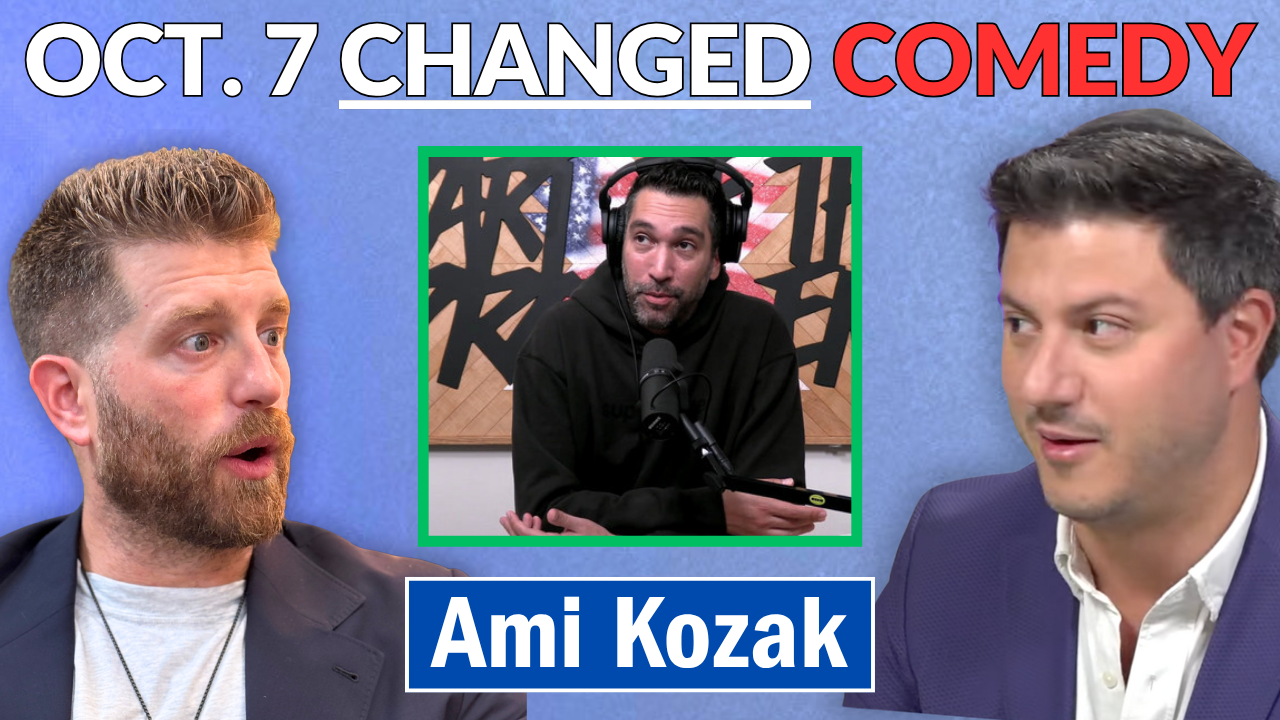
BEST TRUMP IMPRESSION! Plus, Respectful Debate with Those Who Hate - Jewish Comedian Ami Kozak
The thing that makes comedy effective is telling the truth.
You have had conversations with people like Candace Owens and Dave Smith.
There are two ways to engage with this.
We can go off into our corners or enter the arena in good faith.
Demonstrate what a civil conversation could look like with these hands.
I guarantee you there's no problem.
They're small, but they're very effective.
So strongly.
Welcome back to being Jewish with Jonah Platt.
30 minute mentions.
Same vibe.
Same tribe.
Shorter episodes.
My guest today has left quite the impression with his hilarious impressions of Donald Trump, Kamala Harris, Bibi Netanyahu, and Prince Harry, who fun fact is apparently the celebrity I most look like so much so in fact, that when one of my videos was reposted by a Hebrew language account, dozens of confused Israelis wanted to know when Prince Harry had become such a Zionist.
But I digress.
He is a modern Orthodox dad.
He's having incredibly difficult conversations online about Israel and anti bigotry, and he is making us laugh while he does it.
Please welcome Ami Kozak.
Jonah.
Good to be here.
Your majesty.
Good to see you.
Ami.
You've been working as a comedian for a while, among other things.
October 7th happens, there's a shift.
I mean, a month later you've got your podcast out.
We are having very serious discussions about current events and whatnot.
What happened to you?
What was the shift?
I am grew up a modern Orthodox Jew, so Judaism, my Jewish identity was always a pretty big cornerstone of my life.
I went to private Jewish day schools.
Most of my close friends at Inner Circle were all like me.
It was insular, modern Orthodox, and that was the world I came from in the form of whatever entertainment I put out.
I always looked at it in a pretty singular dimensional space of.
What I do online is for entertainment.
You know, the music I put out is for entertainment.
The comedy I put out for entertainment, even the podcasting and the conversations I have is just kinda, you know, shooting the shit.
Kbit Sing.
We're having fun.
You can joke and have fun in a world like that.
You can joke when everybody.
Presumably, uh, has the same values, so then it's fun to poke fun.
It's fun to make fun.
It's fun to roast.
Even edgy humor is totally okay because we all know deep down, we all share the same values.
But on October 8th, that seemed to be completely inverted and all of these sort of things I took for granted that I assumed we all kind of understood.
Like going into Israel and slaughtering innocent people and taking children in elderly and Holocaust survivors.
Captive is wrong and not controversial to say so.
But when that seemed confused, it became a world that I sort of understood in a different way, which was, you know, as the grandchild of Holocaust survivors, I always had that without question.
Like, how did it happen?
How did, how did in a world that was enlightened and western, how could this have happened?
And when you suddenly don't have that question anymore.
Yes.
When it suddenly becomes clear how a world can completely invert itself to think that taking the side of evil is somehow virtuous, all of a sudden everything sort of shifts for you.
It became front and center as a priority.
That the only thing I could really be.
First and foremost was a Jew in the world and had to speak out on this to provide a little bit of moral clarity so that we could return back to a world where we can all just have fun and entertain each other.
When tragedy strikes, everything that's trivial sort of dies away.
Mm-hmm.
And the most important things rise to the surface.
My Jewish identity, my Jewish community, brothers and sisters in Israel, who had had faced this directly, that became paramount and it became very hard to say anything insincere in that moment for a long time.
How would you describe sort of your personal mission when it comes to like, this is the lane that I'm pursuing, the, the way that I wanna approach this tsunami of problems that we're having.
I'm gonna attack this lane in this way with my content and my work.
How would you, you know, categorize that the thing that makes comedy effective is in a way telling the truth.
It's the same thing as commentary when you're speaking on an issue.
In the form of commentary, when you're just sharing thoughts, you're, you're trying to get to the truth of the matter and call out some sort of absurdity.
Even people I disagree with profoundly in this space, there are nefarious actors and we'll, we could talk about that.
And then there are people I think are arguing in good faith and are just wrong or naive, um, but they're at least trying to find and decipher the truth and comedy.
Is effective in the same way.
I mean, you're pointing out something or you're highlighting something, you're finding something resonant.
That's true.
And I just think comedy has a very effective way of cutting through that.
You have had conversations with people like Candace Owens and Dave Smith, both on your show and on their shows.
Very calm, civil conversations.
You're clearly in relationship with these folks who I think you could easily argue are, are.
Openly bigoted towards Jews, certainly our, our major gaslight in, in a big way to the Jewish experience.
How do you begin a relationship with somebody that you know is that way?
There are certain people who I think, you know, I would not engage with because they're just purely nefarious, hateful, not in good faith actors.
I think Candace has arrived at that point, but at the time when I first engaged with her, that was, there was a different threshold and I think.
Initially when she was on the Daily Wire platform and then she started tweeting about Israel and making all these ridiculous, I thought, kind of ignorant and inflammatory remarks, especially right after October 7th, I saw a big reaction in the Zionist pro-Israel community of just the sort of name and shame.
And, you know, call out thinking that that was some sort of effective confrontation of these ideas.
And I said, you know, you might give yourself a pat on the back, write an article and tablet naming and shaming this person, this figure, and thinking you're doing something effective.
I think you're reinforcing the own, your own siloed, you know, echo chamber to congratulate you for doing so.
But I felt that there was an opportunity there.
What's prompted, it was something about the Queen of Jordan.
I stand with the queen of Jordan, that Jews are weaponizing anti-Semitism to silence people into compliance.
And what I saw was, you know, there's an opportunity, there's two ways to engage with this.
We can go off into our corners and say another one, anti-Semite, horrible whatever, or.
Enter the arena in good faith, demonstrate what a civil conversation could look like to actually confront the person and the ideas.
I'll just say it.
I think for for years there were a lot of Jews on the left, progressive Jews who were part of the whole culture of calling a lot of things racist or anti-Semitic, where I didn't think it was appropriate where I thought the term got overused, that I think the terms lost a lot of its cultural power.
And at that time, maybe I thought Candace was falling into that, in seeing Jews using the term antisemitism in the way.
In the way BLM used, uh, racism and throwing, throwing it at every problem and saying that, that's what's going on here.
And so you couldn't discuss ideas.
So at the time I said, let's go into this and have a civil conversation.
And I actually think it did demonstrate that.
And to her credit, Candace had me on for like a full hour.
We had a whole conversation.
I thought it was educational, informative.
I didn't really, it wasn't too much of a debate.
We were going back and forth on different things.
I had hoped I had cleared up some confusion, but also demonstrated that you can still hold your ground, defend these positions.
Uh, defend your convictions and still be civil.
Fast forward months and months later, she seemed to go much down a darker rabbit hole, uh, really isolating herself off into.
You know, darker Jewish conspiracies, frankest Holocaust, revisionism, world War ii, revisionism, all the stuff we're seeing today.
I was starting to see that.
And then my follow up with her, with her was like, look, we had this conversation.
I thought it was productive and constructive.
It seems like it's only gotten worse between you and the community.
Um, how about one more follow up so we could clear things up or see where things stand.
My approach in that second conversation was like, look, you, you can claim all day.
That you're not antisemitic in your heart.
You don't hate Jews in your heart.
You have no ill will towards Jewish people, but that's kind of irrelevant to me.
Right.
I'm gonna talk about what you're actually saying.
Yeah.
Your actual behavior is encouraging.
Antisemitism is feeding into tropes.
Maybe you're just ignorant and are not aware of those things, if I'm being gracious.
But we sort of have the conversation around that and it's still, it got more contentious, but it still remained fairly civil.
And then like the day after that episode aired, she aired an episode, uh.
Trivializing Mangola calling it to doubt whether those experiments really happened.
That was the day after.
So I, I don't think people realize the sequence of things, but once you start to see that eventually I started to see this pattern of using antisemitism, whatever she feels in her heart, using antisemitism as a way for self-aggrandizement, for self-promotion, provocation, understanding that this gets such a reaction.
A a lot of it's a, a clout chase to build this audience, but the truth is the audience is becoming more and more.
I think isolated in a deep, dark corner of the internet, and I think eventually that will cannibalize itself if your brand is to just go against the grain.
It kind of depends what the grain is.
And if you always have to go against the grain, then eventually she'll turn on her own audience and you start to see that happen.
She just ended up having Nick Fuentes sitting next to her, who's proudly, unapologetically antisemitic, and what is she gonna do now?
She has to like defend the Jews to him.
She can't.
She's already kind of created a minefield around herself and now this is the honest representation of where her ideas lead to.
He's right there.
She wasn't nice to him.
He turns on her, and then her own audience turns on her for saying, I can't believe the way you treated Nick Fuentes because.
Irani says, now, fans of Nick Fuentes, this is the world you build, and so you reap what you sow.
In that case, Dave Smith, I think, does believe what he says.
I think he's dangerously naive on all this stuff.
I think he applies a whole western mindset to the Middle East, thinking everyone has the same values and we can get into all the reasons.
I think he's wrong on everything on this topic, but I do think he genuinely believes what he says.
I don't like the accusation that people try to say he's some self hating Jew.
I will say, I don't know if Judaism or the Jewish community is that important to him or that center to his life.
That's a personal question.
I'm curious about that because he does, doesn't seem so sensitive to the plight of Jewish persecution throughout history and these patterns.
He seems to shrug that off and say we're being paranoid.
Those are interesting personal inquiries.
I don't like that as a way to sort of invalidate or dismiss someone.
Everyone's got a different relationship to the Jewish identity.
I'd rather keep it.
On the ideas, that's a little different than someone who's totally nefarious.
There's differences here, and it's important to be discerning in a way.
The, the Dave Smith brand is almost more dangerous, I feel, than the Candace Owens brand.
And especially when it comes to antisemitism.
When you have someone like Candace saying, you know, Judaism is, is based on pedophilia, you're like, okay, that person's an antisemite.
And then when you've got Dave Smith, you know, in the first opening minutes of your guys' conversation, he's like.
Is there antisemitism?
Well, I see some people on Twitter maybe, but like they could be a 15-year-old and sort of normalizing a lot of his ideas, which are a lot subtler and, and gaslighting.
And that's to me is a lot a harder to overcome because it's much harder to, to point to.
'cause it's, it's more about what's not there than what is there.
Uh, and it's easier sort of to mainstream.
Yeah, I mean, I think there's a difference between someone who's.
Intentionally being a bad actor or is intentional evil, that doesn't mean their ideas are not dangerous.
You know, I do think his ideas are dangerous because they're almost unfalsifiable.
Here we are saying, Hey, listen, the barbarians are at the gates.
Israel's in trouble.
Israel's vulnerable.
Jews are vulnerable while he's downplaying all of that.
And then when it comes to fruition or there's a terrorist attack on the homeland or in the United States, or radical Islamic terrorism starts to spike, we say, I told you so.
And Dave will say, I told you so because I've been telling you that.
All of these actions are actually provocations of the west.
It's all our fault.
This is the, this is his worldview, right?
That all of the evil in the Middle East, and that's perpetuated from the rise of radical Islamic terrorism or Jew hatred.
That's the fault of Israel.
That's the fault of the Jewish state.
That's the fault of.
It's allies that the Iraq war is the fault of Israel dragging the unit us into these wars.
It's all due to, it's sort of this weird notion that anything that happens in this region, especially in the Middle East or terrorism against the United States, is initially the fault of the West or the Zionists.
They're the only true actors in the region.
Everyone else else's a reaction.
My main contention to him is that no.
What Israel is doing is a reaction to hostility that precedes it, and he doesn't suffer any of the consequences of his positions on Israel.
It's only Israeli civilians that have to deal with rocket fire every day and the risk of terrorism.
He's basically saying how you negotiate with Hamas because that's what you do.
I was like, yeah, easy for you to say when you've let thousands of terrorists back into Gaza, who will plan the next October 7th, which they did, and he equates that to just some homeless person making threats as if it's empty.
I think Dave ideally wants a peaceful world.
I think he doesn't like war.
He doesn't like bloodshed.
He doesn't like suffering.
Of course.
I think you have to fight those who do want those things.
That's my contention, and you can't pretend they don't exist.
I still think he genuinely believes that will get to a more peaceful and prosperous world.
I think the exact opposite will happen.
The ideas need confrontation, but that's what they need.
They need to be confronted.
If you try to just demonize Dave as a person or question his intentions, you just reflect a weakness in your argument or an inability to make one.
If you're Nick Fuentes.
If you're Jake Shields.
If you're Dan Bazarian, no.
We're not gonna have a panel discussion about.
These claims.
Even at that level though, it's actually quite effective to just tell the truth.
The good thing about antisemitism is that it's false, right?
We have the benefit of the truth.
The good thing about people trying to smear whatever's going on in Israel or the Jews or the Talmud, is that it's all, you know, completely void of reality and facts.
And so let's go down this road, let you, you see an article that says 200 genocide experts say that there is a genocide happening in Gaza.
What's your internal response to that?
I mean, there's always, um, appeals to all sorts of authorities when there's a preexisting agenda wanting to depict Israel a certain way, um, where you have to look beneath the hood on which of these experts and entities are making these claims, these un uh, constructions that are designed around this very thing.
And so oftentimes you create these fake authorities in order to appeal to them to make it sound like there's this consensus about what Israel's up to.
I mean, this is all ignoring the forest for the trees.
People love to point to the radical extremists within Israel.
Um, they're thirsty for anything they can get to try to draw some sort of moral equivalency between Israel and its enemies.
So they'll appeal and say like, Ben Vire said this thing and these settlers, look what they did.
Look at it.
Granted, I'm not gonna agree with it.
And maybe, and you can, you can, you can condemn certain actions by settlers, of course, but look at what you're ignoring in the matter of degree in.
Thousands of hours of speeches and actions and incitement in Gaza and in the Palestinian Arab world of wanting to destroy and wipe out the ud.
So back to the genocide question.
Israel has the power and has had the power since for, for, for decades to commit genocide and hasn't while.
Hamas doesn't have the power, but they would if they could.
And so it's just amazing to me that when you have actual genocidal regimes saying proudly that they want to destroy Israel, all the Jews around the world and the United States, that is all ignored, that is all swept under the rug, turned a blind eye.
I think it just displace a certain confusion or moral bankruptcy.
When you see these fake authorities or institutions coming out to condemn Israel, look at the un.
I mean, who's on the security council?
Who's on the human rights councils?
If you look at where these things stem from, uh, they, I wouldn't use them as a metric for determining what is genocide or what is moral.
The key kernel umami is that that forest for the trees thing, I think especially for the majority of American Jews who we know live in more liberal leftist spaces, traditionally, they get surrounded by a lot of the noise.
It can be hard to maintain that forest through the trees.
And I go, well, wait a minute.
Am I, am I wrong?
Have I been wrong about this the whole time?
Look, Israel's a victim of its own success.
The fact is that.
If every rocket fired at Gaza had landed over the past two years, if there were no bomb shelters in Israel, no mammas, no places for people to hide.
No security warnings, no sirens as it is in Gaza.
If Israel had just let all that happen, perhaps there'd be more world sympathy or understanding or an evenness to this and a power differential.
But I'm not willing to do that, and Israel has to worry more about protecting itself than protecting its image.
No war in history has ever not looked comparable to this.
Human suffering is what happens during war.
That's why we don't want it.
That's why you wanna stop people who wanna perpetuate war, which is clearly Hamas, you have to eventually.
Accept that the choice is, do you want Israel to just sit back and take it and be at risk and take more terrorist attacks and accept that his hostages are just gone and accept a threat living on its border?
Like that's the ultimate choice.
I'm not defending every single military action Israel's taken or not taken or whatever.
That's a separate conversation.
Are you anti-war to its court?
This warden is war never justified because a just war, I gotta tell you, probably looks comparable to this.
Uh, all the same as an unjust war.
It's a question of.
When you have to do this and the hard choices in life and in war that exist, the hard consequences, the, the, the toll and the human suffering.
That's a reality.
Which is why I think you, I understand this sympathy and empathy, but you have to never forget who's accountable.
For a lot of Jews in liberal circles out there who feel like all of a sudden they have to now define.
What this new kind of Jewish consciousness and identity means to them.
Now, you're being forced to defend it in the face of these horrible images.
I can see why people feel kinda lost at sea and not knowing what to do with that compound that with a lack of education on Israel Palestine and the Israel, uh, Zionist Arab conflict and knowing the exact history and stuff like that, like lacking all those tools can leave you feeling pretty adrift.
I would imagine people are falling on sort of one side of that line or the other.
Either it's making them go.
I need to double down on this stuff.
I've been asleep at the wheel and this matters way too much to me.
I'm changing my ways.
Or they've, they're just, you know, one step too far gone over that line.
And they are, to use your word, like adrift.
And this has always been a thing within, I think historically, there's, there's parts, elements within the community, within the Jewish community more broadly that wanna be liked, accepted.
They don't wanna stand out as different or exclusive in any sort of way.
I've witnessed that.
The big things in sort of more like reform conservative circles is about tikun olam and healing the world and values and ideas that are all in line with general Western values.
But anything exclusively Jewish, anything particular, anything minutia about the details of Jewish law, we, we don't want, we don't want that.
'cause that makes it, that, that, that makes us weird.
It's too jewy that makes us different.
Anything that's too, particularly exclusively Jewish, you're seeing that push and pull where people are like, I'm gonna be proud, I'm gonna be authentic versus I wanna.
I don't wanna be the one who stands in the way of acceptance and assimilation.
You know, I think that's right on the money.
Um, so you, you mentioned you were raised modern orthodox.
Are you still modern Orthodox?
Yeah.
How does that show up in your work?
When I perform for Jewish audiences, I mean, I could do inside baseball.
I could do outside baseball.
Yeah.
You know, I can joke and make sketches.
I, I work with a sketch comedy group called J Sketch and we do like real.
Authentic inside baseball sketches about holidays, Sabbath ritual, Jewish life.
So that, and I have found that there's like a real universality in the specificity, like the more authentic and ingrained you get, actually more people relate to it.
Even if they're not in your community, they can see a sort of authenticity in that.
I, I don't get what this is, but I sort of get it.
I sort of understand it.
Even if you're, if you're Italian, if you're black, if you're Asian, but you kind of understand these parallels, right?
My community does weird, something like that.
Also, what, even if it's not the same thing, are you like releasing content on Saturdays?
Do you like do shows on Friday nights?
No, I do not.
No.
Friday night shows, no.
Saturday night.
Uh, aside from that, it affects my work by providing balance because I am unplugged.
Friday night through Saturday night and being a content creator, being unplugged is like so necessary for your Saturday because you are on the constant dopamine kick and feedback loop and just being able to turn off and refocus on family, community, friends, kids.
Wife, it's like super important that I have that built in and it's not difficult for me to shut down.
It's quite a relief and it's become very in vogue in general as people talk about unplugging, you know, the foundation and education that I had both on religious subjects, religious upbringing, and also Israel, and understanding my relationship to that country, having gone there for a year, uh, after high school, having had my experiences, having family there, have friends there.
I'm not just speaking about it because I'm reading headlines and it's in vogue and I'm into this stuff.
Like, it's very personal and it reminded me like having that foundation, um, from growing up modern Orthodox and maintaining it and being part of that community reminded me of like the scene in Karate Kid where he's like, you, Mr.
Miyagi, when you can teach me karate, when you gonna teach me karate?
He goes, show me.
Paint the fence.
Go, go show me wax on, wax off.
And all of a sudden the, the protagonist in Karate Kid, Danny, right?
Yeah, yeah.
He, he didn't, um, he didn't know why he was painting the fence.
He didn't know why he was wax on, wax off, thought it was all nonsense.
When are we gonna go to the real stuff, the stuff that matters.
All of a sudden he gets attacked and he can defend himself in all these ways.
I do feel that way coming out of, from October 8th and on, having had the foundation, having, you know, had the experience.
I have these tools I didn't even realize I had at my disposal going out into this world to combat and to defend.
I, I've definitely never heard Karate kid used to describe Jewish identity.
That was a very awesome metaphor.
That was perfect.
You know, basically October 8th comes.
It's not like you're like, oh, I gotta go, I gotta go hit the books now because I wanna start speaking about this.
Like, you are clearly extremely well informed, well connected, like ready to speak clearly about these topics.
Does that just come from organically through the way you've been living your life?
Or are you a, are were you a student of this topic?
Yeah.
Alan Dershowitz is my dad.
No, I'm just kidding.
Um, that explains a lot.
Jews and non-Jews secular, not secular.
No, I, um.
I was not, I'm not a scholar, I'm not a historian.
Uh, I still had reading to do too, because I actually found that it's good to know the counter narratives even more when you're gonna go into these spaces and the typical hasbara stuff that kids are raised on, you're not really, you're taught about Israel, but warts and all is important.
Couldn't agree more.
Knowing the other side, knowing what your, uh, uh, opponents are, are, are, are reading.
In college, I was in music school at the Berkeley College of Music, so I'd spent all my time and creative energy.
Uh, doing projects, practicing, composing, and just to wind down and, uh, decompress.
I would watch debates.
Oh yeah.
You know, just to take a load off.
Watch high intensity intellectual banter.
It's like overload.
Instead of watching like music videos or listening to music, I'd watch, uh.
Israel debates.
This was back in like early two thousands, so it was still rev relevant and it was like in, its in that cycle of Yeah.
Post Oslo and Camp David and I read, uh, the books on Israel, you know, the classic ones and would watch debates between Norman Finkelstein and Alan Dershowitz when they were sparring.
Mm-hmm.
I'd watch a lot of economics debates, political debates, intelligence squared, old Douglas Murray before the Zionist community knew who Douglas Murray was.
Oh gee.
So I think all those different rising tides help kind of lift this ability to engage this way.
Com, you know, impersonating intellectuals, performing standup comedy, doing content every day talking on camera.
Yep.
So that when there's a camera on you and you're doing a news hit, it doesn't phase you.
You know, you see people on there like, you know, they, it's just it.
It takes time, it takes exposure therapy.
Mm-hmm.
To get comfortable in all those kind of environments.
I think that's what helped.
Amazing.
Your impressions, impersonations, they're hilarious.
They're so great.
Anybody who's watching this who hasn't seen them yet, they're, they're gonna go, we'll make sure we link to all your stuff in the show notes.
Um, and what's great is not just the quality of your impression, but the content, the writing, the thing you're making fun of mm-hmm.
Is, is so spot on.
Could you share with us a little bit your process of developing these impersonations?
Like are you, do you have them right out the gate?
Are you like standing in front of the mirror for 10 hours?
Like what, what do you do?
The process for me is pretty fluid and.
On the spot.
Organic, I think of the premise and I run with the premise.
So it's kind of like ad-libs.
Once I've cracked the premise, like today I posted one called, uh, Tucker Carlson Wedding Vows, you know?
Yeah.
I saw a video of him talking about it.
He's like, I don't know the future.
I don't know the outcome.
I, I, I don't know what's gonna happen.
Nobody knows that's God.
So basically I was like, oh, that's funny.
I don't know the future.
I dunno the outcomes.
Where else do you talk like that?
And then I think on tiktoks, one of these like.
Wedding video vows came up where people are being moved and it's like, you know, maybe, maybe that came up.
Maybe I, I searched for it afterwards just to see what they say.
But putting these people in different scenarios because it's like, where do you have to be genuine is at a wedding, right?
When you're talking to your spouse.
And Tucker to me has been the least genuine actor here, a trafficking and confusion.
So wouldn't it be funny if Tucker Carlson was giving his wedding vows?
I mean, I don't know about the future.
What is love?
I don't really wanna be involved in love.
I don't really know what that means actually.
I mean, I certainly, I've loved my parents, my parents' graves.
I'm, I live across from my parents' graves.
I love my parents.
But what, what does love actually mean?
I mean, I don't know.
Certainly if we got married in Iran or Russia, I would enjoy that.
You know, like once I do that I can kind of get roll for a while and basically, once I have premise, the only thing I really kind of have to write or figure out is the, is the end.
Like what's the big button at the end?
Right?
The character themselves writes it out.
In the proper context of whatever I put them, you know, fantastic.
If I made Trump a masseuse, you know, a massage from Donald Trump with these hands, I guarantee you there's no problem.
These hands, I guarantee they're small, but they're very effective.
So strongly.
Nobody, nobody massages better than me.
It's a great massage.
It's a fantastic massage.
Is there, is there anybody new that you're working on now that you're, that you're toying with?
I, I know you've been on a Tucker Carlson kick a little bit, but who, who else is coming up?
Zoan Momani has been my latest, uh.
Target say of, uh, of, uh, satire, like ear, early two thousands rappers, Zoran, or, or, or right now zoura.
Well, I don't know.
It depends if I want to do the accent, I can start from early two thousands when he sounded like this and then eventually, you know, he had the South African and he said, okay, you know, it's the accent.
Morphing is funny.
I think the content's kind of funny to try to figure out a way to.
Get that truth through of the problems as I see it.
I think the, I think the things he does are very, very manipulative and sneaky and you have to really pay attention.
And there's a couple things.
I mean, it's right for satire, which I like to do, but especially the word play.
You know, he is very particular on how he phrases things.
I don't use the term globalize, the ada, I discourage the term.
Okay.
But what, what do you think about what it actually means?
Never.
Never says that.
Hmm.
It's always, I understand how Jews.
Feel about this term and versus what the intention is ignoring that the infa corresponds to an actual reality, right?
Imagine somebody saying, you know, I understand people wanna globalize Kris, and to, to some people it means something, but to Jews, it means something else.
No, Krisna was an event, right?
Something happened where Jewish stories were attacked and vandalized and Jews were a assaulted in the street.
It was a pogrom.
You can't like redefine actual his, uh, history.
The people who say globalize the Intifada are talking about the second Intifada.
They're talking about what occurred.
Right.
They know exactly what they mean.
They know what they mean.
And for you to discourage the term while not disagreeing with what the term refers to is very disingenuous.
Mm-hmm.
Very, very sneaky.
So that's, I really resent.
The other thing is he keeps calling October 7th.
This terrible war crime, the the horrific war crime of October 7th.
Now, what's wrong with calling October 7th?
A war crime.
There was no war, right?
Calling something a war crime, which happens in the context of a war.
Completely absolves agency of those who started this recent war.
Correct.
The recent campaign began on October 7th, so it wasn't a war crime.
There wasn't a war yet, at least in this current context.
Right.
I mean, we could argue about the state of Israel in constant war, but that's not what he means.
Right?
He means to say that there's this external conflict happening and sure they got out of hand.
I'm not gonna outwardly endorse those things, but it's such a slight of hand to say the horrible war crime of October 7th, as if to say.
There was this war that was going on and they simply reacted.
So it's, it's very, very devious and sneaky.
I resent that.
The last thing he does that really bothers me is when he says, I support a state with equal rights.
Do you support Israel's?
I support a state with equal rights implying there are no equal rights in Israel.
I mean, it's all very misleading stuff, but it's very easy for a oppress.
A person asking not to push back on that Ami, that's our time, man.
Thank you so much for making us think, making us laugh, and for being here with us today.
Where can people find you doing what you do?
Thank you so much, Jonah.
Thanks for having me.
Keep doing what you're doing.
Find me at Ami kza on Instagram at ami kozak on Twitter.
The name of the podcast is AM's House.
The AM's House podcast.
You can also find me on YouTube.
My band is called Distant Cousins.
If you wanna come listen to some music and catch me out there, I'll be on the grind.
Right on.
Alright, he's a minch.
It's been 30 minutes.
I'm Jonah Platt Pace.