
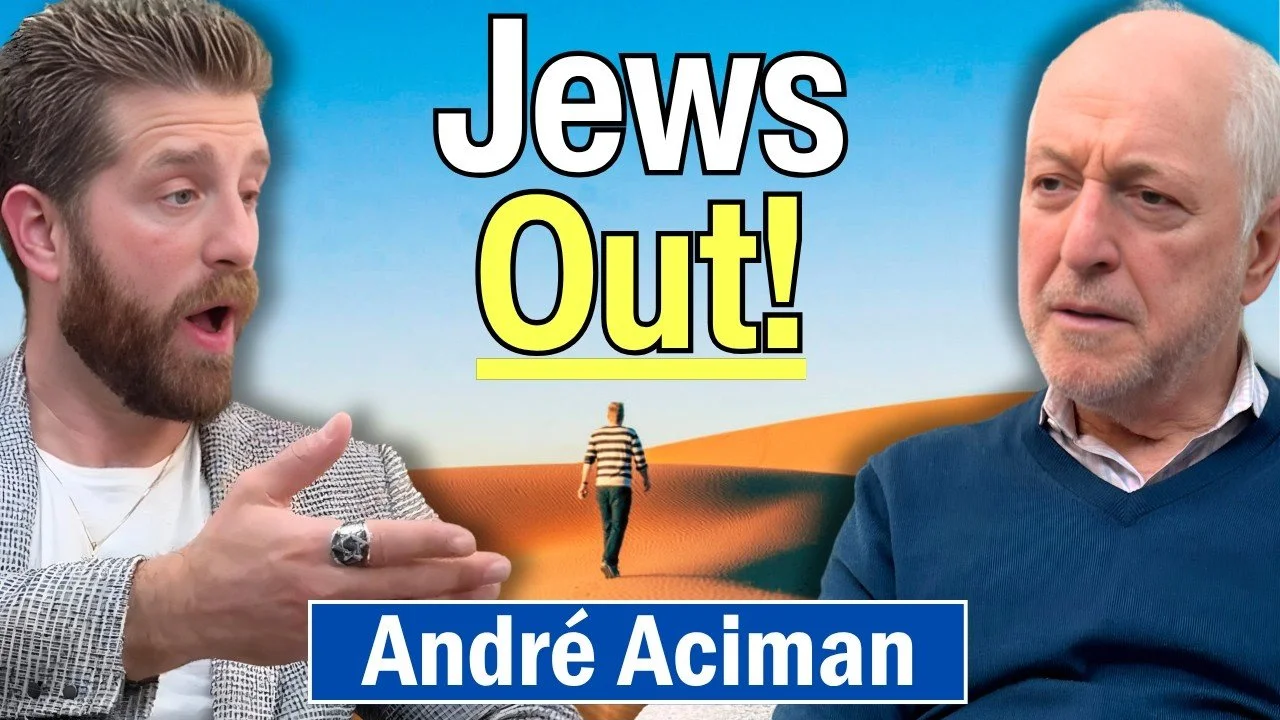
Interview Transcript
"Call Me by Your Name" Author André Aciman - A "Jew of Discretion" Struggles with Sephardic Identity
Watch and Listen
Are you resentful of being Jewish?
Everything that people do not talk about is something that I talk about.
What might it look like to you to go more full Jew?
I never have, and I'm not going to anybody who says we've gotta eradicate antisemitism is fooling themselves.
From Alexandria Egypt to Italy to America, to the Academy Awards.
My guest today has lived many lives, both his own and those of the rich characters.
He's whispered into existence through his elegant novels and memoirs.
I.
He's the author of Call Me By Your Name, the Contemporary Queer Classic that entered the world in 2007 and exploded into the zeitgeist a decade later as the gorgeous Oscar winning film starring Timothy Chalamet and Army Hammer.
He is, as he calls himself, a Jew of discretion, whose Peregrine story, journey of exile, longing, loss, and beauty have defined his life and his extraordinary body of work.
I'm delighted to welcome to the show The Inimitable Andre Asman.
Thank you so much for having me.
Thank you for being here.
It's been such a pleasure getting to know you through your work as I've prepared for this episode.
Okay.
So you are actually my first Sardi Jew on the show.
Okay.
And you are sardi like 10 times over the way.
You've been all through I.
Your family has been all throughout Europe.
Yes.
It's been Sephardic.
Yeah.
Your work is so personal and and intrinsic to who you are.
Can you speak a little bit about, you know, what it means to be a Sephardic Jew and how connected you feel to that heritage?
I am connected to it through hearsay.
And that's another way of saying through gossip.
Uh, that's how I get all my information, is basically family gossip filled with intrigue, badmouthing, and so on.
But my experience as a Jew is mostly.
Through the, the history that has come down to me, and that was repeated to me, especially by my father, who was a historian himself and preferred to know the history rather than the rituals.
So I know I come from Spain, he was brought up speaking Ladino or Spanish, whatever you want to call it.
For my audience who might not know what is Ladino.
Ladino is essentially the equivalent of Yiddish, but it is spoken by people who come or originate or claim to originate from Spain and Portugal.
Cool.
A little, A little Hebrew Spanish mix.
Yes, exactly.
Okay, so sorry, you were saying, but your father.
Oh, my father was basically taught me that, um.
We were Jews from everywhere we were.
Uh, we had always been kicked out or we had always been mistreated.
And finally here we are finally in Egypt where we are.
Free to be who we want to be, and yet again will be supremely ill-treated.
When did your family end up in Egypt?
In 1905.
Okay, so you, they were planting some roots there before you were born?
Yeah.
You were born in the, in the fifties, right?
Fifties.
Yeah.
And when.
They arrived and were there.
What was the atmosphere like?
Alexandria was superb and so was Cairo because these were highly international cities.
So Alexandria, the way I knew it was a highly a Greek cian, Lebanese, Jewish, Italian, French, English world, and everything was mixed together.
It doesn't mean that they got along, but they had to get along.
Because they worked together right before Egypt.
Before we dig more into that, yeah.
Your, your family came to Egypt by way of Turkey.
Turkey, Turkey.
Everybody was from Turkey.
You had some Italy or some Syria or, uh, there was some Syria also.
Uh, but the people from Syria were themselves.
Originally from, not from Turkey, but from the d Dalmatian coast.
So they came all the way from Yugoslavia, Croatia, whatever it was.
And there the languages was.
The language was officially among Jews, was always some form of Spanish ladino, whatever.
Wow.
Such a rich heritage there.
So many different places you would say, you would say, but, uh, what's the But the but is that I was brought up in a city that was once historically majestic and very sort of worldly.
Mm-hmm.
And it became gradually and gradually it became more sort of suffocating.
So you couldn't be really, you couldn't even be a Greek there, even though the Greek population was.
Huge.
Right.
There used to be as many as a hundred thousand Jews.
Yes.
In Egypt.
Now there's maybe 10, I think that's inflated.
Yeah.
Maybe it's six.
Okay.
Uh, maybe less actually.
Okay.
Yeah.
It's a, and a lot of them are basically from the Israeli embassy.
Right.
So whoever's working there, that's, that's the population you were born in 51.
Yes.
So Israel had already been established.
Right.
In your early memories, was the atmosphere already changing right away or did you have a period in your childhood of stability and, and getting to enjoy?
I.
What Alexandria had been, I think, until 1956, which is when the Suez Canal was nationalized by Nassar.
Um, essentially I didn't know anything or I knew better than to know anything.
Mm-hmm.
But I don't think so because life was generally quite pleasant until 1960.
Most people did not feel that.
This was a place that they were going to have to either be kicked out of or had to leave.
What changed in 1960?
In 1960, thereabouts, especially in the summer, uh, a lot of, a lot of businesses were confiscated or nationalized, and people were starting to be sequestered, which means they were forced to leave the country expelled.
That's what that was the.
Question under, like what was the policy of of the government that was leading to this persecution?
The policy was that this is an Egyptian city, which it is.
Sure.
And it was an Egyptian country and the Brits had already been expelled in 19, well, by 1952 they were all gone.
Mm-hmm.
So it was no longer a colony or even not even post-colonial anymore.
It was just an independent country and we were there as foreigners.
Mm-hmm.
Suddenly we became foreigners and we were not.
Officially recognized as being part of the people.
Do you feel in your heart that like you are Egyptian?
No.
No, no.
I never felt Egyptian, uh, because my family came from Turkey, but I never felt Turkish Right in the slightest bit.
Are there members of your family who felt.
Egyptian or they weren't there long enough to feel that way either.
Nobody felt Egyptian and everybody, in fact, I have no relatives and have never had any relatives since 1965 in Egypt.
Does anyone in your family feel like they belong anywhere or because it's been so itinerant?
Everyone feels a little bit of this, a little bit of that.
They will tell you.
I am totally French.
Hmm.
I am totally Italian.
And that's, and, and there's also have people in Britain who feel totally English.
Okay.
I don't.
And I think that most of them, if you scratch the surface and you ask them, where would you like to be buried?
They will give you all kinds of strange answers.
They will hesitate.
Where do you wanna be buried?
I don't know yet.
Uh, I don't think it has come up as, as yet, but essentially I want to be buried in Rome.
If I could be, but I, then I'd have to die in Rome and.
Rome will kill me, but I don't want to die there.
We're gonna get into your time in Rome.
Okay?
I wanna get to a couple of things first, beyond knowing that you were Jewish growing up and that that wasn't.
A mainstream Egyptian national.
Right.
What else, if anything, did being Jewish mean or look like to you?
Well, it goes back again to the history of Judaism as it was given to me by my father.
There were some people who were very Jewish.
Extremely Jewish in terms of, of their observance.
Observance.
In other words, one of my great uncles, and I think my grandmother and her sisters and her brothers were all very observant.
So very orthodox.
Mm-hmm.
So.
At Passover, if you've ever been to a, um, Passover, that's not, um, sort of reformed, right?
Everything is in Hebrew.
The prayers are all in Hebrew, and it becomes deadly, uh, and, and boring because right?
If you don't understand in Hebrew, you're there listening to somebody.
Per rate and going on and on for hours.
Right.
So I didn't want to be that uhhuh, but essentially being Jewish for me meant that I had a history, I had a lineage.
Um, but I also had a set of sort of what you might call spiritual values that were not the Jewish ones.
Say more about that.
You don't believe in God.
So the, the white-haired, bearded man mm-hmm.
Does not exist for me.
Sure.
Okay.
Me neither.
On the other hand, there is a form of.
What you might call spirituality, because I can't come up with a better word.
Uh, a sense of some values, but it's not just values.
It's a sense of irony that you bring to everything.
In other words, I think an Egyptian Jew cannot be just Jewish.
I mean, unless he's totally observant.
You have to want not to be Jewish, which is a very strange concept.
To be Jewish is to not.
Want to be Jewish.
Yes.
For an Egyptian Jew.
For an Egyptian Jew.
But I think if you look at all the prophets that we've had in the Bible mm-hmm.
You'll see that all of them do not wanna be prophets.
Right.
They don't want even to have anything to do with God.
They are really, they're observant, but they are really cautiously observant.
What's in that, I mean, what is, what is special about that?
Why is that our pattern?
I define it as a.
Uh, sort of the, from the bigger picture, it would be a form of irony.
Um, a sense that what you believe in is not entirely true, but you have to believe in it.
Or, you know, your experience in life, in daily life is, yes, you are, have a great job, but it could be taken away from you.
Yes, you have a great.
Family life, but you could lose them and this constant.
But, but, but as you've seen me, I use it all the time.
Mm.
And I use also the adverb almost all the time because you are never almost there.
You are always near there.
Do you feel like that's something specific to you because of the journey you and your family have had, or you feel that that's.
A generalization you can make about what it is to be a Jew.
I will say, to be cautious that it is basically about me.
Mm.
And I've spoken to congregations and that they know exactly where I stand and I say, are you feeling this way?
They will say, no, no, no.
Then they come up to me and they all say, yes, I feel exactly the way you do.
Huh.
So to be Jewish is in part, as I said.
Not wanting to believe in the whole rituals, but those are the only ones you have.
So for me, for example, just to give you a stupid example, it's the example of people who have survived the Holocaust and are now traveling to Israel and are reading from the Torah, and you wonder, wait a second, didn't God just prove to you that he doesn't exist?
Mm-hmm.
God proved that, but then that means that he does exist, doesn't it?
Interesting.
And I say, yeah, okay, fine.
We're gonna play with the words, okay?
Uhhuh, how could you be Jewish after the Holocaust?
But then that's a history of Judaism, isn't it?
Right?
There've been not one Holocaust, but.
Trillions of 'em.
Right.
You know?
Right.
So w And we've still stayed Jewish.
That's right.
So we are sort of headstrong about our Judaism, but at the same time it is softened and mollified by a sense that being Jewish is not so great.
And for many of my.
Time in as, as an Egyptian Jew in Egypt, I felt that I'd rather be Catholic.
This doesn't make any sense, uh, because the Catholics are doing well.
Right.
Of course.
They were not doing well at all.
They were all kicked out eventually.
Hmm.
Uh, because they were all Europeans.
Right.
And the only ones who were left in Egypt are the cops who are Christians.
And of course, they're.
Massively, um, discriminated against.
Yeah.
They're not doing so hot these days.
No, no.
Are you resentful of being Jewish?
No.
No, no.
I am in fact that horrible expression, uh, which I so used very cautiously, is that I am proud of being Jewish.
In fact, I don't want to be anything but Jewish.
At the same time, my Judaism is so warped that it's a kind of street language Judaism.
It's not the real Judaism.
What do you mean by that?
I mean, basically I discovered it when I was in New York in, and I used to go to college in the Bronx and everybody was not even religious, but there were a lot of Jews and they were all feeling that, uh, this is not really the place where I should be.
But then there's no other place that I want to be.
I want to be Jewish because I still observe Passover, but at the same time, I don't want to do this, this ritual.
It's this, this constant.
Turning away from what is obviously for you should have been true and end of story, something that you've.
Called yourself and the character, Elio also calls himself.
This is a Jew of discretion, right?
You have an article that you wrote not too long ago, all about this.
Define that for me.
What is a Jew of discretion and are you still one?
I have always been one.
In other words, you do not tell.
Everybody that you're Jewish, this is something that is unusually New York.
Okay.
In New York, uh, the people that I know, the people I travel with, the people who are my friends all know I'm Jewish.
Of course, that's why I ask, are you still one?
'cause you're in the second biggest Jewish population in the world.
It is, yes.
And that has made me extremely comfortable to be Jewish.
But if you go to Europe, France.
Italy where I've lived, uh, eventually you find that somebody is Jewish after you know them for three, four months, right?
Because it sort of slips in, but it slips in with a kind of, you know what I'm saying?
Don't you?
No.
I don't know what you're saying.
Uh, it's, it's sort of secretive.
It's, it's not something you reveal to everybody.
Why do you still.
Feel that even though you've been, I mean you've been in this country a lot longer than you were anywhere else, my easy answer would be because that's the way my Judaism expresses itself with, with some sense of caution.
You don't tell everybody you're Jewish.
Uh, if I'm in a group that is.
Totally Christian.
I wanna be more like them so I don't express my Judaism.
Uh, on the other hand, if somebody says something horrible about Jews, I'll be the first to say, you know, you shouldn't really say that and I'm leaving.
I'm not a psychoanalyst.
But Sounds like there's a little bit of trauma that you're holding onto here.
Oh yeah, absolutely.
Because it is all the result of trying to, uh, arrange somehow a situation which I can live with.
And clearly there is trauma.
There is trauma of having lived in Egypt as a Jew and yet being discriminated, I was the only Jew in the school.
Mm-hmm.
Many times.
Right.
And so that was not a comfortable situation to be in because essentially they never made the distinction between an Israeli Jew and a Jew.
They thought that.
All Jews are really Israelis.
What would that distinction have done?
What's, what, what was wrong with that in that time?
The, the what was wrong is that essentially every time the word Israel was mentioned, everybody would turn to me and at this time Israel was public enemy number one.
Yes, exactly.
So I, I was Jewish, I was a supporter of Israel, which in fact I was Right and still am.
It sounds very familiar.
It sounds like history is repeating itself.
Yes, it is.
Today, which.
Again, we'll get into, but I want to, I want to get back to Rome now.
So you wrote a book Roman Year.
Yeah.
Which is a memoir, but it's, it's too detailed to be fully nonfiction.
Tell me, you, you, you've added some flourishes.
No, no.
You remember all of that?
I remember all of it.
And basically, and people have asked me this many, many times, is that once you start writing and you delve into your past.
Everything becomes very obvious and very natural.
So I go from what episode to another episode, to another episode.
I didn't remember any of it.
And when I asked my brother, do you remember this?
Do you remember that?
No, I don't.
I don't.
I don't.
But when you write and you focus, things come out constantly.
It's like a magic trick.
I mean, you remember like the, the beverage you had at the restaurant versus what your brother had Right.
Versus what your mother was drinking.
Yes, exactly.
Exactly.
I, I remember all this, uh, first of all, because it was a traumatic moment right when we arrived.
Right?
But at the same time, you remember everything that you have kind of expelled from memory and suddenly it all comes back.
I think something about the expulsion of Jews from.
The North African, middle Eastern countries it that people don't fully grasp who are not a part of that is how you had to give up everything that you had and, and start over from whatever you could bring with you unless you really dig into that.
It's not a concept.
I think people hold onto that.
People who are right.
Businessmen and well established and whatever the government takes, all that stuff, and it's whatever you can get away with, you get away with and you start from a co in a completely different lifestyle.
Totally, totally different.
But at the same time, when you think of the people who escaped Germany Yes.
And Poland or whatever, I.
They had to abandon everything.
Yeah.
And my father was still longing to be back in Egypt.
Mm-hmm.
He was going to go back.
This was not going to last.
Of course it lasted.
Was there like an edict?
Jews must leave or it was just, we're taking everybody's property, we're taking everybody's businesses and we gotta go it.
Well, we gotta go.
No, you had to be kicked out first.
You were kicked out.
They would say, you need to, you're getting deported in two weeks or three weeks.
We were deported.
Yes.
Wow.
And, uh, so, but.
Essentially, that's why my decision was not even the decision.
I didn't decide to leave.
Right.
If I could, I would've stayed and found a way, man.
My father was definitely, and my mother, et cetera.
Everybody was willing to stay whatever the price.
Wow.
So you get to Rome.
Yeah.
And you remember absolutely everything about it.
And now you say you want to be buried there.
Yes.
What pulls you to that?
That maybe that's the place that you feel a connection to?
I went to the cemetery in Rome and because I wanted to see the tune of John Keats.
Hmm.
Okay.
And, uh.
I said, oh, this is a great place because it's very quiet, it's very peaceful.
It's serene.
Uh, it's not a cemetery.
It's a cemetery for all the people who are not Catholic.
Ah, that's what it is.
That's interesting.
And so I felt, I like this.
I like the climate, I like the city, I like the everything.
Uh, I'd like to be buried there.
Okay.
You, you heard it here.
Andre's family.
He wants to go to Rome, but, but you have to die there.
Oh, you can't like send No, you can't.
They're gonna send my tomb or my gaskets.
Hey mean they have airplanes.
You can make it happen.
Okay, so let's, let's talk about, call Me by Your Name, which has obviously become your most famous work, right?
Is it like being a, a rock star who has like a famous song and you're like getting sick of playing it?
Yes, exactly.
That is exactly what has happened and I compare it to the famous, the all those singers who have really.
Many songs, but this one song that they always are asked to play and play Free Bird.
Yes.
And I do like the book of course, but at the same time, you know, tell me something I didn't know about the book.
Mm.
Some people have said things that I said, oh my God, that's a better interpretation than the one I have.
But at the same time, I'm tired of talking about it, but it's okay.
I mean, okay, so, well, we won't dwell on it too long.
Sorry.
Maybe I can get something you haven't talked about.
We'll see.
Um.
For those who haven't read the book or aren't familiar, you've sold almost a million copies all around the world.
Yeah.
What was the impact upon release?
I know obviously the movie I'm sure did a ton for its platform, but what about when it came out?
When the book came out, it got a fantastic book review in the New York Times.
And, um, it never got in the daily Times, but it got in the weekend times.
Mm-hmm.
And it was done extremely well to the point that, of course, the bookstores didn't have any copies because they had run out.
We love that.
Yes.
Okay.
So big, big hit right away.
And it was a big hit.
And I, I, one of the producers of the movie called me from the Blue saying.
We would like to make a movie out of this right away.
No, but a year after.
Okay.
The book came out because he hadn't read it.
Mm.
And after that, it took quite a few years.
As it does, as it does.
Because they had this director, that director, this actor, that actor, and finally they said, Timothy Charlemagne.
I said, who?
Right.
It's not necessarily a natural fit for a film.
I, I mean, a lot of, most of your books, they're not, you know, they're not plot heavy.
No.
They're not big stories.
They're right.
They're almost like mood pieces and, and reflections and a lot about the inner life of everybody, which is unique for a movie.
So, I mean, I understand it had to be very specifically and, and deliberately told on screen to to work.
You have said that it's as much about being Jewish as it is about young love.
Yes.
What do you mean by that?
I think that being Jewish is something that you.
Are intricately told to conceal.
Mm-hmm.
And I think we've touched on that.
Sure.
And I think that young love is is okay, but if it's gay love we're talking about, right?
Then we're talking about something completely different.
And that's something that you do not.
Advertise, right?
And both have this thing in common that they share this somewhat secret thing, identity that you don't reveal except to your very best friends or to your parents eventually, et cetera, right?
And so I think that the connection between Judaism, which is itself.
A, a kind of clan, clan ish religion.
Yeah.
In Europe, especially one, and we're a tribe.
Yeah.
And same thing with, um, gay love.
Sure.
On the other hand, I had very good antecedents because Marcel Proust wrote one of the most famous scenes in the book about, you know, gay love being very much like being Jewish in a city that does not really tolerate Jews.
Mm-hmm.
So it's, it's about that parallel Yes.
Secrecy.
And the fact that they, that Elio and Oliver can connect on that first.
That's, that's correct.
Sort of opens the door to the second one.
They do.
And of course that the fact that they are both wearing, um, mark one, David, one of these, yes.
One of those.
Uh, the fact that they do that means that it is already inscribed in them that whatever legitimacy they need is already granted to them.
Hmm.
That's beautiful.
Homoeroticism, this burst into romance that bursts into unfulfilled love, right?
And missed opportunity for both Elio and Oliver and Elio's father, you revisit that sort of theme a couple of times in your, in your other books.
Correct.
What draws you to that subject?
It's very much like everything that.
People do not talk about is something that I talk about, right?
Or I write about, and I love doing that because it, it unsettles what is most secret about people.
So when it comes to my Judaism, I, I like to expose it, that it's not this religion that you adhere to and that's all you know.
It's basically filled with contradictions and I love that.
And I think the same thing with gay love or even love.
It's always filled with its own paradoxes that are instilled that they're there, but you don't, and it's up to me.
I.
As a writer to unpack them.
And I think most writers do that in one way or another.
They unpack things, and I love to do that.
What inspired the device of them calling each other by their name?
Oh, where did that come from?
It's not even something I'm proud of, but, um, but it's, it's a funny story because, um, we had.
My wife and I, we had friends and it was a gay couple.
Mm-hmm.
And they were both women and they loved each other a lot.
And the only thing is that they had the same name.
So I said to my wife, when they make love, do they call each other by each other's?
And what would the difference be?
Right.
And uh, she said, yeah, that's a good point.
And of course it stayed as a joke Right.
Until it became.
Real.
And I made it become what?
It wasn't as a joke.
Right.
And it became something, it's basically, it's a form of absolute intimacy with somebody else.
If you give them your name, then you've given them everything else more than a decade later.
Yeah.
This book you're tired of talking about, you read a sequel to Yes.
Where does that come?
You're, you're not, you know, it's the only book you've written a sequel to.
Yeah.
And you know, where does find me come from, find Me comes from the fact that I had tried many versions of Call Me By Your Name and I said, it always ends up.
Basically the one love that they had cannot be duplicated.
You cannot, you cannot resurrect this and write a sequel to something else.
Mm-hmm.
So, but I was very interested in the father, what kind of a man, what kind of past does he have that allows him to be so broad, broad-minded in his, with his speech with his son.
And I decided that I would write a whole.
Novella about him, but then I said, that's not enough.
I, I would like also to write a novella about a less young lio who meets a person who's much older and what kind of relationship will they have.
And I was also eventually interested in and what happened to, uh, Oliver.
So you put 'em all together?
I put them all together, but I, I was in, I was not ready to let them go.
And what was the response like for that book?
Initially terrible because, come on, we read about the father and that goes on for about a hundred and some pages.
No, uh, but eventually people love both books and they love the fact that there's, it's not a sequel per se, but it's a continuation of the character.
They love that.
Right.
I, I imagine, I understand, obviously we've talked about some of the emotional.
Themes like longing and unfulfilled love, right?
An identity that's, it's in your work, but also there's some like more tactile themes I've seen in your work.
Stuff like summer.
Or plays a big role in your work?
A lot.
Food and, uh, writing and reading.
What's the connection with each of those?
So like, let's start with summer.
Why is that always featured prominently in a lot of your work?
Oh, well, I think that summer was usually school vacation.
Sure.
It was a time when you could relax, you could do what you wanted.
There was no basically mandate to do something.
I didn't have to work.
I mean, my parents were very poor at the time.
Mm-hmm.
But.
I didn't have to work, so I read books and for me, summer books, leisure, et cetera, these are all intermixed.
On the other hand, if I write about Italy, it has to be the summer I, I cannot even conceive.
And, and if it is the summer and I'm writing about Italy, it has to be about love.
Why, what is that?
What's the, what's the overlap For me, the memory of going to the beach, of being basically almost naked at the beach and watching other people sunning themselves and this sense of absolute pleasure is, is absolutely wonderful.
And for me, because I was very timid as a young kid.
As many of your characters are.
Yes, they're, they're, everybody is timid in my, and they're all a reflection of me.
Sure.
But at the same time, they do.
They do take steps right.
Towards whatever it is that they want.
Mm-hmm.
And classical music is also in there too, right?
'cause that's, you know, I listen to a lot of cla, I love classical music.
I love books.
I love books.
And I love the beach.
And I love sense.
And I love the, the skin.
I love skin.
Mm.
You know, among other things.
I, it's, it's kind of tacky to say that you like skin.
Don't you like the person too?
Well, yes.
I like the person, but I also like skin.
Yeah.
If you have good skin.
Okay.
Half the job is done.
Right.
Okay.
Out of Egypt, false papers, Roman year, Harvard Square, all very much about that feeling of rootlessness.
Right?
Homelessness, transition time.
Um, you, you have a quote that I wanna read back to you.
Um, you inherited a sense that wherever you are, you're supposed to hate and certainly don't call it home because it won't last that long anyway.
Yeah.
Was it possible to have a home?
Somewhere, like where would home have been for you?
Well, home is very much in New York.
It is now, it is in New York.
Let's face it.
I live in New York.
I, I wouldn't live anywhere else.
Is it really my home?
I don't know.
No, I don't think it is.
I mean, it, it's the place that I long to come back to.
Mm-hmm.
Once I'm away and I've gone traveling quite a bit, but.
It's not really my home and I don't have a home, right?
The very concept of home and homeland is extraneous to me.
So when I see people worshiping the American flag or the French flag or the British flag, I'm saying to myself, do they know that they're just worth worshiping a piece of cloth, right?
For me, the idea is not there.
Did you ever or your family ever consider Israel as a destination?
No, never.
Israel represents, um, a wonderful place.
Um, I don't know, Hebrew of course.
Mm-hmm.
Because I never tried to learn it.
Sure.
But I find that Israelis, the Israelis I've known and I've known quite a few, are wonderful people.
Wonderful.
They don't know exactly how I stand vis-a-vis Judaism, because I'm not even a reform Jew.
I like it, but it's never been.
It was never part of the discourse of where we were going to go.
Yeah.
I'm just curious about why.
'cause it seems like, it seemed, it made sense.
Like it makes sense if we, we got nowhere else this place is.
Yeah.
You know, supposedly for us, yeah.
It's, but I'm curious as to why it's not on the was never on the table.
It never was on the table because, uh.
We were gonna go to France.
That, that was really the homeland.
It wasn't the homeland, but it was the makeshift homeland.
Hmm.
And if worse comes to worse, we'll go to Italy, which is where I ended up.
Right.
And England was also a possibility.
But they don't take foreigners in England.
In England, or they don't allow them to become citizens.
Hmm.
And we were citizens already of, of, um, Italy.
Do you feel like.
You're a European?
No, I'm not even a European.
No.
Even though we wanna be France, we wanna be Italy, but we're not.
Not 'cause we're Europeans.
Yeah.
No, we are not Europeans.
Uh, so I'm not American.
I'm really not.
I'm an American citizen.
Sure.
But that doesn't mean anything.
You know?
That's only one country I like and it's America because it's the freest one.
At least it was until a few weeks ago.
But by and large, no, I don't want to live in Europe.
I don't believe in Europe.
Hmm.
If I could, yes, I would go back to the Egypt that once was.
Mm-hmm.
Like that was the pre 1950 Egypt.
Right.
That would be a nice way to live, especially with my parents' money.
Yeah.
But that's gone, that's, that's a closed chapter, so there's nothing I can do.
So you, you kind of, nomadic Yeah.
But you're not really nomadic 'cause you're not moving from one place to another.
It, it's sort of like.
I, I don't know, maybe being adopted and not knowing your biological parents.
Yes.
Very good.
Very good.
An analogy.
Yes.
Yeah.
And you will never find out who your parents are.
Right.
You'll never know.
And you can be, you know, with your family, who is your family forever, but it's, they're still not your family.
Yeah.
What's interesting to me is how much your work continues to be about these subjects.
Even, you know, 50 years into your time in America.
Do you feel like there's still something you're like working out or trying to crack about it?
If anything, I'm trying to crack something about myself.
Who am I?
What do I want out of life?
It's kind of late to ask that question.
I mean that.
Yeah.
Why, what?
I'm wondering why, how you haven't arrived at an answer yet.
There is no answer and none of the answers I I produce for myself are really believable.
I can come up with great answers.
I know how to do that.
I'm a fiction writer.
Okay, sure.
But no, not really.
Um, and uh, people ask me, what is your profession?
I say, you know, I used to be broker.
I became an advertising person.
I became a teacher, I became a professor.
I became all of all, these are scattered.
Professions that I had, but at the same time, none of them gives me any sense of fulfillment.
I love teaching and I love the feel that you have after teaching, but that doesn't last.
I mean, nothing lasts forever.
Nothing lasts, but I.
That's not true because there are some people who believe that things do last, Andre, and they, they put me in my place.
I have tattooed on my chest here.
It says, uh, Gaza in Hebrew, which means this too shall pass.
Oh.
I mean, the good and the bad.
It's nothing.
Nothing.
Yeah.
Nothing.
Even a good feeling from something fulfilling, you still gotta go home and make something for dinner.
Yeah, exactly.
I mean, that's, that to me, that's normal life.
Yeah.
That's exactly what I'd go.
And you've written books and it was successful.
It's made into a movie.
Okay.
What's the next one going to be about?
Yeah.
I don't know.
And I'm having trouble finishing it, so that's very natural to me, that's the, the most relatable thing in my experience that you've said so far.
Okay.
Speaking of, you know, writing for America, you wrote a book called Eight White Nights.
Yes.
Takes place in New York.
Yes.
I love that.
It's, it's like, begins on Christmas, but it's about Jews.
Yes.
Um, romantic, ambiguous, sort of a lot of the stuff we've been talking about.
Why is this the New York story that you decided to tell?
Well, I wanted to write a story that was about two people who've had, they're young, they're, he's 28, she's 24.
Um, they've had quite a few relationships, so there's nothing that they don't know.
Mm-hmm.
And they know that they will end up going to bed together and maybe have a relationship, maybe get married.
I don't know.
Right.
On the other hand, I didn't wanna write a novel where people have.
It's easy.
I wanted it to be difficult.
I wanted there to be tension.
I wanted there all to be all kinds of impediments along the way.
And I think that most of the impediments come from themselves, right?
They know they'll sleep together, so there's no rush.
Actually, the romance is actually not a bad thing, if you think about it, some of the most in.
Tense relationships that we've had, that I've had are basically because somehow the sex was delayed, it didn't come right away, right?
Some of the friendships I have with women today is because I've never slept with them, right?
So there's something that happens when you sleep with somebody that alters the relationship, and I didn't want that altered, and I wanted to deal with characters who are.
It's a beautiful, uh, winter night and it's, it's, they're at a party.
They're going to many parties.
They go to church, they go to St.
John the Divine, and they're all Jewish.
Right.
Okay.
So I like that fact, and I like the fact that there was no sex in the novel.
So everybody was complaining when I was writing it.
That Andre, come on.
They're just waiting for the gratification.
Yeah, they're, they're, you need to have sex.
Meanwhile, I stopped writing this book.
Because there was no sex and I wrote, call Me by Your Name.
Oh wow.
And then as soon as I finished, call Me By Your Name.
Because it was an easy Nothing book for me at the time.
It was an easy book.
It just flowed out.
It flowed out.
Yes.
That's how the best stuff usually goes, right?
Well, that's what they say and I starting to believe it.
Mm-hmm.
And but the other one was.
Torture.
So as soon as I finished, call me by your name.
I went back to the eight white knights and finished it, but most of the tension in eight white nights was resolved in Call Me By your name.
Is there any link between eight White Knights and Hanukkah?
No, nothing sir.
All right.
Just had to ask you.
I was curious, uh, because Hanukkah was never celebrated among Orthodox Jews, among other things.
Interesting.
It was, it was not, it certainly when I grew up, nobody ever celebrated Hanukkah.
Hmm.
We always had a Christmas tree.
And we had Christmas presents in my family's Hope.
I remember for sure in the film, call Me By Your Name, they celebrate Hanukkah.
Yes.
Yeah, they do.
Do they do another book?
I don't remember because, you know, it's a good question.
Yeah.
I haven't read the book in quite a while.
Yeah.
What I did like about the book is that without knowing it, uh, Luca Guino, the director, had them be French.
Italian American.
Mm-hmm.
And they, the mother reads in, in German.
Right.
And what I, I love that because that's my world.
Yeah.
I know.
For me and, and for, for others that I've spoken to a, a big sort of.
A turning point in one's Jewish identity is when you have kids.
Because then you think about, okay, well how am I gonna raise these kids?
What, what role is this gonna play, if any, in their lives?
Right.
You have three kids.
Yes.
So when you became a father, did, did you have any process, thought, process of how you wanted to raise your kids?
Yes, I did.
Um, my wife's, um, grandfather was a rabbi.
Oh, wow.
And she had.
She, I mean she, she never had a Bat Mitzvah, but her sister did.
But she was religious, I think in culturally religious.
Sure.
I was never a bar mitzvah 'cause I didn't want to.
Why not?
My father said, do you want a bar mitzvah?
I.
I said, no, so fine.
That's exactly his attitude was there was no compelling thing.
He was never really Bar mitzvah.
He did his in French, in Turkey.
Interesting.
So you just, there was no, no appeal there.
There was, there was no appeal.
There was nothing.
No meaning.
But my, my wife said that they have to have some.
Uh, the sentence that I, I take umbrage with is, uh, at least they know where they come from up to them.
You give them the facts up to them to repudiate them if they want to.
And that is, I think, is a false setup because.
You indoctrinate your children and it's very hard to un indoctrinate them.
Mm-hmm.
But I think that none of them is religious, thank God.
And, uh, they've had the Bar Mitzvah.
They read something and I said to my eldest son, I said, if you're going to read from the Bible, you might as well quote something from the New Testament too.
And he did.
Interesting.
It what Like in his speech?
In his speech, just as the gospel of Mark says, blah, blah, blah.
How'd that go over?
Nobody paid attention, you know, but I wanted it to be said because somehow it made it, it embraced bigger things than just one thing.
And what was that experience for you as the father?
Bar watching.
Yeah.
The being the father of the Bar Mitzvah.
I don't know.
I, I just went along with it as a blind person would, and as soon as it was over, it was over.
Do you feel like any part of that is like, uh, an an, an interior response to.
Almost like a resentment of, well, I had to be so secretive about my Judaism that now I reject these things and, and they're not important to me.
That is, many people have told me that.
In other words, the, the heritage that I had as a Jew in Egypt forced me, or at least that's what people say, compelled me to, um, make fun and take, um.
Not take too seriously.
Right.
The, the Judaism that was mine to inherit and quite, I could have taken it quite ordinarily mm-hmm.
Without making any objections, but obviously, uh, it wasn't there.
So yes, maybe living in a country that was hostile to Jews made me similarly resentful.
And so you are right when you say something about trauma.
Yeah.
Okay.
So you, you mentioned earlier that you were the only Jew in your class.
Yes.
And every time you, the word Israel came up, which was often everybody looked at you.
Yes.
And, and as I said, that's what students are experiencing today.
Again, uh, you know, 60 years after you experienced it.
Yes.
How concerned are you with the explosion of anti JW hate From both the right and the left?
We've been seeing building in this country and around the world in the last decade, last decades.
I think the last two, three years, especially the last obviously have been tremendous.
And I hate when anybody says from the river to the sea, what they really mean is we will destroy not only.
Israel, but we will destroy the whole idea of a Jewish state.
We will even kill Jews.
Yeah, of course.
And I do not tolerate that in the slightest.
You basically, when you say from the river to the sea, which is a beautiful sentence in Arabic, by the way.
Uh.
It's you, you're basically saying that you want to kill me.
Mm-hmm.
Essentially, we cannot make up the difference that is basically instilled, you know, you're a, a professor, are you?
Seeing or feeling that in, in your work environment or in your classrooms at all?
No, I don't.
That's good.
And uh, I don't, but probably because people know that leave him alone, he's like a conservative person and I'm not conservative, but that's how they see me, which is fine, conservative.
Like politically or conservative, like buttoned up, buttoned up.
Mm.
But they, they, they, I have no idea.
People might even think I'm a Republican, which is the last thing I'll be, because I always wear a tie when I teach.
Mm.
And I wear a tie because it establishes some kind of authority that I don't have.
So they can call me Andre, which which was what my students call me.
But at the same time, the tie.
Establishes some kind of distance.
That's interesting.
I believe it, but who knows?
What do you hope for?
The future of the Jewish community, given where we are right now.
And, and also how, how familiar is some of the stuff you're seeing to what you experienced growing up?
Other than the one example I gave anybody who says, we've got to eradicate antisemitism.
It's fooling themselves.
Yeah.
It's there.
It's going to be there.
It's probably going to be there till the end of time.
Mm-hmm.
It's been there since the beginning.
Yeah.
So why not?
Right.
So in, in, in a sense, I think that that's going to stay.
Does it go into dormant phase?
I hope it will.
From your mouth to God's ears.
Yeah.
Well, he's listening right now, you know?
Yeah.
Right.
So something we talk about on this show, uh, is the concept of going full Jew.
Yeah.
Meaning sort of pushing past whatever voice is in your head that's saying.
Don't do this jewy feeling thing.
Don't do this piece of observance.
Don't sing that Hebrew song.
Don't listen to the Israeli music, whatever it is because it feels uncomfortable or inappropriate, or that you're gonna be judged or too un assimilated.
What might it look like to you to go.
More full Jew I never have.
Right.
And I'm not going to, uh, because I mean the very concept of irony, which I live with, you know, I live with irony all the time and paradox and that sort of thing.
Yeah.
Essentially, as soon as I want to be fully something seriously.
And that's the way I look at myself are are you going like full Jew?
It just doesn't work because I have all this apparatus of negation ready to pounce on my full Jewishness.
Well, that's what I'm talking about, like how.
Pushing past that voice and seeing what happens.
I don't know how to do that.
Mm.
I'm not able to do that.
I would love to, you know, I would love to say, okay, I'm X number of years old.
I'm not gonna learn Hebrew perfectly, but I can certainly go to Israel and go for, you know, six months and learn how to speak the language and become one of them.
Yes, I could do that.
I, I conceivably, I could.
Uhhuh will, I, absolutely not.
You've got a very unique Yeah.
Singular point of view.
Andre.
Yes.
Next for you, you have a, a new.
Series of novellas about to come out next month.
Yes.
Yes.
Called Room on the Sea.
There's three of them.
What are each of them about?
One of them is, um, is, uh, a novella called the Gentleman from Peru.
Actually, he's not from Peru, but I, it, it just seems that he comes from somewhere else, right?
He's got a different background.
Uh, and he's an older gentleman.
And he meets this group of young Americans who have rented a boat and they're there and he says to them, this is in Italy, right?
In Italy.
Of course, course it's in Positano course.
Yeah.
Beautiful.
And basically says to them, you are born on such and such date.
You're born on this.
And by the way, you would've had a twin, but the twin was never born because you ate him in the, in the womb or whatever it is.
And he meets this woman who is clearly doesn't want to have anything to do with him.
And gradually he.
He basically seduces her, but he seduces her with something that she has absolutely nothing to hold against and it has to do with her past.
Mm.
And so mysterious.
Yes.
Okay.
That's number one and number one.
Number two is the novel called, uh, room on the Sea, and it's about two elderly people who meet in the jury room.
And, uh, basically have lunch together because they're in the jury room and they go to lunch and they come back and they have coffee and they, whatever, and, and they do it for a few more days until they realize that.
I like you.
And so that's the second story.
And the third story is called Mariana, which is essentially a work that was written in 1669 and that I modernized about a girl who is seduced and abandoned by a guy.
But it's written from her perspective, which took a lot of guts because I was trying to write, oh, do you think I can't write from the point of view of a woman?
I'll show you.
Was this your first time writing where the, where the protagonist is female?
Yes.
Interesting.
And I, I wanted to basically capture what it is for a woman who is.
Viciously attracted to somebody.
Here's a hot tip for the audience.
I know at least Room on the Sea, and the gentleman from Peru.
You can listen to the audio books already, so on Amazon you could also with Mariana on Mariana.
So all three, the audio books are out if you wanna check them out now.
Otherwise, the book itself comes out June 25th.
June 24th.
June 24th.
You can pre-order it now.
We'll put a link in the show notes now that we've talked about what's about to come out next.
What are you working on next?
Do you have your next project in the works?
Yes.
Yes.
Can you tell us about it?
There's another book that I've also written called Stowaway and it's being published in England, and it's about a man who commits suicide out of love and basically his ex-girlfriend from years before and a young man that he has a crush on.
Um, meet.
They have to meet and they talk about who this guy was.
Interesting.
Yeah.
That seems.
The most sort of outside of you, of, of a couple of these stories.
Because unless one of them is a professor or from Egypt or No, no, he's not from Egypt.
No.
So, and that sounds like a little bit of a, an outside the Andre Box playground for you to be in It's, but it could also be about the real laundry.
Uh, you know, I, I'm not committing suicide.
Right.
But, but it's about the fact that I've had many, many infatuations in my life.
Mm-hmm.
And certainly love affairs as well, and I was trying to put them together and, and see what, what would give and what would happen if I died and people still spoke about me.
We all think about that, right?
We do, but we don't say we do.
Well, I just did.
How does your wife feel about.
Your work and like your romantic past and, and your focus on.
R Romance so much, she sees the manuscripts.
Mm-hmm.
And she makes additions and corrections and she says, this is icky.
You know, don't go there.
Uh, and she will do things like that.
Uh, but by and large, uh, she's, she's a good person to have as an editor at the end of the book project, and I love that.
And how does she feel about my.
Romantic aspirations and remembrances.
You know, she says, you know, it's, it's Andre, you know, that's, that's all it is.
That's what she has to say, and she moves on.
The experience of your children is so different than the experience that you have had Yes.
In your rootlessness and their, you know, permanence.
What's that sort of divide like from, I mean, they, they are just a completely different.
Kind of existence than anything you ever knew up to the point.
I mean, they have me as a father, right?
So how much are they carrying of your journey?
And I, I don't erase myself and, and I haven't erased my, to the point where one of my sons said, dad, I.
I think there's too much irony in this family.
Uh, but he was right.
But I think that they have absorbed their Jewishness and my skepticism in at the same time.
And so they're not very Jewish, but they, they, they get the, the point that they, um, my, my wife is.
Comes from a rabbinic background.
Mm-hmm.
And so they, they understand that, but at the same time, they're, they understand, they understand paradox, which for me was so important because if you, if you can't understand a paradox and you don't understand that things do not make sense while they're making sense.
You are not of my family, not of my ilk.
How important is it to you as a Jew and your family's heritage that.
Being Jewish remains a central identity in your family line moving forward?
Oh, yes.
There's no question.
It is very, I mean, I'm a Jew and I, I tend to side with Jews, except when they kill 50,000 people, I, that's too much for me.
Uh, but at the same time, I understand, I do, when I interview people, if somebody comes with a jish last name.
I don't know what it is that I do, but, uh, I try to control myself because I am already favorable.
Mm.
So I try to inject some kind of skepticism there so that I don't allow myself to be seduced by that.
It's very self-aware.
Yeah.
Andre, that's all I got.
Thank you so much.
Thank you very much.
Thank you.
It's been just really great getting to know you and your, and your.
Mysterious mind and and delighted to have you on the show.
Thank you.
Thank you so much.
Thank you.
Thank you so much to my esteemed guest, Andre Osman, for bringing his singular perspective and experience to the pod today.
Again, you can pre-order room on the scene now.
It's out June 24th.
Make sure you subscribe to my newsletter@jonahplatt.com so you never miss a visit to your city.
And as always, please support the show by subscribing on Apple Podcasts or Spotify and on our YouTube channel.
Thank you so much for tuning in, and I'll see y'all back here for the next luminous episode of being Jewish with me, Jonah Pla.