
Monologue Transcript
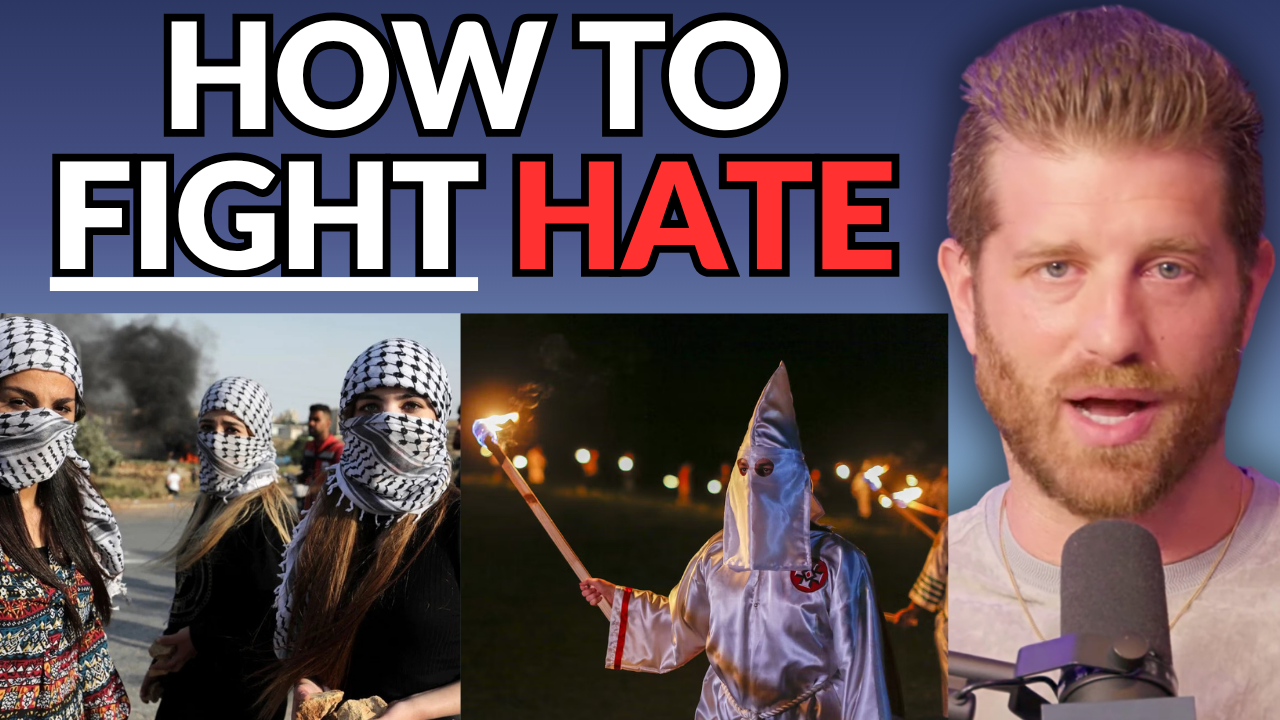
Antizionists vs KKK: How to Destroy a Hate Movement (And Are They Even The Same Thing?)
If you've ever taken the time to check out our website being jewish podcast.com, you'll notice there's a page for contact.
And on that page is an orange button that allows you to record a voicemail that my team and I will hear.
A few of you have taken advantage of this before.
Hi Jonah.
I'm from Sydney, Australia.
I think you're doing such amazing work.
I built the monument to the 45th and 47th president of the United States, Donald John Trump.
Hi Jonah, and being Jewish podcast folks.
Love it.
Recently we received one I thought was worth sharing with y'all in its entirety.
Take a listen.
Hey Jonah.
My name's s Levin.
I'm a huge fan of how you're navigating the front lines of Jewish identity.
Right now I'm reaching out 'cause I believe we're at a point where we have to stop just reacting to hatred and start holding the line by restoring social consequences that once protected our community.
I talk a lot about the KKKP.
The fact that we didn't just defeat the clan through the law.
We defeated them by making their movement socially radioactive.
We made it so that being a bigot calls you.
You're standing in your church, your job, and your neighborhood.
My question to you is, how do we restore this concept?
How do we make this hatred taboo and ensure that everyone rejects these taboo views and the people who violate them out of polite society?
It's a great question S and thank you for it.
I'm now going to do my best to answer it.
First, it's important to be clear, the K, KK is not a direct parallel to today's anti-Zionist movement, and this monologue is not me suggesting that they are the same.
However, as hate movements operating within social norms, there are certain macro level similarities we can discuss.
The Klan initially positioned itself as a civic and moral reform movement, anti bootlegging, anti adultery, pro-public school, pro Protestant values, broad appealing language, that frame participation more as community service than as anything hateful.
Not anti-immigrant, just pro-American, not anti-Catholic, Jew or black, just pro Protestant, Anglo-Saxon.
Most importantly, the Klan provided a sense of belonging.
It was a social club with meetings and events, rituals and regalia somewhere for small town folks to go.
They were politically ambitious with multiple governors and congressmen representing their interests.
They nearly tore apart the 1924 Democratic National Convention in a floor fight over whether to condemn the Klan by name, which Democrats narrowly voted not to.
What the Klan understood very well was that people don't join movements they perceive as hateful.
They join movements that make them feel righteous and embattled on behalf of something worth defending.
The Klan gave millions of Americans a way to act on ethnic and religious prejudice while feeling like heroes of justice.
Sound familiar?
Obviously there are a lot of parallels here, right down to the fight over the DNC.
A few others worth mentioning, the 1920s Klan tolerated violence at the fringes.
anti-Zionists not only tolerated, but call it resistance.
The KKK was legitimized by government and churches, anti-Zionism, by academia, media, and students.
The Klan recruited from where the white middle class socialized.
anti-Zionism from where minorities, progressives, and Gen Zers socialize.
And of course, like the K, k, K, anti-Zionism does not brand itself as hate.
It brands itself as social justice, human rights, progressivism.
It sells moral righteousness, community belonging, and the intoxicating feeling of fighting evil, all while focused entirely on as Vanderbilt Professor Shot will counter put it the intellectually justified, socially acceptable othering of Jews.
Now the twenties were the height of the Klan's popularity, and what followed was a gradual marginalization driven by a mix of legal, moral, and cultural forces.
Exposure was critical.
Newspaper exposes criminal convictions, televised brutality against civil rights, marshes across the south, hauling Klan leaders before Congress.
All this pulled the hood off as it were, just enough for the least committed members.
The folks who genuinely thought they were just part of a Protestant social club to cut bait, sending the Klan into steep and permanent decline in just a few years, membership went from millions to under a hundred K and continued to dwindle From there, though it took way too many decades and a lot of terror before they were finally snuffed out.
So now let's turn back to Era's question.
What can we do to ensure anti-Zionism falls off a cliff too?
Let's start with the most important lesson.
The KKK began to die when it lost the respectable middle, not when it lost the committed core.
The committed court never really went anywhere until it last.
Litigation.
Financial loss and infighting tore them apart.
The bulk of the damage was done when those who had joined for belonging or status or a sense of righteousness, abandoned ship, and no, I'm not talking about Greta's.
SS Jihad Jamboree.
The implication here for countering anti-Zionism is that the target audience is not the committed activist covering their face of the Kafi A, but the well-meaning otherwise decent person who just hasn't done their homework and is doing what their friends do.
Because it comes with social capital in their chosen community.
We know it doesn't work.
We know that public confrontation and counter rallies almost always backfire.
Every time someone showed up to scream at a Klan march, the Klan got to play the victim, and their numbers grew.
Government suppression has mixed results.
It disrupts and sends a message, but it also creates civil liberties concerns that the Klan and anti-Zionists have exploited for sympathy.
And let's be real.
It doesn't change.
A single attitude de platforming without the necessary cultural work creates martyrs, double meaning intended and moral condemnation, which is important in rejecting the normalization of hate is by itself insufficient.
Not because the condemnation's wrong, but because it doesn't actually target the lever of change.
When you condemn someone's beliefs, you trigger defensiveness and identity protection.
That person has already rationalized their position as moral.
They are the hero of their own story and telling them they're the villain doesn't dislodge the rationalization.
It hardens it.
You've made their identity and their belief the same thing.
So attacking one attacks, both moral condemnation from the outside only confirms their suspicions about Jewish tribalism or genocide support or media control.
It's evidence for their worldview.
Not a challenge to it, and I know we all have experienced a version of this unbelievably frustrating train of thought with somebody since October 7th, but take heart friends, because we don't actually need people to change their minds.
In fact, the folks we're talking about probably already agree with most of what we think anyway.
They've just never had it articulated or framed properly.
What we need is for folks to change their behavior and behavior responds to incentive not argument.
Remember that next time you feel the urge to measure success by whether you change somebody's mind or not.
That has never been the mechanism that's created change at scale.
We need to try pulling the same five levers, the clan's opponents to use to alter that incentive structure and here they are.
First, make the social rewards evaporate.
The social reward of anti Zionism right now is progressive credibility.
It signals to your peer group that you are on the right side of history.
You eliminate that reward by putting a dent in that credibility, which is something that can only be accomplished by respected voices from within the progressive movement, and not with lengthy moral arguments, but with brief clear social signals.
I care about Palestinians, but I don't need to be a part of that movement to do so.
That's it.
And it works because humans are social animals who calibrate behavior against what respected peers do.
When the signal shifts from respectable people or members to respectable people find this embarrassing.
The behavioral math changes without anyone having to win a debate.
We need our non-Jewish allies, clear-eyed progressives, moderate Muslims, minority leaders and genuine human rights advocates who are willing to say publicly that this movement doesn't represent their values.
We need to uplift Jews of color who have the innate ability to speak outside the community and be taken seriously.
All of these voices need our direct support and amplification.
Remember, the Klan wasn't defeated primarily by black Americans walking into hostile spaces and trying to win arguments.
It was defeated by its own members losing faith institutions, losing the cover to support them, and external legal and financial pressure.
So stop arguing with anti-Zionists on the merits.
That's their preferred terrain and it just helps them generate more heat and it doesn't make things better.
Second lever expose enough truth to sow doubt or embarrassment.
We must continue to tell the truth about the violent, hateful, well-funded core of the anti-Zionist movement, no matter how fruitless or endless the task may seem.
Because remember, we're not trying to reach that core.
We're trying to give the edge folks an out learning.
The truth can give people who are already uncomfortable a reason to leave that isn't.
I was a bigot.
Oops.
But rather I didn't know what I was actually part of.
Exposing the truth can also cause those deepest inside the bubble to suddenly understand themselves as visible to a larger world that views them with revulsion, pushing them back towards the fringe where they belong.
So keep being truth tellers.
Support investigative journalism and don't give up.
Now about those folks on the edge of that bubble, the ones in it for social acceptance, they're watching the true believers for cues, right?
But they're also aware on some level that their commitment is partly performance.
So perhaps more effective than external embarrassment might be internal doubt, not seated by telling them they're wrong, but by asking questions they can't fully answer.
What do you think happens to Jews in a single state with an Arab majority?
What would a good outcome to this conflict actually look like for you, and how do you think they get there?
The goal is not to win an argument, but to create a little mental friction that leaves your friend lying awake at 2:00 AM wondering whether they actually know what they believe.
Third, make sure there are better options for belonging when they're ready to leave.
When someone is ready to leave the movement, they need somewhere to go.
If the only options are hate Israel or love Israel, a lot of folks are gonna stay where they are because they don't love Israel.
So that must mean they belong in the other camp.
So we need an off ramp that's more open and less binary.
The Jewish community needs to show folks it's okay with us if you say, I care about Palestinians.
I hate the Israeli government.
I'm not visiting Israel.
But none of that requires me to endorse a movement that's celebrated the atrocities of October 7th.
We don't need them to become Zionists.
We just need them to stop being useful numbers to the people who actually want Jews dead.
Fourth lever, sue the shit out of them.
The SPL C'S 1987 civil Judgment bankrupting, the United Claims of America established that organizations could be held liable, not just individuals, which was the killing blow for the KKK because it made institutional membership financially catastrophic and created a deterrent that social stigma alone hadn't achieved.
Today's closest is probably Title VI Investigations, using civil rights law to hold universities liable for supporting campus environments hostile to Jews.
So what can you do?
Be litigious and don't be silent.
Support the Brandeis Center students against antisemitism, the Law Fair Project, and all these other groups who are taking the fights to the courts.
Settlements in court are one thing, but it's gonna take decisive legal victories in the courts to crack this thing wide open.
And speaking of cracks, our last lever, find them cracks.
That is in the coalition.
The Klan was rocked by scandals in 1925 when the Grand Dragon was convicted of murder and rolled over on all the corrupt politicians the Klan had put into office.
They tore themselves apart and membership plummeted.
We've already seen breaks within the anti-Zionist movement.
Most recently in the wake of US intervention in Venezuela and Iran, when many were shocked to find their leftist peers standing not with the Venezuelan or Iranian people, but against them.
Keeping an eye out for these cracks and ways to expose or amplify them is a legitimate strategy for weakening the movement.
Not because I said so, but because it's been done before.
Most of the world is currently repeating the history they never bothered to learn.
But that doesn't mean we have to.
And there you have it ez.
I hope that answered your question.
It sure took me a hell of a long time to research.
It also took a hell of a long time for the KKK to fade from view.
Didn't happen overnight.
These are not short-term problems and they don't have short-term solutions.
So strap in Susan.
It'll take years of concerted effort to dismantle the behavioral ecosystem that allows anti-Zionism to recruit, organize, fundraise, and operate in mainstream spaces.
We can't stop until the ideology becomes homeless, without social reward, without respected voices, and without institutional shelter.
That's the game.
And if you're still not sure how to play it, you know you can always leave me a voicemail.