
Monologue Transcript
Being Jewish vs Living Jewish? THIS Is What Actually Matters!
Not following Jewish laws or customs doesn't make you a bad Jew, but does it make you less of one?
Let's break it down One of my earliest monologues on this show was about my distaste for the self-deprecating concept of the bad Jew, a person who identifies as Jewish, has allowed their connection to the day-to-day observance and practices of our community to lapse, and so categorizes themselves, or allows others to, as bad.
I don't like that value judgment, and if the response to that monologue has been any indication, neither do most of you.
I heard from Jews at all levels of religious affiliation who had thought of themselves as bad, from Orthodox Jews who let some custom slide, all the way down to the most reformed Jews who barely follow any customs at all.
But as I continued to think about this concept, I realized I left the idea a bit incomplete.
I encouraged you to do away with this good/bad scale as a means of judging yours or anyone else's connection to Jewish identity, because it's an unnecessarily moral or normative judgment.
I don't believe there's one correct way to be Jewish, or that the important question to even be asking is whether a Jew meets or fails that totally subjective standard.
But what I did fail to do was provide a healthy alternative spectrum on which we can map ourselves with kindness and objectivity as we each grapple with our own Jewish journeys through life.
I don't think we should be prescriptive, but it's totally kosher to be descriptive.
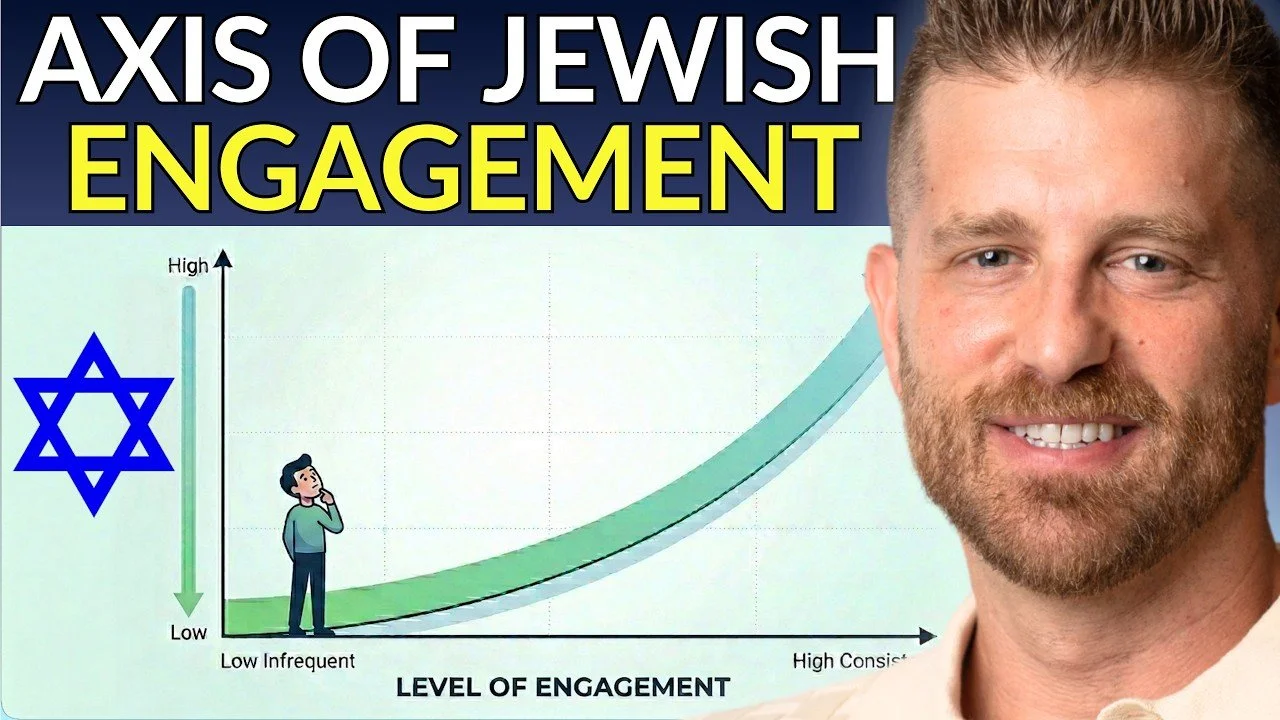
And so I propose that the axis upon which we should be plotting our Jewish identity arc is on an axis of engagement, not observance.
It's not about how much, but about how deep.
I'm not interested in passing a verdict, but I am interested in examining a dimension.
Are you a Jew who engages with the richness of our tribe, or a Jew who does not?
Either way, you're a Jew, no better or worse of one than anyone else.
Tribe membership is binary.
Either you're in or you're out, and if you're in, you're in, baby.
You're as much a Jew as anybody else.
That's belonging from the outside in.
But when it comes to how deeply engaged you are, that's different.
That's about belonging from the inside out.
I'm always drawn to analogies, and in this case, I can't help but think about my union memberships, in say Actors' Equity, the labor union for theatrical performers.
I am absolutely a member.
I pay my dues, I got a card, I got my number, and when I was on stage more regularly, union rules and practices were a part of my regular work life.
But have I ever paid attention to a single union election?
No.
Did I read the handbook or attend a workshop or explore the website or literally anything else other than paying dues so that I'd be legally allowed to perform in the shows I booked?
Nah.
I'm a member through and through, but with the absolute barest minimum of engagement.
Why should we care?
Two reasons.
One, what I would never do is represent myself as being representative of the union as a whole.
I would never deign to style myself an expert or suitable spokesperson for the union or its members in any scenario.
In fact, I'd be certain to preface any conversation with, "I honestly don't really know much about this.
You know, I unsubscribed from all the emails, but in my limited experience, blah, blah, blah, blah, blah." By honestly acknowledging my peripheral relationship to the community, I actually make my blah, blah, blah stronger because I've plotted a point on the engagement axis that someone can actually use to accurately understand where my thoughts and feelings are coming from.
I could be wrong, I could be right, but at least the listener can make an informed assessment of how useful or not my input is to their thinking, and I'm not going out and grabbing a microphone to deliver zealous condemnations of the union I know almost nothing about, or that I'm at least aware I engage with much, much less than many other members way more qualified to speak on it than I.
Unfortunately, today we see many anti-Zionist Jews fail to meet this basic level of humility.
I'm not speaking of the small number who are deeply engaged Jews, who for whatever farcical reason have decided to oppose the existence of the Jewish homeland.
I'm talking about the majority, who seem to mostly fall on a spectrum ranging from those who went to Jewish preschool or camp or Sunday school decades ago, or celebrate a few holidays with their parents, or enjoy bagels, or know some Yiddish phrases from their grandparents, to those who have utterly no relationship to being Jewish beyond an accident of ancestry and an eagerness to exploit that birthright to denounce Israel and the Jews who stand by it.
These are not bad Jews.
They are lost or misguided and certainly less engaged, but none of that makes them a bad person, and it's important to make this small distinction, because we wanna leave the door and the dialogue and the off-ramp open.
But where I do place a value judgment is on the behavior.
What is bad is lacking the self-awareness and respect for others to be able to admit, "I'm probably not the one you should take your cues from here, and I certainly don't pretend to speak for Jews or Judaism at large, because I'm clearly not that engaged a member That simple modicum of humility would change the discourse entirely.
But alas.
The other reason why you should care about my union analogy is that it highlights one of life's obvious truths, which means it's one we often forget and bears repeating.
The way we make our lives rich and meaningful is with intention, and the way to approach life with intention is first to be intentional about creating the time and space for self-reflection so we can ask ourselves, "What do I wanna get out of this?
How important is this to me?
What place do I want this to have in my life?" If your point on the axis of Jewish engagement is on the less engaged side, is that because you considered the options and made a decision?
Or is it precisely because you never considered it that your engagement level is now dictating your choices rather than the other way around?
Show me a child with Jewish parents who ends up completely disengaged, and I'll show you parents, God love them, who were probably not intentional in even considering how important Jewish identity was to them, let alone being intentional on how they communicated that to their kids.
And again, it's not a value proposition.
Neither those parents nor those kids are bad Jews, but they are missing out on something special, and if you're gonna miss out on something, don't you at least wanna make sure it's on purpose?
Adulthood is all about balancing your budget.
Not your fiscal budget, though that's important, too.
I'm talking about the far more valuable finite resources of your energy and time.
That is all we have, our time, how we choose to spend it, and the depth to which we engage in those expenditures.
Think about how much of your time and energy budget you leave unexamined, how much more intention you could bring to bear on those two most priceless resources you possess on this earth When it comes to the unions, I'm good.
I've thought about it, and I could care less.
I am certain I'm not leaving anything deeply meaningful on the table.
But my Jewish identity, my personhood, this gift we've been given that we can utilize to bring order and meaning and goodness to an otherwise chaotic and indecipherable existence, how sure are you that you're getting out of it precisely what you'd like to?
How carefully have you balanced your time and energy budget so that your expenditures actually reflect your true priorities?
How intentional have you been about even deciding what your priorities are?
To bring us full circle, I want to harken back to another early monologue of mine in which I encouraged you to go full Jew, to listen for that voice inside you saying, "That's too Jewy," or, "I don't have time," or, "I don't know enough to participate," and push against it.
To counter that voice with your own saying, "I want to feel more Jewish," or, "I'm gonna make time," or, "So I'll just learn more," or, "Fake it till I make it." If you ultimately land on being a less engaged Jew, okay.
I just don't want to see you land there by mistake or by default, and I know you don't want that for yourself either.
So be intentional.
Seize agency over your own life, Jewish and otherwise, and remember the formula: time plus energy equals engagement.
It's one of life's most precious commodities.
How will you spend yours?