
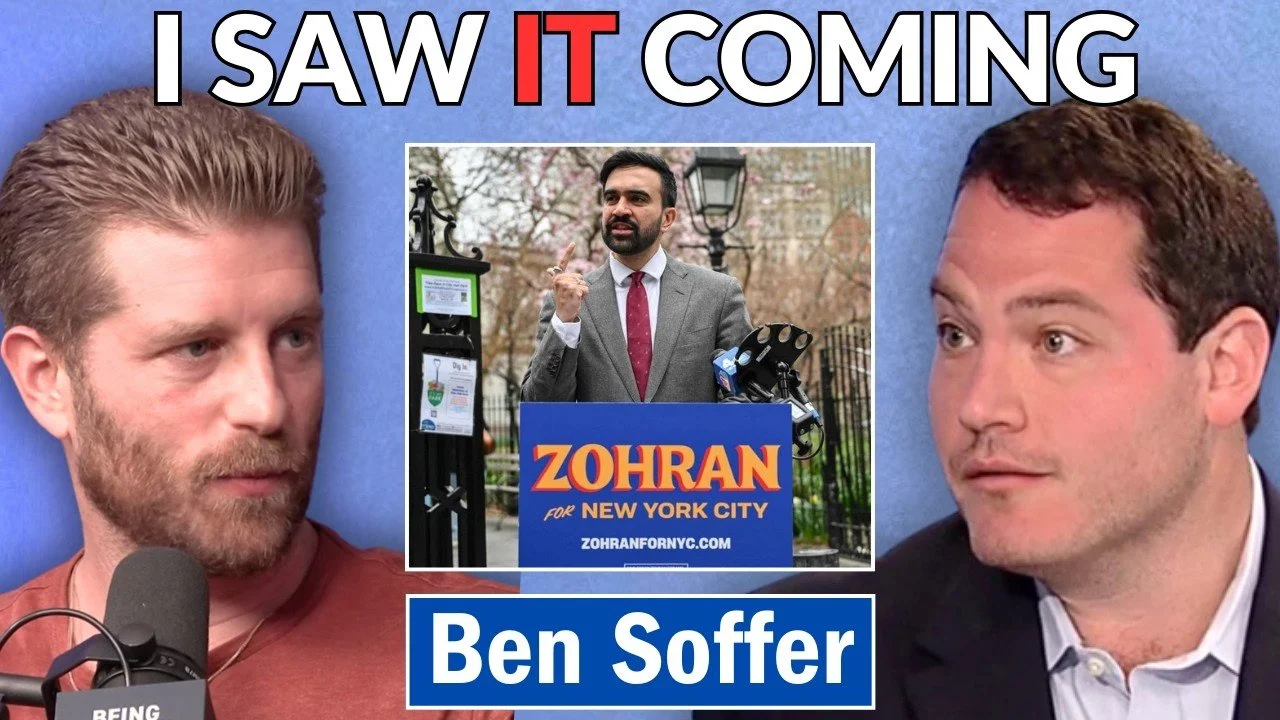
Interview Transcript
A Jewish “Boy With No Job,” Ben Soffer On Zohran Mamdani and The Future of NYC for Jews
Watch and Listen
People will see me eat a cheeseburger and I'm like, Ben, what the fuck are you doing?
That's what I love about being Jewish.
You get to sort of choose your own adventure.
I will not be able to be as proud of New York City without the fear of what we just discussed.
You are just spreading Jewish joy through beverages.
When there's a flag and you're wearing a kea, you're in trouble.
That's just a fact.
Welcome back to our Summer edition of Being Jewish with Jonah Platt.
30 minute Benches.
Same vibe.
Same tribe.
Shorter episodes.
My guest today is one of the Jewish people I've met in the past year, and I say that with the utmost admiration because he is being his full, authentic self to his million plus Instagram followers, and on his Super Jewy podcast with co-host Josh Peck.
Good guys, which I was delighted to guest on for their Passover episode.
This spring.
He's the CEO of Spritz Society, canned Aifs husband to content creator, queen girl with no job.
And like me, he just had another baby.
So let's find out if he's well-rested at all.
Ladies and gentlemen, please welcome Ben Ser.
Thank you, Jonah.
Great to be here.
How's it going?
It's going all right with me.
I'm, I'm decently well rested.
How about you?
I know you've got a newborn, right?
I'm wonderful.
I'm well rested.
I feel good.
The bag's under my eyes, honestly.
Take a peek.
They don't even look that bad.
You look pretty, look good, you look, you look young.
Spring chicken.
Speaking of kids, you, you and I as kids, pretty similar upbringing.
Uh, as far as as Jewish stuff goes.
We both went to Jewish Day School.
We both went to Camp Rama.
Um, you are more modern Orthodox.
I was raised more conservative, but still super familiar to me as I'm speaking to you now.
Where am I finding you on your Jewish journey?
Such a great question.
Um, one to clarify, I grew up conservative.
Oh, I only really became modern Orthodox.
I went to Yeshiva University for college, right.
Um, which sort of took my religious religiosity up a notch.
Um, they have a wide range from honestly, reform up to Hasidic, but I found myself somewhere in the, in the modern.
My wife also grew up modern, which definitely brought me over there.
But people don't necessarily agree with my.
Version of what Modern Orthodoxy looks like.
Like people will see me eat a cheeseburger on Instagram and they're like, Ben, what the fuck are you doing?
Or sorry, I don't know if we can curse.
Ben, what are you nuts?
You sure can.
Um, and what I say to that is, and I'm coming back on your question today, I'm not eating non-kosher meat.
I am mixing milk with meat.
Right?
Does that make sense?
Probably not to most, but to me at least today.
I'm doing what makes the most sense to me.
I remembered learning at Yeshiva University that the reason why we don't do chicken and milk, for example, is on the off chance somebody was strolling by the restaurant and peeked through the window and thought, oh, that looks a lot like a cheeseburger.
Uh, maybe he's eating, uh, milk with meat and, uh, maybe.
Somebody could interpret that that is something that you're allowed to do.
And it just, it just became for me, like we live in a modern society where I'm so, as you mentioned, proudly Jewish.
And for me, that's, that's what matters most.
Like hashem guides me every day.
There isn't a day that goes by that I'm not thinking of him with every decision that I make.
That's my, that's where my Judaism comes from.
It's a, it's a complete unbreakable connection.
Hashem that only got stronger with my son, by the way.
The second that I saw my son, I'm like, oh my God.
Like the fact that people think that God doesn't exist is insane.
Like, where else does he come from?
What do you mean he doesn't exist?
He looks like me.
Um, so, so that was pretty crazy.
So my, my Jewishness.
Is really strong right now.
So first of all, when you say just, this is a small detail, but when you say, I'm not eating not kosher meat, but I'm eating cheeseburgers, does that mean you're eating kosher beef on the cheeseburger?
Yes.
I, I mean, I love that.
That's, that makes absolutely no sense to me, but I love it.
For you.
It, it doesn't make sense.
There's something about in my house eating non-kosher meat that just feels very wrong to me, but.
If there's something that feels less wrong about me taking a crap singles and throwing it on at the end and having it on a paper plate, is it right?
Probably not.
It's what's right for me in this very moment.
I love that.
Okay.
Second thing I wanna dig in on, you said there isn't a decision that you make where you're not, you know, in conversation with God.
What does that, what does that look like?
What does that, what does that sound like?
What does that mean?
I think it has a lot to do with my wife.
I'm very, very blessed to have a wonderful marriage.
I think it has to a lot to do with my parents.
I'm blessed to have amazing parents and amazing sister.
A lot to do with my son now, like I really do wake up just incredibly grateful.
There were times in my life where I definitely let day-to-day minutia, cloud, how grateful I was.
Like, I'd wake up and I'd be stressed.
Or the same way with everybody you go to sleep with, re like constant thoughts about whatever's going on in your life and, and at this current moment, I wake up very grateful and that gratitude throughout my day I know is.
Guided by knowing that there's a higher purpose than, uh, selling alcohol or, uh, cooking or doing podcasts or there's something bigger.
I know for me, having a child was extremely transformative in so many ways, but also I, you know, sort of dialed in and I think everyone does a little bit like the Jewish stuff.
You're like, okay, what am I gonna try to impart to this kid?
How, how are we going to live?
Jewishly, and it may be ways we weren't before because I want this kid to, to get it.
Are are, are you having those kinds of thoughts and conversations?
I think we live really Jewishly, uh, to use your, your words like where the modern orthodoxy comes from is our community in New York City.
Like we are very in it.
While I don't go to Schul every weekend, I'm very much in touch with my rabbi.
Uh, we speak.
Would I like to go to Schul more?
Would he like me to go to Schul more?
Yes.
On both of those things.
But I think that we are very, uh, connected in the city.
The city is in a very strange place, and that only makes your.
Wants to be Jewish and talk about being Jewish even stronger, at least for me.
Let's go down that road.
I mean, tell me what, what is the vibe on the streets of New York right now?
And I'm, I'm, I'm assuming you're referring to the recent election in the Democratic primaries.
Zoran, Ani.
He won that, that spot.
So what, what are you feeling?
Yeah, what are you seeing?
I saw this coming from a mile away.
Um, I had a great closed door meeting with Cuomo probably two months ago.
A half hour, me, him, and a mutual friend for what purpose?
To learn what he wanted, what he would do for the Jewish people like I am of course, uh, a New Yorker.
I'm of course an American, a very proud American, but I do always.
Mention that I am a Jewish American.
My Judaism always comes first.
Mm-hmm.
It's very, very important to me that it comes first.
So when people say things like, oh, uh, what does Zionism have to do with a New York City election?
Well, as somebody who's Jewish first, a whole lot.
A whole lot.
Yeah.
So I had a, I had a meeting with Cuomo just to understand where he stood.
Got a great vibe from him.
Endorsed him publicly on Instagram.
Got a lot of backlash.
He wasn't great as a governor.
The COVID stuff, he had sexual assault stuff.
And, uh, all of that is, is true and terrible.
And the reason that I bring that up is because that pales in comparison to Zoran.
Mandani and what is currently at stake in New York City.
It's.
Antisemitic.
It's anti-American.
It's anti our way of life.
The way that you currently live, Jonah, you could not live that way under, uh, what he is proposing.
And tell me why.
So we can start with the, uh, anti-Semitic piece.
People say, oh, he's, uh, why is he anti-Semitic because he's Muslim?
No, of course not.
Like, that's, that's calling me a racist.
Absolutely not.
Absolutely not.
He's anti-Semitic because he does not denounce, globalize the Intifada, uh, which is a direct call for rallying the troops and killing Jews, which we just saw, right?
We just saw in Boulder.
Like that's what happens when you don't denounce those things.
You have that guy Bob villain, or whatever his name was that said, uh, which is hysterical, that he would use a Jewish musician and then chant death to the IDF.
But that's what globalized the Anada is, right?
It's people get really, really excited to rally the troops in a direction that ends up with Jews being killed or false narratives being spread or dehumanizing, the IDF or whatever it may be.
Two, he is just pro-Palestinian in this war.
He's picked a side.
He hates Israel.
He wants to BDS, boycott, divest, and sanction all Israeli goods.
He wants to penalize Jewish charities in New York City.
Uh, he doesn't want people to make, uh, zionistic contributions, which just so we're all on the same page is a synagogue, right?
Hmm.
If you can't donate to a nonprofit.
New York City that funds Israel, which every synagogue in New York City does, you can't fund synagogues.
Mm.
So whether the intent is to say that we can't pray or practice or not, that is a, a direct correlation.
He started, uh, the Justice for Palestine movement at Boin.
He wrote a song praising five terrorists.
I mean, sort of the list on the Jewish side goes on and on.
As a person who lives in New York and is outwardly Jewish, how do you feel your day-to-day life would change or be affected by if he were to be elected?
Right now, I know the areas of the city to avoid.
I know to avoid Washington Square Park and NYU like the plague.
It's full of Palestinian flags, and when there's a flag and you're wearing a kippah, you're in trouble.
That's just a fact.
Have you experienced that?
I, I'm very, very good.
Famously good for avoiding altercations.
So if I'm on the street and I can sense that something bad's about to happen, I'm fake phone call immediately.
I'm walking into a deli.
Mm-hmm.
I'm not, I'm not getting in your face and saying anything ever.
Right.
I have no interest because I know that that one-on-one interaction.
Is not gonna help the overall cause.
Yeah, it's, it's only going to potentially put me in danger, so I avoid that area.
And the reason that I bring that up is because that area people are very, very comfortable being anti-Semitic, or should I say being anti-Zionist.
By the way, 95% of Jews are pro Zionism.
So if you're anti-Zionist, then you're antisemitic.
Sure.
I don't care what you, how you dance around the fact that if the Jews don't have a right to exist, that you, or if you believe that the Jews don't have a right to exist in a state, then uh, you don't hate Jews.
I, I never understood that.
So there, there, and by there I mean, uh, people who are, uh.
pro-Palestine or globalize the Antifa or whatever it may be, anti-Zionist.
If they become very comfortable Jonah throughout New York City, yeah, I will, I will become less comfortable.
That's that's the way it works.
That's exactly when I actually, when I posted about this, that's the word I used, I said, it's going to be a lot more uncomfortable for Jews if yeah, if this sort of behavior is tolerated.
I think that's exactly it.
Yeah, and I don't want people to mince my words 'cause people love to do that.
I don't think that my life is in danger Right.
In New York City today.
Right, right.
I'm not out here claiming that there's gonna be a Holocaust in Manhattan and that all of a sudden Sharia law is gonna be imposed.
I'm not saying that whatsoever, but what I am saying, which should equally be heard, is that I'm very proud to be Jewish today in New York City.
I will not be able to be as proud of New York City without the fear of what we just discussed.
Mm-hmm.
Like right now we have a blossoming Upper East Side grocery store called ORI that if you don't know it, uh, the next time you're in the city, we'll go.
Okay.
It is gorgeous.
There are new kosher restaurants popping up, and I bring this up because we're very proud to be Jewish.
The Upper East Side is proud to be Jewish.
The Upper West Side is proud to be Jewish.
And if you have a mayor that is.
Questioning that.
I just, I, I would not be shocked if bricks went through the window.
Hmm.
I saw what they did with hostage posters.
Right.
Right.
Like that's when we have a very Zionist state and city.
If all of a sudden it's cool to hate Israel and cool to hate Israeli products, and all of a sudden boycott Israeli coffee shops like we had seen right after October 7th.
The city can become very scary.
How much of you being Jewish online is just you being Ben and that's who Ben is and how much of it, if any, is like with an intention or a mission about how you are representing or expressing or modeling being Jewish?
1000%?
Them being Ben.
Um, I'd say once every six months.
It used to be never once every six months something terrible will happen and I'll need to craft what I feel is like a statement that I'll put on Instagram stories that talks about a current events in the Jewish World movie that I feel about it.
But otherwise, no.
I don.
It's just me being me.
I don't, I actually hate, uh, when people sort of make, turn it into like their entire personality on Instagram.
Like, like become, like, and I've seen this a lot post-OC October 7th, where people have made it their whole personality.
To advocate for Jews in like a not genuine way, like became a job for them.
Right?
Like I, I'm sure you, I'm not calling anybody out by name, but I'm sure that you know the people that I'm talking about.
Sure.
And so for me, no, it was always just being authentic and being myself.
And it's the way that I was raised and, uh, the way that I act with my friends is the way that I act with everybody else.
How Jewish is your audience?
Do you know the answer?
For the most part, my audience is religious.
Hmm.
Religious doesn't necessarily mean Jewish.
Right.
I have a lot of very, very religious Christians, a lot of them, um, that love Jews.
I, I don't have anybody that follows me that doesn't love Jews.
Let's start there.
Right, right.
Anytime I post about anything that goes against that, or like talks about, like when I made a statement about Ani, I, I got a million positive messages and then I'll look the next day and I had 4,000 people unfollow me.
And that's fine.
I'm happy to weed out the people that don't agree with me.
Right?
Uh, on, on that, I'm such a fan of, uh, other types of discourse, right?
Like, I don't want to be in a bubble.
But if you don't like Jews, then you shouldn't be following me.
You should be following somebody else like David Duke.
Um, so pretty Jewish.
They love to remind me that spritz society isn't kosher.
Uh, I, as I talk about picking and choosing, uh, I drink non-kosher wine.
I only drink kosher wine at Shabbat, but when I'm outside of a religious experience, I will drink non-kosher.
It's white wine, Jonah.
It's not even red wine.
So I didn't even think about it.
So I know that I have a lot of Jews because of my comments and because of the amount of people that ask me to.
For society, kosher.
But then I also get a ton of beautiful messages that are like, I'm a, a religious Christian from Oklahoma.
I just wanna know that we love your family.
Um, and so Nice.
And when I look at sort of the info, it's really na it's, it's national, it's also international.
Like 70% is here, 10% is in the uk, 10% is in Australia, 10% is in Canada.
And uh, I think the common thread is that.
For the most part, we all believe in, in a God.
The question is who's who's God.
But there's definitely a, a religious elk to my audience.
When you say you o you drink kosher wine at Shabbat, that's something you do in your house.
Like you save the kosher wine, it makes it feel like more special.
Yeah.
Kos, Shabbat for you?
Yeah, only.
I love that.
Only, only with a kiddish cup.
Like when I'm, when I'm saying, uh, Kush, it's with kosher wine.
Again, this is just me being me.
I will break out a great bottle of cais because that's what I prefer to drink for the rest of the meal.
But like I would feel weird pouring wine on Rosh Hashanah that wasn't kosher again, just me being me.
Well, that's what I love about being Jewish is you know, you can, you get to sort of choose your own adventure.
I think me and you are similar in that, and maybe it's the way that we were raised where there are some people that are very adamant that you cannot pick and choose.
My number one thing is, as long as you're growing towards something, you should be able to pick and choose.
There's two options.
Pick and choose, or do nothing.
You want them to pick and choose.
Exactly.
I'm not ready to be full blown.
I'm not.
I'm ready to continue to try my best on this upward trajectory, but if picking and choosing allows me to feel like I'm closer to Hashem, then let me pick and choose.
And if you don't want me to pick and choose.
Then you're against the Jewish cause.
Because the Jewish cause is eventually we all get to this highest level, but it takes some people a while.
I don't know if it'll happen in this lifetime.
A hundred percent.
And I, I think from the other side, like it, it, it's, it's fear based, right?
I mean, like I've spoken to Ultra Orthodox and sort of the reason a lot of these laws exist to sort of, you know, keep the gate closed so that people don't slip away from the faith and it like the slippery slope sort of mentality.
Sure.
But then.
What you're losing is sort of the other side of that, of people like you and me who, you know, are, are deeply Jewish, but looking to do it in a way that works for them and their life.
Yeah.
So, you know, I, I, you need a little bit of both because as we're also seeing in today's world, like some people have totally.
Lost their Jewish identity because it has been a slippery slope for them.
And they let go of a little more and a little more and a little more and a little more until they got nothing except, you know, a name on a birth certificate.
Totally.
And I'm thinking about this for the first time, but I think that why my, uh, Jewishness and my Judaism has never faltered in terms of my relationship with God is because it's one of the only things in my life that I don't do all or nothing.
I'm somebody who struggled with his weight his entire life.
Ozempic is God's drug.
But before that, even on it, uh, two 90 to two 30 to two 90 to my whole life.
My whole life.
And that's because I'm wired to want to go on a really, really, really hard elimination diet.
So I'll go on something like ke.
For three months, I'll drop 50 pounds, and then the second I have a bagel again, I'll have 40 bagels and it's over.
And if only, if only I could take my approach to Judaism, to my approach to dieting.
And do what I can on a daily basis and eat within reason and have a slice of pizza, but not have six of them and pick and choose, I would be much healthier.
I can't tell you the amount of people that I know that grew up really, really religious, that are now nothing because they felt it was forced on them.
How much of your Jewish identity would you say.
Is about the personhood.
'cause what I've heard you say a lot in this, in this conversation is the religious stuff, the, the theological stuff, the observant stuff.
How much of, how much of it at, if at all, are you thinking about the, you know, tribe from a thousands of years ago that has existed through this continuum and is, you know, this people, I'm a very spiritual person.
Let's start there.
Mm-hmm.
Uh, I, I love.
Meditating.
I love, people are gonna find this shocking.
A sound bath.
I love.
My version of spirituality is a cold plunge because it's deep breath work.
I love all of that.
Actually, my one problem with the way that we approach Judaism is that today you find a it a lot in Kabbalah.
You find none of it in traditional Judaism where the, the person and their experience with the world around them isn't spoken about as much as their relationship with God.
Mm-hmm.
And in my opinion.
God is breath work.
God is the greenery and the forest and being outside and going for hikes and trying challenging things, like that's the idea to me is God is all around you.
I think that everyone eventually reaches this like pinnacle point where.
Whether it's in this lifetime or another lifetime, it definitely won't be an hour lifetime where everybody is sort of on the same page and they're all following the same ideals.
And that to me is, is what it means to be Jewish.
Let me know if you've ever felt this way.
You'll meet somebody who isn't Jewish, but you'll feel on them.
There's a similarity and it's like, okay, I know you're not Jewish at all, but you're Jewish, at least in the way that my heart perceives you as Jewish.
Totally.
And my mind perceives you as Jewish.
And to me it's just.
Basically that you're brought up as a good person with a good hamma who cares about other people, cares about the people around them, isn't selfish.
I think we have this set of rules that help guide us into being the best people we can be.
It's funny, I asked you sort of about the, the piece that wasn't related to spirituality and religion, but you naturally took your answer there.
Yeah.
Which sort of an answers it in another way.
Yeah.
Which to me it feels like the sort of more earthbound aspect of, of being part of this tribe is, is maybe just not a, as important to factor in your identity as the the religious spiritual values.
I think it's maybe because today I take it for granted.
I think it's because I have a state of Israel.
I think it's because I know that that's a homeland.
I think that if that didn't exist, maybe that would've been my first answer because I wouldn't have that to just grab onto.
Yeah.
But because I'm so comfortable, because I have a state of Israel, because we have a homeland, because we have a.
23 and me, even though they're under fire, that tells me that I'm linked back to that land.
That I'm able to be comfortable enough to say that, uh, I most identify with my spiritual part of my Judaism, but perhaps if that didn't exist, I would need to lean on something that was a little bit more tangible.
I love that and I, I love the awareness too.
Did October 7th do anything to alter your sense of Jewish identity in any way?
In any direction.
It made me very sad and angry.
Yeah.
It didn't change my direction.
No.
I remembered posting on October 7th how unbelievably devastated I was.
But to watch that we were about to be blamed for this.
Right.
I remember posting it on the seventh because this is not new.
Yeah.
We've been taught this forever.
This is the exact plight of the Jewish people that has been going on for thousands of years, where we are not the aggressors.
We are trying to exist.
And today's sort of form, social media has just destroyed this narrative.
It's gone.
Yeah.
Poof.
It's completely gone.
So no, October 7th didn't do anything more to me.
It didn't have to.
I would say that October 7th did a lot for others.
Sure.
And naturally I'm now involved with more people than maybe I was before.
Yeah.
Um, because friends of mine that maybe weren't so, uh, not proud, they were always proud to be Jewish, but they didn't understand the same way that I spoke about the comfort in having the state of Israel.
They became so comfortable.
Nothing bad would ever happen and that we were just great.
And then something horrible happened and they were reminded, oh, these aren't fairytales that our grandparents and teachers told us.
These are real things.
The Holocaust really did happen.
Uh, 80 years ago, and you could see how it could happen, especially in an age of non-social media where anybody could get away with anything like, right, we, like you don't know, right?
Like right now we have little snitches hanging out all over the globe, for better or for worse.
Back then you didn't, you could organize an attack and nobody would ever know.
You'd find out in the news on a newspaper, on a curated newspaper, right?
So I think it brought a lot of those people out to fight.
Which in turn gave me more people to fight with.
I love that.
I, I, I remain unchanged.
Yeah.
I, I've always been like this.
I would be remiss if I didn't get into spritz society a little bit here.
Sure, yeah.
Especially the fact that you have, one of your skews is a collab with Clawson's pickles.
Which is like, that makes it the Jewish drink on the market.
I literally just bought a, a jar of whole dill clawson's pickles yesterday.
That's my go-to brand.
Oh, we're the best.
Tell me, tell me about this partnership.
Then you need to go to your local target and pick up, uh, or order it on my local goPuff or order it on your local goPuff.
Or I can send you some, but um.
So, yes, SPRT Society is a wine-based sparkling cocktail company that I started five years ago.
Uh, in addition to being proudly Jewish, I spent 10 years running celebrity and influencer marketing agencies, most notably VaynerMedia, and have been in the influencer celebrity relations game for a long time.
And my wife and I built up these platforms and she had a huge podcast.
I grew a podcast and all of a sudden it's okay, what do we do with this audience?
We could do brands deals forever, but uh, brand deals are fleeting and we wanted to build something tangible and start to the entrepreneurs and our first sort of foray into that is spurt society.
I plan on building brands forever.
I love the CPG space.
It's just so exciting to be able to make the what space.
Like consumer packaged goods, like to, to be able to make something that's better than what's out there.
Yeah.
Like when we grew up, we, at least I never thought about it.
It was like, okay, it's just Coke.
Right?
Right.
Coke is the best, or Pepsi is the best.
Nobody's ever gonna challenge them.
And like, well, nobody, nobody ever said Pepsi is the best of anything.
And by the way, not me, not me, but some do.
I'm a big Diet Coke guy.
Same.
Um, but, um, challengers are here.
Challengers are here.
Uh.
In the soda game.
That's a poppy or an an oli pop or like, these are real, these are real brands.
And in our space, I saw White Claw and truly was challenging beer.
Everybody loved beer.
And then one day they said, eh, beer's, all right.
I'd rather have a seltzer uhhuh.
And it was sort of like an eyeopening, it was like, oh, you, you like.
You like vodka sodas, like I drank that in college, but you like, marry at 30, won a vodka soda in a can.
No you don't.
You just hate beer that much, that you're gonna have a vodka soda.
And then I found out that white claws weren't vodka.
They were malt.
So really they came like a beer soda.
The the base is malt.
Um, and I thought, all right, lack of transparency.
There's an opportunity to make something better.
We have a community of millennial women.
Why don't we ask 'em what they want?
And so I put together a Google form and asked 50,000 of them via dms, their opinions on what those flavors, canned designs, alcohol percentage, alcohol base, and called that group the Spritz Society.
So we named the brand after the group that helped pick it, but they said if you made a wine-based sparkling cocktail that tasted great.
We'd love it.
We drink Pinot Grigio, Sauvignon Blanc rose, and then we, when we pick up these seltzers, they're tequila, malt vodka or beer.
So make something wine-based.
So that's what we've done.
And it started off in very, you mentioned earlier, like aperitif driven flavors.
We moved into more, uh, sort of mainstream americanizing, the spritz to us.
Spritz is just a colorful effervescent cocktail.
Our bestseller is pink Lemonade.
It's a sparkling wine-based pink lemonade sold at Target and even a pickle spritz where if you think about white wine and pickle juice and brine, if you were to cook with them, they would all go together.
Why wouldn't they go together in a cocktail?
And they do.
If you love pickles, it tastes unbelievable.
Did you already have a connect at Clawson's through all your years and you're like, guys, I have an idea.
Or did they come to you?
Yeah.
Like where did that come from?
Yeah, so we, we made in April Fool's joke in 2022 that we were making a pickle spritz.
I thought it sounded like so me, but like kind of gross.
And I didn't realize we were on the heels of like a pickle revolution.
Everybody's like, no, no.
I need it.
I need it.
I need it.
I'm like, okay, if you really need it, let's see if we can make this real.
So we reached out, one of the companies we reached out to was Kraft.
Um, we get Inbounded all the time.
I think I've worked them in the past on brand deals.
And I said, would you guys like to work with us on this?
And they did and it's great.
And, uh, now we just have to figure out, uh, I think it'll be our only savory flavor ever because spritzes in general are not pickles.
Right.
But it's, but it's a great product.
Um, and it's, uh.
It's fun.
It's sold at City Field where the Mets play.
Amazing.
You can go and you go get a pastrami sandwich and a pickle spritz or fries and a pickle spritz.
It's like I'm trying to sell it into Katz's, like it's that vibe.
You are just spreading Jewish joy through beverages, which I'm trying, which I've not seen done outside of Manchez and not Thank you.
They're not spreading too much joy just.
Kash root.
Correct.
We are out of time, but I wanna thank you for, for being here and for setting a great example of how Jewish identity can thrive in the digital age.
Just you being, you doing what you do, it means something.
And so I know, I know your audience appreciates it.
I appreciate it and I appreciate your time.
Great to be on with you and uh, hello to all of your listeners.
Thanks for listening.
He's a mech.
It's been 30 minutes.
I'm Jonah Platt.
Check out my next episode.
What are you nuts?