
Interview Transcript
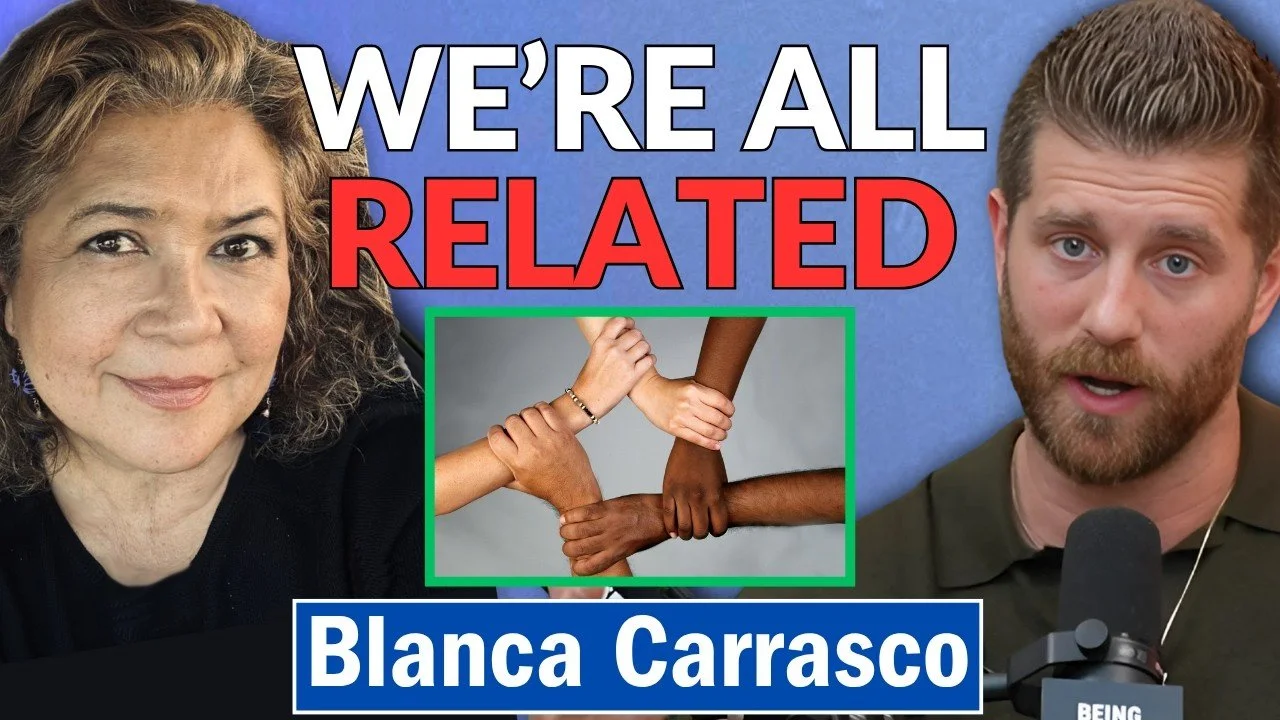
“Convert or DIE!” Crypto-Jews & The Spanish Inquisition with Mexican-American Jew Blanca Carrasco
Watch and Listen
If anything, what I have learned is that we are all interconnected.
>> You were raised Catholic.
How did you rediscover your heritage and these Jewish roots?
>> If you know that you have Jewish ancestry, you are not converting.
You're returning to what was taken away from you.
>> Welcome back to our sparkling summer edition of Being Jewish with Jonah Platt.
30inut Menches.
Same vibe, same tribe, shorter episodes.
My guest today is a descendant of cryptojews, and no, it has nothing to do with Bitcoin.
Born in Mexico and raised Catholic, she rediscovered her Jewish ancestry and quickly became a leader in the movement to reconnect descendants of Spain and Portugal's forcibly converted Jews with their rightful Sphartic heritage.
She's now the president of the Society for CryptoJetic Studies, where she's working to uncover centuries of hidden Jewish identity and help other Benet Anusim reclaim theirs as well.
Please give a warm welcome to Blanca Krasco.
>> Thank you.
Thank you for having me here.
>> For listeners who might be new to this whole concept, if you would tell us who were the CryptoJs and and how does your own family story fit into this history of this community?
So during the um the Spanish Inquisition uh the the uh there was an edict uh by the kings then Ferdinand and Isabella that all the Jews in the country either convert to Catholicism or to leave the uh the country.
Many Jews decided to leave uh knowing that they will leave with nothing, none of their possessions nor their money.
But many of them decided to leave and and we understand that there were different places where they left uh particularly to Turkey, the Ottoman Empire.
Many of those converts decided to continue practice Judaism.
Although they were uh Catholics, uh the Inquisition started looking for them.
So cryptoju means these are cumbers who decided to continue practice Judaism and yet the inquisition now is after them.
So they they face persecution death um and many were able to leave Spain and go into the new Spain and that's how my family comes to being.
I am descended of Marcos Alonso de Lagari de Laron who was a captain.
Um went to Mexico and eventually migrated up looking for places to be as far away from the Inquisition as possible >> with the understanding the Inquisition is not in in Mexico or New Spain then.
So they they migrated.
They kept coming north.
He was part of of this new group of Spaniards um inhabiting Novolon.
There's a particular place in Aon called Montter and Darcas are very very well-known families in in that area.
So I come from the Gara family.
>> Just to clarify for my listeners, maybe they've heard the term conversos.
>> Correct.
>> That's that's everybody who who converted to Christianity to Catholicism in in that inquisition period.
And the cryptojews were the conversos who in secret continued to to practice.
Right.
>> That is correct.
Yes.
They were called either new Christians, no it was Christianos or conversos.
>> I I hadn't heard this term but Ben anusim.
I hadn't come across that until I was researching this interview.
Can you tell me about that one?
>> Yes.
Ben anusim, the children of the anusim.
The word anusim in itself is a derogative >> word per se.
It comes from an like the raped ones or the forced ones.
Many descendants of cryptojs decide not to use that word because of that connotation.
But we do use it so that people understand that we is like we our ancestors were raped.
Yeah.
>> They they were taken you know they were forcibly converted >> and and your ancestor Garza he he was a cryptoj himself.
Yes, it is it is well um documented now >> um that that he was and many many of Garza's have already received their Spanish citizenship because they could prove that the ancestor our ancestor was was >> Oh wow.
>> My great grandmother Constansa de la she was um tried in Islas in Canary Islands.
She died in house arrest, but her bones uh were burned with an effigy of herself and her brother alive.
And three more people from the community, they were burned at a stake in an act in Nasanaras.
>> Wow.
Because they they were discovered as being cryptojs.
>> Uhhuh.
They were procilitizing per se.
they were um again sharing uh Judaism with with the community.
>> So you were raised Catholic, >> correct?
>> At what point did you rediscover and how did you rediscover your your heritage and these Jewish roots?
>> I was born in Toriqua which is uh 9 hours south from the border El Paso Huarees where I live.
I was born to a um single gorgeous single mother.
I knew who my father was, his name, but I never actually met him.
Mr.
Israel Garca Salas, he's the editor of a newspaper and that's it.
But I grew up Catholic as my grandmother instructed us.
So I was very very involved in in Catholicism.
I I I'm passionate about religion.
My mom, she gets to leave the Catholic church.
She goes to a small church in Huarees and and this uh Christian pastor keeps telling them that they need to love their Jewish brethren because Judaism is the root of their faith.
And somehow somebody is teaching them about the the Shabbat and the Jewish festivals.
And now my mom is like, hm, a new world has opened up in front of her eyes and she's sharing with me what she's learning.
they somebody invites this uh person called Jonathan Setel who was a Jew and turned into a Messianic Jew and now he's going all over the world teaching about uh Messianic Judaism about the Jewish festivals and that Jesus was Jewish and he happens to come to Apaso to Su Aquares and and I happened to go listen to him and at that moment something just just clicked on me you know it's like hm I want to learn.
I want to know more.
And and he taught us about uh the Shabbat and we we ate hala and we drink the wine and he goes this is you know reminiscent of the mass.
So he was trying just to make us understand as uh Christians or Catholics as to you know how Judaism was the the the root of our faith.
>> Yeah.
Yeah.
>> So with that um I was invited to a uh to a seder.
When we went, my husband, my children, we all went to the seder.
And when I was taking or partaking of the seder, I felt like the like the story that I had been reading all over for so many years, you know, through just that Bible, it was becoming alive.
I could use my five senses.
I can smell, I can taste, I can hear, you know, the beautiful Hebrew songs.
It it changed my my total perspective as to what I I I have been believing, you know, for so many years.
I decided to want to learn more and and I joined the Messianic congregation here in El Paso.
And that's where I learned, you know, to read Hebrew and to watch a lot of movies that had to do with Judaism or Jewish practices and wanting to learn more about, you know, the uh the Jewish people.
And we will be getting so deep into trying to understand, you know, the the uh the Bible, but not not the New Testament.
It's like now we want to know, you know, the the the Jewish Bible, uh what the Christians call the the Old Testament.
So I was like, "No, we We are not interested about Jesus.
We're interested about everything else.
And and that continue growing.
And I I keep going to these uh we became members of of the Messianic congregation.
And one day somebody mentioned a newspaper article in from Las Cruzes from New Mexico that it talked about how many Hispanics last names have cryptojewish origins.
Then guess what?
All my last names are there and my husband's last names are there.
It's like let us look into that, you know.
So, and and again, think about me.
I'm just focusing on my mom because I know who my dad is, but this is Enriquez Espino Perez.
These are my mom's last names.
And now all of those last names are there.
>> Wow.
>> So, we go like time to start looking.
Let let us go more deep into doing research.
During that time that I was at the U Messianic congregation, Rabbi Steven Leon from the mainstream Jewish conservative movement here in El Paso, he was the rabbi who was uh teaching the Messianic rabbi how to read Hebrew, how to conduct services, how to read Torah, and he was very very engaged in reaching out to all of the all of us who will think we might have Jewish roots in anything that he might be able to help us.
>> Yeah.
>> We keep going uh learning and and not doubting many many of the things you know of the Christian uh beliefs.
>> Sure.
>> And we had to make a decision my family and I as to do want to continue here or do we need to leave?
Do we fit here or don't we?
So we decided to leave the Messianic congregation.
We reached out to Rabbi Leon and and we said we don't belong there.
That was just like a bridge for us to get here >> because I couldn't just leave my Christianity like nothing like just like that.
And and to me was like a bridge to get to.
>> That makes total sense.
Yeah.
>> So he goes, "You're welcome to be here whenever if you decide you want to return because this is the word he says if you know that you have Jewish ancestry, you are not converting.
You're returning to what was taken away from you." >> Yeah.
He goes, "But it's up to you." And I remember telling him that that time and I go, "I don't know.
I don't know for sure.
I know my last names are there, but I don't know." And he goes, "It doesn't matter.
Your heart is what matters.
And if you want to be here, you're welcome." And we started going through classes.
We told Rabbi, we want to convert.
We want to learn.
We want to relearn things that Right.
So we It took us a year, my husband and I.
>> Right.
And is that what the conversion process was more about for you was about the education and the learning than necessarily feeling you had to do it for the the official approval?
>> Exactly.
It's like I need to learn.
I need to >> erase you know the cassette that has been there forever honestly because it's like now it's like no that's not true.
Oh no that's not the way.
>> Right.
the rabbi, he created the Ano Sim Center uh for learning.
And since I'm a graphic designer, we decided to create a newsletter in English and Spanish.
And to showcase stories and to teach about Judaism, Judaism 101.
I'm creating this newsletter.
I'm I'm the editor.
I'm the graphic designer.
And I'm picking up stories, you know, from from friends and congregants to put into into the magazine.
One story comes to my hands.
And as I am uh transcribing into Spanish, they speak about the GarcAs and the GarcAas in Montter and how they are Jewish.
And they knew forever that they were Jewish.
And at that moment, Joe and I go like, "Oh my goodness, I am Gara." So it's like, "Remember, I happen to be Gara." We approached my mom and and I we we both approached my mom's grandmother's sister.
She was 102.
And I go, "Dia, do you remember anything anything out of the ordinary that you will do that not everybody else will do?" and she'll go, "Yes, whenever there was a burial, we will cover all the the mirrors in the house and we will be dressed in black for a whole month or a whole year and we won't bathe.
We won't we won't even fix ourselves." Okay.
Okay.
So, that that's one thing.
And and then she said something that struck with me.
She goes, and again, this she's 102 and we're forcing her to remember something.
and she goes, "Yes, um, whenever your grandma didn't want the older, the younger siblings to understand her, she'll speak Latino." And when she say Latadino, I go like, "Oh, well, how can I interpret that?" You know, Latino, we understand is Jewish and and and Hebrew and Spanish.
She goes, "That's all I can tell you." >> It's a lot of proof right there.
>> Right.
So I I hold on to that and I told Rabbi, "Guess what, Rabbi?
This is what I learned about my mom's side, right?
The Espinosas." And this is through the Espinosas.
And he goes, "Well, that's as far as we can go.
It's okay.
It doesn't matter.
What matters is your path and what you want where wherever you want to go." So at age 15, nine years ago, I decided I'm going to go look for my family.
So I start on Facebook with anyone who was Ga or Selenas, you know, in the area.
Wow.
>> And who happened to have a public uh Facebook, I will send them a message saying, "Do you know this person?
I happen to have one tiny photo where his face showed and I circled it and I put he used to work here and by this time and during these years and if you know anything, I'll appreciate it if you can help me." I didn't say he was my dad.
I just said I'm looking for him.
So I sent like a hundred messages that night and and I got a response the following day.
Somebody said check out this group on Facebook called Sos Primos and these are all the Garsas that that you can imagine they are in that group.
Just ask them to uh allow you to be part of it and then post you a photo.
Hopefully someone can give you uh info.
>> Yeah.
>> Couple of weeks after that I'm back in El Paso.
I'm coming from Hades to to El Paso.
I'm sitting on the on the bridge, you know, waiting to cross.
And here comes a message through messenger and two photos of my dad.
And that person goes like, "Brima, cousin, is this your dad?" I almost I I mean, I didn't faint because it's like I'm driving, right?
But it's like, "Oh my god.
Oh my god.
This is my son.
And I have a daughter and a son.
>> And he looks exactly my dad.
I my or my son and my my dad, they look exactly like each other.
>> Wow.
>> So I get home, I'm I'm trembling.
I show my family the photo.
My son starts trembling cuz he's like, "Oh my god, this is me.
This is me." And I go, "Well, finally we can at least, you know, relate to someone." I tell them the great news.
I I log into Ancestry, the the trips waiting for me, and that's where I see all these ancestors all the way up to Spain and Portugal in the 18800.
>> Wow, that's incredible.
>> Yeah, >> I'm jealous.
I don't I don't know how far back I can go.
>> What I have learned through through all these amazing things that I've been, you know, unearthing is that we are all related.
Jonah, we did DNA testing.
My daughter and Rebecca and my my uh husband Cesar, they they show um Sephardic ancestry whereas my son and myself shows Ashkanazi.
>> And you will go like, "But what are you talking about Ashkanazi?" out of 10,000 people whom I match uh DNA, I have the familiar last names, you know, Garca, Gonzalez, Martinez, Garcia, but I also have Levy, Levine, Asher, Greenberg, and those are my cousins.
>> Wow.
>> So, if anything, what I have learned is that we are all interconnected.
It doesn't seem like, but we are.
and and I'm talking to you and I can tell you I was born in Torion Guawila.
I've never heard of a Jew in my life and yet they are my cousins.
>> Wow.
>> And if people understand that we share DNA, maybe we see each other through a different lens.
>> I love that message.
And it's clear you're putting your money where your mouth is and trying to to connect your your community even deeper.
I think with kindness and with empathy and showing respect that's how people have come to learn about what I practice and they want to they ask me I don't come and impose on them and that has been my mantra Judaism comes into one phrase I I want to do tikun I want to work with God to make this a better world the rest doesn't matter what I eat or how I dress or how like, you know, it's what comes out of my mouth and what I do with my hands and how I look for the betterment of the community near me and around me and my family and and that's my message, Jonah.
Uh, and I think that's the reason that this society um invited me to be their president because although I'm I don't have a PhD, I am the fruit of their labor.
I am the results of their so many years of research.
I am living proof that what they discovered it was right.
>> That's a perfect segue because I I want to know more about the society for cryptojudeic studies.
What what is the mission of the organization and what kind of impact are you seeing that you're able to have?
>> Yes.
So um I I have the halapit here is is the magazine that we that we have that we print twice twice a year.
But >> what does that mean halaped?
The halapit is a um a let me tell you what halapit to illumina all is illuminated for those who seek the light.
So this is what anybody who's looking for the light they they can find it you know uh and that's the name of of the magazine but in this magazine twice a year we post stories of again our researchers and we and this is an academic uh oriented organization is not um religious at all because everybody is welcome to participate and we we don't procilitize absolutely again this is merely academic and and we share the research of the people who are passionate about these stories and and these stories go beyond not just Spain or Sephara.
It goes all the way to those other hidden communities uh that we've seen is pretty much all over the world.
Um, I was invited to give a presentation to people in Turkey and they they have they are the same as us, cryptojews, but they are not Christians, they are Muslims.
>> So, they had to choose to become Muslims, although knowing that secretly they were Jews.
>> Wow.
>> So, it's parallel parallel stories.
I'm talking to people in Istanbul and in Brazil and in in Europe and they're saying, "Blanca, your stories, our stories, our family stories, but we're Muslims.
You were Catholic." >> Wow.
>> So, I mean, this is this uh Jonah I honestly this is a phenomenon that is unescribable, you know, and and we're trying to put pieces together and bring people together and network.
So this is an opportunity for people to network and get to learn, you know, the amazing things that our ancestors went through.
>> Do they call themselves cryptojsws in Turkey or they have a different name?
>> They call themselves the dome.
The >> dome >> don, >> but it's the same d.
Yes.
Look into it.
>> Yeah.
So interesting.
Um, and so your your society of for cryptojetic studies, you have a big conference coming up.
>> Yes.
>> Uh, in Los Angeles, my hometown.
That's how I actually found out about you.
I don't know how I came across it, but I saw some sort of advertisement for the conference.
August 10th through 12th.
>> Correct.
>> It is the the 35th annual.
So, you guys have been doing this a long time.
That's a that's a big that's a big milestone.
Yes.
>> Um the theme is identities and experiences navigating the cryptoJ.
What does that mean to you?
It's it's a little little vague.
>> It Yes.
This time around um we are focusing on on people who have learned about their ancestry like me and and we are going to we're going to heavy mena workshop um as to how to write your story how to write your book because I'm really really interested in writing my my book because many people are asking when >> but among them we're going to have an amazing film is going to be the debut in LA genie Mgrams.
Genie Mgram.
She was from Cuba.
The same story, you know, from Cuban parents that they they she didn't know.
She found out uh they were Jewish because of all her uh investigative labor.
She ended up going to um Portugal.
She found the little town where her ancestors were from.
She found a mig that it was totally hidden and nobody will speak about it and she found it.
>> So she she and her husband they they made a movie about her story and we're going to be showing it on Sunday.
She had an audience with pop with Pope Francis before of course when he was still alive >> and he pledged to her to open the archives the inquisitional archives for her >> so that she can do more research because she does and we're going to have a genealogy worship workshop with her that Sunday morning uh midday and she's going to teach us or teach anyone who would like to start working on their genealogy tree how to use the sources and how to start building up your tree.
So, we're having her her worship at midday.
We're showing uh Isaac Arinstein's movie, The Long Journey, uh the the Secret Juice of the Southwest.
I happen to be in that movie.
We're going to be showing it Monday morning.
Um, it's going to be an amazing.
We're going to be having an opera based on Dona Gracia Nasi who was a very well-known, it was like the Rochild in Spain and she was able to pull a lot of juice and take him into Tiberias.
She actually bought Tiberias just so that she could pull Jews from Spain and and place them there.
>> So, Dona Gracian is well known among the cryptoJWs and and we have Dr.
Michelle Wilner also from LA creating this beautiful amazing opera that is going to be shown on on uh presented again uh on Monday night.
So our our conference gives opportunity for people to either attend a full conference or just pieces parts of it or a full day or just a movie or just the the opera.
So I will really really invite people to look into that.
>> And where would people go if they want to look into it?
Where should where should we send them?
>> cryptojuallto together.com and you will find the the information of the conference and the different opportunities uh to participate.
>> We will be sure to put that in the show notes so everybody has that ready for them.
Um Blanca, this has been so interesting and fascinating.
I'm so happy for you and and the discovery journey that you've been on and the community that you've found and and the all the excavating you're doing I know is so valuable to to so many others.
So keep you know keep telling your story and um I hope I hope some of our listeners will show up for the conference and and thank you so much for being on the show with me today.
>> Thank you for having me.
It's been an honor.
>> My pleasure.
She's a mench.
It's been 30 minutes.
I'm Jonah Platt.
Aasta leego.