
Interview Transcript
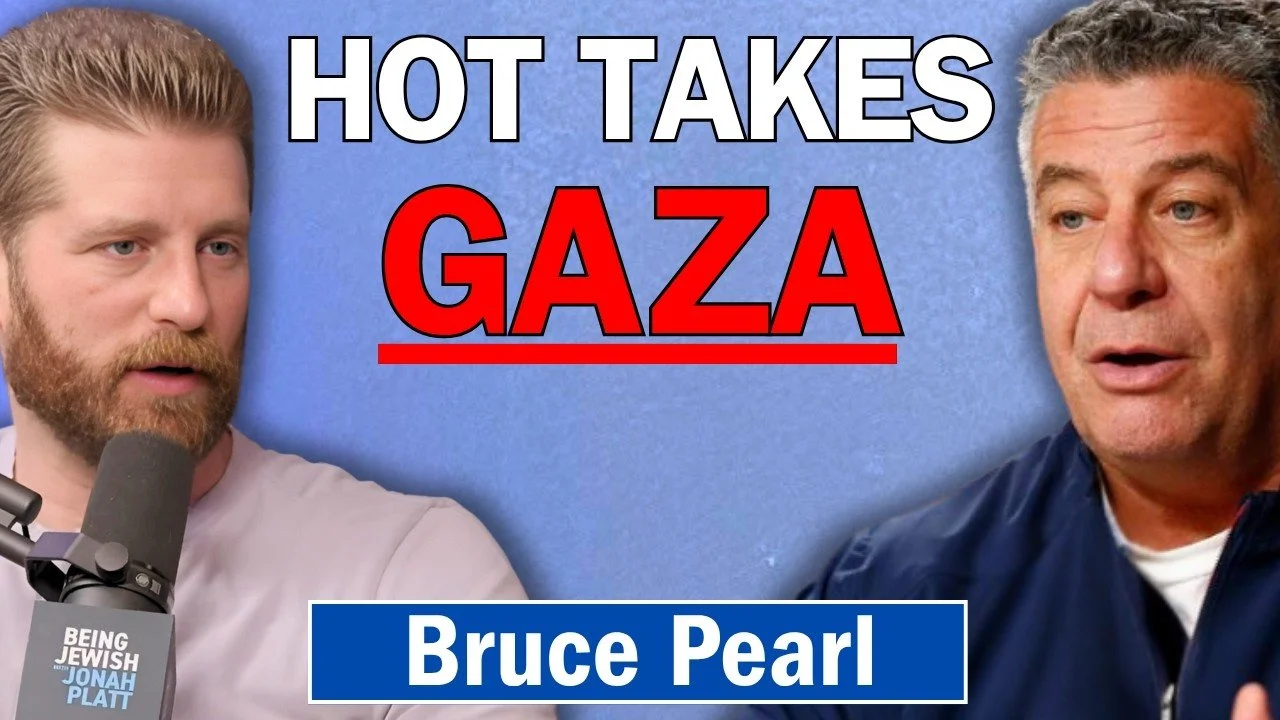
NCAA Jewish Coach Bruce Pearl on Israel & Gaza, College Campus Antisemitism , Jews in the Final Four
Watch and Listen
Hasidic rabbis can get off a plane in UAE and they can walk around the United Arab ants with no fear.
You can't do that right now in Brooklyn.
If in your mind the prescription is not a two-state solution, do you have a prescription of what should be?
He thinks he just freed Palestine because he mowed down two innocence.
Do you know who Alabama's two favorite shoes are?
You and Jesus.
My guest today is an honest to God trailblazer, not a Portland trailblazer.
He is actually an Auburn tiger, but a man who has carved a path through a profession where Jewish leaders are rare and a proud, outspoken ones non-existent before he came along.
He's been a winner at every level, turning around one college basketball program after another, leaving a legacy of excellence and a little controversy in his wake.
He's coached at four universities, has four kids, and just took his squad to their second final four.
Please welcome the coach with Kavanaugh Bruce Pearl.
It's great to be here.
Oh man.
So you, you just finished a, a big successful season.
Any, any days off since then?
Have you had a second to catch your breath?
I took pa a day off at Passover one day.
Okay.
I've taken three days off.
But listen, um, I've got a roster re to rebuild and, uh, as soon as I get that roster rebuilt, uh, we'll take, we'll take a few days off.
Three days.
Good for you, coach.
Um.
Unmitigated success.
As I said, you know, you guys were number one for a big chunk of the season.
You won the SEC regular season, Maui Invitational, second, final four.
How, how are you feeling?
Well, you know, it's, it's funny, during the season you get asked a lot of times to reflect on how you're doing, and then you don't really wanna do it 'cause you're still in the middle of it.
So, sure it's not over.
It's not a time to reflect.
And then as soon as it gets over.
Guys that are going, I got five or six guys that are trying to get in the NBA and professional teams to talk to and agents and everything there, and I gotta replace my whole roster.
The time will come at some point, maybe at some point this summer when my wife and I are out on the boat and the sun is going down and maybe we'll have some music on and.
We'll, uh, we'll thank God for the blessings and we'll enjoy, but you know, you look back at kids that have graduated or great teams and championship teams and it'll mean a lot to me years from now, as much as it means, you know, right now.
Beautiful.
One of the most notable accomplishments of this season, at least for the Jewish community, was the way that you were so outspoken about the situation with the hostages, especially Edon Alexander, who miraculously thank God is now home.
What was that moment like for you, seeing, seeing that happen finally, what you've been pushing for and praying for?
I'd like to tell the whole story because, um, please, please.
You know, I'm, I'm obviously an advocate, uh, for Israel and, and, and we will talk about that.
Mm-hmm.
A lot.
The game is over at Repina.
We've just beaten Creighton, a team that had been to four, the last five Sweet sixteens.
We go into that game, we're not playing great.
Um, and we really got a chance to get beat.
And we play great and we win the game and there's a real chance to go to the Final Four.
So I'm happy and I'm walking through the halls of Repina, getting ready to go to the press conference, and I'm just thanking God and I'm just like, God really?
Man.
I mean, thank you.
I mean, I'm calling God like I got my shirt on, and I don't know.
He spoke to me and he said, look, remember who you are.
Remember where you're from.
Remember what your Hebrew name is, HAI.
And of course, you know the story of Purim and Queen Esther.
Mm-hmm.
Or Uncle Mordecai had a speak into the Queen so that she would speak to the king.
That so Haman wouldn't get his wish.
And have the very first Holocaust or one of the first Holocaust of the Jews.
Yeah.
And fortunately she did.
And so I've always been willing to speak up and my papa taught me that's, that's why he named me.
Wow.
So I said to the guys, I'm walking with Janai Broom and Denver Jones and to Hot Ped.
I said, guys, listen, you guys know, you know what an advocate I am for Israel.
I gotta tell you what just happened.
I, the name Eon Alexander just came into my heart, came into my mind.
I said to my sports information director, he said, do me a favor.
I wanna make sure I got this right.
I think he's the only American held hostage.
In other words.
I wasn't even sure that that was correct, but I said, and she's like, coach, we're going to a press conference.
Talk about the Sweet 16.
I said, look up the only American still held hostage.
Find it.
Google.
Go Google it.
Boom.
Eon Alexander.
I said, all right, that's a sign I'm doing it.
I said, guys, I don't wanna take anything away from our moment, your moment, but this is what just come happened.
We got American held hostage.
I wanna start our press conference with it.
They're like, coach, absolutely, 100%.
To give you an opportunity, just start this pref conference really briefly and remind the world that Eden Alexander is still held hostage in Gaza right now.
And then Tahad says, coach that kid's from Jersey, well, tahad ISS from Jersey City, New Jersey.
So he even knew where the young man was from.
That's amazing.
And sure enough, we did it.
And of course, you know, it got a lot of attention.
It meant a lot to Aidan's family.
I heard from his father.
I heard from his family the next weekend.
They joined us in Atlanta for the Sweet 16.
I asked his father if he would speak to our team and he did, uh, the day of the Michigan game.
Can you tell me about that for a moment?
Can you tell me what he said?
My son was your age.
Mm-hmm.
My son was 18 years old.
He just graduated from high school and he said to me, dad, you know what I wanna do?
I just, before I get started on the rest of my life, I just wanna go to Israel.
I wanna join the IDF and serve Israel for a little while before I get started on everything else.
And so it sort of hit home with my guys going, look, my son made a choice before he had a chance to go play basketball at Auburn, for example, to go do this right?
And this is what happened to him and this is what we're praying for.
And um, and I mean, it was, it's just, it was very, very sweet.
And our guys obviously.
Were heartfelt for what this father and Aidan's brother Roy were going through.
And um, it just made us all be grateful for the position that we're, that we're in.
I heard from people in Israel, I heard from the president of Israel, I heard from Prime Minister Netanyahu.
Their heart breaks when they see Americans, particularly Americans.
They're used to Canada.
They're used to Great Britain.
They're used to France already.
They ain't worried about that 'cause they're used to it by now.
But when the United States of America and college students and different people celebrate Hamas and the atrocities, it just breaks their heart and I make sure they understand.
Mr.
Prime Minister and Mr.
President.
They are the loud minority.
Hmm.
America has your back.
Now jumping ahead to Iain's release, like where were you in that moment?
Did you connect with them at all?
What did that feel like?
We were really worried that after the final four, when there seemed like it was gonna be any day now, um, it got quiet again.
Yeah.
For about three or four weeks.
Right.
And there was some word out there that.
He may not still be alive.
And, um, I did know that there was a lot of talk before President Trump was traveling to the Middle East, that they were working on trying to do something big prior to his trip or maybe right after his trip, sort of as a reward for the president trumping there.
And at least having dialogue, uh, with, with, with some of the people in Saudi, United Arab Emirates mm-hmm.
Or Qatar.
And, uh, you know, sure enough, uh, it happened.
We'll take one.
Family and one victory at a time.
We'll, we'll take it.
When you spoke out, it is so commendable, and I'm sure you've heard it a lot, but it, it really is because that was a time, first of all, it was a time where the, the world had gotten very quiet about the hostages in general, and you arguably had the largest platform of any Jew sort of speaking about them in any professional level.
You know, you had the final, the sweet 16 cameras pointed at you when the whole nation, people who are not thinking about this at all, are watching.
And you took that opportunity.
And I'm curious, you know, the conversation you had with your players, you sort of like, yeah, of course they were cool that we brought, you know, and you moved through it, which is amazing.
I just want to dig into that a little bit.
You know, I had no idea how much that aspect of this story spoke to people that.
First of all that I would ask the players their permission before I would talk about it, but then the response that the players had for me, um, knowing.
You know how much I love this country and knowing that it bothers me that American has held hostage while we're, while we're celebrating.
And you know what reminds me of, and I hadn't thought about this, um, it's very, that's very Jewish, by the way.
Um, you know, when we have a wedding Yeah.
We're celebrating, we're happy.
We are dancing, we're singing, we're putting the, putting our parents up on chairs.
And yet when we get married.
One of the traditions is to break the glass.
Mm-hmm.
What's that all about?
Well, it's to remind us that even, even our happiest moments, the second temple was destroyed.
In Jerusalem.
Yep.
That is so Jewish that in the midst of a celebration that you would think of something, you know, either tragic or sad, and you know what?
That's what was for me.
Hmm.
I think that's why God spoke to me, because he is like, all right, I know you're happy and I know you're dancing and I know you're singing and I know you're like going down the yellow brick road like Dorothy would be right now, but I Don is in a cave.
He is in a tunnel.
He doesn't know when his next meal's gonna be or when he is gonna be beaten next, or whether or not he's ever gonna see his family.
Why does that happen?
How does that come to you?
And it came to me and, and the only reason why, now I look back at it, why it was, I guess, meaningful and I don't like getting thankful for it because these are the things that we're supposed to do.
But totally, I did speak to an audience.
Following college basketball that may not even know we had an American held hostage in Gaza.
And that's the thing about it is, you know, we assume because you and I maybe follow the news and this is something that we're interested in and you're, you know, you've got your podcast and you've got your voice and thank God for you and your voice and your messaging.
Um, but many people are just busy in life and doing other things.
I'd say the most, that's probably the majority to me, that might, may have had some significance.
What was the reaction from all of that, from, from the people around you?
Not your players, but you know, the other colleagues, the other teams, uh, you know, people like that who are in your circle.
The reaction that I would care most about was certainly the reaction that I got, uh, from American Jewry or for the folks in Israel or, or Patriots, uh, in this cadet love our country.
Um.
And, and very importantly the the people here at Auburn.
Um, in the sense that this was their moment also.
And I just don't think I took away from their moment.
I think I added to their moment.
I think they were happy and proud and willing to share.
Auburn's, great moment with, um.
You know, with something that was, um, that was, that mattered some, some something of the kingdom, something bigger than just basketball.
So, uh, the reason why I get upset about that is I'm grateful for that.
I'm just so grateful that that's the, how the vast majority of our Auburns fan fans felt.
And so, you know, when it, when a Don was released.
It just, it, it made more of a celebration even for, for, for the Auburn family.
That's beautiful.
I'm, I'm so glad you felt you had that support.
I did.
You were coaching in the Final Four, along with two other Jewish coaches, Todd Golden and John Shire.
I.
Which is an amazing milestone to have three of the four coaches in this major tournament at this stage be Jews.
I mean, what?
What does that say about where Jews are in America today?
You have three Jewish basketball coaches.
Get to the final four.
Don't tell me this isn't the greatest country in the world.
Don't tell me this is not an opportunity for everybody.
There are going to be obstacles.
For every one of us, there were obstacles for you.
There are gonna be obstacles for my young players to have success or happiness or whatever it may be, but they're not roadblocks.
There are not roadblocks.
And so I've got a group of African American young men that sometimes may have been taught or believed, well, I can't do it because my forefathers, and they couldn't do it.
Say, you know what, no, these are obstacles not Roblox.
If, if three Jewish basketball coaches can get to the final four and, and whether it's not easy 'cause there aren't that many of us, or you know, the different challenges that we're faced with antisemitism or, or things along those lines.
It, it obviously can happen.
It, it also talks a little bit about the Jewish history.
In the game of basketball in the sense that, you know, some of the best early NBA players, uh, you know, were Jewish because the game was played best in the ghettos.
And that's where we lived.
We didn't play baseball very early on because, you know, we, we didn't live out in the, in the parks, in the fields.
We grew up in a, in, in the city.
You put up, you got a ball and you put up.
Basket on a, on a, on a pole and, and, and you start playing.
So the Jewish people have always had a, a little bit more of a close connection, uh, to basketball than some of the other major sports.
Now, Hank Greenberg and Sandy Koufax might take issue with that.
Right.
But I generally speak, I actually, I love hearing that because I, I have always known and felt the, the deep connection between Jews and hoops.
It's like a thing.
It's, it's so interesting to hear it placed in history in that way and that it's sort of in the DNA for us, and I, I had never heard it framed that way, so I love that.
I'm very proud of being Jewish.
So let's go into that family and Jewish and identity.
Your grandfather came to America in the twenties before the Holocaust, fleeing from the pogroms.
But I've also heard you talk about how much of a mark the Holocaust left on your family, even though they were already in America.
Can you, can you tell me about that?
Papa came here when he was 11 years old in 1929, and uh, he came from, he left Turnal, which was sort of Ukraine, Russia, um, Austria.
Back in the day.
Mm-hmm.
He wanted me to know that this country saved our family's life, um, by being able to immigrate here.
Yeah.
And then when Papa turned 32, 22 years after he came to America, he became a United States citizen.
And he told me that was the happiest day in his life.
And so he taught me to love our country, to be grateful for our country, but also, um, to cherish our ancestral Jewish homeland.
And, um, you know, I'll never forget and, you know, you know, papa loving Israel and, and, uh.
Part of his love for Israel was that he was always sad that Israel wasn't born till 1948 because he felt like maybe if in 1929 it was there more of his family could have afforded to flee the Paul Grms and eventually the Holocaust.
Sure.
And, uh, he'd have more aunts and uncles and, and, and cousins.
Now clearly, your, your grandfather had such an enormous impact on you and the man that you've become.
What, what kind of impact are you trying to have on your grandkids?
I.
Wow.
That's a great question.
That's a great, that's something I've actually been thinking about lately.
My grandfather worked really hard.
He was a plumber and he worked, he worked, uh, six days a week.
He had, he kept Sabbath.
Mm.
He kept Shabbat and he was also went to temple the mornings and wrapped a fill in almost, almost, almost every morning.
Wow.
And he worked every Sunday, but he made time for me.
He made time for me to, to, so I could get to know him and love him.
And it was always something that I dreamed of doing.
Um, was getting to be 13, uh, 'cause I couldn't go to Temple with him in the mornings.
I wasn't old enough, or at least the Orthodox temple that he went to.
And I had to be bar mitzvahed in order to be able to do that.
And I got about six months of Papa and Tefillin.
Uh, before he died.
He died very young.
He was 63.
I was 13.
That's very young.
You talk about my being Jewish.
I, I think it's wonderful that we're, that, that people come in all different shapes and sizes and there are Jews that are observant.
There are Jews that aren't observant.
There are Jews that are conservative or orthodox in reform.
But at the same time, I think because I identify so much with my faith, um, I think that foundation of religious school.
Of being bar mitzvah, of knowing that my grandparents kept kosher and, and, and I had a role model.
It, it really helped give me a foundation.
It, it, it got me started at a younger age and I do worry, and I'm not passing judgment.
I'm not, but I think like for example, Amer American Jewry, I think we need to wake up.
Um, we gotta wake up because you could say to yourself, well, I don't really practice, and you know, I don't, you know, I just, I just, you know, I don't always wear my star out or my high, you know, but, but as a grandfather and as a father, I think it's important.
My four children have all been Bar Mitzvah.
Mm-hmm.
My four children have got great, great pride in their faith.
Some practice better than others.
Um, and I'd like them all too.
Be able to have a strong foundation for their children and to identify with their children.
Um, I've got, uh, two children that are married to Christians and I honestly have no problem how they raise their children.
That may be a little bit of a shock to some people, but I want them to have faith one way or the other.
I want them to raise Jewish, or I want them to be raised Christian.
I want 'em to go to church.
I want 'em to go to Temple, but I also want them to know who their Jewish father or mother is.
And I think we can still remain and keep the faith.
Um.
And that's a kind of a, that's a, that's, that's, that's, that's probably more information that you wanted to know or that you wanted to ask, but we want it all.
Bruce, I feel strongly that faith and family has gotta be a part of it.
And so I said, look, if you don't wanna take him to Temple, you better start taking 'em to church.
You gotta get him connected to God.
'cause it's the same God.
And I'm grateful that all my children have absolutely 100% maintained their Jewish identity.
That's great.
What is it more for you?
'cause up until now, the.
Strong piece of the, of the Jewish connection seemed to have been more of the like the family, the peoplehood, the, the lineage.
And now you're talking about how important the sort of religious faith, God theological side of it is.
Are they both equally weighted for you?
Has it changed over your lifetime?
Again, I just go back to, I was so lucky.
I mean, I remember Passover and I remember.
Incredible Seders, where we had tables and chairs downstairs in the basement and, and, and, and dozens of people and relatives and cousins and, and the door staying open for Elijah to come.
The mishigas with, with keeping kosher and the dishes, these dishes for this and that for that, and covering the bread and doing all the, and all these different traditions.
But it was all based on family.
All that practice was done with family.
And that's what makes one of the things about us being Jewish, I think.
So very, very, very special.
Yep.
God chose Abraham.
By the way, Abraham is my favorite Jew.
Why?
Because he had faith.
He had faith.
And while I'd like to kill my son sometimes he was willing to sacrifice Isaac because God told him to.
And that kind of faith to, you know, um.
To, to pick up and, and leave his home and, and go to where God told him he was gonna go.
He loved Ishma Ale and Isaac.
Now, I wasn't thrilled with what he did with Ishmael 'cause it kind of set us up to fail.
But I remember reading the fact that he loved him and he said he would make a great, he, they would make a great nation of him also.
And so as a coach, what I'm always trying to do is bring people together and find things that we have in common.
Um.
I'm, I, I'm not naive at all, and I understand that they're a part of Ishmael's family that want to kill me for being Jewish.
I get it.
They say it, they chant it from the river, Tennessee, and they've done it.
Some of Ishmael's family recognize that Isaac was his brother.
Yeah.
And that Abraham was their father.
And to me, I said, guess what, Ishka, whether you like it or not, we are.
And so can't we choose to recognize that our father loved both of us and, and promised to make a great nation of both of us and go from there.
You're speaking my language coach.
Um, and, and speaking of sort of bringing different cultures together, you, you grew up in Massachusetts.
Now you have become basically exclusively a coach in the American South.
Were there a lot of Jews in, in Sharon where you grew up there were there actually were.
By the way, there's more antisemitism where there are more Jews.
Not many Jews.
There's not much antisemitism.
I.
You know, uh, and our, and our universities and colleges, we got no antisemitism here in Auburn.
We've got a wonderful small Jewish community, but there aren't enough of us that we don't make enough noise where nobody really worries about us.
But you go to big, bigger schools where there's larger Jewish populations, that's where we're targeted and that's where there's tremendous amount of antisemitism.
And so, no, um, I, I, I love and I thank God every day.
For our Evangelical Christian friends.
Sure.
And again, this is something that always bothered me about religion.
Um, it, it sort of has set us up all to fail.
While I was never comfortable with the chosen people aspect of things, I wasn't thrilled that Jesus was telling his disciples, look, the only way to get there is through me.
Right?
And that kind of made it difficult for me and you and many of our other Jewish, uh, brothers and sisters.
And so someday, hopefully when I get that to heaven, I can ask him why, why he set that up.
But.
Again, keep in mind I'm a coach and my job is to bring people together.
I didn't go to Hebrew school and learn that Jesus was born Jewish.
I didn't go to Hebrew school and learn that he was a rabbi.
I.
And a, and a pretty good one.
I I, he lived his whole life in Israel.
Right, right.
Well, guess what?
My Christian friends, many of the, well, first cer certainly in Boston, in the, in the east, where Catholicism was much, much more prevalent than Christianity.
They weren't going to church or, or five o'clock mass learning about much about Jesus and, and Israel and the Jewish people.
But you, you are in the evangelical south.
Okay, you are.
'cause they're reading from the Old Testament that connects us and, and our Christian family and friends are standing with Israel because they're commanded to and I am grateful for them.
In what ways have you and this community like.
Culturally exchanged with one another in your, in your years in Auburn, I imagine there's some, some fun ways that, that has, has manifested, you know, but one fun way to do this, I, I say to my Christian friends, I said, uh, what time's your Passover Seder?
And they're like, what?
Well, what time's your Seder first not a Passover?
Is, uh, is tomorrow night?
Well, we're not having a Seder.
I'm like, well, why not?
Jesus had a Seder every, every year of his life.
And, and I thought, you told me you were trying to be more like Jesus, right?
Oh, the Jew is supposed to have the Seder, which is what Jesus celebrated every year of his life.
Oh, I get it.
Okay.
But I'm not trying to be more like Jesus, I thought you were.
And I have fun with it that way.
Mm-hmm.
And, and, and, and you know, the other thing that we do is we will have Passover Seder, but we'll also connect the Passover Seder with the Last Supper, because that's what it was, right.
So we will invite Christians over to our Seder and we'll connect the two for them.
Or we'll celebrate Sukkot and, and, and, and, and, and, and that festival, a festival that Jesus celebrated every year of his life.
And we'll connect the two for our Christian face without, without dummying down what we're doing, but we want them to be a part of it.
Are you, for a lot of the people around there, the first Jew that they're meeting.
No, I'm not the first through there at the meeting.
But here's the deal, since I've had so much success coaching basketball at Auburn, do you know who Alabama's two favorite Jews are you and Jesus?
Huh?
Hey, you're in rarefied air.
I'm in.
I'm in.
Good.
I'm in really good company.
Um, no, not really.
Here's the deal.
Um, because of the cotton industry, in part because of the cotton industry, um, there were a lot of.
Jews that were involved in clothing, the people that that were here and the state of Alabama got some exposure to the Jewish people, maybe long before many others did.
Do you know, in 1943 by a unanimous vote, the Alabama state legislature, the Republicans and Democrats unanimously voted in 1943 that the Jew and proclaimed and had a proclamation that the Jewish people should have a.
Nation of their own in the land of Israel, Alabama for the win, Alabama for the win.
Let's talk a little bit about you as a coach.
I was so interested to learn that you didn't play high school or college ball yourself.
How did you learn the game and how did you learn to love the game?
I'm 15 years old.
I'm the best athlete in town.
I'm the first kid picked, I'm bat and forth.
I'm pitching, I'm I'm, I'm taking most of the shots and I was an asshole.
I was, I was not a nice kid.
And guess what?
God said, we ain't having this, this ain't going down.
I got a career, almost a career knee injury in a football game and, um, never, ever, ever regained the ability to be able to compete again.
Wow.
And I gotta tell you, it was painful.
I'm sure kids were cruel, kids were mean.
Some of my best friends were just glad to see me cut back down to size.
We're, we're a resilient people the most, and so you know what I did?
I became a class president.
I got involved in a school musical and I learned that those kids that I made fun of, man, they were awesome.
They were smart.
They were funny.
Band.
Band kids are the best man.
They're the best and, and it made me a better person.
God did that for a reason.
Absolutely did that for a reason.
Now, I never lost.
My passion for the game, my love for the game, or my feel for the game.
I obviously had that and it was God's plan, obviously for me to be in coaching.
I didn't know it at the time.
Wow.
It takes a certain kind of leader and mentor.
I.
To be successful, specifically at the college level because it's not just about basketball smarts.
It's about how are you organizing these young men and and mentoring them and leading them.
What do you think it is that makes you so successful in that way?
Like, what, what are you doing that other coaches aren't doing?
Look, my management style is not to know it all.
It's not my job to make every right decision.
Now listen, I can help us win games.
We run better offense, I have better sets.
We do a good job defensively.
It's not my job to make every right decision, but it's the player's job to make my decisions work.
And so.
Whether it be through leadership, putting people in positions to be successful and raising the bar, like no man rises to low expectations.
So my job is to raise the level of the expectations that my players have for themselves to get them to focus on the positives.
I wanna build confidence.
There's no better way of building confidence than to preparing.
The more you prepare, the more confident you'll be.
I say that all the time in the, uh, in the performing arts world, when people ask, you know, aren't you nervous before you go on stage?
And I go, well, if I've done all the work, why would I be nervous?
Correct.
If you've studied for an exam, if you've listened in class, if you've asked questions, when you didn't understand, you're gonna go in that game confident.
I wanna go to Kentucky and I want at Repina to Kentucky.
Look down the other and go, what in the world is Auburn so confident about?
We're confident.
Because we're prepared.
Yeah.
Now I really think being Jewish has helped me in coaching as a teacher.
Um, 'cause I mean, I think, look, rabbi Rabbis teach, that's what they do.
And we work hard, we work hard, get educated, we work hard to save, we work hard to teach our children, we work hard to have these values.
And these are some of the reasons why the Jewish people should be proud.
And, and, and have been, you know, Nobel Prize peace winners or accomplished so many different things.
We've earned it.
Mm-hmm.
None of this was given to us.
God put us in a position and you know what?
Every day, every day, all I want to do is take advantage of the blessings God's given us.
I go to work every day trying to earn this, earn the blessings that God's given us and, and, and, and that.
Something that I think is, you talk about being Jewish.
I think that's, I think that's in us.
I love that.
I, I I, I love the, the humility and the, and the recognition and the gratitude in that.
I think that's something everybody can learn from, and I understand this.
If I don't win, I'm not gonna keep my job.
If and if I don't win, they're not gonna put up with me being on these podcasts or talking about Israel or talking about antisemitism.
Mm.
They're like, look, shut up and coach.
Shut up and recruit.
And trust me, if you look at my social media and you go to Coach Bruce Pearl, and you follow me on x.
Half of the comments after I post something about Israel or antisemitism, or not having, letting Orion get a nuclear weapon or, or allowing Israel to finish the job and destroy Hamas, half of it is negative and attacks on me or just shut up.
And you're not, you're not an expert on this, and I don't proclaim to be an expert on this, but here's the deal.
The rea, one of the reasons why I do it, it's really simple.
What is your Middle Eastern studies courts teaching you in high school?
Oh, you don't have one.
So then let's go on social media and let's read the lies and the propaganda in the back of their minds, they think, well, maybe they're right.
Maybe maybe the Jews did steal the land.
Maybe they did run them outta their home.
I don't know, may Well, that's 'cause you've never been taught, and so you're listening to the loudest voices, who's a very, very loud minority.
Let's talk about genocide for a second.
Can we talk about genocide?
Yeah.
If I thought there was a genocide going on, so I'd be against it.
But you know what?
There's a genocide going on in Sudan right now.
There's a genocide going on in China.
There's a genocide going on in, in, in many, many parts of Africa.
But since the Jews aren't the one killing them, nobody's talking about it, right?
So you wanna talk about it.
Apartheid 50% of the medical industry in Israel, doctors, nurses, caregivers.
Are not Jewish.
In Israel.
You've got government leaders, you've got judges, you've got people in every industry, in every walk of life.
The Arabs that are living in Israel that don't own oil fields or aren't in government are living the best lives of any Arab population anywhere else in the Middle East.
And that doesn't get talked about.
It just doesn't.
Yeah.
So forget about apartheid and forget about genocide and let's do one more thing.
Let's stop talking about a Palestinian state.
Let's stop talking about two states.
There aren't two states.
There are 22 states, 22 Arab states.
There's only one Jewish state, and yes, back in 1948 when the powers that be decided.
All right, fine.
England is outta here.
France is outta here.
You guys are crazy.
We're just gonna go ahead and divide this thing up.
You know Jews, you get the swap land, Arabs, you get the, the, the, the, the mountainous land.
Um, and we're just gonna carve this thing up.
The Jews said, that's awful, but you know what?
We'll take it.
You know?
Yeah.
And the Arab said, you know what?
We want it all from the river to the sea.
Since, since before the state of Israel is born, it was a segment of that population that simply would not live next to a Jew period.
And so they try to kick us outta the land.
They try to scare us outta the land and they've tried to kill us outta the land and they still are to this day.
So.
Stop with a two-state solution.
We tried that.
In 2005, Israel pulled 10,000 Jewish people who were living in wonderful homes in the northern pot of the Gaza, had jobs, had incredible greenhouses, and it was, uh, amazing for lemons and for to tulips and roses and a great agricultural area.
They ripped them outta their homes.
They.
Took their synagogues in a tous.
They even had to dig up the graves of their dead and they took 'em back and gave it all back to Gaza.
In the hopes of what?
Land for peace that maybe just, maybe if we can give them their own place and leave, maybe they'll just be living next door to us.
Peace.
Well, guess what?
Within two years they turned it into a terrorist state, and it's been that way ever since.
And so there cannot be another state.
Where do they want that state to be?
They want that state to be in Judean, Samaria.
I will not say West Bank only.
Now in describing that it is Judean Samaria.
That's how it's referred to in the Bible.
That's how I will always refer to it.
80% of the Bible comes from and was written and the stories about places that were ju and Samaria.
Hebron.
Mm-hmm.
Sheila, all these different That's right there.
The cave of the patriarchs.
Yeah.
Where, where, where, where Abraham is buried.
And so listen, if there was a Palestinian state, where would the capital be?
Where do they want the capital They want it to be in East Jerusalem.
Well, in East Jerusalem, there's the Gardner Gsem, there's Mount Mariah, there's the Temple Mount, which, oh, by the way, the temple Mount, that's Mount Mariah, where Abraham took Isaac up to be sacrificed.
Do you know how many Jews would be able to be there if that was the Capital Zero?
Yeah.
None because we would be killed in a Palestinian state or Palestinian capital.
It makes no sense.
And yet the day after October 7th, you've got kids in college campuses or people in this country, some more supporting Hamas.
It's because they're either been completely and totally misinformed, which I think is partly the case.
Oh yeah.
Big time.
Or they're antisemitic.
So now the answer, are we gonna teach it in high schools?
Are the universities gonna start teaching Middle Eastern studies and teaching the truth about biblically historically and accurately right now?
What's going on?
And the answer is no.
They're not gonna do it.
They wanna stay institutionally neutral.
I'm curious if, if in your mind, the, the prescription is not a two state solution.
Do you have a prescription of what should be Yes.
What the future should look like?
Yes.
Yeah, I'd love to hear it.
I have been to Judea and Samaria.
Seven or eight times I have met with Palestinian leaders and, and talked to them about their history and their angst.
Here's what's, here's what kind of needs to happen.
I don't know whether you do it one community at a time, whether you take Jericho or whether you take Ariel or you take HEB Brown and you just find a way to make that area make HEB Brown.
Great.
Again, that's my line.
Make HEB Brown great again in.
And find a way to make those communities in Juda and Samaria better for everybody.
If you don't wanna stay there and live in a Jewish state, you don't have to.
The 2 million Israeli Arabs that are living there, they don't have to live in Israel.
It's a free country.
They could leave if they want to.
They don't wanna leave.
Life is better for them there.
And so I say to the people, there, you are welcome to stay in your homes for as long as you want.
But this whole.
Murdering Jews and this whole, you know, getting it all back and the nakba that's gone, that's out.
That ship sailed.
That's not happening.
We just gotta enforce the laws and reeducate and over a period of time, through peace, through prosperity, one community at a time.
Uh, 'cause Hamas isn't working and Hamas right now.
If Hamas had an election right now in the communities of Ramallah.
Bethlehem or some of those communities in Judean, Samaria, Hamas would win.
Yeah.
Right now that's what the Jews are living next to.
Is that hard to hear?
I'm sorry.
It's hard to hear.
It's just the truth.
It's just the truth.
Is that a truth that you've seen up close and personal via your, your visits to the region and and conversations you've had?
Yes, 100%.
Mm, 100%.
And again, speaking to different Palestinian leaders, they.
They know how corrupt the Palestinian authority is.
Um, and they don't trust them, and they shouldn't trust them.
They know how vicious Islamic Jihad is.
Mm-hmm.
Just like Golden Maier said, when the Arabs finally recognize or believe that they love their children more than they hate the Jews, there's an opportunity there.
That's what's happened in United Arab Emirates.
Hasidic rabbis can get off a plane in UAE and they can walk around in the United Arab ants with no fear of being assaulted.
Yeah.
You can't do that right now in Brooklyn.
That's happening in Saudi Arabia.
I hope that there can be the next country in the Abraham Accords.
Yeah.
Cutter has gotta, has gotta knock it off.
Cutter's gotta decide what they wanna do.
They're playing both ends against the middle.
Alright.
And if President Trump wants to bring them into the world of what is normal, they got some choices to make.
They can't keep funding the terrorism.
Okay.
And funding the atrocities.
Qatar is responsible.
As responsible for Iran about October 7th.
They're as responsible.
They funded it.
Coach May 21st.
I, I thought this was fascinating when I saw this.
On May 21st, you speak at a, a Breakfast for Jewish American Heritage Month in Washington DC, uh, about waking up to the threat against Jews, as you say, and you say, quote, we've gotta protect ourselves from those people that want to kill us.
That very night in Washington, DC.
Jerone Lashinsky and Sarah Milgram are gunned down outside the Jewish museum in the same city by someone yelling free Palestine.
What, what, what was your reaction when you heard this hours after saying what you said and, and what do you wanna say also to, to people watching this who are taking in this tragedy and, and just sort of looking for some message out of here.
I wish it was somebody that was my age.
Um.
Even, even myself, um, these are young kids.
I've had the joy of a, a beautiful marriage and a beautiful wife.
I've had the joy of four incredible kids.
I've had joy of amazing grandchildren.
I wanna be along, I wanna be around longer to, to see them and love them and, and joy my older years.
But these kids were just getting started.
Yeah.
And they were beautiful and they were brilliant and they were kind.
They got mowed down because of the indoctrination of the lies and because of, quite frankly, the media.
Mm-hmm.
If NBC is gonna air stories that did you know that if we don't get humanitarian aid into Gaza right away, 14,000 babies are gonna die?
Well, I don't want 14,000 babies to die.
To die.
Jonah, do you?
Of course not.
No.
What can we do about it?
What, what?
That's a, that's a a, that's a shunda.
It's just, it's not true.
Right?
You see, it's just not true.
But people don't know that.
And I don't know what this guy's ideology was.
I don't know.
Was he, he thinks he just freed Palestine because he mowed down.
Two innocence, believe it or not.
I'm hopeful.
That was, that was a, a nice, a nice pivot in the wind sprint.
There I am.
I swear.
Um, I'm hopeful because the Jewish people we're not gonna hate, believe it or not.
I don't, I don't hate 'em.
I don't They've been misinformed.
Yeah, they've been led poorly.
Israel is sick and tired of waiting on the next attack.
Yeah.
We're sick of it.
We're over it and we're not apologizing for it, and I don't care what the rest of the world thinks.
How about France?
How about Canada and how about the United Kingdom?
What a bunch of pussies.
Yeah.
Are you kidding me?
You're gonna tell Israel to stand down?
Oh.
Did anybody tell the United States of America or George Patton to stand down or the Russian armies to stand down when we were in there saving your ass.
So get Hitler.
How many thousands of American boys died over on another continent?
Try to save you.
And the only reason why Nazi Germany was defeated is because United States got into the war.
Mm-hmm.
And we defeated Hitler and Hamas must be defeated.
'cause guess what?
It's the only thing that certain elements of the world understand.
The world is gonna hate us in some ways, whether we do it or not.
Yeah, so we might as well just go ahead and do it 'cause it's God bless the right thing to do.
They're trying to prosecute a war and, and save as many innocents as they possibly can.
But these, these cowards hide in hospitals.
They hide underneath their civilian population.
Israel's gonna finish this war.
Usually I like to end my show with something like a lightning round or like a little game.
So I, I'm, I'm not good at it.
I'm really bad at that lightning.
I, no, I got a different one for you.
I'm gonna call this one Pearls of wisdom.
Alright, it's halftime.
Your team is down by 20.
What do you tell them to motivate them?
I said, you know what, we're actually in pretty good shape right now.
You know why?
We should be down 30.
We're lucky to be down 20.
Let's win these first four minutes.
Okay?
Let's win these first four minutes at that first TV timeout.
Let's see if we can cut this deficit.
Let's get, let's shave eight points off it.
Let's get two or three stops.
Let's go and, and let's compartmentalize.
Hey, man, we're in great shape.
We're in great shape.
We didn't rebound, you know, we didn't, we didn't check out.
We, we couldn't make a shot.
Hey, man, we're lucky.
We're only down 20.
Nice.
Okay.
It's the fourth quarter.
Your team is up two points and there's 30 seconds left.
What do you tell 'em with 30 seconds left to going the game?
They're probably in a bonus.
And so we want play aggressively without fouling.
Uh, we don't wanna make, we wanna make sure we don't give 'em a second shot.
'cause oftentimes late in the game, it's that second shot that's matters.
And let's figure out what the best defense to call.
And then let's get that.
Let's get out and let's go.
Like, let's just not let 'em get it and foul us.
Let's get the rebound.
Let's get out and go.
Let's get down the floor, see if we can get an easy one and end this game.
Oof.
I wanna like get up and go run onto the court right now.
Um, alright.
One of your players is spotted at an anti-Israel encampment.
What do you say that the next time you're able to have a conversation with that player?
I probably would bring him in and find out if he knew where he was.
Uh, if he realized that he was, uh, in, in that sort of a situation.
Um, and if he, and, and, and I would ask him if he had any questions or what his thoughts were, I'd like to know what his thinking is.
Um, I actually am pretty excited.
I've, I've actually coaching, uh, uh, Abdul Bashir this year.
Abdul's coming to me from Omaha, Nebraska, and we are clearly of different faiths and, um.
And I am going to, one of the things I'm done is, uh, we don't have a very large, uh, Muslim population here.
Um, but we obviously pray differently.
I'm really looking forward to understanding how he prays.
I'm gonna try to provide as, as comfortable I.
And, and, and, and is nice in an environment for him to grow in his faith.
I'd like to learn more about it.
And I think he has, he is also knows, he's playing for a Jewish basketball coach mm-hmm.
Who's very vocal on, uh, you know, on my social media PAC form, calling out Islamic extremism.
He's gonna be my, my Ishmael and my son, maybe my Isaac.
And I'm gonna be as Abraham.
Nice and, and Abraham loved them both.
What is the biggest internal issue the Jewish community needs to work on in itself?
What bothers me is we're not educating our children.
That's what bothers me, that we're not putting up enough fight at these colleges and universities.
They're taking all this money from Qatar and all this money from some of these other countries, and they've flooded our educational system.
Yep.
Education.
Honestly, education and how we live our lives.
The, those are the most important things and how we live our lives.
If we don't practice our faith, it's, it's pretty difficult to, to to live our life as juice.
Coach, thank you so much for taking the time and for being so open and raw and honest with us.
We really appreciate it getting to get inside the mind of the master and, uh, wish you all the best with everything.
Amazing summer, good recruitment, good roster build, and, uh, and awesome next season, Jonah.
Thank you.
And thank you for the work that you do.
And listen, just because I got these words and I'm passionate about it, don't make me right.
I, I understand that.
So I apologize.
Um, forgive me.
Offer me grace for the things that I got wrong and the mistakes that I made, or if I've upset your listeners in any way, it's, it's clearly not my intention.
Um.
And again, I am really hopeful Israel is safer now than they were prior to October 7th.
I think the curtain has been pulled back.
You and I may have known some of the things that we've, that we've saw on October 7th.
We, I, I knew these things were possible.
I don't think, I don't think most of American jury and many people in the world knew, or unfortunately some of them cared.
Right?
Stop caring about what other people think.
Okay, let's do the right thing.
Let's do what we need to do to survive.
I'm and God bless America.
Amen.
Huge thank you to the coach with Kavanaugh Bruce Pearl, not just for coming on the show today.
For his loud, proud and public leadership.
Lord knows we need it.
Please, please, please subscribe to the podcast.
It's so easy and it really helps me be able to keep the show going.
Go to Apple Podcasts app or Spotify.
Search for being Jewish with Jonah Platt and click follow or subscribe and then do the same thing at youtube.com/at Being Jewish Podcast.
I need you.
That's it for me.
I'll see y'all back here for the next slam dunk episode of being Jewish with me, Jonah Platt.