
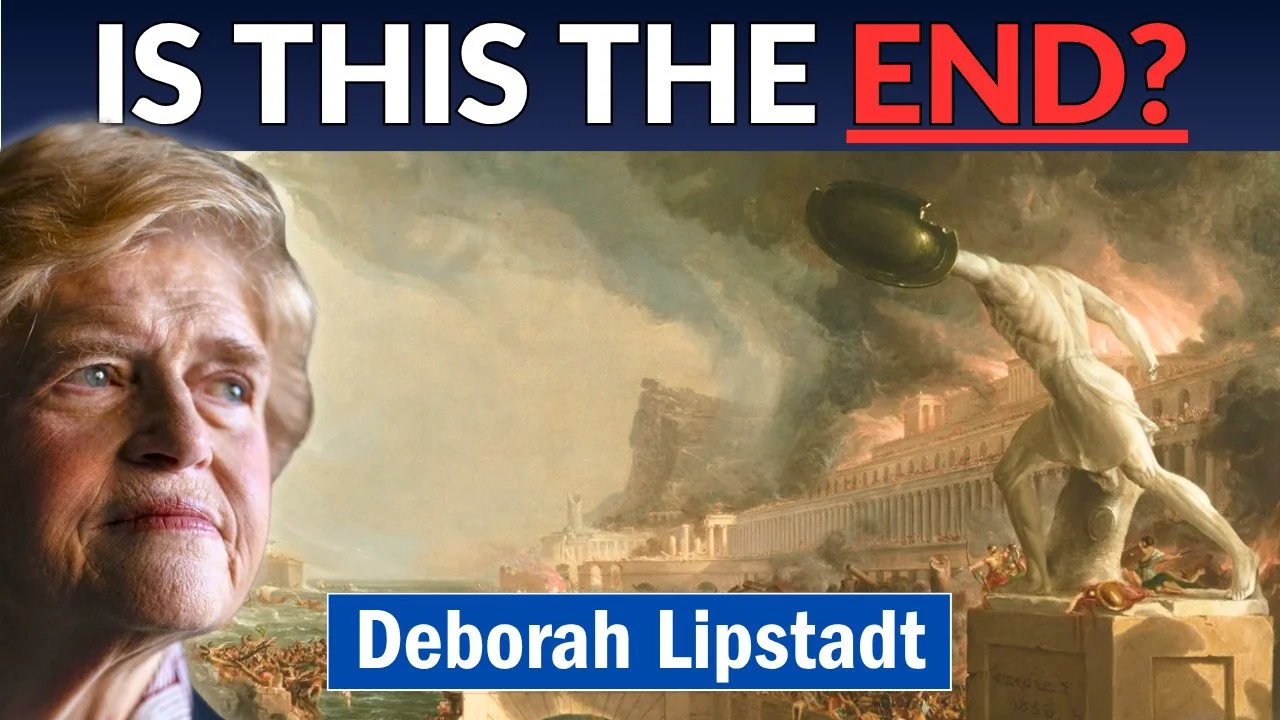
Interview Transcript
When They Say They Want to Kill Jews, BELIEVE The Antisemites!
This is a war.
This is a battle.
We have to know how to fight it.
How do we approach holding the non-Jewish world accountable?
We are fighting something that is global, that is both disorganized and organized.
Can you identify things that Jews in the '30s did or didn't do that we can learn from now?
When they say they want to kill you, you're better to believe them than to dismiss it.
Bruchim habaim.
Welcome to the show, my faithful friends.
We are entering the home stretch of season two here, and I assure you, we are finishing this thing strong.
My guest today is the poster child for the American Jewish dream come true.
A product of Jewish day school and Jewish summer camp, she spent her junior year abroad in Israel, and earned both a master's and a PhD in Jewish studies from Brandeis.
She's built a storied career as a college professor of religion and Jewish studies at some of America's most prestigious universities, including Emory, where she is currently the Dorot Professor of Modern Jewish History and Holocaust studies at the school's Tam Institute for Jewish Studies, which she helped to found.
She's also a celebrated author who wrote a book about Holocaust denial, for which she was sued by a Holocaust denier, beat him in court, then wrote a book about that, which was then turned into a movie in which she was played by Jewish Oscar winner Rachel Weisz, every Jewish mother's dream.
To top it all off, in 2022, she was appointed by President Joe Biden as America's Special Envoy to monitor and combat antisemitism, the first to hold the position at the level of ambassador.
She's also a fan of this show, and I'm honored she's beaming in from Atlanta to be with me today.
Please welcome the woman who strikes fear in the hearts of antisemites everywhere, the iconic Deborah Lipstadt.
Thank you, Jonah.
I wish it was only true that I struck fear or I paralyzed them.
That's what I want.
I want paralyzing cowards.
Deborah, so as I mentioned, you have this role of the special envoy for monitoring and combating antisemitism.
Bad news, it didn't work.
There's still antisemitism.
We didn't do it.
It's worse than ever.
So, uh, what, if anything, surprises you about the situation we as Jews find ourselves in today?
First of all, let me, back to, on the point that it's worse than ever, the only consolation, or Israelis would say hatzina chama, half a consolation, is that I say it might have been worse if I hadn't been in the job.
There we go.
It's pretty darn bad.
There was a stabbing, uh, in Golders Green, one of the most iconic Jewish suburbs of London, openly.
Yeah.
You know, and a few weeks ago there was a bombing of, I think of the Finchley Reform Synagogue, also in North London.
Um, and people said, "Well, they firebombed it at night.
They didn't wanna kill us.
They just wanna destroy our institutions." Now, now that's gone, too.
And it's, London we're seeing it more clearly, but just wait.
What was started in London is gonna spread to other places, and I am deeply, deeply concerned.
It's, it's a troubling time.
To go back to the question, you know, based on what we're seeing, what of it feels surprising?
I mean, o- obviously, as somebody who tracks this closely, you have seen, as, as I have and others, antisemitism has been on the rise since well before October 7th, for a long time.
But even with that knowledge and that data, what are you finding to be surprising about just how dire things have become?
First of all, the normalization, that it used to be shocking to say some of the things that you heard.
In Sydney, in front of the iconic Sydney H- uh, Opera House, where I've been many, many times, uh, on October 8th, 2023 rather, uh, they had a rally.
The Jews of Sydney were told by the police not to come 'cause their presence would be a provocation and they couldn't sure they, they could protect them.
That already is shocking.
Mm.
This is the beginning of everything.
The protesters chanted, and there's some division, I've listened to the tape many, many times, either, "Gas the Jews- Or where are the Jews?
I have to tell you something, it may sound strange as a Holocaust scholar, I fi- find the quote or the cry, "Where are the Jews?" scarier than gas the Jews.
'Cause gas the Jews sort of is a, a throwback to the Holocaust.
Where are the Jews?
We're coming to get you now.
Mm.
The normalization scares me.
The failure of, uh, many governments, some have tried, but more often than not it's been rhetoric and platitude, to take strong action.
And, you know, I used to talk about this being a spectrum from right to left.
I no longer do that.
I talk about it as a horseshoe- Mm ...
where the extreme right meets the extreme left, and they agree on nothing at all except Jew hatred.
When Marjorie Taylor Greene announced she was resigning from the House and s- made some anti-Israel comments, and Netanyahu, which were laced with antisemitism, when she returned to office, she was greeted by Code Pink.
Code Pink, for those of your listeners who don't know, is, is, is left off the charts.
They're hanging on by their fingernails, they're so far to the left.
The only thing that brings them together is Jew hatred.
So that's the second thing that surprises me, the way the right and the left have come together.
We've seen it before.
The communists hated the Jews, the capitalists hated the Jews.
You know, they blamed the Rothschilds and they blamed the Jews as commies.
The failure of much of the world to recognize this, not just as a threat against Jews, but a th- threat against Western culture, liberal democracy, lit- writ large.
I'm not talking about it in a narrow form.
The rule of law, international security and stability.
This is an attack on our civilization as we know it, with all its flaws, and unless something is done to really confront it, uh, th- there could be dire circumstances.
So I wanna drill down on that last piece, because I think for a lot of people, the connection is not clear.
They, they understand death to America is, you know, uh, an attack on Western values, or, you know, what's happening in the UK and sort of how radical Islam is taking over that.
But not necessarily how just Jew hatred, antisemitism, how that- is the same thing.
That, so that like if I'm only hearing you be terrible to Jews, that doesn't necessarily signal to me that you're coming for all of Western values.
So h- h- how do you make that connection for folks?
Think of the threat of antisemitism as a pyramid standing on its head, and the bottom point, the fulcrum, is threat to Jews, Jewish institutions, and those associated with them.
I always add that last phrase because y- your, uh, some of your listeners will remember that about a decade ago, there was an attack on a JCC in Kansas City, and three people were killed.
None of them were Jews.
People in the parking lot who were, uh, were using the JCC, working at the JCC.
So that's the bottom threat, and were it solely a threat to Jews and those associated with them, um, it would be something for a government to take and take seriously.
But it's not solely that.
The second tier up is threat to democracy, and very often people will say, you know, food insecurity is a threat to democracy, voting insecurity is a thr- homelessness is a...
But here there's a specific connection.
If you buy into the conspiracy theory, which i- uh, which is the cornerstone of antisemitism, that the Jews control the government, judiciary, elections, banks, media, you've essentially given up on democracy.
And the flip side, and I know I'm talking to you from LA, uh, at U- I'll use S- UCLA as an example.
At UCLA during the encampments The encampment people, as I call them for lack of a more inclusive term, blocked the entrance to the m- library and certain parts of campus, creating what the Jewish students called the Jew-free zone, and they called it a Jew-free zone too.
And if you wanted to get past them, they had questions.
"Are you Jewish?" If you said no, they said, "Bevakasha." They probably didn't say bevakasha- ...
but they said the encampment equivalent of bevakasha, please go in.
If you said yes, "Do you support Israel?
Are you a Zionist?" And if you said yes to either one, they didn't let you in.
Now, that was shocking in and of itself, but much more shocking was standing adjacent to that setting were UCLA security guards, and when the students turned to them to say, you know, "Let us pass," they said, "We- there's nothing we can do." Well, if those students didn't lose their faith in the, uh, UCLA administration, then, a- and the administration is the local government of the institution which they're part of, the ru- they, they impose the, or, uh, uh, make sure the rule of law is observed.
Or you take Columbia.
Columbia students, and this is not just not Columbia.
Many, you hear this all over, but it was in the report on the, on antisemitism on the Columbia campus.
Uh, Jewish students said, "We had no one to go to." We went to them, they'd say, "Oh, this is a real problem, but we don't take care of that." Or in one very fine school, a student went to the, uh, person in charge of DEI and said, "I had this antisemitic experience." The person listened and said, "That is a serious thing.
I don't handle it, but I'll call the campus chaplain." And she said, "This is not about my religion." In other words, there was a failure to take it seriously, a failure to understand it.
That's the second tier.
The third tier is a threat to international security and stability.
After October 7th, my office at the State Department, my team of about 20 people, uh, which is not a small team at all- Oh, that's big ...
we observed a spike, a real spike, in gutter-level antisemitism on PRC, People's Republic of China, web social media platforms.
So I went to the different intelligence agency, National Security Council, CIA, others, people who look at these things, and I asked them, "How do you explain this?" And they all came up with basically the same answer.
They were, they didn't know for, for a fact, but these people know what they're talking about.
And they said, uh, this is China's way or PRC's way of signaling to the Global South, what we used to call the Third World countries, now called the Global South, to the Global South that we're with you.
They, America, are with them.
So it wasn't ideological antisemitism.
It was, you know, what you might get from Iran, or you might get from the Muslim Brotherhood, or you might get from the white supremacist nationalist, Christian nationalist.
Right.
But it was utilitarian antisemitism, which is a term that I've coined.
Uh, for the Yiddish, uh, speakers or German speakers amongst your listeners, it was a kochlöffel, a cooking spoon to stir up the pot.
A little over a year ago, I was in conversation at the, uh, Paris Peace Forum, which is an international gathering, with Manuel Valls.
Manuel Valls was Premier of France.
The reason I know his name is he was premier during the Charlie Hebdo massacre and the Hypercacher killings.
And he said at that point, when many Jews were thinking of leaving France, and many have left France, "France without Jews will not be France." In other words, Jews are a part of our fabric of society.
If one group in your society doesn't feel secure, then no group should feel secure.
So I say to people who are listening, you know, there've been posts especially, 'cause I follow the London news very carefully, posts from many British non-Jews, "I stand with the Jews." And my response to that is always tha- as a Jew I thank you, but know that you're s- standing with your s- for yourself as well.
As a Holocaust historian, expert, how much of what you're seeing in today's climate reminds you of the climate of Europe in the '30s?
It, there's a basic difference, and I alluded to this a moment ago.
Uh, the basic difference is that in the '30s it was coming from governments.
Right.
Germany was, it was governmental.
Italy, it became governmental.
Austria, when it was, uh, became part of Germany, governmental.
Uh, this is not coming from the government, so in that sense, except from Iran and, uh, you know, a couple of other places, but mainly Iran.
The other difference is the Holocaust has happened.
If you had told someone in 1938 that this was gonna happen, they would've said, "Oh, no, that's impossible.
It's terrible here, but gas chambers, massacres of Jews, uh, experiments on Jews, uh, industrialization of killing, impossible." We now know that it's possible.
I'm not saying, I wanna be very clear here, I'm not saying that a Holocaust is coming.
I don't think that's the case.
But I do think that Jews are living in fear.
If you go to synagogue, a- and you, and there aren't guards outside, you say, "What's wrong?" Yeah.
I go to a synagogue down the block from me, and literally we, of course we have our guards and a police car with the lights flashing and volunteers from the synagogue standing all around.
I say some people come to shul just to be on guard, you know?
Right.
Across the street from us, literally across the street from us is a community church, no guards.
Sure.
No- nobody stopping them.
In Washington, I lived across the street from a Catholic church in the West End of Washington, um, a- adjacent to the State Department, and the church had a sign, "All are welcome.
Come in and pray." I said, if I didn't know the building it was next to, I would know that sign was not a Jew- a, a Jewish institution.
There is no Jewish institution in the world, and now that includes shops in Golders Green.
I just saw a picture of a sign on one of my favorite stores in Golders Green, "To our customers, we apologize.
Our door is locked.
We are open for business.
Ring the bell and we will let you in for our own safety." Yeah.
It's not a normal way to live.
What, if any, can you identify perhaps as- mistakes or, or warning signs, uh, you know, things that Jews in the '30s did or didn't do that we can learn from now h- uh, from their experience?
You know, I hate to judge people ex post facto when we knew what happened, you know.
Uh, some people did things that they thought were very safe.
Uh, there was a man who lived in Fra- in, in Germany who very quickly took his family and his business out of Germany and moved to the very safe city of Amsterdam.
Right.
His mother moved to Switzerland.
His name was Otto Frank.
We know people, Hannah Arendt, moved to Paris along with many Jews.
They thought they were safe.
So I don't know, I don't know what the answer is.
I don't like to judge.
It's always easy to be a Monday morning quarterback.
But I would say something I have learned, you know, regarding Hamas, Hezbollah, when they say they wanna kill you, you're better to believe them than to dismiss it.
We know that's true.
You're a longstanding college professor who's worked at, at different universities all over the country.
Obviously, the, the shift that we've seen in the academy over the past couple decades has been massive and, and deeply impactful in, in regards to the climate we're in today.
Were you noticing that, feeling that, seeing that in real time?
And, and what are you seeing now on the ground?
To change the academy is gonna be very hard.
Yale just put out a survey confirming that there is groupthink in the university amongst professors, uh, that there's not a diversity of opinion, and that students who might have diverse opinions are often afraid to express them.
Well, that's not what a university is all about.
And the problem with the structure of universities is departments, faculties are self-per- perpetuating.
So if I'm on a committee to choose someone, usually it works like this: there's a department, let's say 20 people, 60 people, whatever it is, there's a committee that chooses the candidates.
You decide on a definition of the job, and then the committee begins to cull through all the applications.
Well, that committee, you know, if they see someone from Tel Aviv University, "Well, we don't want someone from Tel Aviv University," someone who was president of the BBYO, whatever it might be.
You can self-select, so it's not, "We reject this person because they're Israeli." They just never make it to the cut.
We've seen that with attempts at Eurovision.
We've seen that at the Biennale in, in Venice.
We've seen it in, in many places, uh, this sort of self-selecting.
And I think universities have to do a very hard job of thinking about this because otherwise they're gonna become irre- irrelevant to American society.
Okay, so let's get a little bit into the specifics of your role as, as the special envoy.
This was May of 2022 until January of 2025.
How different were the first 18 months of your job than the second 18 months?
Night and day.
Night and day.
I mean, tell me when, when you began, sort of what, what was the vibe and what was, what was your agenda, and then what did it become?
At the beginning, one of the reasons I took the job, it's very interesting.
At first, they, they asked me was I interested, put in my, you know, name to be considered, and then I began to have second thoughts.
I'm a senior professor at a university, a chaired professor.
I taught three courses a year.
I had senior seminars.
I had research assistants, teaching assistants.
I had what used to- what being a professor used to be like, you know, with movies from the '60s.
I had a very good life, traveled around the world.
Most importantly, I could say whatever I want, whenever I wanted.
I didn't have to clear it with anyone.
And I was about to say, call the White House and say, you know, I knew I was the top candidate.
They had intimated that to me.
I c- I was about to call the White House when I had a conversation with Sara Bloomfield, a friend of mine of many years, who's director of the US Holocaust Museum.
And I said, "Sara, I'm thinking of not putting my name in, taking my name out." And she said, "Deborah, you can't." And I thought she would begin to talk about the rise in antisemitism and the dangers in the world, and I said, "Why not?" She said, "The Abraham Accords." She said, "There's a chance now to f- change the face of the Middle East.
There's a chance now to change the face of the Gulf.
You could do something proactive." And that really tempted me.
I didn't wanna go into the job just to put out fires.
Hmm.
I mean, that's always part of the job.
You can't help it when you're fighting a prejudice, but I wanted to build something.
And why the Abraham Accords?
You could say the Abraham Accords really deal with relations, geopolitical relations between Israel and its Muslim majority neighbors, particularly the Gulf neighbors.
Well, we, but we saw the Abraham Accords and the problem in a somewhat different perspective or additional broader perspective that many of the Gulf countries have over the years, Saudi Arabia in particular, in past decades, not in recent years, uh, were purveyors of antisemitism in the Muslim world and Muslim communities worldwide.
Wahhabi imams were sent out, and they may not have been told, "Go out and preach antisemitism," but if they preached antisemitism in Brighton, England, or Brighton, Brooklyn or, or any place in between, that was okay.
And I felt that if I could sensitize the rulers, the leaders of these countries, and then eventually of other trips, move down the, the ladder to opinion makers and, and possibly, though I don't think I could have reached them yet, uh, the Arab street, which I put in quotation marks, the populace- Mm-hmm um, we could ch- begin to change this attitude.
Because one of the things about fighting antisemitism is that leaders, whether leaders of countries, states, cities, institutions, university institutions, have to speak out unequivocally, expeditiously- Yeah ...
and then do something about it.
So we were beginning to do that.
We were beginning to make progress there.
I had a second trip to Saudi Arabia, a very rich trip, for November 2023.
It was obviously put on hold.
So that was a dramatic change.
From that point forward, I mean, was it, "Okay, Gulf States, you're on hold.
I gotta go-" Tell people to stop hating us?
I mean, what, what, what did the agenda flip to?
No, after that I was able, I went to Morocco once again.
I went back to Saudi Arabia, but much later.
I went to Bahrain, but it wasn't as friendly, it wasn't as open, it wasn't as- Hmm ...
open to possibilities.
Though certain countries, the, both UAE and Saudi, I know right now they're on the outs over OPEC and oil, but both of them recognize the danger of Islamic extremists, Islamist extremists, Muslim jihadism.
Call it what you may.
And there's a real fear about talking about that openly and directly, and I bet you will get lots of complaints that I even mentioned it.
I don't think so.
Maybe not from your listeners.
Yeah.
But once it goes out, it, beyond.
This is a problem.
And I'm not saying all Muslims, 'cause that would be engaging in the same prejudice that, that we're fighting against.
But I think there has to be a concerted effort on be- on the part of leaders of the Muslim community, religious leaders, political leaders, elected leaders, communal leaders, to say, "We have a problem in our midst." You've visited so many countries, I think you, you said maybe 34, uh, en- engaged with officials from all over the world.
Whose allyship would surprise us to hear about?
I found the Austrians very, very simpatico.
And you know, when you think about Austria, it's not just a neighbor of Germany, but all the Nazi leaders came from Austria, including Adolf Hitler.
Um, you walk through the streets of Austri- of Vienna, and if you know your, your history, you can almost spot places where certain things happened.
I found the Austrians very simpatico.
I wasn't surprised to find the Germans very simpatico.
Right.
I knew that was the case.
I found the French, on the official level, simpatico.
I don't know how much they recognize they have a problem.
Hmm.
The British, I was there when there was a different government, but, uh, Keir Starmer just today condemned the, uh, comment globally, globalize the Intifada.
Thank you very much.
Intifada means uprising.
It can be spiritual uprising.
In Arabic, if you're talking about the Warsaw Ghetto Uprising, you use the word Intifada.
But revolt can mean lots of different things, plague can mean lots of different things.
They don't say globalize Intifada, like everybody should have a spiritual awakening.
They say globalize the Intifada.
What is the Intifada?
The Intifada was an attack on Israelis- You know, 1,200 Israelis I think died, uh, were murdered in the second Intifada, and on Jews worldwide Yeah So it means kill Jews, globalize, kill Jews everywhere, harm Jews everywhere, make Jews afraid.
I hope many Jews wake up in, into tomorrow, day after tomorrow and decide we're going to shul, we're going to synagogue, 'cause you can't make us afraid Yeah But it's easy me, for me to say that.
Any of us who belong to a synagogue or send our, or belong to a JCC, Jewish community center, or send our kids to Jewish schools have pay what is now I call the Jew tax, security And no one complains it's too high We all complain it's too high, right?
It's like so many resources- But we, we complain, but we pay it.
We pay it.
But we pay it.
We pay it.
We got no choice.
You got 44 countries to sign on to global guidelines for countering antisemitism.
You're obviously a big part of the American national strategy to combat antisemitism.
How effective do you think these sorts of things can actually be?
In what ways can government really actually be effective in stamping this stuff out?
You know, it's interesting that you ask me that question, 'cause this week I've been involved in conversations at Emory in creating something that we have not yet, we're gonna officially announce in, in the, in the very near future, what we call EPICA, E-P-I-C-A, Emory Policy Institute on Countering Antisemitism.
I didn't use the word combating because combating suggests the winner, and I'm not sure you can ever have a winner here.
No.
So we're creating at Emory, um, an institute which will have student fellows who will place in Washington over a summer, a semester, we're just figuring that all out now, uh, to work with NGOs, nongovernmental organizations, to work on Capitol Hill, maybe to work in some governmental agencies, depending, you know, uh, which ones, and to see what can governments do and what can't governments do.
I don't think governments can do it alone.
There has to be a feeling th- We t- we talked a lo- in the beginning a lot about Britain.
There has to be a feeling of outrage in British community writ large that this is a terrible thing, this is an attack on us, and to respond, uh, uh, accordingly.
But we are trying to expose students to that.
And one of the things we wanna do, we g- we passed these global, or we got coun- 44, th- uh, actually, I think it's 40 countries and four multilateral organizations- Hmm ...
including the European Union, the Council for Europe, the Organization of American States, uh, uh, and the OSCE, Organization for Security and Co-operation in Europe, to sign on.
Uh, but we wanna monitor and we wanna ask, "Did you sign on?
Are you really living up to it, or did you just sign because it was an easy thing to do?" The first thing of those global guidelines, and they're on the State Department website, and they're still there.
It's one of the few things that I'm very grateful for this, that the Trump Administration and Secretary Rubio embraced wholeheartedly, is leaders must speak up unequivocally and expeditiously.
Hmm.
You gotta say, "This is wrong." Not, "This is wrong, but"- Right ...
" I feel bad for whatever.
This is wrong, but these policies are bad." This is wrong, no but.
There is no but after rape.
There is no but after murder.
There is no but after stabbing someone on the street.
There is no but...
NPR, National Public Radio, after this guy drives, um, a car into Temple Israel in Michigan- Yeah and the only reason he doesn't get to the kids is the car gets stuck in the hallway Right, in the fire doors In the fire doors.
Thank God, and thank God for the guards there who stopped him.
Yeah.
But if he hadn't been, if he'd been able to get through, maybe they wouldn't have been able to stop him.
So what does NPR do?
It ren- runs a story on his two brothers who are in Lebanon and were killed.
Well, it turns out they, in all likelihood, were members of Hezbollah.
Right.
What is in your mind when you're thinking, "We just had a ma- almost had a massacre of little kids"?
I'm sure you're a young father.
Yes.
When you saw those pictures of the little tables with their snacks, each plate with their, you know, their little radish or their carrot and their cookie and their cracker and their cheese, 'cause that's what they were having, their snacks when they were evacuated.
You run...
That's the story you run?
Yeah.
And then when you apologize, you give such a half-baked apology.
"We wanted to humanize, and we want..." You say it's wrong.
You can be totally against what's happening in Lebanon.
What's...
You know, you can think Hezbollah's is the greatest thing since the Red Cross and sliced bread This is wrong, and, and there should be outrage.
The New York Times runs a headline, "Temple Israel Created to Support the Establishment of Israel Attacked by..." What kind of- Right ...
who, who writes that kind of headline?
Right.
I mean, what does that say to you?
Going back to the point I made at the very beginning, this normalization of Jew hatred Is seeping down and seeping into, uh, more and more spheres, and it's, it's, it's okay.
It's okay.
You did a nice little pivot there at the end of that sentence.
So what makes you feel like it's okay?
It's not o- I'm not saying it's okay, but it's okay to put up such a headline.
Ah, yes.
Nobody around the table at the NPR editorial board is saying, "Wait a minute, is that the story we should be running today?
Is that the only story on Tem- on the Temple Israel bombing we should be running?" How do we undo that?
Uh, you know, I, there's a lot of obviously things that many people are doing and thinking and working on to counter antisemitism, but then there are other people who go, "Well, it's hopeless.
Like, look at that.
Like, what do we, we, we got, we got no shot here." So what do, what do you say to those folks?
I know there are people who say it's hopeless and we should just focus on celebrating who we are as Jews.
Look, I come from a strong Jewish identity.
Uh, the reason I've been able to do the work, not just in the State Department, but in, in fighting Holocaust deniers, in, in writing about the Holocaust, the reason I've been able to do that is because I knew what I was fighting for I think that's one of the reasons why I'm so, such a fan of day schools, I'm such a fan of Jewish camps, of Jewish youth organizations, BBYO and then CSY, USY, all the others.
Excuse me if I didn't mention one.
Because they give you a sense of the joy of being Jewish.
They give you a sense of who you are.
They give you a sense of Jew as subject, not Jew as object.
So I think that that's exceptionally important.
Having s- and there are people who said that's all we should focus on now.
I don't think, I, I think that's, uh, uh, a fool's errand because we're in a, we're in a, we're in a, a battle for our lives.
We have to make it unacceptable.
You know, if you're on the treadmill and the person on the next treadmill says, "Oh, those Jews again," or ...
You went to the gym to work out.
You went to the gym to get your, you know, f- 50 minutes on the treadmill and an hour of lifting or whatever it is you do, and, and, and you know, you gotta speak up.
Hmm.
You gotta speak up.
And to speak up, you've gotta educate yourself.
That's why I'm so appreciative of some of the things you do, and I know I've called it out to you privately, but I'll do it publicly as well.
Your takedown of Miss Rachel was so well done.
Thank you.
Those of your listeners and viewers who haven't seen it, go back and listen to it.
You didn't just sit down and say, "Okay, I'm gonna complain about her." You d- you and the people around you, your team, did the research, had the facts, and then you explained why it's outrageous.
If you really care about this, we have to, we have to be prepared to answer.
You know, um, at the State Department, I had lots of interns.
We, I'm, I guess in the three years, less than three years that I was there, 20 interns, uh, circulated through my office.
And one of my interns came to me, uh, Gerardo his first name was, and he came to me on his last day for his exit interview to talk to me, and he says, "I have to tell you a story." I said, "Yes." He said, "But last night I was in my, uh, room, my dorm room," he was staying at GW, "and I was playing video games with a friend of mine, and he made a..." He said, "A good friend of mine, he made an anti-Semitic crack.
And I said, 'Hey dude, you can't say that.' And I explained to him why he can't say that." I said, "Gerardo, my, my job here is finished," you know?
Yeah.
We need the Gerards of the world to say this is wrong.
Not wrong because the Jews lost one out of every three Jews 80 years ago in the Holocaust, not wrong because Israel has fought so many wars, not wrong because two Jews got stabbed yesterday in Golders Green.
It's wrong because it's wrong.
Shout out to Gerardo.
May, may there be many more like him.
Amen, brother.
Amen.
While you were in the role, were there things that you wanted to say or do that you weren't allowed to?
Like, were, were your hands tied at all based on, you know, the politics of your position?
Generally, I figured out how to say what I wanted to say.
One of the reasons why I was able to build the relationships and get a lot done was because- I stayed in my lane, except when I feel I should go out of my lane.
Give you an example.
September 2022, there were, um, uh, riots and demonstrations in Iran.
It was when Masha Amini was killed, the young woman was murdered- Yes for showing up with her hair covered and a few strands of hair showing out on the side.
We've talked about her on this show before.
I waited for my colleagues, uh, the pre- the, the, you know, the White House said something, the secretary said something, but there was no outrage.
My advisor at the State Department came to me and said, "Deborah, you're, you're one of the highest ranking political appointees in the State Department, Senate confirmed.
You're a woman, you have fought for women's rights, Jewish women, non-Jewish women your whole life.
Your voice has to be heard." And I spoke out on that.
When I went out on it, my issue was noticed, and we got over, I had well over a million, uh, retweets of that, and then others in the administration began to speak out.
Anybody who says, "Oh, it's better now," in the past year and a half it's gone out of control.
We are fighting something that is global, that is both disorganized and organized in, in an effort to make Jewish life toxic, make us think twice about going to synagogue, make us think twice about going to the JCC.
Maybe I'll watch services on Zoom instead of going because I don't, you know.
Maybe I won't go into that kosher restaurant or that Israeli restaurant that I like so much.
Yeah.
Now I see there's a group protesting the 92nd Street Y, 92Y as it's now called, an iconic cultural institution in this country- Yeah and in New York City because it doesn't have enough pro-Palestinian or whatever the...
You know, take, take Jewish institutions and go after them.
AIPAC has made some mistakes politically, there's no question about it, but it's, you know, Qatar has given far more money to, to, to influence politics and, and, and institutions.
Yeah.
Something else you did while you were in the role, you held the first ever symposium on online antisemitism.
You got Google, Meta, Microsoft, TikTok, and X in the same room.
What was communicated in that symposium, and what, if anything, were you all able to achieve together?
Uh, and, and you know, how, how aware or A- accountable are they for the dangerous atmosphere that they have collectively created?
This was the work really of a member of my team, Erica Mandel.
I know Erica.
You know Erica, okay.
I do.
So it was Erica's baby, and I said to her, "Go with it.
Run for it." Those platforms had been brought into rooms and been yelled at.
I had been at Congress, congressional hearing where they w- Debbie Wasserman Schultz chaired it, and they were really berated, rightfully so, not wrongfully so.
Right.
And other, you know, and many other called them out, called them out.
And we said, "This hasn't worked." Earlier you asked me 33, what's different now?
We have social media platforms.
It makes it very, very different.
Yeah.
That's one of the main things.
Um, we wanted to bring them into the room and say, "There's gotta be more transparency, more transparency on your algorithms.
You've gotta monitor the spread of the anti-Semitism.
You've gotta do- take- be more serious." And we brought in researchers to talk about the impact.
I remember one of the researchers said, um, when there was, I forget which platform it was, but a woman had baked challah on Thursday night, and she was, it came out gorgeous.
And she had two pictures of her challah, and she said, "I'm preparing for Shabbat." And in response, on the responses, she got 100 watermelons posted.
The watermelon being the sign of the Palestinian, you know, because of the colors.
Right.
And she wouldn't post.
The next time I'm guessing she won't put up those challahs.
Right.
And then a lot of anti c- comments.
Sure.
So you c- can you say, does the, do we go a- we can't go after someone for posting watermelons.
But it's a silencing.
It's a silencing.
It's the Jewish star that you put under your shirt- Yeah ...
instead of over your shirt.
It's the walking to synagogue or d- you drive to synagogue, and you, you park, and if you walk to get to the synagogue, you don't put on your kippah till you get into the building.
Yeah.
Look, we know from another form of prejudice that it's never good when a group goes into the closet.
It's not healthy for the group, and it's not healthy for the society at large.
We learned that from the gay community, from the LGBTQ community.
Yeah.
Many Jews are thinking about going into the closet W- when you look back now on, I mean, obviously there's not so much distance, but you're writing a book, so obviously you're looking back on it.
Mm-hmm.
Right.
Where do you feel, I, you know, we made some real on-the-ground impact that I- you can see and feel today?
I think we did.
First of all, on the global guidelines, getting all these nations to sign on, and now we've gotta monitor and hold their feet to the fire.
Um, not by government, I have no government authority, but if y- at least name and shame.
You signed this, and you say this, et cetera.
Uh, I think that's one thing.
I think the message that we began to deliver that I described to you at the beginning of the upside-down pyramid with the levels of antisemitism- Yeah ...
I was in the offices of, uh, the mayor of Amsterdam, the deputy foreign minister of the Netherlands four days after the soccer riots, and I shared this view with them.
But I said, "This is a threat to you," and I think I got that message out.
Maybe not enough, it's never enough because you can't win this fight.
It's gotta be repeated all the time.
I thin- certainly think that.
The most important thing is we were brought into, uh, many decisions, arms sales, uh, and many international decisions, et cetera, uh, that there was a question, is there some element of antisemitism here?
Are we treating Israel differently?
You know, are we holding a double standard or not holding Israel to the, or holding Israel to a different standard than we're holding other countries, which many people see as antisemitic, and brought into that conversation.
Was everything I fought for successful?
No, of course not.
Sure.
I would say we raised this from a niche issue, you know, sort of little office to the side, to a central force just by vi- virtue of the fact of when I came in we had four people, when I left we had 22 people.
Wow.
How do you think the new administration and the, the new envoy in, in the role, how do you think they've done with the work since you've left?
Rhetorically, uh, this administration has been very outspoken on its, um, unwillingness to tolerate antisemitism.
Um, but I think some of the actions that they've taken- May not have been as efficacious as they might be.
I think sometimes their attacks on universities or, and some of the universities which deserve to be highly criticized and highly sanctioned for, for failing to take antisemitism seriously, but when you're also cutting back on, uh, cancer research and other research, it sort of gives the, the people at the university an excuse to say, "Well, this is not really about ant- this is using antisemitism as attack on the university." Yeah.
So I think there's things that could've been done, uh, better.
I think, uh, you know, arresting some of the people who were here on, on student visas or visitor visas- Yeah ...
um, who were active on the attacks on the activities on campus, which, in which they, they brought Hamas material.
They brought Hamas, which is a terrorist group, sanctioned material to distribute.
Um, I think some of those things were not handled as we- well as they could, and they turned them into martyrs.
What I think is most important is that this is an issue that is too significant to be politicized.
What's worse, antisemitism on the right or antisemitism on the left?
Yeah.
I say that's, that's a wasteless discussion.
It's a waste of time.
We're over the edge.
We're over the edge on the right and on the left.
Sometimes I feel I'm stuck in the lone middle.
Jokers to the right of me, clowns to the left of me, or whether it's clowns, whatever, uh, stuck in the middle with you.
Clowns to the left of me, jokers to the right, here I am, stuck in the middle with you.
Stuck in the middle with you.
So I'm s- I think we're stuck in the middle alone.
Well, we're not alone.
There's a whole, a whole lot of people there with us, I'll tell you.
There's a, that's it.
And, and that's what's necessary.
Not to have them, uh, align with us, identify with us because they feel sorry for us.
Not to identify with us because, ugh, nebech, uh, they wouldn't say that, but what's happening to the Jews is so bad, but because it's a threat to them.
It's a threat to them, and they've gotta recognize it.
You brought us there a little bit about the, the, the political spectrum.
I wanna talk a little bit about- The, the Democrats, given your position under a Democratic, uh, administration, you were- you're introduced on the floor beautifully by the, the Jewish Georgia senator s- uh, Jon Ossoff, who has since participated in several votes, uh, barring arms sales to Israel.
You know, what, what do you make of the way the party has shifted even in the time since you were in, in the post?
Has it shifted, or is it, or is it cosmetic?
Is it, is it deep-rooted?
You know, w- what do you make of it?
Democrats face their own Tea Party.
Mm-hmm.
The way the Tea Party took over the Republican Party, I fear, fear that's what's happening with the Democrats.
Right.
I'm a Democrat.
I've always been a Democrat.
I believe in the values it stands for.
Do I believe in everything it, it, that it's, uh, that Democrats are spouting and mouthing now?
Not by a long shot.
Not, of course not.
Um, but I think that if you play to the fringe, if the f- you think the fringe is gonna get you elected nationally, then you're in for a repeat, and here I'll really date myself, I was very young then, 1972, George McGovern, where you took a candidate who was so far to the left, and even people in the center said, "No, I can't do that," and they went with Richard Nixon.
Mm-hmm.
Mm-hmm.
Don't play to the fringe.
New York City is not the whole nation.
Yep.
Yeah.
I feel the same way, and I, I hope, I hope those considering, uh, higher office will, will take heed of what you just said.
I hope so.
So now I wanna talk a little bit about you, Deborah, the, the human being.
You weave lots of Hebrew and Jewish text into, into your conversation, uh, and you've said before Judaism was the beat of the drum to which your family marched.
I, I love that.
What, what does that mean?
What did that look like for you, and what does it look like for you now?
Shabbat was Shabbat.
Holidays were holidays.
W- our house was filled with, uh, uh, uh, Torah and with, uh, Tanakh, and with, uh, uh, rabbinical, uh, literature, but it was also filled with Malamud, Roth, uh, yeah, non-Jewish writers too.
We were of this world.
We were of this world, and that is, is one of the reasons why I can do the job I do.
Um, that was...
That gave me the s- the strength to do it.
That's who I am.
I'm very much...
But I, I very much wove in...
In fact, in my confirmation hearing before the Senate Foreign Relations Committee, um, it was shortly after, it was a few weeks after the Colleyville, um, uh, uh, attack, attack on the synagogue where four people were held for 11 hours, and they only got out by the rabbi threw a chair at the guy, and- Right and they ran out the side door.
They were one step away from being killed for the building being breached by the police.
I began my hearing with, uh, Baruch, um, matir asurim.
Blessed is the one who frees the captives.
It's a prayer that's in the morning prayers that you say that when you begin your, your...
When you wake up in the morning and you begin your m- and you say your morning prayers.
Yes.
Um, and it's also a description of God in the Shemoneh Esrei, which...
In the Amida, which is the centerpiece of the...
It's a personal conversation with God, the centerpiece of the service.
That was the blessing that was on many people's mouths when they heard the news that these people had been saved.
I said, "But for many people, there was another blessing that was...
They were holding on the side, but they were afraid they might have to say it," and Baruch dayan emet, blessed is the w- the m- merciful judge, which is what we say when we hear someone has died.
In other words, we're broken, we're heartbroken, but we understand this is God's will, uh, even though we may be very sad, very angry, very distressed by this death.
I would venture to say that I was the only Senate, uh, confirmation hearings where there were two, two Hebrew blessings said.
Um, when we launched, uh, the guidelines from the White House podium, there were four of us who spoke.
Um, the head of the N- the deputy director of the National Security Council, the second gentleman, Dale Ephoff, and Ambassador Susan Rice, head of the Domestic Policy Council, and myself.
And I was the final speaker, as Ambassador Rice said, "Deborah, you bring it home." And I finished with a quote from Pirkei Avot, from Ethics of the Fathers, Ethics of the Elders, "Lo alcha ham- l'chah ligmor." It's not unto you to finish the job.
"V'lo atah ben chorin lib'tlemihu." You aren't free to, uh, not do it, not to begin it.
Right.
It's who I am.
Yeah.
I can't not do it, and I don't apologize for it.
I try to make it as accessible.
I just automatically translate.
But it's, it's who I am, and, you know, I find being Jewish joyous.
And that's, I think, what breaks my heart most about what everyth- everything that's going on, is that we're gonna lose that.
Folks, if you just heard that sound, that means Deborah and I just recorded Five Deep Questions, a special segment we record every week that you can only watch or hear if you are a member of the Kehillah.
That's my subscriber-only community, which you can join anytime at beingjewishpodcast.com/community.
And here's a little tease of what you miss out on if you don't join.
Why has this hatred been able to endure?
How worried are you about the standing of Jews in America?
If Jews have to leave America, then no place in the world is gonna be safe for them.
It doesn't start with gas chambers, doesn't start with machetes, it starts with words.
Pretty juicy stuff.
All right, Deborah, we're getting towards the end here.
I wanna talk briefly about the recent Sapir debate you did with Dara Horn, moderated by Bret Stephens at the 92nd Street Y, which was terrific and, you know, must-see TV for much of the Jewish world.
A couple of points I just wanna jump in on with you.
O- one is, and we've touched on this in the, in the program already, but you said, "Anti-Semitism, what's going on here?
This is not normal." And something you said a few times in the debate, uh, is, "The non-Jewish world, you are responsible for it." How do we approach holding the non-Jewish world accountable in that way that they will hear and not be defensive by?
You know, you've been asking me questions for the past, I don't know, whatever, how many minutes it is.
I don't know if I can answer that one.
If I had an easy answer for that, I would've written it, published it, shared it with everyone.
It's not easy, and anybody who has, says they have an easy answer is wrong.
It's not, is not, is not...
It's, it's a tough battle.
There's no one way.
I respect Dara tremendously.
I love her celebration of Jewish life.
Look, we come from a tradition that says, that applies the same stan- uh, reward to honor your father and your mother so your days may be long in the 10 Commandments, and have equal weights and measures.
Don't cha- don't cheat when you're a business person.
In the Torah, it says, "Why?" So your days may be long.
And the only, the third place it says that, when you come upon the bird's nest and there's a mother bird sitting on its eggs, if you're gonna take the eggs, which is a normal thing, send the mother away so she won't see you taking them.
In other words, have compassion for the mother so your days may be long.
We come from a tradition that equates parents, tr- respecting parents Being honest in business and having compassion for animals on the same level.
We come from a tradition that says let your li- land lie fallow every seven years so it can rest and rejuvenate.
That was ecology before we knew b- about green.
We come from a tradition that says when you go to war against your enemy, don't cut down the fruit trees outside, because you're cutting down trees so they can't hide behind the trees.
The fruit trees you live, leave because they give you food.
We come from a tradition that has so many wonderful things.
I don't want a young person to think being Jewish, I'm gonna be, only think, strong and fight the haters.
Yes, be strong and fight the haters, but know that other stuff.
But in contrast to, I mean, the debate with Dara, you can't only know the other stuff and say forget fighting the haters.
You've gotta fight the haters.
Not to change, change the mind of the haters.
That's useless.
I'm not gonna change Candace Owens' mind in a m- Megyn Kelly, Tucker Carlson, feh.
I wouldn't waste a minute on it, but the people who might listen to them, we have to ch- reach.
I love this line.
You say, "It's gotta be taught and it's gotta be fought." Uh, what can my audience do to join in in that fight?
You know, the rank and file Jew going about their daily lives, or non-Jew, allies.
They can start by reading.
There are a number of books, and I'm gonna do something very immodest, include my own in them.
Uh- As you should ...
Dara's book, E- Everybody Hates Dead Jews.
Everybody loves dead Jews.
My book, Antisemit- Everybody loves dead Jews, yes.
Yeah.
They should hate...
Right.
That's right.
Thank you.
Good catch.
My book, Antisemitism Here and Now, which is written as a series of letters to a student and to a colleague dealing with the issue of antisemitism, and there are other books as well which deal with these, with this issue.
Uh, educate yourself.
Think about how to answer.
Uh, don't just get mad and say, "Oh, that's terrible.
You're an antisemite." The, if we were going to battle, a physical battle, we would train.
We would hope our soldiers would train.
They would learn.
They would be prepared so that when it's a battle strategy, they know what they're doing.
This is a war.
This is a battle.
We have to know how to fight it.
So first and foremost, I would e- urge people to start reading, um, my book, other people's books.
It doesn't matter which.
Um, I don't always say that, but in this case, there are a lot, there's good stuff out there.
Yeah.
Educate yourself so that you can be prepared to face this.
All right, Deborah.
Uh, we are going to finish things off here with a good old-fashioned lightning round.
I'm gonna throw some questions at you.
You, you give me whatever response pops into your head.
What is the favorite city that you've lived in?
Jerusalem.
This doesn't have to be the favorite, but a favorite non-Jewish allied voice that you listen to and you follow, you're inspired by.
Douglas Murray in England I find very, very compelling.
Sure.
He's amazing.
This can be from any period in history.
Who's one of your favorite US presidents?
I think Abraham Lincoln.
Eh, easy answer.
I sa- He's a good one.
Yeah.
No, no, he, he faced a difficult, difficult fight, and he held the Union together, and he died for it.
Yeah.
Favorite Jewish holiday?
Yom Kippur.
How come?
Because it's a chance to engage in introspection.
Where did I go right?
Where did I go wrong?
What can I do?
What can I do to make better?
You can come out of Yom Kippur a different person than you went in.
It's, it can be transformative if you do it right.
I bet I'm the first one to ev- to ever say that, Yom Kippur.
No, my dad said that, too.
He, he's of the same mind.
Ah, I know I loved your dad.
Yeah.
And I was gonna say, there's, like, sort of two camps on this.
Either you love it for the reason you just outlined, or you're like, um, who else is...
Like, Jason Robert Brown on my show said, you know, "Yom Kippur's a drag, man." Yom Kippur's a drag, man.
There's just no way around it.
So one of the two.
Well, you gotta, you gotta prepare.
You gotta prepare.
What's your favorite Jewish movie or TV show?
The Adventures of Rabbi Jacob.
I don't know this one.
Oh, it's an old one about a rebbe who has to get to San Francisco and go across country.
It's terrific.
That sounds fun.
You traveled to all these countries abroad.
What was sort...
What was one of the most surprising Jewish communities you encountered abroad?
Well, I think, uh, the most interesting, and it was Djerba, the island of Djerba, off in Tunisia- Whoa ...
where there's a Jewish, a Jewish community of 1,000 people.
It won't be there much longer, sadly, I, I fear.
And they have, every year on Lag BaOmer they have a festival, and they claim it goes back 2,000 years.
Um, and it's a celebration of being Jewish.
So we were at the synagogue.
I went with the American ambassador to Tunisia.
We flew from Tunis out there, and we stood, and it was just so delightful.
It was a real celebration.
The next night in the same spot we were standing, there was an attack by a, a Tunisian policeman on the place, and, and four people were killed.
Oh, God.
Who was the most fun foreign dignitary that you met with, that, like, you really got on with and was a good time?
Abdul bin Zayed, the foreign minister of the UAE Glad to hear that.
What's your go-to bagel order?
Uh, everything With what on it?
A schmear, but not one of these schmears like in New York where the, you have the, the cream cheese is coming out the sides.
A light schmear.
Favorite kind of kugel?
Potato Ah, interesting.
Okay.
Favorite hamantaschen filling?
Oh, I know this, lekvar, prune.
Prune.
Takes me back to my youth.
Ah, nice Yes.
And it's gotta be a lot of it, not this little dab in the middle where you're getting a cookie with a little dab.
Yes It's gotta be a lot of filling Please, spare us the dab.
What's your favorite country to visit on, on leisure time?
London, England.
England, I love England, and that's why, what's happening there so breaks my heart What will you be doing for Shavuot this year?
Possibly going to learn the first night, but possibly going to sleep.
And just celebra- I live in a wonderful community, uh, surrounded by people of all different levels of observance, a, a synagogue that emphasizes community.
So it's really, it's really quite celebratory to, to, to be embraced by this sense of community, people who are, who are joyous about being Jewish Fantastic.
And, uh, my last question, which we ask of all of our guests, challah, rip or slice?
Ripped There you have it.
There you have it, folks.
Ripped, ripped, ripped.
Deborah, thank you so much for the time.
Thank you for all of your work and everything you're doing.
It's been an absolute pleasure Thank you.
Take care.
A huge thank you to Professor Deborah Lipstadt for braving Georgian lightning storms to be with me today, and for devoting her life to honoring, celebrating, and fighting for our people.
If you haven't yet already, please be sure to leave a rating and a review for wherever you're listening to or watching this show.
It takes less than 30 seconds, and it helps us tremendously.
All right, thanks a million, and I'll see y'all right back here for the next historically accurate episode of Being Jewish with me, Jonah Platt.