
Monologue Transcript
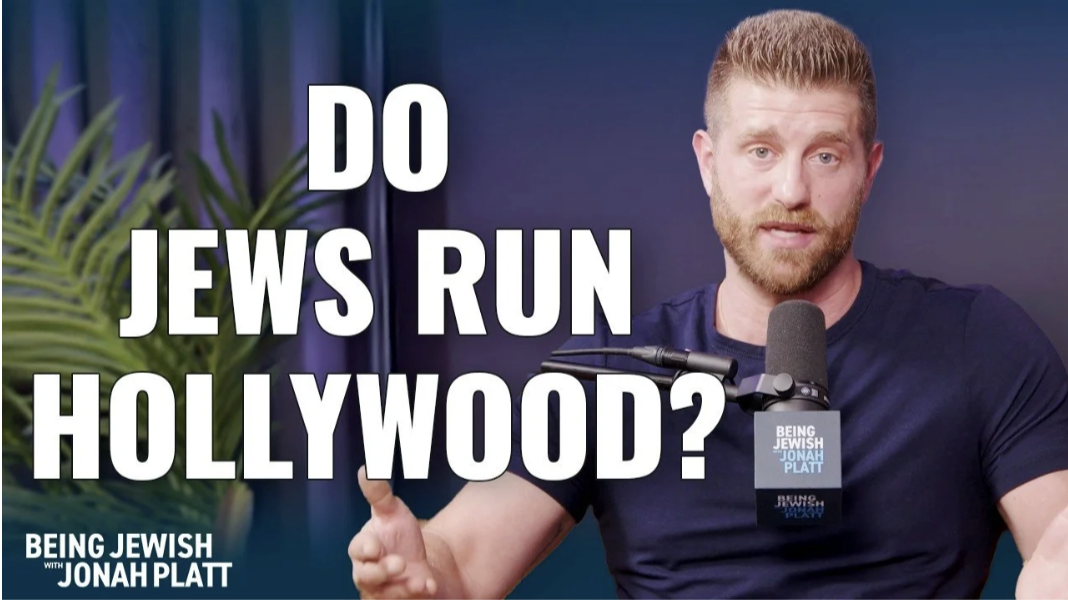
Do Jews REALLY Run Hollywood? The Truth Behind the Oscars
Last weekend, the 97th annual Academy Awards took place here in L.A.
an occasion that, for me, brought the intersection of Jews and Hollywood
into focus, producing a lot of observations, feelings, and questions.
So today, I want to tackle, in no particular order, all the things I
thought about last Sunday, and some of the things a lot of you told
me you were thinking about, too.
One question I get a lot is, if Jews run Hollywood, why does Hollywood
seem to be so uncomfortable with Jews?
There's a lot to this answer, so let's start at the beginning.
before even the first Academy Awards 96 years ago.
Surely, you all recall Hollywood founders Lazar Meir, Wilhelm Fuchs, Shmuel
Gelbfisch, and the Wansal Brothers.
Well, how about Louis B. Mayer, William Fox, Samuel Goldwyn,
and the Warner Brothers?
Yeah.
Hiding one's Jewishness was one of the bedrocks upon which Hollywood was built.
And that is no knock on these pioneering men, all of whom were
Eastern European immigrants looking to embrace their new home and achieve
success in a brand new industry.
And just as these studio heads, or should I say, judio heads, were hiding
in plain sight, so too were Jewish sensibilities and values and humor
leaking into scripts and onto the screen.
In many ways, charting the course for the pop culture defined
values of this great country.
Though, of course, rarely under the auspices of actual
Jewish characters or stories.
So, even though Jews built the industry, their efforts were
rarely to the public benefit of the Jewish people or their image.
And the same often rings true today.
Which begs the question, though Jews have always been an integral
part of Tinseltown, is the Jews run Hollywood trope in fact true?
First of all, there's never been a single study to actually identify
how many Jews even work in Hollywood.
The whole thing is anecdotal.
And Obviously, there are a lot of Jews working in Hollywood, but there
are also many non Jews in positions all over the industry, including the
head honchos at major companies like NBCUniversal, Netflix, and Sony.
And with international conglomerates buying up studios anyway, entertainment
industry leaders don't have the power they used to, Jewish or otherwise.
Furthermore, let us zoom in on some geographically specific data concerning
Hollywood's Jewish gatekeepers.
According to a 2021 study commissioned by Jewish Federation Los Angeles,
A quarter of the city's Jews identified as minimally involved.
And of that quarter, only 5 percent said being Jewish was important
to how they see themselves.
Another quarter of Jews participate in home based activities, but rarely in
Jewish organizational or communal life.
So when we think about Jews running Hollywood, we must bear
in mind that 50 percent of the Jews in this town are not actively
connected to the community at large.
So to expect them to be outspoken leaders or strongly focused on a Jew
positive agenda feels unreasonable.
Though, I have witnessed the post October 7th awakening of many
Hollywood Jews with my own eyes.
So, I imagine this data looks very different today.
Even so, if I may revisit a point I made in episode 23, we must stop expecting all
celebrities with a drop of Jewish blood in them to advocate loudly for our community.
This is not to let them off the hook, but to expect that already disconnected
Jews will carry the torch for us in a time of crisis is just unrealistic.
Take Timothee Chalamet, or as Adam Sandler might say, Timothee a Chalamet.
Despite having a Jewish mother and playing a Jew on screen, Chalamet
has never engaged with the Jewish community in a meaningful way.
You can't expect someone like that to wear a hostage pin to the Oscars.
The world often forgets that celebrities are just human
beings with very public jobs.
They're not symbols, they're not leaders, they're just
people who are highly visible.
Which in no way means they will, or should, feel or
behave the way we want them to.
Speaking of Adam Sandler, as one of the most public facing Jews in
entertainment, many of you have expressed to me being particularly
hurt by his silence since October 7th, which I completely understand.
And, consider this, Adam Sandler has probably done more for normalizing
contemporary Jewish life and popular culture than anyone in the past 25 years.
The man made Hollywood's only mainstream Hanukkah film, the only comedy starring
an Israeli character, a song that introduced millions to the joys of
Hanukkah and simply being Jewish, and he was behind the film You're So Not
Invited to My Bat Mitzvah, which I think is one of the best on screen celebrations
of contemporary Jewish life ever.
I even wrote an article of a variety about it.
Google it.
I am certain in his mind his cultural contributions are his
way of making a difference.
And I agree it should count for something.
But it makes me wonder, are these Jewish actors truly unaware of how
pathetic it is to watch them cower and shrink away from their identities?
And for what?
Follower counts?
A pat on the back from someone who'd humped them before they'd hide them?
In an age where Zoe Saldana wins an Oscar, speaks in Spanish, and proudly
announces her Dominican heritage, and the entire telecast pauses to recognize
Paul Tazewell's accomplishment as the first black man to win the Oscar for
Costume Design, Jews are sprinting the other direction, backwards, into
the 1930s, desperate to prove to their uneducated, anti Semitic peers how
assimilated they are, how they're the good kind of Jews who, you know, renounce
their own people and embrace terrorist propaganda for social acceptance.
Haven't these people read the Hanukkah story, or studied the Holocaust?
In any minority group, are the ones who turn against the rest of the group in
hopes of approval from people who hate them ever the ones worthy of respect?
And let me say this, of all the people I've asked to appear on this show, the
only professional group from whom I've received multiple no's are Jewish actors.
Actors with Jewish names who've earned money and acclaim playing Jewish
roles and have become so morally confused in their quest for community
validation that they literally have no idea who they even are anymore.
There were also two very Jewish Holocaust related films nominated this year,
The Brutalist and A Real Pain, both of which took home acting awards for Adrian
Brody and Kieran Culkin, respectively.
In their acceptance speeches, neither actor mentioned the word Jew or Holocaust.
Despite those things being wholly responsible for their Oscar wins.
Sure, Kieran Culkin is a non Jewish actor who's built a 30 year career playing
a wide range of roles, of which this was just one, and his speech focused
on his family and longtime manager.
And Brody, who's won both of his Oscars for portraying persecuted
Jews during the Holocaust era, did call out systemic oppression, anti
Semitism, and racism in his speech.
But was that enough?
Would it really have been so hard to pay respect to the struggles of
a tribe they temporarily inhabited to further their own careers?
It's not for us to say, but a Jew can dream.
As to why no one at the Oscars wore a yellow hostage pin, well,
nobody wore the bloody red handpin of artists for a ceasefire either.
And nobody even mentioned Donald Trump.
There seems to have been a collective agreement to make the night about what
it's actually supposed to be about.
Movies, not global events or politics.
If award shows want to refocus on just being about
entertainment, I am all for it.
We want celebrities to shut up about politics, right?
Unless they agree with us.
But we can't have it both ways.
After years of preachy outbursts and unwanted opinions, a
return to professionalism and neutrality is A OK by me.
And finally, let's tackle the elephant in the room and talk about the acceptance
speech for No Other Land, the joint Palestinian Israeli documentary
focused on life in the Masafer Yata neighborhood of Judea and Samaria.
Anyone who immediately went into angry defensive mode when everyone
started rapturously cheering and applauding, raise your hand.
Now that we're past the moment, consider this.
There is nothing inherently evil or unfair about people, whether they're Palestinian
or anyone else, documenting the difficult conditions under which they live.
And if the film is skillfully made and tells a compelling story that breaks
your heart, it's going to reach well meaning audiences who feel sympathy
for people living under duress.
That's not unreasonable, context or not, justified or not.
The reality is that Palestinians in certain areas of Judean Samaria live
under military law and are subject to certain practices neither you
nor I would like to live under, and that's fine content for a documentary.
The speeches, obviously, touched a couple nerves.
Basel Adra, the Palestinian co director, called on the world to stop Israel's
ethnic cleansing of Palestinians.
Are there Israelis living within Judea and Samaria who would rather
live there without Palestinians?
Is that the entire country?
Of course not.
Adra also lamented feeling like he was always under surveillance, which obviously
sucks for a regular person like him.
But is it understandable that after decades of suicide bombings and knife
attacks and public shootings, Israel might rather be safe than sorry?
I think so, though it absolves neither side of responsibility for the situation.
Adra's partner, Israeli director Yuval Abraham, laid responsibility for the
devastation of Gaza at Israel's feet, which always bothers me whenever
someone does it, which is all the time.
Then he closed the speech by saying, My people can be truly safe if Basel's
people are truly free and safe.
Do I think Palestinians deserve to be free and safe to a
greater degree than they are?
Yeah, do I think if they were Israelis would suddenly be truly safe?
No way, but it does seem to me that Palestinian freedom and safety is at
least a prerequisite to achieving lasting safety for Israelis Not the whole shebang
but one of the pieces Though how we accomplish that outcome is the conundrum
of our times and will not be solved by a documentary or a speech Let me leave
you with a comforting little secret That speech didn't actually matter.
This was an award for a documentary during a three hour ceremony that around 96
percent of the country didn't even watch.
Oscar acceptance speeches do not meaningfully move the
needle one way or the other.
On screen representation, contemporary narratives, authenticity, these
are things that can have impact, that can reach audiences and
humanize Jews for the masses.
These are things that can shift public opinion.
So demand them, create them, commit to supporting them whenever you can.
And when Jewish actors lose themselves in the miasma of self abasement
and shame, Let them hear from you.
Don't let them skate by and continue to make money off an identity
they're too embarrassed to stand by when it actually matters.
They think we don't see them.
But as the old Hollywood adage says, the camera sees everything.
And so do we.