
30mm Transcript
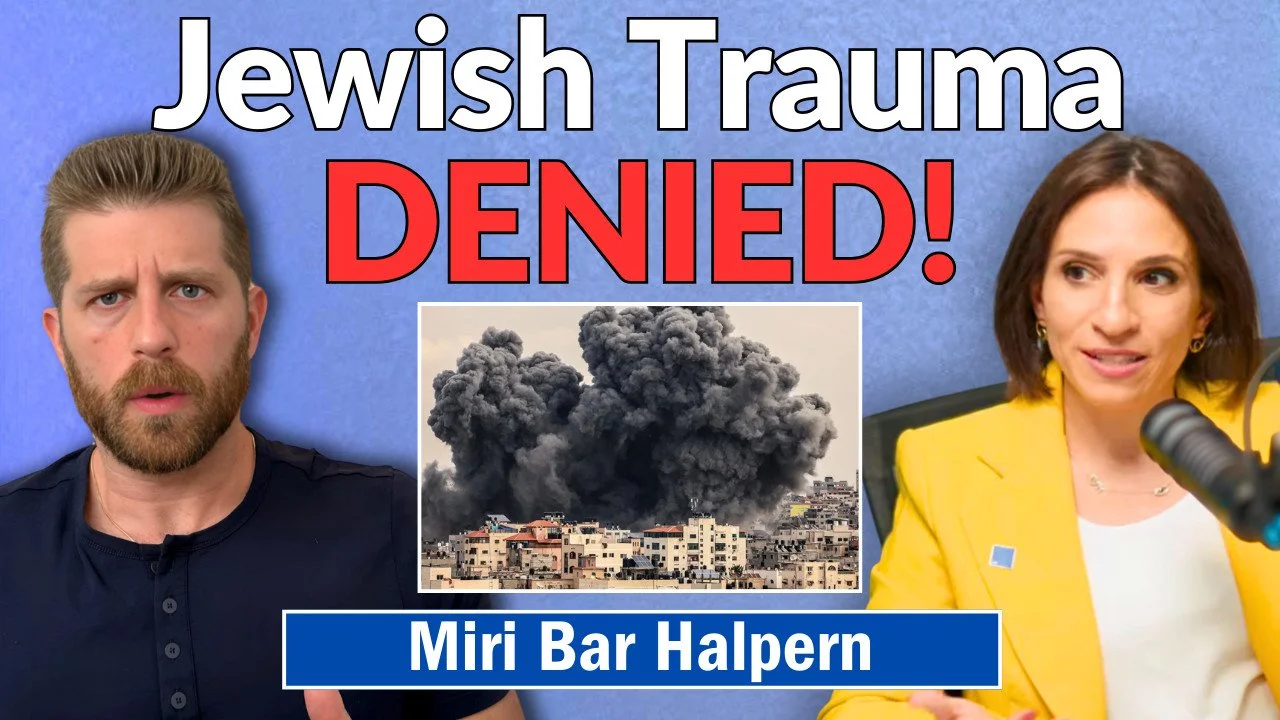
Jewish Trauma INVALIDATED - Israeli Clinical Psychologist Dr. Miri Bar Halpern Breaks It Down
Antisemitism is the connective tissue across all terrorist and radicalized group.
The one thing they have in common, they're all anti Jew racists.
There was just an attack on the bus and that was the bus we're supposed to actually take.
Oh my God.
We meet all nine criteria for traumatic invalidation.
We win.
It's US versus stem.
Welcome back to another episode of Being Jewish with Jonah Platt.
30-minute mensches, save vibe, same tribe.
Shorter episodes.
My guest today is a Harvard affiliated clinical psychologist, trauma expert and director of trauma training at Parents for Peace, a national nonprofit aimed at Radicalization prevention and resilience.
An Israeli American and granddaughter of Holocaust survivors.
She is a mental health leader within Jewish communities offering support and healing, which the Lord knows are in high demand.
She also co-hosts the post-OC October 7th podcast.
Our stories matter on which I was a guest last fall, and I'm delighted she's here with me today.
Please welcome Dr.
Miri Bar Halburn.
Thank you so much for having me today.
Oh, my pleasure.
It's nice to see you again.
So your research and clinical work focus heavily on trauma from terrorism, from war, from radicalization.
A real barrel of laughs.
So what drew you to this kind of heavy, serious work?
Uh, growing up in Israel, I grew up during the second Intifada, so I was always exposed to terrorist attack.
You know, kind of that feeling.
You're sitting in a coffee place, you dunno when it's gonna come.
You're sitting not next to the, to the area where it might hit you.
I was always afraid taking the bus to, to school or to the beach after that.
But it became normal, right?
The abnormal became normal.
I didn't have any PTSD symptoms and post-traumatic stress symptoms.
Really?
Yeah, it's, I mean, most Israelis are super resilient.
It's, it's the way we live is we are gonna take each day to the fullest.
We're not gonna let terror win.
And then I moved to the US.
And I had this moment, I moved it from my doctorate and I got my doctorate in Connecticut and apparently not like Tel Aviv, you party all night in Connecticut.
The lights come up around 1:00 AM if I am not mistaken.
Yeah.
And I was in a party and when the light went on, my instinct was to take.
What did that sensation remind you of?
It reminded me of all those times when you're in Israel and you're just, you're scared and you're functioning on an automatic, it's, uh, this fight, flight, freeze response.
And when people are exposed to trauma or to any type of traumatic event, it's an automatic nervous system response where either you fight, you flight, or you.
So to me it's was sitting on all those memories of growing up with this uncertainty.
But when you're in Israel, you're not noticing it as much.
Most of the people, I mean obviously the south of Israel, throughout the years with all the terrorist attack that happened there and other places in Israel, there's definitely higher rates of post-traumatic stress syndrome.
But other areas in Israel the, until October 7th, at least it wasn't.
As a parent, if I may, how, how old were you at during the second Intifada?
Like teenager or child?
Child, teenager.
Yeah, teenager.
So I was a child during the golf war.
I was a child, uh, the second Intifada, I was in high school.
I actually remember a specific situation.
Um, usually on Friday we would wanna take the, the bus to the beach in Tel Aviv, it's pretty here in a, you know, in LA it's easy.
In Massachusetts you say, go to the beach.
You need to plan for a day at least.
In Israel, it's like, okay, let's grab our bathing suit, let's go.
And I remember we're about to take the bus and I have an older brother and he came to pick me up from school and he said it was just a, an attack on the bus and that was the bus we're supposed to actually take.
Oh my God.
It's just part of the reality, you know, Janah.
So when people say, Hey, let's globalize D Ada, this is Ada.
I grew up knowing what ADA really means.
Your perspective on this will be so interesting because we're.
So many people already feel that attack when someone says globalize the ada.
That's gotta be quadrupling true for any Israeli who knows what that means.
And then sort of even deeper for you, who is an expert in these areas of trauma and and PTSD and all of that.
So what has it?
Felt like on a personal level for you to see the normalization of those kinds of chants throughout the Western world?
So this sits on intergenerational trauma, right?
We, when we're born to this world, we already have the, what we call epigenetic, the vulnerability for some of us to, uh, to trauma that our ancestors went to.
So when people say global ada, it triggers my nervous system.
And it doesn't sit just on my experience, you know, as you mentioned, I'm a third generation Holocaust survivor.
It sits on that trauma as well, not to mention.
Um, so my husband lost his father in nine 11.
Oh my gosh.
That's part of my identity too, right?
You asked me for like, what brought me to the trauma world.
All of those experiences.
Brought me to the trauma world.
Well, thankfully you're doing it even though the way you got there is, uh, I wish we could have avoided.
So, something important that you've been doing recently, you co-authored this research paper for the Journal of Human Behavior in the Social Environment on something called Traumatic Invalidation, and you were looking at it specifically within the Jewish community post October 7th.
You know, I, I, I read through the paper and what, what I.
Appreciated about it was sort of putting a name to something I think every Jew on Earth is, has experienced to some degree or another one facet of this thing.
So if you would, for, for my audience, you know, tell me what traumatic invalidation is, what you sought to accomplish with this paper and, and what conclusions you were able to draw through your research.
So I'll give you the background story to understand kind of like how we got there.
Um, my co-author Jackie, uh, Dr.
Jackie Wolfman and myself, um.
We, we can, we kind of collaborate on this article and we, we waited a year to get it published because it was really important for us that it will be in an academic journal, peer reviewed, not Jewish, because we knew that we need that stamp of approval.
So on October 7th, out of my own need to do something, I wrote a message on an Israeli Facebook group saying, this is my cell phone number.
If you need any support, I'm a psychologist, give me a call.
I was flooded with phone calls and quickly mobilized a team of about seven Hebrew speaking clinician.
And for about a year we provided free support, one-on-one groups, webinars, seminars, immigrants came, we sat in school if there was a ne there.
And I started hearing those stories again and again, that reminded me of what I heard from my non-Jewish, what we call regular trauma clients in my clinic.
And that's the concept of traumatic invalidation.
So it's when someone is.
Not believing you or denying or ignoring your emotional experience after a traumatic event, and especially when it's coming from someone you care about, like a caregiver or a friend, that can actually prevent someone from healing from trauma, and it can lead to mental health issues, depression, anxiety, hypervigilant.
All the way sometimes to self-harm suicidality and PTSD symptoms.
Now, the best way to describe matic invalidation is gaslighting, but it's not just gaslighting.
There is nine different criteria that were coined by amazing researchers in psychology, Dr.
Marshall Lehan and Melanie Herne and uh, Martin Boho.
And they actually researched that concept on different groups, different minorities, L-G-B-T-Q and um.
And the black people, but never on Jewish people.
So I start collecting all the stories and basically showed how we meet all nine criteria right now for traumatic invalidation.
We win.
Yeah, yeah, yeah.
Right.
When you think academic research, usually you get maybe 200 views over years, maybe a thousand, 2000.
We got in less than a month, over 37,000 views of the article.
Wow.
And now it's actually according, at least to Chad, GPT, it's ranked as the top 1% most viewed article across all disciplines.
And I don't think it's because we're those amazing authors.
I think to your point, it gave the language, it gave people something that they can hold onto to understand it, to take to their non-Jewish colleagues and say, that's it.
This is what I'm doing right now.
Right.
What did you hope to accomplish with the paper?
Was it just about.
Naming this thing and saying, Hey, here's what Jews are going through, or were you hoping to, to learn something that you could then act upon or do something with both.
So one point was to help people understand what they're going through, right?
When you think about trauma, the first thing is to be able to name it.
I mean, if you don't know what you're going through you, you will feel like you're going crazy.
So first in psychoeducation and really understanding what am I going through and why am I feeling the way I'm feeling?
Then there's a call for action, especially for the mental health world.
How can you support your Jewish client?
What can you do to help them?
And it's not about asking for any special treatment.
I'm actually not asking for any special treatment.
I just want our trauma to be seen as any other trauma as any other group to have the same type of capacity to hold our pain as well without, what about without?
Well, you caused it.
Trauma is trauma.
Have you been able to see if you've had an impact, especially in spaces like with other psychologists or, or trauma centers or DEI spaces, these spaces that are supposed to be comforting and healing, that have for many Jews been a source of extra trauma, uh, through this traumatic invalidation.
Have you seen, uh, uh, this getting through?
Yes.
I'm happy to say that overwhelmingly.
There is a very positive response to that.
Um, even to the point that in Massachusetts, the State House, uh, just came up with recommendation to combat antisemitism and it's in the recommendation for K to 12.
So I gave a testimony there and they adopted a lot of the things that I recommended for the K to 12.
Can you gimme some examples?
You know, schools like to say that they're, uh, trauma informed and safe for everybody.
If you're safe for everybody, you need to be safe for Jewish people as well.
So creating curriculum that are mindful.
For Jewish student and Israeli students, there are a lot of Israeli immigrants in Massachusetts.
How do we hold teachers accountable?
What report system do we have in place?
How do we make sure that Jewish students feel physically and emotionally welcome at schools?
So they're working through different recommendation right now to make it even more specific per, per the schools and per the district.
But for example, as you probably know, the Massachusetts Teacher Association.
Has been something that has been extremely problematic in terms of the material that they're been using.
So helping teacher being mindful of that and how that can cause harm and even more radicalization for our youth.
So kind of like changes like that on a policy level have been really rewarding to see.
But also on a personal level where I heard clinicians saying, I now can validate a Zionist.
I now understand Jewish pain.
Barham, right?
Where are you seeing the greatest need in this space right now?
Uh, specifically within the Jewish community?
I think the mental health field needs to step up and the healthcare, I mean, I don't know if you saw the recent statistics, but antisemitism is also in the healthcare and the medical profession.
When you think about care, we need to be able to trust our doctors and nurses, right?
So I would say mental health and healthcare will be one big area.
K to 12, right.
Because what we're seeing on college campuses right now did not start on college campuses.
It started with education in the K to 12 world.
So I think we need to have unbiased curriculum.
We need to teach kids critical thinking to help them identify propaganda, to help them, um, counter radicalization and extremism.
And that absolutely starts with education.
And is that an area where you are also.
Speaking and doing work in terms specifically of, you know, curriculum and education and, and that kind of thing.
Oh, that's amazing.
Yeah.
I mean, why not?
Let's do that as well.
Yeah, great.
I'm one of those October eight Jews.
Like, let's do everything we can to just save ourselves.
Okay.
So let's dig into that.
So before October 7th, how invested were you and your work in the Jewish community, if at all?
Or, or was that only get flipped on after?
After the, you know, the before and the after.
It was, I'm definitely a before and after.
Um, if you ask me who you are before October 7th, like, what is my identity?
I would always say I'm Israeli, I'm a mom, I'm a psychologist.
Like I have like my identity right there in front of me.
And then after October 7th, eighth.
I'm Jewish, Israeli, I'm a mom, a psychologist, and then mm-hmm.
So on.
So I had to find a community because I lost my community.
I joined a temple for the first time in my life.
And all my work has changed.
I mean, I, I actually quit my job, uh, as of June, my regular, I was a director of intensive outpatient program here in, um, Massachusetts in a big clinic, and I quit my job so I can do.
Advocacy and training and research on the mental health aspect of antisemitism and, and combating radicalization.
I, I just don't see any other option.
That's amazing.
Um, so let's talk about combating radicalization.
Um, I mentioned the Parents for Peace Organization with which you've been affiliated.
Tell me about Parents for Peace and your role there, and then, and then we'll dig into the, the radicalization piece.
So let's start there.
Sure.
Uh, so Parents for Peace is a nonprofit organization.
They've been in this field for over 10 years.
It was funded by a father that actually their, their son is actually still in prison for life after committing a terrorist attack.
It, it's your boy next door.
Literally the neighbor.
Yeah.
The parents had no clue.
Um, and Miriam Churchill, who is the head of the organization, she really wanted to understand the pathway for hate.
Um, so she started meeting with families and with actually convicted terrorists to understand the pathway for violence.
And from that, she created parents for PTs.
Uh, I'm the only Jewish person there.
They actually heard one of my talks after October 7th and Miriam said.
You don't have to fight alone.
Let us help you.
And the reason is that antisemitism is the connective tissue across all terrorist and radicalized group.
We literally have a Venn diagram to show it.
So we have a helpline and people can call and say, I'm worried about my loved one, please help me.
And we go through this assessment and then they're being paired with a former.
So we have, um, some of my colleagues, we have a former neo-Nazi and a former jihadist.
We have someone from Iran, so we have a lot of people who were in the hate world and got out and then they're also being paired with a mental health provider.
And it's really taking the addiction role model of people being addicted to hate and how can we change that?
Are they signing themselves up?
Are they being brought there?
Is law enforcement involved?
How are these people becoming involved?
All of it.
So we have referrals from law enforcement as well.
We work very closely with them, the FBI, the police, and then, uh, usually parents or friends.
Siblings, usually they don't wanna be part of it because they're radicalized, right?
So you need to find ways to connect with them.
And I think this is where the role of our formers is so important.
Anu bin, who are my friends and my colleagues are doing amazing job, really getting the report, getting connected with those individuals of concerns.
And from that relationship, they're able to show them there is another path, there's another way.
Is there any nugget from, you know, what's working there that you.
Can recommend be implemented at scale to, to sort of filter through a student population at a college, for example?
Yes.
Something like that.
Yeah.
So one of the initiatives we're working on is exactly that.
How do we scale it up?
Because anti-Semitism, as we said, it's not a Jewish problem.
It.
It's a non-Jewish problem and it's affecting Jews.
So you need to have the non-Jews to help to, to change their ways, right?
So part of it is curriculum building, which we are doing actually right now.
Um, so we get, can get into the education piece.
Then a train to trainer model where we can help educators actually identify and mental health professionals.
Identify the warning signs of someone who's going, uh, under the pathway of violence and being able to intercept, so not shaming them.
Um, you know, when you think about someone who is more vulnerable to radicalization, these are the ones that are, um, don't have a sense of belonging.
Uh, they have unresolved grievance.
Um, some of them have mental health issues.
There is a lot of different things that make someone vulnerable.
And the way I say it is almost like.
This pathway just with like trauma, where if they go this way and they're being in those echo chambers online, they can be more pro radicalization, but if they get the right support and get 'em to this way, now you're talking about maybe changing their pathway to more resiliency and post-traumatic growth.
Right.
So you're giving them a sense of belonging and meaning and, and I think the problems, to your point about college right now, I mean.
Do I think everybody's radicalized there?
No, I think most of them are brainwashing, have no clue what they're talking about.
Those are the useful idiots, right?
But they think they're fighting under social justice this higher cause that a lot of them for their own identity are trying to find.
So when you have someone say, oh, I'll tell you who's in, who's in charge of your issues, I'll tell you why you're suffering.
It's the Jews, it's the Israelis, and here's what you can do, not just to make it better for yourself, but to make it better for the world.
Come join us now.
So they give them something to look for.
It's, um, working better than, than, than we would hope it would.
If you had unlimited resources to, to invest in a program, a direction and whatever, what would you do with them?
Like where, where are we under supported and where do you feel like we need to be focusing?
Attention prevention.
Intervention.
So the prevention would be what we talked about before to prevent radicalization and to prevent harm.
Um, you know, I, I can't stress it enough how antisemitism it's not, it's not just affecting us and people, you know, I think that a lot of people, and I don't know if you would agree with it, John, they, they're kind of tired of hearing about antisemitism.
Definitely.
Right.
But I think most people would agree that radicalization is not great for our kid.
So if we can get people to see that, that it's really affecting every single person, non-Jewish people, because there are more risk of verticalization, then I'm hoping we can make more people interested in what's happening.
So that's the prevention piece.
I want to drill into that because I think you're right that when people here, you know, there's so much anti-Semitism, stop beating up Jews.
They're like, all right, we get it.
But then I, you know, at least I hear a lot in the Jewish world of like.
Antisemitism affects everybody.
It's, it's like a much bigger problem, but almost, I hear that so much that that's almost a cliche of, okay, so like what does that even mean really, that it affects everybody.
It's a problem for everybody, and I think people actually mean different things when they say that.
It sounds to me like you are saying it's a big problem because e essentially.
It's, it's, you know, uh, presence and virulence puts your child at risk of becoming like a radicalized hater.
Yes.
So when you look at things from black and white way, right?
Think about the AI oppressed oppressor.
There's no nuance.
And more than that, it's about putting people against one another.
It's us versus them.
And when you look at us versus them, you start looking at P as people as their problems and not as human beings anymore.
Mm-hmm.
So antisemitism is the gateway to radicalization in that regard because it is the oldest kind of like hate in the book of us versus them.
We are the others.
There's no nuance, there's no gray area.
And if you have, you know, we always hear if you tolerate hate for one group, you're gonna tolerate for other group.
Look what's happening around us.
Hate in general and extremism is being normalized.
The fact that people are actually have some sort of understanding to murder, they're justifying murder of Jews because they're a Zionist, I think tells us everything we need to know about society today and how radicalized they become.
Hmm.
Scary stuff.
So I came on your podcast, as I mentioned, our stories matter.
Uh, where did that come from?
How's it going?
And, you know, was I really amazing on it or what?
Well, obviously we're amazing.
There's no doubt about that.
Um, and, and I did and I told you before, I've learned so much from you and your journey within the Judaism world and, and how loud and proud you are.
And I think that affected a lot of our audience.
And I know it affected me.
Every single person went to our podcast.
I took something from that episode, um, and I incorporated in, in who I am in my new identity.
Our stories matter is not something that I started.
My co-host, SU Hess, it's been an ongoing podcast from Trauma-Informed Learning Alliance, and I joined in the, in the last season, the last two seasons, Susan and I met during a delegation to Israel and we just trying to figure out how can we get the voices out there, but from.
More psychological perspective and it's really about the journey to post-traumatic growth.
So when you think about people in general, the resilience, right?
We can bounce back, but post-traumatic growth is when you give meaning to event when you're doing something.
And in my world, what I really believe in is that the best anecdote for trauma is doing is being able to take control in doing something.
So our stories matter was my way of doing.
And you know, it also combined a lot of the poems that I wrote after October 7th, and it was about getting to know stories.
Bringing them to the front.
So the, the season you were on, we interviewed, uh, Jews and Arabs and Christians about the way they healed or tried to heal after October 7th through doing.
And then this specific season that we just ended was about courage on campuses and we interviewed students and, uh, former radicalized people about what's happening specifically on college campuses and what can be done.
'cause I think a lot of us, we mean so well, and we have all those talks and we give workshop, but there's no call for action.
It's almost like you come to this event and like, oh my God, this speaker is amazing.
I can listen from two hours, and then you leave the event and okay, now what?
Right.
So I wanna focus on what can people do and not just preaching the choir, basically something you just said.
Remind me, you mentioned earlier this Venn diagram.
Where about radicalization that like at the center of, of everybody's radicalization, the one thing they have in common is they're all anti Jew racists.
I haven't heard that articulated in quite that way.
I mean, is, is there literally like a, a Venn diagram that's like digital that, that you can send me?
Like, I want to share that Please.
'cause I, I feel like that's a concept that's really important that I don't think is out there.
I don't think that's something people are really thinking about or, or considering as being.
You know, valid.
No, and we have the, so parents for, we actually have the data through our helpline.
Almost every single call we get, not 100%, but almost every one of them.
Doesn't matter if it's the far left, the far right, Antifa, whatever phone call we get that is related to radicalization.
There's some content related to antisemitism.
It's crazy.
So it's one of those questions I get all the time.
People are like, well, well why?
Like, why is everybody so antisemitic?
And I, I mean, I guess your answer would be what you said earlier, which is, you know, it's sort of just sort of the default hate, 'cause it's been there so long, it's like it's the easiest one to tap into of the US versus them.
Do you think there's more to it than that?
I do.
Yes, it is.
The, I heard someone saying it's the first, uh, type of racism is antisemitism.
And I, and I agree with that.
Um, so according to one of my colleagues there, and also someone that I interviewed, yes, Yasmeen, Mohamed, uh, who are not Jewish, they're saying that they think it's actually coming from.
Which I found very interesting.
I never thought about it from that perspective as a Jewish person.
Oh, really?
Person.
Oh yeah.
Um, I don't know.
It's like, what do you have to be jealous about?
It's like I see people as people usually, so I don't, I don't think that because I'm Jewish, I'm more successful.
I think because my, the way I grew up, the way my parents raised me, my onset of values is what got me to where I am.
But maybe, maybe that's really like values, right?
Jewish people have very similar values, like shared connection.
Maybe, I don't know.
But I think right now it's more about, it's cool there's more antisemitism because it's cool and people want that sense of belonging to, to be on the cool side of the club.
And we see it also from some Jewish people as well.
And I think part of it is their fear and their need for safety.
It's almost like they had to be anti-Semitic or anti-Zionists, which in my opinion is exactly the same in order to be accepted in society today.
It's sort of, you know, I've thought about it a little bit like smoking cigarettes.
That, you know, it used to be very cool, normalized, everybody's doing it, and there was no social cost for, for doing so until, you know, there was a decades long sort of very, uh, pointed movement to make it uncool.
And we, you know, the culture completely flipped and now it's, you know, completely.
Taboo to be smoking a cigarette, at least in America.
Not quite the same in Israel.
No.
But you know, I don't know how we, how we have that, you know, pervasive and pointed and approach as with cigarettes, but it does feel like a similar kind of vibe.
It's something I think about.
It's a good metaphor.
I think we don't have enough, um, accountability, right?
There's no cost, there's no put, nothing bad happens to you for doing it.
Not at all.
In fact, some of people would actually say, yeah, you did it.
Good job.
That's right.
You get the, you get the pat on the back for being a righteous hero.
And to the addiction piece, again, it's the high, right?
Mm-hmm.
So there's the same pathways that working on the addiction mechanism in the brain.
So now that you've published this big research paper, what's, what's next?
What are you looking to look into next?
Are you expanding on that work?
Are you going in another direction?
Are you taking a break from research?
Where are you at?
We are, um, doing a huge survey now across the US oncologists to get more data about traumatic invalidation.
So I'm really building specific training and workshop to do two things.
One is to give Jewish people the skills and the tools to combat.
This burnout, the vicarious trauma, the traumatic invalidation piece, all the things that we've been going through, because this has been very long marathon and our nervous system actually never recovered from October 7th.
Yeah, right.
There's one event after another, but then also to educate other people of what they can do and to call up people to stand up.
I need people to stand up for me when I'm not in the room, and I think this is even more important.
So a lot of calling for action for people to stand up and do something.
That's fantastic.
When, when you craft these workshops, you're going into, you said healthcare providers, et cetera, are they coming to you?
Are you finding, you know, an appetite to want to improve situations, or are you having to sort of knock on doors and say, you need this?
I think the fact that the article went viral, I mean, I've been getting literally emails from all over the world, literally from South Africa.
I got an email, so I think it hits a chord.
I think people can really resonate with that and they're asking for more information.
Then just word to mouth.
I've been doing a tour all over different colleges around the US about that aspect of mental health and antisemitism, traumatic invalidation, so people hear about it.
I'm trying to bridge divide in administration and staff because if it doesn't start at the top, we can't expect our students to be able to cope with it as well.
So I'm trying to foster those dialogues for leadership and creating organizations that are trauma informed, that understand the pain and the trauma of every minority.
Including Jewish people, we are not that different.
In order to combat this traumatic invalidation, uh, effectively there's a, a level of education about Jews or about the conflict or that's required or, or do you not need that and you can just sort of grasp the concept and that it's enough?
No, you actually have to understand Jewish people.
I think that, you know, people think of Jewish as religion and right.
Ethno religion.
Like we, I mean, you and I know that, and you talk so much about Judaism and what it means that there's so many different aspects of being Jewish.
Mm-hmm.
And I think more people need to understand those nuances.
Just like we do those deep dive about any other minority group, people should be culturally sensitive to what is Judaism, what is Zionism, how it is part of someone's identity, and when you putting it down or attacking a core part of someone identity, you're actually causing harm.
I don't care how you call it.
It's causing harm, right?
How do you not get burned?
Carrying all of this with you, you know, not just as a person dealing with all this, but as a, a specialist in this area that is, as we said at the outset, so heavy and, and the work is so unending and there's such a, an urgent need for, it's a great question.
So there's a few things.
When I started feeling the burnout as a therapist and I was literally hypervigilant for a long time with sitting with my clients, Jewish and non-Jewish clients, and it's an interesting balance these days, being a Jewish therapist.
The boundaries are very blur with Jewish clients.
So I had to do a lot of grounding sometimes before sessions, I started to do yoga, which I was never a yoga person, but I needed something to calm my nervous system down.
And now I'm kind of noticing I'm doing this check-ins with myself where, listen, this is a very long marathon.
We don't have a lot of people cheering for us on the sidelines, so I'm trying to reserve my energy to where should I give talks, who should I engage with and what is right for me?
I know that I'm not a protest person.
I tried it.
This is did not end well for me to get into conversation with people in protest, but I'm great if you put me in front of a State House or committees or a bunch of people that actually wants to learn, I can do that.
So I've learned how to balance my resources and then to do a check-in.
Am I, am I available to do that today emotionally?
And how do I balance that?
What do I need to do for my own self-care?
Can I lean into my family and my kids and enjoy and hold that dialectic of being with them with joy?
While also fighting and carrying some sadness and, and I think those check-ins are really important.
It's a tall order, but you seem to be doing it with flying colors.
Dr.
Mary, thank you so much for being here and for enlightening us and for doing the incredibly important work that you are doing.
I know we're all grateful for it.
Thank you so much, Jonah.
Thank you for having me.
My pleasure.
All right.
She's a mensch.
It's been 30 minutes.
I'm Jonah Platt.
Take care of each other guys.