
Interview Transcript
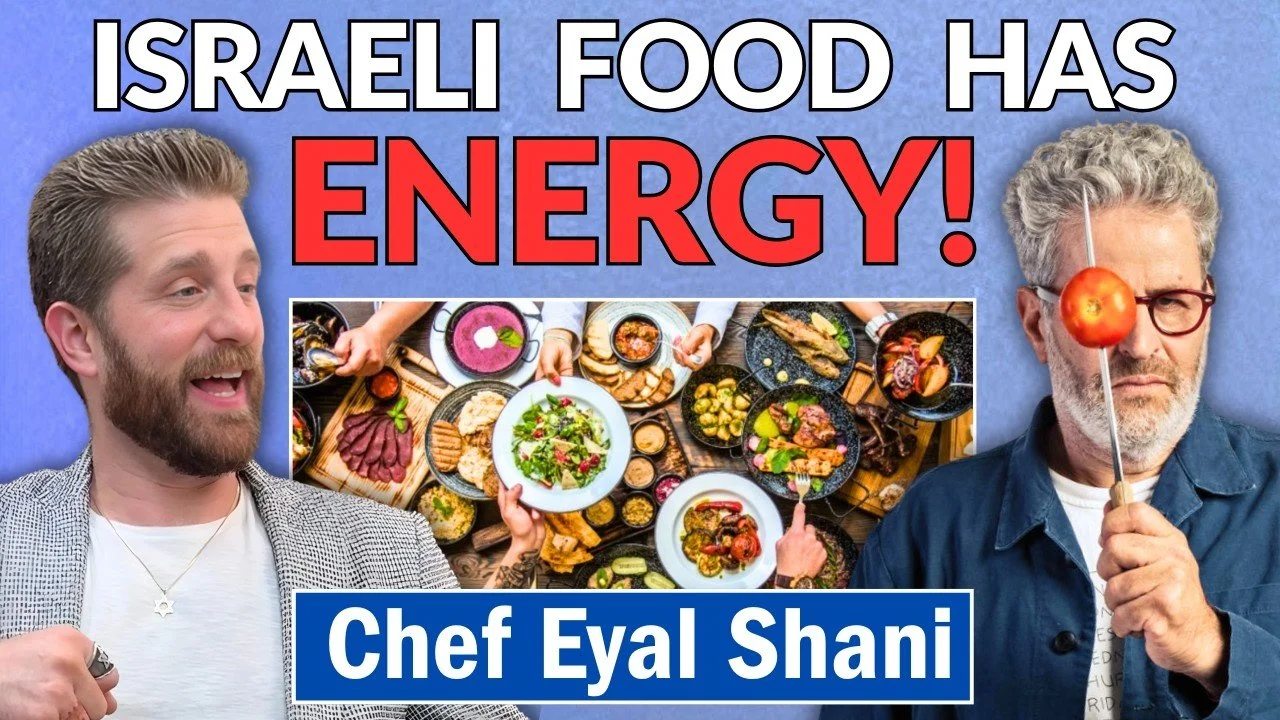
MIZNON - Where Israeli & Palestinian Culture Meet, Michelin Star Chef Eyal Shani.
Watch and Listen
TThere's no borders when we are talking about food.
You received the coveted Michelin Star weeks after October 7th.
You were busy cooking meals for the troops going into Gaza.
I saw the eyes of the soldiers, and that was my mission.
I was completely dead.
Welcome back to our summer series, being Jewish with Jonah Plat.
30 minute benches.
Same vibe.
Same tribe.
Shorter episodes.
Today we're taking a bite out of creativity, deep ancestry and also humus.
A ninth generation Jerusalemite man, that's a mouthful.
My guest today is one of the most influential chefs ever to come out of Israel, despite having no formal culinary training.
He's the force behind Mizan Hassan, and nearly 40 restaurants that serve up Tel Aviv magic to happy diners all around the globe.
I'm already starving.
Please welcome to the show, chef Al Shani.
Hello, Toba.
It's great to have you here.
Thank you.
We already have this on the books and.
I was just gonna be focused on the food of it all, but I have to mention, early July Miz non Melbourne was attacked by some violent protesters.
How much does something like that affect you?
I mean, your world's away.
You've got a lot of restaurants, but it is your restaurant.
So like what's the feeling?
Look, it's a processis.
The touching is a process.
The first thing to touch me, my team, my people that are going with me.
That I'm leading them, that they are part of my soul that are working for us and try to deliver the message that we have to deliver to the world.
And they are the people that are putting their hands on and they were hurt and they are not Israeli.
One of them is Israel.
There's always one.
The HF is always an Israeli.
But all the other team and the other chefs are not Israeli, never experienced in their life, right?
That kind of situation.
For me as an Israeli guy in the last war, in the last, uh, 12 days of war with Iran, when they shoot missiles on my home, I went into the shelter and five minutes after that I went out and continue my life.
Because I, I used to eat, people are shooting on us in Israel from the day that I was born, but for them it's experience that they couldn't imagine that they will passed and they were got shocked and got such a trauma that half of them didn't want to return back to work.
Okay.
That's nothing.
The fact is.
They felt that they fall in such a trouble that not belongs to them, and that's hurt me a lot.
You had the opportunity to speak directly with the team there.
Immediately We made a contact with them and we saw what is happening.
The first thing to do that they threw tomatoes on them.
That was the soft part of the situation, and something was funny with that because.
Tomatoes are running after me all my life in so many different situations.
It's like a symbol.
And suddenly I saw them splashing on my workers and then the chairs enter into the scene and then the tables, and we were very lucky.
Three brothers, Lebanese brothers that have pizza.
Beside us.
Mm-hmm.
These were the people to save my team.
Wow.
And they cut the attack other way they would kill our, our people.
Listening to you speak right now.
Uh, it makes me want to ask how much of what you do is about the people that you do it with.
It's all about the people.
I'm leading energy.
Into the world.
I'm doing it through food.
If you are my guest, I'm creating a dish, charging it with my will, with my wishes, my hope, my energy, and sending it into your body.
You open your mouth, taking it in, it's going down, melting in your blood.
You are carrying my energy inside my body, not less.
That is the principle.
Wow.
With my workers, it's all about them.
Why?
You can have the best methods, the best ingredients, the best perspective of our making food and knowledge, but it's makes nothing.
It's when somebody is seeing you as a customer, looking on your eyes, doing his job, creating your dish, putting his all attention, all his focus into it, concentrating his energy into it, and giving it to you.
That is the process.
So I need the people to be completely into that process.
That is the thing that I'm teaching them.
How difficult is it to maintain that level of connection and passion and personality in your food when you have, for example, miss known, there's, there's a bunch of them all over the place and all different kinds of places, and you have to till you are not reaching the edge, it's not interesting.
It just, and hard job to do.
But when you are reaching the hand and you becoming one with your team and you are trying to influence them, to teach them, to show you, to show them a different way of cooking, that make an immediate influence on the way of life, it's not interesting.
It's interesting when you stepping.
Into a big change that you deliver to your people.
And I got something like 60 restaurants and there's a big question that is coming out of that.
How can I manage it?
I can, how can I control on it?
There's an immediate answer, there's no way.
But when you find that there is no way to do it, you have to ask yourself again.
So what is the way?
I found a very simple way when we're opening a restaurant.
I'm there for a month, for two month with my team, especially with my chef, and I'm coping my spirit, my belief into its own brain, and when I'm living, I'm living with him.
I'm not sleeping with him.
That is the only thing that I'm not doing with him, but I'm eating with him.
We're talking, we have so many conversations about so many things around our life, and then after a month when I'm going back to my homeland, I feel secure that I print my mind on his mind.
And I changed his, uh, changed his point of view.
From that day, he will look in a different way on his life and on the food that he's creating.
That is my way to manage that chaotic situation.
I love that.
So eight Shamona in New York City, which I've not had the chance to eat at yet.
I gotta, it's on my list.
You received the coveted Michelin star just days, weeks after October 7th.
I know.
Despite being a lifelong dream of yours, you were not at the ceremony to receive that star because you were busy cooking meals for the troops going into Gaza.
That's gotta be so many different emotions at once.
Can you take us back to.
Those days when all of that is happening.
At the same time, I had a feeling that we are going to win the Michelin star It, as you say, it was in the beginning of the war.
I thought about it for a minute and these throats left me immediately.
Hmm.
In the evening, when was the big prize?
I was cooking in the front for soldiers that went out from Gaza.
It was after two months that they were there without getting home, without ability to connect to their families, uh, without cellular.
I got a phone call from my partner that is living in New York City and he told me.
You won a star and it was a moment when I roasted 300 pieces of prime rib, 300 pieces.
You know what is to control on it?
You can.
Can you imagine the smoke that is coming that covering you completely?
And through that he told me, you want the star?
Aren't you happy?
I said.
It's a good thing, but it didn't interest me at all because I saw through the fog, I saw the eyes of the soldiers.
I saw the stakes that I have to control on it, and that was my mission.
I was completely the, the Michelin star was looking to me something so far away.
Not belong to the intent of the life that I'm doing now.
It wasn't important for me.
Have you been able to take in that accomplishment?
Now that time has passed and there's been a little bit of space to breathe, even though obviously things are have not ended, but it's maybe not as intense as it was at the beginning.
My goal is to touch as many people as I can all around the world.
With a kind of energy that we are charging our food with, and to make people that we are touching them to be much happier than the moment before we touch them.
Michelin is not our frame.
We are very wild people.
We have no manners, but we have a lot of love.
To our people, to our inner people, and to our visitor, to our audience, to our clients, and that is our mission, to spread a good energy through one, two, that we know how to work with.
And that is hospitality of if you are trying to focus, it's about food.
You know, in, in Schmo restaurant, for example, when I'm serving steak, a piece of steak that it's the most common dish, but people want it, so I have to serve it.
Okay?
You want it, you have to eat a piece of somebody.
I mean, a steak is a piece of cow if a chicho that was alive that gave his life for you to eat him.
So if he gave his life and his body to you.
You have to recognize it.
You don't have to hide it.
I'm eating meat also.
I'm not vegan.
My wife is vegan.
My grandfather was one of the first vegan people in the world, but so what I'm doing is a most in the stays on the charcoals, the metals is very simple.
The meeting in the states is amazing, so there's no problem to get.
Wonderful results, and then when you have to take it out, I'm taking it out with my hands to get the heat of the meat into my body, and then I walking with a rebi in my hand, without gloves, without anything coming into the table.
Put it directly.
On the table without any isolation.
Not, not a napkin, not a plate, not a boat, nothing.
Just put it on taking a sharp blade and slicing so the blood is getting up and there's a paddle of blood and people are looking like that and I'm looking on them back.
Saying nothing, but my eyes are saying, what do you think to yourself?
You are eating an animal.
Now, an an animal is, is created outta blood and flesh.
So I'm giving you the reality of your choices and I, I doing my best that you will enjoy.
But I have a duty to deliver you the all information.
My team mostly is not extreme as me, so they're trying not to do that, but I'm visiting very often to continue to do that kind of things and um, that is schwan, it's very, very naked restaurant that hiding nothing.
Standing on the edge, sometimes it succeeds so much it's touching the sky and sometimes it's moderate.
But that is a character for a restaurant that trying to push the borders and to change itself every day and to be a real alive restaurant.
When you said just now, you know, you have a duty to show the diners, the, the reality of the experience.
Where does that duty come from?
Who said that's your duty?
When I'm doing food, when I'm designing my food, when I'm inventing my food, each ingredient is the, the whole world.
I told you that each ingredient for me is a creature and each creature in the world.
Got a will and got a wish, and there's a place that it feels comfortable and another place that it doesn't feel comfortable.
And I'm teaching my team to follow the feelings of the ingredient that they can feel with their eyes and with their senses and with the fingers.
I know that most of the foodie in the world.
Is taking words, mixing them together, hiding information, and think that combination is the thing with food.
I'm saying to myself, no.
If you are taking tomato and you are brave enough to put all your mind into it, to listen into the inner feelings of that creature.
You can find everything in life the same with cucumbers and personally and whatever you choose.
When I'm entering into a cucumber with my mind, with my fingers, I feel like Alice in the Wonderland and I'm experienced such a deep feelings that I have had duty to deliver it.
Into my people, into my customers.
Never thought about cucumbers that way before.
I, I've read that your mother's family has lived in Jerusalem for eight generations.
Yeah.
It's unbelievable.
How, how does such a deep historic connection to that place, how has that shaped you, uh, as a person and as a cook?
I used to live for the last 35, 38 years in Tel Aviv, but Tel Aviv is full of.
Immigrants from the other parts of the country.
Like New York is full of inner immigrants.
I'm a man that came from Jerusalem.
It's a different, uh, accent in the language.
It's deeper thoughts, it's inner feelings.
Jerusalem is about walls and stones and struggle, unending struggle.
The soil you can feel.
Is full of blood and suffering and a very complicated history, and also full of dreams and hopes and feeling of holiness for all the people around the world.
So from that background, I came and when I began to cook, I was one of the first new Israeli chefs.
There was no food scene in Israel, like there was no food scene in all the new world countries 40 years ago.
So I have to find a way.
There was no internet to get out from Israel.
It was very complicated.
There were almost no cookbooks in Israel, and I didn't know how to cook.
I just had a feeling that I have to invent the Israeli cuisine.
I didn't realize that maybe I have to open some books and to learn how to cook and never lo learn how to cook.
I learned cinematography but not cooking, but I wish to cook.
I don't know why I didn't know that.
If you are taking flour and water, a door is coming out of it.
I didn't realize it.
I was like completely blind to food and felt untalented because I didn't, in beginning, I didn't succeed to do anything.
But I understood that I have to take some inspirations, so I look around.
There was no Israeli cuisine.
There were almost no restaurants, and the restaurants were very primitive.
But what impressed me so much were they all women that used to sell the two cucumbers in between the walls of the old city.
And I look on the way that they are taking care about the three tomatoes, one onion, three cucumbers, and trying to understand what they're doing with it.
That these women were my first vision.
The Palestinians women, the All Palestinians women.
My other inspiration was were the sms, the winds that I met.
In the mountains that are around Jerusalem that I used to go there to harvest the wild herbs.
I bought a lot into my restaurant.
I didn't know what to do with them.
I just took them because I knew that I have to take them.
And then I recognized the sage and suddenly I felt that the sage is giving a mysterious feeling that maybe I can.
Stamp it into my food, and slowly, slowly, from the building blocks of Jerusalem, I create my first food.
What is your relationship like to those Palestinian women who are so fundamental to what you've built and what inspired you?
How does that dynamic feel today?
And, and you know, where, where does it live in your heart?
There's no borders.
When we are talking about food, they're just human beings and there's a humanity and war as are not belongs to us as human beings.
They belongs.
To states, to people that got interest, that making you to be involved in things that make no sense, that pointing on some other people and saying to you that they are the enemy and how you have to fight against them.
And on the other side, the same.
Governors are pointing goods on us as their enemy and convince people to fight against us.
But I know I had a lot of relationship, working relationship, friendships between me and Palestinians when I was young and, and the situation was.
Very close into a complete assembling between the Israelis and the Palestinians before the I Father.
I know just one thing.
A human being is a human being and I'm working for peace and for love, and I think that in that madness that is whooping us.
Now in Israel, one of the biggest path to walk through to get out from that is to reunion ourself.
Our neighbors through food.
Speaking of you have plans to open a new restaurant at a boutique hotel in Kibbutz near the Gaza border.
Why is that an important next project for you?
And, you know, it's, it's probably hard for, for people listening to even imagine a boutique hotel in an area where, you know, we're just picturing the images we've seen over the last few years.
You are asking beautiful questions.
Look, when the war began, we lost everything in Israel.
The pain was so strong.
But from that pain, very quickly, I discover in my first time in my life, the time a part of people.
I'm a part of a nation.
Call Israel, and it's not the structure, it's the people that immediately went out from the disaster and began to help one to each other.
And I look on them.
I was also a part of the i, I cook for refugees, I cook for soldiers, I cook for hospitals, and suddenly.
I fear that I'm not just living in that country, that I'm not just talking Ibu, that it's my mother language, that I'm a part of a wonderful people that have a mission to create a new Israel after the tour, and Israel cannot remain the same country and will not remain the same country as Xi.
She was before the war.
So there will be a new Israel.
I'm sure that New Israel, a symbol root.
A real root is based in ot, Gaza, where the body hotel will be.
So that is my beginning point to do what I can to recreate Israel.
What's a feature of this new Israel?
What makes it the new Israel?
There's a lot of wonderful people around the world.
I met a lot, but the Israelis are so special because it's generations of generation of struggle, hopes, dreams, suffering, pain, and wishes.
It'll be a liberal country.
Israel is not liberal at all.
Israel became a fundamental country.
It's unbelievable what is happening around.
It's happening very quick and very slowly.
It'll be changed.
All right.
Before I let you go, chef, I, I've read that you like to end your days with a nice glass of burgundy.
Do you have a favorite producer?
A a favorite vintage favorite vineyard?
I think that the best village in Burgundy.
It's, I cannot find the wine that is better than what it's bringing to you.
The white or the red or both?
The white.
The white?
Yeah.
The white.
Yeah.
I love a lot, um, of producers.
The one that I most like is, um, Madame Le, that old crazy woman that, that doesn't cut her vines.
Our always so strong that a wine getting completely a different frequency.
That telling me the frequency of the universe, that bringing me the frequency of the universe into my mouth.
And I'm getting a lot of information out of it, but it's so expensive.
I'm gonna have to splurge for a bottle.
Yeah.
Try to get, uh, red.
Boon.
She's, uh, the name is Boon.
It's the most simple and common wine, and you can find it sometimes in some places in reasonable places.
Amazing.
Chef, thank you so much for sharing your, your passion, your food.
It was a pleasure to be with you.
Thank you.
And, uh, I look forward to eating at one of your restaurants very soon.
I hope.
I wish.
I wish.
All right folks.
He's a minch.
It's been 30 minutes.
I'm Jonah Plat at Teon on.