
Monologue Transcript
Find Your Jewish Purpose Through Ikigai - How Japanese Wisdom Can Help Shape Our Jewish Future
What if I told you there's a Japanese concept that's actually the roadmap to creating a brighter Jewish future?
By the end of this video, you'll know what I'm talking about, and you'll also have the tools to create your own personal Jewish roadmap.
This is Being Jewish.
I don't believe in past lives, but if I did and I ever lived one, I feel like I must have been Japanese.
I've long been drawn to Japanese culture, values, art, cuisine, fundamental views on life.
And there's one particular Japanese concept I want to share with you, because it's the answer to the question I am most often asked when I speak to Jewish communities all over North America.
The question, and it's usually the last one I get, is, "So what can we do about it?" We being everyday Jews and allies, and it being the new normal we find ourselves in, a reality in which we are facing adversity at levels not seen for generations, to which the only antidote is a louder, prouder, more engaged, more connected, more intentional Jewish community.
A reality in which each of us must take individual responsibility for shaping, in some way, a better future for us all.
So I'm asked, "What can we do about it?" And the answer is ikigai, kind of.
Ikigai is a Japanese word that roughly translates to your reason for being.
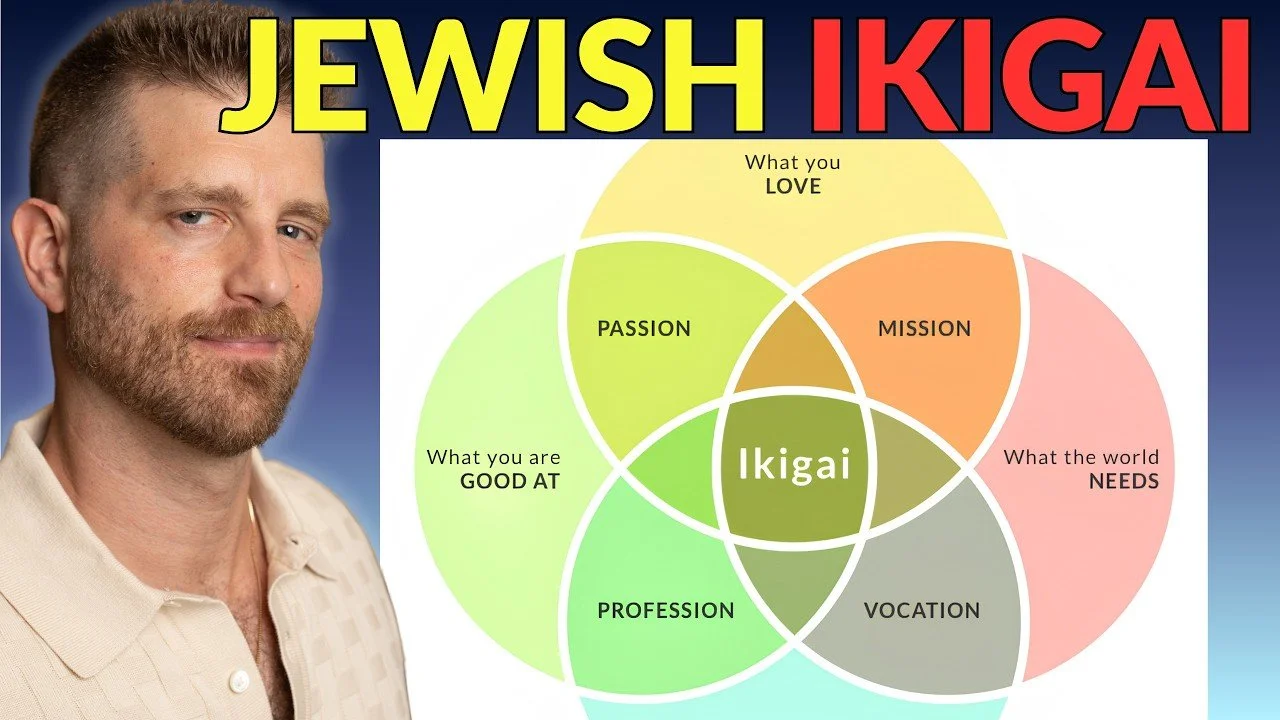
Now, as I researched for this monologue, I learned that in true Western fashion, the concept commonly understood as ikigai is not only not how the Japanese think of it, but was actually invented accidentally by a British blogger who, after watching a TED Talk about Okinawa, slapped the word onto a diagram designed by a Spanish astrologer, which then spread like wildfire through self-help books, HR seminars, and life coaches, evolving into a full-on global industry.
Super Western-y of us.
For the Japanese themselves, the concept is not so deep.
Ikigai is whatever small thing gives your life joy, be it your morning coffee, time with your grandkids, a hot bath, simple daily moments that make life worth living.
The Western expansion, however, is undeniably an excellent model for living a life of true purpose, and I think it's the perfect foundation for how to approach meeting this generational Jewish moment in which we find ourselves.
Western ikigai is built upon four core pillars: what you love, what you're good at, what the world needs, and what you can get paid for.
Find the overlap at the center of those four things, and you've found your calling.
Simple, but hardly easy.
I got lucky and happened to stumble ass-backwards into my ikigai, but as it pertains to how we show up Jewishly, I believe it's much more straightforward to actively chart our own course.
So let's look at each pillar we're gonna need for our Jewish ikigai, or as I like to call it, oikigai.
10 out of 10.
First, what you love, your passion, and where it meets the Jewish world.
We have so much work to do on every conceivable level.
Anywhere you wanna dig in is going to be of use.
Let's take, for example, education, which is already in itself a narrow category you might select from all the lanes you could choose from.
Within education, there's early childhood, K through 12, high school, college, curriculum building, school boards, teacher unions, day schools, Israel education, et cetera, et cetera.
The narrower and more specific you can be, the easier time you'll have getting started.
What is the area within the Jewish world that most speaks to you, that most excites you, that gets your heart pumping either with joy or ferocity or indignation?
Doesn't matter.
Think of the one lane that most calls out to you, and if you listen closely, it's definitely calling, and follow that.
If you can't identify it right away, remember this favorite quote of mine from fellow member of the tribe, Mark Cuban: "Don't follow your dreams.
Follow your effort." In the days after October 7th, my dreams were still to continue working as an actor and writer in the entertainment industry, but my effort?
I was pouring all of my time and energy and brainpower into my Jewish community, totally unconsciously and organically.
My true self knew what it wanted to do, even if my rational self hadn't caught up yet.
So however you arrive at it, pick the patch of grass that feels most urgent to you and start planting The second pillar, what you're good at.
Now, you may not have your ikigai yet, but like Liam Neeson in Taken, what you do have is a very particular set of skills, and it's time to use them for the benefit of the Jews, whether that's in a professional or volunteer capacity.
You're an author?
Next story's gotta be a Jewish one.
Cheesemonger?
Make kosher cheese.
Graphic designer?
Seek out Jewish clients.
Volunteer your services to a synagogue.
Create shareable pro-Israel memes.
And it's not just vocational.
You're a great social connector?
Host Shabbat dinners.
Host pro-Israel politicians.
Host a Being Jewish watch party.
Super organized?
Throw a fundraiser.
Lead a school committee.
Coordinate meals for Holocaust survivors.
Big or small, professional or volunteer, everyone is good at something, and right now, we need you to be good at it in a way that benefits the Jewish people.
We can no longer afford the luxury of giving away our best stuff to everybody else.
You must reserve at least some of it for the exclusive benefit of the tribe.
It's time, y'all.
The third pillar, what the world needs, or in our case, what the Jewish world needs.
Now, as I said before, we need everything from everybody, so I don't really view this one as a pillar.
However, it is useful as a gut check.
As you carve out your ikigai, ask yourself, "Am I filling a void, or am I oversaturating?
Am I mission-driven, or am I ego-driven?
Am I tackling something I actually have the ability to execute, or do I require more help than I'm providing by trying to pull this huge project off?" Don't let these questions dismay or derail you, but they do need to be asked if you're gonna contribute something of real value.
The fourth pillar, what you can make money at.
This one we don't need.
Forget about it.
You absolutely, unequivocally do not need to make supporting the Jewish people the source of your income.
If you somehow figure out how to do that, mazel tov.
You've probably found your actual ikigai.
But that's not what we're talking about here, so I'm gonna swap this pillar out for one of my own, the true third pillar of our Jewish ikigai, your sphere of influence.
Everyone influences somebody.
If you're a parent, you have influence.
If you have a job, you have influence.
If you have friends, if you belong to a temple or a social club or an alumni listserv, you have influence.
And yes, even on social media, you have influence.
You don't need to have a million followers to make an impact.
I bet most of you who might think, "Oh, I have no influence," have 200 or 2,000 or maybe 10,000 followers.
Do you realize how insanely influential that makes you?
Imagine if you were speaking to a room of 200 people.
That's a big deal.
So be clear about it.
You absolutely have the ability to influence people at some level in your life So those are the three: passion, skill, sphere of influence.
Let's put them all together.
Say you're an amazing baker, you love bringing people together around Jewish confections, and you work in a medical office.
Bring homemade sufganiyot to the break room and teach your colleagues about Hanukkah.
Boom.
Ikigai guy.
You're a great runner whose grandparents survived the Holocaust, and you're in a fraternity.
Organize a campus 5K to benefit your local Holocaust Museum.
Boom.
Ikigai guy.
You're a parent, you're very persuasive on the phone, and you care about your kids' day school community.
Line up the auction items for your school's fundraiser.
Boom.
Ikigai guy.
It's all important.
It all matters.
Just pick something and go for it.
Passion, skill, sphere of influence.
Ikigai guy And with that, my friends, my work here is done.
Yours, however, is only just beginning