
Interview Transcript
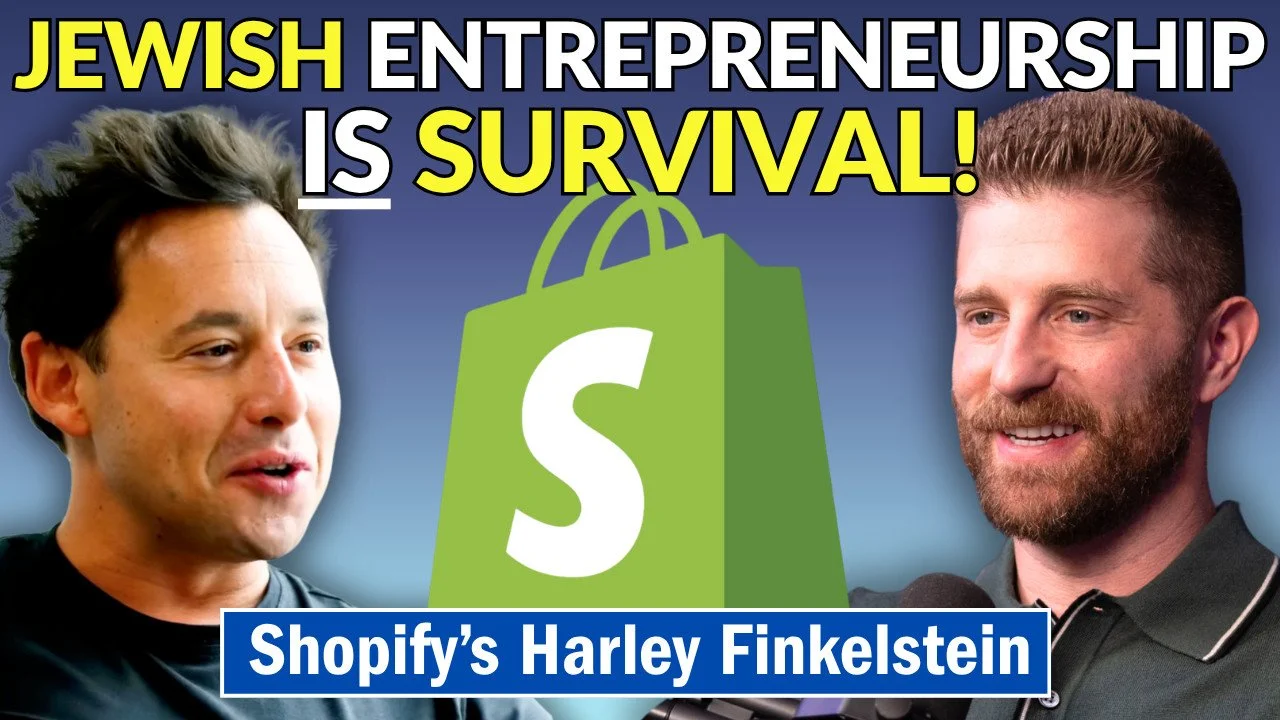
What Makes Jewish Entrepreneurs So Successful (And Modest)? Shopify President Harley Finkelstein
I'm a very proud Canadian Jewish entrepreneur, and I wanna stay in Canada the rest of my life.
They have to understand what it's like to be a Canadian Jewish entrepreneur.
Right.
Now, is there anything tangible you can point to for Jews under Mark Carney versus under Trudeau?
Everyone wants to say they're a proud Jew, but this is actually the time where it is required of you.
Do you feel like something?
Being Jewish has played a role in why these individuals have been successful.
What they are calling advocacy is unequivocally antisemitism, right?
Do things, but just be quiet about it and just stay below the radar.
And I think that worked for a long time.
I don't think that works anymore.
What up?
What up?
And welcome to the show.
I want to kick things off today with a little story.
Imagine you're the grandchild of Holocaust survivors who then had to flee hungry during the brutal Soviet repression of the 1950s.
Now imagine your family works hard to build a new life in North America, only to lose everything during the market crash after September 11th.
Imagine then being unable to afford college.
So you need to earn your tuition money by starting your own t-shirt company that grows from a few hundred items at one school to thousands of items across 50 schools.
Imagine you go to law school, meet your future wife at Habad, and say to the rabbi who operates the Habad out of his house, rabbi, if I make it big, I'm gonna come back here and build you a proper synagogue.
Imagine 18 years later coming back and doing it as the president of a multi-billion dollar e-commerce company that's a household name all over the world.
He's a lifelong entrepreneur, a podcaster in his own right, and a true blue Jew unafraid to live loudly and proudly in the public eye.
Drop that story in your cart and click checkout because it's go time.
Please welcome Canada's top Jew, Shopify President, Mr.
Harley Finkelstein.
Wow.
Welcome.
I mean, I got goosebumps.
Yeah, me too.
Calling me a podcaster is way too, you're a podcaster.
I'm a like, I'm a, I'm a pretend podcaster.
You guys have a lot of episodes.
We, we do.
I mean, but like, it's just, you know, I don't watch sports, so I need something to do on Sundays, so I interview old Jewish men.
I wanna talk all about your show, but, but first I want to.
Talk about your role as this public business Jewish leader.
Um, you are one of Canada's most visible Jewish leaders.
Did you choose that role or did it choose you to quote Spider-Man?
I think with great power comes great responsibility.
That's it.
Yeah.
I think that anyone that has any privilege whatsoever, whether it's financial or fame or a platform, we are not fucking around anymore.
Uh, it is like we are living in like a post, you know, October 7th World.
And I think if you are Jewish and you care about your culture and you have a history like I do where I've holocaust survivor grandparents and I'm a proud Jew, you, you, it, it is the time Now.
It isn't like, well, you know, if I ever need to, I, no, this is it.
That's it.
No, we didn't sign up to be like Canada's, you know, Jewish entrepreneur, uh, poster boy.
But I have a big platform.
People for some reason, uh, listen to me.
And so I take that responsibility incredibly seriously.
It's awesome.
I mean, I, I feel the same way in terms of you, the moment we're in, like, I'm always like, if you're not standing up now, you, you're never.
Yeah.
You're never gonna do it.
Well, it's easy, you know, it's, um.
You know that, that clothing brand Carhartt.
Yeah.
You know there's a, they had this great ad a couple years ago, which is like everybody wants to wear Carhartt until it's time to do Carhartt shit.
Right?
Right.
Like everyone wants to wear like the workman's stuff, right?
Cool mechanic jacket.
But no one actually wants to go and actually like do the actual work.
Right.
It's a little bit like that.
Everyone wants to say they're a proud Jew, but this is actually the time where it is required of you.
And I think, actually, you know, one of the things Jonah, I'm so inspired about what you're doing is.
You are so loud, therefore, others see and say, actually, look how well he's doing.
Being loud.
You are not being ostracized.
You're not being told.
Quiet down.
And I think that gives a lot of other people the confidence that they can do it themselves.
I hope so.
I hope that's true.
Let's talk about social media first, like very openly.
Proudly Jewish on your social media?
Uh, have you always been that way or is that something that's, you know, the last couple years, do you have felt like I need to do this more?
I did it a little bit.
Um, my wife and I, Lindsay and I have two daughters, Bailey and Zoe, uh, seven years old.
Zoe's seven, Bailey's nine, and we started doing a Shabbat Shalom message randomly a couple years ago every Friday.
We hope you had a great week.
We hope you have a great weekend.
Wow.
And then it sort of felt like something had changed post October 7th, where people began to respond saying, thank you for saying that.
And now we've done it, I think every weekend for like three and a half years or four years.
It's pretty cute.
Cute.
It's really cute.
The girls are really adorable for them.
You know, I'm not religious, but I'm culturally, I, I, I really do connect with my, with my, with my culture, my religion.
So I think what I did was I, I cranked up the proverb proverbial volume on all of this stuff too.
The other thing that started to happen that made me louder and a lot more, I think, aggressive about my Judaism.
Is that I had two incidents happen the last couple years that sort of changed my own understanding of.
Jews and our place in the world.
And this was the subject of the op-ed you wrote for the National Post.
That's right.
Which honestly, I'm not an op-ed guy.
Like I'm an entrepreneur.
I'm a, like, I'm a schmutz entrepreneur.
I just happened to have, you know, met the right people and, and for the last 20 years have been building what is now one of Canada's largest companies.
But ultimately, like, I'm, I'm an entrepreneur.
First was, we were filming this podcast called Big Shot, which we can get into a little bit later.
But I, I was doing it, it was the first time we were doing it live and actually we were doing it live at, um.
An entrepreneurship event.
A conference.
Startup Fest.
Startup Fest.
Exactly.
We're there, we're interviewing this incredible entrepreneur who built one of the largest, basically the, the, um, the largest bookstore in Canada, Heather Eastman.
And so we're interviewing her on stage at Startup Fest and.
It like again, the podcast Big Shot is really a celebration of Jewish entrepreneurship.
It's sort of this way of reminding the world that, you know, even though you feel like, you know, Jews are everywhere, we're a very small percentage.
We're 15 million Jews out of seven or 8 billion people.
Yeah.
So the podcast is a celebration of entrepreneurship and, and it's celebration of Jewish culture in chutzpah.
So we're doing this, this podcast on stage, and all of a sudden a bunch of protestors storm the stage.
What does a bunch mean?
Like three or like 30 or 10?
No, like, like two.
Okay.
It was small, but it was aggressive and they, and they rushed the stage and immediately security kind of, you know, jumped on them and, and, and escorted them out.
And it really bothered me.
Not because they disturbed the podcast, but because the podcast was not, it wasn't about Israel, it wasn't a political statement, it was a celebration, a positive celebration of Jewish.
Audacity and Jewish entrepreneurship and Jewish pride, I guess, in some to some extent.
And so that really bothered me and that, you know, again, the thermostat got turned up a little bit at that moment.
And then, you know, your intro is so kind.
You talked about the, the Finkelstein Habad Center that Lindsay and I built.
Yeah.
Which was, you know, uh, I, I grew up, uh, with not a lot.
And for me to have a building stand in the nation's capital with our family's name on it, really matters to me.
And so I'm there and my, my, my parents are there.
My kids are there.
The prime minister of the country is there.
All the, you know, every Jewish politician is there.
And the rabbi that I met when I was in law school as a poor student was standing there, standing next to me.
And I began my speech that I had basically, I had imagined giving the speech for, for years in my head.
Mm-hmm.
And finally the building is there.
It's a beautiful building.
And in the middle of it, I started hearing chanting because the prime minister of Canada was there.
They couldn't get close, but it was across the street and it was clearly that.
It was clear they were there to drown out my speech and drown out the celebration.
At that point, I was like, this has gone way too far because we are masking, we're what they are calling.
Advocacy is unequivocally antisemitism.
Yeah.
This was, again, not about Israel, not about politics.
This was a Jewish community center specifically for students.
A promise I made 18 years earlier.
And there was nothing controversial at all by any, like on an objective, you know, standard Yeah.
About this thing.
Just Jews being Jews and just Jews being Jews, celebrating our Jewishness.
Yeah.
And yet at that moment, all they wanted to do is kind of ruin this thing for us.
And that's after that happened, I wrote this sort of op-ed, which, which became, you know, ma made the rounds because it became obvious to me that like it's not just October 7th and it's not just the history of Jews over the last 2000 years.
Like there is something that has changed.
In the last couple of years that that has created this a new paradigm for being Jewish in the world.
And I think if I'm not going to be loud and I'm not gonna talk about these things, no one's going to, no one's going to do it.
What was the response to that op-ed from, you know, colleagues in the, in the business world, from politicians at all?
I know you said, you know, it's the, it's, Canada has an issue here.
I'm, I'm curious.
It was unanimously and unequivocally supportive.
Uh, and it was, it was es especially supportive coming from people that were not Jewish.
Um, you know, Toby, who's my, my partner at Shopify, it was people that, it was random merchants, uh, like in the business world that reached out and said, I had no idea how bad this got.
Mm.
I think part of the reason that this article had some, there was some virality behind it, was because I think if you were Jewish, you read and said, yeah, that I, I've been feeling that too.
Mm-hmm.
And if you were not Jewish, you read and said.
Wow, this is way worse than I thought it was.
Right.
And you know, I grew up with, uh, as I mentioned, my grandparents were Holocaust survivors and I always sort of felt they would recount these stories of growing up and, and how bad it was for them.
And then one generation later, my father who immigrated from Hungary, as you you mentioned to Canada after the revolution, I grew up hearing these stories of.
Of just people hating us, and I never in my life felt it.
Remember I was born in Montreal.
I grew up in Boca Raton.
Uh, I went to McGill and back in Montreal like I was surrounded by, by the Jewish community.
And so I.
I always understood that it was there in the backdrop, but never in my life did I actually feel it.
And for the first time, I dunno, did I feel it?
I felt it in almost on a, in a, on a daily basis.
And actually, back to the question about like social media.
Part of the reason that I continue to do this Shabbat shalom message every Friday is if you look on, just look at the replies, uh, the public ones on X for example, you will still see a ton of people saying some derogatory, you know, insult, uh, about me being Jewish.
And rather than use that as, um, a reason or uh, a catalyst to do less of it, it's had the opposite effect on me.
I'm doing way more of it.
That's awesome.
I wish that was everybody's reaction.
A lot of people hit that initial wall of, you know, internet blowback and.
Get too rattled and say, well, I'm not opening my mouth again.
Yeah.
So it's, I wonder though, if also like, part of the reason you can do it at your stage and, and, um, I, I say this as humbly as I possibly can and I can do my stage is because, um, I'm at a level now, my company, my business at a level now where I, I think I'm not just going to be the Jewish guy, the Jewish kid anymore, that there, I have other elements of my life that, that have created some level of, of, of respect in the world that.
You know, I think if I was a student doing it.
I would come off like I'm just this Jewish advocate.
Mm-hmm.
Mm-hmm.
First and foremost.
Whereas I think I'm doing it as a business leader.
Right.
And I think because of that, it gives me more credibility.
I dunno if credibility is necessarily the word, because you can be a very credible Jewish advocate, but what it, what it, what it does give you is.
It makes you feel more organic.
Yes.
More honest, more, more authentic.
That's right.
Right.
And my job is not, I don't work for the a dl, I'm not Jonathan Green, you know, uh, Jonathan at a DL my job is running a, a large company.
That's right.
So because of that, I think it creates, it, there's more authenticity to it, that I'm only doing it with the purest motives possible.
Right.
And it's, it's, it almost means more because it's coming from somebody who is not, you know, their bread and butter.
That's, it's a Jewish thing.
That's exactly right.
And I think that's why, you know, this show kind of has to be done.
By you rather than someone who spent their entire life advocating for Jewish rights.
Yeah, because then it would be, oh, this is obvious that you would be doing it, but there's almost like it's unobvious and correct for you to be doing the show.
Mm.
And that's what makes it special.
I appreciate that.
Thank you.
Ha.
Have you had any sort of political engagement within Canada and within, within any of your leaders of trying to advocate for certain changes?
Canada is, uh, you know, a G seven cap, a G seven country, but you know, we're much smaller than the US Yeah.
And for the last 20 years or so, I was living in ot, which is the capital.
And so, you know, it is, um, our relationship to politicians is, is, is a little bit more.
Local.
So I, I know the Prime Minister, our current Prime Minister, Mark Carney.
Um, I've known for a long time, uh, the leader of the opposition I've known for a long time.
The previous Prime Minister lived around the corner from me.
I mean, it sounds a little bit small time, and maybe it is a little bit relative to the us but I've had conversations with all of them about, you know, what I think needs to get done and I push on these things when I see, you know, part of the reason why I wanted, not just the Prime Minister, but I wanted the opposition, uh, the opposition party at this KABAD opening is I wanted.
I wanted to be clear that this is not.
Uh, some sort of party division or some sort of political thing.
Yeah.
That we can all agree that having a wonderful place for Jewish students to gather and feel safe and celebrate their Jewishness in the capital of Canada.
Matters to everybody.
And that visual, there's a photo of the Prime Minister sitting next to, um, the deputy leader of, of the opposition party next to my father.
Mm-hmm.
In the, in the front row.
That photo matters to me.
Yeah.
Because it is very different than what my grandparents encountered, uh, during the Holocaust.
Very different than what my parents, my father encountered when he came from congregate.
It showed unanimous support.
Now, does it trickle down?
No.
I mean, I think, you know, Canada has.
Canada has issues with antisemitism.
I think the US does as well, of course, but I've been able to, because of that position, um, of, of, of whatever power I might have, I want them to understand that I'm a very proud Canadian Jewish entrepreneur and I wanna stay in Canada the rest of my life.
I think they have to understand what it's like to be a Canadian Jewish entrepreneur right now.
And the reason the op-ed was important to me was not necessarily.
To advocate for, you know, some new legislation or, or, or to advocate for some, some change in government.
It was, I wanted them to understand as empathetically as possible, what it's like to be a Jewish person in Canada.
And I could have used an example where I was, you know, at some sort of, you know, um, Israel rally.
And, and, and I encountered some sort of ansem.
I wanted to make it as nonpolitical, apolitical as possible.
So the Big Shot podcast or the opening of a Jewish community Center, again, these are things that across the board are non-controversial.
Mm-hmm.
And yet, in both those circumstances, I encountered.
Hatred that was disguised as some sort of advocacy.
Yeah.
And it's completely, it, it's complete bullshit.
Yeah.
It's just, you're just veiling antisemitism and calling it something different.
Can you feel any shift?
Is, is, is there anything tangible you can point to for Jews under Mark Carney versus under Trudeau?
I know Kearney personally, uh, and two of his closest friends are Jewish.
Hmm.
Um.
I mean, I've had, I've had Mark over to my home for Shabbat dinner.
I never had that relationship with Trudeau.
I think Mark is one of the greatest prime ministers we've ever had in Canada.
And I think, you know, he, it's, it's early, right?
He hasn't been Prime Minister very long, but I am far more optimistic now than I, than I, than I ever was under the previous, uh, prime Minister.
That's great to hear.
The other thing that I think is, is valuable is that.
Mark shows up for these Jewish events when I ask him to.
Mm-hmm.
Not because he is, you know, someone I'm, I'm friendly with, but because he knows it's important to the Jewish community of Canada, and if you actually look at the history of the Jewish community of Canada, like again, small country or a small, you know, uh, Jews generally, there's not a lot of us in the world.
Yeah.
What I, what I learned researching this is that there's more Jews in LA than there are in the entire country of Canada.
That's, and that's totally not surprising.
Yeah.
But there is, there's a disproportionate, um.
Community, like in terms of, if you look at business leaders in Canada, if you look at people that are funding some of the most incredible, even non-Jewish organizations, Jews play a real role in the Canadian sort of ecosystem.
Mm-hmm.
If you think about like, you know, I didn't have posters on the wall when I was a kid of like basketball players or, or musicians.
Um, it was entrepreneurs from me and it was people like really it was people like Sam Broman who created Seagrams.
You had a poster of Sam Broman.
I did, but, but I would've like, yeah, there probably, like, there probably is old guys in suits.
Yeah, I kind of would've had that, if you're right, if that would've existed in the world, that could be a Shopify merchant.
That'd be a very cool, uh, merchant.
Yeah.
You have like, you know, all these amazing, you know, Bobby Kotick up there and you have like Izzy Sharp in the Four Seasons.
Um, but when you think about, when I think about politics, I for, for, I'm not a political person.
I, I don't want to be in politics ever, but I do believe that I am finding it easier to have.
Hard conversations with the current administration that I had previously, and I understand that part of it is, is the fact that the macro has changed that like it is now unequivocal that antisemitism is on the rise in, in the op-ed.
I actually specifically cited data to show when you look at the numbers in terms of antisemitic incidents.
It is on the rise by like an exponential degree.
Right, right.
So I think now we're past the point of is this real?
Now we know it's real.
Yeah.
The next step is how do we fix this stuff?
Going back to your social media for a second.
Yep.
There was a fun, uh, boycott campaign thing against Shopify, uh, because of a, from this Emirati Media company because of a, a tweet that you.
Wrote, which I quote, thanks for saying this.
That was the tweet.
Uh, and thanks was THX, um, you know, you responding to somebody else.
Uh, calling out a news headline saying, this is a, a one-sided news headline.
And because of your response to that, this random Emirati Media company was like, we should all boycott Shopify.
Like, how aware are you of something like that happening?
Does that bother you?
Did you do anything?
You were just like, this is stupid and this will go away.
There are, there have been a lot of those situations where, you know, if you want to.
You see something like that, you, you, you know, they click on my profile, they see that I'm the president of Shopify.
They're like, great large public company.
Let's create a boycott.
Mm-hmm.
I think.
First of all, boycotting anything is ridiculous.
I mean, that's not the way to affect change.
Second of all, it has zero impact on our business ever.
Right?
Uh, and third, I'm just getting used to it, Shopify does not have an opinion about like political affairs.
It is a company, right?
It is a, is an entity, is a legal entity.
Harley is a human being that, that is a leader at Shopify.
I have an opinion about things and I think that, that, that matters first, that matters to me.
So as long as my team.
Feels good about it.
Um, the people that I work with are okay with it.
My, our merchants feel like we are delivering great value.
I don't really care that some random organization, you know, 10,000 miles away from here is trying to boycott me or boycott the company.
I don't think that has an impact, and I think people see right through that.
Yeah.
So I, I, I think I've, I've had to develop really thick skin.
Have you ever had a situation where someone on your team or at Shopify has said.
Hey, I, I need to talk to you about something you said or posted or did just the opposite.
Awesome people, uh, uh, non-Jews message me on Slack all the time about the op-ed saying, I love what you said.
Here I am, you know, Lebanese, or I am, you know, uh, from Turkey, or I am from some country, and I feel exact.
I felt that situation, but I didn't have the soapbox to stand on to write about it.
You did.
Thank you for saying it like they were able to effectively, I.
Replace the word Jew with whatever they are and say, I felt what you felt there, and thank you for bringing light to the fact that like this is going on.
It's not just antisemitism, it's anti all these other isms and it's prejudice.
And so actually the opposite has been true, which is.
We don't wanna work for automatons, we don't wanna work for robots.
We want to know that you, that the people that are leading our company have a strong moral compass and have a high, give a shit factor.
And the give a shit factor should not just be for, you know, commerce and capitalism, but also for the things that matter to them.
And I'm, you know, everything that I've posted, it wasn't that I am right, someone else is wrong.
I'm not trying to like, I'm not invoking some sort of.
Um, opinion, or again, back to the politics of saying this side is good and this side is bad.
I'm just saying like, showing up at the opening of a community center and trying to drown out my speech and yelling, right.
You know, like anti-Semitic slurs at me is not okay.
Full stop.
Yeah.
And so I think actually in some ways, um, it's brought me closer to a lot of the people that I work with because they want to know that like, this guy cares about these things, this matters to him.
And then once, I mean at this point, most people that work, uh, work with me.
And most people that sort of know me, know my story.
They know about my grandparents, they know about my father, they've seen what I've done.
I'm very public on social media.
Um, and they've seen the Shabbat Shaah message.
Actually, the people that actually love the Shabbat Shalom message more than anyone are the non-Jews are saying.
It actually, it's a nice reminder of, you know, it's the weekend.
Yeah.
And like, let's spend time with friends and family.
My initial one was spend time with friends and family, do cool shit, you know, have great experiences, go outside, touch grass, whatever.
And it's, it's, there's nothing controversial about it unless you are looking for a way to attack Jews.
Right, right.
What about the rest of the business community, like your fellow business leaders?
Do you see?
Colleagues showing up in the same way you are, are you disappointed at people who are maybe not showing up and you wish they were like, what?
What's the landscape?
I think there are folks that have the, the leaders that have tried to like just stay out of it.
Yeah.
Um, and I don't pass judgment, but.
I'm more inspired than those that that do.
I think there some people are scared, some Jewish leaders are scared of the backlash.
Yeah.
And my hope is that the more that I do it, the more that they see that they can do it also.
And, and I've actually seen some, you know, after, especially after the op-ed, a few others have actually ridden me and said, you know, that was the, that was the final, like that was the straw that broke the camel's back for me.
I believe I need to do this thing.
I think when it comes to philanthropy in particular.
Yeah, there is real value and I think maybe this is more of a modern way to do it, of actually being a lot more vocal and loud about your giving.
And when I speak to, um, you know, when, when I'm interviewing someone for Big Shot and I ask them about their own philanthropy, some will say we give a lot.
Like in some cases, you know, hundreds of millions of dollars.
Yeah.
But we give anonymously.
It's just our style.
I actually think.
Now in a more, in, into kind of a, in the modern world, I think what that misses is leverage.
Mm-hmm.
That I think by doing things and telling people about those things.
Yes.
It does seem like there's some sort of narcissistic angle to it, or you, you know, you're trying to show off.
Th there may be a part of that.
I, I suppose, I think all of us have a little bit that of that in us, but the other effect is when people watch you do things, they emulate that thing.
Part of why I want to be very loud about this Jewish community Center is I want, there are other places, important cities in the world that don't have that.
Maybe someone sees it and says, you know what?
I'm gonna do the same thing as.
Like I was inspired to do it because I watched Jerry Schwartz at one point and um, Izzy Sharp from the Four Seasons, and you know, these incredible people in Canada.
These, you know, the Broman family put their names on things and I was like, one day, I really hope I can do that myself.
It's interesting, this exact conversation came up a couple of weeks ago with Howie Mandell when I was interviewing him, and he had the opposite sort of tack.
And as, as I'm hearing you talk about it, I, I tend to agree with you, but it does seem it's somewhat generational.
A little bit.
Yes, it is.
Where, where there, there must have something in the air where there were a lot of people doing vanity projects, I guess, you know, or the opposite.
I think what was in the air was there was the sense sort of post.
World War ii, post Holocaust, that it was, we are now distributing, you know, especially, uh, Ashkenazi Jews all over the world.
The diaspora, let's.
Do things, but let's not be too loud about it.
Well, there's that too.
Let's be quiet.
Let's, there's the quiet, and then I think then there's also, and this is what Howie was responding to, the, I want my name on as many big, fancy things as possible and, and it's not a synagogue, it's, I want it on an art museum.
Yeah.
And I want it on, on this and that.
I will say that what I think the Howie strategy misses is that throughout my entire life, watching.
These incredible things get built with people's names on it.
Inspired the hell out of me to do the same thing.
There you go.
Yeah.
It's living proof.
And I get so many messages from people telling me that one day, like, especially Habad.
'cause we can talk Habad if you want, but like Habad is this really kind of special thing to me, to me because like, they don't, they don't, like we were on the beach in Turks and Caicos and literally I was sitting there with my wife and like a hubba rabbi comes up and says, do you want a wrap to fill in?
Right?
And I'm like, sure.
Right.
Like, I was like, how do they even find us?
Right.
But they're, they're unbelievable.
They're everywhere.
They're everywhere.
And they're kind.
And they're nonjudgmental.
They don't care.
You know, if you're religious or not, I want you in.
If I'm not wearing yamaka, they're like, here's my yamikas.
You can wear it while you're rapping till, and it is an amazing thing that they've done.
Um, but after I built it, I've heard, I've heard from countless people, like no exaggeration, maybe 50 people have messaged me over the years to say, Hey.
I'm a student at University of Virginia or Stanford or wherever when I finish, I would love to build something for my rabbi because, you know, our current Chabat house is in a strip mall.
It's a rented, you know, you know, storefront in a strip mall.
That matters.
That is the leverage.
That is how we do it.
So, back to what we were saying earlier, I think there was a generation, you and I have the same vintage, I think of our parents and grandparents where it was.
Do things, but just be quiet about it and just stay below the radar.
And I think that worked for a long time.
I don't think that works anymore.
I think at this point.
We can't be below the radar.
It's not helping.
Yeah, I agree.
I, I'll be curious to see in like 15 years if a bunch of new chabads spring up and I would love it.
I and I for point to them.
Listen, I hope they call me and say like, I'd love to give to those Chabads as well.
Yeah.
I think it's an amazing, that would be amazing.
But that is the flywheel, right?
Right.
What are these centers?
These centers in my speech that that got, you know, that got disrupted.
What I basically is, I was like, this center is not.
A symbol of my success or the fact that I've made a bunch of money.
This is a symbol of like survival that literally like two generations ago, we were in concentration camps and now we're building incredible facilities and beautiful community centers on a personal level, like my, my family's name is on this thing.
My grandfather's no longer around anymore.
There is no way he ever would've thought in 1956 as a survivor coming to Canada on a boat to Halifax, that one day his grandson would put up a, a building like this and put the name, put our name on it.
And if you look at it like a symbol of, of survival rather than a symbol of, of, you know, vanity.
Vanity.
Yeah.
It becomes a lot more special.
Totally.
And it becomes a lot more interesting.
So let's talk about Habad for a second.
Uh, you met your wife there?
I did.
Can you tell us that story?
Sure.
Well, she's gonna hate this, but, um, you know, uh, we met at speed Dating No way.
Yeah.
A success from a speed dating isn't crazy at Habad.
Yeah.
Which, which for all the entrepreneurs listening, it's like elevator pitch competition.
Right, right.
Like it's one hour.
I was, you know, 10 men, 10 women.
We had six minutes each.
And the idea was if you wrote the girl's name, the girl wrote your name, the, you know, they would, they would introduce you what?
After the speed A after it was all done, like a day later, something like that.
Okay.
And so I was like, okay, well the obvious thing to do if you sort of game theory it is you write down every girl's name.
This way you see who picked you.
Nice.
Lindsay, uh, who's not my wife, was the one that I really wanted to, you know, to go out with.
Um, we didn't get matched.
Didn't get matched?
No.
Okay.
This is like 2008, like the primary tool for communication for, you know, early 20 something year old Jews or people was Facebook.
Facebook, Facebook.
Yeah.
So I could message her on Facebook.
I'm like, Hey, like, what the fuck?
Why don't we get matched?
I, I thought we hit it off.
And, uh, she wrote back, she said, actually, I picked you also, we didn't get matched.
So the, the story now that, that, you know, that the Jewish organization says is that they, they, me, they messed up.
It was a mistake.
We started dating and we got married, um, probably four years later.
Wow.
Three, four years later.
And it's been, um, she's incredible.
It's, it's, it's, I am incredibly lucky to have a partner in life like Lindsay.
What did you recognize in those six minutes?
She's beautiful.
She was, and she still is, but it wasn't really necessarily about looks, it was more about I was looking for a partner.
Yeah.
I was looking for someone that, like, together, we would like conquer the world.
Mm-hmm.
And I think more and more as I, as I get older, we've been married now, um, for 12 years or so, um, I think.
You know, we have some friends that are starting to get divorced now.
We're kind of at that age, you know, like we're, I'm 42.
Yeah.
Um, so we're starting to see that.
And just about every, every relationship that I've, I'm, I've, I've seen, I, I've observed where it's kind of falling apart is they were on kind of different journeys.
They were on different tracks, and I think.
Lindsay's ride or die with me.
Yeah.
She was there when like I could, I didn't have any money.
Um, she was there at the beginning of Shopify.
She was there at the IPO.
She was there during COVID when like I was losing my mind because I like being with people and we was like, we, I working from home.
She's been there for every up and every down and she's just sort of been this consistency in my life that has helped me to, to build.
My role models are my maternal grandparents who are still alive.
Oh, that's amazing.
And they've been married for 75 years.
Wow.
And they're, they're incredibly in love.
And and how old are they?
And, uh, 90, 91, 93.
Yeah.
They got married young.
Yeah, they got married young.
Cool.
And, but they have this amazing, um, really it made them married for seven years.
So they got married, I think at 18, 9, 19 years old.
Wow.
And when I look at their relationship, they're like, they're head over heels in love with each other still today.
But I look at the relationship, the key is that.
They love spending time with each other.
They have these little moments like, um, my grandfather, when he was like 80 years old when bought a convertible.
Hell yeah.
And they like, they take these drives to across the border from like to the US because he likes the, the brie cheese better there than in Canada.
And I'll call 'em and say, what are you doing?
We're going for lunch.
Where are you going?
Well, there's this restaurant like an hour and a half away, but they make the greatest rotisserie chicken and we're just going, and then, and I observe them, we take him to the Turks with us every year to the beach.
Um, December.
And I observe them on the beach and often they're just sitting there not seeing a word, but just holding hands.
They're real partners with each other and, and, and they sort of help each other grow.
And I know just because the folks are waiting for it weekly.
Shout out to Courtney, my life partner.
She's amazing.
Go Courtney.
Go Courtney, before we continue, I want to take a moment to share something incredible deep underground in Jerusalem.
As rockets fly and sirens blare, doctors and nurses urgently treat patients.
I'm talking operating rooms, ICUs, even maternity wards, moving below ground in a matter of minutes.
Hard to wrap your head around, but this is what Hadassah hospitals do.
Hadassah, the Women's Zionist Organization of America built these hospitals and now they're working feverishly to expand their underground capacity.
There's an urgent need to equip a new emergency zone with additional beds and to build an outfit.
Six advanced operating rooms so they can continue delivering life-saving care no matter the conditions.
If you're able to help, please consider making a gift@hadassah.org.
That's H-A-D-A-S-S-A h.org.
Your support helps Hadassah continue its life-changing work for the people of Israel.
Alright, so let's talk about Shopify a little bit more.
Um, probably should have had you do this earlier, but for my audience that isn't totally clear, what is Shopify?
What does it do?
It's, it's it's software or a software company, and we make it easy for anyone that wants to sell a product.
Uh, give 'em a way to do that.
So if you wanna build an online store, which is what we're best known for, easy to do that.
Um, but if you wanna sell offline in a physical brick and mortar store, you can do that as well.
If you wanna sell on Instagram or TikTok, or Snap or in Roblox or more recently inside of one of your agentic tools, we make it really easy to do so.
And for 39 bucks a month, you can get started.
And.
You know, I think last in 2025, about $380 billion with a b were sold through Shopify.
Wow.
So it's, it's, it's essentially to translate, it's, it's a sales platform.
Yeah.
It allows you to sell to any customer.
On any service area on the planet.
And, um, we are the brand behind the brand.
So most of the brands you love James Purse, which is my favorite stuff that I'm wearing today.
You know, you, you wouldn't see Shopify when you go to james purse.com, but Right.
We power that and we power most of the brands that consumers love.
You kind of think about, like Amazon is, you go for the things you need and Shopify powers the stores, the things you want.
You went from being one of the platform's, first merchants to now being its president.
Yeah.
That's kind of unusual.
Yeah.
I mean that, how do you, how does that happen?
So if you go back to that story of my grandfather, you know, coming off the boat from Hungary and migrating and immigrating to Canada, I think for a long time, um, entrepreneurship was seen as like the only thing that was possible for someone like him.
Mm-hmm.
He couldn't get a job, he didn't speak the language, he had no money.
So.
Entrepreneurship, first of all, is deeply embedded in my, in my DNA.
It was the tool that my grandparents, my father, used to.
Survive to create a life.
When I finished undergrad, I built a teacher business in undergrad.
I ended up gonna law school not to become a lawyer because a mentor of mine convinced me to become, to go to law school to become a better entrepreneur.
Yeah.
He had sort of articulated ent, uh, law school as finishing school for entrepreneurship.
Mm-hmm.
Which I thought was really interesting.
Did you find that to be the case?
A hundred percent.
I did a joint law MBA at J-D-M-B-A.
Oh, cool.
I thought the MBA was to total waste of time.
Uh, I think the MBA is really good for a networking perspective.
Right.
Uh, but.
Generally, I didn't think that was that valuable, but I thought law school was like, I learned how to write, how to think, how to negotiate, how to be more articulate, how to read 4,000 pages and pick out the one line that matters.
Right.
And obviously my, my Jewish mother always loved to tell everyone, sure.
Hey, my son, you know, he'll be a lawyer one day.
Right.
You know, he.
By that point, I knew that my tribe were entrepreneurs.
Mm.
And so I ended up at a coffee shop with a group of entrepreneurs, and we met every Friday or every Saturday just to talk about our own businesses.
I was in t-shirts.
Another guy was doing some hardware stuff.
One guy was doing a travel company and there was this brilliant.
Programmer named Toby, who were, who was there with us, who just immigrated from, from Germany to Canada, uh, a couple years earlier.
And he was selling snowboards on the internet.
Okay.
And because he didn't like the software on the market to build an online store, he wrote his own piece of software.
That piece of software would, would become Shopify.
And he realized that this snow war business was a good idea, but the software business was a great idea.
And I ended up asking him if I could become one of the first customers to use the product.
And I think I became store one hundred and thirty six one, I think it was 136 or 137 or Shopify.
And I moved my t-shirt business from a wholesale business to a direct, direct to consumer business.
And I spent, you know, the next three years, you know.
Taking whatever I could from a skill perspective outta law school, but really building this online store.
And then when I finished, uh, when I finished law school, I called Toby.
I was like, look, there is no greater catalyst for entrepreneurship than this.
This, this piece of software is magic.
When you combine ambition with this, these, these, these lines of code, you end up with a business.
That to me is magic.
And I joined him and, and.
Basically two other engineers and I became kind of the first non-engineer at the company.
Wow.
And that was almost 20 years ago.
And it's been an incredible ride.
But over the years I've sort of figured out that like the thing, the way that I can add the most amount of value at Shopify is storytelling, finding, you know, getting more merchants on the platform.
Uh, talking to our investors, the media, the public, helping sure that the, the internal team understands the mission, the culture of the company.
And so, you know, ultimately, um, this current phase I'm in is, is being Shopify's chief storyteller out of, in, in a, in a very, you know, at a large scale.
And it's been, it's been the ride of a lifetime.
Alright, so now I do want to get into your podcast.
Yeah.
Big shot, which we, we teased at the beginning.
Uh, this is something you host with your partner David Siegel.
Yeah.
And, um, it is described as an archive and celebration of Jewish entrepreneurs who took risks, overcame the odds, and created legendary businesses that changed the game.
Where did the idea for this come from and what are you hoping to achieve with it?
How far are we from Hollywood right now?
Uh, 20 minute Drive.
Okay.
So here's something fascinating.
If you look at the original Hollywood Studios mm-hmm.
It's MGM and Warn, MGM, warn Warner Brothers warns.
I, I don't know the rest of them, but, but, um, I knew the names.
Yeah, there were a bunch of them.
If you look at the founders of those studios, they all grew up within, I think, 30 kilometers of each other in Poland.
Right.
The cultural zeitgeist of not just America, but in the world, the founders of those studios that created the cultural zeitgeist.
If Warsaw is like right here, they all grew up within 20 kilometers outside of Warsaw.
That is insane.
Yeah.
I can basically use that same lens, that same formula across so many in industries from.
Seagram's to Fiji Water, to the Four Seasons Hotel, to Activision Blizzard, to the Carlisle Group to, I mean, so back to this idea that I pray at the altar of Entrepre.
I'm deeply passionate entrepreneurship, but I also, I'm a student of entrepreneurship.
I love what entrepreneurship is and how it operates, and I'm just, that's, the books I read are all about business.
So I met David Siegel, who's my best buddy, the year I was taking Shopify Public.
2015.
He's the founder of a company called David's Tea.
Mm-hmm.
David's Tea, I think is probably the most successful tea company ever created.
Um, he was taking David's Tea public that year.
We met, he was, happened to be in Ottawa.
I was too.
We met, we started hanging out and he also like praised the altar of entrepreneurship.
And we were started talking about like the connection between.
Jews and entrepreneurship, and there's a bunch of interesting theories and ideas around it.
You know, one is like nobody wanted to go into banking, and so like Jews, we built our own.
We, we exactly.
Nobody wanted to do this other thing, so we did this other thing.
No one wanted to be, you know, doctors and so, you know, and then we became doctors and then eventually they didn't want us in the hospitals we built like Cedar-Sinai.
Exactly.
The list goes list goes at Yeshiva University.
So there's all these stories around the connection between entrepreneurship and, and, and, and Jews.
You know, people know the obvious stories that are out there, the big stories people know about Zuckerberg, for example, right?
Like Mark's amazing and, and everyone knows about Meta, but you know, people drive by the Four Seasons all the time.
In any city and they're like, wow, what a beautiful place.
But no one really knows who Izzy Sharp is, right?
And we began to kind of have these discussions just casually about like all of these incredible companies and all these incredible businesses that were built by by Jews.
And in many cases we realized that a lot of these original founders of these iconic businesses, they were getting older.
And they weren't gonna be around for that much longer.
And no one's actually captured the stories of these iconic entrepreneurs, Jewish entrepreneurs especially.
No one's done it in a way that like, like there's no archive of Jewish entrepreneurship.
We sat down with, uh, Charles Bronfman.
Mm-hmm.
You, you kind of have the rothchilds in in Europe and the Bromfords in North America.
Yeah.
They created Seagrams and, and so many others.
I mean, they own, they owned Universal and they owned Tropicana or Tropic for a while.
It's just amazing story of, of entrepreneurship.
Eastern European Jews come over and build this empire.
So we sit down with Charles Broffman, who's uh, in his nineties.
Yeah.
And we say, tell us your story.
We sat down with this guy, Aldo Benson from Aldo Shoes.
Mm-hmm.
Moroccan immigrant doesn't speak the language when he comes to Canada, builds an Empire Shoe empire.
And we began to kind of do this as he sharpen all these sort of things.
And so we have these stories now that we've recorded pretty much just for our own interest.
Hmm.
And we slowly began to leak them on the internet.
We put it on YouTube and on Apple Podcast and, and Spotify and all these sort of things.
And we expected nothing.
It was like David and I do not watch sports on Sundays.
So instead watching sports.
We meet these legendary Jewish entrepreneurs, usually in their seventies, eighties, nineties.
And we just interviewed someone in their, that's 103.
Wow.
And we don't wanna hear about, you know.
They're private jets.
We don't wanna hear about their trust funds.
We wanna hear about their Shabbat dinner table.
We wanna hear about who's the first entrepreneur they've ever met.
We wanna hear about legacy and what that means to them.
We wanna know why they got started in the first place, and we've created now.
And we've done about 30 episodes.
We've created this incredible archive.
You know, yesterday we, I'll just, I'll leak it on your show.
Yesterday we were with Jeffrey Katzenberg and Barry Diller.
Huge, incredible stories.
You know, everyone knows who Jeffrey Katzenberg is and Barry Diller, but what they don't know is like.
Katzenberg was actually Barry Diller's assistant.
Whoa.
And what they don't know is like, you know, Katzenberg was fired from Disney by Michael Eisner, and then when started Dreamworks.
Right?
With Spielberg.
Right.
And Geffen.
Yeah.
And, and how that all kind of worked.
And so for.
So we created this, this show, this project, this, this podcast called Big Shot and it is this labor of love.
We don't have any sponsors.
We, Dave and I funded ourselves, right?
We asked these questions and we put together this incredible archive, and it's been, it's been amazing.
And, and it's again, you know, it's of the stories are just like mind blown.
We interview.
Uh, Linda Resnick.
Do you know who that is?
No.
Okay.
So she owns the wonderful company that's, uh, Palm and Fiji and, and like I think pistachios, 75% of the, of, of the pistachio market is built by.
Wonderful.
Right.
And when you talk to her and her husband Stewart, I mean, they started by doing like they own the Franklin Mint.
Which like, there was a catalog and like, they were like, you know, you can buy Marilyn Monroe fake Pearls.
And from there they created this mahogany monopoly set.
And then they met someone who made, who had this like idea, like for a water company.
And that became Fiji.
Um, and Mickey Drexler, you know, basically he created Old Navy, but he ran the Gap for, for, for so many years.
Um, Larry Silverstein buys the Twin Towers a week before nine 11.
And like tells that story.
So we have this archive of some of those iconic, legendary Jewish entrepreneurs.
And for the most part, none of 'em have ever done a podcast and they don't do interviews.
Right.
Right.
They're below the, you know, like under the covers and, and they don't wanna be loud about being successful and being Jewish.
Mm-hmm.
And I think we've encouraged them.
As they get, you know, into their later years that it behooves them to tell their story.
We met this guy, his name is, um, Eddie Sunshine.
He created, um, he created basically the real estate investment trust concept.
Okay?
Okay.
He was born in Bergen Belsen, uh, displaced persons camp, and he ended up in Canada and his father hid, I think they had one single item, one single asset to their name was a diamond, and he hid it in the boot of their shoe.
And because of that one little diamond, he was able to get a little house and they came to Canada.
Wow.
And then he was able to send Eddie to law school.
And then Eddie ended up becoming like his company's called Rio Can.
It's this huge multi-billion dollar public, uh, public REIT now.
But you hear where these people come from.
I had a hard time.
You mentioned the opening that, you know, my, my, we lost everything.
Yeah.
In 2001, um, my, my dad wasn't around, wasn't in our lives for, for a while.
He was in prison.
And so I've had a tough, uh, relative to some others, I've had a tough time.
But relative to all of these people.
Right.
I, it was easy street for me.
Right.
So when you hear these stories of these unlikely entrepreneur successes that have built in, in like billion dollar empires and many of them come from absolutely nothing, poor immigrants that have, it's just, it's remarkable.
Is being Jewish a coincidence connecting all these people?
Or do you feel like something about being Jewish has played a role in why these individuals have been successful?
It's the question I ask every one of them.
What is going on here?
8 billion people in the world.
There are 15 million Jews.
There was this fascinating, um, uh, reel or, or you know, segment that I saw on Instagram.
Yeah.
The Joe Rogan one.
Did you see this?
No.
So someone was on Joe Rogan's show, I think a couple weeks ago, and a topic of Jews came up and someone said, how many Jews do you think there are on the planet?
I think Joe Rogan said a billion.
Wow.
It was, it was some number, some insane number.
The guy pulls out his phone and shows him 15 million.
Right.
And it's like, it's mind blowing.
Why?
Because it's so disproportionate.
Right?
It doesn't make any sense.
Even like if you talk to people that you know randomly in the street and you say, how many Jews do you think there are on the planet?
They're gonna say a lot more than there are.
Oh yeah.
So what is going on here?
How is it that a group of 15 million people that everyone, you know, that generally have, have escaped persecution, not just like in the last three years.
And not just in World War ii, basically like the history of 3000 years.
3000 years, right?
Like the story of every Jewish holiday is someone tried to kill us, right?
So what is going on here?
What is in the water here?
Yeah.
And honestly, and so I ask all these, all these incredible big shots, what is going on here?
And, and if I had to word cloud their answers, yeah, it would come out to one single term, which is something I'm, which is something that I'm trying to teach my kids.
And that term is grit.
Grit there is.
They've had to develop these calluses, these proverbial metaphorical calluses, whereby they can't rely on anybody else.
They can't rely on society or their community.
They can't rely on the government.
They just figure it out on their own.
Some people will call it hard work.
Others will say, you know, perseverance.
But the term that I'm sort of, that I've in, you know, we've done 30 episodes, so you know.
45 hours, 50 hours of interviews.
What, what I'm circling around is that the reason that Jews have been so disproportionately successful in business is, is grit.
The other question I ask, which I think you're gonna find super fascinating, Jonah, which maybe is a burden for you and I as, as we're much younger than these people are, um, still, I asked them when they know, when they knew they made it.
Hmm?
When did they feel like they were a success?
Yeah.
None of them said they've made it.
Not one of them.
Come on.
Remember, these are billionaires.
Yeah, I know.
Self-made billionaires that are titans of industry and Aldo.
Uh, the, the shoe, you know, this, this shoe maven, who's, you know, has a huge company and anyone around every mall in the world, every, all has an Aldo shoes.
I didn't know he was Jewish.
Yeah, he's Jewish.
Amazing.
I asked him, I said, and you mean?
He said, I haven't made it yet.
I said, what do you mean?
He's like, he, he said, I still worry about.
My, my monthly burn, like basically his monthly expenses.
Sure.
He's 85 years old and he's still worried about, like, there is this anxiety that we all have that.
I think is incredibly powerful motivational driver of, you know, building, doing, um, organizing, um, working like it's amazing, but there's no off switch to it, right?
This DNA has been, I think, in us for a very, very long time, and when you direct it in the right way and you, and you point it to the right challenge.
I think you ended up building incredible things.
I wonder how much of that, you know, like if you did a series, the same series with non-Jewish.
Billionaire success stories, would they, would that grit be the de you know, the, the common denominator?
I that it's just a, an entrepreneur thing, less so than a, a Jewish entrepreneur thing?
It could be like, you know, it's a little bit of, of, you know, correlation versus causation.
Yeah.
I, I think about that as well, actually.
I actually find that a lot with immigrants when I meet, when I friends that, that, you know, are non-Jewish, but, but are immigrants.
They have that, that mentality, if we got, I gotta just get it done.
But there is something, the, the, the Venn diagram overlap of Jews and entrepreneurship.
Is something to be studied.
Totally.
And I'm studying it totally.
I will tell you the dark side of big shot, which is that as part of, so most people that I ask to be on Big Shot again, they're in their seventies or eighties or nineties, or in their hundreds.
In some cases, most say Yes, they, they have a friend on the show or they've seen the show and they want to, they wanna be part of this archive.
It's a pride thing.
But every now and then someone says No.
And I always have a call or I meet them and I just, no problem.
I'm not gonna pressure you, but I just wanna understand why not.
Yeah.
And the person I met with last night just said, Hey, look, I'm super private.
You know, he's a very, very famous man.
And he is like, I'm private, I don't want to do this.
I was like, no, I, I respect that.
And we actually ended up having a, a big shot episode, but it was just private.
It was off the record.
Right, right.
But the people that often say no to me, um, will say, I don't want to rub it in the world's face that we've had such success.
Right.
I don't wanna give people an additional reason.
To hate us.
Yep.
And I don't say this lightly.
That breaks my heart.
Yeah, because back to how we started this conversation, I think it's important that not just Jewish young people get inspired by hearing their stories, but I think the world should know that the story of the Four Seasons is not a story of marble floors or London hotels.
It's a story of a motel on the side of a highway.
In Toronto.
Wow.
And that this guy who has no money, no connections, was able to create one of the greatest hotel brands, one of the greatest brands in luxury of the last century.
And he did it with like no help from anybody just because of his own grit.
So I view that as like, I want people to understand where this all comes from.
Yeah.
I don't want anyone to think that.
You know, Jews are successful in business because someone helped them, or, you know, they, they got some sort of leg up or they've had some sort of advantage.
The only advantage that we've had is we have no choice, and that's what I want the legacy of Big Shot to be, I hope, um, long after I'm gone.
Yeah.
This, this is a similar discussion that I had with Jason Alexander on the show where, you know, talking about.
That, that tendency for certain Jews in certain industries, Hollywood business, to sort of shy away from celebrating their excellence because, you know, what are they gonna say about me?
Yeah.
And my response to Jason was, well, they're saying it anyway, so you might as well actually own the thing and, and celebrate it and feel good about it.
Carter Cooling any of your show.
And, and also I think to, to a lesser degree to big shot is that a lot of people that watch it are not Jewish.
Yeah.
Right.
And that's like them understanding how this all happened.
The unlikely.
It is unlikely that a small.
Portion of the population has had such an important, has places a role, this ripple effect on, on business and culture in the world?
I'm very proud of that.
I want my kids to see.
We should be.
Yeah.
And I want my kids now that I, now, you know, I want Bailey and Zoe to be proud of being Jewish.
And so your show and, and, and big shot and all the things we're, we're doing.
To me, it's just another way of just increasing the thermostat.
There's this great Rabbi, rabbi Tobe, um, who says there are two types of people in the world that those that are thermometers that go into a room, read the temperature and whatever temperature is, that's what they.
That's the temperature.
Okay.
There are other people that go into a room and they're thermostats.
They change the temperature in the room and the the room energy changed.
You, you've, I mean, you're, you're kind of like that, right?
Sure.
I, I hope some, some days I'm like that too, where I bring my own energy to a room and I change it.
I want these things that we're doing, these Jewish initiatives to change the, the, to change the thermostat and increase the energy on, on all these things because these are not stories of brag.
It's not about money.
It's not about what they've been able to achieve, it's about the impact they've had despite the hardship that they've, that they grew up with.
Right.
And that, I think, makes it different than a bragging thing.
Right.
Right.
Somebody proud of.
If you just heard that sound, that means Harley and I just finished doing our five deep questions, which of course you can only check out if you are part of our Kechi la the subscriber only community, which you can join@bingjewishpodcast.com slash community.
All right, we're gonna finish things off Harley, as I like to do on the show with Little Game, and I have created one just for you.
Wow.
This game is called Shopify or Shopify.
I am going to describe a business to you, and you're gonna tell me if this is a real Shopify product or something that I made up.
Okay?
Black Insomnia Coffee, over a thousand milligrams of caffeine per cup.
Real Shopify Shopify's correct.
Snuggle, bugle, baby wraps, organic bamboo swaddle wraps for newborns.
Shopify, I don't know it, but it sounds like it's something that would exist.
Shopify not real.
Not real.
Someone should real that little Chunk.
Backpacks specifically designed to carry dogs on the New York City subway.
I, I've said Shopify for all of them.
So I have to say Shopify for this one.
Shopify.
There's a store.
There's a real store.
Wow.
It was like a viral thing.
This woman made it for her dog and they sold millions and millions of product.
Amazing.
Good girl snacks.
Their product is hot girl Pickles.
I know it well.
Okay.
I think her name is Mar.
Her last name is Marcus.
Her dad's David.
David Marcus.
It's amazing.
I tried to not go with like the big winners on Shopify, but I guess I missed one.
All right.
Crunch, freeze dried raw honey.
Sold in bite sized pellets.
That feels like it's fake.
It's fake.
Yeah.
I am not.
Okay.
Vegan Cheese brand.
I'm gonna say yes only 'cause it's such a good name.
It is a real Shopify Good name.
Yeah.
Good name.
Good.
I am not.
Okay.
It's pretty good.
Very la.
Uh, yeah, totally.
Or may, may, maybe more organ.
Okay.
Fire belly tea.
A premium loose leaf tea brand described as 21st century tea.
That is absolutely Shopify.
That is my little side hustle with David Siegel.
David, as I told you, David's tea.
David's tea, uh, and David used to keep in his desk.
Tea that only he would drink very high end tea.
Okay.
And when he left David's tea 10 years ago, he kept drinking it.
And back to my anxiety, I can't drink coffee in the afternoon.
If I drink coffee afternoon, like after 12 o'clock, like I can't sleep at night.
Hmm.
So I told him this and he is like, you should try super high-end green sensa, Japanese ensa.
Yep.
And so he started curating all this amazing tea for me and he created a box and kitten accessories.
And in during the pandemic we were hanging out and I was like, why don't we start this?
So we started fire belly tea.com and now we have this tea company, which is like, it's all the stuff he wanted to, he wanted to sell it when he was at David's Tea.
But it was just like, that was more of like, you know, mid-range tea.
This is more high-end and it's, if you like tea or you like.
Frank, if you like energy and you're an entrepreneur, like green tea, whether you buy this one or not, you don't have to, but is like, I love tea.
I love Japanese tea.
Oh man, I drink a lot of Kudo Amazing too.
Yeah.
So that matcha cia.
Uh, but I think we have the greatest, uh, tea in the world at at at Fire Belly.
Um, I think, like you're asking me to sponsor the show now, which is, Hey, let's do that.
Um, sprint, a carbonated energy drink made from sprouted oats and functional mushrooms.
Oh, that sounds fake.
It's fake.
Yeah, it's, it's 'cause of the name.
Dead giveaway.
Sprint.
I know.
Sprouted and functional.
Yeah.
Um, grunt, premium weighted blankets filled with buckwheat husks.
I, I don't know that one in particular, but I know there's a lot of weighted blankets, so I'll say yes.
Fake, fake, fake.
But you know, weighted blankets are a thing, of course.
Right?
Yeah.
It's actually very good for those with multi-generational anxiety, apparently.
Okay.
Yes.
Let's get you one.
Yeah, let's make grunt.
Yeah, that's right.
Uh, skull bliss.
Handcrafted animal skulls for home decor.
Definitely fake.
Definitely real, real Shopify.
You're kidding.
Yeah.
No skull bliss.
Wow.
Yeah.
Bush bomb pubic oil.
I know, I know the founder of that company.
Okay, there you go.
It's a, it's a Shopify rims.
Shout to David.
Taint tonic, a pH balancing peroneal spray for post-workout freshness.
Oh, I hope it's fake.
It is fake.
Okay.
Okay.
Hut denim jeans from a Welsh town of 4,000 that makes only jeans.
Yes.
You know that one?
Yes.
Amazing gun mustard.
Artisanal whole grain mustard from a single farm in Bavaria.
Can you say the name again?
Gun, fake mustard.
It's fake.
Yeah.
Yeah.
Wow.
You were, you were on that one.
Tushy, a $69 bidet attachment.
You underestimate how many stores.
I know.
I, her name is Mickey.
She's a founder.
Amazing.
And I love Tushy.
Okay.
It's great if you don't have a bidet at home and you want a bidet, tushy, tushy Is Tushy ISS the one for you?
I just like that it costs $69.
It's pretty good.
Yeah.
Yeah.
She's an amazing entrepreneur.
Yeah, that's, there's a lot of creativity there.
Uh, okay, now we're gonna end with a couple of Jewish ones.
The matza kitchen, artisan flavored Matza, chips and flats.
Fake, real, real, real.
Yep.
Yeah.
There you go.
So that's good.
They, they do like sea salt and everything.
Bagel vetch, kitchen, a line of hot sauces and condiments inspired by Jewish deli culture.
Fake.
Fake.
All right, and our last one, mazel Tove Mothers a Jewish wedding gift registry platform where every item is pre-vetted by a panel of Jewish mothers to ensure it's actually useful.
I think it's fake, but it should exist.
Harley, this has been awesome.
Thank you so much.
It's been such a pleasure.
Thank you for having me.
Really appreciate it.
Oh, yeah, you got it.
Massive thank you to Harley Finkelstein for traversing the continent to share his love of being Jewish with all of us.
Hope you get home safe.
If you dug this episode, share it.
Click that little share button, throw it in the WhatsApp group, blast it on the email chains.
This show is only as impactful as you help it to be.
All right, that's a wrap.
I'll see you right back here for the next s scum episode of being Jewish with me, Jonah Plat.
Before we end, I'd like to thank Hadassah for their life-changing work in Israel in these challenging times.
To learn more, visit hadassah.org.