
Monologue Transcript
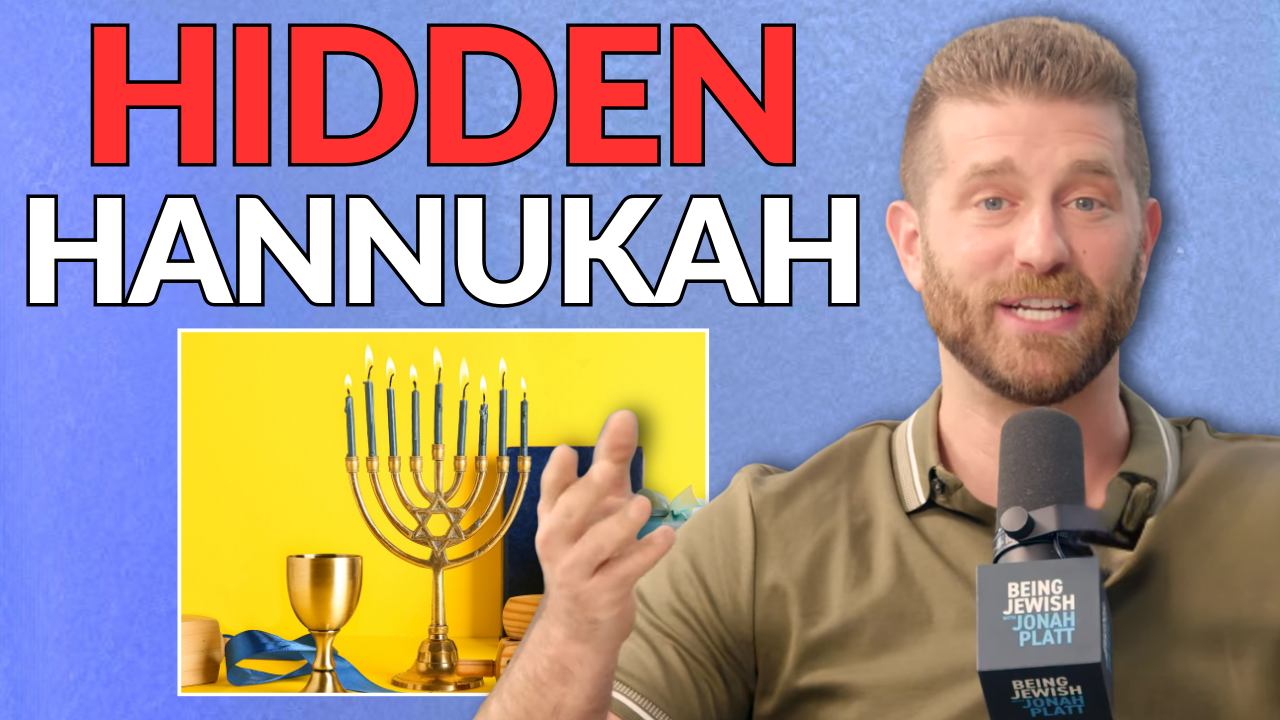
The HIDDEN History of Hannukah: Maccabees, Civil War, and Why It Matters TODAY
I am spending Hanukkah in Santa Monica.
I'm wearing sandals, lighting candles by the sea.
Hi, I'm Michael Jule, and here's a little Hanukkah theme
monologue to mark the occasion.
One of the most incredible things about the Jewish story is that there are endless
reflections and connections we can mind to bring meaning into our lives, wherever
and whenever we engage with the past.
And I think you'll be surprised to learn how much guilt there is to unwrap in
this particular Hanukkah holiday tale.
The classic narrative we all know is of the Maccabees successful rebellion
against the Lucid Empire, which is a fancy name for a branch of Greeks.
Post Alexander the Great shout out to Al.
We've talked about this Greek oppressor aspect before on the show
with author Darrah Horn who coined the term Hanukkah antisemitism.
That is the Greeks saying there's absolutely nothing wrong with you Jews as
long as you give up circumcision and Torah and Shabbat, and other things that are
key components of your Jewish identity.
Of course, the parallel to today is obvious.
That's now in order to be accepted by the majority in certain
leftists and far right circles.
AKA, the soat lucid empire, one must renounce their connection
to Israel, the very land in which this Hanukkah tale takes place.
Now, the line is there's absolutely nothing wrong with Jews as long as
you renounce any and all emotional attachment you may feel to the Jewish
homeland or the people who live there.
However, there's also a key part of the Hanukkah narrative we don't speak
much about, and that's the second front of the Maccabees fight, the
Civil War against Hellenized Jews, AKA Jews who did relinquish parts of their
identity in order to assimilate into and be accepted by the Greek majority.
At every high stakes moment of Jewish history, there have been some Jews
willing to give it all up for acceptance.
Thus, it would appear to be somewhat unavoidable that some should fall into
this trap now, which is disappointing, but also in a way kind of reassuring
the anti-Zionist Jews we see today were inevitable in the loop of
history and entirely unoriginal.
But lest you misunderstand me, I'm pointing this out because I hope
to avoid the path of the Maccabees.
I do not want a civil war with my fellow Jews.
The answer to our schism is not battle.
That doesn't serve us in the long run, no matter how satisfying
it may feel in the moment.
The answer, as hokey as it sounds, is love.
We need to look for ways to bring our brothers and sisters in, not bring
them down, or at the very least, we need to strive to thrive in spite of
them, not as a result of their defeat.
Now you may be thinking F, that the Maccabees won and
established their own dynasty.
That sounds like a thumbs up to me.
Well, the dynasty, the Hashim crumbled, which led to the Romans stepping
in, destroying the temple again and exiling the Jews for millennia.
Why did they crumble?
Because like all religious extremists, which is what the
Maccabees were, they went too far.
Once the true enemies, the Sids were defeated.
The Maccabees didn't shift away from an aggression mindset.
Didn't put down their swords, didn't enact some moderate inclusive
vision of the Jewish future.
Rather, they were messianic zealot priest kings, who forced Jewish
conversion on their neighbors through violence until infighting and corruption
opened the door for Roman conquest.
Said another way.
You had a Jewish government infused with extreme Messianic religious
beliefs that led to ill-fated, territorial expansion, corruption,
civil war, and ultimately collapse all in the name of Jewish supremacy.
Thankfully, this regime was an historical anomaly that the rabbis basically
buried from the Hanukkah narrative and which has not repeated itself yet.
Like the smashing of the bottle at a wedding ceremony to remind
us of pain amidst the joy.
We must remember that within the triumph and hard won independence
that Hanukkah celebrates.
Our ancestors also sowed the seeds of their own destruction when
they let religious extremism and absolute power go to their heads.
A more positive reflection we can take from Hanukkah is in looking at
the way it's celebrated today and what that says about us as a people.
Most non-Jews assume that since they celebrate Christmas, at the
same time, we celebrate Hanukkah.
Our holiday is as important to us as theirs is to them.
But as most Jews can tell you, it's really not.
We don't go to temple to recite a special liturgy.
We don't have to stop working like we do on regular biblical holidays.
Heck, we don't even need challah because there's no official festive meal.
So why does it carry such weight in the modern Jewish calendar?
Because like the tradition of keeping our lit manure in the
window, the idea is to make Jewish continuity visible to our neighbors.
Hanukkah has meaning because we decided it should, and that is one
of my favorite quiet lessons of the holiday that in Judaism, meaning
isn't fixed, it's conferred by us.
Hanukkah didn't become central because ancient rabbis elevated it,
but because later Jews needed it.
Living as a minority reshapes how Judaism is practiced and in Christian
societies, Jews need rituals that are visible, joyful, and home centered.
Hanukkah fits the bill perfectly.
It's portable, non clerical, and practiced on our window sills and kitchen tables.
It reminds us that cultural centrality isn't necessarily
connected to theological weight.
There is much more to being Jewish than legal obligation.
Judaism is not fixed as any movable snapshot from 2000 years ago.
It's a living, breathing, never ending story, and one of our most
important traditions is how we adapt old ones and adopt new ones.
Speaking of adapting, here's a fun fact.
The earliest sources tell us that the first Hanukkah was
actually a delayed sukuk.
A holiday.
The Jews couldn't observe during the fighting.
So when the temple was reclaimed, they celebrated it late.
Eight days for Sukkot, eight days for Hanukkah.
The takeaway here is that Hanukkah is not simply a celebration
of resistance or victory.
It's a restoration, a catchup moment of joy and rededication
after disruption and loss.
How terribly relevant this idea is to us today that even when war interrupts
the flow of our lives, even when we can't imagine business as usual.
Judaism insists we can always return when the chaos abates
still find joy and celebration.
Still take time to mark what matters, even if it's later than we planned.
For another element of Hanukkah that's weirdly resonant today is the humble
dra, you know, the little spinning top the Jews would use as cover for
their tourist study when the Greek soldiers would bust into their homes
looking for illegal Jewish activity.
Except that didn't happen.
The Dral was a much later edition, likely adapted from European spinning
top gambling games with Hebrew letters and meanings assigned later.
You see how easy it is to accept folklore as fact to embrace a narrative without
the slightest skepticism or critical examination, and it's not throwing
shade on the trade, which has become a fun and integral part of the Hanukkah
tradition, but let it be a reminder to us of how important it is to question.
To excavate ideas before incorporating them into our minds as truth.
And last to wrap things up, present, pun intended, the most important part of the
Hanukkah story, the miraculous jar of oil that lasted for eight crazy nights,
except there was no miraculous jar of oil.
Not a part of the JI Hanukkah history.
The oil miracle actually shows up centuries later in the Talmud during
a very different era of Jewish existence when the temple had been
destroyed and our sovereignty was lost.
At that point, the Jewish story was no longer about military might and
wouldn't be again for thousands of years.
Instead, the rabbis shifted the focus from physical dominance to spiritual endurance.
From we one to we are here from fight to light.
This Hanukkah as my family and I light the candles and eat the lakas
and spin the European gambling tops.
It's that last idea.
I'll be holding onto that.
While success on the battlefield is obviously critical for
survival, it is only the means to an end, the real victory.
The key to our resilience is ensuring that our miraculous oil, the Jewish spirit.
That holy spark of goodness in each of us is what needs to shine most brightly if we want to endure for another 2000 years.
So happy Hanukkah, and may we all turn our fight into light.
This is the 52nd episode of being Jewish with me, Jonah Platt.