
Monologue Transcript
Israel's President Isaac Herzog Speaks: Iran, Lebanon, and the Election That Could Change Everything
Watch and Listen
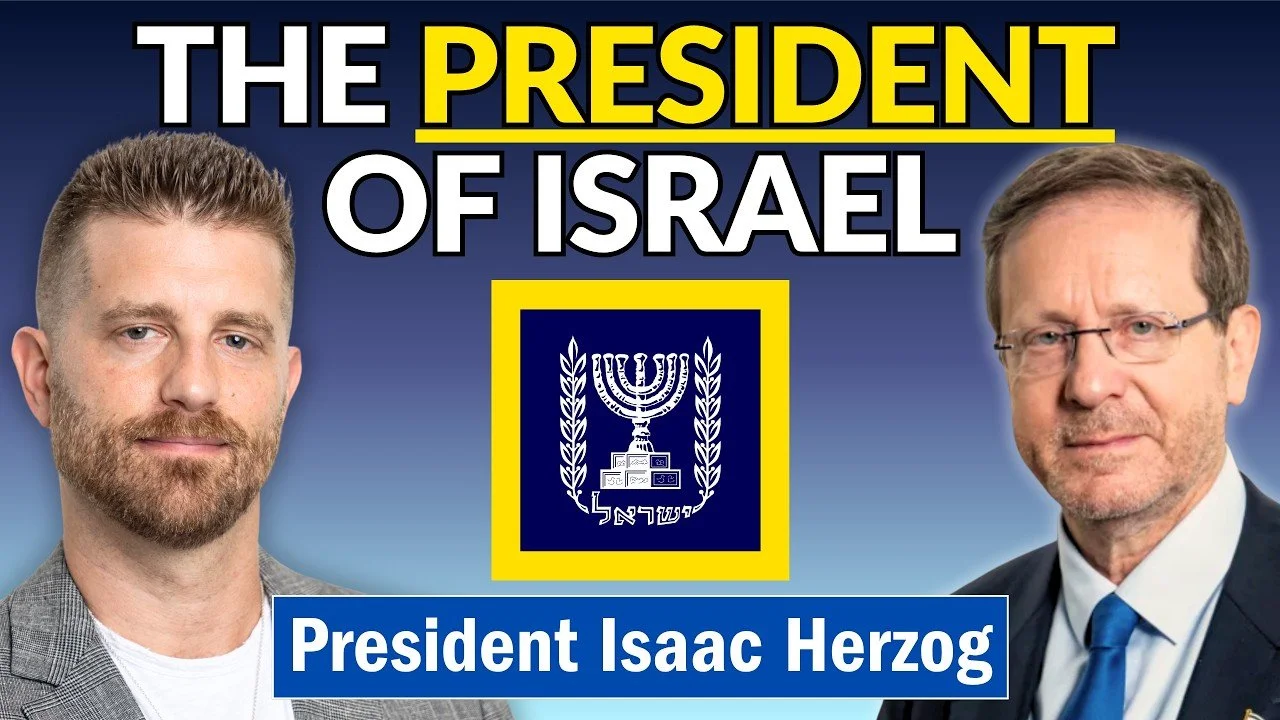
Today's guest is the president of Israel.
Uh, that's it.
That's the whole intro Mr.
President, thank you so much for being here today.
Thank you very much, Jonah.
It's an honor to be in your podcast.
The honor is all mine.
President Herzog, I would like to note for our listeners and viewers that your family and my family actually have a history together.
You know, I look for the rosy cheeks of the Baron family.
The Baron family mythological rosy cheeks.
It's unbelievable.
One, I, you know, I've recently bumped into a letter from, uh, my gr- late grandfather, Chief Rabbi Herzog, to your great-grandfather, and, uh, Mr.
Schiff, asking for support, and there's even a picture when Mr.
Schiff, uh, was it a prime ship?
He came to the Holy Land, uh, to Israel, and he went and they took a picture in the local garden right nearby, not far away from here.
And then, of course, the relationship has continued to the current generation, where you and my mother have a wonderful relationship.
Your mother is awesome.
She's a great Jewish, uh, leader, uh, your family, your aunts and uncle.
I believe that each generation should take a lead role in doing whatever it can to help the community, the congregation, the Jewish people, the state of Israel.
This is our role.
«Bechol dor vador», we say.
And when we say it in the Haggadah, we say, you know, that those who come out to annihilate us in each generation, when you think about it philosophically, it may be correct, but you also, on my mind, in every generation, you have to rise up and do things, and that's why I'm very proud of this interfamily, intergenerational connection.
You and me both.
So Mr.
President, some of my viewers and listeners will not be as familiar with your role and how it functions within the state as many of the constituents obviously that you're used to speaking to.
So if you would, just to kick us off, h- how do you see your role as president, and, and in the role right now, what are your key priorities?
In Israel, we adopted the European model, which is, uh, quite similar to the English monarchy, meaning a head of state who's non-executive, who's a unifier, who's above politics, who deals with major, major issues and questions, but not deal with politics per se.
Uh, you know, in America, the president is the head of state and the head of the executive branch.
In Israel, it's different.
So my role has a lot of content, huge amount of content, but doesn't deal specifically in the decision-making process of the executive branch.
Now, the way I see this role is, of course, something that has to do with the immediate and long-term challenges.
And Israel, in the last three years have been, has been at war.
And my role and my, my mission in life is to support and strengthen the nation to get through this enormous crisis in its history more unified, and especially make whatever efforts I can to unify the Israeli body politic, to unify the nation without demanding unanimity.
That's not relevant.
That's not possible.
We're a debating nation.
We're an arguing nation, but I'm trying to lead the nation to obey the basic norms and rules.
That's a perfect segue for what I wanna begin by jumping into, which is some of the demographic rifts within Israeli society, sort of the, the key headline that's been hovering over the Israeli people i, is this divide between the Haredim who don't wanna serve in the IDF and the more secular population who believes that every able-bodied person, and, and even otherwise, should be serving in the IDF.
Uh, this week the Knesset advanced a Torah study bill to enshrine Torah study into the law, um, essentially exempting Haredi Jews from serving in the IDF.
Very contentious.
W- what's at stake for your country with this conversation?
The way you described it is somewhat superficial, and I understand that's the way to kind of boilerplate it, but it's not true.
Right.
It has to be much more, more elaborate.
First, we are 10 million people in Israel.
It's a big country in relative terms.
In '48, 1948, we were 600, and I re- I made a very big pre- speech at the IDC in Herzliya earlier the week saying, "We've changed, and we are ever-changing.
We're evolutionizing.
We're a nation in evolution, and we are multifaceted, multicultural, multiethnic, and we have to see that as an advantage." You can either keep on crying, moaning, and yawning, or you can say, "It's a hell of an advantage.
Let's use it for the benefit of our nation." We're incredible people.
We have incredible people.
We are a nation under huge pressure and challenges.
My wife and I have met around 2,000 bereaved families.
Every day we go either pay shiva or meet.
Today I met an incredible family.
They made Aliyah from France, a fantastic family from Jerusalem, and they started in Eilat.
So you hear the stories.
Now I get to your question.
So part of the, uh, raison d'être of our nation as the nation state of the Jewish people with, of course, everybody being equal in the country, is the… There has developed an, a conflict between what you'd call Jewish and democratic because we are a Jewish and democratic state And the devi- the, the debate is evolutionized because you have more traditionalism, you have people dealing with issues of faith, you have issues of religion, like you have in the United States, but in a different manner.
There are things in Israel that are not at the discussion zone at all.
For example, as opposed to the United States, the issue of abortion is not an issue in Israel at all.
Okay?
And it's not that it's not a, a religious or a halachic issue, but it's resolved.
Here comes and enters an issue which has been from day one a question in Israelis, who is obliged to serve in the army in obligatory service at the age of 18, and who is exempt?
The law exempted the Arab community, except the Druze community where they already in the beginning stages of the state signed a treaty where they are part and parcel of Israeli, um, conscription, uh, obligations.
And there was a big huge debate from the beginning about the yeshiva students.
Now, yeshiva students, you have… The yeshiva world is one of the greatest gifts that the Jewish people, the whole yeshiva studies, uh, system is one of the greatest gifts that the Jewish people have developed for themselves, maintaining their Jewish identity, sharpening some of their brilliance, and their incredible contribution to humanity starts from the fact that in the yeshiva studies from day one, you ask questions and you cast a doubt, and it's a whole unique system of learning which is extremely onerous and difficult.
And the yeshiva world in Israel has evolved dramatically also in America and elsewhere, and it includes Zionist religious, an incredible group of Israeli citizens who have contributed immensely to Israeli security and Israeli society in all spheres of life, Israeli management, Israeli leadership, what's not.
And they serve in the army automatically, and they, they actually have huge mobilization rates, and they are heroes, and they have made a huge sacrifice, ex- uh, including in the last war.
And you have the Haredi, the ultra-Orthodox, which is a multifaceted community by now- Of course … including huge amount of facets, some mobilized and some, most of them exempt.
The debate on the exemption has been going on for generations.
They say, "We are defending the, the, the nation by studying," and it means studying.
It means studying day in, day out for months every year.
But of course, when people go to serve and people go to serve, they risk their lives.
Our sons and daughters have gone to serve in a huge challenge, uh, again and again and again in reserve duty, in war, and of course sacrificing and being wounded in battle.
And it kind of, uh, brought up and put a major focus on the debate within Israeli society, and the views have developed into a major conflict, argument, and debate.
So the law you mentioned is a first call on a law which says this is a value, otherwise, or, uh, otherwise we don't want any future law about the process of mobilization with the Haredi world to be abolished by the Supreme Court.
Previous legislation has been abolished by the Supreme Court as non-equal, and I've been involved with it for decades, and now everybody's trying to find the right formula, and we are dealing with it in our heated political debate and in the center of the Israeli election process, which will take place, the elections, in October.
What do you feel is at stake with these upcoming elections for the country?
These are gonna be quite heated elections, and my role and my aim is to make sure that Israelis participate in these elections, feel free and at ease to express their opinions, go and vote and realize your duty and the right and the incredible right you have to decide where the country goes, and get through the elections With reasonable, you know, arguments and conflicts, but not deteriorating, God forbid, into violence or anything like that.
And this is something that may sound to you natural and ordinary, but these are very heated elections after a major watershed in our, uh, history, October 7th, and, uh, the war that ensued.
And I'm… will do more, whatever I can to protect, preserve these elections and make sure that they are free and fair and equal for all.
Why are, is this particular election so heated?
To sort of come back to my question of, you know, what are the stakes?
Help me set the s- the stage of, of what's at stake here.
Since the last elections, first ni-… 2023 was a very, very conflictual year within Israeli society.
The whole debate about the legal reform, which was presented by the government, erupted into a major volcano of a debate within Israeli society.
Another epitomization of the conflict between Jewish and democratic, the interpretation, and the blurry boundaries between the three arms of government.
There's a major debate as to the exact boundaries of the three arms of government.
As part of those days of huge debates and, and, and protests, I presented my own, um, proposal, which was a compromise which protected and defended the rule of law, and also created the, uh, in my mind, the correct boundaries between the arms of government.
These are issues that have not been resolved from the beginning of our, uh, foundation.
They ought to be resolved as part of our inherent constitution, and, uh, I'm sure this will be one major debate.
The other debate, of course, and the most heated one, will have to do with the consequences of October 7th.
And I don't wanna go into the whole debate, but it's clear as to how does one transform and translate the responsibility of the leadership, the responsibility of the army and the security agencies, and of course, how does one inquire and investigate the faults of October 7th?
And a, and a lot of emotional debate around it.
And of course, the key questions that we always know, economy, uh, what, uh, w- peace process, the Middle East, the future with our neighbors, the Palestinians, and of course, uh, the, the war with Iran, and so forth and so on.
And it will also be epitomized according to the personal questions of the leadership.
I know we here in the diaspora are, are watching with bated breath to see what will happen there.
Obviously, there's a, a spectrum of political belief and leaning here as well as, as, as we reflect on what's happening in Israel.
But certainly, uh, at least one of the camps is a concern or a, a hope that there will be a change in government that might lead to a, a turning down of the volume of the challenges that we in the diaspora face right now, the, the rampant anti-Jewish sentiment and, and there's a hope that with a change things might quiet down.
Is there any discussion about diaspora when it comes to the outcomes of, of this kind of an election?
So first of all, I- it is very important for me to relay to our listeners and viewers that this is another great example of the greatness of Israel.
People tend to forget we are a vibrant democracy.
People by the millions will go and vote, and one has to respect this democratic process in Israel.
Rather than all those bashers and haters of Israel keep on blasphemizing and lying about Israel, they ought to come and see for themselves.
This is a vibrant, active, impressive democracy with a range of views, unbelievable, from the biggest spectrums you can imagine with Arab Palestinian parties going all the way to the extreme right parties.
We have the whole view and the whole spectrum, and I'm very proud of it.
I understand what you're saying.
Of course, I don't intend to go into that because it is a political opinion within elections, but I would say that I expect the issue of the, the Jewish world and the impact of Israel on the Jewish world to be discussed.
Honestly, to be honest, because of the huge amount of issues on our plates, it's not the top priority, but I was happy That the Jewish Federation of North America, headed by Gary Turow and Eric Fingerhut and their leaders, have signed with the Israeli government this week an agreement regarding Jewish day schools and the support that Israel ought to give to Jewish day schools and to pupils all over the world and in the United States.
I know Jewish day schools are expensive.
We want to strengthen and enhance Jewish education in all its multifaceted nature of Judaism.
We want to see more and more kids join those schools.
I welcome this effort, I congratulate it, and I support it.
And I believe that the story of the Jewish people should be very much in the minds of Israelis.
I'm trying to promote it as much as I can.
Remember my initiative, Voice of the People?
Mm-hmm.
It's an incredible initiative that convenes 150 Jewish leaders from all facets of Judaism around the world, from Israel, from the United States, and the rest of the world.
The next cohort will open for registration later in the year, and I invite people to join and register, and then it will be, they will be selected by an algorithm and which has so far has done immense success in introducing us to Jewish voices which we haven't heard or known in Israel, and also Israeli voices to Jews around the world.
One of the main objectives of mine as President of the state of Israel, the only Jewish nation state of the Jewish people in the world, is to get the Jewish people closer so that Israelis get to know the Jewish story abroad and Jews around the world get to know the Israeli story in a more intimate manner.
This has been a real pillar of, of your leadership for, for a long time, of trying to strengthen this relationship between Israeli Jews and world Jewry, and so I, I'm curious how you see how October 7th has perhaps changed that relationship.
What, what's shifted or evolved in the last couple years?
It was a watershed moment that will be regarded for centuries.
Guys, we're in it.
All of you are waiting in it.
Yeah.
And hasn't gone, hasn't faded away.
It exposed, first of all, major questions in Israel, uh, regarding, you know, our, our trust of our neighbors.
Is there a future for peace?
Yeah.
Uh, of course, our immense resilience, our, the heroism of a young generation that went in and still goes.
Imagine that young Israelis, some of them spent six months in a year now in wearing uniform.
I know it from my own home.
It's changes your life, it changes your education, your job, everything, your plans.
The nation has been mobilized whilst it's yearning for peace and wants to see change.
So that's a watershed moment in Israel and will be discussed heavily, of course, also in the elections, and it has been a watershed moment for Jews all over the world.
First, after October 7th, we had months and months of convoys of Jewish faculty from campuses around the world, from universities in the United States mostly, coming to Israel And, you know, they came to strengthen, but they also g- received a lot of solace and strength because they came harassed, and they told us terrible things about what's going on in American campuses against Jews and people who, who believe in Israel and in Zionism, and what has gone on in faculty and what's going on in internal politics.
I remember one major faculty member for a very distinguished university saying to us, "For 15 or 20 years," he said, "we've been walking on broken glass, you know, as Jews, as Zionists.
We can't say anything or write anything, otherwise we'll be blocked in the way we are promoted, our papers will not be published in the journals," and a lot of other things which we weren't aware of.
We heard, but we haven't seen.
I'm happy that there is a pushback in many universities.
I'm happy that things happen.
I met university presidents who came to Israel, and I met them also around the world to discuss it, and, and there was a pushback.
In many universities, people got fed up with those encampments and protests and riots which were full of blasphemy and lies on Israel and the Jewish people.
But antisemitism has not faded.
It has risen its ugly head all over the world, and also in the United States.
We know it.
We are worried.
We care.
We tell everybody, "We are here for you.
You have our backs." And I think it involves and includes using legal tools, educational tools, community tools, leadership tools.
And I say to everybody, everybody who came here, I said, "Fight back.
We're in it together.
We're absolutely in it together." So this brings me to my next question, which is, w- what do you think is the right balance?
I mean, you, you've talked about how Israel is both democratic and Jewish.
How do you strike the balance between being an Israel that prioritizes its Israeli citizens, w- as, as a country, a regular country should and would, and the fact that it is also the homeland of a Jewish people who are spread all over the globe?
How do you, how do you strike that, that balance?
Wonderful question because it has been there from day one.
David Ben-Gurion sent a letter to 70 Jewish thinkers and leaders around the world and in Israel in those days, in the early '50s, saying, "How would you define-" The nature of, uh, who's a Jew and a Jew… W- or, you know, the dilemma between Jewish and democratic.
He got beautiful answers.
Now we all, we're all on the web, we're all connected.
We have institutions.
We discuss them at length, and I'm very respectful of all these Jewish organizations that I keep on meeting and having incredible discussions with.
It will always be the question, but I believe, and this is my point I'm putting a major focus on, is educating Israeli leadership to be aware of the needs of our brothers and sisters around the world, to understand the diversity of Jewish life abroad and its wealth and its richness, to understand the various streams in Judaism, which some of them are less present in Israeli public life and discourse.
To understand that things they say or legislate or decisions they take have direct impact on Jewish communities and Jewish life abroad.
To think how we protect and preserve and help.
To strengthen the connection.
To introduce each other to each other.
That's why you have these beautiful shlichim and, and emissaries in communities and in schools, on campuses, in order to intrus- introduce each other to each other.
All I'm saying is that rather than growing disparate, we have to grow more united, more aware.
We can have our arguments and debates, but now the equation has changed.
Israel and the United States both have the major pillars of Jewish life by the millions, let's say six and a half, seven million each.
The rest of the Jewish world has about three million, but at the end of it all, we are a small nation amid- amidst a sea of eight billion human beings.
We have to do whatever it takes to continue to preserve our her- great heritage, to be united, to understand that we are under constant threat, which was always there, and on the other hand, to keep doing good and contribute to the world.
Jews and Israelis are doing great in contributing so much to the world.
I'm so proud of it, but we are under attack all the time, and we have to raise our heads and voices and tell our real story.
Amen.
Speaking of being under attack, um, as we've sort of been touching on throughout the conversation, Israel has been involved in war for the last several years.
Uh, I w- I wanna talk about two of those fronts, uh, the first being Lebanon.
These things are very touch and go and happening very much in real time.
How real do you see the current opportunity for a sort of lasting peace being?
So I'll say that the recent, uh, MOU which was signed in the State Department in Washington last Friday Uh, under the auspices of Secretary of State Marco Rubio between Israel and Lebanon is a major s- breakthrough for peace.
Well, I'm not naive, okay?
There is a major element there blocking it all.
Name is Hezbollah, a pros- proxy of Iran, uh, fed up to its neck with armaments and ammunition and funding.
A major enemy of Israel, one of the biggest armies in the world, which has been hit very hard by our brave soldiers, including its leadership.
Iran, in its agreement with the United States, have kind of tried to bring itself into the Lebanese situation and having, like, a veto power.
The new MOU, the way I see it, uh, neutralizes it, uh, and, and removes Iran out of the equation.
And the negotiations are quite impressive between Israel and Lebanon because both nations seek peace with each other.
We don't have territorial conflicts.
We demand security and safety, and not at every, uh, terrorist organization can violate the border by sending missiles on our citizens and on our north.
Hezbollah violated the Security Council resolution, which lasted 18 years, in, uh, on October 8th, and thereafter, the ceasefire agreement which was, uh, carved in 2024.
So we are not willing to accept it.
Right now, we have a security zone under our control in Southern Lebanon.
I believe that the international community should support the Lebanese economy and stability and support Israel's safety, and this is being discussed at length between the parties concerned.
So I'm giving it a chance whilst understanding that for that you need to remove Hezbollah or of course, uh, disarm it, get it out of the, um, front line and make sure that there is a solution to remove them out so that our citizens are safe and Lebanon can thrive.
How likely do you think that is in reality that Hezbollah can actually be removed, that it will be politically popular enough within Lebanon to really go after that goal?
Or is this just gonna be sort of a, a stopgap and we're back at it?
The Lebanese leadership is, uh, is showing, uh, courage, and I commend them for it.
We don't have a war against any part of Lebanese society.
We definitely, we don't have a war against the Shiites, the Christians, the Muslims, uh, of all facets, and the Druze.
Uh, we respect all of them.
We have a war with Hezbollah because that's a terrorist organization which de- literally hijacked the country And now the, you know, the political echelon in Lebanon is showing the major desire to move forward with the support of the United States and the international community, and we are willing to do that.
And that has to be part of the grand deal of exiting from the war.
It's obvious to me.
And they cannot blackmail us from Lebanon or anywhere else.
It has to do with Iran as well, naturally.
And the same goes for Gaza, by the way, because in Gaza we control 60% of the Gaza Strip.
There is a UN Security Council decision resolution which was almost unanimously passed, adopting a 20-point plan of President Trump and the Board of Peace, establishing the Board of Peace, calling for the disarming of Hamas, and n- uh, that's the next phase, and bringing in a technocrat government to Gaza, meaning bringing hope to millions of people in Gaza.
And we are willing, we said we are willing to withdraw once this moves on.
That's part of the point plan, the 20-point plan.
But right now Hamas is refusing to disarm.
So we know two major proxies of Iran are ref- are refusing to disarm, and that will have to lead to brinkmanship.
And we will have to get to a moment where the international community, the United States supports Israel and supports these agreements.
They, they brought them forward, and I'm sure they want to do it, and I hope it will be the right thing.
President Trump for being, and his administration, for being so proactive in getting to these agreements.
Now we have to implement them.
So now let's bring it back to Iran, to that front.
Exactly.
The head of the snake, the source of it all.
And that is the big issue, because Iran has been the source of evil in our region and around the world for decades.
I call them an empire of evil because they're using proxies, they're taking their people's money, and they spend billions of dollars, billions and billions of dollars taking from their people's money and income and spending it on hate, war, terror, terror cells all over the world, murder, havoc, killing Americans, calling America the big Satan, Israel, the little Satan, using a major missile program and rushing to the atomic bomb.
This cannot be accepted.
It's a major danger to the world.
And we here in Israel, where I'm sitting here, we are the buffer, we are the wall, we are the protection of the West, of the free world, Europe.
And the world has to understand it.
They don't usually understand it.
Today, this morning, I had a very mo- moving, uh, moment in my life I went and knocked on the door of the American ambassador in the American Embassy in Jerusalem to congratulate the American people, President Trump, the Congress on the celebration on marking 250 years to American independence.
I went as the president of Israel and the head of state of Israel.
I brought in a special letter to President Trump thanking the American people for this wonderful alliance, blessing them on their anniversary, and of course congratulating them on their huge contribution of the United States of America to the free world and its values.
And one of the issues then, I sat down with Ambassador Huckabee, who's a dear friend and a wonderful person, and I thanked him, and we discussed at length this geostrategic development in our region with Iran as the head of the S snake, as we call it, and its proxies, 'cause Ambassador Huckabee is heavily involved in the negotiations with Lebanon.
And we discussed the fact, as I wrote in my letter, that United States and Israel drink from the same fountains of the Bible.
We have the same set of values.
We are vibrant democracies, and we should be strong together in combating this empire of evil and also changing the reality so that we have peace and pursue peace in our region.
This is what we are eager for.
This is what we want.
Peace with all our neighbors, including the Palestinians as well.
In this pursuit of peace, um, which has taken the shape of war b- f- on, on Israel and the US against Iran, how successful has that been?
You know, where, where has the needle moved, if at all, today from where it was six months ago?
So fir- we have to remember, October 7th was a major, major shock to us And a wake-up call, and our nation regrouped and woke up as a lion, really in biblical terms at times I think of it, 'cause I see the, the bravery of the people and how much they are willing to go together and, and fight and defend our nation.
And we've changed reality in the Middle East, and I think now it's an opportunity and it's the right moment to try to reach amicable agreements and carve out peace in the Middle East.
It's not far away.
We've created a NATO-like structure in the Middle East, which is really impressive with allies and friends and neighbors, some above board, some less above board.
We can change the whole relations between Jew and Muslim.
I'm dreaming of the day we will have agreement between Mecca and Jerusalem, Riyadh and Israel.
We can connect the whole world to the Far East through our region.
We can change reality.
It takes time.
We're in it right now.
We're in the war.
It has ups and downs.
Believe me, these are some extremely, extremely challenging and difficult moments, but it's human made.
It can be resolved.
It can… It requires courage, boldness, and also to stand up to the Iranians and tell them, "Get out.
Go build your nation and stop bothering us." And hopefully their nation will wake up and bring change for themselves.
Do you feel that Israel has accomplished what it's wanted to accomplish on the Iranian front, or was able to get to what it wanted to before the ceasefire was arranged sort of without Israel's input between the US and Iran?
The issue is now that it takes time to translate it into full-fledged results.
There are results on the ground in the military sense.
There are other results.
There are disputes and arguments.
We've raised our concerns regarding the Iranian nuclear program and of course the funneling of funds to Iran and where it will go to.
It's all known.
It's no secret.
But we're in the process, and we have now to get to the touchdown, as you would say.
So you are now more than halfway through your seven-year term as the president.
Uh, I, I wanna just take a, to sort of bring us to a close, take a look at the, the past, the present, and the future.
How would you grade yourself on your job so far looking back over these first five years of the job?
I'm not grading, I'm not grading myself.
This is, uh, you know, something I'm not used to doing.
I don't like talking about myself so much, but I'll tell you I really don't think there's been any term equivalent in office to an, for an Israeli president in this term because of the enormous challenges, a major rift in our democracy, a major war, which we haven't seen since our war of independence in its magnitude, from seven frontiers, enormous threats, people in shelters, resilience, bravery, heroism, sustainability, incredible economy, which has moved forward, incredible innovation, wonderful people, and major dilemmas.
Major.
It's like by the hour.
Yeah.
We, of course, have a major political dispute in our society.
We're going through major political decisions.
It's all on the plate.
But I'm humbled.
I see it as my meaning, as, as the book of, you know, the great book of Viktor Frankl, Man's Search for Meaning.
Mm-hmm.
This is my meaning.
This is my being.
Serving my nation, leading it through this turbulence so that we can get to our 80th, um, anniversary of the state of Israel more or less more united and safer.
So now let's jump to that 80th anniversary, which is, you know, 2028, when your term will finish.
What do you hope to be able to say was accomplished between now and that moment two years from now?
I hope we'll be able to reach, uh, understandings on the legal constitutional, uh, divide and move forward, meaning some pieces of legislation that will carve out the boundaries in a way that protects the independence of the judiciary and enable clear horizon of relations between the three arms of government, and it ought to lead to a compromise, which I've proposed already.
I hope we'll be safer and stronger.
We'll have ceasefires around, and agreements around our boundaries so that our nation can go back on track with less mobilization.
I hope we see more elements in our society taking roles, assuming responsibility in many facets.
I hope we'll be able to drill deep, deep into the question of what happened October 7th and have a national catharsis.
All these things are very important to us emotionally and mentally.
I hope that all our wounded and agonized and pained people, and there are many, receive some solace and comfort.
This is what I'm looking for.
That's a lot of work to do in the next two years, so how do you find the energy?
You know, what, what inspires and motivates you to keep doing this work day after day after day?
Look, I have an inner, a, an inner engine that drives me forward.
I inherited it from my previous generations.
I take things in proportion, meaning I know how to analyze, analyze historical consequences and look back and to the future because I have a multi-generational viewpoint, and I'm a freak of history, so I can gather and compare cases.
And I always think about it, think of my grandf- my grandfather was chief rabbi of the land of Israel before the creation of the state, and then the first chief rabbi of Israel.
He was like the pope.
Rabbi Herzog was a giant and a scientist and all.
But imagine that how many people knocked on his door and told him, "My relatives out there in Europe disappeared.
Can you save them?" And he, he couldn't do anything How many yeshivas, how many Jewish institutions?
They're all eradicated.
Or my father, who was a war hero in World War II and later on in Israel's wars, he was one of the first officers of the British Army to walk and enter Bergen-Belsen concentration camp, and he saw skeletons moving in pajamas on the floor.
And when he started speaking to them, they thought he's a Nazi perpetrator, and he spoke to them in Yiddish.
And he said, "I'm an officer from the la- from Eretz Israel.
I'm here to save you guys.
There are more Jews in the world." And they didn't wanna listen until they relaxed and started being fed and cleaned with, you know, huge amount of Jewish bodies lying there rotting in the sun.
Okay?
So there's proportion.
Then they fought for Israel's independence.
Then we built the most incredible nation, incredible people.
It's my duty to express this story and give the nation proportion.
I know it's difficult.
I know.
I'm… Believe me, I absorb an enorm- enormous amount of pain and agony and anger and what's not, but I also see great moments of pride and joy, and I'm trying to relay it to my nation and tell my nation, the people of Israel, "Be strong.
We will get through it together.
Jewish people all over the world, be strong.
We'll get through it together." Amen.
Amen.
I love that.
Thank you so much.
To end things, as I like to do on this show, we're gonna do a little lightning round.
And I have my Israeli version of the lightning round that we're gonna do that I call Ze or Ze?
Okay, let's try it Upper East Side or Upper Galilee?
Oh, of course, Upper Galilee.
It's beautiful, but I grew up in the Upper East Side and I always loved it.
Machane Yehuda or Carmel Market?
I love Machane Yehuda.
Ramas or Tel Aviv University?
Well, I love Ramaz.
Look, Ramaz influenced my life big time.
Ramaz is a great Jewish school.
I'm very proud of Tel Aviv University, but Ramaz impacted my life.
Goldstar or Guinness?
Guinness, of course.
I come from Irish roots.
It doesn't really matter.
There's nothing you can do about it.
Sabich or shakshuka?
I cook shakshuka.
Mm.
I, I make delicious shakshuka, and even recently, the president of Switzerland met me in Davos and said, "I wanna come again because you have incredible shakshuka for breakfast." Wow.
Chocolate milk in a carton or a bag?
That's old stuff, man.
Where did you get that from?
Well, I u- I used to have it in a, in, in, you know, in, in the plastic bag.
It is, as a child.
Bamba or Beasley?
Bamba by far.
Wow.
And I give you a secret.
I dr- when I dr- I drive all around the country.
You know, I'm running all around the country and I get hungry on the way.
I take a, a little packet of Bamba and it saves me.
It saves my life.
Wow, what a, what an endorsement.
Kibbutz or kibboots?
No, we don't kibbutz.
We love kibbutz, and the kibbutzim are the, you know, one of the greatest gifts of- our movement to humanity because it's the greatest and perhaps the only success of socialism in the original ideological sense in the world.
And the kibbutzim have been amazing, amazing, um, people and the kibbutznikim, and of course, the way they defended and protected our borders.
Maccabi or Hapoel?
So I'm a Poel fan, Hapoel Tel Aviv.
Yesterday, I inaugurated the Maccabi games, the Maccabiah, with 5,000 athletes, Jewish athletes from all over the world.
It was fantastic.
But in terms of sports in Israel, I'm a big fan of Hapoel Tel Aviv.
Nice.
Kissinger or Kushner?
First of all, I'm a, I'm a good friend of Jared Kushner, and I have huge respect for him.
He's brilliant, and that's good.
Uh, I'm reading now a book of Henry Kissinger, which it was a huge honor and pleasure for me to know, and I even called him to congratulate him on his 99th birthday.
Wow.
And wrote him a letter on his 100th, and he sent me a beautiful letter back.
I'm reading his book about six figures that impacted the world that he knew, and it's a brilliant book, and I'm gaining a lot of insight, and for me, it was a great teacher.
Arak or Iraq?
I don't drink arak.
It's, uh… People like it.
Uh, as you know, it's, uh, something special, and, uh, it's made of anise.
But, uh, Iraq, uh, you know, the Iraqi Jewish story is so incredible.
We don't speak about it.
Like two weeks ago, I convened a gathering to mark 85 years to the Farhud.
The Farhud were pogroms in, against Jews in Iraq, pogroms we don't speak about.
We had survivors from the pogroms, 97-year-old, 100 years old, 92-year-old ki- people who were kids in the Farhud.
They all made Aliyah.
The Iraqi Jewish story is the Babylonian Jewish story.
It's an amazing story because we had the Babylonian Talmud.
Fauda or shtisel?
I don't have time for these series.
Good answer.
And many leaders who I speak to, and I speak to many, many world leaders, are freaks of Fauda.
Pope Leo or Leonardo DiCaprio?
So I met with Pope Leo.
I was really impressed, and I'm, uh, I feel very warm relations with him.
We had an in-depth discussion on faith and belief, on the beautiful Christian communities in our country and how important they are to us.
And I also called him recently.
We discussed for Easter some very interesting topics.
Pope Leo is a great pope.
I gotta ask the last one.
Challah, rip or slice?
First of all, I love challah.
Challah is… I love challah.
And by the way, now there's a huge amount of, in the, you know, diversity in the challah world, and they're tasty and delicious.
I take them any way they come so long as they are, they are, like, fresh challah.
Amazing.
President Herzog, thank you so much for being so generous with your time.
We appreciate you so much, and thank you for sharing your message with all of us today.
Thank you, Jonah.
You bear a beautiful name.
Jonah is a beautiful name, and it's, uh, so- it's one of the greatest stories in our Bible.
And so you're delivering a great story to the Jewish people.
Thank you.
Todah rabah.
Shalom, shalom.
Shalom.
A massive todah rabah to President Isaac Herzog for taking time out of his busy schedule as, you know, the president to share his mind with us all today.
I'm deeply grateful to him and his team for making this happen.
Folks, it takes a ton of work around the clock by me and my amazing team to bring you a premium show with premium guests like this every single week.
If you'd like to be part of helping bring these important conversations out into the world, please consider making a tax-deductible donation or even sponsoring an episode.
Every dollar goes into the show, and we really, really could use the support.
So if you're feeling menschy, please head to beingjewishpodcast.com/donate or beingjewishpodcast.com/sponsor and become my new favorite person.
All right, I'll see you all right back here for the next presidential episode of Being Jewish with me, Jonah Platt.