
Episode Transcript
Creating an Israeli Olympic Team in FIVE Months?! Defying the Odds to Inspire Jewish Athletes
It got beat 400,000 times.
None of us knew what is supposed.
When you talked to Reagan, it took me more than five months to get this podcast started and you guys did five months, you became Olympic athlete.
The sled is broken.
No money.
No this, the flight is canceled.
Someone died on our flight.
The nickname for the team is Shul Runnings.
But you don't go to shul your Drews when Israelis see this.
Team should realize that this is a team of six guys who put in every single drop of sweat of the last, just a bunch of individuals that's try to understand how to be a team.
Ciao, benvenuti.
Welcome to a record-breaking episode of Being Jewish with Jonah Platt.
That's right.
Today I'm about to shatter the record for most guests on a Jewish podcast at one time.
At least my show.
I have not verified any others.
Today I welcome a former sprinter pole vaulter shot putter, rugby player, CrossFit athlete, and skeleton racer.
It sounds crazy.
No, but what's crazier is that this motley crew of the mosaic persuasion decided to ditch all those individual sports and jump together into an aerodynamic banana shooting down a life-size hot wheels track.
Hoping the guy steering with his feet doesn't kill everybody.
But what's even crazier than devoting your life to a luge for people who want company on their near death experience is bootstrapping an Olympic program from scratch.
During a generational war in a country, more likely to stuff a bobsled with falafel and humus than know how to ride one.
They are inspiring Jews and sports fans all over the world with their grit, determination, belief, and downright chutzpah.
Paving the way for future generations of Israeli athletes to one day carry the torch.
Hopefully, literally feel the rhythm.
Feel the rhyme.
Live from Cortina, it's Israeli bobsled time.
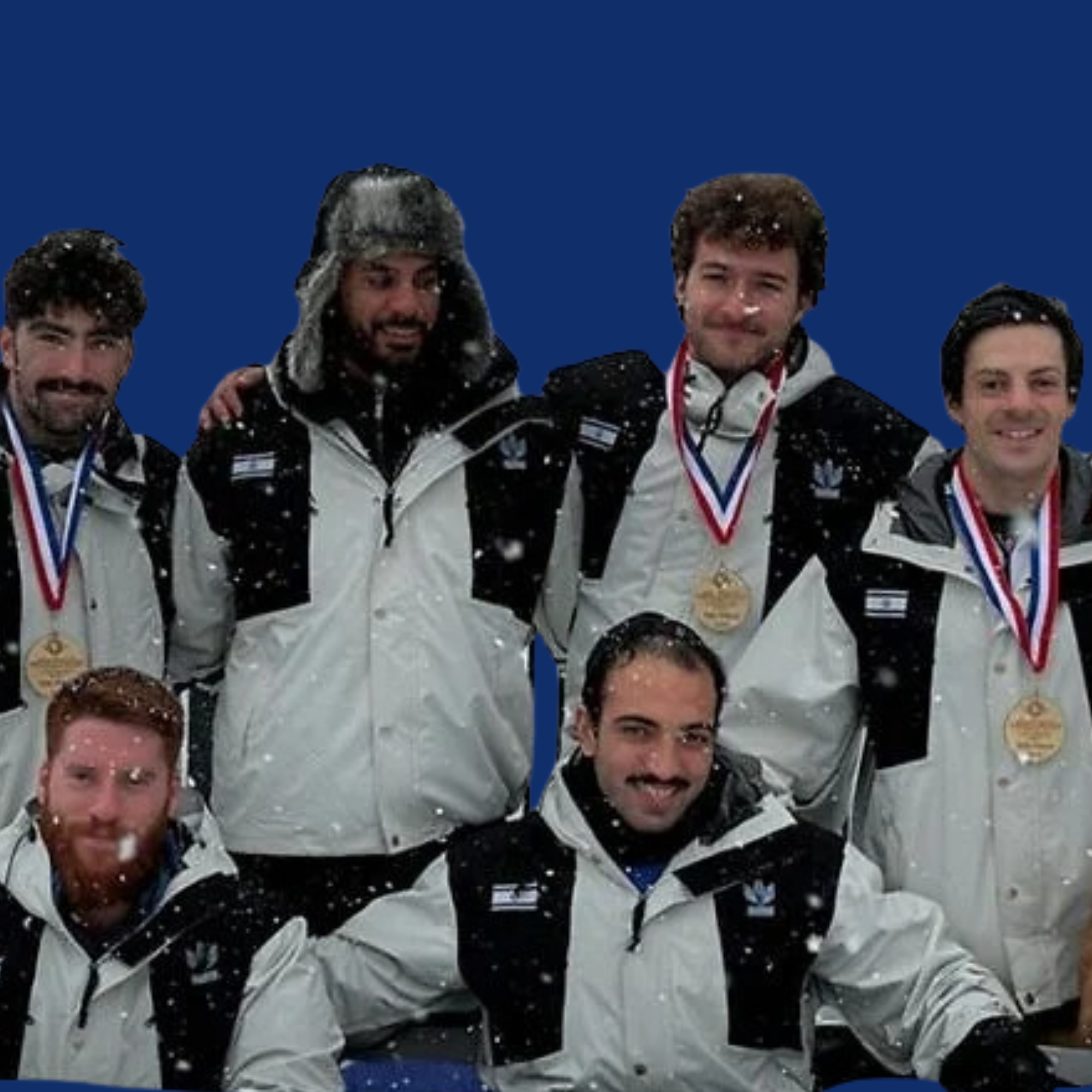
Please welcome your 2026 Olympic bobsled team, AJ Edelman Chen, ward Foe OER Katz Ziman, and ITAM Marsh Sprints.
Gentlemen, thank you for taking time out of your busy training schedule to sit down with me tonight.
It's a pleasure.
Pleasure.
Thank you.
So how's Cortina treating you guys?
What, what's the vibe?
How's, how's it feel being in the Olympic Village?
It feel awesome.
The vibe is amazing.
I feel that everyone is loving us.
We we're the favorite of the crowds.
Yeah.
Ah, that's fantastic.
I'm glad to hear that.
So this episode, it won't air until after the Olympics end.
Uh, yesterday you guys wrapped up the two Man Bob Sled events, and now you're prepping for your main events, the four man bobsled, which is just a few days away.
Aj, you're the team captain.
You're the pilot Manam.
You're the brakeman man.
You're officially an Olympic athlete now.
You have run an Olympic race, you've run a couple heats.
What's the feeling?
It's not different from any other, um, drag competition that I did or any other race.
Like it's feel like normal as usual.
But, um, you got the feeling that, um, everyone want you to accept, like you're not planning on it for yourself.
You want for your country, you want for the people that support you, you want for the people that you love.
And, um, you don't do it only for yourself.
This is the main difference, except that it's, uh, it's just doing your job as any, any other day.
Amazing.
Aj, what did it feel like putting on that blue and white uniform and that fire and ice?
Helmet with the Jewish star on it for the first time this week.
I mean, every single time you put it on, it's quite the awesome responsibility.
One of the things that we learn as athletes who are high profile or or high performing athletes is that all of the work before a race is done before the race.
During the race.
It's a combination of pressure management.
Essentially focus just execution.
For me, it was my final two-man race.
There was some, some sense of mixed emotions, but ultimately we looked forward to the main event, the premier events.
We knew that we're carrying a huge responsibility on our back.
We all spoke about it during a team meeting.
We know what this means for the country.
We know what it means for the future of Israeli sport.
We also know that at the end of the day, our names are not on those uniforms.
The flags are on the uniform.
So when anyone sees this in the future.
They don't know who we are, but they know Israel is there.
So you guys came dead last in every heat in the two man, but you're still on top of the world.
It's clearly, you know, not what you're there to, it's not the be all end all.
For your experience, how are you feeling just about the result and what was the experience of just getting onto the track and getting in competition mode?
I think.
The, the achievement for us is just being here.
Like it's, it's a miracle by itself.
We are here at, like in the Olympic games, like this team, all of us, we are so new to the sport.
We are a team for like five months.
Like all the other teams you.
Like the minimum, they're doing like four years together, like Olympic cycle for a team that is only five months and like running together, it's a vertical by itself to get to the like the highest, uh.
The highest performance in our sport because the, it's a privilege to be there.
It took me more than five months to get this podcast started and you guys did five months you became Olympic athletes.
That's pretty amazing.
There is no such thing as universality quota in our sport and the Olympics.
Sometimes there's something called universality, which is the principle, a greater inclusion of countries, even if those countries fall below an Olympic standard.
You come to think of like Eric McGill who barely made it across the swimming pool in Sydney games, those sorts of things in our sport, because of the unique danger of the sport, because it kills people.
There is no such thing as a universality bull in the sport.
To become a new Olympic nation is, it hasn't been done in about 30 years in our sport without getting the Olympic bit itself.
So China was the most recent new four man team, but they got the Beijing bit.
Israel is the first new four man Olympic Nation since I believe 1988.
Um, it is a, an immense credit to the team that comes to work together to put together a new track.
So when people do say he finished last to achieve an Olympic standard in bobsled, certifies you at a certain level, absolute excellence of the sport itself outside of the individual results of the games, which very often is predicated on your experience at the track itself.
So there's rules of the sport mandate.
40 to 50 training runs for teams be given before the Olympic Games.
Those took place in October, November.
We couldn't afford to do those training runs and then before the Olympics themselves as well.
You're mandated two days of training on the ice.
It's being the rule book for fairness and safety.
Home track advantage is huge in the sport of bobsled, and the amazing thing about the team.
That when you walk down the track, you see 10 German sports scientists, physios.
They pull in everyone in the village to go videotape that track, put it together and feed the information to the athletes.
Every team here has a full cadre of people.
There is no coach with us.
Itamar is an, actually, he's actually an athlete.
We just filled out the roster of athlete accreditations and so you here as they booked, but every single person on the team.
Took a part of the track, it went down the track and worked as one to put it together.
It's such a hard thing to do.
To put together a new bob set track and the team did that as the least experienced team on the track in these games and still remains competitive.
It's quite the amazing accomplishment and it's all credit to the fact that the boys stepped the hell up.
It was really amazing.
So when you say finished it last?
Yeah, we finished it last, but we were Olympic qualification worthy.
And we put in an amazing fight for being on the track for only three days when everyone was up, was on the track for 14 to 20.
What is the difference between a, a good bobsled team and an elite bobsled team in terms of on track performance and how, how do you guys get yourselves from Olympic qualifying level of good to meddling level of excellence?
The first and most important factor is the push.
So the team working together, and I'm gonna speak specifically to Four Man at the moment.
'cause Four Man is not only our specialty, but it's the hardest discipline in bobsled.
So everyone has to work together as one to hit the sled at the same time, to provide an impulse.
'cause if someone gets it early, subtle, start going away and people trip above themselves, they're gonna have to load into this letter at the same exact time and sit down together.
Otherwise, someone will have room to sit and you'll see what happened to the American team in St.
Bart said it was all over social media.
People literally fell over the wall.
They didn't get into the sled.
It happens constantly that they're starting this house.
It's a very, very problematic part of the sport, and every single.
Uh, 10th of a second of deficit of the push is worth three tenths on the drive.
So that brings us to the second component of the drive.
It's where I come in.
It's a mixture of not just my drive, but also the aerodynamics of the team.
The team it, it does sit in the back and put their head between their legs and pray, but they have to do an amazing job to keep themselves stable with an aerodynamic flow profile.
'cause once you hit a hundred kilometers an hour, you know, upwards of 95 miles an hour.
Anything that you do, it's like sticking your hand out of the car.
It creates immense amounts of win drag.
So the team has done an amazing, amazing job of that.
You can't just throw people inside the sled.
And then the third is essentially resources equipment.
So it's a Formula one type of race on ice.
When we talk about Formula One, the type of car you have, the type of wheel you have, really make a huge difference.
So when you're taking a look at the US Bobsled program, for example, they poured at least $8 million into their bobsled program to make it an elite bobsled program.
Because the equivalent is so top tier, the runners themselves, the type of steel, the quality of steel that you have all makes a difference.
The bobsleds that you can buy on the open market range upwards of 120,000 euros for a four man sled.
Right.
This is a very resource intensive sport, and that's what takes us to the final component of an elite bobsled program has money, and that is the one thing that you just cannot choose string together.
So when we say that the team has done the impossible, the team has done probably the farthest in the sport with the least amount.
Unbelievable.
Last technical question, and then I'll get into some more emotional stuff.
Talking about the push, does that come down to, is that, is that strength, is that agility?
Is it a combination?
Is it like, the bigger my quads are, the better the push is gonna be?
Like what's, what's the the determining factor of how excellent that start is?
When we talk about the push, you need to be very strong.
We need to be also very fast to catch this lead, right?
So you run it down the hill on ice, it's pretty, pretty fast.
You're going, uh.
40 kilometer per hour after 30 or 40 meters.
Those components of explos power, strength, and speed is what's gathering up a good pusher.
And then when they will be, it's uh, just, this is how it is.
Just get better.
I'm sure you guys all watch the opening ceremony.
There were some booze.
How did that feel to watch and did that get you guys concerned about what you might be facing?
I don't wanna say we're used to it, but you know, there are uncertain way to being Israeli like feeling on the shoulder.
Right.
But that's also the magic of it.
Like we try to block the noises and we know we are the best and we are trying to do our best.
Hate us will hate, you know?
No doubt.
Yeah.
Like if someone mad and like they crying, like doing a, like this is their problem.
They mad like.
Yeah, the Olympia, I have to say, I didn't know that there is a post on the crowd or I, I ward.
You're not just representing Israel, but you're also representing your own community, the Drew's community, first o Drew's Olympian, representing from Israel.
What does that mean to you and and what's the reaction been with everybody back home?
For me, it's a huge, uh, huge pride, a huge responsibility.
Like people are working.
Do people think you're crazy when you told them you were gonna be on a bobsled team?
Yeah.
Sometimes it 95 like sitting in watching my, myself, aj, you're, you're not only the first Multisport Israeli Olympian ever, but you're the only Orthodox Jewish Olympian ever from any country.
What sort of responsibility do you feel with wearing that mantle?
I do wanna correct slightly winter LinkedIn, um, because there was a, a female through Donka who completed in 2008.
I think when I started out, like the entire purpose of the project, the project was always a obsolete.
I never enjoyed skeleton.
I didn't like the sport of skeleton.
I didn't like doing any part of skeleton.
But skeleton was always, every single day woke up doing skeleton.
It was with an eye towards doing the bobsled team.
I knew that if I made it through skeleton and did skeleton correctly, not only would it provide the base to drive your bobsled, but it would make finding a beautiful, wonderful team as we found that much easier and hopefully funding that much easier.
I think as athletes we've all realized that we had certain levels and expectations of what we wanted to achieve, and then we get to those ex, you know, expectations of levels and goals and it's arms to the back.
So I know for us, qualifying for the games was a big accomplishment, a huge one for the, for the, you know, for the country.
But I think we can all agree, like we're aiming for a really good result in the format.
We're really training hard for it, not just sitting on our butts here.
So, um, we always move on to the next and yeah, I want it to be the first.
You know, Orthodox man to, you know, or modern orthodox man to be in, in games and to set some sort of precedent for the country.
But I think when it comes down to it, all these sort of like titles are, are really meaningless.
Like they're, they're just, it's, no one introduces themselves as like, hi, I am X, Y, Z.
Double Olympian, like you're a jerk if you do that.
So like all it means is just kind of setting a, is breaking a sort of glass ceiling where you know, it encourages other people who are better than myself or better than us.
In the case of the Bob to.
To come after and say like, that's been done.
I'm pretty sure I'm better than that and I can do it myself.
Why is that so important to you?
I know you've said for so long that like the goal was not the Olympics, the goal was paving the path for people to follow.
Why is that so meaningful to you?
I mean, I, I grew up with major depressive disorder or I have major depressive that probably like it doesn't go away, right?
So, um.
There are certain outlets that that, that provide, um, you know, essentially the outlet for emotions and growth and all sorts of developmental capabilities that children have and that just adults and humans have in general, I think that the community itself, Jewish or Israeli community, and I think board mentioned this when he joined the team in 2020, the Jewish committee, that other pursuits are prioritized over sport.
And I did realize that growing up, if a Jewish kid asked their parent for piano lessons, the parent would go to the ends of the earth, that they had the ability to get them piano lessons.
There would never be a talk of, can you make money from this?
Is there a future in this?
But oftentimes, if a kid said, I want to become, let's say like an Olympic level archer or curler or Bob sweater, a parent might say, you know, that costs a lot of money.
Is there a future in that?
What's the value of that?
I think all of us are testaments to the, there is value in sport not just for yourself, but for your community.
And it's just sorely lacking.
I think in, in Israel itself, the team is, is a huge example of once things are accomplished, once it's not just a crazy dream, there's immense value that people pull from this team, right?
That they've seen what's been accomplished and they take a lot of pride in that.
And that's what sport does.
It's a universal language that bridges all sorts of barriers.
It speaks to people.
So sport is just a, I mean, it weighs very heavily on, on my, on my list of priorities.
'cause I think we didn't have that.
I want to take that sort of to the rest of you, fellas.
I, that's, I hear AJ's reason why he's been, you know, the one piloting this sled, as it were.
Uh, what does being a part of this mean to you all?
Is this?
A job?
Is it an experience?
Is it a passion?
Was it a cool opportunity?
Like why are you here?
I think everyone on the team doing sport is a passion.
Like, uh, we are an Israeli athlete, like we're not getting permits for doing sport.
Uh, we all doing sport because we like it and, uh, we all, I think I'm the last time, uh, on the team that, uh, guy doing sport and like I'm doing it for 10 years.
I'm like, I'm doing work in field for 10 years, like I'm working out every day.
I'm giving one hour myself, and I'm sure that each one of the guys over there doing acknowledge me.
I already have, uh, two Israeli record.
I think I'm the only one here.
In a weird way, that was really approaching.
AJ not got a message from him.
Everyone else here come from track and field when I, um, while is doing so AJ just scouted at them, just found them and send a message and they all agreed.
And, uh, I'm coming from a different background, so I'm here to, to, to make my stage bigger.
So I saw opportunity this year.
I was having, uh, I got some accomplishment that I was needed for myself to set strong for my next one.
And I won this a championship in cross.
And of course, with without it, two weeks later, I did those, uh, national records that, uh, me second, uh, in, uh, all ages, uh, weight.
And, uh, two days after I saw AJ's, uh, recurring, uh, message and I was like, okay, this, this could be my path to touch others to try to affect others.
And my, uh, my personal, uh, my personal goal is to let kids that was kids like me.
I said that I'm trying only six years.
I was having a different, uh, maybe how background I started to smoke and, uh, drinking age 13 and it's getting worse and all, uh, when I got older with the criminal, uh, background and drugs and, um, I think as a testament of all of us that it's possible I want to be a testament as myself, that if a kid, um, getting some bad behaviors, if he is, uh, working in bad.
Pass.
You know, no one believe in him, no one giving the love he should get.
He can just blow himself up and accomplish amazing things.
I'm here to compete in the highest, at the highest World Bank competition to prove that can take you anywhere.
This is a dream of every app because without Olympics.
Um, you, you, you can show that after all this hard work, all these years of working, like it all comes, uh, one point, which is the Olympics, but there's no guarantee, right?
There was no guarantee that you would make it here.
You had to commit first.
Yeah.
It's the hard work and this is how you reward for all the athletes to be in the Olympics.
Even if you don't win, at least you mail it to the Olympics.
No doubt I was a professional.
All our track and field, we all hear on sportsmen.
We sacrificed so much.
Aj, why bobsled?
You said, you know, you went, you did skeleton.
It's all about the bobsled.
All about the bobsled.
What is it about this sport that had your eye on it the whole time?
I was originally going to do speed skating.
Rich had a terrific carryover from, uh, hockey.
I got a great scouting report when I tried speed skating.
But I saw Bobsled represented on television that they, Nate and Steve Holcomb's, ary, bobsledder for the us, they had named so to the Olympic team, or essentially the World's Cup team in October of 2013.
And I thought at the time that looked so visually stunning and out of the ordinary.
I can only imagine the reaction in Israel that we actually did the thing.
And so I went to a talent identification camp after getting in touch with the Israeli Federation and they said, listen, you'll never get another three guys to hop in the back of a bobsled you, and you'll never find the money to do it.
Why don't you go try to do skeleton?
So I went to try to do skeleton as the proof of concept for the bobsled team.
And when I was given the scouting report that said that I was the least athletic person they had ever seen, try it, and that I would never be competitive in it.
I thought that this was a great story to tell kids in the future that they could start out at a point no worse than I had.
And I think all the people on the team would agree.
As an athlete, I am the weakest athlete on this team.
Agree.
But it is the most low out team, right?
You want get so out to playing like 99% from the team.
It's uh, Adam, like Adam did almost everything and we are the 1%.
It's, it's not true.
What he's saying is a hundred percent not true.
Um, Bob said is a, is a pure team sport.
And every single day these guys have made the dream come true for Israel.
Like I, I, I only have to refute it because like Ham says, it's very nice to hear, but when Israelis see this team, they should realize that this is a team of six guys.
Put every single dropless sweat over the last number of months to make this work.
And there is no single person in a four bobsled.
If anything, I kind of hold them back.
I push slower than they do, so I can't keep up with the sled.
So, um, especially backwards.
I, especially Christian, I truly mean the team is incredible.
But to go back to, to what you, what you asked about why Bob said.
I tr I dreamed every day about what the reaction might be as though should the team qualify.
And I feel very vindicated in how it has been received in results.
I don't think in the history of the country there has been such a reception to winter story as has taken place in the last months since the qualification.
That's fantastic and so well deserved.
I mean, if nothing else, aj, you've modeled.
Having a dream and then making it happen, come hell or high water and that's, that's pretty, pretty spectacular.
Hey fam, quick break from the convo to tell you all about a new project.
I am so excited to share with you because I have so much free time already.
I'm now the editor at large of Aura Magazine.
A brand new glam, glossy print, lifestyle magazine, illuminating Jewish identity, culture, and beauty with elevation and elegance.
Aura, which means light in Hebrew fits right in line with everything.
This show is about celebrating Jewish excellence, our creativity, our diversity, our cultural contributions, our hotness.
There is nothing like this for us in the Jewish world right now.
And what's even better?
Is, you can hold it in your hands.
It's real.
It can live on your coffee table.
It can start a conversation.
Aura is about honoring who we are.
A vibrant, modern people with extraordinary gifts and stories to tell, featuring gorgeous photos, premium Jewish brands, and engaging articles across art.
Fashion food design ideas, and of course you'll always get at least one from me to What are you waiting for?
Snag your mag@oramag.co.
That's ORAM mag.co.
And for a limited time you beloved listener slash viewer.
Can you my promo code Jonah 10 for 10% off anything on the site?
'cause I love you.
Or a magazine Be the light.
And now back to the show.
What does it take?
To turn a bunch of individual athletes who are, aside from rugby, who are used to playing individual sports, to turn you into a team that has to be a well-oiled machine.
The first month was a tough one, and every time the something was really like going down pretty hard, the apologize came with, I'm so sorry.
I'm just, uh, I'm used to being individual.
So every time something happened like, I'm too hungry, I'm get the fuck outta here, or I'm too tired, or I don't know how to help you, or you just stand the side and don't understand how to, to jump in the walk.
I think the first month was guys were just a bunch of individuals.
Let's try to understand how to be, uh, be a.
A team like this, this for me is the first thing ever you guys were training in the Czech Republic before coming to Italy.
Your appointment got robbed.
That made the news headlines.
That sucks.
First of all, I'm sorry that happened.
It's very vi violating.
Aside from, you know, the loss of property and all that, how do you move on from that mentally and emotionally and not let that define, you know, the start to this journey?
We are so used to, uh, kids getting like.
Bad on us like we used for so many problems.
Like the sled is broken.
No money.
No this, the flood is canceled.
Someone died on our flight and we got like crazy shit always happened.
Funny.
We are so used to really shit happening.
So.
Now they see that happened.
It is happening in a really intense two weeks.
Aj, how, as you were putting the team together or, or going on your search, how did October 7th change the trajectory of, of your mission?
That was crazy.
So we have a team ready to go for the qualification.
Ideally, you want the team no later than two years out.
So the 2324 season would provide us two years.
And then the qualification, we had some great athletes line up for that team and we're all supposed to meet on October 14th, my facet, and I just finished buying this huge truck and a van for modify for the team, like made big plans for that season.
And then October 7th happened and the team were all called to, to reserve duty essentially.
It radically altered the trajectory of everything to the point that the model of that year was that someone would fly in for a week and they would be told to push the sled like a shopping cart.
And they would be totally like, push it like a shopping cart, hop in the back and I'll drive you down the track and we'll see what we can do with this.
And it happened basically every week.
They have like eight different athletes come in that season.
Um, so in blue is meniscus.
While trying it for the first time, it was just a crazy season.
Uh, but ultimately we finished third overall in the North American Cup that season, uh, and the team man doing it.
So I think ultimately the difficulties made it much more easy to manage some of the problems that we've come across this year.
'cause after that, everything seemed quite simple.
But I also would say that like, it just changed where the team, uh, what I wanted the team to meet.
'cause I wanted the team to stand as a symbol of excellence.
Essentially, the team was decimated, right?
And it would have to be put together.
I think the war made it such that when the team was put together, the ceasefire had not yet taken effect.
So we had to put together multiple contingency plans in case people were called back to be leave.
Said it would not happen in the same way as it happened in October of 2023.
So.
Everything was changed about the team, but ultimately, like, just like everything else in, in Israel, it kind of just pushes it forward to something bigger and better.
Amazing war.
I have a question for you.
The nickname for the team is Schul Runnings, which, you know, we all get a nice kick out of.
You're representing Israel on the highest level, but you don't go to shul, you know, you, you're, you're, you're Drews, if the national Anthem talks about ne.
Not Y fish, droy, do you think about that stuff at all?
And if you do, how do you think about it?
Or you know, what's, how does that hit you?
For me, like I think all my father, so emotionally it doesn't affect me.
So we all, all human and I, so I don't care like what background or there you are, what my even I want like to do my best.
All it back, if you just heard that sound, that means we just finished recording five deep questions.
Although this week it was actually six deep questions because we've got six Israeli bobsled team members.
If you want to catch the deep dive, you need to be a member of our subscriber-only community, the Ke, which you can join at beingjewishpodcast.com/community.
This was a really fun conversation.
You won't wanna miss it coming up, as I mentioned in a couple days.
The four man event, which you guys have worked so hard, which you've been waiting for.
How will you spend the time between this interview and when you take the track for the first time?
Bob said is a very unique sport in that you, you spending very minimal amounts of time doing the sport itself and you spend a massive amount of time doing everything that gets you those 55 seconds on the ice.
So, uh, sled work, polishing runners, like it's a very complex machine.
We polish the runners to make them a mirror polish so that there's no imperfections that'll brow the ice.
The boys are in the gym all the time, like it's, it probably like for the two runs a day that we get our 55 seconds.
That's less than two minutes, but we spend at least, I'd say six, seven or eight, yeah, eight hours on the sport.
The boys jumped into a sport that probably, I, I, I don't think you guys had to do eight hours a day, like they adapted to this, so insanely quickly.
The team's dirty is unheard of in our sport, right?
Where you have, you have people who have been thrown in on short notice, like Lola Jones in 2014 made the Olympic for the United States.
He was a hurdler.
But in those programs, you have coaches and mechanics and physios, people do your scheduling.
This team, everyone did it all themselves.
Right.
And that's what adds to make it an eight hour day, not a two hour day.
And that's, I mean, it's a monster credit to the team because how can you be such an elite, high level athlete as all these guys are, but spend all of your time doing the things that you shouldn't have the support system for.
And the reason I fired the shot is because we don't get any of that support yet.
We're expected to operate with that certain level of elite performance.
And we do, God bless the, you know, the boys, they do.
Um, but yeah, I mean, look at this team.
Unbelievable.
Do you think this will be a, a watershed moment for the Israeli bobsled program going forward based on what, you know, what you all have learned and what the committees learned from what you guys have been doing?
I want to believe, yes, we got connected to this board and I want to believe that now after, um, we've made the team regular day-to-day athlete in Israel to say, maybe I want to do this.
That looks insanely good and I want to try it.
So it never happened in Israel.
I, none of us, I think, no.
None of us knew what is opposite.
When we talked to Adrian, he's like, you wanna go the, what is the opposite thing?
Let me check in with you when I'll come back.
So.
Yeah, I, I want to believe it's a huge impact already.
What are your expectations?
Like, where do you, where do you, what are you aiming for and, and where you're trying to place?
What do you reasonably think you guys can achieve?
The top 20 in our sport is considered the gold standard.
It allows you to go through the fourth and final run.
It's two heats on two days, so run one and two.
It's taking place on Shabbat and runs.
Three and four are taking place on Sunday.
The boys have better athletic ability than myself in particular.
So in the two mountain competition, my start deficiency is plays a larger role in the competitive landscape and makeup of where we land in those results.
In the four man I contribute, let's say 20% or less of the bush, and so their greater athletic ability can close that push gap, which.
Push Scouts are severe and difficult to overdrive.
We do wanna make the top 20 in the Four Man.
Four Man is our specialty.
It's the Big boy of Bob said it's considered the a hundred meters of the Winter games.
Uh, but I also think that like one of the greatest things about Four Man is it's a harder version of the sport.
So when the team is better at the harder version of the scoring, it's something to just be proud of, to say that we were highly competitive in that competition.
So that's the goal.
I'd say like put down the three to four greatest runs that we could possibly put down.
Represent Israel as best as we can.
And then everyone back home goes, holy shit.
And Israeli four team, the first new four team in the games without a bid in 30 plus years.
Just threw down a, a spectacular run with, you know, nothing behind them, just, just grit and a belief system.
Honor and brotherhood, beautiful.
I mean, who wouldn't want to tune in for that?
The Olympics are over in a few days.
By the time this airs, there'll be long over.
What's next for each of you?
You know, where will you be when this airs In a couple weeks, will you be.
Laying down on, in a, in a hot tub, you know, icing your muscles for a month.
I think, uh, our dream as a team is, um, keep the program running e and normal day, going to driving school and, um.
We we're gonna, uh, keep practicing out and walk, walk out to be the best push out that we can.
Hopefully they like to pilot lots and, uh, keep doing that.
And then, uh, we're waiting for the next season, so right back to work.
I going driving through, see if I like it.
Finish.
I will like it then.
Uh.
Funding, uh, aspect of the sport comes to play.
If I don't continue going back with, go back to my study.
For me, I have a business I opened last year for a al training and training like a gym studio.
Mm-hmm.
I have to go back to work and course I'm gonna keep training, uh, pushing hard for, for maybe not the next season, the one after.
Aj, what about you?
I need a job.
That's basically it to be our routine manager, Julie.
I think that, that these are spectacular athletes and if either of them or both of them, uh, become pilots, like just, I, I want the program to continue to last.
I'll be around to coach and, and help them.
Um, but ultimately I think, I think it's gonna be a dual rule.
One is I'm gonna work really hard to find the money.
'cause like no one should have to go through this.
Like, I think that, um, that the sport infrastructure in Israel is just so incredibly unfair to athletes.
But no athletes should be paid for the mountain of debt to do this.
If anyone out there is listening, Omar and you, Tamara, are spectacular athletes and we want to continue this program.
And I really think that we can continue this program, bring in a female competitor to make the Olympic Games, not just make the Olympic games, but La Bob for the single persons for medal in four years.
'cause that's actually possible in that single person version of the story.
Let's build something together, like get in touch.
Let's put these guys on the map.
It's much easier to make the Olympics as two teams, that one team and Bob said, because 20 of 28 spots are then open to you rather than eight.
And so like.
Let's build something on this.
That's probably my number one priority is get them the support that they need.
Is there an infrastructure in place to take in support if people want to give it?
We have a nonprofit, so we have a nonprofits advancing Jewish athletics, uh, Jared and Firestone.
Nice.
Started it.
I, and I started it basically.
Ward and I and his cousins were in the, the boondocks of, of, uh, Pyeongchang in South Korea back in 2020.
And I was lying on the floor of the place that I was with Lulu.
I couldn't afford a place with, with warm water or heating.
And so Lulu and I were just li and it was an Asian style setup, so there was no mattress either.
So Ari was just different on the floor.
And I thought, you know what?
Um, we probably need a nonprofit if people wanna give us some money so we can afford some meeting.
So I set up a nonprofit that day.
Um, so the nonprofit exists to this day.
It's called Advancing Church Athletics.
If anyone wants to donate, just get in touch Israel bobsled.com/donate.
Has the the information again in touch and just say like, Hey, I wanna support you tomorrow.
I wanna support Omer.
Like, let's get this thing going.
Alright folks, you heard him.
Let's get this thing going.
What does success at the Olympic Games in 2026 look like to you all?
Have you already achieved it or is there something you're holding out for?
For me, it's not your result, it's your effort.
Um, success was if we was qualified to the Olympics and if we was not qualified to the Olympics.
It's if we get in a gold medal or if we finish less, we, we put in our best effort and like we're doing our, our best and, uh, at the moment that we know that.
Then we can be satisfied with ourself and know that we have success.
We're showing up.
We're ambassadors of our country.
We're the first Israelis for a lot to meet.
First time that's the same, uh, by himself.
Just having fun and laugh with the other people.
Let them know that Israeli speed.
Good man.
You might not come in first, but you're the first to ever do it, and nobody can take that away from you.
That's for sure.
Now before we get to our wrap up of the episode, I'd like to do a deep dive with the pilot himself, the man who not only drives the bobsled on the track, but who has driven this entire program from nothing into Olympic level performance.
Mr.
AJ Edelman.
Aj, how, how different does it look for other.
Israeli sports in terms of the support.
No team has ever operated like this.
It's just impossible to achieve, but that's what makes the boys so special is they have helped carry the team.
They have helped with things.
Um.
But it just doesn't work that way in other sports.
And when it comes to the organizational side, or at least like interacting with the powers that be, that decide if you're gonna go, we don't have someone, we just do not have someone like the decision not to send us to the two critical days of training before the Olympics that essentially sacrifice the two-man race.
I mean, as an athlete, I, I will just never forget it, right?
Like as an athlete, you're going to the Olympics and these boys deserve to race.
They deserved an equal playing field as, as equal as it could be to compete on that race.
And without any knowledge of what the sport was or how it operates at all.
The decision was made.
You're not going to those trainings.
Like no one called us, no one asked us.
There's no understanding of the sport.
So it's, um, you know, it's very different because for other sports.
It would've, I think, at least been the respect to go say like, Hey, why do you say you need this?
Right.
What is so important about it?
How much of that can you attribute to the fact that, as you said, you know, Israelis don't know this sport.
I mean, this is brand new, you've just built this out of nothing.
So, you know, maybe you're saying it's not, or, or maybe it's all, but how much of this is just due to the fact that this is brand new, it's unproven, and they have no frame of reference to it and no infrastructure around it.
That's tough.
You know, I don't know what, what you feel comfortable talking about or not, so I don't want to, you know, push.
But is there any.
Light you wanna shed on sort of how this experience and this partnership has been beyond what you've already just divulged.
The boys woke up one day in October as they arrived in Whistler and read from the Olympic committee put out in the press that the bobsled team stood almost no chance of qualification when it was the exact opposite.
We expected qualification.
We are a good team in terms of the driving ability.
It's one of the only things I'll ever be super proud of in life.
I'm probably a top 10 in the world's capable driver, right?
When it comes to the pushing aspect of things, like, the only reason I'm able to overcome such a severe athletic push deficit is because I spent 12 hours a day watching YouTube videos.
In the first four years, I self-directed everything.
It's been, uh, an immense lift to become the one of the best drivers in the world.
And so to read right off the bat, no chance of qualification when the opposite is true.
And they had to deal with that every day.
Like in in Segoa, when we crashed.
We crashed literally 10 minutes after reading an incredibly inappropriate statement about the team in the press, right?
And it was playing on my mind as I went to the line.
I was thinking at the line, like, I've told the boys every time I've crashed in my career, I was distracted at the line, right?
And I went to the line and the world kept thinking like, I really hope I'm not distracted right now.
I think the only reason I'd shed light on, on, on anything is, is the teams.
Accomplishment this year was not just athletic, it was through their willpower.
It was through their, their ability to move forward, because for the longest time, they were reading in the news that even if they qualified, they wouldn't be taken.
And so as a unit, as a team.
They decided to still push on and do the job and fight till the very last day to change the decision of not taking the team should be qualified.
So, you know, I think, I think it's just an immense credit to them.
Like they're, they're positive.
I'm a more pessimistic person because it's been 12 years of this and then Swift, but I'm also a little bit more like, you know, jaded or whatever it might be because these boys did.
Just such a super human effort and to live with them, to see, to see their art board into it, they deserve everything.
It should never have been a question of whether they went or not.
How do you explain what you know on the surface?
Seems like a pretty puzzling call, like as a lay person, I'm not involved in Olympic sports at all, but you would think, oh, more teams qualifying for our little country is a good thing.
You know, how do you explain an aversion?
You know, before you've even run a race to, oh, they're not, we're not gonna be bringing this team.
I mean, I think it's one of the things that we want to change, right?
There's a mentality that surrounds sport, that the ends are the goals themselves.
That the ends, when we say just justify the means.
The means are unjustified without the ends being accomplished.
Finals, medals, whatever that may be.
It doesn't make sense.
There was a survey a number of years ago, I forgot who did the survey, but about 95% of the kids who aspired to go to the Olympic Games aspired to go to the Olympic games because they saw someone they admired competing in the Olympic Games.
They saw it on television.
And so the team being here, what is that going to do going forward like?
The explosion of support has been enormous.
It is the lowest.
It is the highest return on investment.
Potentially an Israeli sport history for almost literally zero investment from the state in immense return.
And I think of just sport in that general overall landscape, right?
It is puzzling to say, why wouldn't you take a team that is comprised of beautiful Israelis, a Drews guy, like, who's gonna make a significant contribution in this community?
I don't know.
But I do know that I think the, the mentality might shift.
Or I hope it might shift, uh, because we do know that there are some people who, who do believe that at the end of the day, representation truly does matter.
Right?
The Olympic games are a showcase of, of, of the spirit and the accomplishments of the country.
And when you hit an Olympic standard, particularly in a sport that is so restrictive, right, like 30 plus years, not a single new country in the, in the bobsled quota system that didn't get an Olympics themselves like.
It's, it's crazy to think that Israel accomplished that.
Do you feel there's anything riding on, uh, how you finish in, in the event in terms of.
What may be, what, what support may be waiting for you on the other side.
Unfortunately, I do think so.
I think that the team was taken because of the world rank being inside 20 in terms of its Olympic ranking that the team is, is a realistic shot to grab an Olympic finals appearance.
Um, if the team doesn't finish at that high enough rank, I do fear that much of the progress that was made from the people who can make the decisions to bring a future team.
Will have been rub off.
Um, however, it's tough to say truly because I think that every single time the team has accomplished its goals, the public support has been just phenomenal.
It really has been enormous.
There has to be a recognition that being the first in three decades.
Is just the, like that has got to be worth more than making the top 20, right?
That itself has to be something that as a country, as a sport administrator, as someone who runs the thing that you take pride in, that you're able to say, we did that as opposed to see non-competitive.
Non-competitive we're.
Even if you're last, you're the worst of the best of the best of the best.
I know it's hard to.
Think about now as you're still days away from, uh, you know, competing in these Olympics, do you have another Olympics in you?
Whether as, as a, as an athlete, or as a driver of the bobsled program?
I do see my role as more of a mentor at this point.
Like I, I think that these boys are younger than me, faster than me.
They have the capacity to be more talented than me.
And so what a coach provides is what I never had.
It took a long time to get to this point because I had no coach, because I had no one short cutting the process.
The coach is, is able to allow you to get to your potential, and their potential is much greater than Mike.
And I want to see them hit that potential because that's the, that's the joy of an athlete, and I think it's the joy of a Jew, right?
The joy of a Jew, is that your candle?
Right?
It's like moia, like Moses.
Your candle can light many different fires, right?
You're your own fire.
But if you keep that as your own fire, life doesn't spread.
And the joy of a Jew, the joy of, of just being a yid is being able to have many Jews light their own fires.
And I have a flame and I'm really, really glad to be able to spread that flame because in, in some sense as well, it will keep the program alive.
I think it's somewhat a little selfish if I don't take that opportunity to say like, Hey.
Oh, Omar, whoever wants to come in, like, let's do something truly special.
Let's, let's have not five guys, six guys here.
Let's have 12 guys here and four years and two women here, and you know everything that can come from that.
So.
Do I have another cycle?
Let me, I have another two to three physically.
But, um, you know, there's a lot of factors at play that I, I want this to grow.
'cause I mean, you saw these guys, like, they're just the most wonderful examples of of, of Israelis, Jews and Drews that you can find.
And they deserve every shot in the world.
I'm gonna work to give it to 'em.
You've already done the zero to.
Olympians and now you've got that foundation and you've got the attention of people.
There's certainly, the awareness is tenfold higher than it was before.
Shouldn't it be easier now to achieve, you know, whatever you wanna achieve with this?
I can say with a hundred percent confidence, if the money was provided, Israel would be in the gate, every single Olympics from now on with the infrastructure that that's set up with, the coaching that I could provide with the sleds that we have.
The money was there.
Israel would be at the Olympics every single game.
It wouldn't drop out, but it took over a quarter million dollars to do this season.
So, you know, am I gonna be able to raise that for the guys?
I don't know.
And Erma are outta the military.
They don't have these sorts of savings to do that.
And you know, Hamson University.
So after the season started, I did not know whether I would be able to get the boys on the ice.
For the first race we had run completely out of money.
And, um, or I had run completely out of money and I didn't wanna borrow more and I didn't wanna tap my parents.
I think it's so un unfair to do that.
Um, I, I, we were just struggling and we, I threw up a reel of us trading in the format and I said, I said, we're the only team that has no sponsor stickers on their slate.
'cause I lost.
All of my sponsors after October 7th, they didn't want to be involved with what was considered a political thing.
And um, and obviously I'm very vocal online or was very vocal online about my support of, of Israel and, and, you know, the, the war in Gaza.
And so this, this very blessed individual saw it, the real went viral.
Because it got shared.
It got viewed like 400,000 times with 95% of the condoms being like the genocide bobsled team.
It was like that sort of stuff, and he saw it and he got in touch and he cut a check to cover the season.
Right.
It was it's, it was that sort of all you need is one guest.
I tell my boys this all the time, it's like you're gonna discover guys in your life that you might have a crazy dream or a crazy goal, but you just need to find the one.
Yes.
And everything is gonna be no until you find the one.
Yes.
But there is a yes out there.
If you believe in yourself and you believe in that goal and you work hard towards it, someone's going to recognize it.
So ultimately, the individual gave, not because of my appeal he gave, because he saw the boys pushing Ofside.
He saw their efforts, and I'll always take that.
I failed on my own.
I succeeded when the boys joined, and I think that's a major credit.
I'll always give them the credit, like they deserve it.
They worked really hard for it.
Um, but the team was able to get on the ice because a guy saw them pushing.
Now you're gonna have a, a whole lot more footage than just one reel.
And, um, all the people who gave you the, the maybe is not likes, you can call 'em all right back and say, Hey, did you see us on tv?
The greatest thing about representing your country is that not a single person will remember your name in five seconds.
Right.
But they'll remember team.
It's just something that I really wanted.
Right.
I've really always wanted to say that like my time on earth was well spent.
Because at the end of the day, I could take a look back and I could say like, I was a part of that and not think that accomplishment was an accomplishment because someone else took something from that, built their own thing.
And I really do think that, you know, there's a lot of pictures out there now.
Monogamous, kissing my head.
I hate being touched.
But, um, I think at that moments I did realize that there was a, a, a value in just letting the emotions of the moment.
Take over because someone like it should be something that someone sees, like two proud kids accomplishing what they needed and wanted to accomplish.
Amazing.
Well, AJ, I wish you guys the best of luck.
I, I feel optimistic about what you can achieve, not just this weekend, but.
In the weeks and months and years to come and look forward to watching the journey.
Thank you very much.
I really, really appreciate it, Donna.
Alright guys, I wanna finish off as I like to do with a game.
Uh, this one I'm calling Beha.
Uh, to those of you who don't speak Hebrew, it means together, I'm gonna throw out a question about somebody on the team who snores the loudest, and you can all say who you think the answer is.
All right.
Who gets the most nervous before a race?
No, he's nerves.
It's focused.
There's a difference.
Yeah.
Yeah.
It fun.
Yeah.
What, who's got, who gets nervous?
Does anyone get nervous?
Eh, Oher gets nervous.
Oh, mayor.
Okay.
Who complains the most about how they look in the suit?
Oh, wow.
Wow.
I, I'm putting world, everybody's pointing a word on that one.
Of course, not me.
When, when Word says he's staying an hour after competition to meet people to give a good impression of juice, it's a very, or Drew, it's a very specific subset of people.
He is looking to be hooked.
Who's most likely to say one more run when everyone else is freezing?
Wow, this guy, I'd be pleased to go about 20 runs a day if possible.
It's not freezing.
It's not, it's.
Speaker twice and he wanted to go the third one like twice in a row, and he wants to go another.
Who thinks they're the funniest I, the funniest.
I don't want to be the funniest guy.
I, I want to be the team leader who is actually the funniest, oh man.
I'm, I'm a pretty funny guy.
That quiet dude in the back?
Yes.
Yeah.
Over there.
Who blames the sled when something goes wrong?
Aj?
Oh, aj.
Aj.
I never blame the break.
AJ always, oh, we, we watch.
He get stuck.
Not.
In the side.
He said he is running backwards every time.
He pushed slow in whistle.
He was like, why the fuck and dog, you guys don't push.
I'm wearing never.
Oh wow.
He was doing so big interview with me.
He is like, this is not good.
Then the coach said.
Who eats the weirdest pre-race meal?
That's must to be this guy.
Every meal is weird.
He just, what does he eat?
Shopping?
No matter what food it is.
Ketchup.
He taking, he taking five pizzas on the cafeteria and eating only the cheese.
That's like my, my, my 2-year-old who says yala the most?
Do we say, are you ready for tomorrow?
No, we don't say that.
You say that.
You say all the time.
Who's most likely to get into it with a track official?
I official.
I'm pretty nice to them guys.
That's the one.
None us.
Yeah, like we are nice guys.
We're good boys.
Yeah.
Last one.
When you cross the line in the last heat, who bursts into tears?
I had a feeling.
Alright gentlemen, thank you so much for the time.
We are all rooting for you here.
I know by the time this airs, you will have already finished, but, uh, in this moment you're inspiring so many and you will continue to do so, and I just wish you the best of luck.
All the things.
I don't think you say break a leg in bobsled.
I feel like that'd be weird, but get it done.
We're rooting for you and, um, you know, all the best.
Thank you.
Appreciate.
Hey guys, still me, and for the first time, I'm sticking around for an epilogue, as you already know, today's episode was filmed several days prior to the Four Man Bob Sled event at the Milano Cortina 2026 Winter Olympics.
What you may or may not know is what happened next.
After racing in the first two of the events, four total runs, the Israeli team withdrew itself from competition before the third run.
Despite hitting the ninth, highest top speed of the second run, the team finished out of the top 20, essentially sealing their fate for the remainder of the event, and with their chance at meddling out of reach for run.
Number three, the team planned to swap in alternate crew member Ward ce.
Israel's first Drew's Olympian, in order to give him the honor and pride of running an Olympic race.
Swapping in alternates when victory is out of reach is fairly common practice in the sport.
Romania who finished in 17th did this very thing swapping in alternate Andre Nika when a low finish was all but guaranteed.
Due to circumstances beyond the team's control, the Israeli Olympic Committee was made aware of the plan swap.
Contrary to certain stories in the press, there was no signed affidavit, no attempt to lie or cheat, and no official disqualification.
Just a desire to help a teammate realize a dream, and when that proved unattainable, a voluntary withdrawal by the team itself.
Not the grand result the team was hoping for, to be sure.
But as you've doubtless already discovered, for this group of six Israeli men looking to make their mark, it was never about the gold.
It was always about the blue and white.
An enormous thank you to the entire Israeli bobsled team for staying up and talking to me in the midst of their training.
Inspiring stuff, amazing story.
If you love this episode, please do me a favor.
Leave us a five star review on whatever podcast platform you're listening on or the one you use the most.
If you're watching this, it helps more people find the show.
It helps us grow this wild and wonderful Jewish conversation we're having here, and we would really appreciate it.
Alright, I'll see you.
All right, back here for the next high speed episode of being Jewish with me, Jonah Platt.