
30mm Transcript
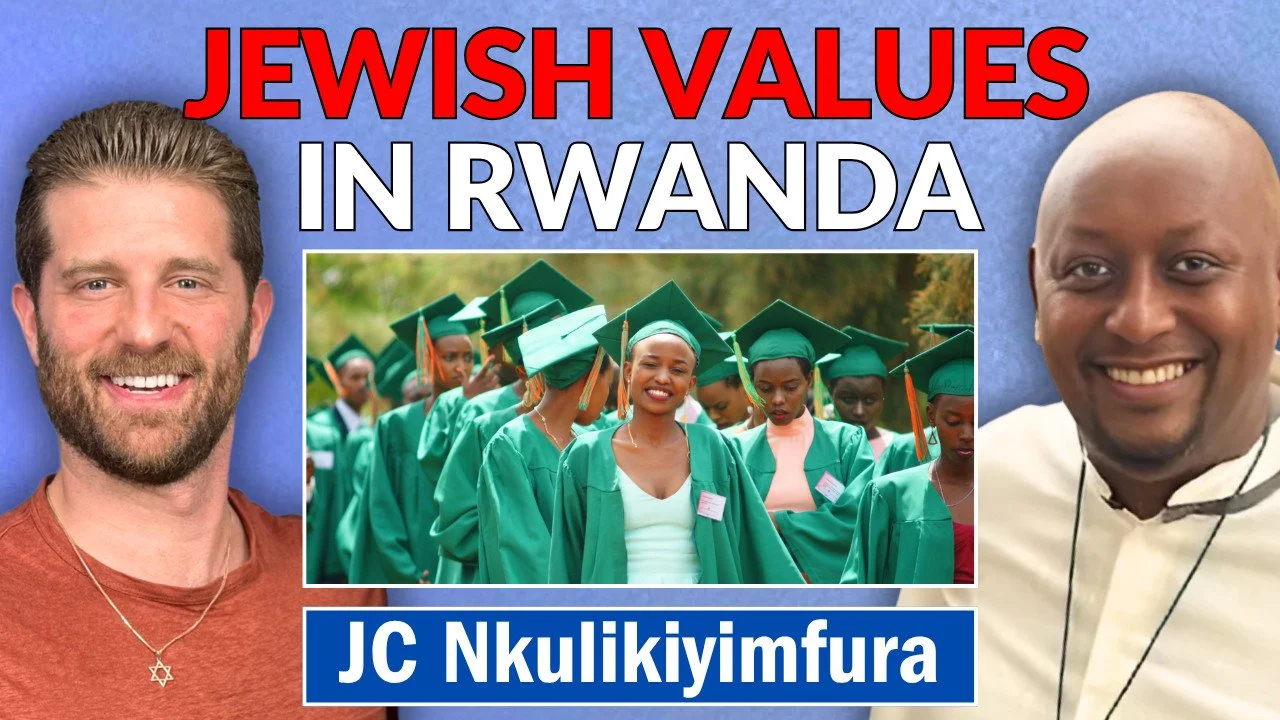
Rwandan Genocide Orphans Are Finding Hope in a Home With Jewish Values | JC Nkulikiyimfura
If you can save one person, you can save the world.
That is what we are looking for.
I think that's a big part of why Rwanda's thriving, because they've made the choice to move forward from the mistakes of the past.
It's a very hard ask for genocide survivors to forgive.
Welcome back to being Jewish 30-minute mensches.
Same vibe, same tribe.
Shorter episodes back in spring of 2009, I was nine months into my first post-college Hollywood job as a driver, where I'd pick up TV show runner Greg Daniels from his house, drive him to the office where they shoot the office.
Then I'd sit around doing nothing until he was ready for me to drive him to the CBS lot where he was helping set up parks and recreation.
I'd sit around there for the rest of the day doing nothing, and then I would drive him home.
I was basically Waymo with a desk, and before I blew my totally underutilized Ivy League brains out, I quit and decided to do the opposite of sitting in an office doing nothing.
I went to volunteer in Africa.
I spent a life-changing month.
In Rwanda at a magical place called the Aga Shalom Youth Village, a holistic boarding school style community.
Founded in 2008 to care for orphan survivors of the Randan genocide and other vulnerable and traumatized teens, and prepare them for a dignified and successful adult life.
Built upon Jewish principles like Tikun, Olam, and Tikun.
Hal A SYV as it's known, is a beacon of light and hope in Rwanda's future.
And today I'm so happy to have the Village's executive director with me as my guest.
Please welcome my to my friend Jean Claude and Kli Kura, Jean-Claude jc, welcome to the show.
Thank you so much for having me, uh, join on the show.
And, uh, too bad I missed you in 2009.
Came probably two years later.
You got there just slightly after me, but you've been there a long time.
How many years have you been with A SYV now?
14 years now.
So as I, as I mentioned, Tikun La Tikun, these are literally foundational philosophies of A SYV.
So tell me a little bit about where those Jewish attributes came from and what they mean to the community.
Oh, it's a beautiful long story.
First of all, uh.
This village, uh, Ann Haman, as founder of ga Norm heard about the genocide against the, in 2005, and she was like, what's going on?
How come I haven't heard about it?
What can we do?
So she flew to wonder in 2006, saw that nobody was doing anything close to a youth village.
So she thought a youth knowledge would be the best way to address those, uh, challenges that, uh, young or are, have, uh, have been faced with after the.
So she, uh, looked at different models in Israel called Gaming Old Youth Village, and she wrote to the then director of this, the village.
I'm, I'm an American, try to build a village, youth village in Africa.
How can you help?
And this gentleman, Dr.
I am Perry, wrote her very long email saying how they could help with a lot of the, uh, Ethiopian Jews who, uh, would really, uh, be able to help us.
I think one of the impulse was.
There are great Jewish values that nobody knows outside of the Jewish world.
Tikun Olam and Tikun Hal, what, how do those two philosophies, you know, what do they mean to you and how do they manifest within the day-to-day life of the village?
We want to be the next best possible family, um, that the children should have had, had their own families been alive.
So it's really, we try to recreate some type of, uh, trustworthy representation of parental wholeness.
And so that's the whole philosophy.
And as a parent, you love your children, you take care of your children, and so the community does the caring for the children who are lost, parents whose parents are no longer there, or who are able to support their own children.
You'll see that we have.
Surrogate mothers and incredibly, these mother have lost husbands.
They have lost their children during the genocide, and now they're coming to raise other people's children.
In addition, we have programs.
Programs are really on a lot by doing basis.
These programs are in sports, music, theater, sign of you mimic.
We have more than a dozen program and practical skills.
Very, very, very hands-on skills.
And they get to build their own thrust and self-confidence.
And once they have all that, they go and apply this in school.
And all of our kids, young people, more than 70% would've never ever completed in high school.
But we transitioned them outside of high school.
Into colleges beyond college, into jobs and internship program and so on.
And uh, this is something we've done for the past almost 18 years, and we're extremely proud of.
We have done well, speaking of the, the college acceptance rate and graduation and, and getting jobs and everything, uh, you guys just did a two year study with Tulane University School of Public Health on the impact and effectiveness of the village, and the results of the study are literally off the charts comparing the outcomes.
A student from a SYV.
Achieves versus a, a control group.
Can, can you talk to me a little bit about those findings and, and what they saw and, uh, how it felt to see, you know, the proof of your concept being so successful?
Almost 70% of our young people got, uh, uh, got into employment.
The cultural group.
On half of that, we had 68 versus 38%.
The social, uh, economic scale was also more than double.
They earned a salary that is, uh, pretty much double or more.
They, uh, were doing extremely much better emotionally.
Psychosocially have been able to start families.
It's amazing.
And I, I also saw, you know, they had certain employers compare the success of an an AGA shalom graduates work at an A place of employment versus somebody else in the same position at the same place.
And again, the A SYV graduate.
The numbers are, you know, double in terms of how much they're excelling, their communication skills, their abilities.
It, it really is an unbelievable proof of concept for what's going on there, that you're not just, you know, helping people vocationally, not just helping people educationally, but holistically, you know, really building up incredible young adult people to go out into the world.
Absolutely.
That's the key word.
Very, very holistically.
And I think, uh, um, when people talk about scale, most people talk about scaling wide.
Uh, we talk about scaling deep.
We are really, really, really invested young person because if you can save one person, you can save the world.
And so that is what we are looking for.
We know that all of our young people, they have an incredible impact into not only their families, but the community.
Uh, and actually the country today, I mean, uh, we have a lot of young people who are into the business world that are doing quite well.
They, um, they are into, uh, government, they are into private sector, they're into NGOs, and so those are all great outcomes and they're able to us.
Not into their own community.
I, I was gonna ask you, are there any particularly inspiring success stories or students who, you know, really went above and beyond once graduating?
We have some that become medical doctors.
We have some who, um, were head of, uh, um, uh, corporate banking, uh, and, uh, left it to start their own companies.
Uh, we have somehow to the tourism sector, I mean.
All this.
Just incredible.
You mentioned scale, and I love talking about scaling deep.
I think that's so cool.
But in another context, I, the conclusion of this study was basically, Hey, A SYV, you should scale what you're doing because everybody needs to learn from this model because it is so successful.
So is, is that something that you all have thought about at all approaching?
I know you have your mandate to take care of your village, but is there any thought to Okay, how do we now.
Take this model and share it with the world.
We believe we are essential of excellence.
We believe we we're sort of like a school lab.
We tried things out.
If it works, we are ready to share it.
And so one of the things we've done was, um, uh, run after COVID, we worked with, uh, the Ministry of Education to train, um, teachers across the country in, uh, all the 170 schools.
We train teachers for three years on how do you teach young people?
And this was a program founded by the MasterCard Foundation.
And so this is kind of how we believe about scaling, using our model to share it with our other organizations.
And so we can, we wanna use some of our one model and approach, uh, to, to do a program with them for the next 10 years.
And that's also something that is being funded by.
MasterCard Foundation.
We're at the beginning phase.
We are convers uh, having this conversation, but we think that we are really well placed to be able to do that.
And that's, that's how we believe our scale.
That's what we believe.
Our scale.
Fantastic.
Fantastic.
The world would be a better place, that's for sure.
Consistent with national trends, the, the study also found that male graduates have more successful outcomes than female graduates.
And I know that there's sort of a, a, a cultural.
Gender disparity between men and women that can be present in Rwanda.
And one way that A SYV is trying to approach that is through partnering with an organization called the Inheritance Theater Project, who I am on the board of and listeners of this pod.
Well, remember we had the artistic directors Jalen Levingston on on being Jewish back in December.
And I'm proud to say this was a ACH that I made between ITP and A SYV.
And I would love for you to speak about the experience of having Inheritance Theater Project do their first international project with you all in Rwanda, what they did, how it went, and what, uh, what the conclusion was.
They inherit inheritance theater, uh, uh, project for a fantastic one.
And again, uh, it's, it falls within that framework of, uh, building, uh, gender equity in the branch.
It all starts with not the hard topics.
Projects where young people get to feel good about themselves.
And so this has really helped a number of our young, uh, female, uh, students.
I'll give you an example.
We received about eight scholarships, uh, in 20 24, 20 25, and I think we still waiting for scholarships to come in 1226, but in, in 20 24, 25, 8 scholarships into.
I would say next to Ivy League programs, um, we had, uh, we had all scholarship work for girls, young women.
And so this, and all of these young women have all had also been part and person asked the, uh, inheritance project.
So yes, yes, they have.
So this is something we're extremely, extremely problem.
What did ITP do with the students in the village?
What was the program?
It was a theater literacy project.
Program.
And so, uh, the, the, I always love the beginning because when they come, they meet with the young people.
They first teach them to exercise their own voices.
You see, like young people, uh, younger, particular are quite shy.
Say, no, scream, scream, let's scream and open the chef up.
And then, you know, they start writing their own plays.
So them coming on stage is now the, I would say the, the, the, the, the, the thing that unlocks all of their potential.
So I, I have a story of this young woman who was extremely shy.
She wouldn't perform and yet she wanted to.
Once she joined the program, she applied to become a, um, uh, the first female student government president.
Wow.
She did a really great job.
Was reelected the second year, which never happens.
And then, and then, I mean, she went on to graduate and she was the first female to have ever been given a job at Aga Shalon right after high school.
To run gender equity, uh, uh, uh, policy to build it.
And now today she's at Bates College doing some, uh, uh, a major in, uh, uh, environmental studies and also, uh, a minor thinking that gender studies.
So I mean.
Those are some of the examples that, uh, we are talking about the impact that it has on young people.
That is so amazing and, and you know, I can't help but have my mind blown at sort of, you know, we think, oh, what difference can one little thing or one person do, but the fact that I've volunteered made this relationship 20 years later.
Make this other relationship, brings this, this theater group.
They do an amazing program.
It affects this one girl and now she's grown into this other thing.
She's affecting other people who are then gonna affect other people.
It's just an amazing chain that, you know, it's just so important for us to keep in mind that what we do really matters.
And, and every little thing can make a huge difference.
And we just, we can never predict how far that can go, as you say.
It's some of these touch points that one might not have thought about in the beginning that really unleash their own potentials.
So you were born in Burundi and you moved back to Rwanda in 95.
Is that right?
Yes.
I was born a refugee, so I did not have a right to citizenship.
Being a refugee is probably one of the worst thing ever.
It takes away your citizenship.
It takes away your identity.
It's very, very, very, very hard.
And so, uh, I had that first passport after the, the, the, the genocide.
Otherwise I had only United Nations, uh, papers.
So that's pretty much what, uh, got us to travel.
So I knew, I knew that, uh, no matter what.
I would go back to my old country and, uh, help to rebuild my country Chi.
So you get there in 95.
After the genocide, what did you find?
What kind of country when you got there and, and what are you seeing now?
You know, 30 years later, Rhonda, in 1994 after the genocide, even 95 was by all accounts, a country that was supposed to be a failed stick.
There was, I mean, this is a country that 1 million people were killed.
3 million people fled and, uh, 3 million people displaced.
That's what happened.
Wow.
Displaced in the entire country.
And so you just have to bring everybody together.
And then we have an exceptional leadership in our country.
The president said we are going to focus with Onri.
Just three things as S.
Number one, we're gonna be together.
We do not wanna be separated, know who to landlord to.
We gotta be together without holding ourselves accountable.
We cannot blame the waste from the ide.
It's our people that kill our own people.
So we hold ourselves accountable and we dream big.
Today, 30 years after Rwanda is doing way better than many, many, many African subsaharan African countries.
Um, uh, I will not name near, but man was so much better.
Uh, in what ways, how are you seeing Rwanda thriving today?
Well, uh, I think istic, uh, the, the poorest of the Poors were still a developing nation.
But really trying to, uh, to add poverty.
I think, I think in the past 25 years, pretty much close to 70% of people have been uplifted from extreme poverty.
Wow.
Education for all, uh, is one of the thing.
Universal healthcare for everybody in while if you are running citizen, you get universal healthcare.
Amazing.
Yes.
You only pay 10%.
Or UBL, the policy on gender equity in government services, you have to have a minimum of 30% female in the leadership.
That's by, that's constitutionally, uh, required.
So, uh, the cabinet.
Has about 50% female, 50% male, all of the government officials, 50%.
Our, uh, we have the highest number of, um, of, uh, uh, members of parliament in the world.
I think it's, uh, female, 64% female.
Wow.
You know, and Wanda has taken some very bold direction, particularly in the, in the area of environment, I think in 2008.
Plastics were banned in the country.
So another countries are catching up today, but rather did it in 2008.
Access to internet is across the country.
Uh, so there are so much, so many things.
It's incredible.
And then the other thing is what made the whole difference is like in 1994 or 1995, the country had to say, what are we going to do?
Let's focus on our home grown solution.
Let's focus on the old values that Rod had two or 300 years ago.
Let's try that to bring them, uh, uh, uh, uh, back up.
And there is one value that I'm not particular, that I actually, I, I co-wrote an article with one of our colleagues, uh, that wanted to do Jewish Forward.
It's a value of means.
You cannot leave the elderly behind.
So if you are going to do swarming, if you're going to do some activities, if you're going to do everything it, and if there is some elderly people or visible people who cannot do it, you have to do it for them.
You don't leave them behind.
And that to me is, uh, is uh, something that is uh, that kind of looks a little bit like KU now.
Yeah.
It is not coincidental that, uh.
Shalom is arriving in Rwanda.
Tell me, what does aga chalo mean?
Literally, aosa means drying tears and shalom peace.
And so, and we are youth challenge, so beautiful.
That's our identity.
That's who we are.
We are holistic, uh, uh, holistic, uh, organization that supports young people in the most comprehensive way.
Focusing on helping to, uh, man the heart and the repair the world.
Yeah.
And you, you, you mentioned sort of these, these randan ideals that are, that are part of the culture.
Something that has always stuck with me from my time there.
I, I was, when I was volunteering, there was a counselor there named Eddie.
Uh, you mentioned.
You know, you had, you guys have house mothers who make the homes feel like a home.
And then you also have these counselors who are sort of like big brother, big sister mentor types that also help sort of complete that family picture.
And I was speaking to Eddie and he told me this story how after the genocide, his neighbor came over to his house and said, Hey, I just wanna let you know I'm the one that killed.
Your grandparents, it was me, and I can, I'm gonna show you where they're buried.
And Eddie, as he relayed this to me, I mean, I'm in shock and he says, you know, I had a decision to make, either I could live hating this man and continue, you know, violence or hate and, and destruction.
Or I could choose to say, you know what?
I want to build a better future.
And I'm going to live next to this neighbor in peace and move forward.
And I, I was just so impacted by that story and by that sentiment.
I think it's so brave to, to choose hope and peace and forgiveness and not rage and vengeance and, and anger and I, I just think that's something that we can't take for granted, that the Rwandan people have made that choice.
On so many levels, day after day, person to person, community to community.
And I think that's a big part of why Rwanda's thriving because they've made the choice to look to the future and, and move forward from the mistakes of the past rather than continue to try to reconcile them again and again, and again and again.
Absolutely.
I mean, uh, we believe that, uh, it takes a lot of energy to hate and, uh, the gains what you get out of it is, uh.
It's pretty much nothing, right?
So give, um, we, uh, we believe that, um, it's a very hard ask for genocide survivors to forgive.
It is, of course, very hard.
However, we only have one country and we say we can forgive what we do not have to forget.
And the other thing as well is that.
That person who sent it to Eddie was also able to heal.
Right.
And we also need to heal neighbor.
Yeah.
Yeah.
It's, it's, it's, it's not easy.
And I know there's a lot of cultures who would not be able to do that.
Uh, so I, you know, that's something that's always, IM impressed and, and left an impression on me.
Um, JC when Anne Haman, who we talked about of blessed memory, who tragically died in an accident a, a decade or so ago, um, when, when she set out to found a SYV, it was because she had been told that the number one problem in Rwanda.
Was the orphans that there were, you know, millions of orphan children that with no future, and so she decided to do something about it.
Looking at where Wanda is now in 2025, what would you say is the biggest problem that that still needs?
Solving the issue of genocide is not something that can be solved in 30 years.
About 80 years after the Holocaust, we're still, we're still crying and we're still feeling a lot of uh, uh.
Uh, sensitivity and the genocide against the Tutsi is also something, uh, similar where there has been so many consequences of it.
And so we will continue to have to address some of these challenges.
Our goal is to help young people to become active agents of change.
We have warriors to do that job, to transform them from a person.
Uh, with pain and anger and sufferance to a person who, a problem solver, who's a critical, who is a person of great values, that's our job.
That's how we are going to help the future of this country.
Our country is its people.
And so our goal is to support, uh, all the youth of Rwanda as much as possible.
In, uh, the small ways that we can.
Yeah.
And as aga sha, uh, our goal would be to work towards a path of, uh, self-reliance where we have a diversified self of income, so that, uh, uh, aga Shalom could be there long after.
People like me are not over there.
Tell me, just in closing as the last thing, as we look to the future, what is the, anything is possible?
Campaign?
Anything is possible.
Campaign is, uh, uh, there is a story about when, uh, I think when you are in the village, it started building, uh, an theater.
Yes, yes.
And so as they were digging, there was this young man, uh, called Clot.
He said what he guys doing.
Uh, they said, oh, we building theater.
He said, but this looks like a pool.
And then, but why would you think we build a pool?
He said, with a SYV, anything is possible.
And so this is a campaign that, uh, we have for five years that we would love people to support A-S-Y-O-B for the next five years to really get us.
To, to, to reach some of our goals of, uh, getting, uh, $20 million.
So we, so far, we have raised up to $70 million.
Oh, wow.
And we need to really raise three more million dollars to sort of get up off the ground a little bit.
Uh, uh, as, uh, I like to say that today if Al was a, a human being, she or he would be like 21, 22 years old.
Uh, straight out of college and ready to explore the world.
And I think this is that sort of the push that we need.
And so anything's possible is like, we want, we want to, to build upon what we have built and, and, uh, and, and, uh, take this village to the next level.
It's a fantastic, I wish you nothing but the best of luck with it, jc.
Keep doing what you're doing.
Those kids are so lucky to have you.
And so are we here at Being Jewish.
Thank you so much for being here with us today.
Thank you.
Thank you so much for having me.
It's such a pleasure.
And please come back.
It's been, uh, been a long time.
Been too long.
I know.
I would love to come back.
It's just a magical, magical place.
Absolutely.
Absolutely.
Alright, y'all.
He's a mensch.
It's been 30 minutes.
I'm Jonah Platt.