
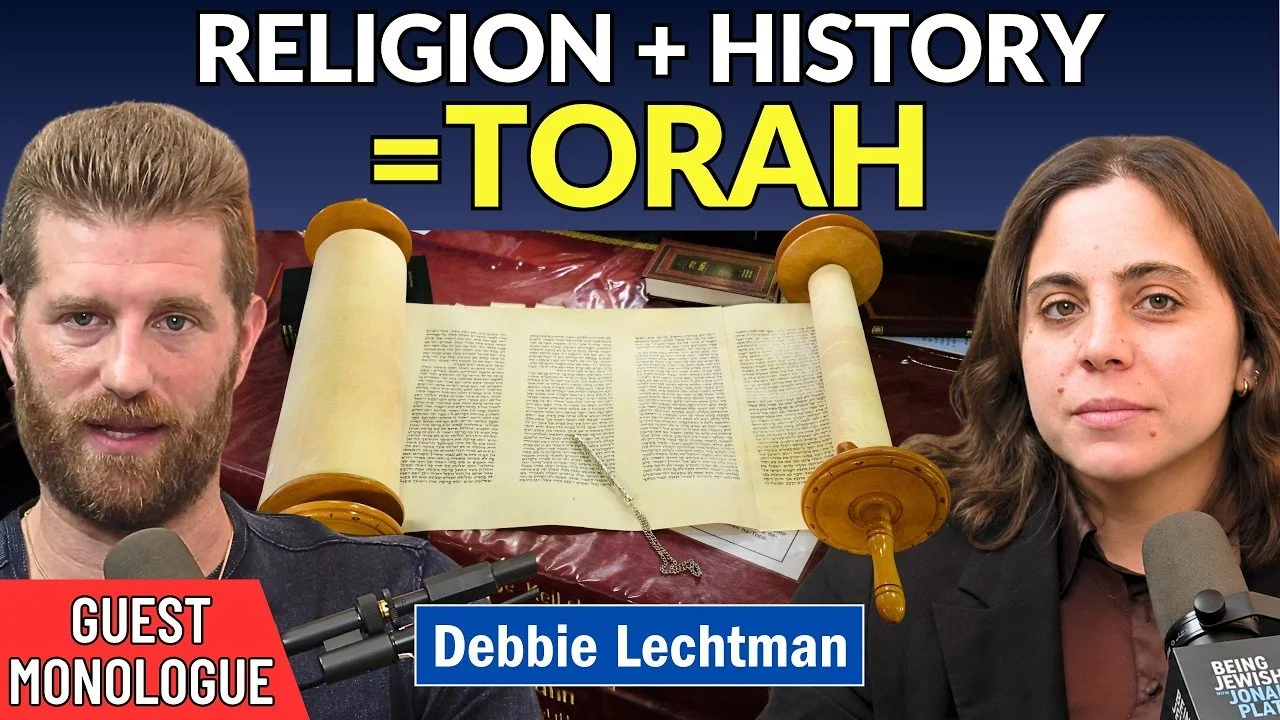
Interview Transcript
Jews Are INDIGENOUS to Israel & There’s PROOF! Historian Debbie Lechtman Destroys Antisemitic Myths
Shalom, chaverim, and welcome to Being Jewish with me, Jonah Platt.
Only this time, it isn't, actually.
For the past two years, the face on your screens and the voice in your ears has been mine, whispering sweet nothings about Jewish identity directly into your brains.
But today, we're gonna try something a little different.
There are a lot of smart and valuable Jewish voices out there, voices illuminating original ideas and perspectives that you haven't heard from me or anybody else.
And as your cruise director through the rollicking seas of contemporary Jewish identity, culture, and current events, I feel it is both my duty and pleasure to introduce you to some of my favorite voices, literally.
You might know her from her writing in Tablet Magazine, the Jewish Journal, or Unpacked Media, or more likely, you follow her brilliant educational Instagram posts all about Jewish history, identity, and antisemitism under her sobriquet Roots Metal.
Or maybe you don't know her at all.
Either way, you're about to, and I'm damned happy about it.
So without further ado, here to deliver our very first Being Jewish with Jonah Platt guest monologue, Ms.
Debbie Lectman.
Over the past couple of decades, and especially in the aftermath of October 7th, bad faith actors seem intent on rewriting the history of the Jewish people, and in particular, severing the longstanding historic, ancestral, and yes, indigenous connection between the Jewish people and the land of Israel.
Archeological, genetic, and other contextual evidence of this ancestral link is reduced to tired antisemitic stereotypes, apparent in viral memes like, "It was promised to them 3,000 years ago." It's infuriating, but unfortunately, I understand where the impulse comes from.
Both Christianity and Islam use the Torah as a foundation for their religions.
Approximately a third of the global population is Christian, a quarter is Muslim, and as you probably already know, only 0.2% are Jews.
To put it plainly, the vast majority of the world population perceives the Torah through a Christian or a Muslim lens.
That complicates their perceptions of Judaism quite a bit.
See, most people understand the Torah as a purely religious document, but that's not exactly right.
Instead, the Torah might be better understood as a parallel to Greek mythology.
There are two narratives about the origins of the Jewish people.
One comes from the Tanakh, which includes the Torah, or the first five books of Moses, as well as the books of the prophets, Nevi'im in Hebrew, and writings, Ketuvim.
The second narrative comes from secular historians who use archeological, genetic, and other evidence to construct their timeline.
What we do know is that the Torah was canonized sometime around the Babylonian period as a sort of foundational tribal charter for the Jewish people.
It was based on Israelite oral histories as well as Israelite mythology, genealogy, laws, and spiritual beliefs, ultimately functioning as a sort of ancient constitution for the nation of Israel.
Greek mythology is somewhat similar.
Like the stories in the Torah, it tells a fantastical narrative of the origins of ancient Greece, or at least what the ancient Greeks understood their origins to be.
However, some stories in Greek mythology do have real world historical foundations, fragmented memories of real history that were passed down generation to generation.
For example, the consensus is that the Trojan War as illustrated in Homer's Iliad is a myth, but it is based on real Bronze Age wars over territory and trade.
Greek myths served as a national charter of Greek identity, explaining the origins of their rituals, cities, and societal values.
Ring a bell?
You'd be hard-pressed to find anyone today that really believes that Zeus is sitting up there on Mount Olympus, yet nobody doubts that Ancient Greece was very much a real place, or Ancient Greece's connection to contemporary Greece.
Nobody doubts that most Greek citizens, more than 90% of whom are ethnic Greek, can trace their lineage to the ancient Greeks.
Nobody dismisses or questions people in the Greek diaspora who feel an affinity or connection with their ancestral homeland.
But it appears that for Jews, the rules are different.
There are plenty of stories in the Torah that have a solid historical foundation.
King David was most likely real.
Both the Tell Dan Stele and the Mesha Stele, 9th century BCE inscriptions of the ancient Arameans and Moabites, mention the House of David.
The Assyrian captivity really happened, so did the Babylonian and Roman exiles.
Though some narratives in the Torah might be prone to, say, the hyperbolic raining down of frogs from the sky, and others have yet to be corroborated by contemporary evidence, the Israelites were a real people, and ancient Israel was a real place.
Modern technology confirms that today's Jews are not only genealogical descendants of the Israelites, but that we have preserved ancient Israelite culture through our language, traditions, laws, and religious beliefs.
In fact, along with the Jews and Greeks, virtually all ancient peoples had comparable foundational narratives, and this is especially true of the Near East.
So the fact that many people today understand Jewish connection to the land of Israel as a religious fantasy or supremacy akin to more recent expansionist ideologies like manifest destiny is not only offensive, but rooted in ignorance, not just about Jewish identity, but about ancient civilizations as a whole.
Some take issue with the fact that the Torah tells us that God promised the land of Israel to the nation of Israel.
But placed into its proper historical context, there's nothing particularly remarkable about this.
From the ancient Egyptians to the Babylonians to, yes, the Greeks, almost all these ancient nations believed their deities had gifted them their lands.
Even the most maligned of movements, modern Zionism, finds its parallel in our Greek counterparts.
The story of Zionism you'll get is that European Jews, backed by European powers, sought to establish a European colonial outpost in Palestine, motivated by religious fanaticism and biblical delusions.
This blatant distortion of truth is entirely purposeful, meant to declare that Jews have no legitimate historical claim, which means that Zionism is not a national liberation movement, but akin to other forms of European colonization.
Well That's BS.
So let us turn to our heroes with the gyros to prove the antisemitic double standard once again.
Ancient Greece emerged as a civilization sometime around 2700 BCE.
Like Israel, they were conquered by a long conveyor belt of ancient empires, from the Macedonians to the Romans to the Byzantines to the Crusaders.
In the late 14th century, Greece fell under Ottoman occupation.
In fact, chunks of modern day Turkey were once a part of Greece.
Gobble, gobble.
The Ottomans even built a mosque atop the Acropolis Sound familiar?
And if you're wondering, Greece demolished that mosque in 1843.
In Jerusalem, Al-Aqsa still stands proudly over Temple Mount.
The Greek fight for national independence established the prototype for these national liberation movements, ultimately inspiring the Zionist movement itself.
Like modern political Zionism, the Greek independence movement traces its roots not to Greeks residing in the land, but to the Greek diaspora elsewhere in Europe.
Just as Jewish communities in the diaspora established the political and financial foundations for a Jewish state, Greek merchants in cities like Odessa, Istanbul, and Western Europe funded and instigated the Greek revolt against Ottoman rule.
There are also differences between the two, but probably not the ones you'd expect.
While virtually the entire world enforced an arms embargo on the State of Israel during the 1948 War of Independence, European powers actually assisted Greek rebels during theirs.
As with Israel, the road to Greek independence was also painful.
The Ottoman Empire slaughtered and expelled up to a million ethnic Greek Christians from its territory in an event known as the Greek Genocide.
The Treaty of Lausanne enacted a compulsory population transfer between Turkey and Greece, uprooting 1.2 million Greek Orthodox Christians and some 400,000 Muslims from their homes, which Jonah discussed on his monologue on the Jews of Thessaloniki.
If the Jewish people are to properly communicate who we are, both to our own children and the world at large, we must first educate ourselves on the historical context of our birth as a nation.
If we can't get our own story straight, how can we expect those who see us through the lenses of Christianity and Islam to get it right?
So sure, go ahead and make your memes about how God promised us this land 3,000 years ago.
Just make sure to mention that lots of deities were in the business of handing out lands during that time period, too.
The Babylonians believed that their supreme god, Marduk, chose the city of Babylon for the Babylonian kings.
The Assyrians thought their supreme god, Assur, had granted them the Assyrian homeland.
The ancient Egyptians believed that the Nile River was a gift from the gods.
The difference today is that the Babylonians no longer exist.
Assyrians are now Christians.
The ancient Egyptians are no more, but their descendants, the Copts, practice Christianity under the brutal thumb of a conquering Islamist majority.
Jews, however, still ascribe to old Israelite religion.
We remarkably still maintain our ancient spiritual indigenous tradition, and the so-called supporters of indigenous rights mock us relentlessly for it.
Once you understand the Torah and its proper cultural and historical context, all the pieces start falling into place.
It's not a spiritual guideline for all of humanity.
It's certainly not a history textbook.
It's not the rantings of religious delusion.
The Torah captured the birth of an ancient nation in written form, where mythology and history touch.
That's a beautiful thing.
It's well past time we Jews start treating it as such.