
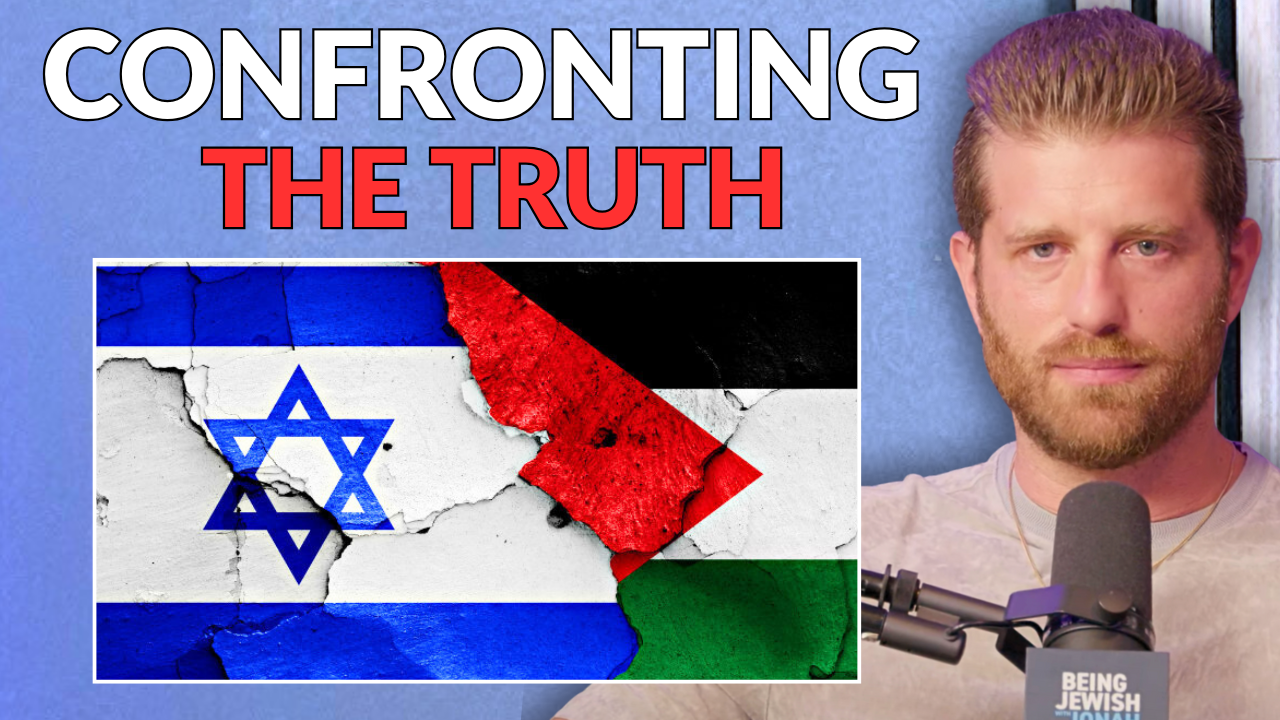
Monologue Transcript
Jonah Platt's Stance on Israel, Palestine, Antizionism, Bibi, Trump & more!
Right now, I'm going to introduce a single idea.
I'm gonna explain why that idea is important, and then I'm going to apply
this idea to myself, to my Jewish Israel and political advocacy specifically, and
in doing so, hopefully open a door to those of you seeing this who may assume
we share no common ground on those topics when I believe in fact we do first,
the idea to achieve clearly understood communication in our relationships.
Personal, professional, casual, romantic, online, IRL, every level of life.
It is critical that we remind ourselves to make the implicit explicit.
That's the idea.
Whatever we assume to be obvious, be it our emotional state, the purpose
of an event or the location of a stapler, we must teach ourselves
to assume that it actually is not, and therefore must be stated out
loud if we are to be understood.
Why is this important to do?
Because the literal opposite is true.
What is most obvious to us is generally not obvious to other people, and in fact,
they're often making a totally different and wrong assumption than the one you
also wrongly assume they are making.
Why does this happen?
Well, there are several cognitive biases at work here, and y'all
know I love a good cognitive bias.
Humans are just so flawed yet so cocky.
Primarily, there's what's called the curse of knowledge.
Once we know something, it becomes difficult to imagine
what it's like not to know it.
So we overestimate how obvious our thoughts or intentions or
explanations will be to others.
There's the closely related illusion of transparency, where we overestimate
how clearly our internal states, our emotions, thoughts, our sense
of morality are visible to others.
They're not, and last naive realism where we assume our perceptions
of reality of what's obvious about the world are shared by.
All these misalignments happen constantly in our interpersonal
lives, and they lead to resentment, misunderstanding, conflict, and harm.
I think at times there are also certain common resistances to being explicit.
One, which I may or may not have experienced in my own marriage, is a
sense of, well, if you really loved me, you would already know this about me.
Which is an understandable way to feel, but is really, as the captain said to
cool hand Luke, a failure to communicate.
Another, maybe a sense of self-respect or maybe self-preservation that
warps into a kind of preemptory and self-defeating resentment.
Why should I have to make something explicit just to give you an understanding
about me you haven't bothered to ask for?
And the answer to that is if a greater understanding would be a positive outcome.
However, it's arrived at.
Why not just take responsibility to ensure it arrives?
There's also, and I think this is the one that has most prevented me from making
the implicit explicit as it pertains to my views on certain public issues,
is a sense of not wanting to play the game, of not wanting to debase myself in
order to pass somebody's morality test.
And also the question of what does this really change?
In the case of advocacy, I'm very intentional in the things I discuss
because I have goals and I only do and say what I think can actually
affect the achievement of those goals.
If I don't think I can move the needle on something, I
don't see a point in saying it.
And yet, as a friend with whom I recently shared a four hour dinner,
helped me realize, shout out to Maggie.
If playing the game and taking the test opens a door to greater understanding.
A door through which perhaps more understanding can then travel through
that otherwise might have remained closed.
That may in fact be changing enough to make the enterprise worthwhile.
And so here I am about to make the implicit explicit.
These are things I know to be true.
The violence being wrt on Palestinians by extremist settlers in the areas west
of the Jordan River is reprehensible.
I'm not talking about clashes or disagreements.
I'm talking about the dudes who wake up and decide to go terrorize their
neighbors to ruin or even end their lives.
It's appalling.
It's appalling that the government doesn't care to crack down on it.
I am against any non-security related Israeli expansionist ideas and either
Gaza or Judean, Samaria that Palestinian people live in and have a longstanding
connection to these lands is undeniable.
To try to deny that in any way is both morally and strategically unacceptable.
However, I do support the current buffer zone Israel has created between its border
and the western bulk of the Gaza Strip.
I think anybody denying the necessity of this buffer after the horrors
of October 7th is out to lunch.
Any other such legitimate and objectively beneficial acute security
situations like that I would support.
There are plenty of videos of individual IDF soldiers doing shameful
things, things that humiliate or violate or hurt powerless Palestinian
people who do not deserve it.
I am aware these individual actions have taken place and
I condemn them unequivocally.
They're disturbing and awful.
I also recognize these actions are not a matter of IDF policy.
In fact, quite the opposite.
As we discussed on a recent episode with former IDF Officer Tomer Parrot.
I also recognize that social media clips are not reality.
Not only in the sense that some are literally artificial, but in that
they lack the context of real life alone with nothing but a short clip
and a take my word for it, caption.
They are not proof of anything, and the widespread acceptance
of this internet video said so.
So it must be true, is delusional and harmful to society.
I also recognize that many of the soldiers committing these atrocious acts are like.
20 years old and their best friends and neighbors and parents have been shot 30
times in the face, or raped or burned alive or kidnapped, and they've been
risking their lives in a booby trapped terrorist hellhole for two years.
And so, yeah, some of the immature ones are gonna objectify a random
Palestinian as the proxy for all the horrors they've been endured.
Take it out on them entirely unfairly.
It's wrong, it's shameful.
It should be punished.
And I understand that it does not take a special kind of 20-year-old
to be emotionally immature and intensely traumatized to the
point of making bad decisions with the limited power they wield.
That doesn't make it right, but it's still true.
The situation throughout Judea and Sumaria is a bad one.
It's stupidly complex, and we have many truths at play here.
The security, the checkpoints, the border fences are all there for a reason.
That hundreds of Palestinians have crossed into Israel and stabbed, shot
and blown up random civilians in cafes and discos and markets and on buses.
As soon as these security measures went up, the murders went down the
Islamist ideals of martyrdom, including a government and the Palestinian
Authority with a welfare system that literally provides financial support
based on attacks and prison sentences.
Rather than need, though some reforms have begun, necessitate
these security measures.
In America.
One terrorist dude tried to sneak a bomb on a plane one time, and now
half a billion of us take off our shoes every time we go to the airport.
So let's be realistic.
And many of those security measures are abused or implemented in such a way as
to purposefully agitate and provoke just to make life shittier for Palestinians.
I was told by a friend of a Palestinian farmer he met whose
properties divided by the border fence separating him from his crops.
In order to reach them, he has to drive an hour north to a checkpoint, spend
an hour going through that checkpoint and another one, drive an hour
south back down to 10 to his fields.
Then do it all over again in reverse to get home.
That's trash.
That farmer is not a terrorist.
He's a farmer.
I could do an entire monologue on what's unfair or unjust about the way
Palestinians are treated in these areas.
But again, it's complicated because the situation did not
materialize out of thin air.
The status quo for Palestinians needs to change and Israel deserves not
to be demonized for distrusting a population responsible for murdering
their loved ones over and over again.
The truth is somewhere in the middle.
I think the Israel education I received here in this country was terrible.
It's not even that we got a one-sided education.
We got a zero sided education.
I mean, I didn't learn that Israel was a parliamentary democracy
until I was in my thirties and I went to day school and sleepaway
camp and birthright and on and on.
And when it comes to Israeli history specifically, I think there has been
an aversion to telling the story, honestly, warts and all the same way.
Most countries struggle to reconcile with the darker mistakes of their past.
We here in America certainly know what this looks like.
Whether from a desire to focus only on Israel's best qualities and ideals,
or a fear that exposing the bad would cause people to shrink away and empower
Israel's enemies or just out of shame.
We simply weren't taught much about Israel.
And for a handful of younger Ashkenazi American Jews, that lack of information
was seen as a betrayal and nefarious attempt to obfuscate the truth.
And that's provided a pathway for the ideas of truly nefarious
anti-Israel enemies to take hold, whether overtly or unconsciously.
I think had we just acknowledged all of Israel's shortcomings as well as
its many triumphs from the outset and just been real with people, a lot
of the anti-Israel sentiment among young Jews today would not exist.
I also think that using that lack of education as an excuse for turning full on
anti-Israel is shortsighted and immature.
As a Nonis Israeli, I feel really unqualified to weigh in about
Bibi Netanyahu and the Israeli government most of the time.
I'm not a professor of politics or military tactics.
I never met the guy.
I have no lived experience as a citizen of his country, and
I don't live inside his brain.
Most people in America are barely qualified to offer a fully informed
opinion on our own leaders, let alone the leader of a country 6,000 miles away.
The only real tool I have for forming an opinion about him is the word of
what other people say, and that's specifically how I try not to operate.
Though it sure doesn't stop most people from running their mouths with impunity.
That's the wildly arrogant and oblivious behavior that's gotten us
into so much trouble around this war.
The normalization of declarations based entirely on what someone heard
someone else say without a shred of actual experience or expertise,
and those declarations being accepted as completely legitimate.
In terms of Bebe, the truth about him lies with whichever side of the
political spectrum you stand on.
I find that as with most things, the real truth lies somewhere in the middle.
In Bebe's case, this means that somewhere between the self-interested blood
thirsty monster and the sole qualified protector of the Jewish people is a
politician who loves his country and wants to save his people, and also
wants to protect the coalition that keeps him in power and out of jail.
I do not support any sort of want and murder of innocent people,
even if the perpetrator is a Jew.
I absolutely hate that this has to be said out loud.
It's been asked of me twice in conversations with non-Jews.
I literally need to declare that I'm not a supporter of starving
innocent people or killing children.
These are very hurtful things to be asked.
Unimaginable, really, that I'd ever in my life be asked such things.
And yet we have to make the implicit explicit.
I see now that if we do not say those things out loud, we are seen by
others as condoning through omission, however fair or unfair that may feel.
The claims of genocide, which appeared mere days into Israel's response to the
bloodbath wrought upon their sovereign land on October 7th are garbage.
It's inversion a technique I've broken down on this show before.
Israel does everything it can not to commit genocide.
Well, Hamas absolutely would commit one if they could.
I have not seen any cogent refutation of any of the hard data or actual
large scale actions of the IDF.
The only arguments being made are based entirely on people parroting something.
They heard.
Somebody else say, this guy or this organization said it's a genocide.
So I believe him.
And as we've already established, that's not an actual argument for anything.
The other argument I see is also not a real argument either.
Lots of people died and that's bad.
When Jews are leveled with the genocide accusation, we naturally
must resort to using the data and objective facts to argue that a war.
However, deadly and horrible and unpleasant is categorically not the
same as a genocide, but when we do this, we're then accused of quote,
being okay with innocent people dying, and thus we're still morally repugnant.
The genocide accuser is thus able to shut the conversation down entirely, allowing
their own emotional response to imbue them with a sense of moral superiority
that lives above facts and objectivity and renders the defender morally
inferior and not even to be considered.
On the flip side, if someone anti-Israel has not come out to explicitly condemn
Hamas at every stage in the strongest of terms, nor said anything about the plight
of the hostages, every supporter of Israel assumes you are a terrorist sympathizer.
So if you don't wish to be thought of as someone who supports the murder
of Jews and the elimination of Israel is a Jewish state, I'd suggest you
make the implicit explicit as well.
It is very easy for me to approve of certain things the Trump administration
has done in regards to Jewish people in Israel, while also disapproving of nearly
everything else he has ever said or done.
It's easy to say.
The Abraham Accords, the hostage deals, the attack on Iran and many
other actions were unequivocally good for stability in the region.
Were courageous and necessary and we're of great benefit to the world at large.
It's also easy to say his administration seems committed to the erosion of
First Amendment rights in a way that is incredibly worrisome and
will come back to bite everybody.
It's easy for me to think we need to crack down on illegal immigration and also think
that being so aggressive with raids that a dad gets shot and killed at daycare pickup
is abhorrent and tragically unnecessary.
It's easy for me to be thrilled that his administration has midlife on
campus safer for Jewish students.
And also recognize that the methods by which they've done so could easily be
used against Jews or anyone else down the line in a way that should worry everybody.
I'm also a hundred percent glad Kamala Harris did not win the election, as
I believe Jews and Israelis would be much worse off than we are.
And as a Jew, I don't feel I should have to apologize for being concerned with the
safety of my own children and community.
I'm also glad I voted for her, so I got to have my cake and eat it too.
I find all of these truths very easy to hold.
Simultaneously, I believe in a two-state solution that results in dignity and
peace for both Israelis and Palestinians.
I believe that the only way this might ever be achieved is if regional partners
step in and take a meaningful on the ground role in creating this new future.
I'm talking Saudi Arabia, UAE, Bahrain, Qatar, Jordan, et
cetera, and of course, America.
The trust is too broken for any sort of volunteer cooperation between
Israel and Palestine to play out well.
There must be pressure from outside forces, ensuring safety and security
for all, and I believe any peace initiative that is not built around
this principle is not built to succeed.
I hope the laud party loses badly in next year's election as whatever
you think of the job he's done.
I don't think Netanyahu is the guy to lead Israel's next chapter, which must
be one of healing, sensitivity, deep strategic thinking and collaboration.
I also hope whatever coalition is formed does not include any parties
from the far right blocking SMO rich and bang vere and their ilk from power.
I'm very worried for what the future holds if these hopes do not come to pass.
I know that not every anti-Israel person wants to see Israel erased
or chance globalize the Intifada or wears a Kaia or hates Jews.
I know that.
I also know that if you hang out at the same protests as the extreme people
who do want all that stuff, or you repost their Instagram stories or trust
their voices on Jewish issues over the voices of mainstream Jews, we're
going to assume you're on the same page or at best tolerant of their views.
Also, for any person who did not engage with this conflict meaningly
until October of 2023, be they an anti-Israel Jew or non Jew.
To assume they have a more complete understanding of the situation
via their media consumption than actual mainstream Jews and Israelis
who have lived this reality their entire lives is flat out racist.
If a white person told a black person, they understood the situation for blacks
in America better because they spent two years chatting about it with friends
and watching Qatari funded tiktoks about it, knowing so little they don't even
know they're watching Qatari funded tiktoks, we'd call that person racist.
Same's true here.
The most left-leaning, peace-loving Gaza.
Supporting people in Israel lived in the kibbutzim on the Gaza border.
Their reward for employing Gaza's, taking them to Israeli hospitals, holding
peace marches in their names was for thousands of Gaza to slaughter them, their
families, and their entire communities.
Anyone who cannot recognize the futility of trying to live next door to a jihadi
death cult does not have an opinion on these issues worth listening to.
I could keep going on for hours, but I'm gonna stop here.
The bottom line is that humility is missing from all
sides of this conversation.
As I've said a few times now, the real truth lies somewhere in the middle,
and everyone who pretends otherwise is only making divisions worse and
peace, less likely confirmation bias is killing this conversation.
The only voices you're listening to are ones with whom you already agree.
You're part of the problem, not the solution.
I'm not perfect far from it, but I know I'd rather try to be part of the solution.
So here we are.
Has any of this monologue accomplished anything?
I don't know.
I guess you'll let me know, but at the very least, there is now a public record
of where I stand on a lot of this stuff.
So if you're looking for common ground, maybe you found it.
If you've still got questions, ask me.
I'll try to answer them.
And if you've got questions for someone in your life, ask them.
Expect that they have questions for you too.
Preempt them.
Make the implicit explicit talk to each other.
Talk to each other.
This is the 44th episode of being Jewish with me, Jonah Platt.