
Interview Transcript
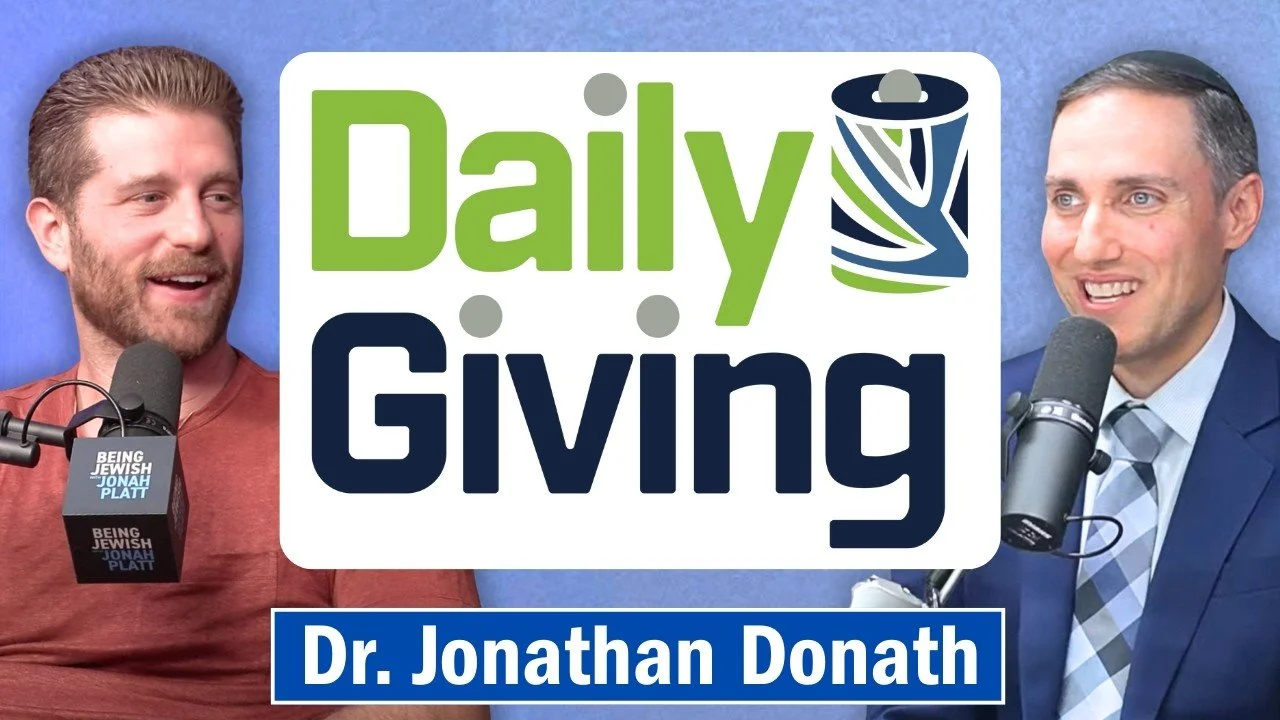
$1 A Day Will TRANSFORM Your Life & Change the Jewish World! Daily Giving Founder Dr Jonathan Donath
Watch and Listen
I thought I had a billion dollar idea and I was like, this is it.
I'm riding this wave as opposed to I'm out of control.
I'm tipping.
I'm about to crash.
Is that I would barbecue pig and I would waft it over to my neighbor's yard.
That seems aggressive, but my all time best story I have to tell you.
Let's go.
Welcome to another episode of Being Jewish with Jonah Platt.
30 minute Menes.
Same vibe, same tribe, shorter episodes.
My guest today is a healer in more than one sense of the word.
By trade.
He's the founder and president of Joint Effort Chiropractic in White Plains, New York, where he specializes in non-surgical spinal decompression therapy, which sounds awesome to me.
But by mission, he's the founder and president of Daily Giving an online platform that's transformed the simple gift of a dollar a day into over $13 million of Staca to over 75 Jewish causes around the world.
He puts the mensch in mensch.
Please welcome Dr.
Jonathan Donna.
Thank you for having me, Jonna.
Oh, thank you so much for being here.
So, you know, it's, it's 2018.
You're doing Mave.
You're doing your daily evening prayers that show one day you put a buck in the sedah box, that's a collection box.
Uh, and, and you're, you're struck with this epiphany that a dollar a day at scale could be really impactful.
Were you, were you marinating on something at the moment or it just literally popped into your head at a thin air?
So I'd actually watched a YouTube video about this, uh.
This rabbi in Israel, and um, he says, I wasn't just a secular Jew.
He says, I purposely ate cheeseburgers on yum kipper the holy day of the year.
That's the kind of guy he was.
He said, I would barbecue pig and I would waft it over to my neighbor's yard.
He's like, that's the kind of vibe that's, that seems aggressive.
It was, yeah.
And he, and he died of a drug overdose.
And this video is like a two hour video talking about his near death experience.
And he basically said he was on the other side of, you know, the other side.
For what felt like 2 billion years.
And the message he got it was, he was pain and suffering and darkness.
And he said, the message he got was, you don't even have one single mitzvah, not one good deed to elevate you.
And just after finishing that powerful video, I put a dollar in the charity box in my local synagogue.
And I had that epiphany that no matter how much money I give to charity, I still get a good deed for this $1.
What a deal.
So I was like, how can I guarantee myself that no matter what I'm giving to people who are less fortunate every single day?
So I call to my friends and we end up automating this platform to try to get people all over, all over the world to give $1 of charity together.
Every day and every day.
We give the entire amount to a different incredible Jewish nonprofit all over the world.
It's a diversified portfolio, and today we've given out.
Almost $27 million and we're giving out over $8.3 million a year now.
Whoa.
That is incredible.
Uh, I was way off with my 13 million.
You guys are crushing it.
How do you think about the spectrum of mitzvah?
Like what, what makes a small mitzvah versus a big one?
Because one would think, oh, giving a dollar is a small thing, but when 22,000 plus people do it like they're doing on your site every day, you're making an enormous impact.
You're part of a group that's giving an organization 22 grand.
In a day, which is incredible.
So how do you think about that?
I think about it as a, a mitzvah is, is a good deed that connects us to our purpose.
And so I like to say giving, if you think about it, every species on earth is hardwired in our DNA to give, to have offspring, to procreate, right?
Mm-hmm.
So giving is actually puts us in alignment with our truest highest essence.
So it's not about, it's not about the amount, it's about the frequency.
It's not about the dollar, it's the daily.
So that's how I look at it.
It's not when you give and you make the decision to give the next day and the next day and the next day you are actually building that giving muscle.
I love that.
Lemme, lemme play devil's advocate.
And here you have to say, so let's say I give a dollar a day.
I'm doing it every day.
I'm, I'm feeling great.
Or I go here, I'm gonna give you a million dollars this one time, but then I'm not doing it again.
Like, how do we compare those to each other?
Well, the, the great stage, Maimonide says that exact thing.
He says, if you could give a hundred dollars to one person or a $1 to a hundred different people, you should give $1 to a hundred different people.
And for that specific reason, because giving is a muscle, and if you don't use a muscle, it atrophies.
So how do you combat that?
That atrophy?
You train the muscle by giving.
Think about the skills you learn in school when you grow up.
English, math, science.
Mm-hmm.
You learn and practice them every single day.
But we're not taught to look at giving the same way we're taught.
Generosity is like a character trait.
You either you're generous or you're not.
No, it's a muscle.
And the more you give, then the reward you get forgiving is that you become a giver.
I love that.
I love that.
Uh, and you know, a thing or two about muscles.
So, you know, I do.
So I, it's doubly true.
So on day one, you launched this thing, and I read you had 46 signups on day one.
Did you feel like, wow, I got 46 signups where you're like.
Dang, only 46 signups.
Jonah, I was so disappointed when I had this idea in, like, I had the idea around the middle of 2018 and, and everyone I spoke to as we were getting ready to launch the website, everything was going on.
You know, everyone's like, oh, it's a great idea.
I'm for sure gonna do it.
And I thought I was so naive.
I thought we'd have like 10,000 people the first few months.
And so by like, you know, day 10 when there's like no one signing up and there's okay, like a hundred people, I was just.
So upset, and so in my mind I was like, you know what, if we just stay steady, just go one person every day.
And so I would literally take out my phone every single day.
It was like nine 30 at night and no one had signed up.
I would just pick up my phone and start going through my Rolodex, just calling people and say, and they're like, oh, good idea.
I'm like, can you sign up?
I'm like, yeah, I'll sign up.
I'm like, I need you to sign up.
Now, you know, it is so hard to get people to do things.
Yeah, yeah.
And I did it for months and then eventually slowly and slowly took off.
We got a thousand people the first year and then COVID happened, and all of a sudden a lot of people gave daily, whether they're reminded in, you know, in their, in their synagogue or whatever, they, there is no synagogue.
You couldn't go.
And so, uh, it started growing more and more and, and we started getting different influential people to speak and they, they, they signed up themselves.
I know Elon Gold, the, the Jewish community, and he, he signed up very early, like maybe three months in and he's been a huge help and fan of what we're doing.
And so he made a, a little video for us on, on his porch during COVID and it, and it went viral and probably like a thousand people signed up for it from it.
So That's awesome.
Elon's the man.
Shout out to Elon.
That's so cool.
I mean, I.
I experience that all the time.
You know, I'm involved with a lot of different causes and boards and even just, you know, with this podcast, getting people to subscribe.
Like, I'll have people be like, oh, I love the show.
I love the clips.
I'm like, well, are you subscribed to it?
And they're like, no.
Just like, it's tough to get people to do anything.
Um, so like how, how long did you have to sustain yourself being the one to like get these.
People one by one.
Yeah.
It took a while.
And I think that if I, if I look back, Jonah, and I think about the one God-given talent he gave me, it was that he gave me this like resilience and just attitude of sticktuitiveness.
You know, that that's, that's really what I added.
And I think that.
It was only 'cause I only had one epiphany my whole life.
I never had anything like that besides that one night where I had it.
It was so like, deeply ingrained in me.
Like I thought I had a billion dollar idea and I was like, this is it, this is, and it just, and it just, it just never went away.
And I wanted to quit.
Like it was just inside of me.
He's like, no, go, go, go.
Whatever.
You know?
Every person who signed up loved it.
They loved me a part.
We sent an email every day to all our givers, telling 'em where the money goes that day and they get a video and a link and they learn about new charities.
So.
The satisfaction rate from what the givers were telling us was so high, right?
Like everyone would say, at first I'll tell someone, Hey, you wanna sign up?
They're like, well, I don't wanna get an email.
I get enough emails and then I'll have friends who are CEOs of big companies.
They're like, Jonathan, I get 10,000 emails a day and this is like the one email I always open.
Like I love how it makes me feel.
We're humans, we're so hard on ourselves, and.
There's so much going on and we're the negative self-talk, and all of a sudden, ding, the email comes.
You're like, oh, thank you for your donation.
You gave something that day.
You're like, oh yeah, I'm, I'm a giver.
Like, oh yeah.
If nothing else, I, I helped somebody, you know who needed help today?
No matter what else my busy life had me doing.
Exactly.
You're up to having given to something like 80 organizations almost.
Is that right?
Am I in the ballpark?
Yeah, you're in the ballpark.
And we're, we, we had 700 organizations apply to us last year and, uh, that became a, i I didn't even tell you.
We, we take nothing, by the way, like a hundred cents of every dollar goes to charity.
Right.
We do have a budget.
We have employees and we have marketing.
We do.
And, but we just fundraise that complete separately.
So there's two accounts.
There's the charity account, and then there's the operations account.
And I fundraise the whole.
Budget separately for that.
So that's, uh, wow, that's my third full-time job.
I want to get into that.
Let's go back to the 80 organizations thing.
How do you select, like what, what's the right criteria?
And also how did you select who to start with at the beginning?
Like what was your criteria then and has it changed at all to now?
When we started, I had, I had called this very famous rabbi.
Someone gave me his number and he's, he's an international speaker and he's very popular and he has so many followers.
And I told him the idea and he says, great idea.
You should get a rabbinical counselor together because people dunno who you are and if you have this thing, they have to trust that it's not going to your kids' college fund.
And I said, you know, that's a good idea.
So at the beginning it was basically the board, like my friends that we started and the rabbis we had, we kind of did, okay, what charities do you like?
What charities do you like?
And right.
We put our other charities that we were, you know, familiar with and very passionate about already.
And that's how we started.
We started with 36 organizations.
The next year we went to 54 the next year.
And then, and then now we're at, we're, we're gonna be over a hundred soon.
You know, the due diligence we do, we, I mean, if I should show you the reports, we have a whole click team of like Harvard lawyers that, that basically like do our due diligence and.
Um, for free, you know, and, and then, and we go over it and we have allocation committee, and we have a board, and we have council.
So it's like, we take it very seriously.
Like we're giving out over $8 million of, of, we're the stewards of people's money.
Actually, this week, Jonah, uh, an anesthesiologist from from Florida, this woman, young woman, she's like early thirties.
She, she, she gave $29,000 and I called her and I was like, that's not usual, right?
Most people give a dollar, right?
Like a day at one time in one chunk, she gave $29,000.
And I said.
And I asked her and she said, you know, I give 10% to, to charity and I can't, I don't have the time to really properly vet and do what you do, and I really love so many of the charities you give to anyways, so I'll just give it to you one chunk.
And I was like, blown away.
That's awesome.
I mean, that's a really interesting way to frame it, right?
I mean, to think about.
It's not just, oh, we're giving a dollar a day.
It's, you can also just trust us with this donation and it's gonna get spread out all over, all these incredible organizations.
Exactly.
Have you messaged it like that before?
Yeah, we, we, we did.
I mean, there's a little bit of like, careful, these are our partner organizations.
They also try and help us grow.
And so, you know, we want, you know, we kind of, we don't want people to think of us as instead of, it's in addition to.
Right, right.
So you know, if you're gonna give your kids school or your synagogue or whatever your favorite charity is, you're giving your big checks there.
It's just an extra dollar a day.
This is more about unity.
Like I'm a unity guy.
I love all Jews.
I love all people.
Like this is good for everyone.
Right?
And so that's what I'm most proud of.
I'm a grandson of four Holocaust survivors.
And to me it's about, it's about unity and like there's a lot as Jews we don't agree on, but like giving charity is just like in our blood to be givers.
We really take pride that it's a diversified portfolio of charities we give to.
Widows and orphans and cancer organizations and special needs and substance abuse and mental health and lifesaving and stem cells and you know, prison, like jail.
Like if Jews go to jail, you know, and they can't pay for the kid.
The kids like, think about the wife and the kids.
Like, they like right.
They pick, they have no money, they can't send their kids to camp.
You know, there's an organization called Olive that does that.
You know, like we, we really like, that's different, right?
It's not your everyday big magazine wrote an article about us and so a hundred people signed up for the mag from the article, but.
Two weeks later, they published a letter to the editor that I really love and the person had written that, you know, I always struggle with charity because I always felt like my $18, my $36 check or whatever, I feel like, what kind of impact am I having?
Right.
But with daily giving for the first time in my life, I'm giving, at the time it was over $14,000 a day.
It's like I feel like I'm a big philanthropist.
Wow.
And I was visiting a domestic violence shelter in Israel that we support, and I, I showed the email that, you know, of the day that this shelter got the money from what they were giving.
And the woman burst stopped crying.
And when she composed herself, she said, I can't believe there are over 15,000 people that know about us and care.
Mm.
And there was like another, you know, just another, like, I've been in this a while and I just, you know, just to, to see like from her perspective, it wasn't even about the money, it was just that there was like, wow, people know about us, they care about us, you know?
But my all time best story, I have to tell you, let's go for listeners, is that a gentleman signed up for a dollar a day and then a minute later signed up again and then a third time and the four, five times in five minutes with five different email addresses.
And I called him and I thanked him and I said, who did you sign up for?
And he said, I signed up for my wife and my three children.
I said, wow, that's incredible.
How old are your children?
He said.
They're one, two, and four, and he said, I already reserved their Gmail addresses, and now in seven or eight, nine years, whenever I give them their password, they open and they log in for the first time they're gonna see you just one email.
But that email is gonna be repeated thousands of times.
And they're gonna see, thank you for your donation, and they're gonna know that they've been givers their entire lives.
Wow.
That's so powerful.
Do you know who your.
Giving community is like, demographically, like where are they and, and from where on the Jewish observance spectrum?
Are they and are, do you have any non-Jews?
Like, I'm just curious to know who, who your givers are.
Yeah, so we, we try to make it the signup process as easy as possible.
You know, we want it to be really, uh, easy and like not have anything that says, oh, you know, because like you said before, if there's like one thing that someone doesn't feel connected, that's it, they'll, they won't sign up.
It has to be like, click quick and easy.
So we, we don't know.
Uh.
Religious level, observers level Jewish, not Jewish.
We don't know.
You can tell from the names.
And sometimes that's who they're, you know, who they're signing up for in honor of the idea for whatever, you know, the people sign up for all different reasons.
Um, but just this week, literally this week, someone sat up and says, someone's called, someone emailed my staff and said, I'm not Jewish.
Can I join?
Like, that was like the most respectful, beautiful thing.
Like, really, of course you can join, you know, so, um, I, I know that 91% of our givers that are in the US and 9% are from 42 other countries.
That's so cool that you're getting that, that international reach is amazing.
I'm kind of disappointed.
You know, I, I think that we're, you know, we're about 22,700 now dollars a day, and I, I think we should have been a hundred thousand people a long time ago.
The great Mel Robbins says, you know, if you don't, if you, if, if a thought pops into your head that requires action and you don't take action with within five seconds, you probably won't.
Right.
So it's really one of those things that if anything we say today inspires you to even think about this, like go on daily giving.org, take one moment and, uh, and Joanne, you will not regret it.
This is, I I, I get told every day, this is their people's favorite charity.
There's giving charity, but when you give charity with 20,000 of your brothers and sisters every day from all over the world, and the, and then the impact, first of all, like with inflation, like our, it just gets cheaper daily giving Gets cheaper every single day, you know?
So you, you mentioned this is sort of like, you know, fundraising for operations is your third full-time job, assuming the, the other side of this is your second full-time job, plus the chiropractic practice is the first.
Like how, how are you balancing all of that and, and you know, how, how big of a chunk of your life.
Is this when you're, you know, running an office all day for a while it became very difficult.
I'm not gonna lie.
It became, I've been in practice for 19 years and, um, so thank God my practice, I have enough referrals of patients telling each other about me that I don't really have to do that much to, um, to kind of make that part go.
But yeah, it's, people are like, how, how much time do you spend on day, daily, evening?
I'm like, all of it, except for when I'm in the room with the patient.
Right.
You know, earlier today I saw patients all day today, you know, so, um.
But it's, you know, I have a great wife, like an amazing wife.
You, you, you know that, that is so important.
She's so supportive and critical and, um, you know, I'll sleep when I die, as, as they say, it's brutal.
I can only imagine.
I mean, I'm, I'm involved in a lot of stuff myself, and for me, ballots is the, like, the thing I'm always chasing.
Um, and I, I can imagine it's, it's gotta be just a, a slam for you all the time.
Jonah, I, I'll tell, tell you the line, someone said to me that.
What you just said that hopefully it really helped me is that we are al always chasing balance.
Right.
But really, we're never gonna find balance.
It's, it's being, it's, it's understanding that there's trying to find balance in the imbalance.
That's what we're looking for.
It's balance in the imbalance.
Eh, I don't know.
I feel like you can, I, you know, it's like, you know, when you're on a surfboard, you, there's always a little bit of a teeter, right?
But you're, you're, you're, you're trying to get as close to that equilibrium as you can.
So I'm not necessarily looking for perfection, but I think there is a level of, okay, I've.
I've got, I'm on this, I'm riding this wave, as opposed to I'm out of control.
I'm tipping.
I'm about to crash, you know?
Absolutely.
Absolutely.
That's, to me, that's a balance of the imbalances I've read in an interview.
Speaking about, you know, scheduling and balance and all that, you said you've given up Tuesdays.
What does that mean?
Tuesday, I, I don't see patients anymore.
I used to see patients five days a week, and so Tuesdays are my days for meeting my whole team, my daily giving team.
You know, I do have four full-time staff.
You know, people don't realize we're giving out more money than.
A lot of Jewish federations, like it's a real operation.
People don't, you know, think, oh, it's a dollar a day.
What's so complicated, right?
You know, we have a social media team, we have a marketing team, you know, we have a CFO, we have technology.
You know, we're, we wanna grow this thing.
How, how big of a team are you right now?
How many, how many people?
We have four full-time staff.
Five part-time staff.
That's not that huge for, it sounds like the amount of, I mean, everybody's got a, must be really.
Carrying their load.
Yeah, exactly.
We all work really hard.
It's like bare bones, it really is.
Exactly.
And who, who are you fading to support you on the operational side?
Maybe you're gonna have some listeners that's gonna be so impressed and be like, it really is happening to be like the greatest charity, ROI in like the world because when someone gives a dollar eight, they love what we're doing so much that they never stop.
So, so like it cost me about a hundred dollars.
Maybe sometimes less of marketing to get a new daily giver, a stranger, someone on WhatsApp, I mean, sorry, on Instagram or Instagram or Facebook or whatever.
So like that, a hundred dollars, I'm gonna get another person to give thousands of dollars to charity.
Like there's not a lot of charity ROIs like that.
So, um, so that's kind of, I, I go around, I talk to people and they love what we're doing.
They love being a part of it, and so they got it.
How different do things look now it's 2025.
You launched this thing beginning of 2019.
Other than the fact that obviously a lot more people are doing it.
H how, how different are the operations, your approaches?
Has anything changed from that sort of initial model and focus, or are you just doing the exact same thing and just you get to do it with more money?
No, a lot has changed.
First of all, we were like a mom and pop shop and now we are, you know, we had paid lawyers a lot of money to make sure everything is, you know, perfectly set up.
We have a giving policy, the whistleblower, all the different policies in place, you know.
Um, to make sure that we're doing everything exactly correctly.
You know, we, we have to audit, self-audit.
Our audit costs over $40,000 a year just for that piece of paper.
From the, the accounting firm that says what you're doing.
Is that what you said?
You gave out?
You gave out.
Um, just to give you an example, is that, is that like an every nonprofit kind of thing, has to do that?
Uh, if you're nonprofit giving up enough, giving out enough money per year, yes.
You're supposed to do that and, uh, yeah, it's a, it's a hard pill to swallow when you have to get someone to donate $40,000 just, uh.
But that's the price of the big, the big leagues, you know?
So, but that's just one thing I think the hardest thing was, was the due diligence part.
You know, just not understanding that when, when 700 organizations apply and to.
Take them all seriously.
And you don't wanna upset anyone and you wanna let them down nicely.
And not everyone's a good fit.
But then even the ones like, we get 700, there were like a hundred that were amazing fits, but you can't, we, you know, we don't want to add everyone yet.
And then you gotta go through and make sure that like they're doing a good job, right?
It's only gonna take one bad organization, one bad apple.
If they're doing something wrong, then all of a sudden.
It could potentially take our reputation down.
And so I think there's that.
I think that people, we do have, you know, more name recognition and branding people, people know where we are now.
I mean, not everyone, you know, I hope, I hope none of your listeners have ever heard of us and check us out.
But, um, you know, it's, it's more recognizable and I think there's a, we we're trusted name and charity now, so, um, that helps.
You know, it's not as hard in your beginning if you, if you have a couple hundred people doing it, there's like that another question, right?
Like, do I give them, are they trustworthy?
So, yeah.
So I, I'm, I wanna dig into that a little bit.
So if you could, and of course speak generally, but like, what makes a, an organization not quite the right fit?
What makes, what makes them the right fit?
Like we gotta get in with these guys and then what's the line you're towing where?
I'd rather have X number of charities receiving a couple days a year versus let's get 365 charities and everybody gets one.
I mean, the goal is to get the 365, like when we're giving $36 million a year.
And I believe, I mean, my first goal, the night I had the idea was I was like, Hmm, how many?
How many?
There's 15 million.
You know?
At the time I was like $14.5 million million, 14.5 million Jews in the world.
I.
I refuse to believe we can't get 1% to give a dollar a day.
I said that's, that's like the mindset I had.
And that's over $52 million a year.
And that's still the goal from the day one.
Like that's the first goal, $145,000 a day, you know?
Yeah.
Yeah.
Um, so Jonah, I mean, listen.
You're the man.
Let's, let's, let's get this thing going, right?
I'm trying.
Hey, here we are.
But, so, so tell me what, what makes, what makes a, an organization not quite the right fit for what you guys are doing?
Yeah, good question.
Um, it has to be national or international because of our reach.
You know, we can't, we don't wanna give like just to someone in Chicago or just LA or just New York.
Um, so that's number one.
It has to be national, even like international organizations, even better.
When we started.
We also needed the organizations to be very recognizable names, right?
So, 'cause people are like, who are you giving to?
Okay.
Oh, you give to Ma David do, oh, you give to United Atala?
Oh, you give to High Lifeline.
Oh, you know, some of these big, bigger, oh hell, these bigger name organizations.
Um, but now we don't need that.
Like we, you know, we don't have to.
And so we, we actually are getting, our sweet spot is like between one and $5 million budget.
Because like then we're, we're a sizable, like we're a real donor to them.
Right.
That's a big impact.
And you're introducing people to, Hey, here's this new organization you maybe didn't hear about.
Exactly.
And now you get to support Exactly.
One of the organizations we started with, um.
Originally their budget was like 400,000.
Well, we were giving much less, but at the time they were like $400,000 organization.
And we, I'm not saying I'm, we're not taking credit for them being put on the map.
Right.
But they are now like a $5 million a year organization, you know, so I le I really love that we were like a huge donor to them and we really, they, they, they really felt so much gratitude to all our givers for, for what it did.
And then they've blossomed after October 7th.
They did so much in Israel.
Um, and they just became like a major name.
The goal is to eventually have 365 that fit that criteria and everybody's getting one bite of the apple a year.
Yeah.
I mean, that's the goal.
The goal is really to get as many people to give a dollar a day as possible together.
It's really, it's, it's just, it's just, I feel like there's nothing, God loves more, loves more than when his children do stuff together for each other.
Like for our brothers and sisters every single day, like, what more could God want knowing that every day I'm giving something to one of my brothers and sisters?
Like, I, I can't think of anything.
God would want more.
God is our father.
We are his children.
I know when my children are like, get along and they love each other, like, nothing makes me happy.
Or it's the same.
Right?
So I'm, I'm on the board of an organization called One Mitzvah a Day, which is, uh, now part of actually, uh, JFNA Jewish Federations in North America.
Uh, we use text base.
Messaging to get people and they just click a link on their phone every day and we're, we're thanking somebody somewhere in the world, an organization, a politicians, uh, whatever, who has done something on behalf of the Jewish people or Israel, just to give them beautiful, positive feedback.
Have you ever considered doing like text base?
Messaging in some way so that people like pops up and you just click it and it's done.
Yeah.
Maybe we have to talk afterwards.
Um, I know, I know we, we use text for something different, like, like, uh, when we did a campaign within our own givers.
Uh, but nothing like that.
Not a cold.
So you're saying use the text messaging cold?
No, you have to sign up for it.
You have to sign up for it, but then it push, I guess it's a little different because yours, you get to set it and forget it.
Like once you've signed up, you never have to worry about giving again.
You're just doing it.
Yeah.
But there's, there's gotta, there's gotta be some sort of cross pollination somewhere.
We can, we'll go offline about it.
Absolutely.
So you've got, you've got a wrapped audience of, of potential givers here.
Uh, you, you've said so much already a about why they should give in the joy.
Is there anything you haven't said that you wanna make sure they take away from this conversation?
Yeah, I just wanna double down on the fact that.
Giving is not so you can make you happy.
Giving is to line you with your true nature, which is to be a giver, even if you don't think that or know that.
And I, it just, by the way, it doesn't have to be money.
That's the truth.
It doesn't have to be money.
It could be complimenting a stranger.
It could be visiting a lonely neighbor or calling someone who's sick, or it could be giving a dollar.
But do that thing daily.
Try it, do that thing daily and just see what it does to you.
Giving transforms you it, it literally.
Shines your light, brings your light up and shines it out.
And the more when you make that decision to give and give again and give again, you are literally fashioning the vessel so the light can shine through you.
I love that.
That's so powerful.
Um, you said already you could sign up at it's daily giving.org, I'm assuming the process, it's just, you know, fill out a couple things, then you start getting those emails every day, right?
Yeah, we, we can't hit people's credit card every day 'cause the transaction fee is like 30 cents.
So that would be a very bad use of your money.
So.
The choices are you sign up for a month or a year and it's recurring, a subscription.
Basically.
You can stop anytime you want.
Every day you get an email, you know, you can try, say, I wanna stop, I wanna get, a lot of people start a dollar day and a lot of, a lot of people, we have more people that go from a dollar day that that start adding more dollars a day than we go from a dollar to canceling.
That's how much people really enjoy it.
So that's proof right there.
So if, if your listeners are like hemming on and thinking about it, I'm just telling you just, just literally, it's one of those things where there's this 1, 1, 1.
I love this video that this one person made for us.
And he said, he said like, one day you like you die and you go up to heaven and there's like thousands of thousands of angels and like God says like, oh, here you are.
And he is.
What's all this things like, oh, these are representing like a mitzvah for an angel.
For every mitzvah you did, you, you know, you've clothed the, you've clothed the poor people and you fed the sick and blah, blah, blah, blah.
And then he is like, I think you got a mistake.
Like, I, it was just me.
I didn't do any of that stuff.
It's like, oh, remember like 20 years ago you signed up for that authorization called daily giving?
Like that's what this is all about.
I mean, you know, it's not, don't do it for that.
But I'm telling you like, like I said, you know, the reward you get.
Forgiving is that you're a giver and trust me on this, I wasn't always a giver myself.
I'm telling you like it's, it's transformed me and who I am and I, I am blessed to meet incredible people every day and see like the best side of humanity.
There's a lot of not good side of humanity, but I get blessed to see like the very best of humanity and it starts by giving frequently.
Amazing.
Dr.
D, thank you so much for doing so much Good.
In so many ways, you truly are a blessing unto our people and, and the world.
And appreciate everything you're doing and everything you're about.
Thank you Jonah.
You as well.
Keep doing what you're doing.
It's great.
And we need more people like you out there, uh, representing us.
You know, I'm not going anywhere.
Alright.
He's a mench.
It's been 30 minutes.
I'm Jonah Platt.
Go sign up already.