
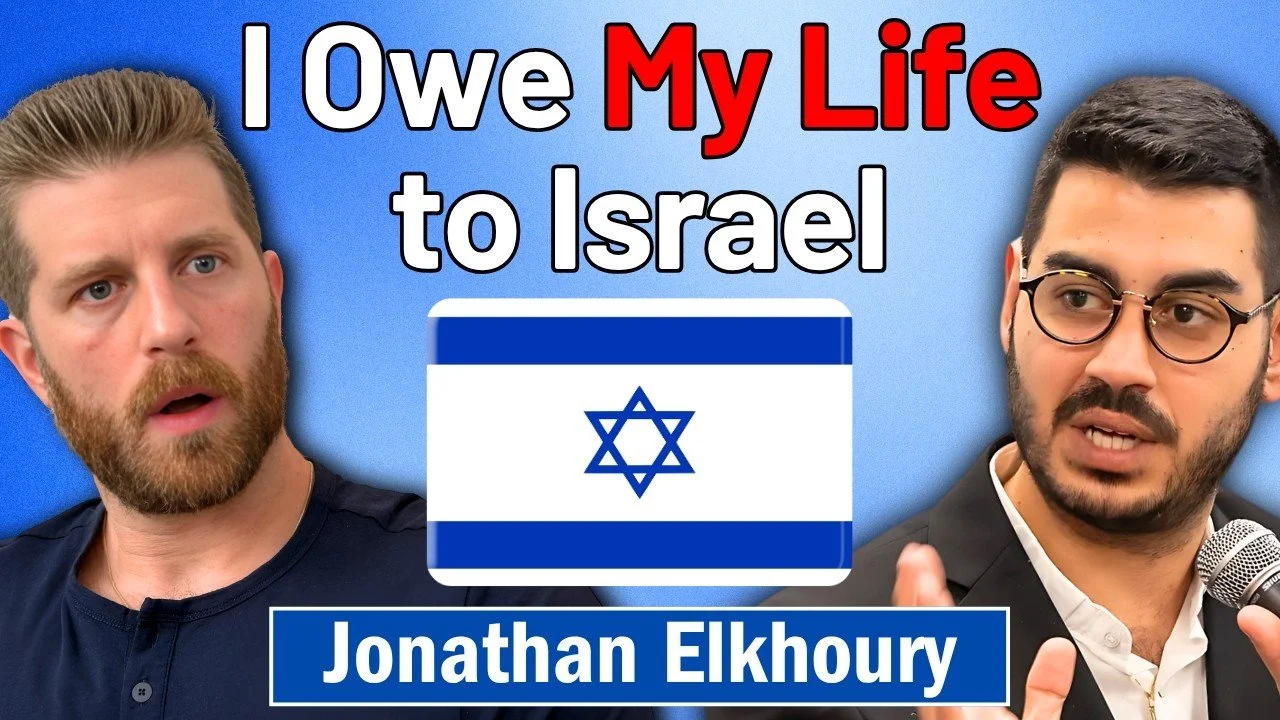
Interview Transcript
The TRUTH About Minorities in Israel with Gay Lebanese Christian Activist Jonathan Elkhoury
Watch and Listen
According to the West's narrative of Israel, a person like you doesn't even exist.
Everyone wants to believe that they're human rights activists.
How much of that trauma do you still carry around with you?
I mean, how much is of that, of that part of your story is still present?
Do you want my answer or my therapist answer?
Sir?
Welcome back to our summer edition of Being Jewish with Jonah Platt.
30 minute mentions.
Same vibe.
Same tribe, shorter episodes.
My guest today, what a guy we met on my recent trip to Germany and Poland for March of the Living, which I spoke about in great detail on a recent episode of the podcast that I suggest you check out so you can get caught up.
He is a proud Christian, gay, Lebanese born Israeli who uses his platform online and IRL to educate folks about the real Middle East.
He's got an incredible story, incredible positivity, and he is doing incredibly important work, especially on American college campuses.
He's our brother from another mother.
Please welcome the delightful Jonathan Elco.
Hi Jonah.
Thank you very much for having me.
Oh, man.
Of course, you, as I said, are, are Christian, gay, Lebanese born and a proud Israeli?
Yeah.
According to the West's narrative of Israel, a person like you doesn't even exist.
Right.
How much are you feeling that basically erasure of people like you from the rhetoric coming out of the West?
Not only that, they think that people like me doesn't exist.
They don't really listen to people like me because suddenly, uh, when it comes from a minority, within a minority, within a minority that is also an Israeli or supporter of Israel, that means that anything that I say doesn't counter them.
And this is where a lot of this hypocrisy in the West coming from.
Which I really deal with on a almost daily day basis, both on social media and also when I travel to campuses and to talk with a lot of anti-Israelis that tell me, Jonathan Elkhoury , the Israeli Lebanese Christian, gay, the minority living in a majority country, that I don't have my full rights as an Israeli citizen, that I live in an apartheid state where I can focus and be whoever I want.
And then I come in the flesh and tell them, Hey, listen guys.
What you're saying doesn't really match reality.
Do we have racism?
100% like everywhere in the world.
But what you're saying about my home that I currently live in Israel is completely lies to your teeth.
And a lot of them don't really know how to cope with it.
So I've been targeted many times by anti-Israeli folks on campus, or even in the streets.
I've been yelled at, I've been kicked, I've been spat on on college campuses in the us.
Since I've began my, my activity, and I feel that I have to be driven much more to show these people that you are completely living in a delusion and you have no idea about what's going on in Israel specifically about minorities rights in Israel.
What do you think that says about.
Why folks like that who are kicking and spitting are even in the game that they don't actually care to listen to you or know the truth.
Like what are they really there for?
You know, everyone wants to believe that they're human rights activists.
Everyone wants to have.
This, uh, lightning of becoming and helping and assisting to someone in need.
But when it comes of a basis that is basically lies on, on a lot of lies and misconceptions and a lot of half truth that has nothing to do with reality.
There's a problem.
And then when you come and tell them, listen guys, you've been told all these years.
Lies about my life as a minority in Israel.
And then they can't cope with that.
They don't know how to accept it.
And more often they don't know how to question the beliefs that they are taught to believe from a really young age in this social group that they're part of.
And they're really afraid to lose that social group.
Now I understand them.
I've lost my social group since I was a kid, because of my dad being part of the South Lebanon army.
Uh uh, my dad decided to fight.
Alongside of Israel for 18 years in Lebanon, when Israel invaded Lebanon in 1982.
Basically to fight against the PLO terrorists that committed the same atrocities like Hamas did on October 7th to the surrounding communities of the Gaza Strip in Israel.
And these atrocities have not been translated to the world to understand.
So one of the major things also that I speak about in my lecture.
It's about my own family's history in Lebanon.
Lebanon was supposed to be this Christian, Lebanese, prosperous country that because of Palestinian terrorism in the 1970s, the civil War in Lebanon started where it's still in chaos.
Still today because of Hezbollah and other foreign government really, uh, uh, taking Lebanon down and controlling it to attack Israel from its territory.
Now, this history of the Middle East.
It's really not taught in the US or in Western ies, like in Europe or other places.
And I feel that when you come there and tell them, okay, listen, yes, the Palestinians deserve human rights.
They deserve to live in dignity.
But this is also part of the Palestinian history of terrorism that they did throughout the Middle East, not just against Israel.
They suddenly can cope with that reality.
And we use the word brainwashing to talk about some of this stuff and it, it comes off like we're being, you know.
Extra insulting or hyperbolic, but it really is, I mean, it is almost cultish and it's, yeah, you, they're living with this reality, and as you said, they can't cope with the truth because it would mean deconstructing everything that they've built in their minds.
And so the easier thing to do for a lot of these folks is to lash out at the bringer of truth instead of embracing it.
And thinking critically about it, which is just such a shame.
Yeah, and I always tell them, don't take everything I say as granted.
Go up and look it out.
This is your job to do.
Your job is to question.
Your job is to, to try and search for more information about the, something that a lot of people are trying to feed you information about.
Your job is to go and search.
While none of them are doing that.
When you go to these college campuses, what kind of student groups are you speaking to?
Who are the audiences?
Our target a lot of times is the Jewish and pro-Israeli students, but a lot of them also don't have this information that I hold about my life as an Israeli Christian about the LGBTQ plus community in Israel, about the relations between Lebanon, Israel and the connections and what's going on about some sort of more, uh, connection to the reality that we live here in Israel as a whole, not just as a minority, but also as an is.
Israeli about Israeli politics and stuff like that.
A lot of the pro-Israeli students are not well aware of the whole concept of what's going on here because they don't live here.
I don't blame them.
Right?
This is kind of reality and what we have to face.
The other ones are the anti- Israeli students, and notice that I say anti-Israeli students and not pro Palestinians, right?
'cause there are a huge difference between these two.
When I say anti-Israelis, first and foremost, they don't believe in the right of Israel to exist as.
The nation stayed for the Jewish people, but second of all, if you notice, they're not pro anything.
They're just anti-Israel, anti Jews, anti Zionists, anti-this, anti that anti-America, anti the West.
Yet there a lot of them are trying to hide it in some sort of like a speaking points that will not really make them fall into trouble, although some of them weren't able to do that.
These are a lot of times my targeted audience where at the end of the day I use them.
To connect with other students that have no idea about what's going on.
So, for example, I will travel to college campuses on what's called the anti-Israeli Week, or the so-called Israeli Apartheid Week.
Will there have an anti-Israeli exhibition on campus for a whole week?
And I'll go there as an invite from the students, the pro-Israeli students on campus, and we'll just sit there with a table in the middle of campus and speak with students about Israel, about what's going on here, about the war, about everything you're, you're just.
Think about in, in general about Israel, and we will face these anti-Israeli students.
We will go to their demonstration, or we'll go to this kind of wall that they build over there to try and show students their bodies that are really sitting there in front of us and just.
You know, brainwashing students to believe that this is the reality, while the reality is something else.
So I will go there for a whole week to speak with students, to engage in conversations, and a lot of times the anti-Israeli behavior towards us shows a lot of students where the right side is and where the wrong side is because they will see us engaging with them.
Smiling, talking, explaining, a lot of times, not even giving excuses to our government because this is not our job.
I, I don't represent the Israeli government.
I wanna be that bridge between Israelis and the rest of the world that have no idea about who Israelis are because we've been.
Israelis and Jews worldwide, especially after October 7th, have been through dehumanization.
I don't have to tell you that, Jonah.
Yeah.
I mean, if you know it, you've spoken about it, you've seen it yourself and us being in Poland, in in Auschwitz, seeing the depth of the concentration camps and how big they were.
This factory of death of the German Nazi that did in, in the 1940s.
It really makes you understand that you can't stay silent and you have to do anything in your power to make sure that because of hate and because the Jews went through this huge dehumanization throughout history, that's how the Holocaust was able to happen.
We can't let that happen again, and we have to go there and kind of put that human back.
Into our body.
It's really sad to say that, but this is the reality that we're living.
What do you say to folks who might say to you, like, why are you standing up so big for Israel?
You're this minority, within a minority, as you say, like you live in a this, this supremacist Jewish state, they don't even care about you.
I mean, like what do, what do you say to all that?
Well, it's quite the opposite.
I'm doing what I'm doing because Israel stood by me.
Israel was the only country when my country Lebanon was invaded by Palestinian terrorists, was persecuting us, Lebanese, Christians, and and Shia Muslims and Druze in Lebanon, the only country that stood by us and came to help us protect ourselves.
Israel, this is one of the major reasons that I'm doing what I'm doing today because Israel was the only one standing up for minorities in the Middle East that were persecuted by the Palestinians.
And that's something that can go without acknowledging or recognizing it.
And also, when Israel decided to withdraw from south of Lebanon on the 23rd of May, 2000, Israel gave the opportunity for everyone that is life is at Rick's.
And one of them is my dad.
Being a soldier in the South Lebanon army working alongside of the IDF was to get shelter in Israel.
Israel welcomed about 8,000 Lebanese Christians, Muslims, and Druze to get shelter here in Israel and gave us the opportunity to thrive, and most importantly, the opportunity to live.
So at the end of the day, I own my life.
To the state of Israel, could that be in a different way, different level?
Because there's a lot of issues that weren't solved just by bringing us here to Israel, but yet this, this is reality and this is what happens.
I'm able to live freely as a gay person, the only country in the Middle East that allows me to live as free as I am to walk.
Hand in hand with my future boyfriend in the streets, I'm able to do that only here in Israel.
Um, and this is something that, you know, people say that we do pinkwashing.
When I talk about it, I've been blamed so many times.
Basically what they do is they strip away the human rights movement that Israeli Jews and also Arabs.
Were hand in hand fighting for LGBTQ plus rights in Israel through the seventies, eighties, nineties, and throughout the two thousands.
Till this day, they basically say Your work as human rights activist, doesn't matter.
Israel just gave you your rights just to show the Western world.
Oh, look at us.
We have gay rights while.
In reality, it was the opposite because the government didn't give anything to the LGBTQ plus community.
Every right that the community got here in Israel was through fight, uh, uh, sweat tear and blood of the LGBTQ plus activists in this country.
It's amazing.
Uh, can you tell us a little bit about what it's like being.
An Arab Christian in Israel, the Christian piece of it, and how, if at all, being Christian in the Middle East looks different from being a Christian in the west.
I've spent a lot of time in New York where I started dating this guy, but he's also a Christian by name.
He wasn't a believer.
But he never understood why I call myself a Christian if I don't go to church every Sunday.
He didn't understand why I am wearing a cross if I'm not a huge believer that goes to church every Sunday and kind of prays all day and like read the Bible all day.
And I was, I was looking at him telling him.
This is the Middle East, like I'm coming from the Middle East.
Uh, it's just, it's not just a symbol and it's not just, you know, a title of a believer, but it's also part of your identity of who you are.
So a lot of times you'll wear this to tell other people, I'm not like you, I'm not like the majority.
I'm not like the other minority.
I'm different.
I am my own special kind of person.
Um, but also growing up Christian in the Middle East is growing up in a constant fear.
That what will happen one day, if God forbid, the country that you're living in, might fall into terrorist hands.
It happened to Lebanon.
Uh, Lebanon was a maj, a majority of Christians.
When it was established, uh uh, in the 1940s from the French mandate, yet it lost its majority because a lot of people came in and kind of controlled it, especially after the PLO and Hezbollah started really using it as a platform to attack Israel and control other areas in the Middle East.
You can see what happened to the Christians in Syria after the Civil War started in 2011, 2012.
You can see what's going on to the Christians in Egypt.
Everything is surrounding us.
So basically what's going on is that in Israel, we're living in some sort of a bubble of a bubble of freedom, bubble of protection.
That, by the way, was almost shattered back in 2012 when ISIS started forming out and taking the Middle East and conquering it and persecuting other Yazidis and other minorities, including the Christians and other Muslim groups that didn't believe what they believe in.
At that moment around 2011, 2012, I finished already my high school and I finished my national service as this is like the equivalent of military service here in Israel.
You just do it in a hospital or other community service.
So I did two years in a hospital and then I decided what should I do next when I go back to my civil life?
And at that time.
A forum that was called the Israeli Christian Recruitment Forum, started to operate that basically a priest from Nazareth called for Christians in the Middle East.
That, by the way, were only 2% of the population.
It's nothing.
It's about 170 in Israel or the whole Middle East.
In Israel?
In Israel.
In Israel, it's, it's really nothing because Israel is only about 10 million people.
About 170,000, 200, 200,000 are Christians.
So this priest.
Seeing what is going on around us in the Middle East where the Christians are being persecuted on a daily basis.
He said, we can stay silent.
We can stay on the fence.
We have to actively support the country that is protecting us.
And he start calling for Christians in Israel to join the military or national service as this effort that we don't just take our rights, we also contribute to the society that will, that we live in.
And I started working for that organization.
And then you can say, I understood.
How bad the situation is about Israel in the world.
The huge misconceptions that there is, because when that forum was established, one of the major first questions was, why are you recruiting Christians in Israel to an apartheid military, to a military that basically is oppressing you on a daily basis?
Where we needed to start kind of explaining the situation that is completely different.
From what is being presented, and I'm talking to you about like major news outlets like the BBC, Fox News or other major news outlets that had really no idea about the situation here in Israel.
Isn't that crazy?
It's like the, the places that you trust to be the bastions of information Yeah.
Are as clueless as.
A kid on a college campus instead of just, you know, speaking the truth.
It's gotta be so frustrating.
Is there any outreach or solidarity from the greater global Christian community to, to what you guys are dealing with?
Or does it feel pretty localized?
Oh, it's really localized.
We saw that back in 2012 with Syria.
We've seen.
Of what's going on in the 1970s when the Christian world abandoned the Christian of Lebanon, and this is something that we've seen yet again and again and again, returning and repeating itself.
History always repeats itself in one way or another, and in the matter of abandoning the Christians of the Middle East, the West has completely abandoned it.
The only.
A factor that is protecting minorities in the Middle East is Israel.
We've seen only in the last few days, reports of the IDF basically attacking military positions of this, uh, new Syrian government that were threatening the J minority in some of the territories in Syria.
And the IDF was the one that is protecting them and putting a red line that we're not gonna allow you to touch the Drews in Syria.
This is.
This is where it has become to where Israel is the only one actually standing for human rights in the Middle East while the rest of Western countries are basically, uh, attacking Israel for doing the job that they were the ones supposed to do.
Okay.
So I, I don't wanna keep my audience waiting any longer.
I want to, I want to talk a little bit about your story, your personal history.
You mentioned it a little bit.
Um, what, what was life in Lebanon like before you had to leave?
Can you remember that?
Far back into your childhood.
When I came to Israel, I was nine years old, so I've kind of grew up till almost fourth grade in Lebanon where I grew up in south of Lebanon.
That was about, uh, six kilometers, like three miles away from the Israeli border.
Uh, I grew up in a war zone.
Where the IDF and the South Tabor Army were constantly fighting against Hezbollah terrorists that were trying to occupy the territory and try to take it over.
So you can say that the scenery of my childhood was soldiers just driving by.
I didn't feel threatened.
It was kind of normal, right?
Because my dad was wearing a uniform also.
So I've known that these.
Soldiers that I didn't know back then were IDF soldiers that we're partners with.
They're here to protect us.
They're here because we're working with them to make sure that everything is safe, that everything is fine.
But everything kind of changed the moment that the IDF decided to withdraw from south of Lebanon because.
I told you that on the 23rd of May, 2000, Israel decided to withdraw from south of Lebanon, 100% in 24 hours without even a notice beforehand.
So the huge chaos that was happening in south of Lebanon.
Was really happening in front of our eyes and unfolding in front of our eyes, where suddenly the South Lebanon army discovered that some of the IDF positions were already evacuated, where Hezbollah was already entering these villages that the IDF has already evacuated from.
That created this huge chaos of 8,000 people basically waiting on the border with Israel.
With all these cars and chaos that was happening that day till the last moment when my dad decided to also leave.
Uh, but my mom, brother and I, we stayed in Lebanon for another year and three months.
What was that one year under Hezbollah authority like for you?
Oh, it was a complete chaos.
A lot of the time.
I didn't even spend in south of Lebanon because my mom just sent me to relatives that lives more to the center of Lebanon, where Hezbollah didn't really have a holding back then, but it was a complete chaos because people didn't really know what's going on.
People didn't know what happened.
We still had some family, uh, friends that disappeared one day and showed up months later.
On the streets because Hezbollah just took them into interrogations to a point where they weren't recognizable when they found them alongside of the streets.
And that was something that really affected our life because we didn't go travel even in our front yard.
We wouldn't go and like play with my cousins because we were afraid that something might happen.
So our life completely changed from one side to another, from having some sort of a freedom.
Living our lives to its full to now.
Suddenly also half of my classmates.
Are missing because a lot of them fled to Israel, or a lot of them took and went to a different territory in Lebanon because they couldn't, couldn't live anymore under Hezbollah threat, Asan Oah.
May his memory not be a blessed one, eh.
He gave an ultimatum to the South Southern Army, communities and families.
He said that they have three options.
One option is to flee with the enemy to their state.
That means to Israel.
The second option was to surrender to Lebanese authorities.
And we know that whoever surrendered to Lebanese authorities was later on moved into a Hezbollah facility.
A lot of them were tortured to death in these facilities.
And the third option was, and I'm sorry.
To use that blood language, but this is Hasan's words.
He's gonna butcher them while hugging their own mother.
That's why 8,000 people stood on the border that day and and moved to Israel.
My mom decided to stay in Lebanon because.
She said that the major threat is on my dad and that he was the one that should leave and we'll figure out what to do later.
Because a lot of them also thought that there're gonna be some sort of an agreement and the Lebanese will return back to Lebanon, ev, and everything will be as, as fine and as possible.
Uh, but you know, welcome to the Middle East.
Nothing is certain, nothing is.
Reassured and after really Hezbollah took over, uh, my mom decided that we should do.
The other way around, and we should join my dad in Israel where my mom told me, Jonathan, you have a a few minutes, take something really important with you because we might not get back here for a short period of time, and we're going to be with relatives in Beirut where I took two teddy bears because, you know, I was a kid.
I, I always say like, how didn't they know that I was gay?
Like, it was, it was there all along.
I had a huge collection of teddy bears.
I had a dollhouse that was like a double deck dollhouse that opens in the middle and you have all the accessories.
And we were two brothers.
Okay?
There's no sisters, and I flew with them underneath my arms, basically all across.
You know, at the first time thinking we're going to relatives in Beirut.
Then my mom told me, no, we're going to visit your uncle that lives in in the States.
And then suddenly we led it in Cyprus.
But from Cyprus, we changed from the US to Israel.
Suddenly, here's my dad that I haven't seen for a year and a half almost, and I haven't spoken to, I didn't know where he was.
Now I, wow.
Two days after I need to go to school because my mom arranged our arrival to Israel.
That will be immediately before the school year starts, so we don't miss anything and we'll have some sort, sort of continuity.
So you have all of that suddenly thrown into this classroom that you have no idea where you are, what is a language that is being spoken around you?
What a difficult, you know, kind of adversity to, to deal with as a 9-year-old.
You, you don't speak the language.
You didn't even know you were going there.
You have no idea what's going on.
And it's like, okay, swim.
You know?
That's, and, and, and also, you know, what, what was it like reuniting with your father?
Getting out of Bingo airport.
Suddenly my mom started yelling, here's your dad, here's your dad.
And I was like, looking around like, where is he?
I, I haven't seen him for almost a year and a half.
And he changed so much.
Like my dad used to have a mustache.
He was really thin.
And then he, he came to Israel, he stopped smoking, he took off his mustache, he gained a lot of weight, and suddenly this.
Man that I didn't recognize is standing in front of me and like he has the voice of my dad.
But then it took me a second to realize, because I was also so emotional that I was also like crying from that emotion of like, oh my God, my dad.
And then like, all of that was super emotional and super, um, you can say like Hollywood style reuniting in the airport after.
A year and a half, and then he just took us to NAL where he was based as part of like the South Lebanon army communities that were based in northern of Israel.
And suddenly the following day, I hear my dad in the morning speaking in Hebrew outside.
I didn't know what the language is.
Then I go outside and suddenly see some of the classmates that I haven't seen for the last year because they were here in Israel a month after.
We moved to Haifa and I go to a Hebrew school That was the only Arab speaking kid in the whole school.
We fell in between two communities.
One community is the Jewish community that we're not part of because we're not Jewish, and the other community is the Arabic Israeli community that a lot of them didn't accept.
To integrate us or to include us in their community because they considered us as traitors.
They said, you are traitors.
You betrayed the Arab world by collaborating with Israel.
These are Israeli citizens that I'm talking about.
Israeli members of parliament that orchestrated demonstrations against us going and living in Nazareth.
The Arabic schools didn't accept us to their schools.
The churches didn't accept us.
Many other like community, uh, uh, centers, uh, that are Arabic community centers didn't accept us into their centers.
But only the Jewish schools were the one that actually opened the door for us.
And me going there after arriving here for a month, barely knowing the A, B, C in Hebrew, the 'cause I didn't have time to learn, I still don't really know what's going on.
And then.
Add that to being thrown into the deep water in this school with no one that speaks Arabic.
How much of that trauma do you still carry around with you?
I mean, how much is of that, of that part of your story is still present?
Do you want my answer or my therapist answer?
The combination, uh, well, I'm coping.
I'm coping because at the end of the day, this is something that goes on with you, and it goes on with, you know, how you handle yourself, how you talk with people, how, how do you see relationships and how do you see other connection with other people?
But at the end of the day, I can say that I was, I was growing up.
To be a really strong human being where I don't really, uh, put things under the rug.
I will deal with them, I will face them, I will deal with them and then will continue with my life.
And this is basically what I've done with all of this trauma that have been existing.
Alright.
I want to end on a high note.
What's, uh, what's something positive where you're seeing your work having an impact?
What can you tell us about some, whether it's one anecdote or more generally where you see, have seen your work paying off?
After October 7th happened, one of the first things that my mom said was that what happened to her and her family and basically our whole, her, her whole generation was the same thing that Hamas did on October 7th.
Uh, for the Israeli communities in South of Israel.
And on that level, one of my first ever tweets on the subject was this tweet of what my mom just shared, because I think this kind of was able to connect me back to that DNA of survival that we have here in the Middle East as minorities.
And this is something that I started speaking about in a much more vocal.
And much more deeper than just slogans to actually explain that history.
That was never shared.
And I had a lot of people connect with me on that basis because of it.
So I've really seen a lot of people engaging, not necessarily cursing me, not necessarily trying to shut me down.
There are those, but I try a lot of times, times to look at the positive things that people are commenting.
About people that are sliding into my dms, sharing their personal story also about what happened to them, why did they flee the Middle East years ago, and what is going on, and hopefully being able to achieve peace agreement between Israel and Lebanon and Syria and all of this territory that my generation is already sick of wars, and this is kind of what we're now.
Establishing and you can't imagine how happy I am to see that happening in front of my eyes.
It gives me a lot of hope and this hope I kind of wanna share with a lot of people to keep on dreaming and seeing that there is a lot of changing happening in the Middle East from within the Middle East because of people who are living here want to see a different future than what what other radical people want us to have.
That's reassuring to hear.
I know it will be for the audience as well.
Jonathan, thank you so much for spending time with me today for being a light and a bridge and a total inspiration.
Where can people follow the work that you're doing?
Well, I am on social media.
I am on Instagram, JON, underline, JON, underline, ELK Also.
Uh, X known as, uh, Twitter.
Oh yeah.
Facebook, you know, and Grindr.
Hey.
There you go guys.
Take note.
Uh, alright.
He's a mensch.
It's been 30 minutes.
I'm Jonah Platt.
The peace of the Lord be with you.
Always.
See you next time.