
Interview Transcript
How to Build a Jewish Future: Jewish Federation's Julie Platt on Supporting Israel & Communal Safety
Watch and Listen
None of us in Jewish leadership have the opportunity to say, I'm done.
You have five children.
What the hell were you thinking?
What we don't need to do is publicly argue with each other.
Sounds like you're really slowing down.
Mom.
Every one of us has to fight Jew.
Hey, I don't care how you do it.
Just do it.
Episode 40, golly, can't believe we are here for the final episode of the inaugural season of being Jewish.
What a blessing, and it's gonna be a great episode because we have a very, very special guest joining me today.
But first, today's season finale has been generously sponsored by Jeff and Leslie Wallman, who have been chosen family to me, my parents, my siblings, and our extended family for over 30 years.
Jeff and Leslie, I love you.
Thank you so much for your support now and always.
Now the time has come to introduce my illustrious guest.
She is a leader in every sense of the word, a true multiplier who uses her inextinguishable flame to ignite others never as a means of drawing focus to herself.
She's admired and respected by every person she meets, which is a lot of people, and I know this because they all tell me I.
She has held lay leadership positions in organizations across the country, including her just completed three-year term as chairwoman of Jewish Federations of North America, a role that saw her lead, the diaspora's largest Jewish philanthropic organization through the outbreak of the Ukraine War, the horrors of October 7th, and all that has followed.
She has been a steady hand in the un steadiest of times.
Raised nearly a billion dollars of emergency relief for Israel and was recognized with the Presidential Medal of Honor, the highest civilian distinction Israel can be Ow.
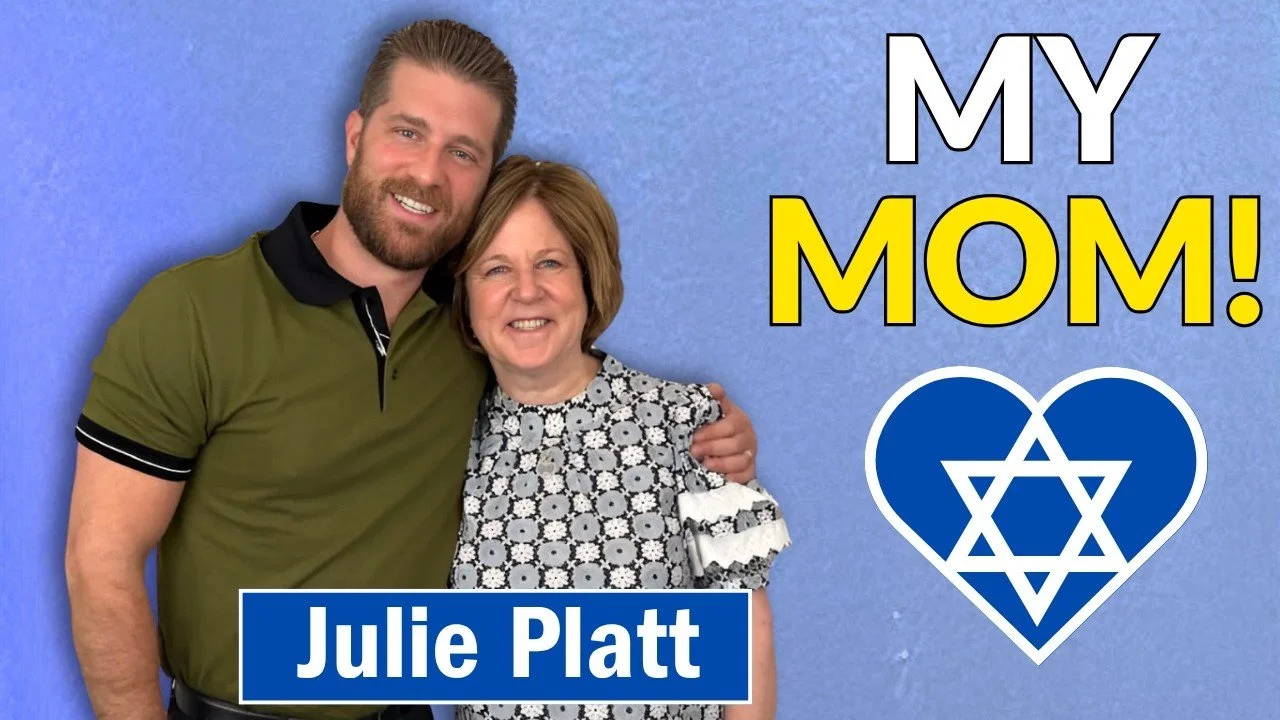
Also, she's my mom.
Please welcome the most beloved plat by far.
Julie Platt.
Thanks, Jonah.
That was such a nice, nice introduction.
Thank you.
Happy to have you here, mom.
Thank you.
To bring us home season one.
Thank you.
So as I mentioned, you just finished your term as chairwoman of JF.
Now, are you even officially out of the role?
I'm not officially out yet.
Not until July 1st.
Okay.
So I know you had your goodbye.
I did appreciation dinner.
How are you feeling about coming to the end of this road?
That it's not the end of the road?
First of all, none of us, none of us in Jewish leadership, whether lay or professional, have the opportunity to say, I'm done.
Right.
We can't be done.
Right.
So I'm not done.
Well, what does that mean?
What's next?
What it means for me is that I will hold on to several of the initiatives that I steered because I believe in them and because it's a heavy lift right now.
Uh, most primarily security.
I was honored to chair something called Live Secure.
Okay.
Which its, Genesis was really after the Tree of Life shooting.
Mm-hmm.
In Pittsburgh.
But it came to full fruition over the three years in which I was chair.
Which was to lift up the professionalism of community security across the federation system.
So I chaired a fundraising campaign of $62 million that was used as a matching fund for our federations, and to empower the secure community network to professionalize community security to make sure that we have the best, the most coordinated, the highest level of security, and we're not done.
Even though the first phase is over.
So I will continue to help lead, not only to make sure it is at that level, but to raise more funds because communities need more security, unfortunately.
So what does that look like?
Like what kind of places are getting more security and what does more security mean?
It's every communal Jewish space.
So it's day schools and day camps and JCCs and every place Jews gather have to be overseen by a professional security organization.
Right.
Any other major things that you've left unfinished that you're gonna continue to steer?
I will certainly be part of raising the funds needed to address the crisis that has arisen from the Iran.
I.
In terms of disaster relief.
That's, that's exactly right.
Um, there's a lot of need right now.
Oh yeah.
More than we ever could have imagined.
And we are mobilizing.
One of the other things that I will continue to be involved in is this, um, new or, um, enhanced relationship between birthright and Jewish federations of North America.
In terms of vol.
You think of it as birthright trips.
Right.
And I know you went on a birthright trip.
I did.
We want to.
Expand the age of people who will go and volunteer in Israel, multi-generational people in the middle of their life who have the time.
Mm-hmm.
And we are very much working on and have, have really grown volunteer opportunities between JFNA and birthright to go volunteer and be helpful to the people of Israel.
Is there like a title for this new position you'll be in?
Immediate past chair.
Immediate past chair, that's right.
Perfect.
And I'll continue to chair live.
Secure.
Fantastic.
How have your priorities shifted from when you came into this role three years ago and thought, here's what I'm gonna try to tackle, and then all of this bogan happens and now you have.
New priorities.
Obviously security is a major one and you mentioned, you know, now we have this relief that Israel needs, but what about big picture?
I'll give you a great example.
At the moment we're calling it live together.
I'm also gonna chair this initiative.
Sounds like you're really slowing down, mom.
We didn't imagine the whack-a-mole of needs at the community level that would arise because of antisemitism.
So.
Fighting in school boards, city councils affecting change in K through 12 curriculum.
That was just not on our bingo card.
Mm.
And now it is the federations are clamoring for help.
And one of the things that we can do is to, again, raise funds and expertise.
We have really beefed up our professional response and we will raise funds to.
Enable federations to hire more professionals, they can't handle all of this.
Professionals will be sort of civically, politically oriented and educationally right.
Oriented who can write curriculum.
Hmm.
So speaking of civic engagement, politics, you've.
Been engaged with many different politicians through all your various roles.
In what ways do you like to be involved politically?
Like where do you try to influence things and, and in pursuit of what goals right now?
So one of those things I've done during my spare time is joined the National Board of apac.
And I did that because I truly believe in bipartisan support.
Mm-hmm.
And I wanted to be part of that.
Uh, I have for a very long time with a dear and close friend, run a political network here in Los Angeles with the express purpose of bipartisan support for, for, for Israel.
And, and coincidentally, and though we didn't see it.
Making sure there are loud statements against antisemitism.
Right.
I have some wonderful relationships that I have grown out of necessity.
Mm-hmm.
Over the past three or four years.
They are now my friends who I can call upon in a very personal way to say, I need you and I need you to say something.
And they need you to say that what happened in Boulder, Colorado and what happened in Washington DC is just not okay.
And to please speak loudly.
And I am proud of those relationships and I will continue to work to grow them.
Okay, so now we've, we've done the little check-in about what's going on now.
Now I want.
Go back to the beginning and sort of paint the picture of how we got here.
And I wanna start all the way back in Wichita, Kansas, where you were born.
Not a lot of people know that unless they know you personally.
I think most people assume that our whole family's from la, but I enjoy getting to tell people that I'm the first plat to be born in la.
That's right.
Um, so you grew up in Wichita.
You were the only Jewish kid in your graduating class of almost 700 people.
As a kid, how much did you feel or were aware of this minority status?
I felt it in a prideful way, not in a negative way.
I was asked so many questions and explained so many times why I was taking off school For what?
Random holiday.
I had a deeply, I.
Um, beautiful Jewish home that my parents made sure that they provided for us.
I am often asked if I experienced antisemitism once.
That's pretty good.
Pretty great.
I had a sixth grade teacher, Mrs.
McGrew, you're on notice Mrs.
McGrew, who made the statement in front of the class that she would not cast her pearls before swine, and I was the swine.
Wow.
That she was referring to.
What does that mean?
Cast her pearls, her wisdom, her educational prowess.
Oh my God.
To me that was, that's terrible.
The one really bad experience I had.
And what, how did you react to that?
Um, I don't exactly remember what happened in that moment other than the upset I shared with my parents and I was on the way out of that school.
I think they would've moved me had I not been.
Mm-hmm.
I will tell you a beautiful story about Wichita, which is I had the opportunity to lead the rally.
In November of 2023 in Washington, 300,000 people, 300,000, the largest gathering of, um, north American jury in our history.
And when it was over, I had the opportunity to speak on CNN and on Fox about the rally.
They had my name, obviously on a, on a Well, Chiron on the bottom.
Exactly.
And it said, chair Jewish Federations of North America.
Three of my high school friends from Wichita looked up where that was.
What that was.
Mm-hmm.
Wrote handwritten letters to me, sent them to the office.
They then sent 'em to me saying, I hope you remember us from Wichita.
We stand by you.
We stand by the state of Israel, and we were so proud to see you.
That's so nice.
Oh my gosh.
Were the people you remembered.
I'll remember them forever for that.
That's so sweet.
Incredible act of kindness.
That's so, so you mentioned your parents and how what incredible Jewish community leaders they were.
Can you pinpoint any sort of specific takeaways that you learned in how to be a leader from both your mother Joan and your father Robert?
People ask me this all the time, like, why do you do this?
Or where did it come from?
I don't remember it being a choice.
I remember it being organic.
This is what you do.
So my husband, mark, your father, told a story last week at that gathering.
You referenced about, um, our senior year of college when others might be going out on a lovely date to recognize their senior year.
And we went out to solicit because I was chairing the UJ campaign at the University of Pennsylvania.
It just always was.
I, I know that probably seems hard to imagine, but I never imagined that I would do anything other than be a Jewish leader.
I just, I never even thought, should I or shouldn't I, it was just like you go to high school, you go to college, you become a Jewish communal leader.
I, I.
Always knew I would and my siblings, I was just gonna mention a hundred percent because all, all three of your siblings have done the exact same thing done.
So it's clearly done the exact same thing in in the water at your house.
Done the exact same thing.
I mean, it was such a joy for me that my sister Amy was leading the New York Federation as I began, I.
Leading the LA Federation and, and then JFNA, we were doing all these things at the exact same time on the two coasts.
Yeah.
Um, and have worked together so closely.
My brother, as you know, leads cam, the combating antisemitism.
Um, and my sister Nancy, is deeply engaged both in the Houston Jewish community and in Israel.
Right.
You were gonna.
Give me a specific example, I think, of your parents.
Right, right, right, right.
So Jewish values aren't just in the synagogue and in your home.
My father in a, in a moment, I won't ever forget, as the chair of the school board in Wichita, Kansas, was very involved and led the integration of the school system.
In Wichita, Kansas first.
I remember putting up street placards for my father when he was running.
I have one in my office.
I know you do.
Um, I remember that like it was yesterday.
We, we put them together in the basement and then drove around and put them up in neighborhoods all over Wichita.
And then I remember distinctly that this was one of the most important things to my father was.
Busing and integration of the school system A, a beautiful Jewish value realized in a very different sphere.
Amazing.
So now let's get to Jewish camp.
Okay.
Okay.
So.
In Wichita, you're the only junior class, but then in the summertime you get to go to Camper MA in Ojai, California where I also went and all my brothers and sisters and all my cousins after you and all of your brothers and sisters and cousins went, now my nephews are all there.
Your grandkids are going, uh, you've called it.
Like going to Disneyland for you?
What does that mean?
I mean, everywhere I turned were Jews my age.
I just couldn't get over it.
I got to have friends my age who were Jewish.
What was so important about that?
I didn't have any, um, and I.
I felt the organic connection I feel to the Jewish people.
Even at my age and at my level.
I had a best friend, um, who you of course knew who sadly passed away.
Um, Debbie Barrick, who I met as a 12-year-old.
The depth of my friendship with Debbie was just different.
It was just completely different than my friends in Wichita because we had this shared heritage and shared set of values.
But I'll also say that something else about it, which is I think I learned a lot about parenting at Jewish summer camp, and I have reflected on this before.
And interestingly enough, um.
Debbie's sister-in-law was my first camp counselor and the camp counselor for Debbie and I in our bunk.
And every night before she put us to bed, she sat on the bunk of every child in that class.
And I knew she had a boyfriend at camp and she was probably desperate to get out the door, but she didn't.
And she sat with each of us to review and process whatever had happened to us during that day and to really speak to us on a very.
Personal level, sort of in an intimate way, and I felt so understood by her.
Mm.
And I always tried to follow that with my own children.
That's so nice.
Famously at Camper Ma, they do musicals all throughout the summer, all of which are in Hebrew.
I was in Fiddler on the roof.
I played Tevye in Hebrew.
That's like a whole nother level.
Um, I did The Wiz in Hebrew.
I know you were in damn Yankees famous.
You played Lola.
I did.
And you still remember it?
I do.
Can you give us a little, a little phrase?
Uh.
It was the Two Los Souls, two Los Souls, or I'm thinking about Byebye Birdie, I mean, oh, even Byebye Bird.
Shalom, birdie, Lara.
I mean, I do remember, what was I, I know 13.
It's amazing.
14.
I remember, uh, luha, you Roth Child.
You've ed this before in conversation with me, that there is data on the impact of, of Jewish camp on.
Forming Jewish identity.
Can you speak about what those findings have been?
So, I'm gi I gave it to you anecdotally.
Right.
But it's the truth.
And this is not to, um, be smudge any other Jewish experience.
I think everybody should have immersive experiences in Israel, I believe, and fight for and help fund Jewish day school education.
Mm-hmm.
But there's some secret sauce.
That happens at Jewish summer camp.
It is that Jewish joyful experience.
It's gathering in white on Friday night and singing together as you usher in Shabbat.
There is just something sticky about Jewish summer camp and it proves out people lighting candles, living Jewish lives, engaging in their communities.
Synagogue, membership day school enrollment.
You can often trace it.
To data points of Jewish summer camp.
It's just true.
It's not a myth.
If I had to categorize it, I would.
Put it under the heading of immersion.
I mean, I think that's right.
That's what makes it so sticky to use your word, is even with day school, even with a trip to Israel, those things are more limited After school, you go home and Israel is a limited amount of time or whatever it is, but when you're at camp from the morning, you wake up till the, the moment you go to sleep, it's all Jewish, all the time surrounded by Jews.
And you don't, you don't get that anywhere else.
That's exactly correct.
That's a beautiful way to describe it.
So.
Talking about camping this way and how important it is, how is it 2025?
And we still haven't made it financially viable for every single Jew who wants to go to camp.
I think we've moved the needle to be sure.
Mm-hmm.
Um, one particular program.
So.
In those Jewish communal positions I've held, one of them was Chair of Foundation for Jewish Camp, um, which if you have not heard of it, I'm glad you'll hear about it now.
Um, but I would make it analogous to sort of Hillel International, which oversees the.
All of the hillels across the country Foundation for Jewish Camp tries to lift up and hold and help Jewish summer camps all over North America.
We instigated something called One Happy Camper a very long time ago.
We funded it in matches with Jewish federations around the country to incentivize Jewish summer camp.
We provide scholarships.
Sure.
And I do think we've moved the needle and help people understand that, particularly based on the data we just talked about, about you wanna ensure Jewish future, send your kids to Jewish summer camp.
Right?
So obviously you've moved the needle, but we're not all the way there yet.
What, why do you think that is when it's so clear, and especially, you know, what we're seeing today with how important it is to have strong, confident.
Well-rounded Jewish identity for people in, in the times that we're living in when campus, an important piece of that foundational puzzle.
The problem is those of us who are lucky to be on the giving side are being asked by our day schools to move.
A giant needle.
Mm-hmm.
Which will require way more resources to fund the trips to Israel I just talked about, to fund the needs in their community and to fund Jewish summer camp.
So I think if you, if I was sitting here and you were talking to me as the head of Prisma, which oversees the day school movement, or Hillel International, which oversees all the Hillels or as chair of JNA, which I still am the call upon resources.
Each person believes is the most important call, and it tends to be a very big bucket of giving that is needed.
What I find the bigger challenge, even than the funding, which I, I know is very important, and I will continue to work on it for the rest of my life, is that we haven't moved the needle of penetration into summer camping.
It's still, and you could.
I'm not sure what the number is because I pay attention to the West Coast, but nationally, but it's probably 10% of what of eligible.
Jewish kids are going to Jewish summer camp.
I'm really talking about non-profit Jewish summer camp.
We still are not the majority of Jewish kids going to summer camp, and of course many of them care about their, their athletic abilities or their performing arts abilities in hopes of moving on their passions and dreams into high school and college.
I get that.
Mm-hmm.
We can't be all things to all people, although we try to.
Right.
Because we need to be good at everything.
But I wish more kids just went to Jewish summer camp.
So you've been the Ramah Ojai board chair.
You've been the chair, as you mentioned, of the foundation for Jewish camp during COVID.
Do you really know how to pick your moments?
I know, uh, how stressful was that?
Oh my God.
It was just awful.
It was literally awful because these camps and their professional staff survive on summer tuition and we refund it.
It all.
Across North America.
Did you lose a whole summer?
Some lost one summer, some lost two summers Who didn't feel, and their parents didn't feel they had the COVID protocol necessary to bring their kids back in very close quarters.
Wow.
You're living with your friends Sure.
In Jewish summer camp.
Um, it was awful.
We lost a few camps that closed forever.
Because they didn't have the, the financial backing and resources and reserves.
Yeah.
It was such a loss leader.
A complete loss leader for a summer and a loss leader for the second summer.
We're back fully rebounded.
Fully rebounded.
Amazing.
Fully rebounded and an overflowing with campers.
Are you seeing an uptick?
Yes, we are.
That's great.
Which is wonderful.
It's what we refer to as the surge, uh, um, a phrase coined by Jewish federations of North America.
More kids wanna go and be in community with their fellow Jews.
So let's talk a little bit more specifically about Jewish Federation.
It's obviously been a major topic of this discussion so far, but I wanna talk more about your involvement with it on a personal level.
You mentioned that you were soliciting for the UJA campaign while you were in college.
Like where does that come from?
How did, how did that start?
I had watched my parents lead.
Both locally and nationally.
I believed in the federation system at 18 the same way I do now At.
68 almost.
I very much believe in what the federation system can do, even more so since October 7th.
I am so proud of what we do.
I believe in it.
I put my funding behind it and our family's funding behind it.
I won't ever walk away.
So many people have said like, what's your next chapter?
And I just keep saying like the same chapter.
It's been for 50 years, which is, I just, I believe in what we can accomplish.
There are wonderful things happening across North America.
I.
In Jewish communal organizations, and I'm part of many of them.
Mm-hmm.
But where my focus has been and will continue to be is the federation system.
If you had to encapsulate what the Federation does in, in a line or two, what's the log line?
We are able to convene.
In 140 plus communities at a moment's notice to imbue professional expertise to help communities feel safe and secure and educated and engaged.
And more than anything to try to support them in every way we can.
Whether it's through data, through marketing and communications, through physical security, through community relations expertise, to also have flourishing Jewish communities.
It's not just enough to have a Jewish community, it's to have all those things that make you have a flourishing Jewish community.
I.
I give $10 to Federation.
What does Federation do with that $10?
We do a lot of things with your $10.
I know.
So, um, we fund our key partners in Israel, the Jewish Agency for Israel, the JDC, the Joint Distribution Committee, um, on which my sister, Amy is.
Deeply engaged.
And, um, JDC operates in countries around the world.
So when you give a federation gift, you are helping what we do in Israel, what the Jewish Agency for Israel does in Israel, what JDC does in Israel, what JDC does around the world, and what we do in North America.
What we do in your local community.
That all happens through a gift of the federation.
Amazing.
You were only the second woman ever to be JFNA chair after former Congresswoman Kathy Manning.
Did your gender come into play at all during your tenure?
Yes.
Yes.
Mm-hmm.
Um, so I'll say a few things.
First, I hope someday the second question people ask me after they say, what's your next chapter?
Which is, what did it feel like to be the second.
Leader of Jewish federations of North America will be commonplace.
Right.
And there'll be lots more who follow me and no, I will never run for Congress because that's often the third chair.
Are you gonna follow Kathy and remember Congress?
Nope.
Which I'm glad to hear.
Thank you very much.
Yeah.
I want very much for this to be two pronged, one that more women raise their hands everywhere I go, particularly when I'm speaking to women leaders, that some of it is on us.
You have to put your hand up and say, I want the next position in the general campaign in federation leadership, not just in women's leadership, so that we are side by side with seats at the table.
That's often on us, but unfortunately it's also, and I have experienced personally a question of whether a woman leader will be as strong, as critical, as loud.
When needed as a male counterpart, I hope I have spent the last three years putting that to rest.
I will continue to do so where it's not about my gender, it's just about my ability to lead.
I love that answer.
So it's been an eventful three years to put it Mildly.
Put it mildly.
So first you come in on the heels of COVID.
That's right.
What have you learned?
Broadly about the Jewish community as you were coming in, anything that you were able to develop because of COVID that you guys are still holding onto?
So two great things came out of necessity.
One is something we called at the time, I think J Crif.
It was the Jewish communal response, something.
We brought together the heads of the major Jewish organizations and sat at the same table.
Zoom on a constant basis saying, we gotta do this together.
What can we do?
How can we organize around PPE loans?
How can we help what is needed in this moment that now continues as something called Jewish together, which I don't think would've happened before, where the, the heads of all those.
Jewish communal organizations come together and talk all the time about the fight against antisemitism, the response to Israel, all the things that are needed, and we do it together.
And Federation has convened that and I'm very proud of that.
I think the perception is in the wider Jewish community that these major Jewish organizations do not communicate and do not work together at all.
And we do.
And, and I wanna dispel that.
Can you gimme an example of how that's manifested after one of these meetings of something you all have then done together in concert?
The rally.
That's a really good example for you.
That was everybody.
Um, our partner in this was something called, um, the Conference of Presidents.
That's the presidents of all the major Jewish organizations and there are.
Dozens.
But that organization helped us to mobilize 300,000 people.
And there was not like, who's gonna take the credit and which organization gets to sponsor it?
And it was just all hands on deck.
And we have done that repeatedly.
How do we hold on to that, even when it's not an acute crisis?
Something maybe that you wouldn't expecting to answer is everybody being clear what their mission is.
And I think we've tried really hard to make people do that.
What we do is different than what.
A DL does.
And that's different than what a JC does, and that's different than the foundation for Jewish camp.
So we work very hard on that of everybody understanding what their role is and then using it together for, um.
Response to these kind of moments.
I don't find the disagreements that maybe we saw many years ago out of necessity, sadly.
But I think people are really trying to row in the same direction in their own mission statements.
Obviously there's still a lot of overlap.
There is.
So let's say it's combating antisemitism.
I mean, there's like.
20 organizations, let's say they're combating antisemitism, and it feels like that's not necessarily a bad thing, but it's bad if we have 20 different action plans for how to combat antisemitism instead of one or two that are all happening together.
How, how do we, how do we work with that?
It's challenging.
Of course not.
So we have often said.
Everybody's gotta throw their ideas out.
In this moment, we don't have the luxury of not listening to somebody who has a new idea or who has a way to combat antisemitism.
What we don't need to do is publicly argue with each other.
There's probably nothing I hate more than seeing somebody say, well, they don't know what they're doing, or We know how to do it better ADL's doing this.
And I don't agree with that actually.
We have to have deep respect 'cause everybody's trying to get it right.
There are times we will overlap and where we can do things together, and there's times where we won't, and what they're doing has nothing to do with what JFNA does.
What we are trying to do is to convene the table.
So that everybody knows what everybody's doing so that we can try to work together.
It is not foolproof and um, in fighting, I think is our worst look.
Oh yeah.
And I.
Really hope everybody listening to this will say, airing our dirty laundry and infighting and calling out members of the Jewish community publicly is just no help at all.
I'm reminded of something, so for, for a number of years, I sponsored a stem cell symposium series at University of California, San Francisco.
I remember I wanted to support stem cell research because of how important it is and something that the professionals there identified as being an issue was.
Sort of the siloed nature of scientific research that somebody in Germany's working on this one thing, somebody in California's working on this one thing, and if they're never brought together, they, they just don't know what each other is doing.
So by doing this sort of symposium series, I, we were able to bring people from all over the world together.
And a lot of amazing partnerships sort of came out of that.
You mentioned you're convening, you've got this new together thing.
Is there, is there room for more of that?
So it's interesting you would say that because prior to coming.
To speak with you today.
I was on a call on this topic, but the topic was about the messaging.
When something happens.
We're so far behind in the coordinating messaging that we've seen from the other side, from the anti-Israel antisemitism or the Jew hate side of this.
Right, right.
So what would it look like if overnight the Smartest minds were part of a messaging hub?
And when something bad happens, they convened in real time.
And by the time you woke up the next morning, if you were at any of the places where messaging comes from, you were part of a messaging hub and everybody had the same talking points.
I.
Everybody sent out the same message the next day.
That's what we're gonna try to do.
I think that's amazing.
We don't necessarily have the answer of what the messaging will be.
Sure.
We ought to bring together people who do this really well so that we're not like two weeks later saying, well, what should we say about what happened?
But that by the time you wake up, you have the talking points.
I think that'd be fantastic.
We're gonna try to do that.
Right on.
So back to your time at JFNA, you start with COVID, then you get the outbreak of the Ukraine war because things weren't interesting enough for you during your time.
What, what can you tell me about that period of your, of your leadership?
One of the things that I often say when I'm out speaking to communities is that unlike any time in Jewish history, any Jew who needed to be rescued from Ukraine.
Was rescued from Ukraine, so we were able to immediately, because I'll tell you another analogy we use all the time, and this is coined by the president and CEO of Jewish Federations of North America, Eric Fingerhut is you don't build fire stations.
For a fire, you're, you're, you have them in place so that all you have to do is turn on the spigot.
We had the fire departments across Ukraine and across all the places that refugees needed to go to get outta Ukraine, so that all we had to do was turn on the spigot.
So in no time at all Jews who needed to get out of there, and it was women and children because the men were not allowed to leave.
We got them where they needed to go fast and safely.
And then because we had the fire department in Ukraine, we could provide all the resources needed on the ground to those behind.
So I felt incredibly proud of our work and with the partnership actually of the First Lady of Ukraine and with the first lady of the state of Israel and.
With me.
We convened a group of philanthropists to say what's needed that we're not addressing, that we don't see, and to do some very private and serious funding on the ground in Ukraine.
Amazing.
Then obviously the biggest disaster, October 7th happens, you immediately jump into crisis relief mode, and I think the tally at this point is 850 million, is that right?
We're almost at 900 million.
That's right.
Almost at 900, but it's moving very fast right this minute.
Because everybody's reactivated.
Mm.
And the money is just going fast and furiously into Israel right now.
That's amazing.
Mm-hmm.
What has been the hardest part of this job that you've done for the last three years?
Probably an answer you're not expecting me to give unless you're gonna go on to Penn at some point in your questions.
Penn's next.
That's the hardest thing I've ever done.
So let's get to the, the mishegas, uh, at Penn.
Um, under then President Liz McGill sort of starts with the, this Palestinian Rights Festival situation and Penn's handling of that.
And then of course, October 7th happens.
Famously, the president's brought in front of Congress, doesn't say the right thing, to put it mildly.
Uh, eventually is ousted.
I, I think, at least from my conversations with you, and you can say if I'm correct or not, that you know, Liz McGill was just sort of the wrong person at the wrong time.
Not necessarily a, you know, a bad actor or nefarious person.
I know Liz, I call her a friend.
Of course, she is no Jew hater, right?
She's a friend of the Jewish people.
I think she was caught in a moment.
Who is to blame for that moment is not important.
She was caught in a moment and was never able to recover from it, and it was clear in a, in an instant that she was not gonna be able to recover from it, and that we had to make a change and she had to make a change.
I was, happened to be in a, in a position to be very much part of that moment as vice chair of the board, as you know.
Mm-hmm.
For about.
28 days, I was the chair of the board of the University of Pennsylvania because it was automatic when both the chair and the president resigned.
In a moment, I got to be part of the decision.
To, um, lift up the incredible president of the University of Pennsylvania right now, Dr.
Larry Jamison, and the incredible chair of our board, Raman Veron.
And I feel completely confident that we are not in that moment now, and that we have the leadership both.
Of our president and of our chair to take us out of this moment, and I think we are fairly far along that path.
What was the most brutal aspect that you endured in those couple months?
I'm loathed to say this because it's being Jewish with Jonah Platt, but I received more hate from my Jewish community than from any other community at the role I decided to take.
At Penn, the way I decided to handle it, um, which as you know, follows the adage of Anne Richards.
Mm-hmm.
The governor of Texas.
If you don't have a seat at the table, you're on the menu for lunch.
That's what I decided to do, was to double down, along with several very significant Jewish leaders who found themselves on the executive committee and the board in this moment who partnered with me along with our non-Jewish.
Trustees who were never at odds with me or with our, their fellow Jewish trustees, not for one minute in my work.
The nastiest people are definitely from the Jewish community.
It's where I get the, the most, the, the hate that irks me the most, and I find to be the most sort of baffling, startling.
I know at one point, you know, you were basically getting doxed, I mean, you're getting thousands of emails.
Um, what, what did they not understand?
That you wish these folks would have understood that, you know, obviously if they had spoken to you face-to-face in 30 seconds, they probably would've understood the values that drew me to Penn, that kept me engaged as a trustee for 20 years are exactly the same.
This is a very troubling time.
It was a very difficult moment on Penn's campus, on campuses around the country.
There was no playbook.
For this, we'd never seen anything like it before.
Mm-hmm.
And as soon as we figured out the playbook, which was as simple as the enforcement of time, place, and manner.
Everything started to turn.
Mm-hmm.
You know, people say, but they were encamp.
It's all across North America and you were failing us all across North America.
I don't know the exact numbers, but um, I think there's 3000 maybe colleges or institutions of higher learning in North America.
The number of encampments was a fraction of that, but our lovely social media made you feel like every Jewish student on every Jewish campus, all across North America was cowering in their.
Dormitory room, it just wasn't the case.
It was just what you saw was terrifying and what we had to impress upon the leadership at this universities, in Penn's case, under President Jameson, with very little difficulty.
He saw it the same as I did and as my fellow trustees was, just follow the rules.
Decisions have consequences.
There were going to be consequences.
Whether your listeners know about it or not, there have been consequences.
People were denied diplomas and their future employers know it.
How are you personally or through JFNA or attempting to tackle these deep seated.
Ideological issues we're seeing on college campuses.
So of course one of the biggest challenges we have seen and has been uncovered is lies within the faculty.
And anybody who understands how universities work, know that there is a.
Great decision making ability that happens within the faculty Senate and around tenure.
That isn't a spigot that can be turned on and off at will.
That takes a lot of energy.
It takes a lot of conversations around what I would consider some very loud, bad actors.
University faculty shedding a bright light on those members of our faculty giving, um, their fellow decision makers in the faculty, the support that they need.
But I'm gonna tell you an answer you probably would not imagine I would give, which is in my double down.
Segment, which is so fund at universities.
Fund chairs in Jewish studies Fund Middle East Study Professorships Fund, Penn Hillels Fund.
Your Hillel fund, where you went, where you live in the community, where you now find yourself.
I've said the very thing on the show fund them, you can help all these things happen.
The.
Change in the, in the composition of faculty, but it takes funding.
What kind of impact do you feel like you were able to have in those 28 days?
As the interim board president, I am not responsible for the choosing of our chair or the choosing of our president, but I was loud, as loud as loud, can be leading a process for the chair and in leading a process for.
Um, the president along with lay leadership of the University of Pennsylvania, so I feel very proud of the role I played.
Many people think I just handpicked Ramadan and it was all my decision and they had no say in it.
That's not how it went at all.
But I did lead a process along with my professional colleagues of how it would go, that we would do it real quick.
Because we needed leadership and I wanted out.
Right.
I didn't want out because I, at some other day and some other time, wouldn't have considered being the chair of the University of Pennsylvania, but I was the chair of Jewish Federations of North America and that had to come first, and I couldn't do them both.
I couldn't emotionally handle it.
Yeah.
And I couldn't physically handle it, so I needed it to happen fast.
What about in terms of the federation stuff?
I think just emotional stamina.
Um, I, I, along with.
My professional colleagues and my late colleagues have cried more I think in the last two years than I ever has, have as a leader cried over the good we do and cried over the suffering that we're watching in the Middle East.
Uh, I, I'm just, I'm more fragile.
Emotionally than I've ever been.
It's a lot of trauma.
It's a lot of trauma.
What's been the most rewarding part of the last couple years?
I've traveled to 50 communities.
Oh.
Um, since I became chair.
It doesn't matter if I'm in Augusta, Georgia, where their whole community leaders are 40 people who come together and have dinner with me or.
New York, UJA or the Los Angeles Federation, which I'm with all the time, it doesn't matter.
Everybody's hearts are exactly the same, and I'm so inspired by the people who are doing this, who have run outta steam and won't let it stop both professional and lay.
I'm deeply inspired by that, and that's what fuels me.
That's beautiful.
Everywhere that you've ever been in life, that's meant anything to you as an adult, you've turned around and.
Been on their board or chaired it or volunteered there.
Um, we, we even found a, a Jewish phrase that it's, that seems to, uh, exemplify that, which is hato recognizing the good, a conscious appreciation being loyal or kind in return to someone that helped you.
You are on the board at Penn Rama.
Uh, you're on the board of your kids' high school.
You're on the board of a hospital where your kids were born.
What do you make of that?
That's such a good question because I thought about it a lot, particularly since I went on the board of Cedars, right?
Um, Cedars Sinai Medical Center here in Los Angeles.
It's the model of the grateful patient.
That's where I learned it.
What does that mean when you receive great care or great.
Um.
Great influence in your life.
You wanna say thank you.
And I've been lucky enough to be on the thank you side, and that's why, that's what fuels everything I do.
So when they asked me to be on the Cedars board, they safely delivered my children and safely delivered my grandchildren, took care of my father.
I'm so grateful.
I want to give back to the places that have been wonderful to me.
Jewish summer camp.
Are you kidding?
I couldn't wait to get on that board.
And then ultimately to.
Chair it and then chair Foundation for Jewish Camp.
'cause I'm so grateful.
And the same applies to Federation.
They are holding up Jewish communities worldwide and I'm so grateful for that.
So I want to lead with gratitude and that's why I do it.
Exactly.
My last couple of questions.
Don't necessarily have a unifying theme other than they're things I'm curious about.
Okay.
And wanted to ask you, so this is the, the questions that Jonah wants to know section.
Okay.
Most people absolutely hate soliciting money.
You're excellent at it.
What's your approach?
You have to believe in what you're asking money for.
So I won't ever ask for money for something I don't truly believe in.
I can't fund everything, so you're gonna have to join me.
And because I want the mission, the project, the the initiative to be funded, and I can't do it all myself, and I believe in it.
I'm not afraid to ask you to help me do it, and I know how it feels when you've done it.
I know the pride you take when you are part of seeing something.
Come true or be funded or provided help.
And I wanna give you the opportunity to feel that way.
So if, if I may sort of tweeze out what I just heard as being the nugget that I think people can take away, it's really personalizing the ask.
And it's not like I.
Hey, this organization that I'm involved with needs some money.
It's, I'm trying to accomplish this thing.
Will you help me?
That's exactly right.
What was your experience being on the receiving end of me saying, mom, I'm in love with a Catholic chick.
Oh my God.
Um, okay.
That is really tough because I'd already fallen in love with Courtney.
So like, well, now you're saying no.
You mean even when you first met, met her, I mean, at the very beginning.
Yeah.
I don't mean now.
Now she's, you know, queen of the juice.
She is Queen of the Jews weekly.
Shout out to Courtney, right?
That's right.
So maybe I'll say two things.
Of course, it was my dream that all of my children would marry someone Jewish.
And I would lie if I said that wasn't I.
Um, in my book of dreams of being a Jewish parent, I also thought I knew you and I knew that no matter what might happen, you would find a way to raise Jewish children.
So I think I knew that, but I think more than anything, and Jonah, this speaks to everything that's happening right now in the Jewish world.
You are more important to me than any decision you will make about.
A spouse or how to lead your life, or what your politics say, or your practice of Judaism or your krut or anything you do.
I want my family to stick together and be together and love each other and that will win the day always.
I mean, that's beautiful.
But I also want to know just sort of the truth of like, when I said that, I mean, can you recall I freaked out.
Yeah.
There we go.
This is what I'm looking for.
Oh my God.
I, because I wanted you to, I wanted Jewish grandchildren.
I'm pretty sure I would've said right away, like I already mentioned conversion.
You did right.
You did.
Did that calm me at all?
Of course it did.
Okay, good.
Okay.
It called me immediately.
You have five children.
What the hell were you thinking?
Uh, can I tell you a fast story about it?
Yeah.
Yeah.
So, um, I came from four.
I always imagined I'd have four.
Mm-hmm.
That, to me, was like the right amount to have in a family.
Mm-hmm.
And then we were finished, um, after Ben was born and I was part of the Wexner Heritage Fellowship program.
Briefly tell, just tell me what that is.
It's a wonderful young leadership and learning program that is, um, sponsored by and funded by the Wexner of Columbus, Ohio, who I now have the great opportunity to lead with in the larger Jewish community.
And.
One of our last lectures after this program was from Rabbi Yitz Greenberg, who is one of my heroes in Jewish learning, and he looked out at this group of 40 leaders and said, I expect you all to go lead, and I expect you to find your place and your passion to lead, but if you really wanna do something for the Jewish people and you have the resources and you feel you can handle it in your life, go have another Jewish child and three of the families in that Wexner class.
Have an extra child that they were never considering having because of Rabbi Greenberg's suggestion and Henry Platt is the result of that.
What a gift to the Jewish people there.
You Harry Plat is, there you go.
There you go.
Shout out to Henry.
How do you approach Bibi Netanyahu?
What I mean by that is, you know, it's somebody who's very controversial, deeply unpopular in, in Israel and in parts of America, but you are, you know, the chairwoman of a major Jewish organization that has to engage with the Prime Minister of Israel.
How do you juggle those considerations?
I don't actually interact.
With Prime Minister Netanyahu, much more with the minister of the diaspora.
Um, the ways in which we are funding the, um, stimulus we wanna give to the government of Israel to partner with us in much we are doing in funding.
But I would lie if I didn't say that just before October 7th, I was in Israel for the ga first, the 75th birthday of.
The state of Israel.
I was there too.
Yes, I know you were.
We had a great time together.
I spoke to some issues that affected the diaspora that were decisions being made by the government of Israel.
I'll, I'll just give you one example, please.
You hope that diaspora Jews would consider bringing their daughters to celebrate their bat mitzvah at the hotel.
Right?
But for protestors.
And members of the Jewish community to disrupt.
That just was abhorrent to me.
Sure.
And so I spoke out about the egalitarian prayer space so that the hope of the Jewish community wanting to come to be with.
The community in Israel would not be thwarted.
So you're somebody who does not enjoy the spotlight.
Why do you think you're so uncomfortable in those moments?
Because I understand, you know, there's humility, but then there's, you know, wanting to disappear when people are talking about you and disappear and what, where, what do you think that's about?
I don't wanna be thanked for what I think is my responsibility.
Maybe that's what it is.
Like people will say, you know.
I'll never be able to be the kind of leader you've been.
Yes, you will.
I, I, it's all our responsibility.
It's just I do it my way.
So I think it makes me uncomfortable being recognized for what I truly believe is what I was born to do and what I was born to take on as a Jew, as a woman, as a mother, as a daughter.
It's just who I am.
So don't thank me for that.
I'll tell you, but I feel like we could dig a little deeper.
Maybe if you thank me, you'll think it's not your responsibility.
Maybe that's what it is.
That's interesting.
Don't thank me for something you should be doing.
I love that.
Are you surprised that of your five kids?
I ended up being the public Jewish one.
Um, you know, no.
And the reason I'll say that is because you used to always gry the fact that you were a natural born leader.
Like whenever it would go, oh, Jonah, you have to do this.
You're the leader.
Or if you don't follow this rule and end up in detention, everybody else will think it's okay because you're a natural leader.
And I know you sort of push back against that, but I've known it.
Since you were born.
So the fact that you are using it now in this way, no, it's not a big surprise to me.
I also saw you at camp and I saw what those camp friendships meant to you and what your day school friendships meant to you and what family means to you.
And I think this is an expression of all of that.
And by the way, you're really good at it.
Thank you.
So I'm glad you used your skills in the same way I've used my skills on behalf of the Jewish people.
I'm deeply grateful for that.
I'm proud of you.
Thank you, mom.
You bet.
Can you point to anything that you've learned from the pod over the past eight months?
Oh my gosh.
It's the joyous part of my week.
If you ask me one thing that I have repeated, maybe it won't be what you would imagine.
No, I'm interested what Dara said.
About, we are people who kiss books.
Right.
I found that one of the most beautiful things I've ever heard.
I kiss a Jewish book when it falls on the floor and when I leave Shu, I never thought about it.
Yeah.
Till Dara said it.
What a beautiful thing we are.
We kiss books.
Yeah.
This past January you received the Israeli Presidential Medal of Honor from President Herzog, a non-citizen of Israel, receiving this award, and you were the only one receiving who was asked to speak at the award ceremony means you're the MVP.
What did that mean to you truly to receive that honor?
I don't say this lightly.
I enjoy a deep and close friendship with President, her and his wife, and I.
Think that is one of the biggest gifts of my Jewish leadership is my relationship with them.
So if you ask me what that meant to me, the phone call from President Herzog to me telling me that I had won that award was probably the most precious moment of all I thought he was gonna ask me to.
Do something on behalf of the Jewish people.
In my wildest, wildest dreams, I never thought I would get that phone call.
The execution of that at that ceremony was a deep honor and very beautiful, but the moment of that phone call and being able to share that with my children and my husband was the most precious part of that honor.
That's so nice.
When receiving that award, you highlighted the importance of Diaspora Jews taking on leadership roles.
Interestingly, and I want to get your take on this.
We had, uh, Jason Robert Brown on the show, and something he said was, look, not everybody is a leader.
It's a leader.
It's a, it's a personality trait.
Some people are.
Terrified and their body like literally has a chemical reaction to being put into those moments.
They don't want it.
What?
What's your take on that?
I remember that well, and I actually took a lot of comfort from what he said, informing the answer I'm gonna tell you right now.
Yeah.
Which is how do you define leadership?
I'm leading on a grand scale, right?
I think leadership is inviting your kids to Shabbat dinner and saying, once a month, commit to it.
Right.
I think leadership is, you have or witness a.
Jew hate moment and you don't walk away from it, but you walk towards it.
You don't have to do that on a grand scale.
Mm-hmm.
You can do it when somebody comments on your Instagram in a nasty way and you try to do a a back and forth with that person.
That's your own personal moment of leadership.
Maybe just don't do it.
If they're talking about Rachel Ziegler, maybe not Jonah, I'm glad you can say that with laughter.
Um.
I think leadership is defined in many, many, many different ways.
And everybody isn't meant to do it on a public setting.
Yeah.
But everybody can do it from the comfort of their own home.
Literally everyone.
I happen to agree with you in that regard.
I, I say that all the time, that it's just about leading in your own.
Lane in your own sphere of influence.
I used to say this long ago when I was the chair of Women's philanthropy in Los Angeles, women would change outta their workout clothes and get in a formal attire to come to an event and then change back and get in carpool line.
And I would say as my closing remarks, don't change your clothes.
Get in the carpool line.
Walk into the lobby of your day school and have somebody ask you, gosh, you're dressed so nicely.
Why?
And say, I went to a Jewish event.
That's leadership.
Yeah, just do that.
Right.
What is your call to action?
To everybody listening, old and young Jews and allies alike in this moment, what do you want to impart as a, as a final, the final bit of advice for season one of being Jewish lead, lead in just the way you've just talked about lead, however it is I.
You don't have the luxury to be quiet.
Lead in what matters the most to you.
If you are the product of Jewish summer Camp Lead, get someone else to go to Jewish summer camp.
Tell your friend who goes to a non-Jewish, private or public school to join your kid at Jewish summer camp.
Lead in fighting Jew hate.
Every one of us has to fight Jew hate.
We're in a moment, so I don't care how you do it, just do it.
And if you have the resources give, you have to give.
You can give to lots of things.
You can give to the things that matter to you.
Our family is very supportive of the research against multiple sclerosis because it matters to us.
That doesn't mean you can't be an and giver.
Everybody's gotta be an and giver right now.
You've gotta give to what matters to you and you have to give Jewishly and you have to do both.
Great advice, great words of wisdom.
Mom, thank you so much.
Thanks for having me.
This been, this been such a pleasure.
Thank you.
Thanks for, for bringing us home.
Thank you, Jonah.
Guys, that was my mom.
Isn't she amazing?
Thank you mom for being here, and thanks again to Jeff and Leslie Wallman for sponsoring this very special episode.
Speaking of amazing, I want to give a huge shout out to everybody who makes being Jewish possible week in and week out.
All of the incredible guests who have shared their time and their wisdom with us all season long.
The studio owners and technicians in la, New York, Philly, Israel and Detroit, the badass Jewish women on my team, who I've spoken about before, my YouTube guys, the production team at Rainbow Creative, my designer, my token, Israeli.
My kids who love and support me even when I'm locked in my office or out of town, and of course my wife Courtney, double weekly.
Shout out to Courtney for being the best partner a guy could ask for.
I love you money.
Thank you to all of you out there for being part of the BJJP community.
Whether you are brand new or have been tuning in since I launched this thing eight months ago, an extra special thank you to my friends, family, and followers who never miss an episode.
Who text or email or DM me to let me know how much you love the show, what you're taking away from it, and what it means to you.
Your feedback and love and support throughout this process have truly meant so much to me.
I screenshot and I save everything.
Please never stop this journey into podcast Land has.
Been life changing and reaching this end of the season milestone with all of you is a blessing, and in fact, it definitely feels like a ano worthy moment To me, the ano is a prayer.
We say on special occasions, momentous life events, a way of expressing gratitude that we have been fortunate enough to reach this moment.
So if you know it.
Please join me if you don't just say Ah, amen.
At the end.
You're a part of this too, bar.
Ah, amen.
A few last bits of business before I let you go.
Next week we are launching two Count 'em, two new formats of being Jewish.
Starting next Tuesday, we'll be releasing a new series called.
30 minute mentions, same host, same idea, but shorter, more focused conversations with an even more diverse plethora of Jewish professionals.
Starting with Israel's current special envoy for combating antisemitism, Michal Kotler, 30 minute mentions will be available on audio and YouTube only.
So if you're a JBS viewer, make sure you head to being jewish podcast.com and click watch now, or listen now, depending on your preference.
Then subscribe to being Jewish so you don't miss out on the action.
And starting next Friday, we'll be launching our new Best of Being Jewish series.
We've taken all the best moments, lessons and conversations, broken them down into themes like the Black Jewish Connection, deconstructing Jew hate and Jewish wisdom, or putting 'em together for you.
It's basically like Cliff Notes version of season one.
So you're gonna love it, whether it's brand new to you or a reintroduction to fantastic content you forgot about months ago.
And if you haven't yet, make sure you're signed up for my newsletter and following both me and the show account on social media so you don't miss any of our summer updates or announcements about season two.
Again, you can find all of that@beingjewishpodcast.com as well.
Only one thing left to say.
That's it for me folks.
I'll see y'all right back here for the next unforgettable season of being Jewish with me, Jonah Plat.