
Monologue Transcript
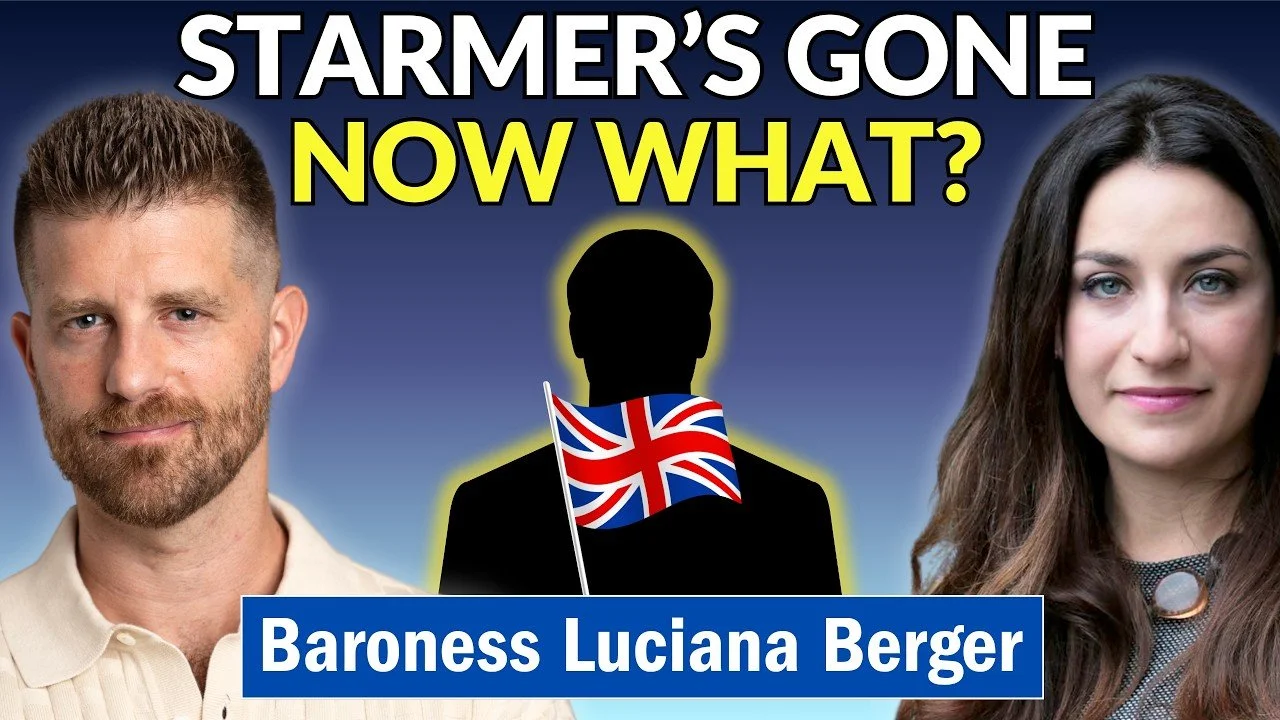
Is Britain Still Safe for Jews? I Ask Jewish Baroness Luciana Berger, House of Lords for the TEA!
Watch and Listen
Hear ye, hear ye.
By order of His Majesty's Royal Government, I hereby present to you a guest far too distinguished for this show.
A former member of British Parliament, and recently appointed member of the House of Lords.
She is a tireless campaigner against anti-Jew hate in all its forms, including from within her own Labour Party Since her days as a national student leader at university, she's faced serious threats to her physical safety simply for being publicly Jewish, but she has not for one moment shied away from her courageous leadership as one of the UK's most vital and respected Jewish voices.
It is my distinct honor to present to you the Baroness Berger of Barnhill from the Borough of Brent.
That's right, a baroness.
I wore my finest jacket.
I'm Jonah Platt, she's Baroness Luciana Berger, and this is a very British episode of Being Jewish.
To Being Jewish, your home for deeply candid conversations on Jewish identity, culture, and current events.
I'm your host, Jonah Platt, and today I'm joined from across the pond by the brilliant Baroness Luciana Berger.
Baroness, it's wonderful to see you.
I hope wherever you are, it's got air conditioning.
Thank you so much, Jonah.
Yeah, it's, uh- It's pretty, it's, it's pretty warm for London, although we had the heatwave last week Now, folks, this is actually the second conversation between the Baroness and myself.
And no, you didn't miss an episode.
We actually recorded a full episode just a few weeks ago that you shall never hear, though if you're watching this right now, you are seeing a little clip of it over my shoulder.
And yes, I am wearing a tuxedo, but I was not gonna do that twice.
Baroness, you had come straight from making a major announcement about Britain's new under-16 social media ban, for which you've been a major champion, and I guess you felt sort of a bit distracted by all that you were doing because after our recording, your team expressed some concern about how it had gone and should we maybe redo it.
But I had thought it was totally fine, and I had no intention of reshooting it.
But not five days later, even bigger news came out of that island of yours with the resignation of Prime Minister Keir Starmer, who had factored majorly into our conversation and into your political career.
So at that point, I figured, okay, great.
If you're game to do it, let's do a new one because that is such a major shift that affects so much of what we had discussed.
So I would love to start there.
Y- you actually left the Labour Party under the rampant anti-Jew bigotry of Jeremy Corbyn when he was in charge and only returned recently under the leadership of Starmer, and now he's out.
So w- where were you when you found out that he was going to resign, and how did you feel hearing that news?
Let me just rewind to your point about what happened when we last spoke because behind the scenes, yes, you're absolutely right that, uh, we just had the announcement about the introduction of a ban for social media for under 16s.
Uh, we had a previous conversation on what was an extraordinarily busy day in Westminster 'cause there was a lot of noises, uh, and a lot of action and political activity going on.
And I think it's fair to say we, we anticipated something was coming.
So that's why I was perhaps a little distracted during our previous call.
It was a pretty busy day in Westminster as well.
Uh, I speak to you again today from the parliamentary estate, my office here, uh, adjacent to the House of Lords.
Uh, but yes, in terms of, uh, the Prime Minister, we thought something was coming, but it was very quick.
We have within our British politics something where when the Prime Minister's going to make a- an announcement, they put the podium outside Number 10 when he's seeking to speak to the country, and you know something pretty big's coming when the podium, uh, is put outside the black door of Number 10 Downing Street.
In terms of kind of the announcement that he made, it's off the back of what has been a challenging time, not just because of our domestic politics, but because of geopolitics and what's happening right across the world.
And I think probably the thing that prompted, uh, his decision was we had local elections here in the UK back in May, and the results were pretty catastrophic for the Labour Party.
We lost just close to one and a half thousand councilors right across, uh, the all four corners of the United Kingdom and, or certainly, uh, across England.
We lost the devolved government in Wales And we were unsuccessful in Scotland despite, you know, a very heavily fought campaign.
We are two years into a, we have a five-year term in our politics here in the UK, and I think there was some concern about the trajectory and, and what would come next and how we would go into the next election where, again, I n- I mentioned our politics have changed.
We've got new forces that are very active that were not so active, uh, at the last general election, particularly coming from the right of the Conservative Party.
We have the Reform Party that, uh, you know, are very, very, very divisive, have policies that, you know, I certainly do not agree with and are promoting division and hate in some parts of our country.
Another party that's popped up to the right of Reform called Restore.
Lots of concerns from members of Parliament who were going back to their constituencies at the weekends and had been campaigning during the election and really felt palpably on the doorstep, despite, you know, a, a very significant win at the general election in 2024, that we weren't necessarily going in the right direction.
Listening to the Prime Minister's statement that he made, but he acknowledged that whilst he's done so much to propel the party, get it elected, he wasn't the right p- person to lead it into the next general election, and that's why he made the decision to stand aside.
And so as we meet today, we have a, an official selection process that happens like a primary within one of your political parties.
There is a deadline coming up in just a couple of weeks' time.
So far we only have one person that has indicated they are putting themselves forward.
That's the Right Honorable Andy Burnham, who has very recently been serving as the metro mayor of Greater Manchester, which is, it's bigger than the town of Manchester.
It's all the, the boroughs of Greater Manchester.
It's a area of 2.3 million people.
Uh, he's been in that role since 2016 but was formerly an MP, formerly a Secretary of State for both Health and for Culture, Media, and Sport.
And in all likelihood we are anticipating that there won't be any other candidates and that he will become leader of the Labor Party in just a couple of weeks' time.
So before we get into Andy Burnham, which I, I would love to get into, I, I wanna understand sort of f- uh, from your personal point of view how this shift is hitting you.
Were you surprised?
Were you hopeful that this would happen i- i- after seeing the sort of disastrous results?
Uh, I mean, where do you sit with all this?
We find ourselves in a very different moment in terms of what, what this moment requires.
The demands from the public I think are Uh, more impatient.
There's more of a sense of urgency, and we're also contending again with factors beyond our control that are impacting on our cost of living here in the UK.
It's fair to say that our prices have risen.
People really feel it, and we haven't seen our wage growth commensurate to increase in prices.
Lots of people really, really struggling to get by, and people demanding to see action.
And lots of commitments that were made, lots of action in motion, but people still, I think, struggling to see all of the outputs or outcomes of those commitments.
I say that with a heavy heart because I think Keir Starmer has done a really important job to turn the Labor Party around, and he did so in a way that many of us, myself included, didn't expect.
All credit to him that he was able to really consistently address the party to root out antisemitism at all levels from the leadership.
I want us to make sure that we win the next election because I think the, the stakes at the next election will be even higher.
Oh, say more about that.
You know, a potential government under a reform.
Currently the leader is a man called Nigel Farage, I think would do this country immeasurable damage.
You know, things that we take for granted today and, and the cohesion that we see in our communities and in our society, I think already is at risk because of division that they seek to sow in which they feed off.
It is extraordinarily negative, divisive, toxic.
It's a drip, drip, drip of really ugly, nasty stuff.
But I went to campaign for Andy Burnham in Makerfield, where he's just been returned as a member of Parliament, where he was just elected in a by-election, and people saying things on the doorstep that they'd seen on social media which were categorically not true.
Um, yet but they'd been fed this stuff, and they believed it.
So we've got a whole big job to do around misinformation and disinformation, but that's what we are battling now in the run-up to, you know, our next general election, and we need something pretty bold.
To close the, the loop on the Starmer of it all, you know, your, your personal connection to him is significant.
I mean, it was his leadership that you felt comfortable returning to the party under, and it was, it was under him that you received your life peerage in the House of Lords.
Personally, as you sort of close that chapter, like, what, what has his chapter as the leader of the party meant to you on a personal level?
I joined the Labor Party because, you know, we carry our membership cards, and, and lots of it's digital today.
But certainly when, uh, you know, twenty years ago, twenty-plus years ago, the membership cards that we held were very clear about what the values were at the Labor Party.
And the values essentially center around equality, social justice, and anti-racism, all things that I believe in and can sign up to, and which led me not just to be a party member, to be actively involved, uh, be a candidate for local elections for council.
And I came into Parliament, and I was there, and I, you know, I… It was such a privilege.
It was such an amazing responsibility, and I loved it, and then it all changed.
We lost the 2015 general election.
I was returned, but the party overall, uh, was unsuccessful in winning that election.
We had a leadership contest, and a man called Jeremy Corbyn became leader of the Labor Party, and there was a lot of concerns when he was one of the candidates.
And in fact, at that leadership election.
Uh, I backed a guy called Andy Burnham, who put himself forward to be leader of the Labor Party back in, uh, 2015.
I'd served with him.
He actually had been… He was an MP at the time.
He was the shadow secretary of state for health, and I worked with him in his team as his, his shadow minister for public health.
Uh, and I was involved in that campaign.
Unfortunately, Andy wasn't successful, but Jeremy Corbyn was.
There was, uh… The rules allowed at the time anyone to pay £3 to essentially have a vote, so like $5.
Whoa.
Uh, we saw all these people pay their $5, people who declared very publicly on social media that they had no interest in the Labor Party, some from the conservatives, but also some from the far left.
I think there's lots of things that happened at that time, but there was also a groundswell of support that came behind Jeremy Corbyn.
He was successful.
And I, I'm always in the camp of giving someone a go.
Sure.
And so much so that, you know, I was asked to do a bigger role.
I was asked to be the first ever shadow cabinet member for mental health.
For my audience who doesn't know, what is shadow cabinet?
You have the government who's elected, and then the opposition party has their representative that, we call it shadow, that is, like, their, is like their opponent.
Yeah.
We call it just, like, the minority, minority leader- Yeah.
So you have the minority leader- or something … but then the- Yeah … individual people that have specific policy responsibilities.
And so I'd had the, uh, shadow policy responsibility for public health.
That had included mental health.
And then I got to see him up close and personal, as did many other people, in what was the weekly shadow cabinet meeting.
And in the wake of the Brexit referendum that we had in the UK, where there was just a majority that voted to leave the European Union, uh, myself and… I, I forget the exact figure, but it was around 60 of us left the, the shadow gov- government under Corbyn.
He and the party could and should have done more to change that outcome.
I should add that I was also at the time the parliamentary chair of the Jewish Labor movement.
And again, I think the, the closest parallel I think you have in the States is the Jewish caucus of Democrats.
So I had a, a national responsibility, uh, within that space as well.
And I saw over the course of a number of years things get increasingly worse for Jewish members across the country and, and I also experienced it personally as well.
I'd go back to my constituency, which was in Liverpool.
It was my home, the place that I loved, where my children were born, and I'd go into the microcosm of the monthly meeting of the Labour Party in my area, and it would just be like a parallel universe in terms of the discussions and in terms of, uh, how I and others were treated.
When I first was elected in 2010, I had around 200 members, and over the course of five years grew my membership to 800 people, and it was so lovely.
I, you know, I have such fond memories of the campaigning that we did and everything that we did socially as well as politically in terms of campaigns and knocking on doors and speaking to people, but also just going for a bite to eat or going to the pub.
But then it all changed, and it changed under the leadership of Jeremy Corbyn.
All of the lovely people left because it became very toxic.
It became a very unpleasant place.
And we had people come back into the Labour Party who had previously essentially been resigned to the history books, 'cause they'd been expelled from the Labour Party in the '80s when under a previous Labour leader, Neil Kinnock, they rooted out essentially kind of a Trots- a Trotskyist, uh, element.
It was called the Militant Tendency, and a lot of that came from Liverpool.
And so people who'd previously not been allowed to be in the Labour Party were welcomed back with open arms, and we had some very unpleasant times.
And I think back to the last-ever constituency meeting that I attended in Liverpool.
That meeting came just a week after I had featured… In fact, a few days after I'd featured.
There was a big picture of me on the front page of The Times newspaper because it, it had been uncovered that there had been a Labour Party member that had made physical threats against me openly on Facebook pages, and someone had reported that to the Labour Party nine months prior.
But the Labour Party hadn't told me about it, and they hadn't told the police about it, and those threats met the criminal threshold of what would not be allowed in this country in terms of, you know, physically threatening someone.
So it was all over the newspapers because There's a whole dossier of these cases, uh, that, you know, the Labor Party had failed in its duty and responsibility to essentially safeguard its members, obviously including its members of Parliament.
And I made my contribution to this meeting and talked about that, and also the threats that I had faced and also that my team were experiencing.
So again, just a few weeks before that meeting, there was a hand-delivered letter to my office that one of my team had received.
I didn't realize what it was.
Opened it, you know, a few hours later, and it was l- a whole load of detail about how they were gonna come and attack the office.
They were gonna throw acid on me, uh, how they were gonna attack me, rape me.
It was pretty horrific.
And is this all- all around you as a Jewish person or your politics?
Well, uh, I mean, some- some of it's conflated.
Just Jewish person.
Often the two went hand in hand.
So I, I mean, by the end of my time in Parliament when I, when I finished in 2019, I had seen six people go through the court system in the UK and convicted of the threats that they directed towards me and their antisemitism.
Uh, four of them came from the far right, and two of them came from the left.
And, and four of those six went to prison.
Yeah.
Is that right?
So the four from the right went to prison.
Wow.
But there was countless others.
The volume and the toxicity of the abuse, which might not have met the criminal threshold, that was directed at me and, and just a few others because we would not accept the antisemitism that was Very, very clear to us.
And so I, I talked to this meeting, and I s- explained what I'd been experiencing.
And the… Even in spite of these horrific events, that me and the team were still getting on with doing the important job of representing my constituents.
I was met at the end of that presentation with literally stony cold silence.
There was not an iota of humanity in that room.
And I just looked around the room, and I, I was like, I, I… This is so far from the values of the Labour Party that led me to join it in the first place.
It was at that meeting that I made the decision that I could never, ever go back into a room like that ever again.
In the end, I, I came to the conclusion that the party was betraying those values that had led me to join it.
Those values of equality, which is supposed to be for all.
Anti-racism, that should be covering everyone.
And when it came to the Jews, that just wasn't the case.
You know, Jeremy Corbyn, who on… You know, we had this big, horrific, uh, issue back in March of that year where something surfaced where he'd come out in support of an artist who'd painted a mural that was antisemitic, and he w- posted on a Facebook page in support of the artist.
I pressed him and did so quite publicly.
It took four attempts for him to make a proper apology, and that wouldn't have been the experience for any other form of racism.
And he only made that proper apology on the fourth occasion under duress after we'd had, which was unprecedented, over 1,000 people within the space of a few hours came to Parliament Square.
I'm pointing 'cause it's just, uh, up from where I am now.
So just in front of Parliament, we had over 1,000 people, Jews and our allies, come together to say enough is enough, that we cannot continue with this, these issues and, and the, uh, this experience of antisemitism when the leader himself, he had come out in support of an antisemitic mural and the artist who'd painted it and couldn't apologize properly for it.
I just knew that I couldn't in good faith continue and face the possibility of a general election and have to knock on doors and say, "Vote for me as your local representative for a fourth time, but also get this guy as prime minister in Number 10." I, I just couldn't do that.
Uh, the fact that I even had to m- consider making that decision was something that no one ever, I don't think, really wants to do when you kind of join a political party.
It's part of your life.
You, you represent it for 10 years.
And then I had to make that decision, and I did so, and there was a number of us uh, in February 2019 who left the Labour Party Quite similar to what a lot of Jewish Democrats are experiencing right now here in America is asking or already leaving, do I have to leave this party as it, it starts to teeter towards the left into full on anti-Israel, anti-Jewish sentiment from, from its furthest left candidates.
But a lot of people are going through questions they never thought they would have had to ask.
So I'm sure this will resonate with a lot of folks.
So to bring it back to where we started, you then come back to the party once there is a change in leadership.
Yeah.
So just to explain what happened in the intervening period.
So we had the general election of 2019, Labour lost, and we then had an investigation instigated into the Labour Party.
So we have in the UK a statutory body, a statutory organization who has responsibility for overseeing the implementation of equality laws in this country.
We have an Equality Act.
It was introduced in 2010 by the Labour government that was in power at the time, and this body, the Equality and Human Rights Commission, oversees to make sure that that law is being implemented.
There was an investigation that the commission undertook into the Labour Party over a couple of months, and they found that the Labour Party, under the leadership of Jeremy Corbyn, had broken the Equality Act, that they had been responsible.
The, the, uh, findings were that it was responsible for the intimidation and harassment of its Jewish members, and that there had been direct political interference from Jeremy Corbyn's office which had exacerbated the situation.
And as a result, the law m- means that those, for those organizations, I mean, it's quite extraordinary for any political party, let alone one of the two big political parties, to be found guilty of breaking the Equality Act, let alone the political party that itself introduced the Equality Act in 2010.
Right.
And then the process is that they, the Labour Party was put into what's called special measures They essentially are overseen by the Equality and Human Rights Commission, and they have to fulfill, uh, an action plan.
And there's lots of different things that the Labor Party had to do to turn itself around to improve the situation and to improve its processes and how it was- should have been responsible for caring and its duty of res- care to, uh, Jewish members at all, all levels of the party and looking at its membership, et cetera, et cetera.
And so it was under the leadership of Keir Starmer.
The findings came out when he became leader, and he was responsible for overseeing the action plan.
And after a certain amount of time, uh, I think it was early 2023, that the Equality and Human Rights Commission took the Labor Party out of special measures.
They felt that the party had made sufficient progress and had com- uh, in completing the action plan to rid it of all these issues of anti-Semitism within the party.
And that was testament to the leadership of Keir Starmer and his commitment to this issue, uh, as well.
I mean, he had a legal responsibility to do it, but he really was committed and, you know, we saw people rooted out at all levels.
He totally overhauled the leadership and the processes and, uh, and that made a fundamental difference, and it meant, uh, for a number of people, myself included, I could return to the Labor Party, which is what I did in 2023.
Okay, so now let's shift over to the likely successor, Andy Burnham, who you've, you know, revealed you have campaigned for and have a, have a long relationship with.
I know from having done research for this interview that the, the Jewish leaders in Greater Manchester certainly view him as an ally in the fight against anti-Semitism.
Things have been a little squishier in a post-October 7th world.
I, uh, I will say, you know, he called for a ceasefire less than a month into the fighting.
Uh, he wants to recognize Palestine as a state, hasn't really addressed anti-Zionism as an issue.
Most would probably peg him to the left of Starmer o- on this.
What, what's your read and sort of w- how do you expect him to approach this moment in terms of, uh, the Jewish community?
That's one view, of which there are lots of different views.
Uh, and certainly the things that you outlined, I think very much typified what we saw from the Labour government.
I don't think they were at odds with the position of Keir Starmer, just to be clear, in terms of, uh, in the wake of October the 7th.
I can only reflect on, on my engagement with him, both from when we were both members of Parliament together, but also I was in contact with him last year in the wake of, we had the horrific, uh, attack at the Heaton Park Synagogue on Yom Kippur, where two people died.
Uh, and he was metro mayor of the Greater Manchester at the time, and he was very public in his attendance at the vigil, along with government ministers.
We were in contact at that time.
Uh, I know that he also returned and engaged, uh, with the community away from the cameras.
Uh, and he certainly had, you know, connection and involvement with people from the community throughout his political career.
So, um, you know, I think I see him as certainly as, as a friend, uh, and an ally of the Jewish community, and someone who, you know, I certainly feel comfortable to go and talk to w- where there any challenges, um, arise if they were to.
Let's say that Andy Burnham's position on, on the Israel situation is the same as Keir Starmer's, is the same as sort of the general Labour Party position.
Are you comfortable with that position, or do you feel that there needs to be some, some motion there?
If we just look at society within Israel and the differences of opinions and views there, I, I mean, I, I've been to Israel on various, um, occasions over the last couple of years and seen for myself the demonstrations and the concerns of the government from within Israeli society, uh, let alone, uh, from beyond Israel.
In terms of what I think we can and should be doing to make a difference is I've always had some very strong relationships with those parties on the left in Israel.
It's now Democratia, formerly Avoda.
And I hope that we will do more to engage with those opposition parties, certainly in the run-up to the elections that we're expecting in Israel because I would like to see a very different government, uh, than the one that we see at this moment in time.
And I think that's a role that labor can play here in the UK in the same way that Macron, uh, does that from France, um, and, you know, and other countries as well.
I think we can and should be playing a role to really engage with the opposition What about in terms of British Jews?
That's sort of where I'm more interested in terms of, uh, where you think the government currently is in its understanding of the issues facing British Jews right now, and, um, where you think, if at all, there's room for improvement.
It's been a very, very difficult year, starting- Oh, yeah … from the terrorist incident at Heaton Park Synagogue.
And the difference for us here in the UK is that we are a very small Jewish community.
It depends what figures you look at, but w- between 250 to 300,000 people.
You know, there are less Jews here in this country than there are in the entire state of Pennsylvania.
And, you know, when the events happened in Manchester So many people that I knew, myself included, were aware of people that might have attended that synagogue or neighboring synagogues and would have had a connection and were, you know, very, very deeply affected.
For the number of antisemitic incidents that we have in the UK, which has escalated, uh, over the last decade, and particularly in the wake of the October the 7th attacks, the figure to me, and it- it's not just about the numbers, but that really resonates is that for all other forms of racism and racist attacks in this country, on average it's 12 attacks per 10,000 people or less, depending on which group.
The- whether it's, you know, for the Christian community, the Hindu community, the Muslim community, Sikh community.
It's everything from 12 downwards, 12 attacks per 10,000.
And that's 12 attacks too many.
Yeah.
For the Jewish community, it's 121 attacks, and that's reported- Wow … incidents.
That is reported incidents.
And, and there's- we've got a big issue of underreporting.
So for such a small community to have that, it's, that ma- then that gulf and to have that proportion of, of incidents.
And again, that's the stuff that we know about.
Again, there's lots of low-level stuff that's happening, particularly in our National Health Service- Yes both for patients and for medical professionals, doctors and nurses.
Big issues there.
One of the big areas that we see this all the time, again, quite often it's kind of low-level stuff, might not meet the reporting threshold, but people feeling increasingly alienated and ostracized at work because they are Jewish, is in the arts.
Uh- Yeah … big issue within the arts in the UK and then in the media and creative sectors.
And so that's the backdrop, and particularly over the last year we've also seen these very public horrific events as well.
So we, we had a stabbing in Golders Green, which is very close to where I live in northwest London.
Yeah.
We saw, uh, the horrific attack on the firebombing of four Hatzolah ambulances.
Then we've had cases of big Jewish sites where we have cultural centers, synagogues, schools, where people have been convicted of… So we've just had a lot of stuff happen that's been very public.
And in the wake of that I think we've seen a, you know, a, a, the government step up.
I wish it hadn't been in the wake of murders, which is what we've seen But certainly we've seen a lot of action.
We've seen a lot more support forthcoming for, uh, the Community Security Trust, which is our national volunteer security organization, which means that now even more, I, I think it's perhaps all rather than more, but all Jewish organizations, institutions, schools, day centers, synagogues have amplified security.
So my kids' school, my kids attend Jewish primary school, uh, and they now have what used to be a couple of guards.
They've now got five guards, wire around the school.
We've got additional measures to stop cars ramming, uh, anyone that might be on the pavement around the school.
And as of a few weeks ago, we've now got a security dog.
So my kids go into school and they see a muzzled dog.
A- and to get to my kids' school, they pass another primary school that's not a Jewish school, and they see, they know, I mean, they're only seven and nine, but they have said to me they can see very clearly the difference, where the school next door has no security.
They've just got one person on the door.
We've got to go through double security doors.
It's a very, very different experience.
A- and, you know, the government has been forthcoming in providing both the financial resources to pay for a lot of that infrastructure.
Uh, and also we've seen, uh, efforts across government and across departments to really think about what can and should be done in all the respective government departments, be that health, education, culture, media, and sport, communities, and housing, to think about how more can be done to counter antisemitism, um, from all angles.
It sounds like you're saying to me that you feel positively about the direction things are going, uh, in terms of the government's involvement, and that it, it is being taken seriously at the level required.
Is that accurate?
Yes.
We're going in the wrong direction generally.
The trend about, you know, the number of incidents is going in the wrong direction, and- Yes.
Of course … we've got a lot to do.
If we look at, you know, polling of people of all ages, but particularly young pe- people, we've got a real job to do.
We've got a real job on our hands to- Sure … educate about antisemitism, 'cause it, it evolves and it mutates and it manifests itself in lots of different ways and has done for thousands of years, and I think there's very little understanding of what modern-day anti-Jewish hatred looks like.
So externally, we've got a problem on our hands, and in the worst case examples, we're seeing British Jews murdered on the streets of our country.
But we have seen the government respond to that and step up in terms of the attention it's giving and the resources it's extending as well.
Frame for us, like, the, the temperature as a British Jew right now.
You know, how, how much are you feeling or are your constituents feeling, as they're walking down the street, hostility or a danger, and how much are they feeling you know, a safety of, well, I know at least the institutions, the police, the government have my back.
Like wh- where, where are people feeling as they walk down the street today?
The borough in which I live in is, uh, has the highest proportion of Jewish people compared to any other constituency in the UK.
So I have that experience, and I've lived in, in different parts of, of that area, and that's where my children go to school.
And, you know, th- there has been a lot of events.
You know, there have been, you know, too many incidents, and particularly over the course of a short space of time.
So, and again, because if anyone hasn't experienced it themselves, again, I come back to that figure of 121 incidents per 10,000.
Everyone will know someone.
If it hasn't been them, if it's, you know, not one of them or their children or their parents, it's someone else that they know really well whose kids on the way to school got attacked on a bus or a tube, or who's been told they've got… can't wear the school uniform with the Magen David on it because there's worried about the repercussions for those children, uh, who- or who have faced some discrimination or ostracization in the workplace, all of these different things.
So that is kind of the reality.
And, and it's very visible as well in terms of the additional security measures Let me ask it this way.
Let's say I'm, I'm me, I'm Jonah, and I'm like, "Hey, I'm gonna, I'm gonna move to, to England.
I hear it's great there.
Uh, do you recommend I, I come as a, as a Jew and it's, I'm gonna have a great experience?" Or it's like, "A, check back in a couple years, and you might feel a little bit better about it"?
my interpretation of what's happening in New York, for example, if you wanted to go move to New York, that, you know, you have similar questions about what your experience, uh, might be because of the reported incidents of antisemitism and the, you know, the sense of feeling of, of what's happening, uh, beyond the Jewish community.
What I would say is that in spite of all this stuff, which, you know, I don't wanna downplay because it is really significant, and it does have a big impact, there is a lot of great stuff going on.
Uh, I am on the advisory board of the Union of Jewish Students, uh, which is the body that represents all Jewish students on campuses in higher education, in schools across the UK.
And while there's been some, some big challenges on campuses, and there's a big report that has just come out that charts all the increased incidents of antisemitism on our campuses, we are also seeing more Jewish students doing more Jewish things and coming together, uh, and being able to, and wanting to express their Judaism in whichever way they wish, whether it's religiously, culturally, eating some great food, uh, or doing fun stuff.
So in spite of this, you know, we have obviously faced anti-Jewish hatred, you know, over the decades, over the centuries, uh, and it's how we tackle it.
Uh, I do think it's important that we do everything possible to tackle it because what starts with us doesn't end with us And quite often where we're seeing increased incidents of antisemitism, certainly we had a report in the UK which called antisemitism a very light sleeper indeed, and it's often the canary in the coal mine.
Uh, and I'm under no illusion that what's being directed at us as a Jewish community, you know, I've, I have other friends from other minority communities that are also facing increased incidents of racism and discrimination.
That's part of our wider politics as well.
So I think we have a responsibility to stand up and speak out about it wherever possible, and I say that because, you know, I've been in court, and I've listened to the victim impact statements of people for whom this kind of abuse or these kinds of attacks have had very lasting consequences.
People haven't been able to re- you know, maintain relationships with their partners or family and friends.
They haven't been able to go to work, and some of these things can have a real deep and long-lasting impact.
But for those people that can, I think it's incumbent on us to speak out about it, to challenge it, to try and turn things around because otherwise the alternative is far worse.
All right, let's shift gears a little bit.
You, you mentioned your kids are in Jewish primary school, um, and which is very typical in the UK.
70% of Jewish kids, uh, attend Jewish primary school.
It's an amazing number.
Here in the US, it's more like 20, 25%, and of the non-Orthodox community, it's only 5%.
So we, we are way, way, way, uh, underrepresented there.
Uh, the big difference is your Jewish schools are state-funded in an amazing way, where essentially the government is funding the secular curriculum and, and the, the Jewish curriculum is being supported more by suggested donation, let's say, of, of the, the families, which I think is a r- what an, uh, an awesome model.
I love that.
I wish we could have that.
Um, is there anything besides the obvious affordability that you think makes enrollment at the Jewish day school so high, or is it just, oh, it's, it's easy to do it, so we're doing it?
Well, I think certainly at this moment- More people are turning to Jewish schools because they want their kids to be safe.
Because regrettably, I mean, I have a friend who's had to take her child out of a non-Jewish primary school and put them into a Jewish primary school because of the abuse that she faced as a parent because she'd previously made Aliyah and had lived in Israel and returned.
So her daughter's best friend, the parents took against her, and then made it very difficult for her child.
Uh, and so that's just one example of which there are a number of people that unfortunately had, have had, that had those experiences.
So it's often seen also in addition as a, as a safer space for Jewish students, uh, of all ages to be able to express their Judaism in whichever way they want, uh, to do so freely and, and not have to conceal it.
I, in fact, yesterday just speaking to a, another parent who, uh, they had an international day, and the daughters wanted to go to school, uh, wearing the Israeli flag, and the parents basically took the decision that they didn't think it would be safe for their kids to be able to do that, and to go to their non-Jewish, which was a, a mainstream, uh, non-religious primary school and to do that.
Uh, and so they chose not to.
Could you try to categorize the, I know it's broad, um, but it's not huge, but to categorize the British Jewish community.
It is, you know, as you said, 250, 300,000.
It, it's, it's small compared to us, but it is the fifth largest in the world.
Is there, is there a distinct character or vibe to, to the British Jewish community that, that feels distinct from other communities around the world?
Well, I've, I've had exposure to lots of other Jewish communities because my brother lives in the States, so, uh, my brother's in Nashville, and his wife's from Louisville, and he's previously lived in New York, and I've got family in the West Coast in California, and I also spent a year with the Jewish community.
I lived in Madrid as part of, uh, you know, studying abroad, and so I experienced the, the community there.
And what can I say about the British Jewish community?
It's so vibrant.
Uh, it's so eclectic.
Uh, I grew up experiencing everything from my very religious commun- uh, family from the northeast of England that lived in Yeshiva, in Gateshead, through to other family that was essentially Jewish atheist.
Uh, and we have all and everything in between, and there's an acceptance of that as well.
And we just have so much that goes on.
We've just, you know, have- we've just had a, a Jewish cultural festival.
Uh, we have some fantastic organizations, including one called JW3, which is, uh, the heartbeat of Jewish culture and- film, uh, and does so many activities and brings people together.
Our youth movements, again, if I kind of reflect on my own experience, so we've got, uh, very well-attended Jewish youth movements starting from primary school level r- right through to 16, and the leadership opportunities that provides to the older children to look after the younger children.
Uh, and again, if I think about my own experience, you know, what got me into politics, uh, it was attending a summer camp at my synagogue, which was, the whole theme of which was around tikkun olam, and how do we repair the world and how do we do that from our community right through to, uh, our country, right through to globally, and how do we protect the planet.
And we are recognized as, you know, as being, uh, part of this country's very important population in terms of, you know, our contribution, uh, in terms of what we do nationally and how we contribute.
And quite often it's, you know, the experience of Jewish organizations that others come to learn from, be that what we do around social care and supporting the elderly, uh, what we do, uh, for people with disabilities, uh, and again, the support that we extend to young people and youth provision as well.
So I think it's great.
As, as one of Britain's most prominent political Jewish leaders, you know, what, what do you personally want to tackle i- in the near future?
You know, what are your important goals as a Jewish leader?
I know you have many just as a, as a politician and as a, as a, as a British leader, but just on the, and through the Jewish lens, what are you hoping to accomplish in the near term?
It connects to what we've just been talking about, you know, why, uh, the Jewish British community is fantastic and what we contribute and, you know, it certainly over the course of the past couple of years, a- and I think much of our conversation unfortunately has been weighted towards some of the bad stuff, but actually there's so much good stuff.
Let's, let's lean into that.
Being able to be not defined by the anti-Jewish hatred, but being defined by the contribution that we make, you know, ensuring that we, I think as a community, we are very close-knit, but we are outward-looking as well, and making sure that that only continues to flourish.
For me, I think that's what I'd really like to… I've spoken about it within the Chamber of the House of Lords, you know, trying to lean into the, the positives as well as obviously countering the negatives.
Uh, but that's what I'd like to be doing more of.
And now, Baroness, as I like to do, we're gonna end with a little game.
For our first recording, I created a brand-new, very British, very Jewish game just for the Baroness called An Understatement of Biblical Proportions.
I thought it was quite clever, and I don't want it to go to waste, so I am saving it exclusively for my Kehillah, my stupendous subscriber-only community.
If you'd like to enjoy the game with us, please do a mitzvah, give the show your support, and join this fantastic group of humans at beingjewishpodcast.com/join.
You'll get exclusive content every week, limited merch drops, preferred ticketing to my live events, a monthly live virtual Q&A with yours truly and the whole community, and a whole lot more.
But I'm not gonna leave the rest of you totally gameless, so let's have ourselves a little lightning round.
By personal request, favorite Jewish holiday?
Hanukkah.
Can I tell you why?
Presents?
No, not just the presents.
Because who doesn't like fried food?
Ah.
And it's a festival of light and miracles, and we certainly need more light and miracles, so.
No doubt.
Most underrated Jewish holiday?
Shavuot.
I would have answered that, too.
I mean, that's what I was thinking.
Not just because of the cheesecake, because of the learning and because of the opportunity to kind of stay up all night and- Totally.
It's a great one.
Uh, what's the most overrated Jewish holiday?
Uh, Purim.
Okay.
Why?
Everyone gets so excited about Purim, and obviously my kids love to dress up, but I find the noise is a bit much.
Uh, in terms of younger members of the community are excited by it.
I kind of… It's, it's probably my least favorite because of all the booing and the, the rattles and the… You're not that old, Baroness.
And I don't like, of all the food, uh, I, I'm not, I'm not keen on the hamantaschen, so.
It's not our number one pastry.
I'll, I'll agree with you on that.
Do you have a favorite Yiddish word that you like to say?
Well, as a proud Jewish mother, there's nothing that I like to do more than kvell over my children and their achievements, so.
I get it.
Is there a distinctly British Jewish custom that you don't find anywhere else?
I think in terms of, like, our chicken soup, very heavy knaidels.
Uh, lots of, um, lokshen.
Wait, so what, lots of what?
Lokshen.
What's a lokshen?
The noodles.
I've never heard that word before.
Oh, so maybe that's a, maybe that's a, that's the, the British Jewish called the lokshen, like the, yeah, the noodles.
Yeah.
What kind of a noodle is a lokshen?
It's like a very thin spaghetti, but small.
Huh.
I've never- Yeah … heard it called that.
Yes.
Love it.
Great.
Who's your favorite British monarch?
I had the privilege of meeting- The queen before she died, so, uh, Queen Elizabeth.
Yeah Not, not William, William, Harry, Ste, Harry, Dick, John, Harry three?
None of those guys?
No.
Who was the worst British monarch?
No, I'm not gonna, I'm not gonna trash the monarchy.
I love the monarchy.
I have the privilege of working, uh, with one of the monarchy who is a patron of the charity that I chair.
I chair the Maternal Mental Health Alliance, and I see the dedication and diligence that the Princess of Wales certainly gives to that cause, and gives a lot of her time and energy and effort and commitment to, so.
Shout out to the Princess of Wales is something I've never said on this show before.
What's one of your favorite Jewish rituals?
It's the ritual of Friday night.
The, the ritual of having a fun night dinner- Yeah … and having that time with my kids, often after the end of a busy week, just having that opportunity to sit down, have a meal together.
I mean, we try and do it in the week, and we'll do it over the course of the weekend, but having that separation, having the custom of lighting the candles, uh, having the wine, having a challah and all the tradition that goes with that.
Yeah.
We love Shabbat.
Shabbat's number one.
Where is your seat in shul?
Front, middle, back, right, left, center?
I tend to sit back left.
Back left, okay.
Interesting.
You're, usually we're either front left for Saturdays, or we're back right for high holidays.
It's an area that I gravitate towards, but if I spot someone I'll have a, you know, we'll catch up then.
Yeah.
A little chat, yeah.
Totally.
What is your Hebrew name and why?
My Hebrew name is Leah.
Knowing that that was the ugly wife- Thanks, Mom and Dad I'm not sure why my parents chose it.
What's one Jewish custom you wish all of England would adopt?
The festival Hanukkah, because it spreads it out.
Mm.
Christmas is just so much focus on one day and so much pressure on them to do everything on one day, whereas at least for the eight days of Hanukkah, we get to space it out.
I will say in, in my, in my experience, my… So my wife converted, so her family is Catholic and, and we basically, you know, we start watching The Grinch in, like, early November, and by the time Christmas rolls around, I've, I've watched it 700 times.
So we, we have a pretty long Christmas season, uh, but I totally get what you're saying.
And now we're gonna end it as we always do with the final question: challah, rip or slice?
So I'm Ashkenazi, so we slice the bread, but I love going to experience a Sephardic Friday night where they, uh, more freely, like, tear it and throw it around and, uh, it's not just kind of the, the slow.
You know, you, you have the choice, Baroness.
You, you could do some ripping in your own home if you ever felt the urge.
Oh, no, I, you know, I like it neat.
I like it neat in pieces.
And also 'cause if, if you rip it, then when it comes to having bread with the soup, then there's nothing left or it's the… You know, you can't give someone a proper slice with the main course, whether it's the soup or whether we… You know, when we have, like, the dips and the egg and- Mm-hmm, mm-hmm … the chopped liver and the schmaltz and stuff.
Uh, if you kind of attack the challah, then where's… You got to have the bread to eat with the snacks.
So I'm a slicer, too, but I will say I find that a, a ripped slice is a better soaker-upper for soup than a cleanly cut slice.
You get, like, more surface area maybe- I accept … with the rip.
I accept that charge.
Yeah.
Baroness Berger, thank you so much for your time twice.
Uh, it's been such a pleasure, and wish you all the best of luck with everything you're working on.
Thank you so much.
Thank you so much.
Great to join you.
Thank you again so much to Baroness Luciana Berger of Barnwell of the London Borough of Brent.
I think I nailed that.
And thank you so much, all of you out there watching and listening.
There are a lot of ways you could spend your time and your energy, and I am truly grateful that you've chosen to spend a little of it on me.
If you haven't already yet, please subscribe to the show.
Your presence and commitment helps us in so many ways to continue bringing these incredible conversations.
All right, that's it for me.
I'll see y'all right back here for the next jolly good episode of Being Jewish with me, Jonah Platt.