
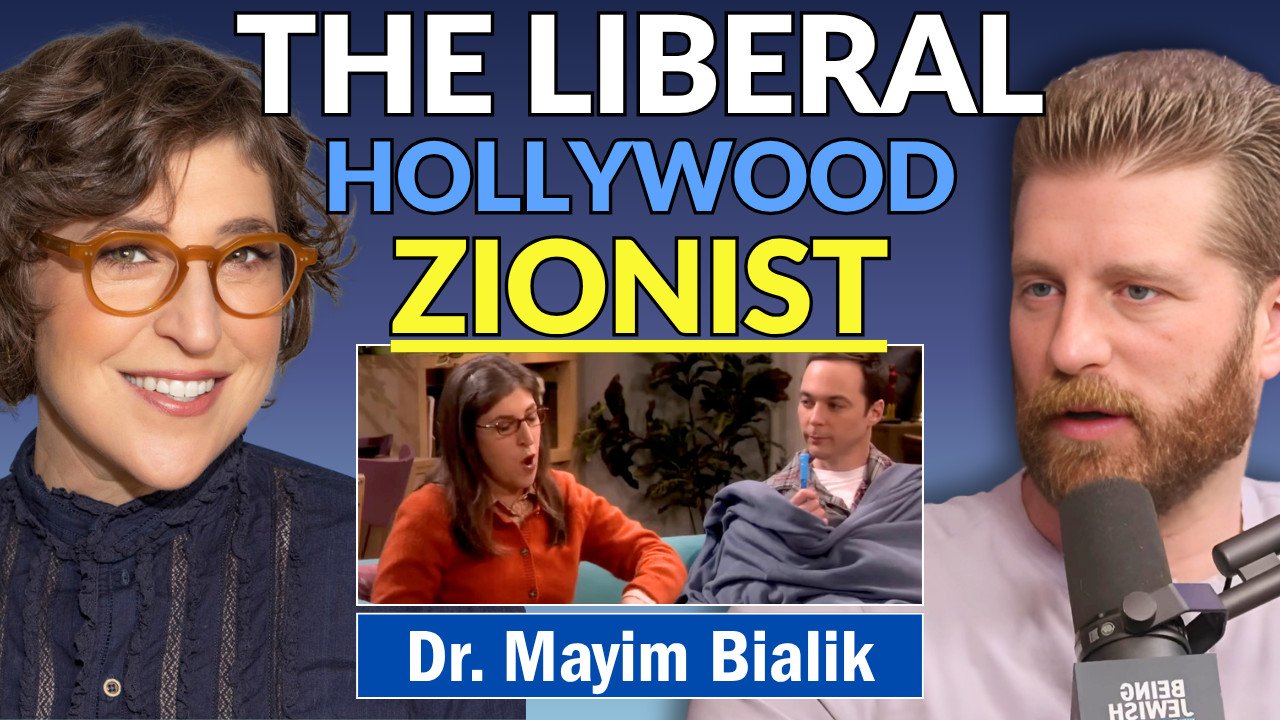
Interview Transcript
Jewish Actress Mayim Bialik WON’T Hide Being Jewish, Even When She Feel Less Safe in Public
Most Hollywood child stars fall from innocence to infamy, but this actress did the opposite.
She followed her fame all the way to becoming an Orthodox Jew.
Oy.
She didn't just blossom, she bloomed into a full-on neuroscientist, four-time Emmy nominee, best-selling author, hit podcaster, and one of the world's loudest and proudest Jewish celebrities.
But has it come at a cost?
Let's find out.
She's Mayim Bialik, I'm Jonah Platt, and this is Being Jewish.
This episode is brought to you by our sponsor, Wondering Jews with Michal and Noam, an unpacked podcast.
Start watching or listening at unpacked.bio/wJ.
Willkommen, bienvenue, welcome to Being Jewish, your home for deeply candid conversations on Jewish identity, culture, current events, and more.
I'm your host, Jonah Platt, and today I'm joined in studio by none other than the real awesome Blossom herself, Miss Mayim Bialik.
Mayim, welcome to the show.
Oh, my goodness.
Thank you.
Mayim, Mayim, Mayim, Mayim.
That's it.
Mayim besason.
I was- Do people just sing that at you all the time?
When I was a kid.
Um, indeed, that is my name, is the same as the song.
Yes.
Well, welcome.
Thank you.
It's a pleasure to have you here.
Thank you.
You have many career accomplishments, of course, which many people are well aware of, but I have so much respect in addition to all that for how, how openly Jewish you live your life.
Mm-hmm.
Which shouldn't be the exception, but often is.
Is that something you have ever thought to yourself and decided to do?
Is there, like, a gauge to what you show and what you don't, or y- is that I'm just me being me?
The easy answer is it's a little bit just me being me, but I think as, you know, you well know, the mediums that we can engage with have, I think, changed the way a lot of us present ourselves.
So, you know, when I was on Blossom, I was 14 to 19.
There was no social media.
That's right.
There were no smartphones.
You know, w- like, even having a publicist was something that a lot of people didn't have if they were actors.
You know, it was a very different world.
By the time I got to Big Bang Theory, which was, you know, many years later, you know, almost 20 years later, it was a completely different landscape, and by then I had been writing for Kveller.
You know, I had been- Mm-hmm … mommy blogging, is what we used to call it, but also writing a lot about Jewish identity, Jewish observance.
Um, at that time I was quite observant, and so I would write in particular about a lot of, you know, what observance means, especially for a modern lens.
But once social media became a thing, I think the question was, yeah, how much of yourself do you show?
You know, maybe it was naivete.
I did not think that there would be a problem with me showing that these are the holidays I celebrate or this is what I do, and apparently what I was opening myself up to was, you know, an internet that became a reflection, you know, of a lot of the places in society that were still not comfortable with Jews- Yeah being Jewish, no matter their observance, political persuasion, belief system.
Mm-hmm.
You know, it didn't really matter, and that was a, a, you know, long before October 7th, for sure.
Sure.
When you first- Sort of felt that, you know, this, there's this increased exposure and now you're getting, I mean, when it sounds like you're getting some negative online- Threats threats.
How does that alter your behavior?
I guess it doesn't.
Baruch Hashem.
It alters my sense of safety.
Mm.
Not just my personal safety, but my sense of safety in the world.
I, I think that's kind of undeniable.
And it also, you know, echoed a lot of the fears that many of us were happy to discard, that we inherited from our parents or our grandparents or our great-grandparents.
You know, many of us wanted to push aside this notion that we are other.
Yeah.
Look, look how assimilated we are, and indeed we are, you know?
And through all of, of our history, you know, we have survived by adapting just enough, you know?
Right.
And maintaining just enough to sort of have that tension, you know, be, uh, palpable.
It changed when I was first protested against long before October 7th.
Protested in what way?
I was giving a talk in, I believe it was in Ohio, Cincinnati.
I was speaking at a secular university with a secular topic.
And, um, it came to our attention that there was a group of anti-Israel activists.
Yeah.
I don't know what the moniker was, but I remember that I was shown the flyers that were being distributed to encourage this protest to happen, and the flyers said a very simple and confusing sentence.
It said, "Mayim Bialik is a Zionist." And I thought, "Well, that's strange.
W- why would that be cause to be protested?" They know me so well.
Right.
And I remember there was that confusion and, you know, in hindsight it's very kind of clear it was, you know, part of this Zionism is racism, you know, campaign.
And yeah, during my talk, this group stormed into the auditorium, and this was like a 1,000-person theater.
It was a large theater, with flags and screaming and this, that, and the police had to remove them and this was 15 years ago.
Wow.
This was a long time ago.
Yeah.
That changed my requirements for security.
Mm-hmm.
Yeah, it definitely caused some sort of destabilization of comfort, right?
Totally.
That, that many of us, you know, have kind of been used to being used to.
But it also really pissed me off.
Like, you're not allowed to use Zionism as a slur because it's not.
I mean, at least the last time I checked.
Right.
It's a definition of, you know, someone who believes in an autonomous and free state of Israel, you know, with secure borders and with safety, um, as our historic, spiritual, literal, and figurative homeland.
That says nothing about politics, says nothing about how I feel about a two-state solution, a three-state solution, the treatment of, uh, Palestinians in Ga- like, it says nothing about that and- Right … and again, this could be my naivete, which apparently, you know, many on the extreme left, I would say, and I guess the extreme right, have redefined Zionism- Right to be something that, again, I did not think that it was 15 years ago and certainly not now.
Yeah, I don't think that's a naivete.
I think that's just people co-opting a word- Yeah … and calling it something else.
Yeah.
I think it's hard to fully understand if you've never experienced the shitty feeling it is to be protested or harassed or, uh, like, any of that stuff.
Like, I'm a pretty tough cookie.
You seem like a pretty tough cookie.
It's not fun.
It, like, it really doesn't feel great.
It's an understatement.
Like, uh, it, it doesn't feel good, not to the point that I would be like, "You shouldn't do that.
It doesn't feel good," but it's disturbing.
Yeah.
I experienced this when I was at UCLA.
So I'm 50 now.
As a student.
As a s- as an undergrad, and this was, um, the beginnings of, uh, what became the Zionism equals racism, you know, movement.
So I'm- That's somewhat unusual.
I mean, most of the guests- Yeah … who I've had on the show, even of 50s and above, have been, "Oh, well, when I was in college it was a totally different landscape." No, I went to UCLA.
So I'm 50 years old now.
I entered UCLA at, at 19.
That's 30 years ago.
Wow.
And we, in the five years that I was an undergrad there, we went from having positive interactions with all of the other minority groups on campus, the Latino, Che- you know, Chicano organization, the African student union, um, all of the, you know, Asian American, Pacific Islander groups.
We had positive relationships with all of them, and by the end of the five years there, they had been encouraged to sign, um, an anti-Zionism charter.
Wow.
This was in the '90s, you know, the late '90s- That's early … early 2000s.
Um, there were swastikas painted on Bruin Walk during our, um, Yom Ha'atzmaut week that we were, you know, scrubbing off.
Um, Rabin equals Hitler was chalked all over Bruin Walk, and it was the beginning.
What we now see was, I believe, you know, a, a global campaign- Yeah … of basically, you know, intellectual hijacking of the university system.
We went from being able to converse as students and academics to not being able to speak at all.
And this notion of non-engagement- Yeah … which is not the approach that I take, that's what is the most disturbing.
Being shouted down, this is a new phenomenon.
So it's not just being protested, right?
Right.
It's being shouted down with anger, with aggression, with threats of violence, in a way that there is no conversation.
That, I think, is what's most alarming about whatever movement this is that is so actively seeking to, um, engage in protest.
I mean, we, it's certainly something we've talked about on this show before, how, you know, anti-Zionism is a hate movement, and it's not interested in a conversation.
It's not actually interested in solutions.
Correct.
It's, it wants to shut down one side and- Ostracize them and other them and- Well, and- … in, in certain ways get rid of them entirely.
Well, and look, we've had many opportunities even in our lifetime to see, oh, what happens when people don't agree about something?
How do we talk about it?
Mm-hmm.
So we've seen this with Black Lives Matter.
We've seen it with the LGBTQIA++ movement, right?
Yeah.
We've seen it with the, with even with the trans community.
What does it look like if, let's say, someone doesn't agree, but how do we have dialogue, right?
And it's not done perfectly, but for some reason this situation and this conflict seems to be one that is above conversation, right?
It's so- Or below perhaps.
Or below.
That's true.
It's depending which side of it you're on.
Right.
So your name obviously is Mayim.
Yes.
Do you feel like you've had to explain your Jewishness your whole life?
It's funny.
I don't know that I would've thought of it like that.
I've had the opportunity to identify as Jewish every single time someone doesn't understand my name.
Yeah.
And there's not a situation I've been in where anyone has guessed the pronunciation of my name correctly, like my whole life.
Once I became, I guess, more of a public person maybe.
Right.
But every single time someone has made a comment or asked about my name, I've had the opportunity to say, "It's Hebrew for water." My name means water in Hebrew, right?
Mm-hmm.
And then what's the most common follow-up?
" Oh, that's so beautiful.
Oh, that's interesting." We love that.
Yeah, we love that.
You have a quote that I loved.
You, you once said, "There is nothing worth fighting for that is more important than the legitimacy of the Jewish people and the existence of the state of Israel." First of all, I think we gotta get everybody to sign that pledge.
I mean, let's pass that around.
You are a neuroscientist.
Mm-hmm.
You host a podcast, Mind Biologics Breakdown, talk a lot about mental health and different things like that.
What is the disconnect between, from your point of view, the stakes of that statement, which are so existential and urgent and important, and what's the chasm there between- Mm-hmm other people deciding to act on it when the stakes are so high?
I mean, what do you see there?
It's a great question, but it's one that you could ask about many different aspects.
I mean, not just of, like, human existing, but of Jewish identity, right?
Because I've heard people say that there's nothing more, right, important, critical, and prescient than being religious, right?
Which I don't think is true.
Mm-hmm.
It may be true for some people.
But I think at this point in time, so much of our Jewish identity and the Jewish identity of our children and our people, you know, is dependent on how we respond to a global attack- Yeah … on our legitimacy.
And, you know, I think that what social media and TikTok misses is that there's an academic practice of examining anti-Semitism, just like there's an academic practice of examining systemic racism.
Right.
You know?
Um, or the, the variety of injustices that are done all over the world, and have been for thousands of years.
This is not a group of Jews coming up with an idea that they hate us.
You know, there's an academic tradition- I'm almost done with my master's in anti-Semitism studies.
Right.
Well… That you can even get a master's in it.
There you go, yeah.
So, you know, to be able to, to frame that takes more than 10 seconds, right?
Yeah.
There's a very systematic procedure, um, that many people all over the world have spent and dedicated their lives to perpetrating, and that is de-legitimization and all of the things that happen.
Questioning our peoplehood, questioning our right to statehood, our right to self-defense.
Those are tropes, you know, and they're, they're tropes for a reason.
I'm interested in sort of what you see- As the disconnect for Jews- Mm … who- Mm … might think this, what you said.
I agree that fighting for- Mm-hmm … Jewish identity is so important, but, you know, I gotta watch this TV show, you know?
I got- I gotta go to the grocery store.
I think it takes all kinds, and I think we're, we're called for different things at different times.
But this is the time, right?
Well, this is the time, and people do exactly what they're able to.
Mm-hmm.
And I don't presume to judge because I don't know what the rest of the capacities are of any individual.
And the fact is, you know, there's a lot of things that happened in my heart, in my mind after October 7th that I don't share, and that I didn't share with people.
And in some cases, those may have prevented me from acting fully in ways that I wanted to, right?
Mm.
Maybe there was an event I wanted to go to, but I couldn't.
Maybe my fear was too great.
Maybe my anxiety about what it would mean to confront this global threat, maybe it's too much.
Mm-hmm.
And I give people the right to be in denial because it's a powerful tool Sure … that people hold onto when what's on the other side might be too overwhelming or scary.
You know, why are there Jews Who turn on us- Yeah you know, turn on their own people, different question, and I think- Mm-hmm … has a different, you know, set of framework around it.
They're almost more understandable to me.
Because they at least have an, an agenda that they're working off of- Mm … of, you know, "I don't agree with this statement." Right.
"And so I'm gonna… What I think is the most important thing is- Right … my progressive values, and I'm gonna go with that." It's not a- you mean it's not apathy and yeah.
Yeah, yeah.
Yeah.
And I… As opposed to someone who says, "Yes, I agree.
This is a really critical time.
I just… I'm not gonna really contribute to it right now." Yeah, I… Yeah, to- and to me, and again, this could just be my bleeding-heart liberal side, right?
You know, to me, there, there may be more, right, to that.
And like I said, it kind of takes all kinds, you know?
Yeah.
I pick up trash when I see it- Me too … in places, right?
Mm-hmm.
I wish everyone would do that.
To me, it's like- Yeah one of the easiest things to do.
Yeah.
It's one of the easiest things to do.
You can literally make the world a better place by leaving it with less trash than you entered it, and you don't have to clean up the whole world, right?
I, I agree with that.
That, and that inspires- But I love that you're hostile towards people who are apathetic.
I'm not hostile.
I, I, and well, I mean, what I, I challenge people to- Yes, sure … because I believe everyone is capable of contributing in their own way.
You're correct.
Right, and- I'm not saying everybody's gotta come out there and be a, you know- No, and, and I- shouting from the treetops … well, and I think one thing that I see, it's the, it's, it's just before apathy.
It's like, "Yeah, it's important, but someone else will handle it." Yeah.
Right?
That definitely gets my goat because if you think it is important to the level that we're talking, then yeah.
I do think you have to be willing to stand for, to stand up for, and to sacrifice.
Yeah.
And, and I also, you know, understand that some people feel the need to hide.
Some people feel the need to take off their kippahs now.
Yeah.
Someone literally said to me the other day, he was not Jewish, "I like your Jewish star.
I don't see a lot of them anymore." Wow He said, "My girlfriend's Jewish, but I don't see a lot of them, and I like yours." And I was thinking, "What is this world?
What is this world?" And what an interesting guy that he was observant enough to see many of them before and notice them diminishing.
Correct.
I, I love this guy.
I know.
All right, here's another, here's another quote of yours that I like.
"If people are critical of me for being Jewish or because I visit Israel or believe in the right of Israel to exist, that hurts me a lot." Mm.
Are you hurt all the time?
I guess so.
I mean- I mean, like- That sounds… That's, that's gotta be tough … it's like I feel like there's gotta be a Yiddish expression, like to hurt is to be a Jew.
I definitely think since October 7th many of us have experienced a level of hurt, um, you know, that, that previously was kind of unfathomable.
Yeah.
I think that since October 7th we've had to think a lot more than we did before- Oh, yeah … about the way we present ourselves and how we talk and where we speak Hebrew and, you know, all these things.
Yeah, I think there's a, a tremendous amount of grief, and it is, it's collective grief.
It is intergenerational grief.
What are your strategies?
How do you stay buoyant and h- hopeful and- Um … you know, deal with the, with the hurt?
You know, I think that there's a new sense of community for the Jewish people.
For sure.
I think that, you know, all of a sudden going to synagogue wasn't just like going to synagogue.
Right.
It was like, "I need to be around people who I don't have to explain myself to." Yeah.
I don't agree with everyone at my synagogue, right?
Yeah, sure.
I don't always agree with the rabbis.
Like, we're allowed to not agree with everybody, right?
I wish I didn't take this, but I really felt that.
I felt like I need to be held close.
Yeah.
I think also, you know, leaning into Shabbos, leaning into Yom Tovim, like leaning into the things that are good and joyous about us.
Mm-hmm.
Like, we have a culinary history.
We have music.
We have dance.
We have a calendar that's all our own.
It's always been phenomenal to me, but especially to push back on that hurt, yeah, it's being able to remember the things that don't hurt.
Yeah.
And I think I also felt a really different kind of camaraderie with all kinds of Jews in a way that I never did before.
For sure.
Because I think whatever your denomination or identity is, like those are your people, and you feel comfortable, right?
Mm-hmm.
You don't have to explain yourself.
You, "Oh, I'm not, I used to be…" Like, you don't have to do that, right?
But what happened for me is, like after October 7th, we seemed like one- Yeah in a new way.
Mm-hmm.
And when I would see religious people, where normally I'd be like, "Oh, I'm not as religious," it was like, "What's up?
Hey." You know?
Yeah.
And I was like, "This is what it feels like to be in a community." Right.
One more Mime quote for you.
Oh, my goodness.
It's like a This Is Your Life.
All right.
This is an older one.
You said, "Israel is the country I most identify with as mine." Mm.
Do you still feel that way?
Absolutely.
Great, that's the whole question.
Um- Well, I think it needs, like, a little bit of fleshing.
Yeah.
Like, this is the country that took me in.
I'm a, a proud American.
I'm patriotic in that I- When you say took me in, you were born here.
I was born here, but I'm saying, like, I would not exist- Mm … had Ellis Island not moved us through, right?
Yeah.
Moved my grandparents through.
One of my grandmothers, uh, she came from Warsaw, she, she had polio.
She had to be, you know, essentially snuck in.
Wow.
Like, she was marked at three.
I'm only here because of that.
Yeah.
And I believe in the values of this country.
I believe in the freedoms that many of us hold sacred.
I, I also believe in, you know, the complexity of this country- Sure … and that it was not discovered 250 years ago.
There've been Indigenous people here for, you know, for most of history.
Um, but you know, I, I believe in, in the promise, uh, that, that brought my grandparents here.
Yeah.
But it doesn't feel like mine- Mm … the way Israel does.
Yeah.
Israel's mine because that is my homeland.
It's the place that I return to in my heart and in my prayers, and I physically return there, and it feels like coming home.
Yeah.
I don't kiss the ground when I land here.
I kiss the ground when I land there.
Yeah.
You know, when I leave here, yeah, I miss home.
When I leave there, that's, like, a, that's an eternal longing.
Like, that's where we've been exiled from for thousands of years.
Yeah.
Like, that's… I'm in the exile.
Like, I'm a diaspora Jew.
That's mine.
This is what took me in.
And all over the world Jews have been taken in, and we've had dozens of dialects that we design wherever they place us, but that's, like, that's where I've been placed.
Yeah.
My ancestral, primal home is Israel.
That's my people.
Would you ever make aliyah?
I've thought of making aliyah, uh, more than twice.
At this point, my life is here because of my kids- Yeah … my mom.
I mean, I've tried several ways.
I'm happy to pay taxes and be considered a citizen, I just don't know that I can live there- Mm-hmm right now, right?
And there are certain requirements.
So you know, if anyone from the Israeli government wants to take my money, I'm happy to pay taxes, you know, for citizenship.
Let's go.
Let's get her in.
I feel like we should get me in.
Like, wouldn't that be… I already feel like a c- It'd be the biggest win for Israel in three years I already feel like a citizen, right?
Yeah.
So a few weeks after October 7th, you recorded this nine plus minute- … TikTok video.
Is that how long it was?
Yeah.
Really just speaking off the cuff it seems, speaking your truth.
Yeah.
Millions of views.
Yeah.
What, if you can recall, like, felt so urgent in that moment that you're like, "I gotta go put this on the internet," and, like, what was the response that you got from that?
Gentiles.
I wanted non-Jewish people- Hmm … to understand what it felt like to be Jewish right now.
That was really what it was.
Because we're a very small percentage of this country.
We're like the Amish, and if you live in a city, I know you think we're everywhere.
Um, you know, like it's- Maybe not this audience.
Right.
No, but I'm saying like- You know … if, if other people hear this- Right … a lot of people who are like… My favorite thing to do is to ask a gentile how many Jews they think- Right … are, you know, especially if they live in New York or if they live, you know, in any large city.
Like, I've heard people say like, "I think like 50%." No.
So, um- Two.
Right.
What I was driven by, you know, was wondering what it must be like for, you know, even the s- sweet gentiles, right?
Yeah.
To be walking around the world after October 7th and be like, "What the f- is happening?" Like, "What happened there?
What happened in this far-off place that I've never been to and maybe can't even find on a map?" Yeah.
"But what's happening with all these Jews?" Like, what, that's what, that's really what, what I felt motivated to explain, not as a defense, not as like, "Let me explain." It was just like, "If you're curious what it feels like, this is what it feels like." And that was just my experience, but I also know that it resonated with a lot of people, probably because we're all very similar, 'cause we're a people.
We are a tribe, and we share a lot of things.
We share a heart.
Did you receive response from the audience you were trying to reach?
Mostly I heard and hear from Jews.
Hmm.
A lot of Jews felt really seen and heard.
And obviously I don't need to shout in a matchbox, which is a lot of, I think, what you and I and people like us end up doing, right?
We end up speaking to people who get it, right?
Right.
But, um, I know that people shared it.
I know that they shared it with other people.
Yeah.
And people told me that they would share that with people to say this.
Right.
" This is how I'm feeling.
This lady, you know, articulated it.
This lady you know from TV"- Mm-hmm "she's feeling it, too." You've called being a liberal Zionist… I guess I have more quotes.
You've called being a liberal Zionist a strange intersection.
How, how's that going for you these days?
What I've discovered is that I cannot, you know, be asked to choose between being a liberal and being a Zionist.
I think that- Every term and all of the nomenclature that many of us used to use, especially if we are, you know, liberals or Democrats, right?
Right.
None of that seems relevant anymore.
You know, I, I've had, you know, so many people laugh in my face when I say like, "I used to be a progressive." That's what they called us.
Yeah.
And I think the part, part of that is that this spectrum on both ends has been pulled so far that it's just a circle.
Totally.
It's like a messed up circle.
So, um, I don't identify, you know, with many politics of the far left.
I mean- Sure … you know.
Um, and I don't identify with many of the things that, that the Democratic Party has chosen to prioritize, you know?
Um, not just for the Israel reason or the Jewish- Yeah … reason.
I think many of us feel very confused about our identity as Democrats because I think the Democratic Party has really let a lot of us down, you know?
And saying that, you know, earned me accusations of being a Republican in my own home, right?
Which there's nothing wrong if people wanna be Republicans, but I'm saying the fact that that is where, that's how polarized it got.
Right.
That if you questioned- It's so binary … right, that if you questioned what's going on in the Democratic Party, all of a sudden there's only one solution, that means you're a Republican.
Right.
No, I got a lot of other choices in between, you know?
Um, so for me, you know, the, the principles of liberalism hold true- Totally … no matter what.
I, I believe in upholding the fallen and healing the sick.
I do… You know, I'm okay with also living in a country where some people believe in the welfare system and some people don't.
Mm-hmm.
Like, I was raised to understand that people have differences of opinion.
We don't go shooting each other in the street about it, right?
Right.
So none of that has changed for me.
I believe in many of the policies surrounding, you know, uh, legalization of drugs, of prostitution.
You know, I'm a liberal.
Mm-hmm.
I bel- I don't believe, I will never believe in the death penalty.
Right.
Like, you cannot get me to change.
However, this notion that support for Israel Um, is in conflict with the Democratic Party is fallacious, and it's, you know, it's sinful, right?
Yeah.
It's, it's sinful.
A- and in addition, whatever's going on on the other side of the spectrum is, you know, a lot more in line with my, you know, Democratic socialist tendencies of like, "See?
I always knew they were against us." Whatever's happening on those far fringes of the right- Yeah … is also not appreciated.
So I feel like we have to get out of that binary, right?
Mm-hmm.
A- a- absolutely.
And this country is young, and whatever experiment we were doing seems to be revealing that there's something about this, you know, binary system- Yeah that is not, um, it's not meeting my needs, certainly, as a liberal Jew.
I think that there's a lot of moral ineptitude.
I think that it is egregious to treat one minority population with such disdain, hatred, disrespect, and intensity when if any other minority group received this kind of attention, uh, the, the, there would be, uh, blood in the streets.
And I- that is the most suspicious aspect of what is going on, and this is what I tell my children.
No ma- we don't have to agree on everything, but there's something conspicuously suspicious about the attention being paid to Israel.
Yeah.
We've seen it in the United Nations.
We're used to that, right?
We've seen it in certain fringes of campuses, right, and of organizations.
Never, like af pa'am lo, never in my life did I think that any Middle Eastern program, right, Middle Eastern studies program at a university- Mm-hmm … would only have candidates that don't believe in the right of Israel to ex- and never in my life did I think we'd see that, right?
Yeah.
There's something happening here, right?
That's the Buffalo Springfield- Yeah … song.
Would, would you ever run for office?
I can't even get the mail on time.
Uh I can't even put on my shoes.
So you're saying there's a chance.
I wear slippers most days.
No.
I mean, look, uh, the, the way the politics is going now We need good people.
Cl- well, clearly anything goes.
You know, I'm- Yeah.
All, all you need is a good AI campaign- I'm learning that- and you're in … no, I literally, like, on any given day, there's not enough food in the fridge 'cause I forgot to go to the market.
You do not want me in aging.
They have, they have people for that.
No, but I really… No, it's not… I mean, look, I think there's a lot of ways that I can, can do advocacy- Mm-hmm … and continue to.
No, I think that until I can reliably find my keys, my AirPods, and my cell phone, we should not have me taking on any civil responsibility.
You've also said- Oh, my goodness Someone did their research.
Okay, this is literally the last one, though.
Jews are often the canary in the coal mine.
Mm.
And that's not, you know, a specific Monica- Sure quote, but you have said that.
Yeah.
If that's true right now, what, what's the warning?
What's coming in the United, the way of the United States if we continue down this road?
There's a group of people who have, um, you know, perverted their own, you know, religion in many ways to attack people who are not like them.
And, um- You know, radical jihadist, um, individuals do not single out Jews.
Um, we are simply the first.
We're seen as kind of like the simplest, you know, first attack.
Um, but there is no fondness for Christians, you know.
Many of us, right, are infidels to a certain, you know, group of, of individuals.
And, you know, it, it feels, it feels necessary to say this is not about Islam.
This is not about the origins of Islam.
This is not about the Quran.
This is not about individual Muslim people.
This is a completely different conversation.
Right.
Right?
I am not attacking, um, Islam.
I'm not.
Um, and, you know, hatred and attacks, um, on Muslim people are horrendous and we emphatically, categorically, undeniably, um, do not condone that.
This is a very, very old, um, and complicated, you know, battle that is being waged, not just on Jews, but on, you know, all people who do not believe a certain way.
I, I don't know how many other ways people need to see it.
I thought 9/11 was gonna be a wake-up call.
It was for a couple years, and then everybody forgot.
Mm-hmm.
Um, I mean, that's like I'm being hyperbolic.
Sure, sure.
But like a little bit, that's kinda what it feels like.
That is what we're here to announce, right?
This canary.
Um, there's more.
It's a, it's a crap job, but I guess somebody's gotta do it.
That's your bedtime story, Joe.
Sleep tight.
Thank you.
You know, one of the things I love most about podcasting is getting to have conversations that don't pretend to have all the answers.
That's probably why I've always enjoyed talking with my friend Noam Weissman.
Noam has been on this show.
I've been on his.
And every time we talk, I walk away thinking a little differently about the world, and that's exactly what you'll find on his other podcast, Wondering Jews with Michal and Noam, a podcast from Unpacked and Open Door Media.
Hosted by my friends Michal Biton and Noam Weissman, two seriously dynamic Jewish voices, they tackle the big questions about the Jewish experience and about life.
They explore what anti-Semitism looks like right now, what the future of Jewish identity might be, how American Judaism is changing, and a whole lot more.
Now, what I love most about the show is that it's not about arriving at neatly packaged answers.
It's about wondering together.
Michal and Noam bring real intellectual honesty to every conversation.
They challenge each other.
They push back.
They keep it curious, and they invite listeners into the process.
And it's not just serious.
It's joyful.
They laugh.
They make Judaism feel alive, and they create the kind of conversation that leaves you thinking long after it's over.
Search for Wondering Jews with Michal and Noam wherever you listen for your podcasts or watch them, Spotify, Apple Podcasts, and YouTube You have family, a lot of family in Israel.
Mm-hmm.
Specifically, you have family that lives in the West Bank area.
Mm-hmm.
Judea, Samaria, whatever you wanna call it.
Yeah.
Um, how does having family in this contested area shape your relationship to the situation there, and, and has that relationship been useful as a vehicle for discussion with other people, or has it been a magnet for people- Um coming after you, or both?
I mean, look, w- what I learned is that it doesn't matter if I go to the West Bank or Israel proper, like, haters gonna hate.
Mm.
You know?
Right.
I, I've never heard someone say, "I would have no problem with you visiting the land of Israel if you wouldn't cross the green line." Like, no one's ever said that to me.
Hmm.
It's just not a thing people say.
Right.
Because people who hate that you're in Israel hate that you're in Israel.
However, Jews ask me a lot about the West Bank.
Um, and I would say that the years that I've spent, you know, um, in the West Bank and with my family have given me, I think, a more nuanced understanding maybe of the complexity.
Yeah.
You know?
I, I can't- I would assume so.
Yeah, I can't, I can't say that I get it.
I can't say that I can explain religious Zionism, you know, um, t- to a satisfactory degree.
And, um, what I know is I have seen what it was like when that land was given away by Netanyahu many decades ago, and for many families, it was their only opportunity to ever get out of a tiny apartment, right?
Mm-hmm.
It was the promise of a home.
It was a promise of, um, a different lifestyle, you know, than people who were living in cities, right?
Mm-hmm.
It was supported by a government that does a lot of things that I don't agree with.
You know, I've also seen it obviously grow.
You know, my, my, my family lives past Maale Adumim, so most people when they hear West Bank, they think, like, "Oh, Maale Adumim." Maale Adumim is a, a very large, over 100,000 people now, um, you know, city, um, and surrounding area outside of Jerusalem.
But there's a lot of West Bank- Mm-hmm, mm-hmm … you know, beyond that, and that is where, you know, I go into.
It is complicated.
It's become a lot more painful.
Um, and it is true that the more you see about what happens at checkpoints, the harder it is to go through one.
Hmm.
I, I will say that.
And as I've gotten older, the soldiers look younger.
Wow.
Yeah.
Funny how that happens.
Yeah, but it's very, that's painful, too.
Say more about that.
Israel has a very interesting structure, you know, for- For its military in many ways.
You know, acharei, right?
Like, the, our, our leaders and serge- they go first, you know?
Mm-hmm.
And the soldiers are behind them.
Right.
Which is like, you know, when people hear that, it's like, oh, you know, that's, that's how, that's how we go to war.
Right.
Um- Unlike America, which is- Correct … generals in the back.
Correct, and you send all the kids in, right?
Correct.
And, and look, it's still war, war is terrible, right?
War is horrible.
It's not healthy for children and other living things, you know?
Um, but y- yeah, we have a, we have generations that I've seen grow, right?
I mean, I'm 50, and I've been going to Israel since I was 16.
So I've seen my cousins have kids and grandkids and, you know, I've seen what it's like for young people also to be raised in conflict.
Meaning, in the same way that we would say the patriarchy affects men as well as women- Mm-hmm … whatever is going on in Israel, it affects everyone.
Sure.
Sure.
Meaning it, it impacts and it erodes trust and love and, you know, when I think of the God of my understanding, that's a God of love and cohabitation.
Is there anything more you can illuminate for us about- life in the, in the West Bank, especially- … far out there, like that you've seen up close and personal?
You know, when you're on an armed settlement, it's, it's a real bubble, you know?
And many settlements, um, like the one where my fam- one where part of my family lives is an armed settlement, you know, and that means that there's a, you know, a giant gate and an, you know, armed soldiers.
Um, and then once you're in, those gates close, it's like a bubble.
Mm-hmm.
Everything you need, you know, pretty much is there.
Like- So there's no- There's a market … where they are, there's no integration.
No.
It- they're, they're totally separate.
Yeah.
Okay, okay.
Yeah.
Well, yeah, I know, 'cause some- No, this is a good question you know, 'cause some- Sorry … people are like, you know, we go to the same supermarket.
No.
We just live in this- No, no, no … community and they go to this community Well, also, oh, so there's- You know … there's different kind, there's different kinds of places in the West Bank.
Yeah.
Obviously.
For sure.
If you're on an armed settlement, you know, that's different.
Yeah.
And, um, men wear guns to shul, you know, over their tallisim.
Like, that's, like a thing that sometimes happens.
Um, and you know, it's very hard because I feel like I have to apologize, you know, that people live there, and that's not for me to do.
Do you know what I mean?
Like, it's beautiful.
It's a beautiful place.
Right.
Like, it's, it's beautiful.
The… it's like the desert is thriving, right?
Mm-hmm.
It's like there's, there's a supermarket and different minyans, and you could go to this minyan, you can go to that minyan, and, like, there used to be a, a Carlebach minyan where they only do Carlebach melodies.
You know, like, it's like I spent, I've spent so much beautiful time there davening and learning how to cook and watching, you know, my aunt and, you know, like, uh, just watching what traditional Orthodoxy looks like, right?
Uh, that's part of my experience there.
And, you know, another part of my experience is one of my cousins once said that he was driving by and he was patrolling an area that, you know, was mixed as it were, and he saw a tiny child cowering behind a bush, and the bush was not even very dense, so the boy, like, it was so clear that he could be seen by anyone, but his fear was such that he was trying to make himself so tiny.
And my cousin, who at the time was a soldier, said, like, it broke his heart.
Like, this is what me driving by makes this child do- Mm.
Right?
To cower behind, like, a twig, right?
They, like, it's not even safe.
That also, you know, happens, and there are regions of the West Bank that I have driven through, um, that do go through, you know, um, Arab towns.
Mm-hmm.
When I was a teenager and into my 20s, we took buses, and the bus would go from a settlement where, you know, where, where I was staying, through various Arab towns.
This was before the Second Intifada.
Mm.
And there was always… You know, it's an interesting moment, 'cause you're passing through someone else's village.
Mm-hmm.
And you're stopping and you're picking people up- Yeah … and you're all sharing a bus.
But of course, I grew up with these images of buses blowing up, right?
And you don't wanna be fearful about every person who gets on the bus.
That's not a way to live, and yet that is the way that a lot of people live.
And I know that the other side of that is, what's it like to see a soldier, right- Yeah … drive by?
That's also terrifying.
Like, this is the tension of, of the West Bank.
And there are regions in the West Bank now where there are red signs.
That is different.
And the red signs say, "You cannot enter here.
You are not protected if you go here." Mm.
And those are entrances to certain, you know, Arab villages.
And you know, technically, that's for everyone's protection.
Right.
You know?
But those red signs are newer.
I hadn't seen those before.
What the West Bank is like is it's like a lot of human beings.
It's a lot of human beings.
What's the feeling of being in a place where they have to carry guns to shoal- Mm-hmm, yeah to, to, to protect- Mm-hmm … themselves?
Sure.
And, like, what does that mean in terms of their presence there?
Yeah.
And, and you sort of can look at it from a, with a little bit of a remove.
That doesn't feel very safe to me.
Like, that feels like this is not the world that I want us to build together as humans.
Yeah.
You know?
Yeah.
And I think that's the thing, too, because it's not just the West Bank.
Like, and this is what I was glad that my children were reminded of when we went in December.
Much of Israel is integrated.
Yeah.
Much of Israel is integrated.
We once went into a coffee shop in a mall And we were the only non-Arabs there.
We were the only people not speaking Arab.
We were the o- I was the only woman not in hijab.
Mm-hmm.
And there's nothing wrong with that, right?
Right.
Like, that's a lot… You know, when you go into a supermarket, when you go buy shoes, when you like, the, there's all sorts of people, and that's in many places in Israel, you know?
And, like, that's important for people to remember.
Complicated stuff.
Speaking of your sons, you've mentioned them a couple times.
Uh-huh.
And, and you mentioned they're 17 and 20.
Correct.
So they're sort of right in the thick of, you know- Yeah … high school, college- Yeah … where it's, in this country it's been sort of the front lines of dealing- Yeah with anti-Jew sentiment.
Mm-hmm.
How, how have these couple of years been for them?
I decided, you know, after October 7th in particular, you know- To allow them to have their own processing and their own experience, and with that comes a certain amount of anonymity that I grant them- Mm-hmm … because they're not anonymous, right?
Meaning I let them have their own experience, and I don't… I mean, I could write so many amazing articles, I think- … you know, about, like, what it's like to parent in this day and age, and what's it like when your kid goes to a UC.
Yeah.
'Cause apparently those are very difficult places.
Um, you know, I made the commitment to my older son, um, you know, not to be part of any parent advocacy because of my name- Mm-hmm um, at the school that he, you know, attends.
Um, because he needs to have his own identity.
He needs to have his own life.
You know, he carries my name.
He looks just like me.
Um, that's not easy, you know?
So, um, there were a lot of meaningful, complicated conversations, obviously, after October 7th.
Um, he was a high school senior, my older one, at that, at that point.
But we also called on, you know, our secular family in Israel to try and have some of these conversations, and we got help.
I'm really grateful to my, um, my Aunt Judy and my Uncle Elliot.
Shout out, Aunt and Unc.
Shout out .
Shout out to, you know, the community of Kibbutz Gezer, right?
Like, for being part of what I consider kind of raising my children, you know, in that, you know, Israeli kind of consciousness.
He has a strong foundation, and also, I would, I would add, you know, a very liberal perspective in terms of I, I want my children to tolerate other people's opinions.
Sure.
I, I want them to be able to have reasonable conversation, and I also want them to be educated.
Yeah.
And that's what I've said to both of them: "You don't have to agree with me, but you also can't make things up, and you can't take things off the interwebs that are not true and use those as evidence.
The New York Times can do that, but you cannot." We got different standards in this house than The New York Times does.
That's right.
But post-October 7th, um, was when we went to the orientation at my, my younger son's school, which is a Jewish school.
The head of school got up there and he said, "You know, I had a whole speech prepared about why you should send your children to Jewish school." He said, "And then October 7th happened," and it was like… It's like it's a mic drop.
Right, I don't need to- C- correct, because- … to make any more speeches … c- correct, because, you know, my goal in sending my child to a Jewish school was so that he would n- s- so that both of them would not be ashamed of being Jewish simply because they're Jewish.
Hmm.
And, like, that's a low bar here, people.
Yeah.
Welcome to the world in 2026.
I just don't want them to hate themselves because of their ethnic- And religious and cultural identity Have you been successful?
I, I wouldn't say that I've been successful.
I would say that the Jewish school system in, is not perfect.
No.
And I also think it's exorbitant.
I don't really understand why things have to be so expensive in general.
I'm just like a hippie.
'Cause it's two schools in one.
Right, right.
Ex- exactly.
You know?
But I'm just like a hippie, so like- Yeah … you know, I'm like, "It's education for everyone." To the greatest extent possible, and not, not everyone obviously is affording Jewish school or has that op- opportunity, but wherever you're doing it, whether it's at home, whether it's at, at their public school, whether it's at a Jewish school, whether it's at Sunday school, which, you know, I went to, there needs to be a reinforcement- Yeah of not just our identity as it relates to a war in Gaza.
Yeah.
But we have a calendar.
We have an intellectual heritage.
We have food.
We have music.
We have a global language.
Th- imagine that.
We have a language that is the unifying language of Jews all over the world.
That language is Hebrew, right?
That is a fundamental education, right?
To learn Hebrew is to learn what it is to be Jewish.
Mm.
So much about the grammar, the way we form things, the way we structure it, which words are regular, which are irregular, which are the ancient words, like the onomatopoeia, the number, right, the numbers that go with words.
Right.
That's like, that… We have a language.
Yeah.
That's remarkable, you know?
So that- Totally … needs to be reinforced wherever we can.
Love that.
Yeah.
Let's talk a little bit about Hollywood in, in the post-October 7th landscape.
What are you seeing?
I think there's been a lot of remarkable Jews who have stepped up.
I feel that way too, for sure.
And I think I know what everyone's thinking.
There's a- m- most Jews have not.
I know that's what most people are thinking, right?
Or, uh, uh, there, it's like Hollywood hates us.
Yeah.
Right.
Well, No, and I don't know that I'd say that, but I think there's been a lot of remarkable Jews.
Yeah And, like, you and I could name them, and I'm sure everybody, you know, who's listening could as well.
But there's been some exceptional remarkable Jews.
And, you know, I wanna call out Ben Stiller, who wrote a beautiful piece for Time Magazine.
You know, I haven't checked in with Ben personally on how he's feeling today, right?
But the fact that Ben Stiller wrote a piece for Time Magazine saying, "What is happening?" When secular, liberal, apolitical Jews are being, you know, attacked, like, what's… What, what?
Mm.
I consider that incredibly courageous, right?
There have been things like that- Yeah … that have really, you know, touched my soul.
Debra Messing.
We love Debra.
You know, Jerry Seinfeld and Jesse.
Yeah.
Like, you know, even Amy Schumer, who they, you know, they eventually got to her, you know.
Um- What do you mean?
Yeah, she had… There was a thing, and she had an apology, and it was, like, a thing.
Ah.
And, you know.
And I don't, I don't know who the they is, but I'm saying- Right … like, I, I meant that in a non, non-threatening way.
Yeah.
Um, but, like, there have been amazing… You know, Sacha Baron Cohen has, uh, has done some incredible work.
Um, you know, there's been an entire behind-the-scenes, you know, group of mostly women, um, but men as well, you know, who have protected those of us who speak out, um, and who were getting silenced literally by platforms.
Yeah.
So there's been a tremendous sh- showing up, you know, for, I, I think in a lot of ways.
I think there's also been a real fatigue, and I think there's a fatigue for all of us.
N- n- I, I did not want a war, you know, that lasted this long and looked like this.
No one did.
Of course.
N- no one… And, and I know that there's a lot of people who are like, "Oh, that was the goal, is the, the gen***de in Gaza." No, that was not the goal.
Right.
That's not how that works.
And I think that that wore out a lot of people in Hollywood.
Yeah.
Because I think a lot of Hollywood is secular- Mm-hmm … liberal Jews.
For sure it is.
And it, it has become increasingly hard in a, in a liberal climate, especially in Los Angeles and Southern California.
It has been hard for many people to maintain that because it's very, very, very painful.
Yeah.
And so I think there's that, and I think that there's a lot of people who feel like- Yeah, like everything Jews touch becomes a problem.
I think that's, I think a lot of people feel that way, and I don't think people would say that, but I think that we're a, we're a problem.
We're noisy, and we're, um, we're complicated, and, you know, we get involved with things that, um, make trouble.
I think you're giving even there a little too much credit.
I mean, I th- I mean, it's been my experience in certain situations, has nothing to do with the, the people involved themselves.
You know, I, I've, I've talked about this before.
Mm-hmm.
I had a situation, I was doing a Shabbat event- Mm-hmm … and there were certain folks, I couldn't even get to come to that 'cause they were just like, "Too hot right now." Oh, yeah.
For sure.
You know?
Yeah.
And it's like, too hot to go to- Yeah … dinner with Jews?
Yeah.
You know?
That's, that, we're not- I mean, look … I'm not stirring anything up there.
There's… No.
You know?
But also, you know, there's a lot of, there's a lot of justifiable reticence, you know, to participation.
I, this is one of the questions I get asked, you know, by when I speak for Jews, which I do a lot.
It's mostly who I speak for, you know, when I go out- Mm-hmm … and about.
Um, or I do speaking engagements.
You know, "Why won't more people speak up?" It's very, very clear.
It's, as you should not be confused.
People don't speak up because they don't want death threats.
They don't wanna have to hire security for their home.
They don't wanna worry about walking down the street.
They don't wanna worry about people beating up their kids at school.
Like, that's why.
Like, that's what it looks like.
It's that fear.
And sometimes it's justified, and sometimes it's not, but you know what?
Fear is the same.
How much of that is actually happening, though?
I've seen things happen to Jews in office that are terrifying.
Right.
That's terrifying.
Sure.
To have your house burned down on Pesach?
Right, right.
That's terrifying.
To have red paint splattered all over your car and your driveway, that's terrifying.
That happened to, like, a regent of UCLA.
Yeah.
Minutes from here.
Mm-hmm.
Like, spitting distance.
That's terrifying.
And you know what?
Like, my fear that I might be harmed physically, that's a big fear.
That's not like, "Oh, that might happen to- oh, they might not have coffee at my coffee s- Sure." Like, that's, this is a fear of, like, what does it mean to leave my house and go to the market right now?
I was out with my kids in Hollywood, um, at a, a really awesome vegan restaurant and, um, it's just, like, it's in a strip mall.
Okay.
And I'm saying, like, it's like a dive.
Right.
It's like an awesome dive.
Sure.
And, like, most people who are vegan know what I'm talking about.
It's, like, in the middle of Hollywood, and, um, I was there with my kids, and we were walking from the… You know, it's in a strip mall.
Right.
You know, so we're walking- You're in the parking- … from the restaurant.
It was in the parking lot, just, like, to a l- to our car, and there was obviously there had been a, some sort of protest that I did not know about.
Okay.
Because three grown adults were wearing, you know, Zionism is Racism shirts, and the man of the group started to come up to me, and he did not have a positive look on his face.
Mm-hmm.
And I had this moment of like, I'm in this parking lot with, with my two teenagers.
What the fuck is about to happen?
Yeah.
Like, what, like, what… And in that moment, I'm not weighing the statistics.
I, I'm, I'm saying to my children, "Get in the car and do not ask any questions.
Get in the car." Yeah.
And I'm thinking, "This is a grown man.
I'm a 5'3" and a half, like, old lady, basically." Do you know what I mean?
Yeah, yeah.
Whose crime is being a Zionist.
What are you even entering into my physical space to talk about?
Like, what are we doing here?
If it was a woman, I'd be like, "Okay, some lady wants to get in my fa-" You are a grown-ass man.
Right.
What are you coming up into my physical space in this parking lot- Right … to do with that T-shirt and that look on your face?
Yeah.
What's happening?
I wasn't at the protest.
What happened?
Did you just get out of the car?
I got in the car and I felt scared.
Yeah.
And my nervous system, it got dysregulated because that's what happens, and I drove home, and it was quiet in the car.
Yeah.
' Cause no matter how much my children wanna, like, talk about this, that, and the other, that's scary.
Yeah.
It's no way to live.
It's no way to live, and it's the way a lot of us are living, especially if you wear Jew on your face- Yeah … as I describe it, if you're a public Jew.
Which I think it's important to do.
Yeah.
In spite of it all.
Yep.
2022, you made your directorial debut.
I did.
As They Made Us- Yeah … is the film.
Mm-hmm.
Uh, could you get it made now the same way?
It's a good question.
So yeah, that, um… I wrote that film a year after my father, «zichrona livracha,» uh, passed away.
I wrote a screenplay that I never thought would go anywhere, and I ended up not only getting it made, I directed it, and Dustin Hoffman and Candice Bergen, um, starred in it, also Simon Helberg- Yeah from The Big Bang Theory, and Dianna Agron.
Is it a Jewish movie?
It's funny, m- my, my kids once heard me being asked if every character I play is Jewish, to which I think my, uh, then five-year-old said, "Well, it has to be, 'cause you're Jewish, right?" Mm-hmm.
Yeah, I think that it's a, it's it's a Jewish-y, you know, it's a Jew-ish, um, kind of movie.
Um, you know, it's not like Bad Shabbos, right?
Right.
Like, it's not about Shabbos.
Um, but yeah, it's definitely there, you know, would I be asked to tone stuff like that down?
Um, I don't know.
I think that's the beauty of independent film, um, and of funding.
But, you know, post-October 7th, um, endorsements changed for me.
We lost sponsors, um, on our podcast.
Really?
Um, speaking engagements changed for me.
Wow.
So yeah, Hollywood, f- and, and I'm not the only Jew.
Many of us felt that.
Many of us felt that.
So I think that, yeah, that might change investors.
And what I see, and I've seen this in other minority communities as well, is a sort of self-segregation has started happening, 'cause we've needed to, like, join forces.
Right, you find the people who- Correct … are gonna support these things and- But I'd like to say that, like, that feels dangerous in a country that was, you know, supposed to be, right, a, a place for, um, for everyone to be the same, right?
Do you attribute the sponsorship dropout, things of that nature, to we don't like this Jewish person, or we don't like this person talking about Israel?
Or is it, like- They're getting political.
I, I just wanna sell washing machines So, you know, at the time that October 7th happened, it was the middle of the writers' strike, the WGA strike at Jeopardy!
Yeah And I was let go about two months after October 7th.
Mm-hmm.
Um, and you know, I'm not gonna stand here and say I know why that was.
It could've been because they, the new producer just preferred Ken Jennings.
Like, that's completely their prerogative.
It, it's an unfortunate set of timing.
Yeah You know?
And, and also, I've been, as many liberal Jews have been, I have been actively excluded from many prominent liberal organizations.
Wow.
Yeah.
Like, you're no longer, your voice is no longer welcome here.
Wow.
Uh-huh.
And which, like, again, for a bleeding heart liberal, that's pretty, that's a low blow because I marched with a silly hat.
You know?
Like, I, I did a lot of marching for a lot of other organizations that I still believe in, you know?
I'm not… And I've had Jewish fr- friends who have said, like, "See?
You can't be a liberal.
They don't…" You know, no, that's not the solution.
You know, that's the fabric of a society.
The things that hold us together are the different kinds of people who come together to support women, underserved populations, the poor, you know, mental health.
You know, I also have a bone to pick with Jeopardy!
I was on it and I came in second.
Oh, that's right.
I forgot.
And I s- it's really a bone to pick with myself.
Yeah I, like, brain farted and blew a question I knew the answer to.
Oh, jeez.
I'm terrible at Jeopardy!- It's the damn- So I- It's the damn buzzer Well, the buzzer is a, that's part of it It's like 90% of my a- That is definitely- a- anxiousness was on that That's definitely, right A- as you lost endorsements, sponsorship- Mm-hmm … whatever, did new ones come out of the woodwork at all from, like, you know, friendlies?
I think there's been, you know, the most positive influx possible of Jewish speakers.
So I guess technically less, you know, opportunities because- Hmm in so many incredible people, and that feels so good.
Okay I, to always say yes, always say yes.
That sound means Mayim just finished answering my five deep questions, a bonus segment I write exclusively for members of the Kehillah, my subscriber-only community for my most supportive supporters.
Join us, won't you?
To get exclusive content, exclusive merch, preferred ticketing to my live events, monthly live FaceTime with yours truly and your fellow Kehillah members, and a lot more.
This week's five deep questions was a doozy.
Here's a little taste.
Aliens.
I don't believe we are alone.
Those angels, those are actually representations of other beings.
Another thing that's spoken a lot about on your show are near-death experiences.
Where is your consciousness?
Does it exist outside of your body?
Is it fundamental?
Is it something that we learn?
Juicy stuff.
You have, um, described yourself as a baal teshuva.
Uh-huh.
What is that, for those in my audience- Okay … who don't know, and, and what led you there?
Um, yeah, I'm considered a baal teshuva because I was not raised with observance and took on observance, um, when I was, I guess, yeah, in college.
So a baal teshuva, yeah, is the owner of that, um, that answer of return, as it were.
Um, and I was raised Reform, but my mother was raised very religious, and there were a lot of remnants of her Orthodoxy in my childhood.
So I think I actually got kind of a mixed- Hmm … you know, um, experience.
Like we had two sets of dishes, but I didn't know why.
I thought it was just like breakfast dishes and dinner dishes.
Yeah.
But sometimes we would have tuna fish for dinner, and she'd serve it on the breakfast dishes, and I didn't understand.
Hmm.
Now I do.
We had two sets of dishes.
Yeah.
Um, and I also grew up in a very, you know, my, my grandparents immigrated from Eastern Europe during the series of pogroms, you know, uh, leading up to the Holocaust.
So, um, my, my mom's parents in particular lost, you know, my, m- much, m- m- most of their family, and so like the Holocaust was like right here.
That's how I describe it.
It was like right here.
Um, so like- They were Yiddish speakers.
My mom did not speak English in her home of origin.
I was raised with Yiddish.
I spoke Yiddish to my children.
Wow.
Um, like, you know, I grew up in like a very shtetle-y kind of, you know, home, um, because I, I mean, my, my mom's parents lived, like, survivors, and they lived in a community of Holocaust survivors even though they were not, you know, in camps.
But that was just, like, the, that culture.
Um- Yeah.
So the notion of taking on observance was very scary to my mom because she's like, "You're gonna be religious just like my sister who moved to Israel," 'cause my, my mom's older sister, um, you know, became more religious and made Aliyah when I was born, and- I'd get that parental fear.
Yeah.
Oh, yeah, totally.
And it was like, "Oh- It's like you want them to love their Jewish identity but not so much that they- Cor- correct … move thousands of miles away from you.
And also like, "Oh, you think you're so hot, you celebrate Shabbos?
Like, oh, I'm not good enough for you?" Yeah.
And you know, it was, like, a little of that for many years.
Um, but, but yeah, um, I, I took on observance in, in college.
I had a, as I said, a very, you know, traditional wedding, and I, um, was, you know, quite observant, um, for the years that my kids were young.
And then I got divorced when my kids were four and seven, and it's, it's, was much harder.
Um, there's not really a place for divorced Orthodox women, uh, with young children in Jewish communities, meaning it's like a, you're kind of an odd- Hmm.
You know, it's like, do you get invited to places with couples?
Like, that's sad, and, like, if you're not looking to be dating right away, you know, it's just like a little bit of a- It seems like an oversight.
It's like a liminal space.
Um- Huh.
Yeah, I think that, like, unmarried Jewish women is, like, a very special category, but in particular, like, being divorced and with ki- like, it's, you know, it's very different.
Um- That's gotta describe a lot of women.
Yes.
Oh, I know, yeah.
I know plenty.
Yeah, I, I know many, too.
Well, especially, like, when you age out of, like, the 20s and 30s.
Right.
You know, then it's like, "Oh, now I'm this lady." I think that's- We gotta- Yeah … we gotta, we gotta plug that gap.
I mean, I think it's very, very, very interesting, yeah.
All right.
Let's get to this game.
We're gonna do a good old-fashioned lightning round.
I know you speak Yiddish, as you've mentioned.
What, what's one of your favorite Yiddish words or phrases?
Fashimelt.
What's fashimelt?
Fashimelt is the, you know when you open a fruit and it's kind of mealy but also dry?
It's not just mealy, it's also dry.
That's fashimelt.
Wow, I can't believe there's a word for that.
Why wouldn't there be?
That's so specific.
Because if you, otherwise you'd have to say, "It's kind of mealy but a little bit dry." And it's like, "Is it rotten?" It's fashimelt.
Fashimelt.
Uh, what's, uh, one of your most memorable or unique experiences davening on the road?
Ooh, davening on the road, what a great question.
The year that I said Kaddish for my father, I did the full year.
Yeah.
And I was once in Savannah for, um… It was a speaking engagement.
And what I always would do during my year of Kaddish, because the most reliable place to say Kaddish on a weekday is an Orthodox shul- Sure I ended up going to Orthodox shuls a lot mostly.
And also, I'm pretty observant, so, like, that's fine.
But they often don't allow women to say Kaddish.
Mm.
Or it can be complicated, so I would always alert them.
Savannah, Georgia, they are so unaccustomed to having women at their weekday Minchas that there was no women's section.
So I was placed in a refreshment corner off the main synagogue room.
Okay.
And the mechitza they created… And I'm not saying this to tell a bad story about Orthodox people.
They did it as lovingly as they could.
They put a, like, a cart, like, a library cart of books as the mechitza to try and create this- Could you duck down behind that, please?
But honestly, then I, I recited Kaddish.
It was fine.
But they literally were like, "We have to improvise," and, like, "We don't have a women's section because, like, there's no, never a woman here." And so they made this little alcove my, um, my mechitza section.
Okay.
That's certainly unique and memorable.
Well, you asked.
Uh, what was the most Jewish moment on The Big Bang Theory?
We lit candles together on Hanukkah.
Aw, that's nice.
And, like, I would put the word out.
Um, it would usually be, if it happened on a tape night, um, we would do it between dinner and touch-ups before the show.
And we would all gather, um, cast members who wanted to, producers, crew.
And, um, it was really beautiful, and we would all sing together.
That's so nice.
Yeah, yeah.
If you made aliyah, what city would you live in?
Oh my gosh.
I mean, I'd wanna live in the middle of the Old City.
Special place … I would wanna live in one of those, like, weird, windy, crazy little streets.
Um, I mean, I could also imagine living in Zfat, like, you know, of the places I've been.
Spiritual place.
Oh, and just, like, uh, just, like, it's, you know, on the hill, and just that region.
And actually, I have family in Hoshea, which is near there, which is also lovely.
Um, but there's something about living in, like, a place that feels ancient.
Yeah.
Like, I want, I don't wanna live in, like, a new building.
Right.
I wanna live in an ancient place.
Cool.
What's your favorite Jewish holiday?
I'm a person that gets a lot out of, like, Tisha B'Av, like fasting.
Whoa.
Yeah.
That's definitely- It's a deep cut … you're definitely the first answerer to be that.
It's a deep cut.
It's a deep cut.
I'm- Saddest day of the year for this gal it's probably, okay, but, like, saddest and also the potential for redemption.
Sure.
And, you know, a day of, like, true immersion.
Mm-hmm.
The only other one you could compare it to is Yom Kippur.
Right.
Not just because of the not eating, but when you don't eat, y- you can't expend a lot of energy, so you're spending the day immersed, you know?
And I really, I, I just, I really, that's a thing.
Do you have a favorite parsha?
I love a Jewish question.
Yeah.
I get so many of them here.
You know, um, Vayigash was my bat mitzvah parsha.
Okay.
And, like, Joseph revealing himself to his brothers is very, very special.
Hmm.
Um, it's special on, you know, so many levels.
Like, what does it mean to be seen also by your family?
Hmm.
What happens when we change?
Do people recognize us, right?
What's it like to reintroduce yourself to people?
I mean, like, just, like, it's so many things.
Love that.
I'm a super, you know, super Jew nerd, in case you couldn't tell.
Yeah, it's, I'm, I'm, I'm picking up what you're putting down.
If you could have any three Jews, dead or alive, over for Shabbat dinner- … who would they be?
Um, my partner, Jonathan Cohen.
Nice.
Um, just, you know.
He's gotta be there.
He's gotta be there.
I mean, it's hard not to have my kids, but, like, I'll, I'll, I'll, I'll go, like- Th- they're already invited … okay, fine.
There we go.
These are three, three- Okay, so I would put- … ushzakim … okay, my partner, my okay, my partner, Jonathan Cohen, I think we'll, we'll, we'll make him one.
Um- You know, Albert Einstein and Sigmund Freud It's a hell of a dinner table conversation Like… Yeah.
And I'm also thinking like, "Oh, there's so many ladies," like Golda Meir.
Like, there's so many incredible Jewish women, like- Yeah … Chana Senesh.
Like, there's so many incredible women, but like, I think like Einstein, Freud.
I mean, also you could throw Marx in there and kick out my boyfriend, but, you know.
Wow.
That'd be a really interesting conversation.
And my last question that we ask of all of our guests, challah, rip or slice?
Oh, my goodness.
It's not even ripping, it's called knipping.
What is- That's the Yiddish That's Yiddish for rip, is knip?
Knip.
It's a knip.
You're the first knip we've had.
Knip.
Knip it.
We've had a lot of rips, not a knip Knip, and also the best part is the keppe, the end, the head.
Oh.
Some people call it the heel, but in my house we called it the keppe.
Oh.
Yep.
Love that.
Mime, thank you so much.
This was delightful.
Thank you so much.
It's been a, a real pleasure.
Thank you.
Thank you.
And thanks to all of you for watching.
If you enjoyed the show, please be sure to like it, subscribe to the channel, and leave me your thoughts in the comments.
We talked about a lot of stuff, would love to hear your feedback.
And I want you to try something.
Share this episode with someone you think might find it interesting.
If you're a Jew, send it to an ally.
If you're an ally, send it to a Jew.
I predict good things will happen.
And if I'm right, find the clip from this episode on Instagram or TikTok and let me know.
I'll be waiting for you.
All right, that's it for me.
I'll see you right back here for the next whoa episode of Being Jewish with me, Jonah Platt.
Thanks again to our sponsor, Wondering Jews with Michal and Noam, an Unpacked podcast.
Start watching or listening at unpacked.bio/wj.