
Monologue Transcript
"My Family Doesn't Agree on Israel, What Do I Do?" Jonah Platt Answers Your Hardest Questions
Watch and Listen
Welcome, my friends, to Being Jewish, your home for deeply candid conversations on Jewish identity, culture, and current events.
I'm your host, Jonah Platt.
And today, my conversation is with you, my dear viewers and listeners, across social media and my newsletter, both of which you can find on our website beingjwepodcast.com.
I intreated you to send me your questions so that I might answer them right here on the show in real time because I love connecting with y'all.
And a brave few of you answered that call.
Call you say.
That's right folks.
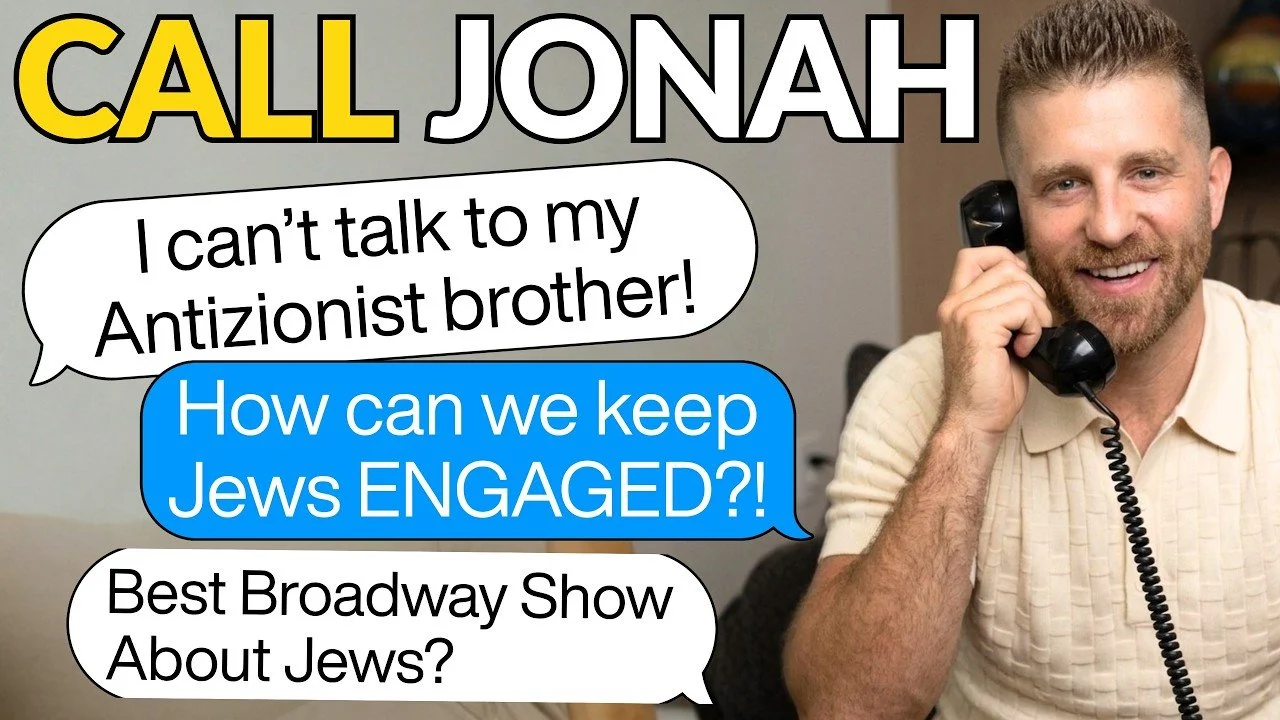
It's time for another installment of the Jonah Phona.
Our first caller is Dave from Madison, Wisconsin.
Let's hear what he's got to say.
>> Hi Jonah.
I'm actually working on a satirical Jewish drama right now.
through your podcasts have become these incredible research tools and they end up taking about twice as long to listen to each episode since I'm constantly stopping to make notes.
Thank you very much for your engaging content all the time.
>> You're welcome.
>> My question to you is about the browse ingra conversations which I found fascinating.
They introduced me to this concept of Cath Shamay and this argument for the sake of heaven and I'm wondering in your opinion, do you think that's actually still possible in American Jewish life right now?
Or has October 7th and everything that's come after it made the stakes really too high for that kind of holy argument?
Have we lost this ability to disagree and still stay in the room together?
Anyway, thanks so much for all that you do and I can't wait to hear this episode.
>> Thank you, Dave, for calling in and thanks for listening to the show so carefully.
I really appreciate that.
I think Dave, honestly, you answered your own question a little bit.
The fact that we had that episode with rabbis Browse and Ing speaks to the fact that yes, we certainly are still capable of having these kinds of arguments.
And not only are we capable, we are thirsty for them.
I I've got to say that episode in particular, I have never gotten more feedback on any episode of the show from the professional Jewish community than I got on that episode.
And and I think what that speaks to is that Jewish professionals are steeped in this stuff from sun up to sun down.
All of us as Jews in the community, we're thinking about things affecting Jews, but then we we check out here and there.
We've got our jobs.
We've got things that have nothing to do with the Jewish world.
But if you're a Jewish professional, it's all you're thinking about.
The fact that I heard from them so much positive feedback, thank you for this conversation.
This is the conversation we need to be having, I think, answers your question.
I think there is so much weighing so heavily on our hearts and minds right now and it's it's very healing to have them out in the open when you do it the way that rabbis Ing and Browse demonstrated it which is respectfully with the uh sense of good faith and safety that it's okay to disagree um as long as we agree that we're coming from a place of of love and respect as they both did.
They disagreed pretty strongly with one another.
I mean, very different points of view along the spectrum, but with respect for one another and and with an acknowledgement that this is a critical conversation that needs to be had.
And so I think it's really important that our Jewish leadership continues to model that for the rest of us and to keep having those kinds of conversations and and allowing us all to work out these very sticky, challenging conflicts we're facing as a community out in the open.
So I I would encourage anybody listening to to court those conversations whether that's a as a listener or as a participant at your dinner tables within your communities.
We can do hard things.
We can hold two truths at the same time.
As long as the environment feels safe to do so.
So as long as you're with a person or in a space that you trust where we're all ultimately on the same team, we can talk about anything.
All right.
Next up, we've got B from New York.
Let's hope it's Midler.
>> Hi, Jonah.
My name is B and I'm listening from New York.
I've been listening to the podcast since episode 1, and I'm just so grateful for everything you've done for the community.
Your podcast has made me feel a lot less alone since October 7th.
Some of my favorite episodes were when you talked about the connections between Jewish history and Broadway and theater, specifically with Steuart Whitesman and your dad.
So, my question is, in your opinion, which Broadway show or character or song best represents Jewish voices and Jewish values?
>> Not B.
Midler, but at least I was on topic.
Uh, thank you, B, for that wonderful message.
And, um, you know, speaking of words that rhyme with Midler, my answer has got to be Fiddler.
I mean, it's kind of obvious.
I I would think.
Um, but, you know, I don't want to be too tricky about this response.
I think Fiddler on the Roof is is a gorgeous show.
There's a reason it continues to be performed decade after decade after decade, and it's because it really does an amazing job of honoring Jewish values and customs and tradition.
[music] We see a dialogue with God in a way that's so real and questioning and challenging between Tevia and God throughout the show.
Um, we see the vital importance of our Jewish customs and traditions, the beauty of the wedding ceremony, the unfortunate legacy of pagms and and the challenges we face and the adversity we face from the outside.
We see the beautiful Shabbat moment.
That's one of my favorites, the the the way they have the Shabbat prayer and it's not just their family, but all the families in their homes in sort of that beautiful interconnected way.
And then ultimately that that you know that balancing act of the fiddler on the roof, the the struggle between modernity and tradition.
And ultimately, Tevia continues to choose his family over rigidity uh in a way that I think is beautiful.
And you know, we watch him in real time try to figure out that balance.
And to me, that's really so much of what adulthood is, Jewish or not, is finding the balance in your life.
And watching him try to figure out the balance between what he believes in and his religion and his custom and his tradition and his love for his children is just so human and very Jewish.
Um, and I it's it's going to be a hard one to top.
I think it's a gold standard for a reason.
All right, Batten Third coming to you between his junior and senior years of college.
It's Matthew.
Take it away, Matt.
>> Hi, Jonah.
I'm Matthew and I'm from Long Island, New York.
I am currently a rising senior in college.
As someone who's been a graduate college student, I've been thinking about an issue in the Jewish community that has been festering for years and we are only seeing the effects of it now after October 7th.
And this issue is never talked about in the Jewish nonprofit world.
This issue is one of which I'm very passionate about.
Um, and I think if this issue is resolved, it could lead to a lot of progress.
And the issue is that there's a lack of postcol Jewish programming.
What direction should we point them in?
How can we sustain, you know, someone going on Birthright and continuing that in America when they come back from their trip, continuing that Jewish community after college?
I'd like to know what your thoughts are and thank you very much.
I really appreciate all that you stand for.
Your monologues and the guests you bring on are always very interesting.
Thank you very much.
>> Thank you, Matthew.
Um, so you raised a couple of things and I want to answer by saying first of all I think that you know you said that this is an issue that's not spoken about that I would certainly disagree with.
In fact, this is a major issue that's been spoken about for a long time.
It is a an area of huge concern for the institutional Jewish world of how do we reach these 20somes and how do we keep them connected?
um my mind jumps to my first conversation here with Sarahwitz who talked about sort of that typical uh kind of American Jewish arc uh without even the hilll or the the birthright but just the bar mitzvah and then I'm I'm kind of out of here uh maybe I come back to it and I'm getting married or something.
Um so it's it's long been an issue and it's something that's discussed a lot.
I will also say part of the issue is just an issue of postcol adulthood.
You you have spent however many years, whether you go to grad school or you just come out of of undergrad, 20some years, in a structured school environment where your annual schedule, your weekly schedule, your daily schedule is determined for you and then you're kind of pushed off this cliff and it's like, okay, go now make your own life.
And the Jewish aspect of that comes along with that as it as sort of any aspect of adulthood comes with that.
you you need to seek out and create the life you want to live.
And it's a challenge because, as I said, it's not something you've really been asked to do before as a young person until you're out of school.
I remember feeling this very acutely after college.
The image I have in my mind is when Wy Coyote runs off the cliff and then he looks down and there's nothing under him anymore.
That's what it sort of felt like to me coming out of college.
Uh and it it's very it's a lot to wrap your arms around.
Um, and you really have to be proactive about it.
So, that's that's part number one.
I think it's really important to say there isn't going to be a built-in track for a person to just sort of walk out the door of college and straight into the next thing.
You have to make it for yourself.
You have to seek it out.
And the second piece of that is there are actually tons of programs for this demographic.
The issue is perhaps they're not being communicated enough or marketed enough or people aren't finding them enough, but they exist.
Uh, off the top of my head, I know there's Olami in in New York.
We had Rabbi Schmoel Lynn on this show who was my college rabbi who has sort of made it his life's work to appeal to this very group and create amazing programming for that postcol demographic for all the reasons you said, Matthew.
There's Olami.
You mentioned Birthright.
Birthright has tons of postbirthright programs for people to join um in all sort of levels and ways of engagement both at home and abroad.
Um your local federation is going to have all kinds of programming.
Uh here in LA, there's a number of sort of leadership cohorts.
Your synagogue, you know, I know my synagogue in LA has a program called ATID specifically for young professionals.
Um, basically, honestly, as I'm thinking about it, every Jewish organization I've been involved with along the way has programming very specifically catering to this demographic.
There's there's tribal gatherings for which is sort of like a adult summer camp for young Jews.
There's a ton of it out there.
So I would encourage folks in your position and and you know your peers to I don't know get on Claude and search what are the young Jewish programs near me.
There's a ton out there and I think the way that we can perhaps go about helping you and your peers more is again through the communication of these uh and doing a better job of meeting people where they are which really is social media.
I mean, if you're not advertising this stuff on Tik Tok and on on Instagram, uh, you know, if it's just going out in the synagogue bulletin, you're going to have a hard time finding it.
So, we have to do a better job of getting it to folks.
But there certainly is a lot to choose from.
And then the last thing I'll say is if there's something you're looking for and it isn't there, take it upon yourself to start something.
You know, if if what you're missing in your life is a Shabbat table community, host a Shabbat.
invite people to it and build that community.
Again, it's it it comes part and parcel with becoming a postcol adult is you have to start taking real responsibility for your own life and making of it what you want.
And I know it's a muscle that you haven't had to use quite as much yet.
Uh but that's it's really the only way.
And last, but certainly not least, her name was literally invented by Shakespeare.
Jessica, please take us home.
Hi, I wanted to get your view on a family member who is also Jewish, but we have very differing views on what it means to be Jewish and what it means to be a Zionist.
In today's day and age, I'm having a hard time navigating communicating with this family member because I support the state of Israel and they are veering towards the other side.
I feel like maybe you would have some insight and would love to hear your thoughts.
Thank you, Jessica.
Now, this is a topic I've discussed numerous times on this show, in my monologues, in conversations, on social media, and on my Substack, which you can subscribe to at stubstack.com/jonaplatt, by the way.
So, my first instinct when I received this uh Jessica was not to answer it again, but it's a question I get at basically every live event I do anywhere in the country.
So, I know so many of you are dealing with this and so I'm happy to get into it again.
So, the part I'm going to zero in on is, you know, my view on a family member who is Jewish, but it means something different to them and they have very different views on Israel.
And what I've said before and I'll say it again is to me specifically talking about a family member, the most important thing is to preserve that relationship with the family member.
That has to come first.
That is my number one view of it.
There should be no issue that separates family from one another.
Like like we spoke about earlier in this Jonafona session, we are capable of holding difficult conversations as long as we're coming from a place of love and respect.
So I I think it's very important to have the conversation walking around with that sort of unspoken tension, that inner dialogue of what is this person thinking?
What are they thinking about me?
Are they really hateful?
Do they think I'm a genocide heir?
Do I think they're a jihad supporter?
All of that stuff can get put to rest with a open, dispassionate, compassionate, candid conversation.
listeners, longtime listeners and viewers of the show will know about my five C's.
I would encourage you if you haven't checked out that monologue to go check it out.
I'm not going to repeat the whole thing here, but the the general thesis is carve out a good chunk of time, sit down with this loved one and seek to understand them.
Give them the opportunity to explain themselves.
Be curious.
Make it a very safe place for them to be vulnerable and honest and be really heard by you from a genuinely curious place.
And you can also do the same.
And the key thing again is to be centering the relationship and have your agenda be that the agenda is not tell me what you think so I can tell you why it's wrong and change your mind.
That doesn't work.
That doesn't go anywhere.
That makes people defensive.
And you can't change somebody's mind forcefully, certainly not in one conversation.
And if someone sniffs out that that's the agenda, the walls are going to go up.
If they feel the agenda is, I love you.
You're my family member.
I want us to come to a place of understanding on this.
Even if we don't agree now, even if we don't agree ever, I I'm telling you, just airing it out, it it removes that tension from the interactions, and it it opens a pathway to continued conversation.
And God willing, at least it opens a pathway for you not to even have to talk about it anymore if you don't want to because at least you know each other's heart.
You remind each other that, oh yeah, this is my family member and we're just on opposite sides of this thing, but we can still love each other.
We don't have to have our whole relationship be about this disagreement.
It can be about the 99.9% of other things we do agree on and are connected by and things we share as family members.
And we can just be together like that and understand that, okay, mammy, now we don't talk about this thing together anymore.
we we can respect that we're not going to come together and it doesn't need to define the relationship.
So I I I think you know it's very important to face that fear that fear of I can't have this conversation.
You can you can do it as long as it's calm and from love and from a place of as your family member I feel blank or when you do this as your family member it makes me feel blank.
uh not well actually Israel did this in 1948 or whatever.
Let that can come out but it has to be conversational and and more surface than the real depth which is we love each other and let's stay connected on that.
To everyone who wrote and called in, thank you so much.
If you'd like to hear your question answered by me on the air, head over to beingjweishpodcast.com.
Click contact.
You'll see a big orange button that says start recording.
It's as easy as that.
And perhaps you too will be enshrined in Jewish podcast glory for all eternity.