
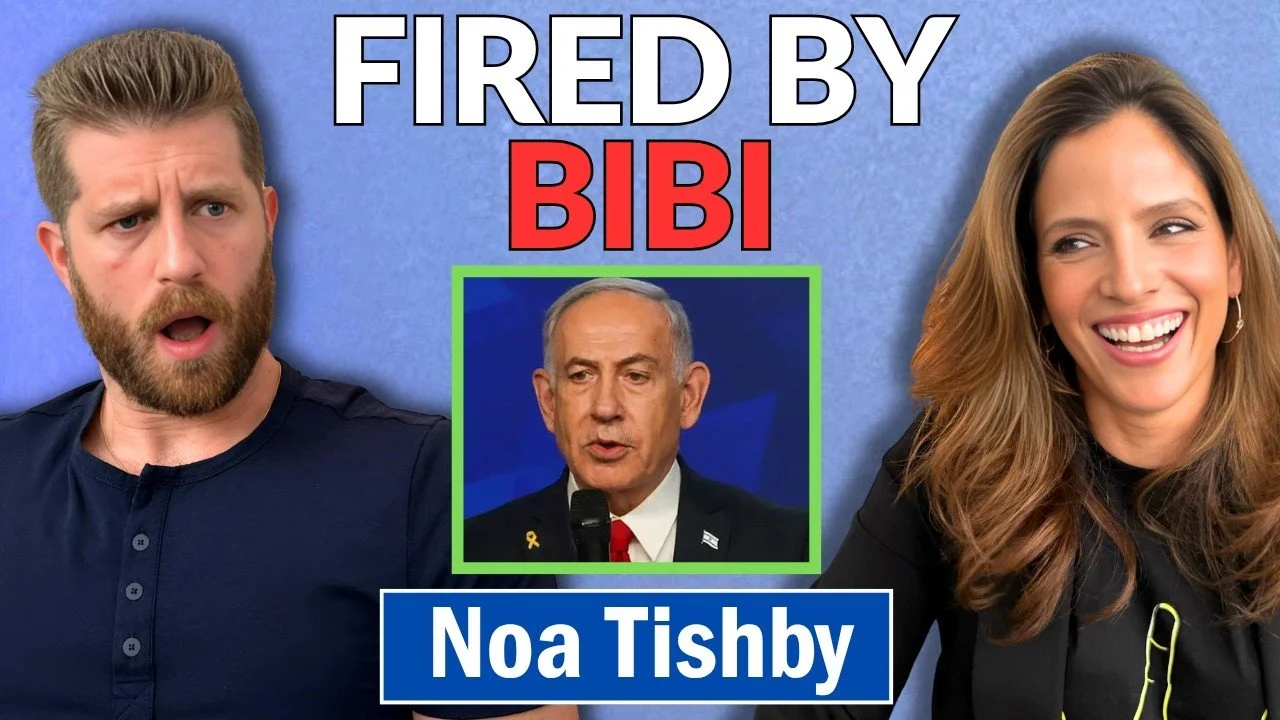
Interview Transcript
How Noa Tishby is Fighting the Global Antisemitism Crisis, Inspiring New Jewish Advocates
Watch and Listen
This is the Jewish advocacy crossover that people have been waiting for.
This is not going to be solved over a weekend of brainstorming in the Hamptons.
What's something that American Jews don't understand about Israelis?
The Hadids, all of them, literally, all of them have blocked me.
We're never gonna eradicate anti antisemitism, but I'm gonna sure give it one heck of a fight.
Welcome one and all to today's episode of Being Jewish, which has been generously sponsored by my friends Jacob Fenton and Phil Castle.
Jacob.
Phil and I were recently together in Poland at the March of the Living, which I spoke about on an earlier episode of the pod, and they would like me to dedicate today's episode to the memory of those who were robbed of their lives during the Showa, as well as to honor those who manage to survive.
Jacob Phil.
Thank you so much.
Alright.
Today's guest, what a powerhouse.
She's been an actress, a producer, an author, a speaker, and was also appointed as Israel's first special envoy for combating antisemitism and the Delegitimization of Israel, which is a tall order, just to say, let alone to do.
Though she's lived in the US for a quarter of a century, her family roots run deep through the very foundation of the modern state of Israel, offering her a unique perspective on global Jewry.
Alphabet.
She is a child of both worlds.
She's a mom, the biggest name in the Jewish advocacy world, and one of my wife's most unwavering girl crushes.
Weekly.
Shout out to Courtney.
Please give a hearty m Haba to Miss Noa Tishby.
Hi.
Hi Noa.
Thanks for being here.
Thank you so much for having me.
Finally, we've been trying to make this out for so long, the beginning since.
Beginning literally was I a first text?
You were definitely the in the early batch.
Great For sure.
Like, yes, I wanna come on.
But like, yes, let's try and find it.
And this is, this is the Jewish advocacy crossover that people have been waiting for.
So I wanna jump right into talking about that special Envoy gig.
What was the impetus behind that role?
What were the specific goals that you were meant to accomplish, and how did you attempt to accomplish those?
So first of all, the uh, role, I held a position for less than a year.
Really?
Because the government Oh, really?
Yeah.
The government changed and there were a couple of, of steps that were taken that, uh, that, that ended that position, which we can get into later.
So bottom line is this, this was the first time that Israel had a special envoy to combat antisemitism.
I was appointed by.
Foreign minister, a lapid under the Lapid Bennett government.
I've known him for over 20 years, and we've been friends for a very, very long time.
And he called me up and he said, let's meet.
And I said, we, we sat at a cafe and he goes, you know how every country has a special envo for combating antisemitism?
Every country, A lot of countries, the eu, I know, eu, Canada, US Canada, and now Australia.
There's, yeah, there's not every country, every country should have it, but a lot of major countries in the world.
Um, and I said, yeah.
And he goes, you know, Israel doesn't have one.
And I was like, huh.
Interesting.
Like it didn't even occur to me at the time, and I go, I would like you to be the first.
And I was like, yes, please.
Absolutely, yes.
Then I started laughing and he goes, why are you laughing?
And I said, well.
It just occurred to me, Mr.
Foreign Minister, that you are setting me up to fail, right?
Like you're literally giving me a position in which I'm never going to be successful at, ever.
And he started laughing as well.
And he goes, I expect you to end antisemitism within the next three months.
Right?
Please submit a report.
And, uh, we, you know, we started laughing about this.
So first of all, I was an, it was an honor to serve as Israel's special envoy.
Um, I'm saying this because I had a few people in America that advised me not to take that position.
Why?
I guess because I'm Israeli American.
Their position was, which I understand they had an opinion, um, was don't take that position because it's going to peg you as too much of an Israeli.
You are a very, uh, be highly appreciated author and spokesperson and, uh, activist and producer and whatever.
It's going to peg you as an Israeli.
My response to them was, do you understand that this is not a joke for me?
I was like, this is not about.
Perception.
It's not about my brand, quote unquote, right.
My family is there.
This is about life or death for the Jewish people and the existence and safety and security of the state of Israel.
Like if you think I shouldn't take this position because it's gonna hurt my brand, ya outta your mind.
Thank you so much for that advice.
I'm still gonna take that position.
Yeah, the position included.
Coordinating with the Israeli government and various other governments around the world.
We worked with the un, I testified in front of Congress, uh, and started building this infrastructure to combat, to bring into awareness what now is clear to everybody else.
Mm-hmm.
But wasn't, uh, so much at the time, the importance of bring this fight to the international stage.
And I think it's a very important position that is now held by Mical Koler.
She's a great woman.
Mm-hmm.
As well.
And, uh, there's no.
Ending antisemitism, right.
That is been around for thousands of years, not going away anytime soon.
A lot of people ask me, how am I not discouraged?
How am I positive in this fight?
How am I still strong in this fight and still optimistic and, and have this kind of like, let's go get 'em.
Mm-hmm.
Type of an attitude is because.
The way I see it is that fighting antisemitism is not a goal to achieve.
It's a context to live into.
So we just have to wake up every morning knowing that we're gonna make a little difference and keep going and keep going because we are a, a link in a chain.
Mm-hmm.
But it's never going to be.
Solved.
It's been around for thousands of years, so if you think that you can end it, let's go out and fight antisemitism.
In order to end antisemitism, you're gonna get burned out.
We're never gonna eradicate antisemitism.
But I'm gonna Sure.
Give it one heck of a fight.
Yeah.
I can tell you that.
Was it your agenda?
Like, here's what I think we should do, or was the government like, here's what we'd like you to do?
That government was highly collaborative and very, uh, attuned to the world at the time.
They appointed me because I already was in this, in this world and doing this, this work for a very long time.
So they were very attuned and listened to what I thought we need to do.
Were there deliverables?
Like, did you guys be like, all right.
In, in the next six months, we'd like to move this thing, but this thing, but again, it was, it was only 10 months because then the government fell right.
And the, uh, new government cabinet came in and they asked me if I wanted to stay in the position and I said, yes.
It took me a minute, I had to think about this.
Mm-hmm.
Because obviously the, the new government was, uh.
Not exactly to my kind of taste, specifically not enough representation of women and, and stuff like that.
You're more liberal generally for the group?
I'm more liberal generally.
Yeah.
Yeah, for sure.
I'm very hawkish on defense.
Sure.
Extremely hawkish on defense, so I'm, I'm like a normie.
Mm-hmm.
Yeah.
You know, I took a minute to think about it and I got back to them and I said, yes, absolutely.
I wanna stay in this position and serve this government because I believe that fighting antisemitism is more important than any political stance.
Absolutely.
Uh, now or ever.
Mm-hmm.
And, uh, then the judicial overhaul started happening, right?
And that was in January 23 that it started.
And I took a few months and I didn't say anything.
And then I had to state my opinion, uh, at the time, which was that.
Uh, going through with all the laws that were proposed, specifically one of them, uh, which is, uh, allowing the government to overturn a Supreme Court decision by a simple majority of 61 would weaken Israel's.
Democracy and I had to speak up, uh, against it.
In what forum did you speak up?
The first thing I did was write a, an op-ed in Hebrew.
I am a strong believer in you, uh, wash the dirty laundry, uh, in the home, right?
And you.
It in Hebrew and you say it to Israelis or to the government or to whatever.
So when I have criticism of the Israeli government, I usually pick up the phone and call somebody and tell them what I think, uh, needs to be done rather than do it publicly.
So I wrote an op-ed in wnet, uh, stating very clearly where I stand publicly, and, uh, I got a signal that it wasn't, uh, encouraged.
How, how quick was the vitro farmer?
They're very quick.
They're like, uh, and I was like, and I understand, but.
You know, did you think that was like gonna be on the table?
Like, once you put this out, you're like, totally.
But that's okay.
It was, it was necessary at the time.
Did you give any tips to Michal when she took over the gig?
No, she's great.
She has, yeah, she's great.
Michal is gonna be involved with a new being Jewish project that we're gonna announce shortly, so stay tuned for that.
So you, you've been doing this advocacy work, as you said, for, for decades.
What have you identified now, like Noa in 2025, as the areas of focus for you for your advocacy?
Like, what lane are you?
Choosing to be in and, and how are you addressing the things you think need addressing?
I've been doing this for such a long time.
Yeah.
Mostly under the radar, mostly kind of preparing for the past few years, but it's been a very long time.
And I'll tell you the biggest difference that I've noticed from when I started to now, yeah.
People are now aware.
That's good.
Whereas they weren't before.
Mm-hmm.
So the problems actually haven't changed.
We've identified the same problems that were occurring that we're, we're seeing now.
15 years ago, right?
We've been talking about, I say we because it's not just me, but there was a small group of US activists and organization, a very small group that saw this iceberg that's about to hit the Jewish community in Israel and try to warn the larger.
Kind of Jewish community and Israel, when you say this iceberg, what, which part are you talking about?
And Zionism being the new form of antisemitism, if I can just put one.
Right.
You know, just one of the issues that we're, that we're seeing because as an Israeli right.
I knew the dangers and know the dangers of radical Islam, the dangers of Sharia law.
Sure.
Of Jihadism.
I understand what that culture, in its extreme form, uh, is capable of doing to the world, to the Jews, to the world, to Israel in order for the 12th Imam.
To show up in the Muslim world, which is a, a Shia, uh, you know, it's a, it's a Maha, it's called in, in Shia Islam, which is Iran, essentially.
Okay?
Israel need to be eradicated.
That's what needs to happen, right?
So there's no beating around the bush of what they've been trying to do for the past.
46 years, right?
They have been arming militaries around Israel.
They have been threatening Israel.
They've been talking about this very clearly.
They need this for not just expansionist political reasons, but for religious reasons.
And when you have, you are fighting against a military that is, that is religious, in essence, that is jihadi.
There's no rationalizing with that.
Agenda.
So being an Israeli, even a liberal Israeli, I knew that this was coming.
So we knew that.
And then I saw what was happening in America in terms of this, like twisting Israel to, to turn Israel to the big bad wolf of the world.
Mm-hmm.
And manipulating and gaslighting and using language against us and using intersectionality and all that.
You know, all that's kinda like using colonialism against us and using apartheid against us.
And I, I saw this and.
The collision came on October 7th.
Mm-hmm.
And then we were joined by the wonderful, beautiful October 8th Jews right around the world that were like, oh, okay, now we got it.
Mm-hmm.
At least now we're.
Fighting the real fight.
Yeah.
At least now everybody's having the same conversation, whereas before, I used to have conversations with people and be like, do you understand what's happening on college campuses?
Actually dangerous for Israel?
And people both here and in Israel were completely brushing it off.
Mm.
I would go on TV in Israel and.
In Hebrew say, do you understand that they're talking about occupation 48, not occupation, 67.
They're completely delegitimizing Israel's right to exist as a Jewish state from the beginning.
Mm-hmm.
Like, it's not, and these are not conversations that are being had in radical Islamic, like Right.
Countries in the region.
These are conversations that are being had held on Harvard campus.
Right.
And people are like, no, it's fine.
They're, it's, you know, they'll get outta college, they'll get out of it.
Grab everybody's a radical on college campus.
And I'm like.
This is organized.
Yeah.
A lot of people throughout the years would come up to me and have a variation of the following line.
All right.
Israel needs a PR team.
Yeah.
We just need to get a crisis management PR team and find a solution and find a thing and get a PR team and get this done with.
And I, every time I'd be like, uh huh.
Okay.
And I just kept telling people like, this is going to take a long time.
This is not going to be solved over a weekend of brainstorming in the Hamptons.
Like Right.
It's just not happening.
Like this took a very long time of a lot of groundwork and a lot of money and a lot of thinking, and we need to be patient in this, in this.
Fight to turn this ship around.
Mm-hmm.
This is not gonna be a quick fix.
So how are you trying to reach the, the, the rest of the non-Jewish community with this messaging?
My organization 18, what we do, our mission statement is very simple.
All right?
It's fight antisemitism, defend Israel.
Inspire Jewish pride and inspire.
Jewish pride to me is one of the most important things that I've been doing in the past few years.
Like I'm not bothered by trying to convince those that you, we can't convince.
And I have a lot of people that would come up to me and be like, oh, you gotta sit down with Ilhan Omar, and why don't you reach out to Bel?
I'm like, why would I reach out to Bel?
Yeah.
She's blocked me on Instagram like years ago.
I'm blocked by the entire Haddi family.
I feel like it's a badge of Forger.
Yeah.
You really made it.
I really made it When the Hadids, all of them, literally all of them are blocked.
Me.
I wonder if that was in the family chat.
Like, we gotta block this chick.
I know.
Alright, I gotta block this woman, this bitch, this Zionist bitch.
So there are the, the ones that you cannot turn, the ones that are completely brainwashed, the ones that are co, like there's no talking to them.
Why waste your time not interested at all?
I'm talking to the moderates.
I'm talking to the ones that are sitting there going like, all right, well I don't love bibe.
But also I don't think that Israel should be eradicate.
It's not the worst.
Thing in the world.
Yeah.
Those are the ones that I'm talking to.
And those are the ones that you have to talk to very slowly in various ways.
So whether it's college campus tours that we do, or whether it's social media, whether it's uh, media or cultural events or whatever, it's a yes and approach.
And I think it's true for, for me, it's true for, for you, for what you do.
Mm-hmm.
So we just need to, we just need to keep going.
This is not going.
To be fast.
We got generations here.
Yes.
Where have you seen like a real positive feedback from your work?
Like, oh, that worked.
I made an impact there.
First of all, I see it every day.
I get it every day, whether it's walking down the street or on my social media or through whatever, like we get it every single day and knowing that our.
Work makes a difference.
Uh, but I'll give you a couple of examples.
So one of them is I went to speak in Atlanta, a couple of, you know, maybe a year ago or something a couple of years ago.
Great Jewish community in Atlanta.
Yeah.
Great.
So I go to Atlanta and this girl comes up to me and she said, I want to tell you a story.
She's like, I am.
She was a student at Emory and she, uh, got into college and she decided to create, um, an interfaith reading club.
Because she wanted to reach out to other faiths.
Great.
And you know, that's what I always say to people.
Sweet.
I'm like, change's gonna come IRL not on social media.
Mm-hmm.
You're not gonna change a single person's mind while fighting with 'em on the comment section.
You're just gonna get an anxiety attack and it's probably a troll.
Yeah.
Or a bot from Iran.
So she started an interfaith reading book, reading club, and she gave my first book as.
The first mm-hmm.
Book to read.
Mm-hmm.
And she said, she told me, she said, this girl came up to me after two weeks and she said, oh my God, I read this book.
I did my research.
I went online, I did my research.
She's like, it completely changed my mind.
I was totally lied to.
And that girl I.
Was the head of SJP in Emory.
Whoa.
And she, she's out.
Wow.
She's like, that's it, I'm out.
I was lied to.
I, you know.
That's amazing.
That was, I'm getting goosebumps every time I tell this story and I hope this girl is watching me.
'cause she came up to me like maybe a year later, she's like, remember that?
I heard you talk about this.
I was literally like, that's why I do what I do.
I love speaking at high schools and colleges.
Yeah.
It's like my favorite.
My favorite thing to do.
Um, how come, why do you love it so much?
Because it's the younger generation and they're what matters.
Like we're great, like, but we're not what's important.
They're the ones that are important and they're why we do this, this work, and.
Strengthening them.
Like when I, when I have a girl comes up to me, this awesome girl that I met in Texas, Sadie, and she's running to be, she's in, she's, she's, she wants to be Miss Texas.
Actually, you can still vote for her.
Go to my social, I can vote for her.
Amazing.
And she, she wants to be the first Jewish, miss Texas and the second Jewish Miss.
America, let's go.
She's gorgeous and awesome and so sweet.
And she was like, and I'm wearing the star of David and I'm so inspired and you're so this blah, blah, blah.
And I like to, to me again, that, that's why that's worth everything.
That's amazing.
That's worth all the death threats in the world.
There you go.
So let's talk a little bit about your book.
Yeah.
I Which one?
I, uh, Israel we're, start with Israel.
Okay.
So Israel, A Simple Guide to the Most Misunderstood Country on Earth.
Mm.
I have talked about it several times on this show.
It's part of my, like being Jewish book set.
Like if you're gonna start, that's gotta be one of them.
Yes.
That's the in intention, super di digestible, balanced, uh, really terrific stuff.
What, if anything, would you say, like, people responded to the most in there?
Like, what's the thing you hear about back the most?
Like, I had no idea about this thing.
Ah, I think one of the things that people are surprised by is that the fact that the Jews will return to Israel.
Uh, and that it's, their land is mentioned in the Quran.
Mm.
So a lot of people are like, I didn't know.
I had no idea.
That is something I think that a lot of people comment about the appendix at the end, what's on the appendix at the end.
It's, it's just the entire story of Israel in bullet points.
Mm.
And I was like, let me make it really easy for you.
Boom, boom, boom, boom, boom, boom.
Just in case anybody asks boom, boom.
And people are like, this is really useful to me.
Yeah.
People love my grandmother.
Which one And love Soft defin.
Yeah, and funny, it's like stuff defin and it's like, so I can't even believe that I've created this world in which.
People know my grandmother from the kibbutz and they come up to me and they're like, oh my God.
She looks, she sounds like such an amazing woman.
And she is.
And she was.
And to be able to keep her memory alive like that and tell the story of my family like that, and a way that hopefully Ari will read, my son will read one day and you know, beep.
Proud of.
And that's special.
Yeah, it's very special.
All right.
So tell us, uh, I didn't wanna get into all of your family in the book 'cause we could do an entire 90 minute interview just about your amazing roots Yeah.
With your family and the creation of, of Israel.
But let's talk a little bit about Softa.
Who, who helped form the first kibbutz in Israel?
Yeah.
Here's the thing that people don't understand.
In the turn of the century, there was a group of radical socialist.
Young like, like teens and early twenties.
Group of psychos, essentially like real deal socialists.
Real, not like today, fake socialists.
They were communists.
The reason my grandmother moved to Israel because she wanted to be a communist and she couldn't be a communist in Russia because you know Jewish.
So she was like, oh, where can I be a communist and work the land and also be Jewish?
In the land of Israel, and that's why they came there.
They came before World War ii.
They came because of antisemitism in Europe and they built a country, imagine it was like 19 whatever, when they started showing up there and they're wearing dresses and their hair up.
In Europe and these girls are taking off their dresses, putting khaki Schwartz, and like it's starting to work the, the, the land and demanding equal rights, which were nowhere else to be found and helping build the country.
My grandmother.
Built roads and planted tomatoes.
Like she, she actually, they actually did that.
Mm-hmm.
And they all lived in kibbutzim.
Not all of them.
Some of them lives in cities and various other places.
My other side of the family, my dad's side of the family was in Jerusalem since 1922.
My.
Mom's side of the family lived in a, basically a commune.
A socialist, right?
A socialist commune.
Like it wasn't today.
Like the progressives that are pretending to be No, it's like, but they asked for their kombucha.
Right.
You know, those are the real deal.
Sharing everything.
A kibbutz is, you live, it's a village essentially.
Right?
But it's all communal.
You don't own anything, so everybody gets paid the same.
So decide you get paid 10.
Shekel a day, whatever.
I'm just making this up.
Yeah, yeah.
But everybody does.
Doesn't matter if you run the thing, if you milk a cow, right?
Right.
Everybody gets paid the same way the kids are raised in a kid's room together, all the, you basically give them to a communal nanny.
You see them once a night in the evening for like an hour and a half.
And then they go back to sleep there, whatever.
I have a lot of issues with that.
Yeah.
That, that part's, uh, questionable.
No, that part didn't, didn't survive, didn't age well, but at the time it worked for, they were pioneering trying it up.
You pioneer.
They were real pioneers.
Yeah.
And the women were a pivotal part of building that country.
My grandmother, when I, when I was doing research for, for my book, I read my grandmother's diaries.
Oh.
And I was blown away.
First of all, we think we invented polyamory.
No.
When I said they shared everything, I mean, I meant they shared everything.
They shared everything.
Yeah.
They were, I, you got all the details in the diary there.
Was there when she suddenly kind of throws there that her and her husband, whom they've been together their entire life.
Right.
We just decided to stop with the affairs.
And she didn't say, he stopped like we, so I called my mom and I'm like, what on earth was that?
And she's like, oh, yeah.
That's just how it was at the time.
Like they were just, it was actual free love, free spirit, real socialism, real communism, real sharing.
Mm-hmm.
Of everything right?
As you see.
Say stuff like that.
I'm reading in her diary.
The other thing that she suddenly again, she kinda like throws it out there and I'm just like paused and I'm just blown away.
She was talking about, she called it the the ladies' farm, which was like a group of girls.
This is 1936.
A group of girls come together with a, a, a guide named Zab for some reason I remember that name.
And one cow.
And they give them a tent and they're sending him out to like farm somewhere in the middle of nowhere.
And she's describing how they were farming the land during the day and like singing and dancing during the night and what they were eating.
And one night there was rain and all their tents were blown away, but they were laughing and, and I'm like.
Oh my God, this is insanity.
So it's a very inspirational thing to, to read.
Having, having known her.
Mm-hmm.
You know, and really understand how incredible that generation was and how powerful that generation was and what it is that they did, which is create a country again after 2000 years, it was.
Such a radical idea.
Yeah.
And to, to have it be successful is something that we should never forget because we grew up to, to Israel being a given.
Right.
But in 1936, if you were to say a Jewish state is going to be recreated in the land of Israel, people would've thought you're outta your mind.
Yeah.
And they were something else.
You're.
Not really shy to sort of, to talk about in the book is Judea and Samaria and, and your view of what's going on there.
Can you articulate for us what you feel is happening there and what should be happening there?
I can't articulate that because it's, it's TBD.
There is what we would love to see happen.
Right.
And then there is what can happen.
Right?
The bottom line is this, Israel needs to be Jewish, democratic, and strong.
That's it.
And the reason that.
Judean Samaria or the West Bank, or however you wanna call it, the reason that that region, that ancient Jewish region is not Palestine.
Right.
Which is essentially was supposed to be Palestine.
Mm-hmm.
Shouldn't be, uh, a question to be asked of Israel.
It should be a question that should be asked of Palestinian people.
There's been a constant, um, refusal.
For the Palestinian people to actually create their own state.
Right now, what they're committed to is the destruction of the state of Israel, and that is just unacceptable.
So I can't tell you what needs to be done with Judea and Samaria, TBD, because you are positioned sort of.
You know, born and raised in Israel, so deeply entrenched there and have now been in America for so long.
You, you can sort of speak to all these different cultures and I love America.
Can we talk about that?
Love it.
I'm so patriotic.
I'm like, I feel like, I mean, most people who move here are Yes, because we understand how.
Lucky we are to be here.
Mm-hmm.
So lucky to be here.
So when I see these like radical demonstrations against America and when I see all these people that are calling Israel and Apartheid state and then America is an apartheid state, and you're like, shut up.
Yeah.
Just zip it.
You're, uh, anyway, what surprised you the most about Jewish life?
Outside of Israel when you got here.
So many things.
It's super different.
It's so different.
I don't think people really understand how different being an Israeli Jew and being, oh my God, it's so a diaspora.
You are.
Oh, so different.
Yeah.
First of all, just for background, for people who don't know my background mm-hmm.
I was raised very secular, so very Zionist like super Zionist, but also like.
Super secular.
My dad is a complete atheist.
My mom is agnostic.
Whatever we, I've never been to a synagogue before moving to America.
Did you do any holidays, traditions?
We did the holidays because again, that's an identity thing, first of all.
As all of us know, and you know, you can be an atheist and still be Jewish.
100%.
This.
Right.
You were saying, you're saying this, but this is a funny conversation that I had with Emmanuel Acho when we wrote my second book, right?
When we wrote the thing together, which we'll also discuss.
Yeah.
So Emmanuel, he's incredible.
We wrote this book together called Uncomfortable Conversations with a Jew, and we had all these uncomfortable conversations, and when I said, you can be an atheist and be Jewish, he goes, whoa, whoa, whoa, whoa.
Wait a minute.
What?
So this is something that's very confusing for mm-hmm.
Christians in America and for some American Jews.
So first of all.
Being secular in Israel.
Meaning again, my family, we grew up with like no religion.
We never did like Shabbat dinner in terms of like candles and stuff like that.
Nothing.
But we did celebrate the holidays, like Passover and Rush.
You do the, the big and you do like the cheese and OT and you celebrate in school and you know, whatever.
So you celebr celebrate.
Like in America, if you would say you were secular, you wouldn't even know what Shavuot was, let alone eat cheese on it.
Right.
You know, I think that's changing though.
I think that's changing.
Okay.
I think that's changing because a lot of people in America are starting to understand that you can still celebrate all of this as an identity and a cultural thing.
Mm-hmm.
Rather than like a belief system.
Right.
Because the thing about Judaism, as we know, is that it's not about what you believe in.
You don't need to believe anything.
It's about actions.
Right.
What kind of a life are you living?
Mm-hmm.
Who are you?
What, what do you do?
Your community, what's your accountability system and the traditions and cultures that we have in this crazy group of people that, that we are.
So, I grew up very, very secular, and I was not connected to my Jewish identity that much.
Like if you'd asked me who I was as a young adult, I would have told you, I'm a woman, I'm an actress, I'm a producer, I'm a writer.
I'm a this, I'm a that.
I'm, I would've said a million things.
I'm an Israeli, I would've said that.
Mm-hmm.
But Jewish was like me.
Sure.
Right, right.
But then I moved here and a lot of things changed for me.
I was here maybe, I dunno, three, four or five months or something like that.
And I am at my boyfriend's house who's like non-Jewish and whatever, and, and I.
The phone rings and my family's on the line and they're all like, happy holidays.
And I'm like, great, happy holiday.
I'm like, what?
What holiday is it?
And they go, it's Rashana.
And I just, I was just like.
I stopped, like my heart dropped.
Mm.
Because the thing is, it's not that I forgot that it was Hanana.
I completely didn't even know that it's coming.
And I'm like sitting there, I hang up the phone, I'm sitting at my boyfriend's house, he's Australian Church of England, whatever, and I'm looking at the, I'm like in the Hollywood Hills, and I come up to him and I'm like, oh.
So, you know, it's a, it's a Jewish holiday today.
And he is like, great.
And I'm like, can we do something tonight?
He's like, great.
What do you wanna do?
I'm like, can we, can we do a dinner or something?
He's like, sure.
Katu, we're at Katsuya on Ventura, which is a sushi place in la, right.
They got honey at Katsuya me.
So Honey, it's me and my Church of England boyfriend, Australian boyfriend, and my Church of England, Australian girlfriend.
And the three of us are sitting at Katsuya and they go, okay, there's very positive.
Yeah.
Like they're lovely, right?
They're trying to help, right?
And they're like, great, what are we celebrating?
And I'm like, the Jewish news.
And they're like, great, what does that mean?
And I go.
I don't, I don't know.
I had.
And they're like, okay, great.
Well happy Rahan.
Right?
I'm like, great.
And I'm like, Downing saki.
And I was devastated.
Mm.
And I, at that moment, I'm like, I'm never gonna let this happen again.
Because that sent me on a really interesting quest.
Sure.
Which is like, if I am Israeli and Jewish, but I'm not living in Israel, what does that mean to be Jewish?
Yep.
That was, I think, the catalyst that sent me into the journey that I'm.
That I'm on today.
What I've observed is in is in Israel people, I mean they take the Jewish part for granted.
Completely granted.
'cause it's all completely, you're immersed in it completely.
You never have to think about it.
Yes.
And then I run, run into this know's Rashna because everyone tells you it's R Hashanah.
Yes, exactly.
And then I run in this rabbi, um, and he goes, oh, I read your book.
I'm like, great.
He's like, I loved it.
I go, thank you so much.
He's like, that Rosh Hashanah story.
I go, yeah, yeah.
And he goes.
What God invented America.
I'm like, why?
He said, so Israelis will remember that they're Jewish.
I'm like, yes.
Yeah, exactly.
Once you're here to, when you're in the minority, you have to be super intentional or you got nothing.
Yeah, exactly.
You gotta make it for yourself, and once you're intentional, you find out that it's the most extraordinary thing in the world.
Yeah.
And then I tell people, I'm like, why do you like Shabbat candles?
Why not?
We've been doing this for thousands of years.
It's not gonna end with me.
Okay.
Yeah.
If that's the least of the answers.
Just do it because of that.
Yeah, just that.
Love that.
Don't even worry about anything else.
So we've talked about just now, like sort of something Israelis might not understand about American Jews in the way that they have to be intentional, but I want to, what's the reverse?
What's something that American Jews don't understand about Israelis?
Hmm.
There is an essence in Israel that you guys dunno what we're dealing with and f off.
Right?
Like, we're the ones that have to deal with the worrying and the fighting and the this, and Hamas and Hezbollah, Iran.
And like, don't, like we don't right now with the grownups are talking Yes.
Like we're, we're actually dealing with what we need to deal with and like f you with your opinions about us and whatever.
And that, that kind of, that.
Vibe is something that I think Americans don't understand.
They also think that whatever it is that they say about like bibb matters or about, like Israeli politics matters.
Nobody cares in Israel.
There are certain American institutions that must be able to pull some levers in Israel and, but levers are different than, than saying publicly what you think or what you feel.
Or like some celebrities saying like, what I think is blah, blah, blah.
It doesn't, it doesn't matter.
No, they're not listening.
They kinda like rolled their eyes and be like, you try being a bump shelter and then we'll talk.
Right, right.
So we've talked about Israelis, we've talked about American Jews.
What about Israeli Americans?
That's its own sort of unique, I.
Community too.
In la we have the biggest Israeli community outside of Israel.
Yeah.
Mm-hmm.
Which you're a part.
Yeah.
How would you categorize that community?
I think the one thing that you can say about Israelis living anywhere else in the world mm-hmm.
Is that you can take 'em out of Israel, but you can never take Israel out of them.
That's for sure.
Whether it's with the accent sometimes, or with the obsession from Bomba or with the news, like we're all.
Completely obsessed with the news, and that is true for every Israeli living everywhere.
When you have children, the concept of living in a big country and the thought of not seeing them every single week when you grow up is a terrible thought.
When I moved here and my friends were like, oh yeah, we're seeing our parents once a year on like Thanksgiving or whatever, Hanukah.
I was like, what?
Like when you live in Israel, if you don't go home for Shabbat every Friday, you're.
I like that.
I love that we're already planting the seed.
And my son, I'm like, U UCLA is like a great school course.
Of course.
You know what I said?
I said, Dari, I'm like, oh, when you go to college, I'm obviously gonna move to whatever city.
And I'm like, I'll just be cooking for your friends and just hang out.
You guys will do your thing.
Just come sleep over goes, obviously.
And I'm like, yes, in the nineties before you come here, you come to America.
Hot off being a household name in Israel.
Uh, you, you start on Ramat Aviv Gimel, which is sort of like, I don't know, Melrose Place.
Melrose, yeah.
For Tel Aviv.
Yeah.
Yeah.
That's a big deal to be that huge, I mean, on a huge show, a huge star of that show and go, yeah, I'm gonna leave and go to this other country where no one's ever of me.
Hundred percent.
What's that decision?
It's completely insane.
It's a psychotic decision.
I don't know how I did that at the time.
Do you regret it?
Well, you don't regret because you love being, oh my God.
Not only am I not.
Oh my God.
Okay, so first of all, looking back at it now and seeing like an early twenties girl who really had everything, like I was on the highest rated primetime drama.
I had the number one album in the country.
I was on, uh, doing the national, um, theater production, ab Bima, national Theater Production of West Side Story playing Anita, and you're like, thanks, I'm gonna leave.
Yes.
What, what is that about?
Yeah, it's, it's crazy.
And to think about it today.
For many years there because then I moved to America and then I had like incredible successes, but also a series of epic failures.
Like one after the other, after the other.
It's brutal here.
Brutal.
And I didn't know why I wanted to stay here.
Like I had no reason to stay here.
I.
There were moments in time, in my time in LA before finding my actual voice and what I actually needed to do in life, which is what I do now.
Mm-hmm.
People around me, like my family and my friends are like, go back.
You have all these offers there.
Like go back.
And I'm like, no, I need to stay here.
I need to be here.
And I.
I, I don't, I didn't know why.
You just felt it.
Something inside felt, this is right.
I felt needed to be here.
I always wanted to be in America.
Even before I came here for the first time, I knew that I'm gonna be here.
I knew that this is where I need to say what I need to say and do what I need to do.
The interesting part was that I thought I needed to become famous in order to be heard, right.
And start talking about what mattered to me.
Mm-hmm.
And then it ended up being the other way around.
I needed to do, relate to that journey very much to start speaking.
And people listen and that.
Then it just became very clear when my first book was coming out, when I started writing my first book in 2019, when I got the first book deal with Simon and Schuster, I had an aha moment in which I'm sitting there and I go, oh, this is what I've.
Trained for.
Mm-hmm.
This is what's gonna be from now on, and I knew it, and back in 2019 I kind of understood that it's all coming, like the vector, like it's, it's falling into its track and yeah, it made, it made sense.
In between you leaving your mega stardom and becoming and writing a book, you have a lot of success as a producer.
Yeah.
Especially with, uh, be Tepo the, which is the Hebrew version of what became.
In treatment.
Mm-hmm.
You sort of opened up that Israel to America pipeline.
Now there've been many shows.
Yeah.
So, and that was, you know, a hugely successful show.
Many seasons, many awards.
Yeah.
Yeah, yeah, yeah.
We're nominated for 14 Emmys and Golden Globes, and were a Peabody Award, and it created a market where a market didn't exist, which is the market of Israeli television formats in the us mm-hmm.
Which all these other formats came after, so it never happened before.
So part of the entertainment industry to me, was always, it was always about telling stories.
So I.
Have always been an actor and a producer and a writer, and behind the scenes and in front of the camera and behind the camera.
And, but then moving to America and people were like, I was like, I wanna produce.
And they're like, you're so adorable.
Shut up.
Basically sit down and be pretty and shut up.
Uh, and just wait for your number to come up as an actress, right?
And then maybe, maybe, maybe we'll let you produce.
And I'm like, I don't think so.
Uh, yeah.
So I kept looking for content to produce.
I kept kind of saying, all right, while I'm.
Taking acting classes and auditioning and suffering through this.
I wanna tell other stories.
I wanna find something to tell, like a story to tell.
And I heard about in treatment and the first time I heard about it, I was just like, oh my God, this is the most brilliant idea in the world.
How did I think about it?
So it's in treatment is basically two people sitting or right in front of you, like just like this?
Mm-hmm.
It's a therapist and a patient and they're having a conversation and I'm like.
I went to therapy.
Why didn't I not think about this?
This is brilliant.
I go to Israel and everybody's talking about the show.
Everybody's like, oh my God.
The first season just ended in Israel.
And I'm sitting with my manager, I'm going to a meeting, and she also turns to me, she's like, oh my God, did you see be put?
It's like, brilliant.
And I had again, an aha moment.
I was like, oh my God.
That's the show, that's the format.
And I just came off shooting a television show for NBC called Coupling, which was a British adaptation.
Mm-hmm.
To an American, I remember that show.
Mm-hmm.
Right.
So I'm like, this is a format I can take in treatment and adapt it just like they did with other shows.
Like they've never done this in Israel.
We can take the show and adopt it.
And I turned to her and I was like, do you know the creator?
And she said.
Yeah.
And I go, do you have his number?
And she goes, yeah.
I'm like, call him right now.
Call now.
Remember I haven't watched an episode.
Wow.
I haven't watched a frame, but I'm like the combination of the brilliant concept with how everybody is saying it's the greatest thing since sliced bread.
It's brilliant.
So I'm like, call him and she calls and she's like, hi.
And I go and I'm like.
He's like, she's like, no teacher wants to talk to you.
So I take the phone and I go, what are you doing tomorrow?
And he goes, uh, I'm like, we need to meet and it's not about what you think it is.
And I go, okay.
'cause I'm thinking he might think that I want to roll, act in some be apart.
I'm like, no, it's not what you think it is.
It's not that.
And he goes, okay.
And I turned to my manager, I'm like, can you get me the show?
I need to watch the show.
Like I need to watch it.
So I watched the show that night and I'm like, obviously it's brilliant and it's amazing.
And I show up for coffee that morning and I go, what's happening with your show?
I'm like, oh, well we're doing the second season.
I'm like, no, I'm gonna sell your show to HBO.
And he looks at me as if I'm outta my mind because at the time there were no television formats from Israel that were sold in the US at all.
There wasn't even a clause in the contract of the television show in Israel that was addressing international format sales rights.
Right.
But I just knew that this is the first show from Israel that can be adapted.
To an American format.
Needs to be adapted.
Has to be adapted and will be adapted.
And I did it.
I did it.
Started making phone calls, got Steven Levinson and Mark Wahlberg on board as co-producers, and we went ahead and sold it to HBO and, and.
Basically made history with that show.
And since then, obviously like Israel, Israel is one of the countries that sells the most amount of television formats to the us.
Like euphoria is an Israeli format that people don't actually know.
I mean, obviously Homeland, like there's so many shows.
And do you feel like that's still the case in 2025 today, or it's like, it depends.
I think that, um, first of all.
A good story is a good story, is a good story.
And this is just a moment in time.
And remember, people don't, euphoria is not sold to the public as an Israeli show, right?
Of course.
I'm sure most people have no idea.
No idea as they shouldn't.
It's fine.
It's just doesn't matter.
So in terms of the, uh, executives in networks, absolutely it'll still be the same.
There's gonna be a lot of work that will need to be done with Hollywood in terms of telling the story of Israel and telling the story of the Jewish people once the war ends.
Say more about that in terms of where.
The state of Israel is, and the Jewish people are at the moment, is we are in triage.
We are in the emergency room.
Mm-hmm.
Meaning there is a war with Iran that's happening.
Mm-hmm.
There's a war in Gaza that's happening.
There are 53 hostages that are still held in captivity and need to come back home.
There's still threats within Israel and there's still antisemitism in America, and there are threats here at home.
We're very much in triage.
Yeah.
Once everything kind of calms down, there's going to be room to retell the story of what it means to be Jewish in America and the story of Israel, because the Jewish community I.
To a certain extent, even though we did create Hollywood, like invented Hollywood, there's an amazing book called An Empire of Their Own, which I recommend everybody reads, which tells the story of how the Jews invented Hollywood.
So the Jewish community escaping persecution in Eastern Europe came here also because they weren't accepted in the East Coast and over here, basically orange groves and nothing.
Right, right.
And we're like, all right, there's this ilian kind of concept of.
Taking a bunch of people, like invented the concept of taking a bunch of people in a room, putting chairs, and then using this like motion picture machine to screen movies, like mm-hmm.
That's something we've actually spoken about on the show is how Jews invented Hollywood.
And then, you know, as the years have gone on, we've sort of.
Kept ourselves out and whitewashed out of it a little bit.
We, we did this, so the Jews invented Hollywood and started to create the story of America.
Literally created an Americana.
Yeah.
Literally created the American dream, the American, like the, the movie star, and we left ourselves away from the table.
Mm-hmm.
We have not been telling our own stories.
Enough, and this needs to change.
Amen.
So once the war ends, I am urging every single one of the members of the Jewish Hollywood community to actually take a hard look and be like, all right, what's a cool Jewish slash Israeli story that I can tell?
I think it's gonna be crucial part of recovery and recreating and reimagining what it uh, means, what it means to be Jewish.
Don't you think that the people who would be telling those stories are already trying to tell those stories and the ones who aren't are never going to listen?
I, again, because I've been doing this work for a very long time, I've seen a lot of, uh, Hollywood actors shun Israel and being Jewish, uh, for many, many, many years.
And actually after October 7th, many of them.
Took ownership.
And I think it's a beautiful thing.
So we might not see everybody that we wanna see being vocal, but the ones that are vocal are incredible.
You know, we kind of get used to the fact that like Michael Rappaport and Debra Messing and, and Selma, Blair and this and that, like, and Gal and like all these people are out there being visible, being powerful, being unapologetic.
Brett gma, like, there's so many, I'm sorry, I'm forgetting.
Like, you know.
Well, there's not that many, well, it's more than we used to.
It's more than there used to be.
And speaking of, you know, celebrities speaking out for Hanukkah this past year, each of the eight nights, you lit candles with a different celeb.
Yeah.
Including a couple that we hadn't heard from.
Yeah.
Like Mila Kuni and Gwyneth Paler.
How did that come about?
Hashem was very active.
In that?
No.
Um, so first of all, I wanna shout out to Gwyneth on this because she was the first Yes.
And then Gal was the second.
Yes.
And once I had Gal and Gwyneth as a yes, it was much easier to get people sure.
To agree to do this.
So we basically did, every night I lit candles with another Jewish or, or an ally, right.
Person that didn't really speak about their Judaism or whatever.
And the intention was Jewish identity, Jewish pride, celebratory, mm-hmm.
Non-controversial.
Nothing about Israel, just about being Jewish, just about being Jewish, just about having fun and, and kinda like fun and cheeky.
Um, but a lot of people are afraid to even go into those waters because they get, yeah.
They get shit even for light.
A Hanukkah candle we got, we got a lot of, it was mostly positive response.
Yeah.
And the thing about Hanukkah is that Hanukkah is, the mandate in Hanukkah is that you are public and that you put your menorah in the window.
Right.
And that it's, it's a, it's a, it's almost like a, it's a midst of a, to be public about this.
Mm-hmm.
That's why there are menorahs on the streets and all of that.
Yeah.
And this Hanukkah project was probably the most visible candle lighting in the history of the Jewish people.
'cause pre presented to 161 million.
Wow.
People around the world, so I.
Couldn't have been more proud of, first of all, the people that participated.
Did you already have a relationship with Gwyneth?
Yes.
Okay.
A very, uh, not a, not a deep relationship, but I had a relationship with her.
And she And she was your first call?
She was the first call.
And she was the, she was a yes.
Within 30 seconds.
That's amazing.
Amazing.
Because I seeing she was like singing.
Prayers and stuff.
I mean, it was amazing.
I'm getting goosebumps.
She was seeing the prayers.
She was talking about her Jewish family.
She was talking about her Jewish upbringing.
She's very, she's, I, she identifies as, as very much as as Jewish, which is extraordinary.
And she's just the most gracious and fun and funny, and sweetest and gorgeous human being.
And she's amazing.
When you get with somebody like Gwyneth Paltrow, who's clearly so connected and has such a big platform as an entrepreneur and in all these different worlds.
Are you like, okay, now what are you gonna do next?
Like, how do I get you to, how do we carry this onto something more than the Hanukkah video?
You're like, I'm gonna take the win.
She spoke about being Jewish.
I think that's great.
I think that everybody and anybody that needs my help knows to reach out to me.
I do a lot of these coaching calls behind the scenes and help people and what to ask, what to answer, how to.
Do it.
And I am not trying to push anybody to do something that they're not comfortable with.
So your second book, which you mentioned earlier, uncomfortable Conversations with a Jew, which you co-wrote with Emmanuel Acho, one of the, another Extraordinary ally.
Yes.
An amazing ally.
Yeah.
Shout out to Emmanuel.
Shout out to Emmanuel.
Yeah.
Something you said in that book, you say, one of the biggest misconceptions about Jewish people is that we are a race.
It's important to establish that there's no such thing as a Jewish race because the idea that it is a race has been foundational to antisemitism for decades.
Mm-hmm.
What I have found.
More recently at least, is that, and yes, I agree.
Of course Jews, we sort of precede and exceed the idea of race.
But to me the problem is that everyone thinks Jews are a race and that the race is white people.
Yeah.
And that, to that to whether you use the word race or tribe or whatever, to distinguish that we are.
Our own thing.
It's an ethno religion, ethno religion, whatever you want to call it.
Yeah.
We're an ethnic group.
An ethnic group.
So we are, we are an ethnicity.
Yeah.
So we're on the same page on that.
Yeah.
Okay.
I mean, the majority of, uh, American Jews are white passing, but that's not true for the majority of Jews around the world.
But for Americans, uh, specifically progressives on campus, when they think of a Jew, they think of Seinfeld.
Right.
And that's not what all Jews look like or what all Jews are.
Right.
So this is why I loved.
Writing the second book because a lot of the times I don't write this for the outside, outside of the community.
I write this for us.
So it is uncomfortable conversations with a Jew, which is the questions that non-Jews wanna ask, but it's also the questions that Jews need to know how to answer.
Hmm.
So we need to know how to answer to what is Judaism.
Are you a race?
Are you religion?
Are you, what are you?
So all these questions were answered in the second book.
Alright.
So let's talk a little about what's going on right now.
Yeah.
With Iran.
How are you feeling?
Just, you know, how are you doing?
Uh, very stressed.
Yeah, very stressed.
Um, how's the, how's your family?
My family is okay.
Thank God everybody is okay.
Everybody is very stressed.
This is not a joke.
We, you know, when we realized what was happening.
It was a shock, but it had to happen.
The Islamic Republic of Iran has been threatening Israel for decades, has been prompting up financing, building, arming, training armies around Israel for decades have been responsible for terror around the world for decades against Israel, the US.
US allies, Saudi Arabia, whatever, for decades, their entire personality, their entire reason of being is to import an Islamist revolution all around the Muslim world and, and, and eventually the world, the entire world.
They are an evil regime that at the very least should not have a nuclear.
Power plant and or a ballistic missile program, like at the very least, I'm not even talking about, yeah, the regime should probably change for the better of the people of Iran that are being oppressed and held hostage by their own regime, but that is not it for Israel to decide.
I.
Israel had to do it.
There is no matter how progressive you are in Israel, no matter how anti BB you are in Israel.
Everybody is very supportive of taking this action and they are taking the very heavy price, but they understand that it needed to happen.
That's an amazing thing about Israelis like that, that pragmatism.
Yes.
And there was so like, we know this needs to get done.
We know they're gonna kill some of us.
We're gonna get bombed, but like we get it and we support it.
Yeah.
Yeah.
I think that's rare.
So as soon as this war started across the board by everybody that I was talking to, everybody was like, it's about time.
Yeah, let's do it.
And remember, they're almost, after two years of fighting, they're exhausted, right?
Completely exhausted.
But it's very clear that this needed to happen.
And we're seeing the missiles that are getting through the Iron Dome and, and all the Israeli air defense and the ones that are hitting, are hitting.
Hard and they have thousands of them.
The other war that's still ongoing is obviously Israel, Gaza War.
What outcome would you like to see, let's say the day after?
Well, would you like to see well of all the hostages need to return?
Of course.
There is just no more time to waste on that.
There hasn't been.
I would like to see the Sunni moderate golf state.
Coming in and helping control Gaza because again, sadly what had occurred on October 7th is that the entire, sadly for the Palestinians, right, is that the entire normal world understood very clearly that the Palestinians are just not ready to govern themselves.
Because when they're given a land as they were given, uh, both with Judea and Samaria, some parts of it, and with Gaza Strip when they were given that land, uh, they came up with October 7th and that just can't happen again.
So this is, this needs to be a joint effort of countries in the region.
It needs to be a regional allyship that actually takes care of Gaza, hopefully for the betterment of the Palestinian people living there.
On a permanent basis or a let's wait and see basis on a let's wait and see basis.
Yeah.
Listen, I'm all for them having self-governance and self-determination.
They just proved this to us that they can't.
Right.
They're not ready.
What's next for you?
Like what are you working on right now?
I'm not gonna tell you.
No, it's all too secret.
There are a lot of, can you tell us anything?
I mean, um, there are a couple of things.
So, first of all, again, I have my organization, uh, 18.
We have a lot of things in the pipeline.
We're gonna do another college campus tour in October, which is the, uh, voices of October 7th.
College Campus tour, which we did a couple of months ago, which was extraordinary.
I'm taking survivors of Hostage Survivor and and October 7th survivor and bringing them to kids on college.
Amazing.
Because when they come to the US usually these survivors go to fundraising events.
So they talk to the adults in the room.
Mm-hmm.
And I wanted to make sure that they make it to.
The kids that actually need to meet them.
Yeah.
And it was so successful and so impactful when we did it a few months ago for sure.
So we're gonna do another one again.
Great.
We're constantly working on content.
We're working on a bunch of YouTube, stop and you know, so there's a lot in the pipeline.
Okay.
So, uh, often like to end the show with a little lightning round.
Mm-hmm.
Just some.
Some quick, mostly lighter questions.
Yeah.
What is an Israeli show that Americans should be watching?
I loved a show called Rehearsals.
I didn't make the rehearsal with Nathan Field.
No, not their rehearsal.
No, no.
It's called OT and they never made it to America.
Right.
As far as I know.
It's just so great.
So look it up.
It was Kahan 11.
So great Favorite Israeli show ever.
It's hard to answer.
Sure.
But I'm going to say that El never fails.
So it is the sitcom, the sketch comedy show that you've seen a lot of their, I've many of their questions, you've seen a lot of their content on online sort like the Israeli SNL.
It's so much better than SNL and it's just, it just never fails.
So every time I watch it and I'm like, oh my God, they did it again.
Yeah.
Yeah.
And I've been doing it for like 20 years, so extraordinary.
I really liked their like, uh, red Cross Uber Sketch was very funny.
Yeah.
You've made thousands of videos on social media.
Uh, can you think of any that have been like among the most impactful.
Yeah.
What's some of like the greatest hits?
Which River Rich Sea?
That was a video that we filmed at the Sundance Film Festival.
There was a demonstration, I was speaking at Sundance and there was a demonstration outside anti-Israel Proma, whatever, and I was like, let's go and, and when once this hit, it's.
Tens and millions of views.
Who are some of your favorite follows on social media?
I love what Michael Rappaport does 'cause I love how blunt and in your face he is.
It's absolutely adorable.
I really like a wider frame, so I'll follow a wider frame.
I think they have very balanced.
I love MIG is great.
Um, there are, my God, I'm now forgetting and people are gonna be, so that's a good three.
That's a good number.
You talk about in your book Israel, like needing to educate oneself with facts in history.
Mm-hmm.
What are some of your favorite resources that you could recommend for getting facts in history?
All the, you know, the Benny Maurice and the history and the My Promised Land and the things, like, I read all the, all these books.
Mm-hmm.
You need to, you need to read and I, because I read Hebrew, it's kinda like a cheat sheet because I read.
Israeli media and books and Hebrews.
So I'll read anywhere from like s and you know, all of that.
So I don't think I have any particular sort.
I mean, I love Danor.
What he does mm-hmm.
Is fantastic.
I listen to the podcast and the Marker and those podcasts as well pretty regularly.
So, great.
Good tips.
What's your favorite Jewish holiday?
I, as a kid, I loved pouring because I was all about costumes, but now they're all great.
I have a kid.
Every one of them is awesome, you know?
Yeah.
Like with Ari, it's about celebrating with him, so they're, they're all great.
Last one, can you please leave our audience with a call to action, something that you want people to be doing in this time?
It's tricky because if you're watching this podcast, you're already doing.
Like the people that are watching this are self-selected to people that are interested in our topic.
So to anybody that's watching this right now, I can safely say, keep doing what you're doing.
I.
Just keep doing what you're doing.
'cause you're already doing it and you're already doing great.
So dig into your Jewish identity, understand what it means to be Jewish, celebrated as an incredible identity that's similar to being like black or LGBTQ plus community, whatever.
It's an incredible identity that deserves to be celebrated and it's one of the ancient ones out there.
It's extraordinary.
So just keep doing that.
You heard it here, folks.
Yeah.
Noa, thank you so much.
Thank you.
I'm glad we finally made it happen.
Me too.
Thank you.
Thank you again to Jacob Fenton and Phil Castle for sponsoring today's episode with our mutual friend Noa Tishbe.
If you're in LA and looking for amazing kosher dairy food, hit up Phil's restaurant, the Milky Way.
You won't regret it.
Folks who've only got one episode left of the regular season featuring a very special guest for our finale.
But don't worry, we'll be launching two new formats of the show over the summer, so be sure to stay tuned for that.
We're also gonna be putting out an audience feedback survey, so if you wanna weigh in, make sure you're subscribed to my newsletter, which you can do@beingjewishpodcast.com.
And be sure to follow the show on Instagram.
At Being Jewish podcast.
That's it for me.
I'll see y'all back here for the next Sababa episode of being Jewish with me, Jonah Platt.
Can I use Sababa as an adjective like that?
Sure.
Great.