
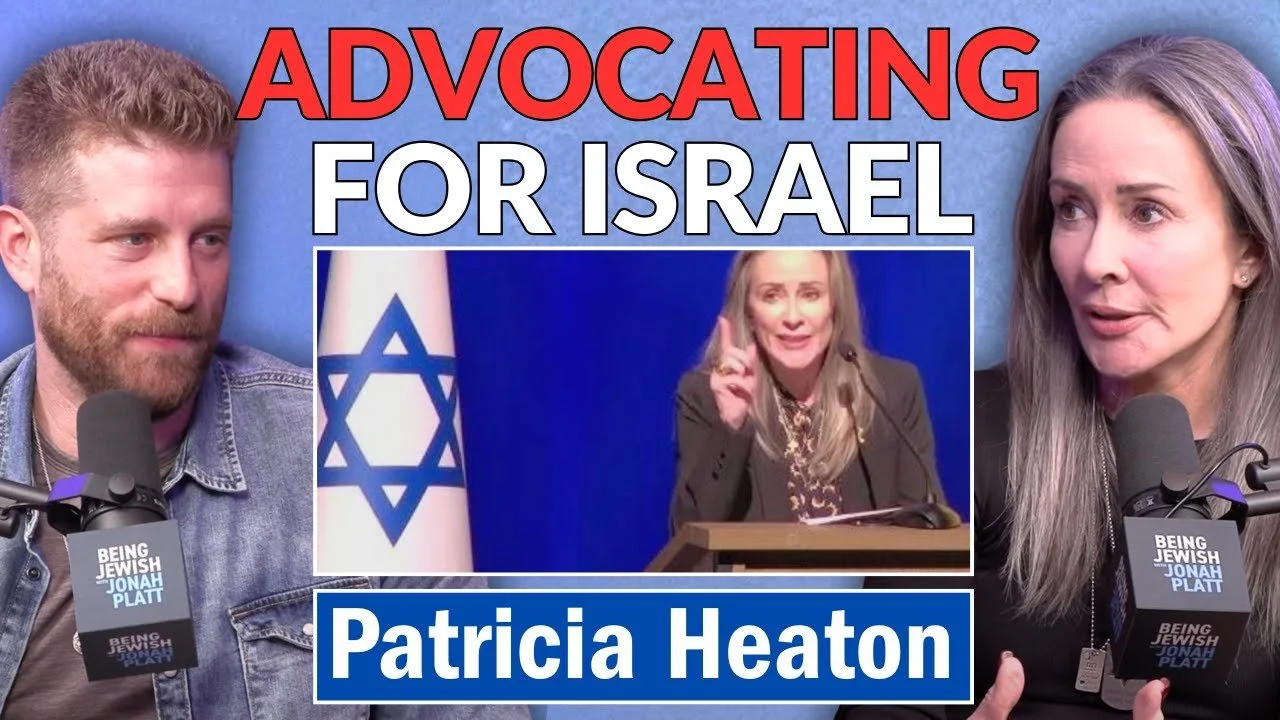
Interview Transcript
Everybody Loves Raymond's Star Patricia Heaton Tackles Jewish-Christian Allyship After October 7th
If you follow me on Instagram, you may have seen that recently I got into a little back and forth with a random anti-Jew bigot who sent me a rather unhinged and fully racist DM.
I decided to share our interactions to my stories as a means of both schooling this fellow and more importantly illustrating what standing up to hate online actually looks like.
I began by posting his initial fbomb laden rant, calling it out for its obscene anti-Jew racism.
My friends and followers responded with messages of support and humor which were greatly appreciated.
However, there were also two trends I observed in some of the responses that caught my eye.
One common response was about how scary or frightening his words were.
And I understand that for those who have not encountered anti-Jew haters up close and personal, the intensity of their vitrial can be extremely jarring.
Is it unpleasant?
Yes.
Upsetting?
Sure, it can be.
but scary.
Why should we be scared of a random, uneducated, overconfident musician on the internet spewing racist garbage that would be condemned by any decent human being?
It's like in Wicked, which I told you I would blow your freaking minds, when Alphabet tells the wizard, "You have no real power." And when Glinda tells her, "Don't be afraid," she says, "I'm not.
It's the wizard who should be afraid of me." We have the power of factual knowledge.
We Jews know what is or isn't true about Jews.
We know the reality of the situation in the Middle East.
And we know we have the moral high ground in this face off.
These are not serious people.
They are brainwashed, ill-informed followers who don't know how to think critically.
Why should you, who is none of those things, be afraid of them?
I mean, is there anything cultier than ending every single statement with free Palestine?
as if that's a normal thing to do in regular conversation.
It's straight out of the white power playbook.
I also want to return to a question I've posed on this show before.
What exactly is it that you're afraid of?
It's important to make yourself be specific and then investigate if it's something that logically requires a healthy fear.
For example, this guy on Instagram was a random musician who tried to pick on a Jew and unfortunately for him chose the wrong one.
These far-left anti-Israel genzers, and millennials are not street toughs.
They're college students, hospital interns, yoga instructors.
These people have no desire to get into a physical altercation with a stranger from the internet.
They're just bullies like on the playground picking on those they assume are weak.
But when stood up to, their confidence quickly erodess because it's all built on low information bluster.
We have to stop being afraid.
What has being afraid done for Jews?
Has it saved us from persecution?
Do they like us more because we're afraid of them?
When has evil ever been vanquished by fear?
Fear hasn't served us, it's silenced us.
Which leads me to the second common response I received.
Something like, "Thank you for using your voice to call this guy out because I can't use mine." Friends, you know I love you.
But if we all continue to rely on the small handful of Jewish voices speaking out against hate, we are doomed.
Jews are already minuscule in number.
We can't afford to shunt our collective responsibility onto an even smaller group.
It will never be loud enough to turn the tide.
The reason I posted my exchange with the struggling musician was not to show you all what I've been up to.
It was to demonstrate the way these exchanges need to go if we're going to affect real change.
If you view me and other Jewish advocates as leaders, that's great.
That means we are setting an example for you to build on.
But when it comes to calling out anti-Jew hate, please do not think of us as your representatives.
As if you have no voice, as if you have no role to play in this fight.
Because not only do you have a role to play, it is one you must play.
If we are ever going to change our situation, the only way, literally the only way, we're going to flip hate for Jews into respect for Jews is if we start acting with self-respect and strength.
In life, we teach people how to treat us by the ways we behave and respond.
That's true of every relationship.
If you allow yourself to be picked on, you're teaching the bully to keep on coming back.
We must create a social cost for being an anti-Jew bigot.
We need to make these people feel uncomfortable.
Right now, the most common reaction the haters receive is cheers and likes.
So why would they stop?
We have to make them stop.
We must, each of us everywhere, all at once, have a zero tolerance policy for anti-Jew racism.
This is a very low bar.
This is the bare minimum of self-respect we should afford ourselves.
Imagine if we created an environment where the anti-Jew haters of the world were too afraid to voice their bigotry because every time they did, they were tsunamied by Jews and allies explaining what horrific racists they are.
Most people avoid direct confrontation and really don't like being publicly shamed.
So, we need to be confronting and shaming them on moss if we're going to shut them up.
If I had to pick one mission to pursue until the end of time, it would be this.
Creating a world where the Jewish people are strong, empowered, loud, and unafraid.
Just imagine what such a world would look like.
It's within our grasp if we just have the courage to pursue it.
Now, I understand why you might hesitate to speak out.
You're afraid of the perceived consequences, which, as I've said before, are never as bad as you imagine and are often quite positive.
I also recognize you may not feel you're fully equipped or knowledgeable enough to take these haters on, which never stops them, by the way.
So, I want to arm you with some rhetorical ammunition for the fight ahead.
Obviously, studying up on the conflict, keeping a breast of its developments from multiple sources is a great way to build confidence, but combating bigotry is not about being a historian.
You don't need to speak to the invalidity of every empty quote unquote fact they present.
You just need to call out the racism and bigotry in their words as easily as we do for every other minority group.
So, here are three basic responses that will apply to nearly every anti-Jew interaction you encounter.
I'll give you a second if you want to throw open the notes app or grab a pen.
One, to take the behavior of an individual and generalize it to the entire group to which they belong is textbook racism.
I mean, just starting a sentence with you blacks or all blacks is already skin crawlingly racist.
And yet, we allow you Zionists or all Zionists to skate on by.
Don't.
Two, roughly 90% of the world's Jews believe that the Jewish people deserve to govern themselves in some portion of the land to which they are indigenous, aka Zionism, as it's most commonly understood by Jews today.
If your stance runs counter to that of 90% of a group, it is very clearly anti- that group.
Saying you're anti-Zionist is saying, "I'm anti-Jewish safety and I'm anti- 90% of all Jews." That's clearly an anti-Jew position.
And to tokenize the 10% of Jews who do hold the radical position of being anti-Jew themselves is again textbook racism.
Tokenization is racist.
And believing Jews among all the world's people should not have safety and self-government is racist, too.
Three, trying to teach a group what its own terms or experiences or history is is super identifiably racist.
For a non-Jew or anti-Israel Jew to try to teach you what Zionism is or what actually happened in 48 or what the modern Jewish experience is is virulently racist.
Again, this would be instantly obvious if perpetrated against any other group.
Imagine being non-Latino and going onto a Latino person's account or approaching a Latino friend and confidently saying, "Let me tell you what Latinos are all about." I mean, it's just an insanely racist thing to do and so very easy to spot and call out.
Standing up for yourself is a muscle.
We are all capable of it.
And you will get better and better at it the more you exercise it.
And remember, you don't need to be an expert on Israel to call out racists.
You just need to be an expert on calling out racism, which is a lot more straightforward.
The battle of the my facts are better than yours is an exhausting bout that can go 20 rounds.
The you're being a racist Jew hater and here's why fight is more like a two- round knockout.
So lace up your gloves and join me in the ring each and every one of you right now and for every moment going forward.
Because to win a fight, you actually have to show up and fight it.
This is the 12th episode of Being Jewish with me, Jonah Platt.
[Music] [Music] There are a number of words one could use to describe my guest today.
impressive, prolific, spiritual, generous, multifaceted, courageous, hilarious, and no doubt a woman of great kutzbah.
She stole our hearts as Mrs.
Debbie Baron on the classic sitcom Everybody Loves Raymond.
And today, she's capturing our hearts once again with her bold advocacy on behalf of Israel and the Jewish people.
She's a three-time Emmy winner, a producer, a published author, boy mom to four, and an invaluable friend to the Jewish community.
Please welcome the one and only Patricia Heaton.
Thanks, Jonah.
So, I I said this to my guest, Van Jones, a couple of episodes ago.
There's like not a single Jewish event happening now that you're not at.
It's like you're at the rallies, the college campuses, you're in Israel, you're at the Jewish media awards, which I'm on the board of, by the way.
Oh, you are.
What a great event that was.
How did you come to be there?
Um, I don't I don't know to be there.
I was just I know.
I was just invited to um present to to Cheryl Sandberg.
So that was really an honor.
That's so cool.
Yeah.
And then of course you also built a nonprofit.
It's like I have never envisioned building a nonprofit.
Certainly not one that was all about making sure Israel has the right to exist.
I had never even been to Israel.
Right.
So this is a this is a perfect segue to like my first big question is like tell us how this journey started.
You you are like a full-time Jewish advocate now.
More or less.
More or less.
Right.
So Take me to the beginning like what was where what began this?
So pandemic then strikes writers actors and so there was this time of just sort of nothing happening and I'm a doer and I need something to do and so I was praying for the Lord to give me something and I said it doesn't have to be acting although it would be great to have another wonderful series.
Sure.
But just I just need some something.
What is it that you want me to do?
And like five years prior to that, I had also quit drinking.
And I just feel that was part of like this preparing me to do something where I needed to be really clear-minded.
And then October 7th happened, right?
And I saw all this Hamas body cam footage all over social media, right?
It's harder to find now.
It's funny how they remove it.
It shouldn't be removed.
I couldn't agree more.
And I I wish the Israeli government were a little more Yes.
freely uh disseminating that material.
So I saw it and I was so shocked and outraged and you know I grew up in a household my dad had served during World War II.
We knew who the Nazis were.
We knew what they did to the Jewish people.
We knew all about Anne Frank.
We knew this was a terrible thing.
Yeah.
Common knowledge.
This is terrible.
One would think.
And so I was so outraged and I just assumed I would look around Nashville where there's three churches on every corner and they're all pro-Israel and I thought they're going to be pouring out of their churches and they're going to be planting hostage posters and there's going to be Israeli flags and there's going to be and there was nothing and I thought I we need to be doing something.
This is like and I posted on Instagram and I said, "Did you ever wonder, gee, if I were a German during World War II, would I be that good German that hid my Jewish neighbors?" Well, today is the day you get to be a good German.
And I got together with my friend Elizabeth, and she's Christian, married to a Jewish man, and we said, "How do we activate Christians to be visibly and vocally supportive of the Jewish people, of Israel's right to exist, and to fight anti-semitism?" And so that's been the goal of this organization we created called 07c October7th coalition.
So you can go to October the number7coalition.com and and find out what we're doing.
But we just started reaching out to the Jewish community in Nashville saying we're here for you.
Uh we did a big unity dinner with Jewish uh leaders and Christian leaders.
We with the Israeli consulate, we sponsored the screening of the body cam footage in the southeast.
It hadn't been screened there.
Wow.
So we we rented a theater and we screened it.
We uh worked with Congregation Shereth Israel, very musical um synagogue to fly Israeli musicians who had just finished their IDF service to come and record their music.
And we debuted the music at the Nova Festival in LA um when it opened.
And so we've been going around to different cities and bringing Jews and Christians together.
Um, in May we're going to have a Jewish Christian women's conference in Israel called Deborah Rising.
Um, very cool.
We're gonna have some scholars there.
Um, why Deborah?
Because, you know, Deborah was the one that said this is this is the time, you know, that we have to rise up and save Israel.
And that's what we feel we have to do.
The biblical figure.
Yes.
And there's so, you know, there's so few Jewish people and there's many, many, many Christians.
And so we we need to come together.
And that was really just out of, you know, the the Hebrew word is haneni.
Here I am.
And when I just said, you know, Lord, here I am.
What do you want me to do?
This seems to be what he wants me to do in this moment.
I still love acting.
I'm still, you know, reading scripts and looking for work and things like that.
That seems to be it.
And there's a there's a scripture uh in the New Testament uh one of Paul's letters to his letter to the Ephesians where he says, "Put on the full armor of God so that when the day of evil comes, you do everything you can to stand and after you've done everything, stand." So we just do everything we can in the day we're given and then we just stand.
It's amazing.
And and what's so interesting is like in many ways your journey over the past year really parallels my own, you know, as somebody who was who works in entertainment, has been focused on entertainment.
That's been all I've been doing really.
And then the things you mentioned, the the strikes, the this, the that, the slowdown, there's like then this moment happens in that vacuum and feeling like, okay, there's something really important that I need to do here.
Was there a decision-making process at any point of like I'm going to pivot my focus and energy into this or it's just always been like I'm going here, I'm going there, I'm doing this.
It really is stepping out in faith in a way that I've never attempted before.
And the outpouring from the Jewish community, you know, it's it's it's sort of sad in a way because like where is everybody else?
Where is everybody?
It's weird.
I couldn't agree more.
It's it's a from a really activist community.
The Hollywood community gets on board almost every single thing.
Why was this so different?
It's the it's the question of our day, right?
Yeah.
What has the response been from the the Christian community to the October 7th coalition?
Are you getting a lot of incoming come to my church, come to our community kind of things or are you having to pull people in?
How's that going?
I'm learning a lot about different denominations theological view of Israel.
And there's lots of different views.
Sure.
And there are some that was I was a bit takenback by some of the should I even name names Presbyterians um that really don't see any connection to Israel other than it they see it as a secular country like any other country.
Interesting.
Now, that's that's a slice of u the Christian world.
Most Christians understand the importance of Israel historically and spiritually to Christianity and what the Bible says about the Jewish people.
Um Jesus was Jewish.
I mean, to me, it's very simple.
The biological family of our Jewish savior is being attacked and we need to do something about it.
And we are grafted into what we see as being grafted into the Jewish line of heritage.
And and I also see that the the Jewish community is also very varied in their theology.
Big time.
Big time.
Maybe even more than Christians.
Individualistic experience really.
Yes.
And I think people are also fearful about attracting any attention to their community by pro- Hamas people who, you know, it it's tricky.
There's been shootings at churches and things like that.
And so, you know, you understand that pastors feel a responsibility to their congregation to keep them safe.
So, there's that aspect of it.
They're they're afraid for their the safety of their congregation.
But also, I think Western Christianity has some of it has morphed a little bit into Christianity is about being nice.
And Christianity is actually about truth.
It's not about being nice.
Sometimes when you tell the truth, it doesn't feel so nice.
Okay?
I think we have to look at the truth about what's been going on in the Middle East.
When you support Israel, it's not doesn't mean you're anti-Palestinian.
It means you're anti-radical Islam.
And that's really affected through UNRA and the UN and the monies that got have gone in and the Hamas leadership has really become a cancer in that community.
Oh yeah.
So that's making it really difficult.
Absolutely.
and we have to call it out.
But I believe that there are Palestinians that are waking up and saying, "We're sick of this.
We don't want this.
We never wanted this." So, you know, hopefully those voices rise up and become stronger.
And I think with the new administration coming in, Trump administration, I think they're going to be much more hardline.
And I I'm praying that it brings this to a a swift conclusion.
And I'm praying that the U mullas in Iran get kicked out and that the prince comes of Iran comes back in.
So there's a lot that could be happening that you know I'm praying for from your mouth to God's ears.
Yes.
So a lot of people you mentioned you know that that Hamas body cam footage and how it at the beginning you know first week after October 7th there was a lot of it a lot of people saw it.
Not a lot of people then started a nonprofit and began speaking out.
What makes you different?
In Chris Rock's very first special that really catapulted him to fame, he had this whole routine that I cannot repeat, but we we take cursing on the on the podcast.
It's be worse than cursing.
But the punchline of it was he was making fun of people who brag about taking care of their kids.
Like I take care of my kids.
And he said, "Hey, listen.
Why are you bragging?" I'm doing the very white version of it.
Why are you bragging about that?
That's just what you're supposed to do, right?
That's how I feel about this whole situation.
This is just what we're supposed to do.
If every Christian rose up and and called their representative and put pressure on them and and joined together with the local synagogues and said, "This has got to stop." And and went to the universities and said, "This has got to stop.
You can't keep kids from going to school, from going into their classrooms.
You can't be harassing Jewish students." If every Christian rose up and did that, I don't think we would have the problem in the country that we're having now.
There's just this this winking at anti-semitism can't be tolerated.
I mean, after the anniversary of October 7th, you know, everybody's sort of like, uh, okay, that's one year down.
And, you know, there was I felt like almost like a collective kind of, okay, now now what do we do?
And are things going to calm down?
No, they've gotten more.
You know, this this little girl, I guess recently just uh in London, a bottle was thrown at her head.
The guy is shot going to his temp synagogue in Brooklyn.
Um Chicago.
Oh, is it Chicago?
Chicago.
Chicago.
Um you know, in in Canada.
Canada.
A mess right now.
What the heck?
Really bad.
You know, and they're arresting the one lone Jewish guy.
Meanwhile, they're all calling for the end of Western civilization and the disruptor.
He's the disruptor.
He's the one that's going to cause the problem.
So, you know, and I feel that same kind of anger is we've we've got to stand up because the other side is so well funded.
They're so deeply embedded.
They've been they've been planning this for a long time.
You know, I I say that like all us normies have been raising our families, trying to have our career going, contributing to our communities, trying to have a vacation once in a while, paying our bills.
There's other psychopaths that spend their lives 247 trying to figure out ways to kill Jews and bring down Western democracy.
That's what they do with their life.
So, we don't want to be that person.
But for now, we all have to really take a chunk of time and focus it on trying to put this whole movement down.
Again, there's such an interesting parallel between your words and mine.
Actually, the the monologue that I do for my show that precedes this interview, I said like verbatim some of the things you said except about the Jewish community that that I feel the Jewish community needs to do a much better job of standing up for itself.
Obviously, if we had the the numbers of the Christian community far outweigh ours, but even Jews for ourselves, we we do not stand loud and unified.
And I think it Why is that do you think fear?
I think it's a deeply embedded well that's always my question.
It's very vague.
I think for a lot of people there's just a fear of like something bad's going to happen.
I think they see the violence and I've talked about this too.
There's this availability heristic where you you associate how quickly you can recall a recent example of something with how likely that thing is to actually happen.
Yes.
Which is not true.
I mean obviously there is violence but it's it's very and they're all horrible but it's specific isolated events.
It's not like millions of people are getting attacked in the streets.
The the likelihood of something happening to you are like 0.00001, right?
So people are afraid of violence when they I don't think they need to be.
They're afraid I think generally of what I'll call smoke to use another Van Jones term of like social media backlash which again is like it's literally not even real.
No, it's strangers at home.
If you don't look at your phone, you don't even know that it's happened to you.
Correct.
Uh but people are afraid of that.
And then I think people are afraid of am I going to lose my friends?
Am I going to lose my job or whatever.
And my my response always is if you have a job or a friend that is going to dislike you because you're a Jew, like that is not the job you want and that is not the friend you deserve.
So it's a problem.
I I mean, you know, I'm Irish Catholic and there's there's there's sort of something in my DNA that's always looking for a fight.
Like it's just part that's a good quality.
It's good except the Irish right now.
They are the worst.
I mean, they really are.
I didn't know this until all this stuff happened.
I was so shocked and disappointed in them.
And in fact, I had a a movie, a script that's about a family, American Irish family that takes a road trip to Ireland.
And I'm like, I don't know if I want to even shoot over there because who wants, you know, you have to vet the crew and make sure they're not all, right?
I think it's like one of those societies that they've had their own issues and they've incorrectly sort of placed this situation on top of theirs and like see it's just like when this they see it like the troubles.
Yes.
Exactly.
When it's they're completely different situations.
Completely different.
Yes.
The best way to deal with a bully is to punch them in the nose.
Just it only takes one time and then they're gone.
This is literally from my my monologue from this episode.
Yeah.
You're just nailing it.
Yeah.
Like and you have to punch back.
You can't power.
And I know there's that whole phrase of, you know, I'm not a a Jew with trembling knees, right?
And so that's exactly the attitude.
You have you just have to fight.
And as I said, like I think it's my Irish DNA that I I don't shy away from one.
That's it's a good good skill to have these days.
Yes.
Right.
So anti-Jew hate has been around for thousands of years, well before October 7th.
How aware of it were you before the 7th?
Like was this on your radar at all?
because it it had been doubling and doubling and doubling for a while before we got here.
Right.
I know there was a as you said there was this big uptick happening in the last few years, maybe even last 10 years and I was seeing that the world is just getting more hostile.
Yeah.
Right.
It feels like it for sure.
Yeah.
What's your idea of where that's coming from?
I have a couple ideas.
Um, I I think one, and I know that you're a supporter, but I do feel that uh Trump's sort of persona and rise along with that, he sort of made it okay to talk disparagingly about other groups and other people as he does it all the time.
And I think that sort of opened the box to let people be like, "Oh, it's it's totally socially acceptable to hate on people now." So, I think that's part of it.
Mhm.
I think that social media plays a huge part in it because it's so echochambery and and doubles down on the polarization and just really pushes people into their corners through the the algorithm.
And I think the the media has not helped out.
The news media the way how it is so biased and not just the bias but like sort of the demonization of the other side where the people who don't agree with me are the enemy or trying to destroy our country or whatever it is, right?
I don't know how you have like a healthy community, right, with those vibes in the mix.
Yeah.
I mean, I had never been a Trump supporter.
I didn't vote in the last couple elections because I didn't believe in the choices we were given.
And I still feel like this ele this election cycle was um it's just like not great.
Come on.
How many people are in this country?
These are the two.
Um so, but I am more of a conservative.
Sure.
I would say that there's I would say that there's been this this victimhood stuff, this oppressed oppressor kind of ideology that's taken hold that what it does it stirs up resentment.
So there's tons and tons and tons of resentment.
I think that's spot on this this sort of level of resentment.
And it made me think of of two things.
One is there's also this sort of level of with that resentment, this level of like entitlement and privilege of like I'm resentful of for example America and the role it's played in the past.
Meanwhile, here I am like living a wonderful American lifestyle and benefiting from it and I spent all my energy talking about how horrible America is.
Yes.
So there I think there's that.
There's that.
I think you're right.
And I remember growing up I'm much older than you, but growing up there was always the the rich kids in the neighborhood.
You knew who they were.
Their dad was a doctor or insurance salesman or had car dealerships.
Where'd you grow up?
Cleveland.
Cleveland.
I was just there.
It was great.
Oh, you were?
Where are you?
What?
East side.
Shaker Heights.
P.
No, I was like I stayed like downtown.
Oh, okay.
Where were you?
Water.
I was there for a Jewish Federation event for a speaking event.
Oh, fantastic.
Is it strong there?
Must be very strong.
The Jewish community there's amazing cuz on the east side.
Yeah.
It's it's it's like multigenerational like the same sort of pillars and founders of that community are like five six generations in whatever and so they've just built this very familial strong Jewish community.
They're one of the strongest federations in the country actually.
Oh ex excellent.
I have to get back there and do something.
I know they were asking us to do something.
We just haven't been able to to work it out yet.
But um so anyways, Rich Kids in the Neighborhood.
Yes.
rich kids and you knew who they were and you were always hoping you got invited to the birthday party cuz they had a swimming pool.
I get it.
But there wasn't a resentment.
It's just what is.
Some people have more than others, but we all lived in the same community and we all went to the same schools and and I think you're you're right that social media has ged up this kind of thing of the halves and have not have nots.
Um but it's even like with um like I saw somebody, you know, posting some anti-semitic thing about how the Jews think they're superior, right?
I was and I'm thinking to myself, well, they are.
Have you seen the Nobel Prize list compared to this the size of the, you know, Jewish people, the population, and the numbers that have won Nobel prizes?
Like, have you seen we won 22% of all Nobels?
Yes.
I'm just Don't you want to be around people really good at what they do and who are committed to education and and committed to the flourishing of all human beings?
Isn't that a great thing?
And and it's the reason like listen it's why God chose the Jewish people.
You needed people who are smart and stubborn.
That's what you have.
Smart and stubborn.
I'm just making a huge generalization.
Yeah.
Which which you know is is fine.
And I know I know a lot of stupid Jews too but right.
I mean but as a whole but culturally of course you know you're right in terms of like the values and the priorities.
I was actually just listening to um Malcolm Gladwell's newest book.
What's it called?
It's called Revenge of the Tipping Point.
Okay.
and he was talking about uh Ivy League schools, the the way you used to get into Ivy League schools, this is in like the the early 20th century, was taking an entrance exam.
Like that's all you did.
And the Jews were just crushing it.
And they realized like we can't just have this entrance exam.
There's way too many Jews.
We don't want this many Jews in our schools.
That's where college essays come from.
That's where interviews come from.
That's where knowing what your extracurriculars, putting all of this on your application comes from.
Yes.
like we got to have other criteria so we can keep Jews out because they're too they're too smart and good at taking Yeah.
They're too focused.
And now that and now with Asians too.
Exactly.
They're feeling the same because they're too smart.
Yeah.
You grew up in Cleveland, Irish Catholic.
Were you always this strongly connected to your faith from the beginning?
Well, my my mom was one of 15 children.
Wow.
Her mother, my grandmother, was Catholic mother of the year for the United States.
And she and my grandfather got medals from the Pope.
Oh my god.
Yes.
And that's insane.
That's amazing.
And I have about a hundred first cousins on my mom's side, but all 15 had between five and 10 kids, you know.
That is crazy.
Have you ever all gotten in one place at the same time?
We've tried a couple times, you know.
Yeah.
You put out the call, right?
And then whoever can make it can make it.
Yeah.
But you don't even know like anybody could show up.
I We had a Christmas party many years back and I just said, "Well, let's just put it through the grapevine." And people just kept showing up and saying, "I'm your second cousin.
I'm the daughter of your first cousin who you know so um that's that's always fun and um and then my sister's a nun at St.
Cecilia's convent in Nashville and um yeah so my mom was a daily communicant there's a thing like before Vatican 2 which is when all the masses went to the whatever your native language was and the priest instead of facing away from the congregation turned toward the congregation there were these modernization changes that were made but before that it was in Latin you kept your hair covered the women covered their hair with these chapel veils and so that's kind of the foundation of how I grew up so it was pretty strong it quite the imprint.
It's just it would be like growing up Orthodox, right?
That's that was the vibe.
Yes.
Very um ritualized um a very healthy fear of God, you know, feeling knowing that God is watching you all the time.
Don't slip up.
Yes.
And I think and I still believe that and I often look around and going thinking looking at people, what they do, what they say, how they behave and thinking God can see you.
Are you not aware of this?
You know.
Yeah.
So your your mother died when you were 12 years old.
Yeah.
How did that loss shape who you are today?
And and in what way, if any, did your faith help you navigate that?
Yeah.
This was when there was no real therapy for kids.
There was no grief counseling.
Yeah.
And we're Irish, so and my father was a big sports writer for the Cleveland plane dealer, very well known.
And so we had a huge wake and everybody showed up at the wake.
And then we had a huge funeral.
And then we had a huge after thing.
Mhm.
And And then you got home and it was like, you know, okay, everybody finished their homework and, you know, do the dishes.
And there's no processing.
No processing.
You know, I I don't like I wouldn't say that that's what caused me to drink so much at Ohio State.
I could use it as excuse.
I probably would have anyway.
Um, but I there was just emotionally tumultuous for many years afterwards because you're kind of sitting on this grief, but I was having a lot of abandonment issues.
So, anytime a change happened within my immediate family, my oldest sister goes off and becomes a nun.
My next sister goes off and gets married.
My brother, who is like my best friend, we're both living in New York.
He goes and takes a job at a newspaper in San Francisco.
every time it was like a massive emotional upheaval of seeing another person leave my life, you know.
So that just uh you know that's was painful.
Um the beauty of Catholicism is that we are not allowed to commit suicide.
So anytime I had that thought, I just would not do it because I had a fear of being eternally separated from God.
So, you just, you know, you just kind of soldier through.
I did, I did end up going to a lot of different therapy.
Uh, I used to drink a lot, do a smattering of drugs.
Nothing nothing too nothing too heavy.
Just, you know, quaude, a little cocaine.
Quaude sound like they were pretty cool.
They're very nice.
Yeah, we used to on that era at Ohio State, we used to have what we called soaper Sunday.
Soaper.
Yeah, it's a it's a term for quaudes.
Is a soaper.
I hadn't heard that one.
Yeah.
So Sunday.
So Sunday.
And in the Jewish men, we have Super Sunday where we raise money for the Jewish Federation.
Well, the Irish have Soer Sunday.
And you're doing so Sunday.
I like yours better.
Sounds way more fun.
So you're extremely outspoken about your Christian beliefs.
Another thing you and I have in common.
I'm very outspoken about my Judaism.
So I want to give you props for that cuz so many people view speaking about that as like lame or weird or not, I don't know, socially acceptable for whatever reason.
Well, yeah.
you really want to kill a conversation, you just bring up Jesus.
But let's talk about my Emmys.
So, okay, here's something fun to talk about.
So, aside from supporting Jews, which is very unpopular these days, you're also, you know, have been vocally Republican and anti-abortion.
Yeah.
Uh in an entertainment industry where those things are also very unpopular.
So, you got the entertainment unpopular trifecta going for you.
Yeah.
Abortion's really the third rail in this in Hollywood.
How have these stances affected your professional and personal relationships?
Well, just to give some context, so I was we grew up as Kennedy Catholics, which means we were Democrats.
Okay?
You know, we boycotted grapes to support Caesar Chavez and the migrant farm workers.
We were involved in the civil rights movement, but we're Catholics before we're Democrats.
And about around in the 80s, the Democrats brought on abortion as part of their platform.
And so we were like, can't do that anymore, right?
So, you know, I became a Republican.
And then more recently, I registered as an independent because I just this Republican thing was getting very crazy and messy.
And with the uh with the abortion uh topic, I find it very anti I find abortion very anti-feminist.
I find it very it's a tool that I hate to use the word patriarchy but it only serves abortion serves men mostly.
What do you mean?
Because they don't have to take responsibility.
Isn't it more feminist to empower women to decide for themselves what they want to do?
We all know that life begins at conception.
That's a scientifically proven fact.
I'm sure at this point you can recognize that not everybody agrees with that.
It doesn't matter.
It's true.
Okay, it's true that life begins at conception, right?
And the life in my womb is a human life.
So, it's a human being in a stage of development that starts the minute you conceive that child and it's your son or your daughter.
It's a human rights issue really because you have to look at the developing baby in the womb and say at what we know this is a human being.
So, at what point does this human being are they given civil rights to live?
It's an interesting question, right?
Because the Constitution gives us the right to life, the right to life, liberty, and the pursuit of happiness.
So, when does that right to life start?
I don't have the data or the science to to get deep into that one with you.
I know it's certainly worth a discussion.
Well, that's the thing.
See, it would be nice to be able to discuss this and not be shunned for like I I I am never invited to Hollywood women's things really.
No, not that I care, but persona nongrada.
Yeah, you just you're not allowed to have that view.
Like that's just weird.
I don't think that's fair.
Here's the thing.
Politics never came.
You've you've worked.
When you're on a show, you show up.
Yeah.
You're there to make the show.
Make you say your lines, you're nice to the crew, you, you know, you're professional, you're friendly, you have a good time, you're appreciative, you're cooperative.
Um, so that's always all it was about.
But, you know, if you're on a set for a long time and for years and you start talking and stuff, you know, there were just people that really felt mostly like a lot of crew people, um, just felt like they couldn't really talk about politics.
They were afraid to.
Yeah.
I think all of that sort of prepared me for what's happening now because it's it's like I've never been at the I shouldn't say that.
I've had two very long running shows and I have a star in the Walk of Fame.
I've never been in In some ways though, you kind of just tried to keep it on the low down because you didn't want to stick your head up, but you were aware that there was, you know, push back going on.
So, we cut to at Columbia University, I think, in when all that crazy stuff was happening.
When you went to go speak.
Yeah.
When I spoke at the hostage rally.
Yeah.
And I'm on a stepladder with a megaphone outside of Columbia University in New York going, "My name's Patricia Hayden and I'm a Christian and we have to support, you know, Israel." I watched the video.
And so part of my brain was saying that and the other part of my brain is like, I cannot believe I'm screaming I'm a Christian into a megaphone in New York City.
You know, it was just like, how did I get here?
How did I get here?
You know, it's come a long way.
What was the feeling there?
You know, I I just have always noticed that the the rallies with Israel and with Jewish people are just full of song and joy and hope and and kindness and, you know, it's such a different vibe.
So, it's it's great to be a part of that.
And the hostage rally that I spoke at was a lot of Israelis there, you know, and they have a really strong they're Israelis.
Yeah.
They're they're not shy.
They're not shy.
And so that was really kind of great.
And I think there were a like uh at least 500 maybe more there at that rally.
And it just it just felt good to my goodness.
Well, there I was the only Christian there that I was aware of.
So, I I just knew I had to say something and, you know, hopefully get that message out to the Jewish community and to the Christian community.
Were you surprised to see what we've seen on college campuses?
Listen, they're breaking the law by allowing these encampments to block students from any student from getting to class, but particularly Jewish students.
Like you shouldn't be receiving federal funding if you are allowing people to harass and threaten Jewish students and keep them from going to class.
This is like this is why Elise Stefonic was was at that congressional hearing was like what is wrong with you?
And it continues to go and UCLA you know the government put this a sanction on them saying if you continue to let these camps happen you're going to get your funding pulled and they appealed that ruling.
They appealed that ruling at UCLA.
It's like, are you out of your minds?
I honestly, I have to say, I don't understand why you would vote for the Democrats.
We don't need to go down that whole road.
I No, just just a little just touch on it.
I'll touch on it.
Explain it a little bit.
It really was.
For me, I couldn't ever stomach voting for Trump.
No.
And I said this to a friend of mine.
I said, I get that people hate Trump.
I totally get it.
I totally get that they just cannot bring themselves to vote for him.
I think a lot of people didn't vote for him.
I think they voted for what they feel his administration.
A lot of people held their nose to vote for him.
But I also think there were too many people in Hollywood that came out and tried to pretend that Kamala was something special when when they just before they were saying, "No, Biden's really special and he's totally fine." And then they said, "No, he can't do and here's a person and we're just going to install this person and she can't speak.
She can't answer any questions.
She rambles on um and she's wonderful." Like just say, "I don't think she's great, but I'm holding my nose and voting for her because I don't like Trump." I totally get that.
I think either way, people were holding their nose.
And for me, like the nose hold for Kamla was was much easier for me to do than the nose hold would have been for.
But you did you get come out and say, "She's so great." No, never.
I came out and said, "I'm going to I'm going to support her because I think this is what you know what I believe I should be doing." But it was never here in our in this grand vision for America of how she's going to change things.
You know, I think and I think that's part of why she lost is, you know, what was the the vision?
There really wasn't one.
And meanwhile, Trump had a very strong of I'm going to change everything.
And you know, we're a thermostatic country.
We like change.
We vote for change all the time.
Well, Obama said the same thing, too.
He said, I'm going to I want to fundamentally change.
want to change everything.
I said, "That sounds great.
Let's change everything.
Let's do that." You know?
Well, you know what?
To me, what's kind of frightening is the fact that Biden's wandering around in the jungle and she's in Hawaii and and this has been going on for a long time, months and months, and everything just keeps rolling along.
So, you're like, do we really need it?
Like, who's is there someone in charge?
Because nothing it doesn't matter that they're not around.
Like, there's a machine in place.
And I think that's part of it and I think people uh really feel disenfranchised and that there is a big machine in Washington and that it needs to be dismantled and needs to be disrupt let's say disrupted.
I won't say dismantled because it I don't think anybody wants anarchy, but I think people want to disrupt some of this stuff that's been in place for a long time.
I think that's probably right.
Yeah.
You have gotten the opportunity to speak to a number of hostage families.
Yeah.
What have those conversations meant to you?
Well, I spoke to Rachel uh Goldberg Poland in Israel a couple weeks ago.
How was that?
You know, I just don't know how she uh I I don't know how you do that, you know, and um I I guess but maybe what else could you what else would you do if you're not going to speak up for your boy at every opportunity as long as you can?
and and despite the way it turned out and that he lost his life fighting to the end.
Yeah.
Um you know, she's still she there's a serenity about her.
Um and there's also grief there.
And that's just one of those things.
That's why you you have to believe that there is a God and that he sees your pain and your suffering and he understands it.
I think for Christians, this is why Christ is so important because of his suffering that you know that there is a God that suffered that understands your suffering.
Um, and you know, I shared with her this one scripture where Paul says, "Now we see as through a glass darkly, but then we will see face to face." So now we can't understand everything but all will become clear right in the end.
And then there's a beautiful speech that you can look up on YouTube from Lord of the Rings where Frodo and Sam Wise are kind of at the depths of despair where everything seems to be falling apart and and Sam Weise has this beautiful speech about the the um the stories you know what what by rights we shouldn't even be here.
Everything is so terrible and it's hard to even think about an ending because how can an ending be happy after so many bad things have happened.
But we remember the stories about those people who had a chance of turning back but they didn't.
Those are the stories we remember.
Those are the people we remember that didn't turn back.
And Sam and and Frodo says why didn't they turn back?
And Froto and Samwise says um because they knew that there was some good in this world and that it was worth fighting for.
And I feel that's what like Rachel is doing.
She's experienced this terrible thing and she's not turning back and she just keeps going and that's it's so heroic.
So heroic she's unbelievable.
Yes.
Wow.
We've we've gone from Chris Rock to Tolken to the scriptures.
You're very well read.
You got a lot you got a lot up there and you remember everything.
I'm I I can't remember anything.
So, let's go to the My Zuzuza Your Zuza project.
Tell me what that is and how that came to involve you.
I've always known what a Mizuza is.
And um I mean, you've always known.
I've just I don't know why I know this stuff.
I mean, I only went to Israel two weeks ago for the first time, right?
But I have enough Jewish friends.
I I mean, I'm in show business, right?
I know what it I knew what it was.
And I just it just popped into my head.
Mises or yours is it literally popped into my head and I thought it's two things two inspirations like I thought of the movie Spartacus um where they all step forward and say I am because the problem has been how does a Christian literally show Jewish people they support them like what could you do because people want to show something and maybe they're not going to fly an Israeli flag outside their house but what kind of thing you do and I thought this could be a great thing and there was a story from 1993 in Billings, Montana, where a Jewish boy put a manora in their window and a rock was thrown through the window.
And so the Billings newspaper published a full page manora that people could put in their windows and 10,000 people in Billings put the manora in their window.
So that's a Spartacus moment, right?
So we were trying to get it going and we're trying to get social media influencers like Christians.
We were going to send them a muza and start having them do it.
We not one single person responded.
Wow.
So, I happened to be going on Fox and Friends just to talk about 07C and Elizabeth and I said, "Should we just announce it?" Like, we weren't really, it was not planned or plotted or, you know, we're just like, "Let's just let's just talk about it." And so, I just went on and I said, "This is a Spartacus moment." And this poor there's an organization called myuza.org that gives free muzas to Jewish families.
And if you're a Christian, you can purchase one.
So, it's it's a different than what you're doing.
Correct.
But we said their name and said, "You can get this is where you can get a muza." And so they were like, "Could you have given us a heads up?" Because because now we're being inundated with kind of like Yeah.
their their website broke or something, you know.
Love that.
So it took off and it had there were a lot of interesting responses to it from the Jewish community.
Yeah.
I I read about some of the the mixed responses.
There was like, "Hey, this is wonderful." Yeah.
There was like, "Oh, which it is, by the way.
No, thank you.
Yeah, there was like, oh, this is a little bit cringy, but we're not in a position to be picky about who our allies are.
There's that.
Okay.
Um, and then there was like there was I got called I can't I'm not going to say it, but somebody called me an an R word and a C-word.
An R word.
I know the C word.
Yeah.
Oh, the R word.
Okay.
Yeah, the R word.
Okay.
Yeah.
I was like and I saw that and you know people always say oh you know Twitter is a cesspool of like and when I got that comment I was like oh I like felt I'm in the game baby know what it feels like.
Yeah it was kind of fun actually.
I mean I just I block people.
I I'm so fast with the block.
I don't understand that can't be on Twitter.
I'm like close don't have open DMs and block.
That's all you do.
And then your timeline is a thing of beauty where everybody, you know, you don't just, you don't need to give everybody the time of day.
Nobody deserves your attention unless you want to give it to them.
But there was just this very small sliver and I what I realized is because I read the comments and I don't think people understand that I read the comments cuz when I if I respond there's this like oh crap, you know?
Right.
Yeah.
Totally.
People think they're just I always think of it as like they're lighting a bag of dog [ __ ] on fire, putting it on your door and ringing the door and running.
And if you like chase after them like, "Oh my god, I never thought this moment was going to happen." I think it's such a great show of solidarity.
I really think it's awesome and very meaningful.
And I I find it very comforting.
And I read some of the comments.
People were like, "Oh, this is like appropriating." I was like, "They're not doing it to like copy Jewish traditions.
They're doing it to be friends." It's like what a weird misunderstanding.
Yes.
And also, I think we should have probably made it clear that we were just getting the case, right?
Not the scroll inside, not the scroll inside and all that.
I probably could have made that clear, but I think at the end of the day, it's like whatever.
That's I the intent is what's important.
I think you visited Israel two weeks ago.
Yes.
Tell me, you know, what what did that mean to you?
What were some of the highlights?
The trip itself was I mean, Jerusalem physically is a beautiful place because you can only build with Jerusalem stone.
So, it glows.
The city glows and it's gorgeous.
And you know the downside of the war is there's no tourists there.
But that's an upside if you go because you have the place to yourself.
Yeah.
And everybody's so happy to see you there.
Yes.
And you know it was just you know being a person of faith to be around um our spiritual ancestors who are very openly and vibrantly living in the presence of God at all times is just a beautiful thing.
I was very moved by the whailing wall because there's no degrees of separation for Israelis and the pain of October 7th, right?
They all know have family members or hostages murdered, whatever.
And so the intensity there, you can you can feel the intensity of the people that are praying there.
So that was very moving um to to just see all the sites of our Old Testament history and New Testament history, the places that Jesus walked.
It's everywhere.
Uh when we were up in Capernium, we were standing where they believed the sermon on the mount was given and you can hear the iron dome behind it going boom.
Yeah.
And you see the puffs in the sky of the missiles that are being taken out from Lebanon.
Right.
Yeah.
So, it's this crazy combination of um this ancient history and it's not really history.
It's like a river that's flowing and you're in the river at different points in time, right?
Everybody steps into this river and it's one one continuum.
Yes.
And it's alive.
It's really alive.
And I really felt the faith is alive and it's very exciting.
I said to Dave, my husband, we need to get burial plots in Jerusalem because or somewhere in Israel because our boys are never going to visit us our graves no matter where we so instead of doing it like forest lawn, right?
Let's go to Israel and then we'll have a front row seat to the second coming.
Like we'll be first in line and Dave likes to be first in line.
So, um yeah.
But it was very moving because it's a real mixture of just secular and religious and it's such a diverse community for being very Jewish.
It's very because the Jewish community is diverse.
Yeah.
So you have so many different, you know, um, cultural elements there and you have the best of it, you know, and it's it was it was very exciting.
Sure.
It was like moving and meaningful and fun and joyous and there's such an exchange that we were having as Christians and Jews together that Did you film some of this?
Yes.
And so it's all going to be coming out.
I just didn't want to put it out like in random fashion.
Here's this and here's that.
I'm trying to like sort of putting it together um with my social media team to have it be a little more impactful.
Amazing.
But it's important.
It's just really important for Christians to understand the the importance of Israel on on a spiritual level, but the world needs to understand the importance of Israel to the world and the contribution that Israel is making.
Yeah.
On so many levels, the technological level, just everything that they give to the world.
But Israel is sacrificing their sons and daughters not just to save Israel, but to save us, to save America, to save democracy, to save the world.
Their actual children, their flesh and blood are on the front lines.
They are the tip of the spear in this fight.
And we owe Israel an eternal debt of gratitude.
And that is why we need to be doing every single thing we can to support the Jewish people and Israel.
Amen, sister.
That was a I'm we're we're leaving it there.
So, we usually take uh some questions from our Instagram audience.
Dory.chite asks, "What's your favorite Jewish food and favorite Jewish word?" Oh.
Um let's see.
I like punam.
Hey, that's a good one.
Punam.
And my favorite Jewish food, I guess.
I love the kala bread.
I love kala.
It's hard to beat.
When you eat kala, we've asked this of many of our guests.
Do you rip it or do you slice it?
Rip.
Slice seems weird, right?
That's like eating pizza with a fork.
That's good.
I like that.
Um, okay.
We'll throw in one more.
Um, okay.
This is a good one.
Uh, Megan_218 first says, "I grew up watching Everybody Loves Raymond with my family, so I've always been a big fan of yours.
Do you have any advice for those of us who aren't Jewish but want to support the community in every way we can?
What are some organizations or charities or acts of service you would recommend?
I would reach out to both your local synagogue and your local federation and find out get ideas from them of where you can be most supportive.
I would go to myuza.org and order a muza.
Put it on your doorframe.
Say my is a yours is a hashtag Spartacus moment and post it so that people on social media can see that you are supporting.
Social media is where so much information is coming both pro and con and more you know more pro- Hamas um media is out there.
It's very organized.
It's very well funded.
So we need more pro-Israel um social media.
So post as often as you can on social media.
There's also like Mand David uh Magda dome.
Yes.
The ambulance service really needs contribution service.
Yes.
And then anything supporting the IDF is important too.
Amazing.
Last one at marissa.mmyotus yoga.
Not a question just a comment.
So so grateful for you and your advocacy.
I hope you know how appreciated and loved you are.
A that's so nice.
Thank you.
Thank you so much for being here.
This was such a great conversation.
You have great questions.
Thank you.
I appreciate you had great answers.
Oh, thanks.
[Music]