
Monologue Transcript
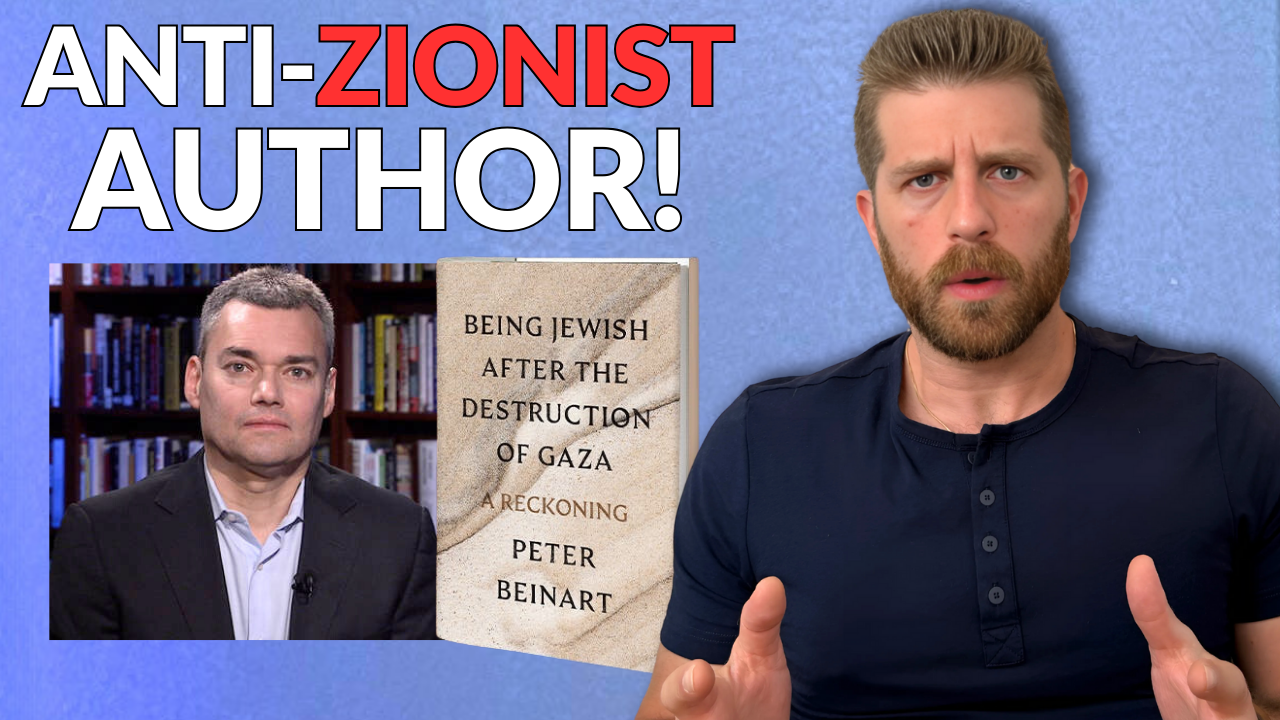
I Read Peter Beinart’s Book So You Don’t Have To
This past January, journalist, political commentator, and anti-Israel Jew,
Peter Byner wrote a book called Being Jewish After the Destruction of Gaza.
It's a New York Times bestseller with hundreds of wonderful
reviews and ratings on Amazon.
It's respectful, well written, and like most anti-Israel polemics sounds
exceedingly reasonable if you don't know what's very purposefully not being said.
Lucky for all of you.
I read it so you don't have to.
What the book gets right and what I find to be the key truth at the heart
of the Jewish anti-Israel argument writ large is that Israel and its supporters
have not done enough to reckon with the ugly parts of Israel's creation,
societal issues or decisions that have moved it further away from peace with
Palestinians rather than towards it.
I find that to be an objectively accurate and important observation.
It's true and deserves to be discussed openly.
However, this is essentially also true of every other country on planet Earth.
Hell, America's almost 250 years old and we've barely started
reckoning with our own history.
So despite it being the right call, it should not be surprising, nor a
unique blemish on Israel above all other countries that we've still got
some work to do when it comes to how it's passed, is examined and discussed.
The idea that Israel hasn't been fully honest with itself makes for a very hollow
foundation for the frenzied demonization that has become the defining pillar of
most anti-Israel Jews, Jewish identities.
Folks like Byard have no plans to leave their comfortable lives in
America out of moral righteousness over American atrocities.
Do not call for America's dissolution as a state, nor make their entire
personality as Americans about decrying historical missteps or even current ones.
This double standard brings me to what the book gets wrong in his urgency
to retti the Israel Palestine scale towards his definition of justice.
Byard falls victim to the very same method he decries.
He lays the blame for the conflict entirely at Israel's feet.
While de-emphasizing the culpability of the Palestinians at nearly every turn,
rather than balance the scales, he simply places his thumb on the other side and
pushes down, fundamentally undercutting his own argument in the process.
For instance, he attempts to ascribe the notion that Hamas uses
human shields as a disingenuous Israeli excuse for wanton violence.
Despite the fact that Hamas absolutely does use human shields and could
literally keep every single Palestinian safely underground in its 500 miles
of tunnels if it had any desire to, but of course, that's not addressed.
He uses the phrase international law so many times.
It could be a drinking game, but never wants to examine how Palestinians continue
to break it only by his accounting Israel.
Something the book gets right.
It asserts that Jews often gloss over parts of our ancient history where
the Israelites were the aggressors.
A prime example being the end of the Purim story, where the Jews saved by
Queen Esther's bravery then go out and slaughter a bunch of their enemies.
I find this to be a totally valid assertion as I'm betting.
Many of you had no idea that McGill ended that way until I just told you.
What I find invalid is the implication that what did or did not happen in
any biblical story or whether we pay attention to that story in 2025 or
not, has any bearing whatsoever on what is actually happening in Israel
today or in the mindset of Israel's supporters, what Jews view themselves
as became immaterial on October 7th.
They were victims of the most horrifying massacre of Jews in generations.
Similarly, what Israel did or did not do to Palestinians in 1948 has
no bearing on whether Israel did or did not do something to them in 2025.
If I stole an apple in 1993, that is neither an argument
for nor against the accusation.
I stole an apple in 2025.
Ultimately, I either stole the apple this time or I did not.
Every argument must be made on its own merits, which the book often fails to do.
Opting instead to blame actual events on a perceived Jewish mindset rather than on
how or why the events themselves unfolded.
I've seen Byard fall into this trap before when he appeared on The Daily
Show with vehemently anti-ISIS, Israel Pundit, John Stewart.
Stewart, and Byard agree that just because Jews have been victims
before doesn't mean they can't also be aggressors to which I say a duh.
They're right.
Any person can do anything, even if that thing was done to them.
There was nothing novel or revelatory or brave about that statement.
What's actually quite malevolent about this line of discourse is the implication
that a basic truth that anyone is capable of anything is somehow proof of Israel's
culpability in regards to the war in Gaza, that because Israel, like every
other country on earth, is capable of doing harm, they are indeed guilty in
this specific instance of having done it.
This is literally not an argument that guy hit me.
I am capable of hitting and you think I hit some other guy, are not
causal or even correlated ideas.
This is not logic.
Something the book also gets right is that Israel is deeply flawed.
This should be obvious to anyone who views Israel as what it is a
country run by people, all of whom by definition are deeply flawed.
The book rightly argues that Israel was born in conflict, which meant
bloodshed and displacement and anguish for thousands of people
with plenty of historical evidence.
But again, it deliberately only colors in part of the picture.
It neglects to acknowledge that Israel's creation mirrors that
of every other state birthed from nationalist interests, certainly in
the mid 20th century when this dynamic was playing out all over the globe.
Instead, it focuses purely on Israeli aggression, either downplaying
or outright excluding Palestinian culpability across the board.
And again, it attempts to use those past events as proof of guilt
regarding current ones, even though they are by nature disconnected.
Something else the book gets right is that Israel's control over
Palestinians and parts of Judea and Samaria is unjust and often cruel.
We know why checkpoints exists.
We know why there's no trust.
We know security is paramount, and yet none of that excuses the abuse
of power or needless agitation.
The book also rightly spotlights some of the inequalities for Arabs living
in Jerusalem, legitimate grievances that require calls for justice.
However, as you've likely guessed, the book makes no mention whatsoever
of the unmatched equality.
Israelis enjoy Jews, Muslims, Christians, Drews Palestinians alike
that is entirely absent from the Palestinian Territories, as well as every
neighboring country in the Middle East.
20% of Israelis are Arab Muslims who live and work at every level of society.
In America, the number is 1%.
Here they've never been on the Supreme Court or in a ruling
government as they have in Israel.
Why?
This is all seemingly unimportant information in a discussion about
Arabic quality in Israel is beyond me.
The book also makes the case for having an Israel with equal rights
for all and claims that to be anti the Jewish state is not to be anti-Jewish.
Yeah, okay.
There are billions, billions, more Arabs than Jews, and their
birth rates are quite high.
It would not be long at all before a quote.
Equal land became a Muslim majority country and one need only.
Look at literally every other Muslim country in the region to
know precisely what happens to Jews in Muslim majority countries.
They die or flee to Israel, which Oops no longer exists to suggest that an
entire ideology built around reaching this likely result is somehow not
anti-Jewish is the ultimate turd sandwich.
Something else.
The book gets right is the need for Jews to better listen to Palestinian
voices, even if it's hard, even if it's with a grain of salt, even if
it's infuriating, even if it's not reciprocal, it will either sharpen your
own ideas or poke holes in them, both of which are desirable outcomes that lead
you to a more complete understanding.
And if it leads to some shared humanity too, well, wouldn't that
be a good thing for everyone?
Lastly, the most important thing this book gets terribly wrong is that it absolves
Palestinians of all its impediments towards peace and refuses to acknowledge
the existence of jihadist ideology at the heart of Palestinian society.
By now's main framing is that if only Israel, this if only
Jews, that they would be peace.
And of course it is certainly true that there are plenty of if onlys Israel
should and must do if they want to pave the path towards truly lasting peace.
Yet, absolutely none of it matters if Hamas remains in charge of Gaza,
and the Palestinians who support them are not deradicalize from
wanting to exterminate all Jews.
The Israelis most desirous of peace with Gaza's, the most left-leaning and most
engaged in trying to uplift their Arab neighbors were the first ones raped,
beheaded, and burned alive on October 7th.
That is not hyperbole.
That was the plan.
To slaughter the peaceniks of these specific kibbutz in the most grotesque
and blood thirsty way imaginable.
It is completely disqualifying for any sort of argument to be made against
Israel without first contending with the immutable fact that Hamas seeks to
kill Jews, not because of persecution or occupation, but because they are alive.
I was taught a long time ago that to make a strong argument, you need to be able to
make the other side's argument for them.
I have yet to see an anti-Israel voice be able to do this probably
because if they could, they wouldn't be anti-Israel anymore.
Disappointingly, but not surprisingly, being Jewish after the
destruction of Gaza is no exception.
But hey, look on the bright side, at least now you don't have to read it.
This is the 49th episode of being Jewish with me, Jonah Platt.