
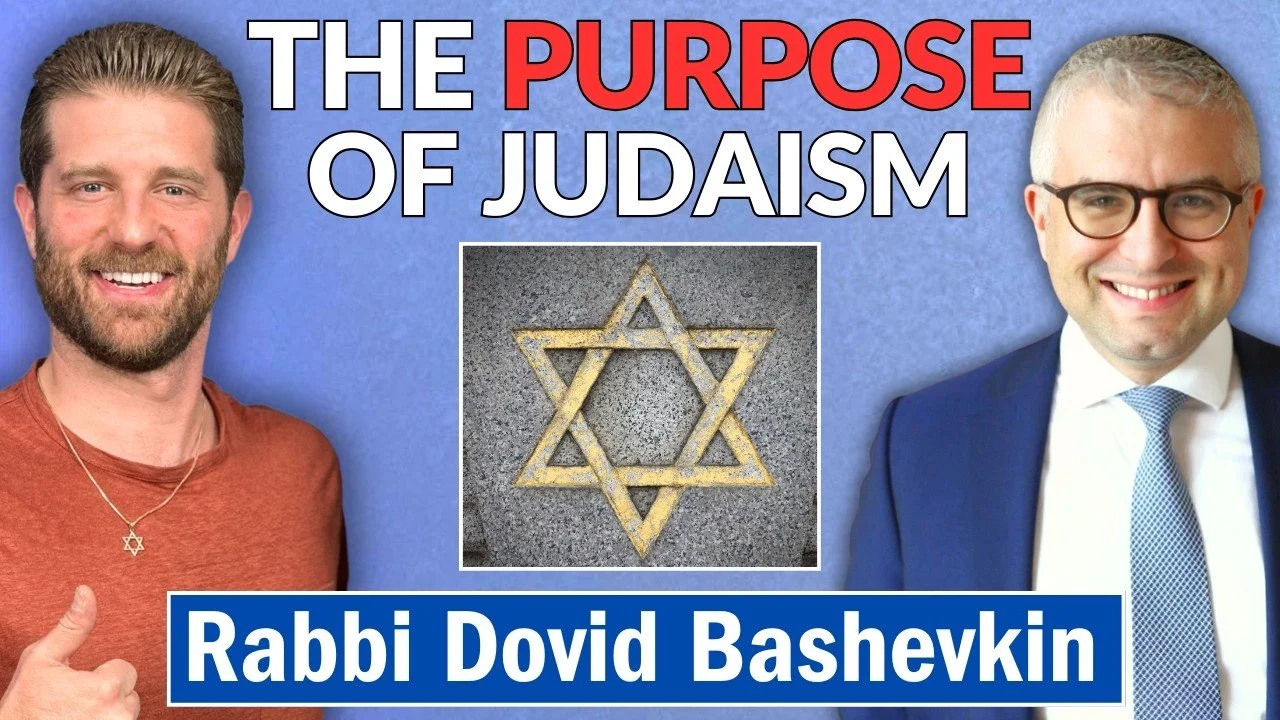
Interview Transcript
What is the Purpose of Judaism? Rabbi David Bashevkin Has The Answer… And It’s Not What You Think!
Watch and Listen
Jewish institutions are like big ocean liners.
They don't have the dexterity that modern conversation has.
We need more bridge building within the Jewish community.
Big time.
There's not a Jew in the world that doesn't have some class of Jews that bothers them.
In the Jewish world, there was something even more interesting happening, and that is.
Welcome back to Being Jewish with Jonah Platt.
30 minute benches.
Same vibe, same tribe, shorter episodes.
My guest today is a Jewish educator, thinker, writer, and communicator, working at the crossroads of Jewish tradition, accessibility, inclusivity, and self-reflection.
Whenever I ask folks which modern orthodox voices I should have on the show, this dude is always top of the list.
So you spoke, we listened.
We got him.
Ladies and gentlemen, please welcome Rabbi Dovid Bekin.
Jonah, thank you so much for having me.
It's really a joy to be here.
Let's jump right in.
If, if you could articulate your mission as an educator, as you know what, we'll get into 1840, that you've built this entire platform to communicate ideas about Judaism, what would that be?
A sentence that I come back to a lot is that.
The purpose of Judaism is not to fight antisemitism, but we fight antisemitism in order to focus on the purpose of Judaism.
And I would say my work begins not with the fight against antisemitism, which is crucial.
And I don't mean to diminish it even for a moment.
It's absolutely existentially necessary, but I, there's not as much as I can do in that space and where I really try to focus my efforts.
Is helping explore.
You know, individually, collectively with families, what is the purpose of Judaism?
And I think that the vision of Judaism that I'm trying to articulate was what I would probably call like familial Judaism.
A Judaism that begins.
Home that begins in the home, that enlivens, that elevates the home and then reaches beyond, as opposed to a Judaism that begins maybe in a synagogue or in a study hall or Judaism that begins in a, in a textbook.
I, I think we need to reclaim the Judaism of the home.
And articulate and talk and describe how we can make our homes, our home life.
A beacon of Jewish life, practice and commitment.
Why is that the key, that sort of family outward approach, uh, as opposed to say somebody who, you know, walks into a synagogue and feels the divine and that's their way in.
You know, what's, what's, what's so crucial about your approach?
I think there's something about our familial relationships that is paralleled and, and mirrors really what Jewish identity is all about.
And that is, um, nobody really chooses their family.
Um, you know, I have the two parents that I have.
You don't really choose your.
Siblings or where you were born into or that, that world that you, where your childhood emerged from.
Mm-hmm.
And I think for a lot of people that's really difficult because we've been taught, uh, by so many that the way that you find your individuality, the way that you find the path is what you accomplish.
And it's very important to accomplish and to build and to have your own unique flavor.
What I think is unique about Jewish identity is that it's.
Forces you to reflect and find meaning in your unchosen identity, not just your chosen identity.
It's actually learning how to integrate your unchosen identity and your chosen identity.
And I think that the place where we naturally learn how to do that is in our connections to our own childhood and our own family.
Uh, there are people who've had very difficult childhoods.
There are people who've had very lovely and joyful childhoods, and we take that.
Almost fixed static idea that part of ourselves that we didn't choose how we spend the rest of our life either trying to escape it, ignore it, sanctify it, or repeat it again.
And we're basically spending the rest of our lives reacting to this very static part of our identity.
And I think in a very similar way, what Judaism is, is a reflection on Unchosen identity and how to integrate it into your chosen identity.
I, I like that framing.
So now I want to jump into 1840, which I mentioned is your platform where you have essays and podcasts and social media, all this stuff around this space.
So tell me, where did 1840 come from?
What are you trying to accomplish with it, and why is it called 1840?
Yeah, so let's start with why is it called 1840?
What a ridiculous name for a Jewish, uh, uh, program or initiative.
Uh, 1840, believe it or not, is named after a calendar year.
It's named after the year 1840, which is significant for two reasons.
One, in terms of global history, and one is.
Pacific to Jewish history.
Let's start with the global history.
1840 was a transitional year for the world.
It's when the industrial revolution was heating up.
The world got a whole lot smaller.
Locomotives telegraphs were beginning to emerge and people were beginning to contend with their identity in a new way.
What does it mean to be a citizen of the world?
So to speak.
Mm-hmm.
Celebrity culture started to bubble up.
People were trying to not just make a living and survive.
They were trying to figure out how my identity is going to really be my own and uniquely mine.
And they were contending with their own sense of self in a very modern way.
That's happening on the largest.
Scale in the Jewish world, there was something even more interesting happening and that is the year 1840 Jonah, believe it or not.
And it's good that you're sitting down Uhhuh, it corresponds 'cause I'm about to get a little bit kabbalistic or probably more kabbalistic than your average being Jewish with Jonah Platt uh, mensch episode.
But it is the sixth century of the sixth millennia on the Jewish calendar.
Where the Zohar, which is a classic text of mystical thought in, in the Jewish world, in the Jewish canon, the Zohar says, at the sixth century of the sixth millennia, which corresponds to the year 1840, the lower waters, the underground waters of wisdom are going to open up now.
People thought that this was going to lead to a Messianic awakening.
There was no Messiah that came in the year 1840, but there was a lot of excitement.
Classically, Jewish waiting for mess, waiting for Messiah.
Messiah doesn't show up, and the Jewish community kind of fragmented for how they dealt with it.
On one side of the community was, let's say, the more conservative elements of the community who said, you know why we're not in the Messianic age.
They blame technology.
They said because of the telegraph and the locomotive, and people are so distracted.
Then on the other side of the other extreme was the more progressive elements of the community that said, you know who the Messiah is?
It's the telegraph.
It's the locomotive.
The technology is the Messiah.
There was a middle path, and that's the inspiration for what we are doing, and that was a specific Hasidic school, which began, you guessed it in 1840.
It was the Hasidic School, known as ish bits and ish bits, said that modernity allows us to ask redemptive questions.
What does that mean?
A redemptive question?
A redemptive question means we may not be able to bring the figure of the Messiah here, but for the first time, we are asking ourselves questions that haven't been asked on the mains.
Dream scale in all of Jewish history, people contending with their Jewish identity in new ways.
Even asking the question, what is the purpose of my Jewish identity?
What is the purpose of Judaism?
These were questions that during the Crusades and during years of, of terrible persecution, when all you're doing is trying to survive and put food on the table and make sure that you're not.
Killed you don't have time to, you know, reflect a naval gaze about what is the meaning of your identity.
As modernity began to emerge in the enlightenment and every Jew is beginning to interact, not just with the stel but with the wider world, we started to ask really redemptive questions.
Questions that ultimately the answer to them, though we still may not have a concrete answer, the answer is redemption itself.
The answer is.
Is how people learn how to feel comfortable in with existence itself.
How to learn, how to find meaning in the world, because as I said before, if Judaism is about learning how to integrate your Unchosen identity into your chosen identity, the ultimate Unchosen identity is existence itself, is being alive.
Sure.
So Judaism, in a way, and this is something that we specifically leaned into and centered in the time of modernity, is really reflecting on the question, the universal question.
It's not just the Jewish question, it's the universal question of how do we find meaning?
How do we sanctify existence?
So who, who have you discovered is your audience at 1840, who is responding the most and getting the most engaged with the work that you're doing?
Our core audience I call, is post institutional Judaism, people who had an institutional presentation of Jewish identity and Jewish commitment, whether that's in a classical yeshiva or in a day school, or in a Solomon Chapter or in a Camp Ramah, you grew up.
In one of those places, and you went through all the Jewish institutions and there's a very specific and important lens and framing in which the way Jewish institutions talk about Jewish life, they're, they're a little bit more, um, static.
Uh, Jewish institutions are like big ocean liners.
They don't turn that quickly.
They move at a good pace.
They're carrying a lot of cargo.
There's a lot of important cargo.
We don't wanna lose these ships, but they don't have the dexterity that modern conversation has.
And I think that when people leave institutions, they have a certain idea of.
Jewish expectations are, and then they enter the real world and maybe some of the dissonance of the stories they were told and the Jewish world and, and real life that they see outside unmediated by institutions.
Start bringing up questions.
Maybe questions about xenophobia like are, like, what does it mean to be a different people?
Uh, what does it mean to, is this racist?
Is this, those are real questions.
It might.
Bring up questions about, uh, prayer.
You know, like, what are we doing here?
Is this actually gonna make anybody healthy?
Is this gonna save anybody?
These very basic questions that I think you only have the ability to confront when they're on your own terms, not mediated through an institution.
I think that's.
1840s core identity and core audience.
Something you do on the site is what blank means to me.
You have these series of essays where you, you tackle some big idea, what does Zionism mean to me?
What does, uh, Jewish education mean to me?
And, and in the Jewish education piece, you, you hit on something that I agree with, which, you know, you basically just alluded to in your response, which is that.
Jewish education ends and the the institutions stop.
And we've talked about that on this show before.
I had Sarah Herwitz on who has a book here all along all about how Jewish education ends people.
She's a dear friend.
She's an unbelievable, Sarah's the best.
She's fantastic.
Yeah.
So I mean, it's the same, same thing.
So can you articulate sort of what you feel can be done to.
To bridge that gap.
Obviously you're providing a service for folks who are wanting further education, but how do we.
Ensure at least better than we are now, that people are staying on that conveyor belt of wanting to continue to educate themselves and knowing where to go for it.
There's a verse in Proverbs that talks about education.
It's actually a fairly famous verse, even for people who aren't familiar with a lot of verses, is the one that says, teach a child according to its way.
Which in Hebrew is KO teach a child according to its way that even when the child gets over, he will not stray from it.
And most people look at this idea as saying, teach a child to love a certain path.
So even when they get older, they won't stray from it, meaning they won't stray from that path.
They won't get off the conveyor belt.
And there's a beautiful idea that different people have articulated that when it says that you should teach a child according to their way, so even when they get older, they will not stray from it.
The, it is not referring to any specific path.
The IT is referring to Jewish education itself.
What we need to learn is how to teach people how to fall in love with lifelong learning, how to make the experience of learning so joyful, so it's not as outcome centric, but really enjoying the experience of finding what you.
Finding resonance and opening up the canon of Jewish learning.
So it's not just Hebrew and Aramaic text.
It's not just texts.
I think a big part of Jewish learning that's been neglected is Jewish history.
One of the great.
18th century mystics was known as Rabbi Mosha Hayato, who was a, a great mystic.
He was a playwright, really interested, fascinating personality and, and, and thinker.
And he had this idea that there are three manifestations of divinity in the world.
There is God.
There is Torah and there is the Jewish people.
So what does it mean to connect to God?
So you could connect to God through prayer going out in nature and all sorts of ways and connecting to Torah is probably study.
We associate that the most with Jewish education.
I think that we haven't really figured out and what we should be championing more is learning how to.
Study the Jewish people themselves.
What does it mean to study another?
What does it mean to confront the other?
What does it mean to have two Jews talking in conversation?
You and I do, David and Jonah, who have totally different Jewish backgrounds.
And just having a conversation about what our Jewish commitments are, what Jewish life is like in our own lives, what's difficult for us, what comes naturally, why is it difficult?
Why do some things come naturally?
If we learned how to learn from one another, if we learned the le, the amount of education that emerges.
From just speaking with other Jews contending with their own Jewish identity and practice, we would realize that one of the great doorways and entry points for Jewish commitment to Jewish life and Jewish thought, it doesn't even lie in a book.
It doesn't even, it's not even in the synagogue necessarily.
It's, it's really engaging with curiosity and a generous curiosity of talking to other Jews.
Find out why you hate other Jews.
Every Jew, there's not a Jew in the world that doesn't have some class of Jews that bothers them.
You know what I mean?
Every Jew, they might not admit it.
They might not admit it.
Every Jew has some, you have a Jew that you don't like.
Every Jew has one Jew they don't like, I'm sure nobody likes.
So to me it's more about, uh, if there's a person that you don't like who happens to be Jewish, less so than a type of Jew.
I think some people, there are certain types of Judaism.
That they might not admit it, and they're not malicious about it.
I'm not criticizing it.
I'm actually saying it's beautiful in find out the places of Jewish practice identity communities that actually get your blood boiling a little bit.
Mm mm-hmm.
And instead of turning away from it, instead of running away from it, allow yourself to sit with it.
Allow yourself to meet somebody who you.
Kind of makes your, makes you upset and, and learned how to ask yourself what's going on inside of me that I feel this way?
Is it something that's threatening me?
Is it dangerous to me?
Is it because I feel like they're looking down upon me?
Is it because I feel like they're too box?
What is it?
And I think that that type of.
Learning, and I call it literally education, which is learning how to speak to one another is the type of Jewish, is the Jewish education of the future.
As we have more and more access to texts and to AI and to all the great thought and all the great ideas from all of history, I think one of the things that we need to learn is just basic how to, Jews should speak to each other, how to learn, how to manage our.
Own ideology, our own theology, our own outlook with the world, and how to square that.
And still with love and optimism and holding that intact, engage with Jews who don't have the same views that we do.
I think that's a really excellent point.
I mean, I, I'm thinking, I, you know, I do a lot of bridge building work in my life between the black community and the Jewish community and et cetera, et cetera.
But it feels like.
We need more bridge building within the Jewish community.
Big time.
Big time.
Big time.
And, and I don't, you know, as you're speaking, I'm sort of racking my brain a little bit and I'm like, I don't know how much I've seen that.
And that feels we're really missing that.
Yeah, there, you know, there was a criticism, Ravi Huttner, who was one of the great Jewish thinkers.
He was an Orthodox or Yeshiva, very conservative thinker.
He one time criticized Martin Buber.
He had a very interesting criticism, 'cause I wanna reverse it.
He said, Buer understands.
Anu, but not Nu, he was making a pun on a classic prayer that Jews say that's also a great fish song called Anu.
Mal Fish has an ANU horse.
Fish has an ANU mal.
Anu means our father, and Malkenu means our king.
And the criticism he was saying that Martin Buber to Martin Buber was that Martin Buber was all about Anu God as father, Jewish peoplehood and not enough of God as king commandment, commitment, all of that stuff.
And I think in some ways, a lot of others, uh, have it reversed where all they know is God as Commander God of ritual.
But they don't know God of community, of Jewish peoplehood.
And I think specifically in this moment when there is so much, not just divisiveness, but just ignorance about other Jews, meaning that basic Jewish literacy should not just be about an understanding of Jewish text and Jewish practice, but a part of Jewish literacy is understanding the contemporary body of the Jewish people.
What are the different expressions?
How many Jews at different forms of, of Judaism and different, different for types of Jews have you interacted with?
And I think a part of Jewish literacy is learning how to cultivate really meaningful conversations.
I'm not just saying your, your dentist and your doctor and your business partner are different types of Jews, but like having a meaningful conversation with another Jew, without being threatened, without feeling insecure, without feeling judged.
But just having non-hierarchical conversation, which again is why I think.
The work that you are doing is so absolutely crucial.
Thank you.
I mean, that's certainly, uh, one of my sort of mission statements is, is to showcase that diversity of, of Jewish expression.
And I think what, what you just said kind of hits it on the head a little bit, at least from people outside the Orthodox community looking in, is that fear of judgment.
That fear of not living up to an expectation, that fear of condescension, that fear of.
Not being able to relate to, to orthodox folks who they don't have an interaction with and, and they just see them as being different and, and, you know, isolated.
What's the view from Orthodox looking out that you think gets in the way of, of community?
I think in the other direction, one thing that is unique and unfortunate is that.
The basic Jewish vocabulary and literacy is very uneven between the Orthodox and the non-Orthodox community.
One of the great investments that has become has its own series of challenges, but really has demarcated The Orthodox world has been.
Sending your child to pro, get a private Jewish education from, you know, kindergarten through high school, which has become more and more common.
Neither of my parents, I'll have, you know.
Ha went to Yeshiva.
Mm-hmm.
Uh, but, but they sent all of us to Yeshiva and that created a world of kind of haves and have nots when it comes to a lot of just basic Jewish literacy.
And it's unfortunate.
And I, I do understand why for many.
They may presume that because they were given the gift of a very strong j uh, Jewish education, they may misinterpret that part of their unchosen identity 'cause they didn't choose to do that.
It's part of their unchosen identity as their own accomplishment, and that's a danger within the Orthodox world.
Those who have that gift should recognize it as a gift and ensure that it doesn't lead to unearned entitlement, but instead a sense of responsibility In the words of the rebi, if you know Olive teach olive.
If you know the first letter of the Hebrew alphabet, teach that letter.
If you were given Yeshiva education, share it with joy and with pride and with excitement.
Don't be pushy.
Don't be judgmental.
You should relate to it as the gift that it is.
And I think there are many in our community who do so and those you know, who are looking outwards, who may have had bad experiences with, you know, an Orthodox Jew is anybody who's had an experience with any Jew.
To remind yourselves that never cut yourself off from any Jewish community.
Look past the surface and meet human beings, meet people, learn about their lives and experiences.
If you approach it with the same integrity that we approach J Jewish texts, you know, the way, like we take out a safer Torah, and there's a sense of of reverence and importance when the arc is open and the Torah comes out.
We should feel that way when we meet other Jews.
It's an opportunity to really learn and expand what it means to be Jewish.
I love that, that image and that framing, I think, I hope people will hold onto that.
Uh, what you just said is also a great segue to what I wanted to ask you about next.
One of the things that you can get dinged on for being an Orthodox Jew, and this is the same sort of, uh, uh, any religion or any, any group in which you are taking sort of the.
The, the, the highest possible road is that when you err in that road, you get dinged worse and you're now, you're, you know, you're a hypocrite, you, you're a phony, you know, all that stuff.
And you know, you're talking about the humanity of everybody.
So I, if you could just sort of respond to that.
'cause I think that's an image that sometimes people have.
They're like, look at that orthodox person doing something sinful.
What a joke.
You know, as opposed to.
Seeing them as human beings who mess up, even if they're trying to hold themselves to a higher standard, anytime that there is an Orthodox Jew in the news for, you know, some salacious or negative reason.
And, and that does happen and we don't need to pretend that it doesn't, there is a sense that occurs both within and outside the community of real moral injury.
It, it hurts my internal moral universe.
I would say, just to really emphasize the question, uh, and the responsibility in many ways.
I have a harder time with the question of how a learned, sincere, educated Jew.
Can be capable of creating such a desecration of godliness through their actions.
I have a harder time with that than, you know, other major questions of the Odyssey.
That's my, the, that's a theological question and the way that I approach it is really emphasizing number one, that.
There's this incredible Talmudic dialogue where when God was giving the Torah, the angels came before God and said, do not give this to the Jewish people.
This belongs to us.
This is the holiest expression of Revelation, a godliness.
How could you give it to just regular human beings?
It's gonna be atrocious.
And God looks at the angels.
It says, have you ever read what's inside of this?
Go look up.
Tell me what you read.
And the angels start reading from the Torah and it says, don't steal, don't murder, don't cheat, don't commit adultery.
And God says this is designed specifically to address humanity.
I don't want to give it to angels.
I don't want the Torah and divine revelation is not meant to give it to people who are already perfect.
The Torah and revelation is meant to address our imperfection.
So in a sense, I'm never as.
Fully surprised.
I'm always saddened when I see somebody who has given the gift of a Jewish education and still is capable of making headlines for negative reasons, but I don't look at that as an indictment on.
Torah, and I don't look at it as an indictment on Judaism or the Jewish people or any Jewish community.
What I look at it as, well, this is who the Torah was given to.
The Torah was given to people who contend with cheating and with adultery and with murder.
It was given to us because of our humanity.
The Torah would not be necessary if we were inherently perfect.
Great response.
Uh, we're, we're getting close to the end here.
I could, I could talk to you all day.
Uh, but I, I wanna finish off with talking about NCSY, the, the National Conference of Synagogue Youth with which you are heavily involved.
For those of you who don't know, this is the Orthodox Union's Teen Organization national, across the country.
Jewish teens today, what are they looking for when they come into to NCSI?
What do they want from their Jewish life?
There is a Jewish model for what the teen experience is.
To be a teenager is wedged in between your bar mitzvah, which is when you're 13, 12 or 13.
And when you turn 20, when you turn 20 in the Torah, there is actually, that is a milestone where you become susceptible to.
Punishment, you can be tried in court.
That's only after the age of 20.
So the teenage years, I like to say are in be wedged in between responsibility and accountability.
Responsibility begins bar and bat mitzvah.
Accountability is when you could actually participate in court and when you're in that nexus.
You're very idealistic.
The very word for teen in Hebrew is not our, which comes from the Hebrew word of heir, to be awakened, to be idealistic, to look for something.
The common denominator I always find with teens is as idealistic as they are, teens want authentic relationships.
They are a bloodhound for insincerity.
The ultimate idealistic vision is, can we be real with one another?
Can we be honest?
Can we have a sincere interaction for 10 seconds of our lives?
And I think especially now in this generation in 2025, what do teens want?
What do they crave?
I think they crave authenticity in the most idealistic, holy way.
And, and like every generation, it's that generation that reminds us who sometimes are a little hardened.
You know, that's not how the world really worked, and we have all of our responses.
What we really want is that authentic experience and interaction.
I think that's what teens crave most.
Do you feel like you're able to give that to them?
I think we are, because the NCSY model is that all religious.
Change conversation comes from non rabbis.
It's not a rabbinic driven organization.
There are rabbis like myself available, but all of the conversation is teenagers talking to like college advisors.
Who, who, honestly between me and you, they don't know what's going on either.
I mean, they're, they're, they're college kids, but they, the college kids find purpose by being a mentor to a teen teens find, you know, a role model by looking at kids who are in their college experience and the magic of NCSY and why I think it's able to create long-term sustainable and emotionally healthy religious change.
And that's been a real emphasis, especially since I've been in the organization the last.
10, 15 years, um, is because it's not synthetic.
It's, it's, it's college kids who are as imperfect as anyone, uh, who are really being the role models for, for these teenagers, bringing them to Israel for the summer, et cetera, et cetera.
And that's why I think the, the change of NCSY is that idea of falling in love with education itself.
I love that.
David, thank you so much for being here.
We're definitely gonna do this again.
It's been a real pleasure getting to talk with you and, and hear your perspective on all this stuff.
Uh, if people want to see what you and 1840 are up to, where do we send them?
You could find a lot of my work on social media.
I'm pretty active on, on X or as it was known, Twitter, uh, d Bash ideas.
And you can visit the 1840 website.
This is important spelled one eight.
F-O-R-T-Y 1840.
So the one eight is numeric and 40 is spelled out.
18 forty.org.
And we have, you know, weekly emails, podcast videos, essays, and you could check all of that out@eighteenforty.org.
Alright, make sure to do that.
We'll put it in the show notes.
Alright, he's a bench, it's been 30 minutes.
I'm Jonah Platt.