
Interview Transcript
One Question Got This Orthodox Rabbi Over 500K Subscribers! YouTube's Favorite Rabbi Manis Friedman
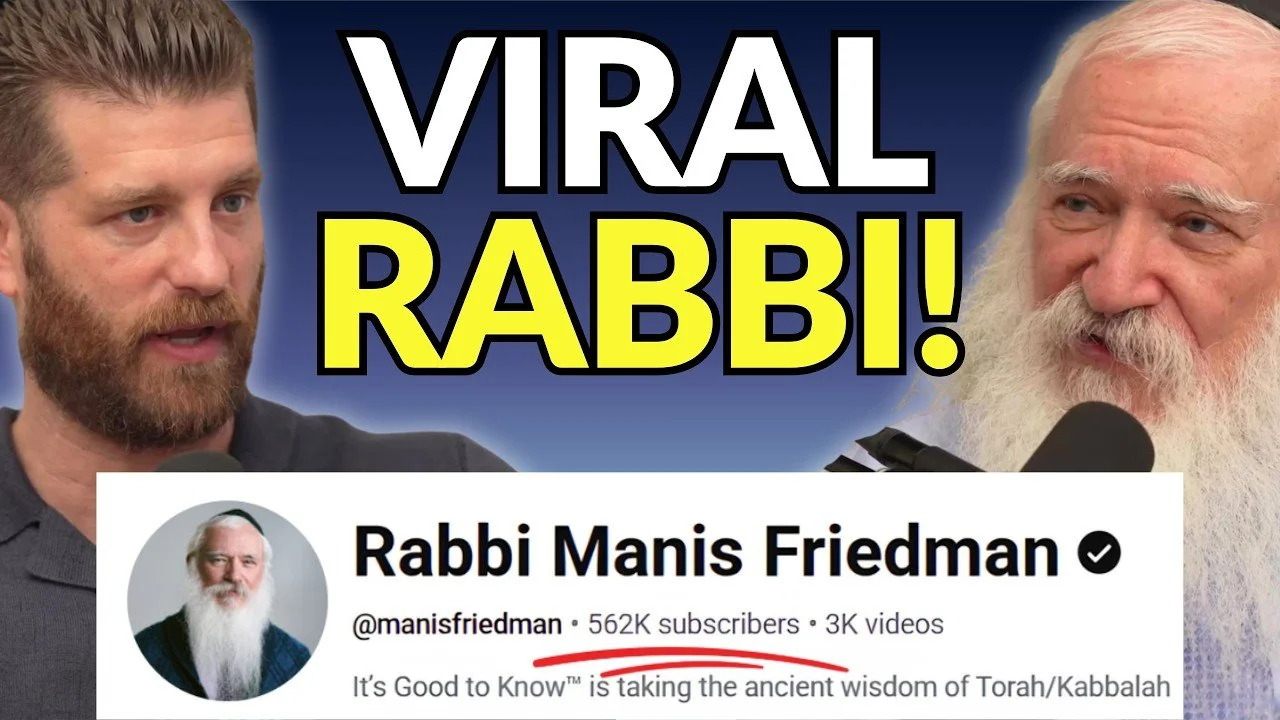
With half a million YouTube subscribers and nearly 400,000 on Instagram, this social media sensation is taking the internet by storm.
But the best part?
He's an 80-year-old Hasidic rabbi.
How did he amass such a huge following?
Why is his message going viral?
And what's it like being Bob Dylan's personal rabbi?
Find out right now.
I'm Jonah Platt, he's Rabbi Manis Friedman, and this is Being Jewish.
Shalom, and welcome to Being Jewish, your home for deeply candid conversations on Jewish identity, culture, and current events.
I'm your host, Jonah Platt, and today I'm joined in studio by none other than YouTube's most popular rabbi himself, Rabbi Manis Friedman.
Rabbi, welcome to the show.
Thank you.
And thank you for this lovely kippah, which if you're watching, you'll see I have, I have donned in the interim, uh, courtesy of the rabbi.
You offered, and I felt like this would be an appropriate episode to wear one.
I've not worn one on the Being Jewish show before, so today's as good a day as any.
Rabbi Friedman, h- how does an 80-year-old Chabad rabbi end up with 3,000 YouTube videos and half a million subscribers?
How'd you end up on this path?
Do you have to start with my age?
Well, it's, it's, it's kind of amazing, right?
I mean, when people think digital influencer, they're, they're thinking Gen Z.
They're not thinking someone who's been doing this for 50-plus years.
Yeah, 'cause the message hasn't gotten old.
I have.
But the message has not.
It's vital.
It's life-saving.
It's life-changing.
It's, it's, it's… Can't stop.
Let's drill into that in two ways.
First, let's talk about the message itself.
Like, what is your message, and why do you think that's resonating so much with such a wide audience?
Maybe two things.
Number one is, are we getting anywhere?
As a species?
Yeah, as a planet.
Uh-huh.
Are we headed anywhere?
Are we getting there?
Is there a goal?
Is there an object- Is there an end to this?
Or as some people say, "There'll always be wars, there'll always be suffering, there'll always be…" I don't like that.
I don't like that picture, and, and it's not true.
Creation has a purpose, and there's a direction, and we've been going in that direction.
You know, with a little backsliding.
Mm-hmm.
A lot of backsliding.
Yeah, yeah.
But there is a direction, and we are getting there, and if we would do it more consciously, it, it would, it would move things along a little faster.
It's happening naturally.
In the last, I don't know, maybe 20 years, the question of why are we here- Has become so urgent and people are desperate To, to what do you attribute that new level of urgency that you're seeing?
It's a mystery.
Mm.
I don't know what did it.
We've been going through the motions for thousands of years.
Mm-hmm.
Where are we?
State of the Union, you know?
Right.
Like, what, how are we doing?
We don't know.
We don't know where we're going.
We don't know what the pur- It, it, it, it makes people crazy.
In their private lives, of course.
Mm-hmm.
You don't know what you're living for, you don't know what your goal is, you don't know why you wake up in the morning.
Yeah.
That's dangerous.
And you feel that by focusing on that, that's what people are, are coming to you to guide them towards that purpose, or to at least start thinking more intentionally about it.
In some way, that is the essence of Judaism.
What is Judaism's message?
There's a purpose, there's a goal, we're getting there.
What's the goal of Judaism?
What, or what does Judaism say is our goal?
God created the world as the lowest of all creations with the potential to be the highest.
We're here to bring out that potential.
How have you come to identify that as the purpose?
Well, first of all, that is the stated purpose.
Religiously.
Mm-hmm.
This is what we believe.
Now it's become an urgent need.
It's not a belief anymore.
When kids are saying, "I didn't ask to be born," uh, we better come up with some answers.
I've not heard it framed that way, so, like, I'm curious.
You say it's stated by God where?
Throughout, like, this is a something with a beginning and a, and a goal towards the end that you're trying to achieve as a race?
Yeah.
As a human race.
It's called tikkun olam.
Mm-hmm.
Repair the world.
Well, I guess the, it begs the question of why.
If God could have just created a perfect world, why did he create an imperfect one that we have to repair?
Good question.
But these questions are not philos- philosophical or academic anymore.
They've become urgent needs.
I don't understand, why are we doing this?
And, and we happen to be the most comfortable of, of any generation.
Oh, yeah.
It's not like we're desperate from physical need or deprivation.
Right.
And maybe because we have free ch- free time Right, because those needs are met … we can actually think that going through the motions just so that I don't die, it's not making sense anymore.
So death is not what it used to be.
That's encouraging- Yeah … I suppose.
I'm curious, so we've… That's, like, the message piece of how and why and what you're doing.
What about the operational piece?
I mean, how do, how does a Chabad rabbi become a YouTube sensation with half a million subscribers?
That's the wonder of it.
All I'm doing is saying what Judaism is, and they were saying, "Oh, we've been keeping this a secret?" Yeah, I feel like you gotta give yourself a little more credit.
I mean, there's a lot… It, it doesn't just happen that, oh, I have a good message, and now I have thousands of people watching me all the time.
I mean, you're putting a lot of energy and work, whether it's you or, or, or your team or whoever, to create a ton of content on so many different topics.
Like, did you decide I'm gonna do the YouTube route, that's gonna be where I'm gonna land, or was it we started making some videos, people are really responding to them, let's make a couple more?
I mean, how did, how did that part of it work?
Very organic.
Very organic.
Completely organic.
All I do is talk.
That's it.
And I talk a lot.
So just stick a camera in front of you- Yeah … and you got a lot of content.
Put in the quarter and- Okay … it'll play.
It's getting to the one question that people need an answer for but are afraid to ask.
Why?
That's interesting.
Why do you say people are afraid to ask that question?
I think we've been intimidated.
Scientists won't ask why is there a universe.
Really?
Yeah.
Oh, oh, that- that's philosophy.
Uh, no, I'm trying to describe this world.
If you can't tell me why it exists, I don't know what it is.
If you can't tell me what a car is for, then I don't understand a car.
Right.
You can tell me all the pieces and how it works, but what is it for?
What is this world for?
Particularly if you are religious and you believe in God, and God is perfect, and God is infinite, and God is almighty, what in the world is he creating this for?
Good question.
It's a very good question.
Yeah.
Who have you discovered is your audience?
I know it's, it's quite large, but is there… I mean, how would you describe it in a, in a sentence or two?
Who, who is tuning in?
Everybody.
Old, young.
It's such a universal message.
It doesn't leave anyone out.
What about, like, geographically?
Do you know where your audience is?
Everywhere.
In equal measure?
Well, some are more surprising than others.
What's a surprising place?
New Guinea.
Yeah?
Decent following in New Guinea, huh?
Okay.
You know, they have, they need purpose too There's one guy who would come on a weekly program that we have, and then one day he says, "It takes me eight hours to get to where there's internet." He walks eight hours to listen to an hour's worth of information, then he goes back and he shares it with the villagers.
After about a year, he sends us a picture of a building that he put up, Torah Center of New Guinea, and he is the teacher.
That's amazing.
And people come in canoes.
That's wild.
That's very cool.
I mean, talk about impact.
Yeah.
That's amazing.
What have you discovered hits the most with your younger audiences of the things that you discuss?
Dating, family, marriage, relationships.
Sure.
Always hot.
Yeah.
Always, always intense topic.
Purpose of life.
That's it.
It's all coming back to that.
It is so necessary.
Yeah.
People are suffering.
Like, most anxiety, which is so widespread, everybody's on anti-anxiety.
Sure.
Why are we so anxious?
We're safer than ever.
Mm-hmm.
We're living longer than ever.
We have more freedom than ever.
What's with all the anxiety?
Well, I think the three things that you just pointed out, uh, beyond the purpose question, which I agree is hugely important, is we are today so overexposed to life's dangers and negatives because of the prevalence and ubiquity of social media and the media, that we are seeing more things we think we need to be anxious about than ever before, that probably for the most part existed, we just didn't have to see them or look at them and think about them, and now we do.
And so it… people get wrapped up in it, and they forget those three things that you mentioned, that we're safer than ever, we're healthier than ever, we live longer than ever.
We're, we're more comfortable than ever, all of those things.
But I think another way of saying the same thing is, "Okay, now I get the whole picture.
I thought, I thought I didn't know," right?
There was a time I, I only knew my little village and my shtetl and my… right?
Now I see the bigger picture.
Why?
What is all that's going on, it doesn't scare me, it puzzles me.
Why?
What is the point?
A lot of suffering in the world.
Yeah.
A lot of evil in the world.
A lot of corruption in the world.
What is this?
Who needs this?
Well, those are two different questions, right?
It's the why.
Justify this.
Make sense out of all of this.
Yeah.
So most of the anxiety comes from not knowing why.
We're just gonna go through these motions over and over, and then our kids will take over, and they'll go through the same… This is a treadmill that we… Where are we going?
Not knowing who created you and why, it's gonna leave you anxious, even if nothing terrible is happening, but nothing makes sense.
And, and that's a compliment to the human being.
We really are intelligent creatures.
Intelligent creatures can't handle- Senseless, pointless anything Mm.
Why?
That's an intelligent question, and yet religion tells you you can't ask why.
Scientists don't want to deal with the question of why.
What do you mean religion tells you you can't ask why?
Not the Jewish religion.
We're encouraged to ask.
Yeah.
But that's because we're not really a religion.
Right.
No, religion is meant to discourage individuality, discourage independence, discourage questions.
That's one way of framing it.
One might frame it as it's providing the answers, thus- Right … not requiring a question.
But it's, it's giving you the comfort of, "Here's your answer.
You don't need to be anxious anymore.
I've got it for you." Yeah.
"Here's the answer.
You can't ask any further questions." Okay, so let's move into, this is a good segue into the answer.
I mean, you, you've posed the question.
Now we- this is a great introduction to the episode.
Now let's get into the meat.
And I wanna start by having you define some stuff for me, if you would, 'cause my audience really ranges in terms of I have Jews, non-Jews, new Jews, old Jews, all the, the gamut.
So Hasidism, what is it?
And how much is what it is today is reflected in how it began under the Baal Shem Tov centuries ago?
To oversimplify- Yes, of course … oversimplify, but getting really to the point of it, the Baal Shem Tov basically said, "You pray to God.
You believe in God.
You trust God.
You serve God.
You worship God." Good for you?
Yeah.
Very good for you.
What does it do for Him?
What does it mean you're serving Him if all you're doing is getting benefits?
"Save me, protect me, bless me." What- Yeah … you're on the take all the time.
You ever stop to think what's in it for Him?
It's an important question.
Is this really a relationship?
Or just follow the rules and shut up So what's the answer?
What's in it for God?
So first of all, just that question.
Can you stop for a moment and ask if there are two people in this- Yeah … or two beings in this relationship, and you never stop to think, "What is He getting from all of this?" Yeah.
" Oh, no, He's perfect.
He doesn't need anything." Well, if He doesn't need anything, how do I relate to Him?
He doesn't need me?
"Yeah, but I should love Him with all my heart." What are you talking about?
The Ba'al Shem Tov says y- y- you're not, you're not participating.
You're just using.
This is the revolution that is gonna fix the world, and it can do it overnight.
I, I said this to a church group in Puerto Rico.
"Get off your knees and stop using God for your benefit.
Do something for Him.
He has a bigger investment in this world than you do." That makes sense.
Oh, yeah.
And in, in 15 minutes, the entire structure, their entire orientation towards God, towards life changed, and they were all like, "Yo, why didn't we think of that?" Right.
" God is here to serve me?" What does God get from this mess?
This- Tell me … God creates Adam, and then God said, "It is not good for man to be alone.
I will create him a helpmate." Okay.
The big question is, why did He say that?
Create what you need to create.
Why announce it beforehand?
Yeah.
It's almost like I gotta apologize for what I'm about to do.
I gotta give you a, a justification because I'm gonna create women.
Right.
You, you- Let there be woman … you're on a roll.
Yeah.
Right.
You have… You know, you created the light, and you created the sky, and you created the grass.
You created a man.
Now create a woman.
Right.
What, what is this new statement here?
Hm.
I'm going to create a woman because it's not good to be alone.
If you really listen with a little bit of sensitivity, God is explaining Himself.
Hm.
In fact, all of Torah is God explaining Himself.
Not a bunch of commandments.
That's such a non-Jewish version.
Like even the Ten Commandments.
Yeah.
What is it called in Hebrew?
Aseret Hadibrot.
Dibrot, yes.
That's not commandments.
Who, who invented this world, this word commandment?
What's the translation?
10 statements.
Sayings, statements.
Sayings, right?
Yeah.
God is revealing himself.
Why did I create this world?
'Cause it's not good to be alone.
And what was God before he created the world?
Alone.
I mean, completely alone.
There was absolutely nothing except him.
Now, you would think that that's a pretty good situation.
Why mess that up?
Right.
So God says, "'Cause being alone, not good." Why not create another being that can frolic with God on God's level?
He did.
That's us.
We're just not there yet.
Oh, we have freedom of choice.
In order to not be alone, there's gotta be someone else.
If I don't have freedom of choice, I'm not someone else, I'm just more of him.
Like angels, they're great.
They're just more of him.
Mm.
He can't have a relationship with an angel.
It's like having a relationship with your clone- Right or shadow.
So he gives us freedom of choice so that there is someone with an opinion, with a feeling, with a will, who can love him or hate him.
Now he's not alone.
At least it's interesting.
Yeah.
Now the question is, how does he get us to love him?
Mm.
He needs the fact that we don't have to love him, 'cause if we're just programmed that way, then he's still alone.
So please feel free to correct me if I'm wrong.
I've just started reading about Maimonides, and it seems like he would disagree with this premise, right?
Because his whole idea is that, like, we shouldn't even attempt to relate to God in any sort of humanistic way like this.
God needs us.
God needs companionship.
Like, God is so unknowable and so on a different plane that it's like p- a preposterous statement.
So how, how do you respond to that kind of a thinking?
He's not saying we don't know.
He's saying God doesn't wanna be alone.
Why?
If he's perfect, then what's wrong with just being himself?
We don't know, not because we're not informed.
There's nothing to know.
Like, I hate being alone.
Why?
'Cause that's divine.
If you were God, you'd also hate being alone.
So here's, here's the beautiful thing about it.
Yeah.
By saying it is not good to be alone, God created that in us.
Otherwise, we would love to be alone.
Mm.
That's why people are always saying, "If everyone would just leave me alone- Yeah I would be perfect." But then if you leave everybody alone, they get really upset.
"I'm so alone." Mm-hmm.
So this alone thing, there's so much godliness in nature.
The reason people can't stand being alone is because they're created in God's image.
It's not human.
The human side of me would much rather be alone.
This divine thing in me, for no- External reason.
In other words, not for any practical benefit.
I don't want to be alone.
It's gonna cost me And there are practical benefits But that's not what the aloneness is all about.
Right.
It's not like I'm alone because I don't have anyone to do my laundry.
I'm not alone because th- n- nobody to talk to.
I'm alone because I'm the only one.
And why is that not comfortable?
It's divine.
That is the most impressive, the most awesome thing about God.
He is eternal, he is infinite, he is all-powerful, and just being himself does not add up.
Why?
That's divine.
Mm.
And the fact that we have that in- that instinct o- that is the most amazing part of… That I can't justify being just me, that goes against every human instinct.
Without you, I'm not, I'm not good.
With you, I'm fine.
Yeah.
That's not human, because without you, I'm free.
With you, I, I have to make adjustments.
Why would I wanna do that?
It's divine.
Mm-hmm.
So it turns out that every statement in the Torah, God is saying, "I need you by my side.
I need you, but I don't want you against me, I want you with me.
So here's what I do, do it with me.
Here's what I like, like it with me.
Here's what I hate, hate it with me.
Stay by me.
Stay with me.
Stay on the same page with me." Why?
It's not good to be alone.
Yo, fam, if you wanna make sure you never miss a beat with what's happening in my world, make sure you get signed up for my weekly newsletter.
I use it as a central hub for everything that's going on in my life, from extra thoughts on these episodes, to new projects I'm working on, to my live appearances, and just things that are inspiring me week to week.
It's zero spam, just us hanging out once a week in your inbox.
Head over to beingjewishpodcast.com or click the link in the show notes and drop your email.
Would love to see you over there.
All right, back to the show.
Now let's put that into practice.
Let's talk about Chabad.
For my audience who might not n- know, they've heard the word or they've, they've experienced it, uh, but what is it all about?
I would love to hear your thoughts on that.
You know the famous song, to know him is to love him?
Yes.
Old, but goodie.
You can't love someone you don't know.
You can try, you can fake it.
It's not real.
Right.
The more you know, the more you love.
Sure.
And that's why intimacy in the Torah, the euphemism for intimacy is knowing.
Mm-hmm.
Adam knew Eve, and she got pregnant.
Right.
That's called knowing.
Yeah.
So knowing is an intimacy that you can control.
The intimacy of the heart, you can't control that.
You can't say, "L- love." Right.
" I'm supposed to love right now." But if you get to know the attractive features of the person you're supposed to love, you- the love you will develop will be real, not artificially stimulated.
Right.
Which, which comes from faith.
Believe in God and love Him.
That love is not… It's not the real thing.
Right.
The only way you can love someone is by knowing.
So God gives us the Torah in order to make Himself knowable.
"Oh, God is a mystery.
We can't understand Him." Yeah, well, He doesn't like that, so He goes out of His way to make Himself knowable so that you can love Him.
That's Chabad.
A- and that's true of every relationship.
You don't love your wife unless you understand her.
"Oh, I can't understand women." Well, then she's in trouble.
And by the way, the same way we treat God, that's how we treat our spouse.
Say more.
Same way.
I'm talking to this guy who says, "Oh, no, no.
We'll never understand God.
He's a mystery.
You can't understand Him.
You can't." I say, "You think that of- about your wife, too, right?" Women, ugh, who can understand w- Yeah.
That's not surprising.
You say the Rambam says that God is not human.
He doesn't have human features.
You can't attribute human, human characteristics to Him.
Yeah.
But the Torah is full of that.
God's eye, God's mouth, God's- Right … head, God's arm, God's speech, God's anger, God's love All of that is not real?
I mean, he says they're not real, they're not literal in the way that some people take them.
Okay.
He is real.
He's the creator.
He's gotta be more real than me.
How would I become more real than my creator?
Doesn't make sense.
Mm-hmm.
So for example, God's arm, mentioned so many times in the Torah.
Right.
"His right arm embraces me." Does he or doesn't he?
No, he doesn't have an arm.
Okay.
What are you doing to him?
Mr.
Potato Head?
You lost the arm?
Right.
What Rambam is saying is we have a misconception.
We're convinced, just by nature, that our arm, what we call our arm- Mm-hmm i- is a real arm.
Does God have an arm like ours?
No.
So when we say he has an arm, w- uh, we, no, not really.
See?
There's, there's the mistake.
Does he have an arm really?
Yes.
A literal arm?
Yes.
You mean like my arm?
No.
'Cause my arm is not the real thing.
It's created in the image of him, so I have something that looks like an arm, but it's not the real thing.
He's the real thing.
That's what Rambam is saying.
Don't be convinced that a physical arm is more real than a spiritual arm.
It's not.
It devolves into a physical arm.
Mm-hmm.
But that's, like, the lowest representation of an arm.
Sitting with my granddaughter, she's crying 'cause the doll broke.
Mm.
The arm came off.
I said, "Oh, I can't imagine how much that hurt the doll." She starts to laugh.
I said, "What are you laughing?" She says, "It didn't hurt." I said, "How could it not hurt?
The arm came off." She says, "It's not a real arm." I said, "Why not?" She says, "It's plastic." I said, "Oh, right." Plastic arm is not a real arm.
A real arm has a bone with some skin on it.
Oh, that's a real arm?
It's a bone with skin on it.
God has a real arm.
We're created in his image.
We have something like it.
Mm-hmm.
We also have one on the right and one on the left.
Right.
But come on, his arm is the real arm.
Yeah.
His speech is the real speech.
We babble.
He says, "Let there be," and there is.
Yeah.
I can't do that.
I say, "Let's have quiet," and it doesn't get quiet.
Right.
We've got it all upside down.
God has more sensitivity than I have.
I'm having this debate with a rabbi.
Okay.
God doesn't need anything.
God is perfect.
And we're back and forth f- for, for long, long time.
Then October 7th happened.
H- he was seriously distraught, couldn't calm down.
He said, "Why?
Why did God allow such a thing?" I said, "Why not?
He doesn't need anybody." He got angry.
He says, "How do you talk like that?
What are you saying?" I said, "I'm, I'm just quoting you." Right.
This is a serious issue.
When I see somebody suffering, it hurts me.
Does it hurt God?
No.
What, I'm a, I'm more of a mensch than Him?
I'm more sensitive, I'm more caring than the Creator?
That's ridiculous.
Mm.
And, and it's dangerous.
Because of this notion that God is without character, everything falls apart.
So to say, "So what is He getting from this?" Oh, He doesn't get anything.
It's over.
Right.
It's all over.
Then what are you being religious for?
Right.
For your benefit?
That's called religion?
That's called serving God 'cause you're following His good advice for a good life?
How are you serving Him?
And if you're not serving Him, what's all the sanctimonious dying for the cause?
Get the benefits as much as you can.
What are you dying for it?
Mm.
What, the mesirus nefesh, you know, "I'll give my life for this"?
No, improve your life with this.
Nothing makes sense.
Nothing makes sense.
If the creator of the world doesn't need the world, what am I worried about?
Right.
Good question.
It's good framing.
And then one, one final presentation of this concept.
Okay.
If the world ended tomorrow morning, gone, no sun, no moon, no movements, nothing, over, fade to black.
Would it be a tragedy?
That would be a h- a human tragedy For whom?
For humanity that disappeared.
Right.
So who would w- who would, who would grieve?
Right.
It wouldn't be a tragedy.
Right.
Be a blip.
Yeah.
This whole world that we're so intense about, if it disappeared, it wouldn't matter at all.
Right.
See, that's where the anxiety comes from .
Yeah.
I'm working, I'm busy, I'm, I'm responsible.
I'm, I'm, I'm, I'm going for therapy.
For what?
We're a speck on a speck in an infinite sea of specks.
Yeah.
And if it ended tomorrow, no one would care.
Yeah.
Except God.
Right.
To him, it would be a tragedy.
Right.
So who's got skin in the game?
I don't care.
Here's the future.
This is Mashiach.
Human beings come to the realization, "I don't need anything.
I don't need anything." Not I have too many needs.
I have no needs whatsoever, 'cause I don't need this.
Not that I don't enjoy it, most of the time, and I like my life.
Do I need it?
I don't need any of this.
This is so amazingly liberating because it's so true.
People who feel needy are not healthy.
It's not natural for a person to be needy.
It is natural for a person to, uh, prioritize their own survival and flourishing.
Their own survival, which they don't need.
I don't need to survive.
It's a tough sell.
No, it's not.
It's so real.
Did I ask to be born?
No.
Do I need to be born?
No, but now that you're here, you'd wanna- Make the best of it … yeah, you know, you don't wanna give it up.
But I don't need it.
But you don't need it.
I, I like it.
And I hope I continue liking it, 'cause if I don't like it, it's over.
Right.
And that's why we're so desperate to enjoy.
Because if I'm not enjoying, I'm out of here.
And I started giving people answers before I knew anything.
I was straight out of yeshiva.
I, I, you know.
And they're asking me questions that are really heavy and serious.
This one woman comes to me.
I'm 22 years old.
What, what do I know?
Right.
And she says, "I have a plan this afternoon.
I'm going to kill myself." There's no meaning to any of this.
It's all meaningless.
I can't stand this.
It's meaningless.
I said, "It's all meaningless?" She says, "Yes, it's me- nothing.
It means nothing.
It's all meaningless." So like a wise guy, I said, "So why do you need to kill yourself?
Sit quietly, you'll die eventually.
What's the hurry?
It's all meaningless." She was shocked.
And luckily she didn't kill herself .
But really, why- My question was, if it's all meaningless, why is she coming to her rabbi to even talk about it?
Something she was- So she was at our program … well, something meant something to her.
Yeah, yeah.
But the point is, it's true.
If it's all meaningless, I'm not gonna wait.
I can't stand existing meaninglessly.
Yeah.
The most dangerous thinking is, it doesn't mean anything.
Doesn't mean anything?
You're suicidal.
Why?
Human beings can't handle meaningl- we can handle pain.
We can handle a lot of pain.
We can't handle pain for nothing.
Yeah.
All right.
That's the killer.
Yeah.
So when we discover I really don't need anything, 'cause everything I do is to survive, I don't need to survive.
I am not needy by nature.
I popped into this world.
I didn't ask for it.
I didn't expect it.
I didn't… I don't need it.
Here I am.
What, and I have needs?
No.
I have handicaps.
If I want to live, I gotta do certain things But then I have to want to live Right Because it's not natural Right So when people get problems, issues- Right … it's not because of trauma.
It's because of senseless.
I don't understand why all of this is happening, any of it.
It used to be that survival was the name of the game.
The farmer wakes up his kid 4:00 in the morning, "It's late, it's late.
We gotta get to work." "Why?" "Gotta get the seeds in.
It's the season.
If we don't get the seeds in, the winter's gonna come.
We won't have-- We're gonna die." All right, you get up.
Try it today.
Wake your kid up today, 4:00 in the morning.
"Wake up, wake up.
It's late." "Why?" "We're gonna die.
We're gonna die." "Well, if you don't catch the school bus, and you don't get good grades in, in grade school, and then you make it, don't make it into, into high school, and then you can't make it into a good college where you can get a good job so that you make good money so that you can pay the mortgage, then you'll be out in the street, and then maybe you'll contact a disease and you'll die.
So wake up." So wake me up tomorrow.
What is this?
And besides, you don't die.
You go on welfare.
Right.
You're still, you're still protected.
Yeah.
Mm-hmm.
So death is, is not what it used to be.
Mm.
It's just not the motivator it used to be.
And now we're thinking, "What in the world?" For all these thousands of years, people did whatever they did so as not to die Why?
You gotta live.
Why?
'Cause if you don't live, you'll be dead.
Right.
Yeah, yeah.
What is the point?
That's back to that question again.
Live in order to not die.
It doesn't make any sense.
Yeah.
So now we really need to know why are we here.
Kids are asking, "I have to clean up my room?
I have to c- I didn't even ask to be born." So let's say you're a parent, and a kid has that sort of a response.
How do you help them understand the purpose and the why without, you know, you'll learn over the next 50 years of your life, you'll get it, like- No you won't … I- The 50-year-olds are asking the same question.
So h- how do we, how do we teach the seven-year-old?
So first of all, don't panic.
Kid is not suicidal.
Right.
He's precocious.
Right.
He doesn't wanna make his bed.
He's got a, he's asking the best question in the world, and you didn't give him an answer?
Aren't you the parent who's supposed to provide the answers?
Yeah.
But the best we can do is say, " Well, I didn't ask to be born either." This is the crisis and the tipping point that changes the world.
Stop thinking of yourself as needy.
You are needed.
Wake up, 'cause if you died, the tragedy would be God's tragedy, not yours.
So to answer the question that I think I asked, like, I don't know, like 20 minutes ago, Chabad, what's it for?
It's to put that need- Information that, that into the world, and to, to turn that neediness into giving.
So imagine this double blessing here.
I don't need anything.
Yep.
What a relief.
It is so liberating.
Yeah.
On the other hand, I'm necessary?
To the Creator?
That's a reason to live.
Yeah.
Now you got something to do.
So I'm unburdened from my needs, and yet I am needed?
That's the whole story right there.
God calls Abraham Abraham says, "Hineini," which means, "Here I am." It means, "I'm available.
You need something?
Tell me, please, 'cause I, I don't know, I don't know why I'm here." So I'm not here for me.
That is the opposite of everything modern psychology tells you.
It's all about you.
Love yourself, validate yourself, take care of yourself, and we get more and more depressed 'cause it's not true.
Think of somebody else and you're already feeling better.
Yeah.
Okay, fam, real talk.
You've been listening for free this whole time, and honestly, bless you.
But if you're ready to upgrade from casual listener to in-the-group-chat, my Being Jewish Kehillah is calling your name.
Kehillah is Hebrew for community, and as a member of my subscriber community, you get exclusive weekly footage from the episodes that nobody else gets, merch discounts, premier tickets to my live events, and a spot at my monthly office hours, the live Zoom hangout where I take all of your questions, spill some behind-the-scenes tea, and we kibitz like family.
Pick your tier: Chi Five, Tribe, or Mensch.
It's a lot of Jewish words and a lot of Jewish fun.
Sign up at beingjewishpodcast.com/join.
All right, where were we?
What do you say to a non-Orthodox Jewish woman who might see Orthodoxy as limiting or diminishing of women from the outside?
From the outside, that's what it looks like.
Yeah.
So what do you explain to them?
From the outside, the Torah looks terrible.
Not just for women.
For women, children, and other living things.
Right.
Because it's so, it's so misrepresented.
God wants a relationship.
Where do commandments fit into a relationship?
So we use the word commandments constantly, and then we wonder why nothing makes any sense.
God says, "I created the world in six days and I rest on Shabbos, so keep Shabbos." Say, "What, what, what?
I should keep Shabbos 'cause you created the world?
What's the connection?" God is saying, "I need you by my side.
During the s- six days of the week I'm creating, create with me.
Be creative." Right.
" Produce." Yeah.
Right?
"On Shabbos I rest.
Rest with me.
Stay by my side.
I hate pork.
Hate it with me." Okay.
"I ce- I celebrate holidays.
S- some days are special.
Make it special for you, too.
Stay with me." So imagine a guy sitting by his Shabbos table, observing Shabbos, you know, doing everything, and his kid doesn't wanna come to the table.
What's lacking here?
Observance?
Religiosity is lacking?
The father is sitting alone.
The kid won't come to the table.
It's not a religious issue, it's a relationship issue.
Why won't you sit with your father?
I understand this, but what about the, the, the female piece?
The, the woman piece?
There is nothing in Torah that is more awesome than the woman.
I mean, who made Adam eat from the tree?
Woman.
The woman.
Who told, uh, Yaakov to trick his father into giving him the blessings?
A woman.
Who told Avraham to send away Yishmael 'cause he's not gonna inherit the land?
A woman.
Everything begins with the woman in Jewish life.
You're not a man unless you're a man to a woman.
So reread the Torah properly.
How would you respond to an anti-Zionist Orthodox Jew who believes their values are telling them that they should be opposing Israel at this moment?
They're out of their mind.
Great answer.
Okay.
Yeah.
You have… One of your books is Doesn't Anyone Blush Anymore?
And sort of the key ideas in there are about modesty and intimacy, and sort of at the core of that is that the purpose of modesty is to preserve intimacy.
What does that mean?
It means that pornography is not intimate.
To put it mi- Well, I think everybody knows that … to put it mildly, right?
Because intimacy means just us with no thing between us.
If I want to marry you for your money, that's not intimate.
Could be a good idea.
Mm-hmm.
But it's not intimate.
Sure.
If I want to marry you for love, it's not intimate.
Okay.
' Cause I don't want you, I want your love.
Hmm.
I want something from you rather than you.
"It's not good to be alone" means I just need you to be with me.
I don't need anything from you.
Where does modesty fit into that or, or preserve that?
So modesty means there's nothing to see.
If you want me- Hear me.
Seeing kills intimacy because seeing is very impersonal Uh, say more on that.
What do you mean?
God doesn't let us see him.
Right.
Because he wants an intimate relationship.
And if you're impressed by what you see, the relationship will last about a month.
Seen that, been there, done.
Right.
Because what you see is not the person.
You just see things about the person.
And that's why intimacy has to be at night in a dark room.
'Cause if you see, it distracts you from the person, 'cause you're just gonna see a thing.
Even if you're seeing how beautiful she is, beauty is not her.
Mm.
She won't always be beautiful.
I don't know.
You haven't met my wife, but- In the same, in the same, in the same way.
Yeah.
So- Weekly shout-out to Courtney.
So the point is, seeing ruins intimacy 'cause it doesn't let you get to the person.
It gets to something about the person.
This guy says to me, "I love everything about my wife." I said, "That's interesting.
Why does she want a divorce?" "Do you love her?" He said, "I love everything about her." Mm.
Uh-huh.
Not the same thing.
I said, "But do you love her?" He says, "What does that mean?" He doesn't even know what that means.
Yeah.
So she is feeling alone in the world, which is a horrible feeling.
Yeah.
Let's end with this thing.
Yeah.
The message to the world.
You know, we gave the world monotheism.
Yes.
But, but that was about 4,000 years ago.
Yeah.
What, you know, what have you, what have you done for me lately?
Yeah.
Any guy who goes to work, anybody, anywhere in the world, who goes to work and produces something useful, he is serving God.
God wants his world perfected.
If you're doing something to improve God's world, he owes you.
You're serving him.
You complain about the boredom of the job 'cause you work on an assembly line?
You're not working at… You're serving God from f- nine to five most days of your life.
You're a religious fanatic and you don't even realize it You are serving God from 9:00 to 5:00.
What are you getting from it?
That's not the question.
You're doing something for Him.
So Chabad starts this, this project of stopping a guy in the street saying, "You're Jewish, you wanna put on tefillin?" Right.
And if I do, what, am I gonna become religious?
Am I gonna go to heaven?
Right.
No.
You have five minutes, can you do something for God?
Yeah.
So if a guy says, "Put on tefillin?
I don't need that," great.
Even better.
Yeah.
So you have five minutes for God, so something that you don't need, which is really not even real.
You don't need anything, and that's, that's a problem with religious people.
If you're religious, then you have to do this.
You have to pray.
You have to bow.
You have to… I have to?
I don't have to anything 'cause I don't even need to be here.
Then what is all this?
Can you do something for God that you don't need, or does it have to be about you?
And if it has to be about you, you're headed for a depression, 'cause human beings are not beasts of burden.
We're not meant to be needy.
You are needed, and most people who produce food, produce products that are useful, toothbrushes, you're serving God.
Do it with joy.
Amen.
Rabbi, we're gonna end things here, as I like to do on the show, with a little lightning round.
I'm gonna throw you some rapid-fire questions.
You just toss them out to me.
The Rebbe or the Baal Shem Tov?
The Rebbe.
Favorite Bob Dylan album?
I don't wanna say.
Knocking on Heaven's Door?
There you go.
Uh- By the way, Dylan endorsed my first book.
I, I saw it.
Yeah The only thing, the only thing he ever endorsed.
Amazing.
Books or YouTube videos?
For myself, books.
You're prolific with both.
What about for, for an audience?
Oh, Yeshiva Internet.
There you go.
Best advice your father ever gave you?
Don't walk into a store if you don't intend to buy anything, 'cause it frustrates the store owner.
We've actually talked about that, that bit of Torah on this show a couple of times.
Really?
Yeah.
Yeah.
I like that one a lot.
What's some of the best advice you've given to your 14 children?
It's not about you.
It's not about you.
Don't get hu- don't become a teenager.
Skip that.
Skip.
Just go from being a kid to being a m- an, an adult.
Skip the teenage.
It's too much about you.
Love that.
Uh, what's the most underrated mitzvah?
Love your fellow Jew.
If we can't love our own- We're not getting very far.
Amen to that.
Um, what's the most overrated modern relationship advice?
Ooh.
Put yourself first.
That is so bad.
Well, you've said that in terms of dating, that dating should be sort of a selfish enterprise, right?
Yeah.
So how do you square those two things?
But you don- but you don't date forever.
Right.
You date selfishly.
You get married selflessly.
What's the most underrated piece of modern relationship advice?
You gotta surrender to each other, not use each other, and people don't like that word, but they want it.
The surrender.
They want to surrender.
Sounds good to me.
Favorite Jewish holiday?
Sukkot.
How come?
It's light.
It's, it's, it's joyful.
Mm-hmm.
Do you have a least favorite?
Tisha B'Av.
I think I can guess why.
Yeah.
And, uh, the final question that we ask of all of our guests, challah, rip or slice?
Rip.
Break bread.
That's maybe the best answer I've gotten so far on this show.
Rabbi Friedman, thank you so much.
This has been a real pleasure.
My pleasure.
And thanks to all of you for watching.
You can find all of Rabbi Friedman's work, including his new book, Divinely Vulnerable, at itsgoodtoknow.org.
And hey, if this conversation made you think, made you mad, or made you call your spouse, do me a favor and share it with someone who needs to hear it.
And when you're done with that, sign up for my new Substack, won't you?
To get weekly articles from me on all things Jewish at substack.com/@jonahplatt.
All right.
That's all I got.
I'll see you all right back here for the next intimate episode of Being Jewish with me, Jonah Platt.