
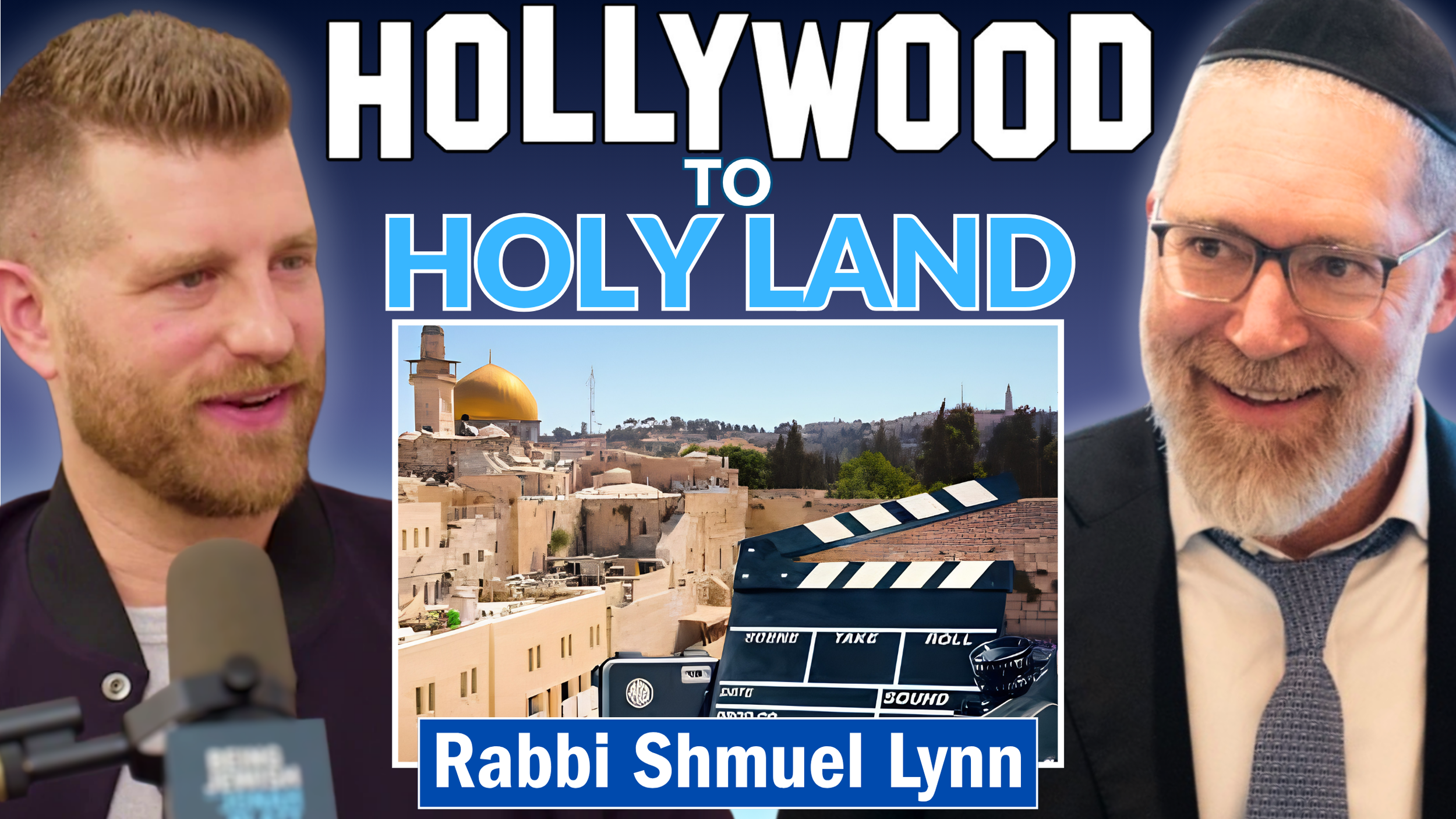
Interview Transcript
Hollywood to Holy Land, Screenwriter Turned Orthodox, Rabbi Shmuel Lynn on The Future of Judaism
I know what it's like to grow up not knowing anything about Judaism, that's how I grew up Have you ever thought about that as being part of your secret sauce?
It's hard to call it secret sauce 'cause that means you're selling something.
College and post-college kids.
Why is that the mission?
If you think back to professors that made a big impact on you, it wasn't just information, there was an experience that you had in the process of learning, and learning is a very deep thing.
There are so many different parts.
You can meet a person at the morgue also and know a lot about them, but it's not the same as having a cup of coffee with them.
Welcome back to Being Jewish with Jonah Platt, 30-minute mensches.
Same vibe, same tribe, shorter episodes.
When I was a student at the University of Pennsylvania, I wasn't super involved in Jewish life.
I had plenty of Jewish friends and a lot of East Coast family that I could spend holidays with, but Campus Hillel wasn't really my scene.
So still, I, I, I wanted some Jewish connection somehow, so I joined something called the Maimonides Leadership Program, which was a weekly discussion learning session led by a dynamic, engaging, and approachable rabbi who happened to have been a Hollywood screenwriter in a former life.
No surprise then that we connected and remain connected 20 years later.
He's changing the Jewish world one student at a time, and he's here with us today.
Please welcome Rabbi Shmuel Lynn.
Rabbi, it's great to see you.
Jonah, it's great to see you.
If you come for Shabbat tonight, it'll be a double pleasure.
Oh, I wish.
So, uh, because you spent the first chapters of your life outside the Orthodox world, you have such a relatability and, and a way of speaking that really connects with young people, I think.
Ha- have you ever thought about that as being part of your secret sauce?
You know, it's hard to call it secret sauce 'cause that means you're selling something.
You got a lot of mits- mitzvot in the world, you know, you have to do.
Where's the mitzvah of doing this?
And really, our, our sages teach us that you gotta look deep inside and, and, and look at your own trajectory and your own story.
So there's no question that kid born in New York City, growing up in Palm Beach, Florida, where there was antisemitism everywhere- Mm I was kicked out of four of the five clubs, um, on the island and, uh, and having the trajectory I did, and then finding this way of life, so the relatability for sure is there, but I think, you know, I think that I, I felt it not just as an opportunity 'cause I fit the mold, but as a calling.
Sure.
It's in everything that I do, putting myself into the mindset of someone who's, like, coming into Judaism from whatever way they're coming to it, either it's October 8th or it's anything before, that's bringing people to say, "Where am I?
How does this fit in?
How do I...
You know, what I wanna know, how do I wanna grow?" So, uh, I feel like I was, in a sense, born to lead in that way.
So let's talk about that calling, if, if we can.
So h- how does somebody transform from- Being in LA in the Hollywood scene to fast-forward, you're this, you know, rabbi, educator, deeply embedded And I went to Duke University undergrad, and I dabbled at NYU Film School, and I was living in the Village, and I went like, "Okay, the arts and theater," it's always been a part of my life.
My great, you know, my grandparents are jazz musicians and, and theater and f- and theater, you know, the arts and entertainment and music- Yeah ...
always been a part of my life.
But, uh, that made it through, you know, NYU and then out to LA of course, and, and as a budding screenwriter out there.
There's no question that the industry, you know, loosened the top in a sense of trying to ask yourself the questions of what's, what's real out here and, and, uh, and what do I, what do I do with this and where do I go and what are my surroundings like?
But then it re- you know, it wasn't some great, grandiose ho- you know, search for the Holy Grail.
I can't take credit for that.
Um, being in a situation where I end up working with a, a, a couple of guys who themselves had gone through a similar journey, who were a writing team.
They had written for The Cosby Show and Will & Grace, and, and, you know, they were young, handsome, successful, funny guys, and the question's like, "Why are young, handsome, successful, funny guys wearing a beanie on their head and caring about being Jewish?" And I got introduced to an entire world of let's call it observant Jews in the industry, and they all had great resumes and CVs and, and, and accolades, and I'm just like, "Yeah, but you don't really believe in like, you know, planes and talking donkeys and things like that." You went to Harvard, you gotta know something.
Nope.
So it started a journey like that, slow, starting to figure out what's real and what's true, and having, I think, the courage to sort of question the assumptions that I, that either I was mired in just 'cause of youth and, you know, what, what young people think in, in your environment, and starting to think for yourself, and it wasn't overnight.
Was it a difficult moment of letting go of what you thought had been, you know, your path and was important and you'd been devoted to and working towards to completely shift and go in another unknown direction?
So yes and no.
Um, there's no question that to many of my friends in LA, they're like, you know, "What, what are you doing?" Like, you know.
And half of it was in, in secret until I started, you know, said, "Okay, guys, I'm, I'm actually into this." Um, I happened to have a, had an agent that got me a, a writing job credit for a story about the Holocaust, actually the story about what pre...
what, what predicated the, the Kristallnacht episode, and, uh, fascinating story.
Phenomenal.
And I got so into it.
I'm like, "Oh my gosh, meaning- something meaningful and real," and it connected me.
Had nothing to do with religion.
Right.
Just like I, I felt somehow connected to this story.
It led to a lot more, there's no question, but, but I didn't...
I never felt I was leaving.
I knew I was leaving in that my mindset was, was, was elsewhere.
I didn't think I was leaving the profession, 'cause here I was sitting with, with people who were in the, in the industry and are leading very eng- let's call it very engaged- They openly engaged and committed Jewish lives, and the opposite's true.
I said, "Wow, I think this is how you can survive in Hollywood," 'cause I had that big question, like, how am I gonna end up the person I really kind of wanna be in, in, you know, and not the people other people want me to be?
But my whole idea is I went to Israel, and I studied, and I came back, and I went back again, and I came back, and I came back again.
The idea was I was going back to the industry.
My, my, my wife and my rabbi more conspired to say, like, you know, "We got other plans for him." And yet somehow it's- And here I was still back in it, so.
Right, exactly.
So it, it's all come full circle in a, in a funny way that you had a movie released last year that you wrote about the Holocaust, about Bardejov, this specific town, village in Slovakia.
Tell me about that project and, and, you know, that must've been exciting to be able to put your passion, all your passions kinda together in that one way.
It was, you know, I felt that, like, I got a little bit of a, a, a kiss from above in a sense.
You know, I definitely devoted so much time of, of my life to it, to the craft.
And, um, even though editing bays don't exist anymore, like, you know, you're not splicing film and, you know.
But, but, like, tying the craft and thinking it through.
And then, you know, I just landed from Poland a few days ago.
I, I go a few times a year.
Yeah.
By the way, obviously in what you and I are both doing post-October 7th, um, the Holocaust story is actually really key, I think, to getting us over this hump that we are as a people in messaging and perseverance and vision.
Um, Holocaust survivors have the answers that we're looking for, and we need to spend more time with them, and there aren't many of them left.
Yeah.
And the story in Holocaust and the story there and what goes on is a real...
It's a, it's, it's a supercharged point.
You know, you, you...
Electric car, there's a supercharge that, that you can get there Jewishly, where you can see we've been through the darkness and what comes on the other side.
And you, like, look at the state of Israel as an outgrowth of, like, a Holocaust.
And you say, "Okay, maybe something even more incredible is coming on the other side of this darkness." But it's very powerful.
So I go there all the time.
Wow.
It's a defibrillator of, of, of, of Jewish identity.
We have October 7th now, so, so, so...
But, but it's powerful.
But nonetheless, I...
You have to fundraise, and I called a, a, a, a, a, a survivor from Los Angeles who's a philanthropic man, and I, you know, asked him if he would contribute.
"It's such incredible work, Holocaust education, you know, testimony, et cetera." And he says, "Nope.
I only give money to my hometown preservation." A few years later, I was with a group going from Krakow to Budapest through Slovakia.
I said, "You know what?
I'm gonna call his...
I'm gonna call his bluff." And he said, "Sure.
I'll pay for your hotel, your food, and I'll get you a tour." And we stumbled upon...
And now I've been teaching Holocaust for, for 20 years.
I've been there.
I see it with my own eyes.
The Slovakian story anyway is a fascinating story 'cause it's not as attractive or wasn't as well known as the Hungarian story, as the Polish story, the German story.
But it's fascinating in and of itself.
The story was only known, discovered about a decade ago.
And this particular episode, which was at the very first transport of, or organized transport of, of Jews to Auschwitz early on in, in Auschwitz's career in 1942, were...
ended up being 999 Slovakian girls, 16 to 22, thinking they were going to a shoe factory.
Okay?
Jesus.
That wasn't...
That was discovered 15 years ago or so, let's call it.
Wow.
Okay?
The idea of, of those transports.
'Cause Slovakian story, the Germans didn't go in.
The, the Slovakians did the work themselves mostly 'cause they signed up- Mm ...
with Hitler to one.
So anyway, this town managed a very beautiful shtetl and, and very w- amazingly courageous, um, Jews who were leading the, leading the charge there.
Basically, there were about 300 girls at, from...
They had been rounded up from there and the surrounding areas, and they're gonna go on this train, and they found out the trains were not going to a shoe factory But to a place called Auschwitz, and they found out what happens there, and they basically had to figure out, "Well, how do we save our daughters?" And they did, and they managed to do it in the most brilliant way by feigning a typhus epidemic, 'cause the Germans played the work thing, so typhus would be a scourge to their plans.
So they played them at their own game.
They smuggled into the deport center where the girls were being held double doses of the vaccine so they would show symptoms, and they managed to get all the girls out and stop the transport.
Now, it doesn't have the happy ending you might want because, of course, eventually the ones that did leave went to Hungary, and that story comes later in 1944.
But it's an amazing...
It, it was amazing.
So I...
So this is like, this is the most incredible story.
And I thought it was, you know, when, w- when COVID hit, I thought, "My goodness, this is the story." Typhus vaccines, epidemics, COVID.
No one knew October 7th was coming, and this is really a story.
And it turns out that I called this man, who, the, the survivor, and I said, "Who are you?
And I'm coming to see you." And he says, "Well, I don't live in California.
I live in Pennsylvania." I said, "Where?" He says, "I live in Philadelphia." I said, "Where?" And he said, "Val, he's around the block from me." So- Amazing ...
we became super close, and I said, "You gotta make a movie." He says, "Yeah, I did my research on you.
We're making a movie." And then it came out, and there it is.
It's amazing.
That's so cool.
You mention in there that, uh, you're, you're taking college and post-college kids to Poland.
Your, your, your career as an educator, as a leader, has been focused 100%, really, on that age group, those college and post-college kids.
Correct.
W- why is that the mission?
Like, why is that your target?
Great question.
I don't wanna take away from anyone who's doing high school work or early education work or adult education work or family work and Judaism- They're all important all important.
I think that, uh, that was where I, you know, I, I was waiting for a Jonah Platt of the world.
Like, you're on your own.
You're thinking.
You're great.
I wanna be in a place where people can make the biggest changes, where they're free to make biggest changes, where they're already being pushed to think.
Now, between you and me, we...
It's another conversation over, over, you know, over a glass of wine, of where the world has changed in people's mindsets in 20 years since you and I met.
The freedom that you had to think back then and the conversations we had, the...
All professors at Penn will tell you that the world's changed in, in, in, in the classroom also, and the mindset's changed.
But people who can think and, and can grow and are at a stage of life where they can really change their loyalties, change their ideas, be open to consider things.
And I think that if we're being surgical, clinical, if my job is to, to drop in and parachute in and try to make the biggest impact as possible on a demographic that's got the greatest ROI, that was it for me.
And it's also the language that I, that was ready to speak, you know?
I was ready to, to deal with this stage of life, and I need that to leverage the idealism and then ride the waves of the world's, you know, new orders every, every few years.
You know, I think the goalpost shifted a little bit, which is why 10 years ago, I...
Penn still happens, and we still have programs at all the campuses here and around the country, but I particularly moved to begin the programs post-college.
I felt the goalpost shift- For pe- for people, their independence, their ability to, to think downfield, their bility- ability to consider life and marriage and future and career changed Those conversations and thoughts are happening a little bit later in life for people than they were 10 years ago.
Yeah Yeah, it's the way this works.
Everyone knows that we, we kind of all, we've all been dumbed down a bit, so like, you know, we gotta rise to the occasion.
Um, and so I, I have a center in Manhattan.
That's where I fu- I, I function at.
It's obviously a much bigger endeavor than just one campus, 'cause it's New York City.
It's in Greenwich Village.
We're talking about Olamim.
Olamim now, and it's packed every night of the week, you know, especially post, I mean, post-October 7th is a different world.
Mm.
Even before that, for the s- eight, nine years before that, you know, is it was, uh, it's a, it's...
I think that was the place I felt that we needed to be, and the, and what I needed, what I felt that the Jewish people, the next, the investment of next generation of Jews, the leaders or the people who are either gonna be part of the solution or not, I felt that was the place to make the biggest impact.
So when you say impact, w- what kind of impact are you trying to have?
I think it's like pointillism.
I think there's a big picture that's made up of the, of the, of the individuals.
Um, there's no question that if we, we have to think big, why not?
We have to go for generational change, but there's no question that it's one, it's literally ""Bishvilo nivra ha'olam"" it says.
Bef- you know, you have to say, say that the world was created just for me, and it's raising every single Jew to the, to the greatest vision of what they can be and how they can see themselves.
So we're always striking the balance.
To be honest, I had a board meeting before this, and even this is 20 years in, we're still talking about making sure that we're maximizing individual growth and attention.
And if someone steps up to the plate and says, "I w- I wanna change the way I interact with the world as a Jew," which is happening all the time now.
Yeah.
Forget the spectrum of religiosity, just identity, just friendship and community, just knowledge about what things are.
You know, y- I know what it's like to grow up not knowing anything about Judaism.
That's how I grew up.
Sure.
So it's, it's trying to make big cultural changes.
New York City, we definitely have...
You know, we changed the college, uh, campus, you know, field of, of education for sure.
Everybody wants to make a great thing of themselves, you know?
Mm-hmm.
I've watched you do it over the years, right?
So like, you know, can you imagine, imagine, imagine thousands and thousands of Jonah Platt's, what the, what the Jewish world would be if, if, if, if today's y- generation, who are in the main cowering and afraid and unable to, to, to, to express themselves, to give them the language, give them the tools, give them the power and the vision and the confidence and the, and the beauty of it.
That's, you know, that's, that's what we're going for.
That brings me to my next question, which is sort of like, what, are you seeing a difference in the attitudes and, and emotional state, I guess, of the kids who are showing up at Olamim now as opposed to three years ago?
There's no question that we are on a, we are, we are in a generational change right now.
There's no question.
And if we don't do it ourselves, well, the world's certainly doing it for us.
So I've had to sit back and I, and I, and I, and I train a lot of people in the field, and I speak at a lot of conferences and, you know.
And, and like, yeah, yeah, like the classes you gave before, the messaging you had before, let's go, let's redo it.
There's a different, uh, y- it's a different song that we have to play.
Um, the love has to be there, the connection, the depth, the profundity, the truth, the Torah itself.
But yes, it's, it's, it's, it's a different thing.
It's a, it's a very different thing.
And, and it's interesting because it's the Israel question- Mm-hmm which of course, like, you know, o- obviously, of course, we have to educate them, we have to be there, and that's a big thing, and more trips to Israel in solidarity.
We've done dozens of solidarity trips to Israel.
That's a huge part of saying this is connect people there, they should have friends who are Israeli, we're in this together, like it or lump it, as they say.
They're like, it's not going back to what it was.
On the other hand, that can't be a s- a smokescreen for someone's own individual recalibration and growth as well.
There's a spiritual side also, and you have to have both.
You have to have the, I think, the, the, the, the big national uplift that we need, and we have to have the exter- the externals, and we have to have the internal spiritual uplift as well, and I really believe those two have to go hand in hand.
Yeah.
I agree out of my own experience that I'm, you know, constantly, uh, working on now.
And the, the spiritual stuff has always been More of a challenge for me of trying to, to connect at that level.
I'm continuing to, to work on that and, and enjoying getting deeper into that, for sure.
As a storyteller, which you undoubtedly are, you've brought a lot of that, not just through that screenplay, but in a lot of the programming that you do and a lot of the projects you've worked on.
You know, you had that im- immersive play about, you know, uh, 1909 in New York City.
You have a, a play about Jews during the Spanish Inquisition, this, this famous trial, and the movie, other things like that.
Would you attribute those projects to your personal passion sort of shining through?
Or are you seeing something specific about that methodology that you're like, "This is something we need to be doing more"?
Ca- can it be both?
Yeah, it definitely could be both.
I, I mean, I assume it is, I guess.
There's no question that it like, it's, it speaks my language.
You know, everyone, if you think back to like the, to professors that made a big impact on you, and you know, I remember the ones that I can point to that it wasn't just information.
There was an aura.
There was an experience that you had in the process of learning, and, and learning is a very deep thing.
There's so many different parts.
You know, we, in, in the Torah, when it...
Y- you think it's prude when it says that Adam knew Eve, you know?
But the, the, it's a translation of a word which is in Hebrew called daat, which means to know, ani yodea, I, I know.
So the reason why it's used as, not because it's prude.
It's because knowledge h- has many different factors to it, and there's a calibration of mind and of, of, of emotion and of, uh, physicality.
And you're gonna find that code in a sense, you know, everywhere in Judaism, from every mitzvah's gonna have.
It's, uh, it can, it can attach to the head and the heart and the body and the physicality.
So a full calibration of knowledge is, is really needed.
When someone says, you know, if someone walked into the room to you and said, "You know, I know everything about love, but I've never been on a date in my life.
I've just been studying the history and the chemistry and the biology and the sociology of it," and he's got a, a PhD this big- You know?
But he's never been on a date, but you're laughing him out of the room.
He doesn't know anything about love.
Right, right.
It's just, it's a cute little, little, little in, you know, story just to bring out something that this is, you know, in, in, in the Shema it says, "Don't go after your heart and after your eyes." And the, and the sages say, "Heresy is in the heart." Why?
I mean, heresy's up here.
I think- Right ...
I'm an atheist and this and that.
Why is it over here?
This is the path, and it's a real thing.
It's not trivial.
So h- anyone's gonna do that well, whether it's the food that you serve in the Maimonides program, right?
Or the ambiance that's there.
It's curated.
We, we, we all do that.
That's part of the experience.
But actually educationally it's much more ...
It's, it's, it's really super important.
And if you're, you have a natural talent, let's maybe in that area of storytelling, as you said beautifully, 'cause that's what it is.
You bring someone on a journey.
It's not manipulation.
It's you're opening a person's senses up and you're letting them get a chance to know something, not just over here.
People ask me, "What's the difference between what I do and a, and a Jewish studies department," let's say.
Not to take anything away from academia, but like, you know, you can meet a person at the morgue also and know a lot about them, but it's not the same as having a cup of coffee with it.
So a lot of what I do, and I do it in extreme way, but the way even our center is curated and the experience.
You, you walk in on a Tuesday night in New York City, there's a jazz band, an open bar, food galore, and classes that are, that are great, on target, spot, speaking your language all night long.
And people will come in from the streets 'cause they hear about it and say like, "This is not the Judaism I grew up with.
This is like Greenwich Village.
Like this is the..." You know?
And the idea is like, we need to open up.
And yeah, I, I, I have a ...
You know, I enjoy it, and maybe, maybe the Almighty gave me a, a bit of talent in that area.
But so to make really experiences like that, the trips that we do and the plays and theater to actually, actually use the story head-on, I think is very powerful.
I mean, I think that a Jew that comes in and like, where do you get someone to put their phone away today?
Right.
They'll, they'll still do it in the theater.
So you get someone to come into a theater for two hours and go through a, a, a journey of Jewish history, and they can ask themselves, "Wait, how did I get here?
And what did my great-great-great-grandparents think when they came through Ellis Island about what they wanted for me?" And like, and then you ask them like, can you, you, you ...
We, we do immersive theater.
So at the end of the day, they're writing letters to themselves from their grandparents on Ellis Island on a boat after having been through an experience and seeing the trials and ordeals that people go through, and that your great and your, and your ancestors went through, you know, fleeing Cossacks and whatever.
And you're like, that's so you can go to Penn, man, and that you could like, you know, have a podcast and like there's 3,500 years of people rooting for you, and maybe even asking things of you, you know?
And, uh, so experience is, is key.
You've got a huge family.
You're running these programs.
You're going to Poland.
You're writing screenplays.
I mean, y- you remind me- The person you remind me the most of is my mom, like in, in your, in your boundless energy and ability to be in seemingly like 50 places at once.
Where, where do you get your energy from and your ability to just...
I mean, writing a screenplay alone is like the most painstaking process, and you're doing it while doing 100 other things.
So I'm, I'm super impressed by it, so I'm, I'm just curious how you, how you get through it all.
I'm about to send you my first...
the draft of the next one that I've done, that I'm doing next.
Which we're gonna talk to about that in a second.
Oh, okay.
Put a pin in that, yeah.
And, uh, 'cause you're busy also now, so I still want that time from you 'cause your notes are too good.
Always.
You know, some people ask me, like, my, my, you know, job satisfaction.
So I, I, I see things through the Holocaust.
I can't help myself.
You know, I'm...
It could- Some people think it's morbid.
I, I actually think it's, you know, I think it's also you can have a great sense of humor there also.
What do you mean?
Meaning if you can laugh through that, and maybe you have to earn your stripes.
You have to go to Poland as much as I do, or be a survivor or something like that.
Mm-hmm.
Mm-hmm.
But, you know, they, the sages teach us only two things in all of creation laugh: God and man, right?
And the last laugh is a real thing.
Laughter is when everything was supposed to be one way.
Think a good slapstick comedy.
Everything's supposed to be one way, and like that you realize the opposite was completely true, and that experience brings out laughter.
So if you see the darkness and the light and you c- and you go back and forth so much you almost stop, you almost can't tell the difference, you, or you would never have one without the other.
That's the deep part of it.
You know, that laughter, you gotta laugh through it.
But, like, so it might be morbid what I'm gonna say, but people ask me about job satisfaction.
Like, I don't know.
If you ask the partisans in the Slovakian hills in 1942 who are bombing German convoys and blowing up rail lines and, like, taking Jews, like, "What's your job satisfaction like?" I don't know.
I mean, like, I don't, I don't know how to answer the question.
So on the one hand, I have an amazing job.
It's, what an incredible thing, 'cause I get to meet tons of people like you and be part of people's journey for better, you know, hopefully for better, and, um, and be having real conversations in real areas of life, and then, you know, in a place like Oc- post-October 7th, where it's really, you know, touch and go, life and death stuff- Yeah for people's own lives.
Um, it's a privilege and it's humbling, and I get the energy from the mission.
I'm surrounded by amazing people, and I see people come alive, and I see what wisdom and truth and identity and, and a sense of history and knowledge and spiritual impact has done for people over 20 years o- of my career.
I'm humbled by it, and I wake up every morning saying, you know, "If this is what the Almighty gave me, if I had to go through Palm Beach and everything else to get there." It's the mission that, that, that, uh...
You know, you sleep these days?
No, you got kids.
La Baby.
Not enough, yeah.
You got a wife.
You have a busy podcast.
You're out there.
You're one of the few that are making a big impact out there, and I'm, I get a lot of...
I just have to say, very proud of you.
Thank you.
Always, always I wanted you to be a rabbi, and, uh, but, like, this is, like, let's call it, like, the, you know, the, the, the AI version.
So you mentioned you've got your next project.
Already underway.
What's, what's the new screenplay about?
There's never been, uh, a, a- there's been documentaries, but a dramatic, uh, representation of the Soviet Jewry movement.
Yeah.
Now I remember as a kid, bar mit- all my bar mitzvahs, I was upset about it then 'cause those got taken and sent to the Soviet Union for Soviet Jewry.
Um, but you're talking about people, like, who are alive and there and tell you that they went through it, they beat the KGB.
And it's not just the people who were there.
The post-Holocaust guilt of American and, and, and European Jewry was that we were too little too late in the Holocaust.
Mm-hmm.
All of a sudden you're faced with a few million Jews behind the Iron Curtain who are suffering and wanna live in Israel.
And all of a sudden there was a chance for so, like, you know, housewives, housewives of, of, of America and, and the UK, you know, like, like, brought down the Iron Curtain, literally brought down the Iron Curtain.
If you go into it and the pressure, the US pressure, where'd that come from?
Who pressured them?
And the agricultural agreements that were between the, the, uh, the Americans and, and, and the Soviets had to do with a lot of pressure that came about Jewish freedom and immigration and how that changed and how it pushed towards perestroika and glasnost.
But the point is there are...
This is an incredible story, and right now what we need to draw from, we need heroes.
Yeah.
These are people, you walk on Ocean Boulevard, Ocean Parkway in Brooklyn, and all the Russians, you know, they're, they're like, these people, like, were- sacrificed a tremendous amount.
They knew very little about Judaism, but they knew because they weren't, they weren't confused by anything.
"I'm a Jew, and I wanna live freely as a Jew, and Israel's my place, and I might not know anything, but I'm gonna fight to the last breath for it." And so I've had the great privilege all these years of, uh, it sh- ironically, of someone my wife's family used to champion when they were in prison and they were in the Soviet Union and their cause.
And it turns out they moved to Israel when they got out eventually and ended up in little sleepy Bala Cynwyd, Pennsylvania, where I live, around the corner from us 20 years ago, and we've become super close.
And you may remember, I sh- I used to bring her in to speak at Penn and tell her story of a young woman who it was, greatness was thrust upon her and who fought, and the KGB on numerous occasions tried to finish her completely, and what that meant for her and her life and her struggle.
And so this is her story that, uh...
And because of the last film, she was very hesitant for someone to actually make it public.
It's very hard.
It's a difficult, triggering story.
Mm.
And because of the last film, she said, "Okay, ready.
Let's go." I love it.
W- that's a, a beautiful message of hope to, to leave on.
Rabbi Lin, thank you so much.
It's just been great getting to, to chat with you.
We're overdue anyways, so this was perfect.
I think what you're doing is incredible and incredible, and, like, you keep using your strengths and your talents and your leadership ability.
And, uh, and, and God willing, you know, we should be dancing at all the right occasions, you know?
God willing.
God willing.
Thank you.
All right, he's a mensch.
It's been 30 minutes.
I'm Jonah Platt.
That's a wrap.