
Monologue Transcript
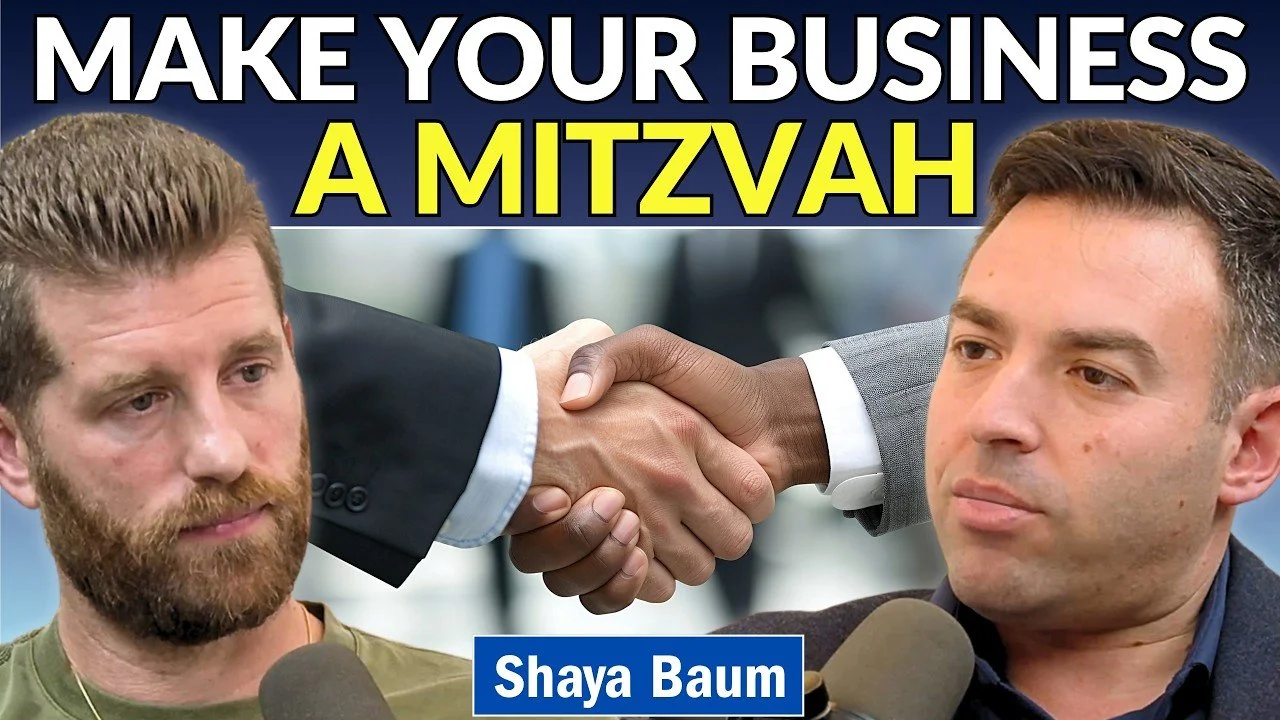
Saving Companies From Predatory Debt and People From Prison | Jewish CEO Shaya Baum’s Many Mitzvahs
Welcome, folks, to Being Jewish, your home for deeply candid conversations on Jewish identity, culture, and current events.
I'm your host, Jonah Platt, and my guest today is the true embodiment of what it means to be not just a business leader, but a Jewish business leader, someone who aligns his career goals with his values.
By day, he's the CEO of Wing Lake Capital Partners, fighting to keep businesses from the prison of predatory debt.
By night, he runs Firefly Advocates, a nonprofit fighting to keep under-resourced people from actual prison.
On weekends, he's building bridges between Black, Jewish, Chaldean, and Middle Eastern communities through yet another nonprofit he founded.
And this December, he's throwing a massive concert in Tel Aviv just because he can.
I'm exhausted, but he's just getting started.
Please welcome the mensch from Michigan, Mr.
Shai Baum.
How are you?
Nice to meet you.
Great to meet you.
Great having you here in LA.
Thanks for coming on the show.
I'm trying to think if you left out any times there, but no, I think you covered everything.
Yeah, there's a lot to cover, man.
You're, you're a busy dude.
So let's jump right in.
I wanna start with this concert in Tel Aviv that you're doing in December.
Why this concert?
What's it all about, and what is it for?
So I think kinda backing up a little bit, how we ended up throwing a concert in Tel Aviv when I know nothing about music- nothing about concerts and nothing about producing them or hosting them.
Since October 7th, I think there's this concerted effort to tell a story that's not true.
And through my work through Firefly over the years, which is the nonprofit, uh, that's focused on prison reform, wrongful convictions, giving jobs to predominantly minorities who get into situations, uh, where it's very hard to get out of, uh, I have built relationships with other minority communities and said, "Let's go there, and let's see the truth, and let's tell a story." Because very sim- it's really very similar.
On the Wing Lake side, we have distressed companies.
Mm-hmm.
We save companies.
On the Firefly side, we have people in distress.
We save distress.
Yeah.
And now with 10 to 2 Brothers, it's, there's a situation which is causing a lot of distress, and the real, the reason for it is simply because the truth is not being told.
And no offense to you or to me, but people like us telling the story doesn't carry as much weight as someone who doesn't look like us- Sure … or someone who doesn't have a horse in the race, where the perception is- Yeah … that if we say something, we get discredited, or what we say gets discounted, unfortunately.
Yeah.
And I think that we're all talking to the wrong people.
We have so many beautiful dinners, and we bring in all these guest speakers, but every person sitting in that crowd, not one of them changes their mind.
Mm.
Because they all came in with a, with their beliefs, and they all left with maybe a little more belief, but it doesn't matter.
Those are people who know the truth.
How do we tell the story properly?
And to do that, we need other advocates.
We need to partner with other communities.
My grandfather's a Holocaust survivor.
My grandmother just passed last year.
She was 97.
Sorry.
My grandfather's 99 now.
Yeah, and I know you guys live next door to each other.
Right next door.
Amazing.
And I always wondered, how did the Holocaust happen?
Never fully understood how it could happen, and social media has really showed me how it could happen.
Yeah.
And I'm, my life's mission is to prevent the next one from happening.
Well, that's good news to my ears.
I'm glad, I'm glad you're, you're in the fight.
A lot of people are in a lot of different ways, and you're tackling it from a lot of different angles.
So now that we've seen the bird's-eye view, take me into the specifics- Okay … about this concert.
Why this concert, and is it a benefit concert, or it's just to bring people together is the benefit?
It, just to bring people together.
I think, number one, music is a unifier, right?
Yeah.
Music brings everybody together, everybody.
Music and sports, two things that- Exactly.
Those are the big two … put your politics aside, put your race, religion, nothing matters.
You come together.
You hope.
Yeah, that's true.
We do hope.
And the opportunity to showcase the truth at scale.
So I've brought 13 delegations to Israel since October 7th already.
Wow.
Delegations of what kind of people?
You name it.
Pastors, judges, Black, white, Chaldean.
Chaldeans are Christian Arabs from Iraq.
They've, there's a big community in Michigan.
Right.
So this is mostly you're taking folks from your community in Michigan?
The way it started, kind of backing up a little bit- Yeah, yeah … is after October 7th, I had a bunch of friends, CEOs of major companies, and they said, "What's going on there?" You know, this is crazy and all these other things.
I said, "Why don't, why don't we just go?
Take a trip." Like everything else in my life, it happens by accident.
I was like, "I'll just take you." And I took this group of eight people, and every one of them, their mind was blown.
I remember I had one friend who, before we left, he said to me, "You know, I'm very supportive of the Jewish people, I'm very supportive of Israel, but just want you to know, you know, I have a lot of, you know, Muslim friends." And I said, "Come with an open mind.
So do I." Yeah.
Just I'm, I'm not asking you to hate anyone, I'm just asking, asking you to see reality.
And every person in that group said their mind was blown, and I… The ne- and then word spread, and all of a sudden I went from, "Hey, I'm gonna take a few CEOs of major companies," to I have a 95-person waiting list.
Wow.
I'm not advocating for Israel here.
I'm advocating for truth.
Mm-hmm.
And whatever that truth is.
Right, but just go and see with your own eyes and draw your own conclusions.
Exactly.
And every person who has gone has come back a different person, and they have all become advocates for the truth.
And the reason for the concert is because I think it's the ability to bring people together and say, "You're being lied to," but I can't be the messenger.
I need people with huge platforms who don't look like us to be that messenger.
It doesn't matter to me what color skin.
It doesn't matter.
It- it's, it's people who have platforms that we don't- Mm-hmm … and speak to a different market than we speak to.
Yeah.
'Cause again, I s- there's, like, this concerted effort to keep us divided, and I'm making a concerted effort to bring us back together.
It's so important.
Yeah.
What style of music or musicians?
Can you tell us anything about who's coming, or we're keeping it under wraps till the big day?
The three that are coming are rappers.
Sweet.
Yeah, should be interesting.
And then we have a very diverse lineup there of Muslim artists, Jewish artists, uh, Ethiopian artists, so it's gonna be a diversity unity concert.
Wow.
I mean, this sounds like a, like an all-day affair.
It's, it's gonna be, yeah, it's gonna last for a while.
That's, that's awesome.
Sounds like a great time.
And it's gonna be at, I would love to, it's in Tel Aviv?
Tel Aviv.
Amazing.
When is it?
December 10th.
I'm booked on December 10th, sadly.
But if you're not, you should go.
Hold on.
Who's more important than my concert?
I need to hear who it was.
Uh, I believe it's Palm Beach Federation, so Florida, I'll see you December 10th.
Unfortunately, not Israel.
Has it been difficult to get artists to say yes to performing in Israel?
Yeah, so there hasn't been a concert in Israel, a major concert in Israel since October 7th, um, because people don't wanna go because of the hate.
And I also have the relationships that many people don't have because of the prison reform work.
So the number one issue in the Black community today is prison reform.
Mm.
And because I've spent so much time, way before we had this antisemitism issue, way before October 7th, you know, I, I think people know that they can trust me.
They know that I'm not taking them there to advocate for Israel.
I'm not.
I'm, I'm taking people there to advocate for the truth.
All right, let's shift gears a little bit.
Let's talk about your main gig, Wing Lake.
It's a capital firm.
So just help explain to my audience what it is you do and what it is that lands the businesses that you are helping in the hot water that they're in.
Uh, came across a company years ago that I looked to buy that had this thing called a merchant cash advance.
And a merchant cash advance is the equivalent of, like, a payday loan for a business.
So you take $100,000 and you have to pay back $200,000 over 30 days.
Mm-hmm.
And what happens is no company has that level of free cash to pay back their loans, so they take… You know, you take from Peter to pay Paul.
Mm.
Company comes to me.
They have 17 cash advances totaling $33 million.
Wow.
And I looked at it, I said, "There's no way this is legal." The last one, if you, like, computed the effective APR, it's like 3000% interest or something like that.
And I said, "There's no way.
There's no… How is this legal?" And I went and I paid off all the MCAs and bought out the business.
In hindsight, I way overpaid, knowing what I know today.
And the next day I had the cash advance companies themselves send me, I think it was like 700 or 750 companies say, "Hey, can you pay me out?
Can you pay us off on these two?
'Cause these companies are not paying us anymore," or they're continuing to take this, you know, debt on top of debt on top of debt.
I was buying companies and running them.
You can't run them all because it's just operationally not possible.
So I said, "Is there a way to partner with companies in this cash advance space, provide them with capital that's affordable, restructure the business, clean…" You know, j- if you're paying your cash advances, you're not paying your payables, your vendors, so you're in, you're in severe distress- Sure … generally speaking.
Restructure the business and then pay ourselves off with a bank loan or SBA financing, clean the company up.
And I didn't realize how big the market was and how many companies were in that space.
To be fully candid, I had no idea that it was gonna turn into this massive fund where all of a sudden all these companies that are in distress are coming to us for funding.
That's amazing.
So when you undertake this work, does it feel like work?
Does it feel like a mitzvah?
Does it feel like both?
It's profitable, which is good.
Yeah.
And that, that, that part's helpful.
But there's no question that they're… Every one of these companies would be bankrupt if we don't get involved.
You have two doors when you come to me, bankruptcy, file- Yep … or you've managed to raise equity or family funds or someone else is willing to invest in your business, which generally speaking no one is because you're in so much distress, who would put money into your company?
Right.
So it's very rewarding.
I think most people don't realize the amount of jobs we've saved, the amount of companies that would be out of business today if not for the fact that we partnered with them.
So it, it's rewarding in the sense of every one of those companies have a mom with a sick kid or- Sure or you know, you never… You know, you hear the stories behind the people whose jobs you've saved, and it's very rewarding.
That's great.
All right, so let's talk about Firefly Advocates.
Yes.
I read there's a, there's a beautiful sort of origin story to how this came about.
I'd love for you to share it.
Yes, this was, this was a interesting story.
Like everything else, I've repeated this multiple times now, completely by accident.
Right.
So one of my employees came in and said, I think it was her cousin had a he said, she said, she said.
So she came home, and turns out the boyfriend decided to be with a different woman when she arrived home and, you know, smart approach would be dump the boyfriend, right?
She chose to run the girlfriend over with a car.
Okay.
I know.
Missed.
Crime of passion.
Missed.
Missed.
Yeah, didn't even hit the girl and still got charged with a attempted murder with a deadly weapon.
Wow.
Which I thought was a little harsh, but probably shouldn't have tried to run her over.
Yeah.
Smart.
So this girl comes and says, "You know, hey, Shay, I need, I need you to get a lawyer for her." And, you know, she's facing like, you know, 30 years to life or whatever, 25 to life for attempted murder.
So I call my friend, and this is pre-COVID, and I said, "Todd, I need you to take this case.
And of course I'm not gonna pay you, but, you know, other than that, it's gonna be very lucrative." And he says, "No problem, but, you know, I have this investment in this company.
I want you to come sit with me in court.
I gotta talk to you about this deal I'm involved in." In those days, you'd go to court and you'd sit there from 8:00 AM till 5:00 PM not knowing when you're called.
Mm.
And I'm sitting in court with Todd, and I'll never forget this.
Big Black kid gets up and he's being charged with, I think it was possession… He's being charged with violation of probation.
Okay.
He was, he had a 10-year probation for possession of marijuana.
He's eight years in, driving to work, and he didn't have registration for his car And he's charged with, he had a $180 fine, and he basically would've had to go, go to prison for two years because of violation of his probation.
And I raised my hand like I was in class, 'cause what do I know?
And I said, you know, "Hi," and judge is, "Who are you?
I'm, I'm here for something else.
But, uh, if I pay his fine, you still have to put him in prison." And she said, "No." And I said, "Um…" She says, "There's a $5 processing fee." I said, "Okay, I think I can handle it." And I, I get up and start taking the money out of my wallet, and the bailiff comes running.
He's like, "You can't give the judge money." So I walk out, I pay his fine, and the mom is crying, and all the kids are crying.
And I remember, I remember turning to Todd and saying, "How many more people in this room today are here because of that versus someone who really should be here?" Right.
And he said to me, "You're gonna be broke by the end of the day if we're not called next." And turned out, uh, I didn't almost go broke, but it was a very expensive day.
Mm.
Ended up paying fines for a bunch of different people and ended up, I saw the quality of some, some of the public defenders, and I started hiring attorneys for people while we were there just based on, you know, the facts of their case when I felt like they weren't getting proper res- representation.
And word spread in the holding cells that there's some guy out there paying fines and hiring lawyers for people.
So- It must be my birthday.
Literally.
So all of a sudden I start getting all these letters, and I don't even know how everyone found me, and I'm reading through the cases, and then there was, like, a news article on it, and that spread among the prison.
The criminal justice system in general is so unfair, and anyone who says it isn't just doesn't, doesn't have any exposure to it.
And I didn't, to be fully… You know, full disclosure- Sure … I knew nothing.
And this became a huge, huge project for me.
Um, not just focused on actual innocence work.
We've had three people come home now, uh, on life sentences- It's amazing that we've brought home.
We have a hundred, a thousand, I don't even know how many jobs, 'cause I think the number one issue is people get out of prison, they have no way of supporting themselves, so they, you know, they end up back in again.
And the system is set up to keep people in this cycle, so I'm very, very focused.
It's the number one issue, uh, to the Black community.
Highly affected by it, obviously.
And I think that as a Jewish person, uh, we have resources that maybe they don't have, they have resources that we don't have, and the ability to partner together to help each other is critical for both of our survivals.
I was with you until the very end.
What's the flip side?
What's the helping each other piece here?
So, uh, I hope I'm not… Uh, I don't wanna say the name of the person.
Actually, he probably says it publicly, so I'll quote him.
Uh, Van Jones said something to me.
Van Jones, friend of the pod?
Amazing guy Has been on the show before, and- He's an incredible guy He sure is And I'm sure he's said this publicly, so I'll, I'll say it.
The Black community has one thing we don't, they have numbers Big time We have things that they don't, right?
We have access to some resources that they don't have, and the ability to partner together benefits both of our communities Totally.
You co-hosted an Exodus Dinner.
Yeah This is his Black Jewish- Yes you know, allyship series.
He's, he's done them in a lot of… They take different permutations, but the basic idea is the same, which is trying to bring these communities together.
I know you co-hosted with Judge David Perkins.
Yes Who was in the room?
Like, what, what was that event for you, and, and what do you feel like was the outcome?
Incredible event.
First of all, the speaker I brought in, Sigal Kanatovsky, is the lady who's taking me to Ethiopia.
Amazing So she came and was our guest speaker.
Judge Perkins came with me to Israel on a trip, and was so impacted by everything that happened there that we said, "Okay, we're gonna do more to bring our communities together." Amazing Uh, when I gave my speech there, in my introduction, I actually spoke about Van specifically, and I said, "History, we have the, the righteous, you know, the righteous Gentiles." Yeah, yeah In Yad Vashem, they have the wall.
And I said, "We're gonna look back at this time, and he is going to be on that wall one day." Mm So just as a, a, a real credit to him.
He's an incredible human being, and I, I have a lot of respect for him No doubt The room was full of very, very diverse people from very, very different backgrounds, and the way that Van structures these Exodus Dinners, where I'm not sure if you're familiar with it, but you have prompts- I've been to a few.
Yeah Yeah, it's, it's amazing.
And the outcome was, I think we had 20 tables or something like that.
I can already… I can tell you definitively that 13 of them have already had follow-ups, get-togethers as a group.
Wow Yeah That's powerful Amazing.
Amazing To do what?
To continue individual friendship, or to create initiatives, or, you know, what are you seeing come out of there?
So I'll give you an example.
Right now, the security company that I pay is a, is a Black-owned business.
The… What happens is, I tell people all the time, you throw a rock into a water, right, and you skip it across, and the ripple effect is huge.
Mm-hmm Two people coming together.
And the way I found the Tantuattu brothers, which is a crazy story, was a Chaldean guy I sat next to on the floor at a basketball game, and he made the most inappropriate joke to me ever, and that's how we ended up becoming best friends.
But I'll tell you about that after.
But at the actual Exodus Dinner, the impact has been all of these groups are now either doing business together, um, going to each other's churches or synagogues, really learning, learning about the other person's culture.
You know how many people in that room had no idea, no idea that some of the Jewish people, when they walk to shul or walk to synagogue on, on the Sabbath get yelled, "Heil Hitler," or, you know, "Free Palestine"?
My grandfather, who was, who was religious, I walk him, you know, every Saturday to synagogue.
And, you know, at nine years old, he left Germany getting yelled at, "Heil Hitler." And 99 years old, guess what?
He's back to getting yelled at, "Heil Hitler." Mm.
There's like a 90-year gap where we had the best 90 years in the history of the Jewish people.
Mm.
But this is the norm.
Yeah.
And we need to get back to that 90 years, and how do we do it?
Yeah, I mean, I've talked about with Van a lot, and then with the communities that I will speak to when I travel the country, Jews don't understand how little other people know about us.
Exactly.
They don't know anything.
Nothing.
We take it all for granted.
Well, you know, this is so obvious, so apparent.
I'm living this day to day.
No idea.
You- you're 100% right.
Let's get into Tent of Two Brothers.
Yes.
So this is the third organization- Yeah … with which you're involved.
Yes.
Uh, and so you, you mentioned a funny origin story, so let's go there.
Yeah, so my, my co-founder, a guy named Mike Kassab, who is now literally a brother to me, uh, closer than most my siblings, and Mike and I are sitting on the floor.
We sit on the floor at the Pistons game for a while next to each other, and to say we're very different might be the understatement of the century.
Uh, Mike is seven vodka cranberries deep before the end of the first quarter, and I'm sipping my Diet Coke.
The Pistons were playing against a team that had an Israeli player, and I get into an argument with him.
Which one?
W- the Nets?
Danny Aviv.
Wizards?
Danny Aviv.
I think it was on- Oh, it was, uh, Portland at the- Portland Trailblazers.
I think it was on Orlando back then.
No, he was only on Washington and in Portland.
So maybe it was Washington.
Okay.
It was before he got traded to Orlando.
It was before he got… Okay.
Yeah.
And I get into an argument with this guy in Hebrew, 'cause we're right next to the bench, about, like, you know, Netanyahu, and we start arguing politics.
I'm yelling at him, he's yelling at me.
And Mike turns to me and says Are you Jewish?
I said, "Oh, no." You know, here we go.
Another- Right, right.
I say, "Yeah, why?" He says, "Well, my tickets are up for renewal, and you probably got a better deal, so I just wanna know how much you paid so I know how to negotiate." And I think, "This is the first thing you say to me, really?" Whoa.
Exactly, right?
But instead of getting upset about it, I said, "We're gonna make this a learning moment." I said, "Aren't you Chaldean?" And Chaldeans are known to have, uh, the stereotypes about them are that they have, um, like, stores that have a lot of cash transactions.
Gotcha.
Gas stations.
And I said- Is Chaldean an ethnicity?
Is it a religious group?
Yeah, so it's Christian Arabs from Iraq.
Christian Arabs from Iraq.
They would say they're not Arabs, so to be very clear, he's not Arab.
Iraquis.
But Christians from Iraq who, uh, were butchered by ISIS and the Muslims also after the Jews left Iraq, actually.
Mm.
Uh, so I turned to Mike and I said, "Aren't you Chaldean?" He said, "Yes." I said, "We both know you paid with a bag of cash, so you got a better deal." And that's how we became friends.
And we became very, very close, and we realized that we have so much more in common than we do differences.
Of course.
And we said, "This is, it's insane that our communities don't talk to each other.
What are we gonna do about that?" And we started changing it, and we brought in a Black woman, and we said, "Okay, how do all of our communities talk to each other?" And, and that's, that's what we've been focused on.
And, and all of a sudden you see the impact.
And i- in your head, it's, "Oh, what are the three of us gonna do?" You know, we don't, we're not huge, famous people.
But I, I could promise you today that we've had more of an impact than most people with huge platforms because of what you can do when you come together.
Give me an example.
The trip to Israel.
All of a sudden, we're hosting this concert in the Middle East that's gonna be seen by- That's through this organization.
Yes.
100 million people, like, two years later, are gonna see a concert because of the fact that two guys on the floor, instead of getting into an argument over something, decided to become friends.
What do you mean 100 million people?
Oh, you're gonna, it's gonna be stre- it's gonna be 100 million views on this concert.
You'll see.
I'm s- uh, from your mouth to God's ears.
That's a lot of people, man.
Inshallah.
This is the concert of the century.
Amen.
Amen.
You'll see.
Um- Yeah, it, it's gonna be huge.
And more importantly than that, much more importantly, is the, once it's socially acceptable for people to go again, I already have a bunch of huge names in the wings for people who told me, "Look, you gotta do the first one.
Iron out the kinks.
Get through all the hate, and then we'll come, we'll come with you next year." Is the focus on the relationship within your local Michigan community, or are you looking within countries in the Middle East?
Are you looking at nationally?
Like, what's the focus?
There's no question that it started with, you know, the people you know.
Mm-hmm.
But since then, it's taken off.
Again, like everything else, it started as, you know, just a little thing that, "Hey, why don't we try working together?
Why don't we invest in a company together?
Why don't we build a business together?" Now we have millions and millions of dollars between our communities in deals that would have never come together.
So- All hi- his whole network, he's a, he has a huge company.
All of his employees are now using, you know, Jewish lawyers, Jewish accountants- … Jewish doctors.
All of them, all of, and people I know are investing in Chaldean-based businesses.
Same thing in the Black community.
And, and you scale that, and that spreads.
So right now we're working with communities all over the US, investing in companies, building businesses, you know, helping minorities.
Where it started off as just, "Hey, let's do this one thing and let's see what happens." That's awesome.
It, it's… People always say, "Well, I can never do what you're doing 'cause I don't have that scale." And the answer is, I didn't start with scale.
I started by just doing the first thing.
Right.
Take the first step.
I tell everyone, take the first step.
I promise you, things, they build on each other.
It's, it's great advice, and I hope everybody at home listens.
I mean, I say all the time on this show, exactly as you have just said, you don't need a giant platform.
It's like that's, those aren't the only people who can make an impact in this world.
It's everybody has to be chipping in in their own way, and you never know where things can go.
Y- you know Bruce Pearl, the coach of- Yeah, of course … Memphis?
Had him on this show.
Did you?
Yeah.
Oh, so I, I love Bruce.
Yeah, he's great.
He just, uh, he spoke at my golf outing that I did this past year.
Nice.
And amazing guy.
And, and he said that he, he… When he spoke, he said, "Everybody just do a little more." Yeah.
A little more.
Like, you don't have to think, "If I can't do everything," then just take the first step.
And, um, my business, Firefly, Tent of Two Brothers, nothing started with this is gonna be this big thing.
It all started with let's just do this one thing, and it just took off.
That's it.
That's it.
A, a lot of people get frozen in that, well, what, what is the right first thing for me to do, or what's the point?
Right.
It's not gonna make a difference.
It's not gonna make a difference.
That's the most common thing.
Yeah.
It's not gonna make a difference.
I don't have your resources.
Right.
Well, I didn't have it then either.
Yeah.
It's important to hear.
Yeah.
Where, where does the name come from, Tent of Two Brothers?
I'm trying to remember how we first founded it, but I mean, the obvious was, you know- A, you know, Isaac, Ishmael, and the- Oh, there we go kind of the two brothers.
We all started from s- in the same place, and, and we need to get back to that, and there's so much hate, so much misinformation, and, and people believing everything they see.
But I, I firmly believe that we need to start countering that, and we're not doing enough.
We're really not.
I, I mentioned this before, I'll mention it again 'cause my number one frustration point, we keep speaking to the people who agree with us.
We need to start speaking to the people who don't.
Well, that's, that's, that brings me again to what I wanted to say.
You're reminding me about the, the, the Exodus dinner.
I mean, did you find that it was this self-selecting group of already moderate, happy to connect people?
Or are there enough people that are like, "I'm not quite sure why I'm here, but I'm, I'm game to see what's up"?
It's interesting.
I, I think what, what I found the most was what you had said before, and that is that most of the people have no idea.
So, like, they, they're, they are caring, and they want to do so, but they, they don't even know where to begin, and they don't know, they don't have the information.
No, not that they don't know where to begin.
They don't even know the issues that our community is facing.
Right.
They don't even know what- And, and by the way, same thing for our community.
Right.
When I start talking about prison reform- Oh, good … and how unfair the system is and all that other stuff, you know how many people look at me like I have a hole in my head?
Right.
Like, "Really?
Does that really happen?" Yes, it happens every single day.
Van is a great reminder to me o- on a personal level of, like, just the notion that everybody's community is dealing with something right now.
Yes, yes.
And everybody is, as they, as understandably, is focused on the needs of their own community.
But being, i- if you want a friend, you need to be a friend, and everybody's got issues right now, and we all need to be helping each other out.
And it's like a rising tide lifts all boats kind of thing.
100% true.
That i- you couldn't, uh, you say it better than I do.
You should start, every time people ask me the question, I'm gonna send them to you now.
Perfect.
You're, you're 100% right.
Yeah.
You're 100% right.
Ultimately, we need each other.
I think you asked before, how do we both, you know, h- how is it a two-way street?
Right.
And the answer it is, it is, and we need each other now more than ever.
Yeah.
Let's talk about just the Jewish community.
Yes.
What, what is something that you wish the Jewish community understood more and, and was taking more action towards o- on a communal level?
I wish we would invest less resources in talking to each other and more resources in talking outside of our network.
I'm not, like, the Jewish community is incredible.
The charity, the, the amount of help we, you know, I don't have to tell you.
No.
You know everything about it.
Your listeners know everything about it.
But I think the one weakness we have is we spend so much time and effort talking to each other and not enough talking to people who don't agree with us.
And to your point earlier, and I think this is a critical one, the vast majority of people, in my opinion, don't hate us.
They just don't know.
Yeah.
And all we need to do is start taking all these resources that we're putting into speaking to each other and say, "Okay, let's direct them where we should." And that, that's, that's really my number one focus.
The other question everyone always asks me on every single thing is, "What advice do you give to other people starting out or who wanna, you know, who want to wanna make a difference- Sure … or wanna open a business?" And, and I tell them, "The number one thing every person can do is get a good mentor." Hmm.
I tell people this all the time.
Well, that's, that's, that's hard, easier said than done.
I, I've actually had a very hard time, especially, like, when I was more focused on my entertainment career, I think finding mentors who actually care and are really willing to be there for you is very difficult.
It's very tough.
It's very, very tough, there's no question.
Uh, but I think if you're asking as a Jewish community what can we do more, I think what we could do is we can mentor people coming up to say, "Take that first step." Love that.
That's a, it's a great message to end on.
Shaya, thank you so much for the time.
Thank you for all the- Thank you for having me awesome work that you're doing.
Certainly people who have been following this show know how much I'm aligned with you in terms of the bridge-building we need to be doing and reaching outside of ourselves.
So just, you know, kol hakavod to everything you're doing.
Thank you.
Keep it up, and- Kol hakavod to you Thank you.
Can't wait to hear- You got a new platform … uh, hear the lineup for December.
Everybody keep an eye out for that one.
Thanks for having me.
Keep up the amazing work.
Thank you.
All right.
Folks, you can find links to all of Shaya's orgs in the show notes, and catch him on his own show, Back to Business, wherever you get your pods.
If you want in on more conversations like this one, make sure you are subscribed to this podcast on your favorite audio app and on YouTube, all of which you can find links for on our website, beingjewishpodcast.com.
All right, that's it for me.
I'll see y'all right back here for the next advocating episode of Being Jewish with me, Jonah Platt.