
Monologue Transcript
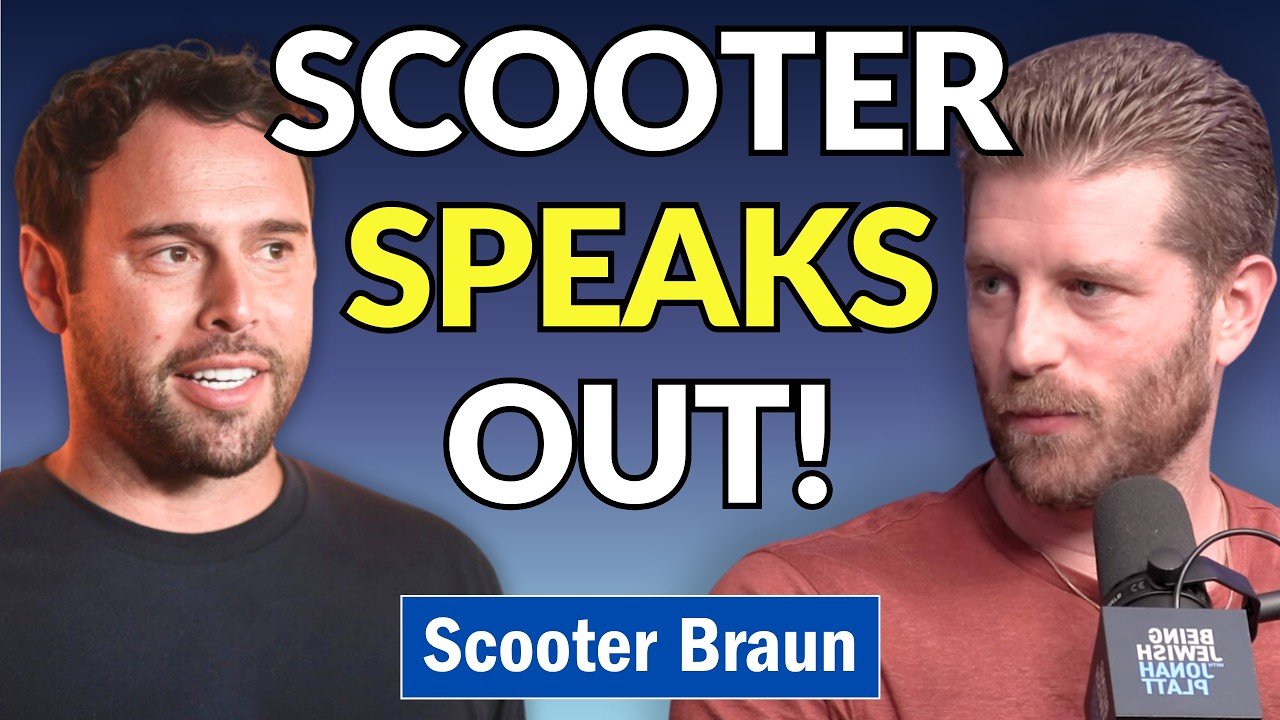
Scooter Braun’s MOST Important Project - And it’s Not what you think!
Watch and Listen
He's famous around the globe for discovering Justin Bieber, repping major artists like Ariana Grande and Kanye West, feuding with Taylor Swift, and selling his company for over a billion dollars.
But what you might not know is that after October 7th, he focused his producing skills on a singular project, the Nova Music Festival Exhibition, an immersive memorial recreating the horrors of the Hamas attacks for hundreds of thousands of visitors across the United States.
We say actions speak louder than words, but he's using both of them to stand up proudly for the Jewish people.
He's Scooter Braun, I'm Jonah Platt, and this is Being Jewish.
Scooter, welcome to the show.
Thank you.
That was very kind of you.
That's- And, and very, you know, witty and, and, you know, that was fun.
I'm gonna send that to my mom.
Nice.
You should.
Shout out to Mom.
October 7th, it's sort of where a lot of these conversations seem to start.
To fill in a little background, you are a grandchild of survivors.
You were Ariana Grande's manager when she experienced a horrific Islamist terrorist event at a music festival at a concert.
What did October 7th mean to you with all those extra layers, and, you know, what, what was that day for you?
When you grow up in a home of, uh, Holocaust survivors, my grandmother was in Auschwitz, my grandfather was in Dachau, and you hear stories since you were just a little boy, um, of why we don't have much family or kind of what happened, you, you get this sense of like you understand certain types of evil exist in the world.
And it almost prepares you for those moments to have that kind of expectation that these things can happen.
Coming out of, uh, of the Manchester attack and that experience with our team, um, having the background I had, helping, uh, put together March For Our Lives with the kids from Parkland, um, I had been involved with my family's history and then my own history with events of tragedy, and I had seen the world respond by coming together.
And I think the thing that was kind of shocking and horrific about October 7th is the idea that we stopped as a society having empathy for each other and feeling like we need to choose sides without having a conversation.
To me, a music festival is off limits.
You know, it's what's why the Nova exhibit was what it was.
We talked about the Nova Music Festival because I thought that was a place people could stop and see this exhibit and say, "Wait a second, these were innocent kids of all different cultures, all different nations, all different beliefs, joining together in a peaceful concert that's actually promoting peace in the future." They chose the Nova exhibit site 'cause it was so close to the border.
They said, "We hope we can dance with them one day and all have peace together." And then to see them butchering, murdering, raping- young kids, and then the world goes silent, my industry goes silent, that was incredibly frustrating.
And when I got to meet those kids who were victims and see that they were still hopeful, still wanting people to come together.
I mean, these were the hippies of that country.
Yeah.
It was really hard to see them be abandoned, and I think that's why I felt a need for, um, us to step up.
That's why, you know, I was blessed to meet a saint of a human being in Joe Teplo.
Shout out to Joe.
So many incredible people.
Um, and then Ophir and the rest of the team who were victims.
I mean, these guys were victims, and they put this exhibit together with us.
You mentioned earlier, you know, October 8th, kinda everything changed, but I, I mean, I don't think it changed that day.
I think the seeds of change had already been laid to where you get to this place that there are people who literally cannot look at kids being mowed down at a music festival as just kids being mowed down at a music festival.
It has to be through some lens.
Because they're Israeli, they're all villains.
I mean, how does that hit you?
Look, I, I agree with you that the seeds d- it didn't c- pop out of nowhere.
I think the difference was with October 7th, um, you couldn't look away anymore Um, you couldn't not be aware.
I mean, I have so many friends who've come to me and they said, you know… And these are not Jewish friends, and they'll come to me and go, "You know, I remember when Jewish friends would say to me, 'Oh, they're a minority,' or, you know, 'People are antisemitic.'" Which by the way, I hate the word antisemitic.
I wanna start there.
We hate it on this show, too.
Why do you hate it?
'Cause I think it's alienating.
I think it, it takes Jews apart and doesn't make people understand the experience.
Um, I'd rather use the word racism.
Yeah.
There's two words that I hate, Zionist and antisemitism.
I've given monologues on why I wanna stop using both of those words, so I'm, I'm curious why you wanna stop using Zionist.
Because, one, people don't understand what it means.
Yeah.
And I also don't think it's necessary.
You know, it, it means something of a Jewish person's right to, um, for, to have a homeland, to have self-determination.
Which I believe every human being on this world should have.
Mm-hmm.
Um, but just like a swastika, you know, was altered and changed to mean something very hateful, and when it meant… If you go to Indonesia, you'll see them all over the place as signs of good luck.
Right.
I think that the word Zionist has been taken and used to create this idea that you don't have to say the word Jew.
You can just say the word Zionist, and then you can say really hateful things about Jews.
Or you could say, "I don't hate Jews, I hate Zionists." But then why are you attacking someone at a restaurant and not at an embassy?
The other reason I don't think it's necessary is the idea of needing a Jewish homeland is not needed anymore.
Right.
It exists.
So- We did it … just to be clear, as someone who's been called a Zionist a thousand times on the internet, h- hundreds of thousands times, as if it's a bad thing.
One, I've never considered myself a Zionist 'cause I didn't know I needed to.
Right.
I just grew up a proud Jew, and if someone wants to have a conversation with me, have a conversation with me.
If you wanna call me a dirty Jew, just go ahead and say it out loud.
Uh, if you wanna call me a Jew, say it out loud.
And if you wanna call me a proud Jew, say it out loud.
But you don't need to use words to avoid the subject.
Um, and I think that when it comes to antisemitism, we are the most successful minority in history.
I understand why certain people would have a problem with that.
We have contributed a tremendous amount to the world.
Jews are 15 to 16 million in total around the world.
There are 2.2 billion Muslims and 2 to 3 billion Christians on the planet.
So to me, when people understand those numbers- We are less than 10% of the other two major religions' population, and I can understand why other minorities are saying, "Well, what do you have to complain about?
You're able to lift each other up.
You're a smaller group of people.
You've been so successful.
What are you complaining about?" And, and I can appreciate that.
I'd rather celebrate our achievements than talk about being a victim.
I don't wanna be a victim.
So if you're going to see something that's wrong, include it with everything else that's wrong.
Let's join everyone else in our crusade to make things right.
Let's call it racism so that we don't alienate everyone else's issues and actually stand with them.
And when you alienate us, you make us seem as if our issues aren't significant as much as their issues, and I think that's wrong.
So I, I don't like the word.
I wanna say it's racist to do it to any minority, including ours, and we have a responsibility to stand up for someone the same way we expect them to stand up for us, and we should continue to do so.
I like that framing.
I haven't thought of specifically that angle of the inclusion by calling it racism, and I prefer calling it racism 'cause that's what it is, and I think people don't really even understand what the word antisemitism means.
But I like your framing in terms of just thinking about it from, well, that's something we can all relate to and, and includes everybody dealing with that kind of a hate.
I think that's smart.
Listen, I, uh, one of my close friends, uh, pointed out to me.
She's Mexican, and she was like, "That's racist what's happening to you." And I said, "Yeah, I agree." And she goes, "Well, what is this antisemitism?" And I explained it, and she goes, "Well, it's just racist." And I said, "Yeah." We need to find common ground both in the good and the bad so we can stand together and make a change.
Yep.
No doubt.
After October 7th, you, you, you galvanize very quickly.
You're in Tel Aviv by December speaking at a rally.
You know, what, what was that flip that you become this, this man on this mission, that you're going, you're doing.
There's, there's no waiting period.
So it's funny you say that 'cause I, I went to, um, a camp called Camp Ramah when I was a kid.
Heard of it.
I also went to Camp Ramah.
There's still a chat on my WhatsApp of, like, a bunch of our friends, and one of them is a friend of mine named Aviva.
She said to me, she goes, "You know, I was really happy to see you step up, but I was wondering in the first month, where were you?" Hmm.
She goes, "I always see you step up." She goes, "If you, if you kinda go through my history, I'm, I'm not one to kinda wait." Um, and she said, "I didn't see you speaking up at first," and I was like, "Where is he?" And when it first happened, I was trying to be supportive, but I also felt I was the wrong person.
Why?
You know, my life had changed a lot in the last five years.
I went from being someone who stepped up and was very vocal in these moments to, uh, going through a divorce, going through, um, a hit, you know, in the public eye.
Then COVID hit right as that happened.
So the world shut down.
That narrative cemented.
I never combated it.
I was dealing with, you know, my family and trying to, you know, work things through with my divorce and make sure that my kids were okay.
And, and the world just stopped, and then you come out of it, and for the first time in my life, I had social anxiety that, "Wait, do people still like me?
Do they love or do they hate me?
Should I just kinda…" Like I was confused.
I never had that experience.
So I thought I was just the wrong person.
I was like, "I don't wanna add into this and, like, not be a help." And then I started to watch very few people sp- stand up.
Yeah.
And very few people speak.
And I knew I still had a platform, and it got to a point where I was like, "You know what?" Let me just, like, post one thing.
Okay.
And then you post another thing, and then you just find yourself being like, "But you're not understanding.
Like, let me educate you, and let me, let me just show you, like, you can have empathy over here while having empathy over here.
Like, we can have this conversation." And then I said, "You know what?
I need to go to Israel, and I need to go and meet these kids from the Nova Festival." Right.
And, and the reason wasn't that I didn't know the horror was real.
It was because I wanted to be able to p- tell people I saw it for my own, myself with my own eyes.
Yeah.
Um, so I went.
Um, my friend Josh introduced me to Joe Tepplo.
Joe and I got on a plane.
My bro- my, my father came.
My brother Sam came.
Um, we went, and we toured, and the blood was still on the walls, on the floors of nursery schools, let me be clear.
Yeah.
I saw horrific things.
Um- We're talking at, at the kibbutz, too.
Yep.
And, and then, you know, you go to a Nova healing camp, and you start to meet these kids, and you start to hear their stories, and they don't know who I am.
I'm not saying anything.
And you're seeing their hope that the world's a better place, and then they find out who I am, and then they say to me, "Why is the world silent?
Why, why… We're not soldiers.
We're, like, we're kids at a music festival.
Like, what the hell?" And then I became angry, and I said, "This is wrong." And I, I went, uh, two days later to the exhibit which they had in Tel Aviv, and I met Ophir, who became my partner later.
Um, Ophir was shot in the legs twice while he had a nine-month pregnant wife at home with his first child.
His best friend was killed in the car right in front of him.
Um, he called his wife, not telling him she was injured, just letting her know he was okay while he was afraid he was bleeding out, um, 'cause he didn't want her stressing 'cause he wanted her to be okay with the baby.
Um, he was able to survive.
He became my partner in the Nova exhibit.
And when we went to the exhibit in Tel Aviv, it was a memorial.
It was a place where they had a couple things.
They didn't have all the screens that we had and everything we created to tell the story 'cause everyone knew the story there.
And they had a lost and found, and people were literally arriving and finding things in the lost and found.
And I looked at him, and I looked at Joe, and I said, "I know what to do.
Joe, will you help me?" Joe said yes.
And he's like, "Oh, we're talking about…" I said, "No, no, let's make this happen." And two weeks later, they're in my living room in LA.
We start designing the exhibit on the, on the, uh, table in, in the kitchen.
We put together an amazing team, and people started to step up.
And then we opened in New York, and then came to LA, and then Miami, and obviously it's in London now.
Um, and it's made a difference.
And I know it's one person at a time.
It's hand-to-hand combat.
It's not digital.
Yeah.
But y- once you're in that place, you're immersed, and you start to realize the story of what happened.
And we're not expecting you to choose a side.
We're ac- we're just expecting you to choose humanity.
You mentioned the opening in New York, opening night, protesters, Hamas supporters, smoke canisters, like, all this stuff.
Can you articulate what it feels like to have to walk that gauntlet?
They weren't there in the beginning.
They weren't there in the beginning?
No, not in the beginning.
Um, when we did the opening, it was quiet.
Okay.
A lot of people came.
Um, I don't think because we had opened anywhere people knew what we were, so they, they weren't, like, focusing on it yet.
Yeah.
It wasn't until we had traction that the protesting showed up.
It was very interesting.
When we weren't a threat, no one was there.
The mayor came.
A lot of people came.
People were very moved.
They were crying.
Most of the footage we show is either the stories of these survivors or literally the videos that Hamas put out on Telegram themselves.
Right.
We just reshow what they shared.
Mm-hmm.
And when you see the bullet holes in the porta potties, um, I remember walking Paul Tollett through, uh, founder of Coachella, and he started to cry because he, it, it hit so home for him of like, "This is what I do." Um, and when you're walking musicians through… And it was interesting, some musicians were very public about being there.
Some said, "Hey, I wanna come, but please don't say I'm here," 'cause they were so overwhelmed by the politics.
We started to get r- traction, and that's when the protesters came.
And the interesting thing is they didn't come inside.
We welcomed them inside.
Didn't fight them.
We said, "Please come inside." Yeah.
"Please walk through, and then if you wanna protest, go right ahead." But they didn't wanna come inside.
There were two survivors, Tomer and Danny, um, young kids, early 20s.
They would go out in the streets when this would happen, and they would solicit and advocate for people to come inside and walk it with them.
But they wouldn't say they were Israeli, and they wouldn't say they were survivors first.
They were just two cool kids walking outside and getting to know people.
They would build rapport, and they'd say, "Come walk inside with us." And Tomer was amazing at this, and he got people who were protesting to come inside, and they didn't protest a- after that.
They were moved.
They saw humanity.
They saw common ground, and they said, "But don't you think this is wrong?" And he would say, "Yeah, there's things that I think are wrong, absolutely.
But this is also wrong." Yeah.
And that would change.
And then after the protesting, Josh always laughs about this, Kaden, who works with us, uh, I went on Instagram and immediately announced that we're gonna be open for two more weeks before we'd even raised the money to do so.
I said, "Thank you for coming.
You've inspired us to stay open for two more weeks, and we wanna do that so that you have time to come." And then they didn't come protest anymore.
What do you think that was about?
Bullies only react when they believe they create fear in the victim.
Totally.
If you are not afraid, if you are not altered by a bully, they move on to victimize someone else.
When we showed we weren't afraid, that we're not going anywhere, that we welcome you in, that we greet you with kindness, that we're not attacking you, that you could say the most hateful things about us, and we will say, "Please come in"- There's no interest.
I've seen it with my own social media, ferocious attacks.
But then when they realize it wasn't affecting me, they move on to someone else.
Our first real conversation was at Nova, where you were essentially, like, conducting business so that people would come there ostensibly to have to be there if they wanted to sit down with you.
They didn't know where they were going.
Right.
So tell, like, w- how did that play out for you, and did that lead to, you know, uh, good opportunities to introduce people to what was going on?
Yeah, I think, look, at that point, um, I had, in my career I thought it was very important for people to see it, and I was seeing the struggle of getting people within my industry to see it.
I wasn't fully retired at that point.
I was semi-retired.
People call me and say, "Hey, I gotta have a meeting with you," or this, that, and the other, and I would say, "Meet me at this coffee shop." And I would give them the address to the Nova Exhibit, and we had a coffee shop- Right … in the back, um, when you're in the healing room, once you've walked through.
I remember my, uh, my friend Ryan Tedder, you know, he met me, and he goes, "Where am I?" And I said, "You're at the Nova Exhibit." He goes, "Okay." And he walked through.
He took his time.
He was deeply moved 'cause he is a loving guy who loves everybody, one of the smartest guys you'll ever meet, and, um, and he's a musician.
And he had the coffee with me, but then he said, "I wanna meet some of these kids." And he met them.
He said, "I'm so sorry you went through this." Usher came multiple times.
It was really interesting 'cause Jermaine Dupri, who was, like, a mentor to me, one of the guys who gave me the industry, he came, and then Jermaine became, like, a tour guide.
Wow.
He started calling people and being like, "You need to see this." And he was pulling people in and bringing them, and it was just… There were so many people who came through who were so deeply moved.
And I wanna be clear, they didn't choose a side.
You know, there are people who hear those names that went to the Nova Exhibit, and they're like, "Oh, they betray- they chose a side." Those people didn't choose a side.
You can have empathy and advocate for a child stuck in war in Gaza and still advocate for a kid who's been murdered in, in, in Nova.
The one does not exit out the other.
It's, it's insane to me.
When people were protesting, I walked out and, and they saw me.
And I said to one of them, "How much money have you donated to, uh, children in Gaza?" And they were like, "What?
It's not about money." And I was like, "Well, you're saying we should be donating." I said, "How much money have you donated?" And they hadn't.
Of course not.
I had.
Right.
And I said to them, and they were like, "Well, we don't understand.
What do you mean you had?" I said, "Do your research before you come and you protest here." And I was like, "I, I'm-- There's no issue for me to advocate against war and advocate for a child stuck in that war." Do I believe Hamas needs to be destroyed and that ideology needs to be taken out so that those kids have a chance at a better life?
100%.
I can also disagree with certain decisions the Israeli government ha- makes while still loving my friends who are Israeli.
Like, you can-- We can have all these different conversations and this dialogue, and I, I just recently saw a young man speak at Harvard And it was, like, my favorite speech I've seen in years, um, where he spoke about, I think it was his Pakistani Muslim grandfather and his Holocaust-surviving grandfather, and the relationship they had, and him, him begging of his, his peers and this generation to have conversation, to create respect amongst each other, to not think that there is an oppressor and an oppressed or a right and a wrong, that we're allowed to have gray area, and we're allowed to respect each other.
And I, I think that is the biggest battle ahead, and people aren't realizing.
It's hard to get people to listen when we're calling them useful idiots.
Sure.
I understand it, but it's hard to… You know, when you're insulting someone, it's hard to make them listen.
It's hard to get a Jew to listen when you're using the word genocide.
You know, they, they go red, and they don't see anything else.
Mm-hmm.
What people need to understand is that the people who want us divided want us to keep yelling at each other.
I truly believe the majority of this world does not want anything but peace and prosperity, and they just wanna make sure their families are okay.
Yep.
No doubt.
But there are people who really, really want to confuse us, so we keep yelling at each other.
So, you know, I'll come on this podcast, and someone will say, "That's pure propaganda." Right.
But they haven't listened to the podcast.
Happens all the time.
Some wanted to be seen, and some didn't.
How does that hit you?
I think I've gotten to a certain place where, um, I'm not really interested in judging people.
You know?
Y- I don't know how they're gonna react or what they're going to do afterwards.
I'm grateful they came.
I know that every single person that came, whether they wanna be vocal about it or not, it has made a difference in how they see the world.
I remember, um, one of the guys I worked with there, he was deeply affected and angry, and I was like, "You gotta fight this battle a little bit differently.
You know, this, this battle isn't about everyone doing what you want.
It's about getting an opportunity to just m- maybe make a difference." You know?
You don't know if someone's vocal now, and six years from now it hits them like a, you know, ton of bricks.
Were there people who you reached out to to come and visit who refused?
100%.
People that you were assuming would maybe refuse or that you were surprised by?
Both.
Or both?
Both.
Both.
There were people that refused, didn't even respond, like I didn't even send the message.
Then there were people who I was sure they were coming, and they either avoided it or wrote me, "Hey, I appreciate it.
I'm not gonna come down." What does that do to a, a relationship?
You know, I have tattooed on my arm, it says, "Be kind, for everyone is fighting a hard battle." It's a quote by Plato.
You don't know what someone's going through.
You're not living in their sh- you know, their shoes.
I have my own opinions, but I don't know y- I don't know what they're going through that day or if, if they even have the bandwidth to take something like that on.
So to me, I got to a place of that sucks, I wish they saw it.
This is a big part of my life.
It's really something I want people to see so they can understand what's going on in the world.
But, you know, you win some and you lose some, and there are definitely people who came who were not going to come, and then they did come, and then they were supportive and, you know, wanted to help.
Like I said, I'm in a place in my life where I'm not really interested in judging people.
I think I've been judged too much myself- Hmm … for things that have, you know, that just aren't true and have nothing to do with me for me to do the same to others.
Is there a boundary to that sort of grace and generosity?
Is there a, is there a circumstance where it's, it's too much, it's too far to grant someone such, you know, magnanimity when they're doing something that's disappointing or immoral or whatever?
Or do you feel like you can really hold it?
I think there's a difference between someone disappointing me and someone, someone doing something immoral.
Okay.
I think there's also something, there's a difference between someone attacking my family or putting my family in danger versus someone who's disappointing me.
Hmm.
I think my line is, um, don't hurt the people that I love.
I, I'm actually okay with you hurting me.
That, I, I can handle that.
Yeah.
But don't, don't hurt the people I love.
And, um, and I think that's where, you know, kindness only goes so far.
Any particularly challenging visits that stand out to you?
Or were they all just, you know, overcome by the story?
No, there's definitely challenging ones.
Hmm.
You know, once the exhibit was closed, I did private events inviting, uh, those from the pro-Palestinian community to come see the exhibit, bringing, you know, my Palestinian friends in to see the exhibit.
Um, one of my friends, he's an amazing guy.
I talked to him this morning.
He's Palestinian.
He walked in wearing a keffiyeh 'cause he wanted to be very clear about who he was, and he told me he was walking in expecting people to be very angry with him wearing that.
And he also was impressed that people, including an Israeli, walked up to him and said, "Are you Palestinian?" He said, "Yes," and he goes, "Welcome, cousin." And they hugged, and they walked through the exhibit together.
Wow.
And he was shocked.
Afterwards, we had a sit-down between Israelis and Palestinians and Arabs who had come and talked, and it got heated at times.
You know, you're talking to former IDF soldiers talking to people who have said that they are the devil.
Yeah.
Um, and it was very interesting to watch one of these former soldiers look at, look them in the eye and say, "I want you to know there are things that I saw that were really wrong." And they weren't okay.
And there are things that have been done to me and my friends, including killing family members of mine and friends of mine, that were really wrong and not okay." He goes, "But unless you and I make a change, what happens to our children?" And I saw both sides cry together.
I saw people get heated, but I also saw, um, an amazing moment.
I actually put it on my Instagram, where, uh, a gentleman who is Palestinian, 31 members of his family have been killed by Israeli airstrikes since October 7th.
Um, he came over during the last war when he was 15 years old as an exchange student and then was granted asylum during that war, grew up, you know, from 15 years old advocating in the United States.
And he talks to his brother, who still runs an NGO on the ground in Gaza weekly.
M-multiple family, 31 were killed, and he's been advocating against Hamas, um, and talking to his brother of what's really going on on the ground while also advocating against the current Israeli government He met a father whose two teenage daughters were murdered at the No exhibit.
I turned around and saw these two grown men have a conversation, and then start weeping together and hugging each other, and I took a picture of them from a distance, and that's what I posted, of these two men holding each other weeping together.
That was the magic of that exhibit.
That's why I was so proud to be involved.
What comes next?
Like, how do you bottle that up?
Right now, there's so much misinformation.
There's so much division.
The best thing that's happened for this fight or any other fight was the World Cup.
Yeah.
'Cause it was a reminder of humanity.
It was a reminder for a moment that we actually can get along.
I loved the World Cup content, all these people loving ranch dressing and Costco- Yeah … and Bass Pro Fish Shops and, like, you know, being like, "I was wrong about America," and I was so proud as an American seeing all that content.
I was like just… I was so deeply proud of, of being an American citizen and being a citizen of the world and seeing how we can come together, and I think we need more of that.
Less arguing about who's the victim and who's the oppressor and who the oppressed, and finding common ground on why we love who we are, and I think that's the fight we have ahead of us because that's what stops hateful ideology.
It's the simple concept of if you have a dark room and you put light in it, that light can fill the room, and that's easier said than done.
People will watch me who literally agree with me, and they'll just say, "He's naive." All right, talk shit, but I'm doing it.
You gotta try something.
Well, I'm doing it.
I'm seeing it work.
I'm seeing it work.
I'm seeing it happen.
You know, it doesn't mean that I'm naive.
It doesn't mean that I don't know there are hateful people out there.
I saw what happened to my family.
I saw what happened in Manchester.
I saw the conversations and what happened in October 7th.
I understand there are people that are far too gone in this, and they are hateful, and they will never see.
But I also know there's another generation that comes, and you have a chance to educate them.
I've been called all kinds of names by both sides.
I've been called a genocidal maniac by one side who know nothing about me, and I got called a capo by my own people when I talk like this, and in my opinion, you're all pussies.
You heard it here.
You don't scare me, either side.
My job is to look across a room and extend my hand.
That's real bravery, and that's what my grandfather said to me before he died.
He was a Holocaust survivor.
He said, "Do not be afraid, and do not walk to your death." Well, I'm not going to be afraid.
I'll never walk to my death, and I sure as hell won't be afraid of either side.
And I'm looking forward to more challenges, to raising kids who are ready for those challenges, to walking with friends who, from all walks of life, who are willing to stand with me and say, "Hey, we can make a difference in this world." How do you empower or, or reassure folks who look at you and, and your example and what you're modeling go, "Oh, well, you know, he's just, like, too big to, to be canceled.
He's, like, successful.
He's got all… He can say and do whatever he wants.
Like, he's fine, but I, I couldn't do it"?
Bullshit.
I was canceled.
Like, what are you talking about?
Like, if, if… What is canceled?
That's nonsense.
Probably the most canceled person in the world is on a second term of the presidency.
Like, I-I… What are you talking about?
There's no such thing as canceled.
Be brave.
Get up, make a difference.
Try.
I wasn't the first choice to do the Nova exhibit, I assure you.
Like, you get up and you try and you make a difference.
That's what it is, and people can misunderstand you.
You know how you change the past?
You don't stay in it.
You move forward.
You do something else.
These are stupid little sayings, but, you know, they say cast a stone in the ocean, that ripple.
You know?
It, like, you got… It has to start somewhere.
And the best part is someone who's not even born today is gonna come along in the next generation and make a bigger difference in this world than everyone we can imagine So you don't think you can make a difference?
You're already here.
Get started.
Let's talk a little bit about the music industry, which you are now fully retired from?
Yeah, I'm, I'm consulting.
Consulting.
The music industry has been, there have been several, but uniquely sort of one of the worst in their response to the last two years, I think.
There's been a, a handful of really bad ones, but the, the music industry's been one, both from a, a, a point of view of a lack of outspoken support and from a lot of platforming of anti-Jew hate.
What do you think it is about the music industry in particular that laid the ground for this kind of a disappointment?
I think people forget that musicians are people.
This is a people problem.
It's not a music industry problem.
This is a social media problem.
So much of the civil rights movement was, was paid for by the entertainment industry, by mu- by musicians, by entertainers.
I wonder if they had social media, would they have done the same?
It's crippling when you're going on social media and 10,000 people attack you at the same time.
It feels like the world is ending.
It feels like you are on the wrong side.
Yeah.
But if you have 100 million people following you, 10,000 people is nothing.
You don't know that in the moment.
O- one comment, if you're looking for negativity, if the brain is saying, "I wanna know if people like me," one comment you will, you will stick to.
Imagine 10,000.
Those who want us divided focus on that, and I think that what you're seeing is good people thinking they're doing the right thing.
Oh, sure.
That's how the whole movement works.
Thinking they're doing the right thing, thinking they're hel- being helpful, thinking they're advocating And what I think, what I learned from the Nova Exhibit, 'cause I remember Sheryl Sandberg said to me, like I'm doing my, you know, my documentary, which is amazing.
Yeah.
But when, before she knew I was involved, before she knew what it she was, she was like, "Well, that's not gonna do enough 'cause it's a one-time thing.
Like it's, you know, it's not digital." Right.
And then when she came, she's like, "Oh my God, I had no idea, Scooter.
Like, this makes a massive difference." And I think what it taught me is, um, go the fuck outside.
Meet people.
Talk to them.
Get off social media.
Make a difference one person at a time.
Let them think of a real friend.
When I think of a Palestinian, I cannot avoid the fact that I can think of real people that I co- know are my friends.
I think that's really huge, and I was thinking that as you were describing your Palestinian friends, how many people within the Jewish world do not have a, a Palestinian connection?
By the way, how many people don't have a true Jewish friend?
Right, and that too, on the other side.
Exactly.
And then here, and they don't know each other.
Yeah.
You know?
And, and that's, that's one of the biggest problems.
It's hard to hate when you can start to meet people.
I'll give you a great example.
I'm not gonna out certain people.
There's a young man who I know who is very big in the political scene.
Okay.
Loves making political content, has a lot of followers.
And I saw him start attacking, um, during the Iran war, and he was attacking, um, through his political lens.
And I said, "Hey, can we just talk privately away from social media?
The, the attack you're doing in this moment, I can understand certain things about the war that you disagree with, but this specific attack doesn't make much sense to me." And I asked him where he's getting this from, and it was so politically driven, and I said, "But have you talked to any of your Persian friends about their experience and why they are so happy in this moment and what they're hoping for?" And, and he said to me, "Well, I don't have any Persian friends." And I, same thing.
When Venezuela… My family, on their way from America, did multiple generations in Venezuela, and then escaped Venezuela.
And, you know, when that happened, I, I understood what took place, 'cause… And, um, I spoke to a friend who was, like, not understanding, and I said, "Well, do you know anyone in Venezuela?" And they said, "No." And I said, "Do you know all the Venezuelans are celebrating right now?" And they said, "What are you talking about?" It- you need to create common ground, and I think that we're not gonna do it in a digital world.
We think that we're touching people because we're touching so many at once.
That's not how you build friendships.
That's not how you build understanding.
You don't build understanding by having a conversation with 10,000 people.
You build understanding by having a conversation either one-on-one or around a small table.
Those are the greatest conversations.
And people, because we're growing up in a world of social media, they don't think that's significant.
They think, "I need more likes.
I need more views.
I need this.
And the more sensational, the more views I get." So what we need to start encouraging people to do is meet each other.
To meet each other, to have conversations, to go to restaurants, you know, or, or communities and say, "Can we talk?" And it's not always gonna be easy.
Sometimes you're gonna be thrown out, sometimes you're gonna be called names, sometimes it's gonna be really, really hard, and that's gonna be the challenge.
But can you have the bravery to go and try?
I can't wait for how many people who know me, who respect me, who are gonna say I'm naive.
There's, like, no point in trying.
You can't talk to these people.
Yeah.
And by the way, they're right about certain people.
I know.
It's tricky.
They are.
No, they're right about certain people, and it doesn't mean I can't protect my family and my friends while still trying.
And part of the challenge is having not only the bravery to go and try, but to take on all the people who are telling you you're naive.
To shut them out and still try.
What else can we do but try?
Well, by the way, and, but be clear, you can protect your family- Yeah … while still trying.
Yeah, you don't have to be stupid.
Correct.
There's a difference.
Obviously, you feel a great personal responsibility in this moment as, as you, Scooter.
Do you think that there should be a general sense of responsibility for Jewish artists and executives and, and people of influence in, in this moment?
Or is this back to the I don't judge people, you do you?
I don't feel a responsibility as a Jew Personally Say more I feel responsibility as a human.
My fascination is as a Jew.
This is not my first rodeo doing stuff like this.
This is just the first time I've received so much hate for doing it.
Hmm.
My fascination comes from, "Oh, that's interesting." Doesn't mean I'm gonna stop, but this isn't… My responsibility doesn't come from, "Oh, I'm Jewish, like, let me get them on my side." I've been doing this stuff.
Whether people wanna realize it or not, I've been doing it because I think it's a humanity issue.
So I don't see it as a responsibility as a Jew.
I think you have a responsibility as a human being, but you also have a responsibility to your family to only… to do as much as you can.
And when I say that as much as you can, it's also as much as you should not do.
What do you mean?
I could be doing this stuff all day long.
My kids still need a dad.
Oh, sure.
You know, I still need to be there in my relationship.
I still need to be, you know, a son to my parents.
I still need to be a friend to my friends.
Yeah, you're not a machine, you're a person.
So that's why I don't judge.
Are your wheels turning on, like, what's the next thing that you, Scooter Braun, can contribute to this moment?
Let me put it that way.
I think my wheels turn, I think a lot about my grandmother, and I think a lot about my kids.
A lot And I think about what life looks like in the future.
I miss my grandmother a lot.
I miss my grandfather.
My grandfather died when I was 14.
My grandmother died a little over nine years ago.
When she left, she told us that she was really happy to know that we were safe, um, that, that we were gonna be okay, and that she just wanted to make sure that my kids would remember her.
A part of me is always really happy, even though I know she's watching, so it doesn't matter, she sees us.
I'm sad that she would've been so scared, that if she would've left now, I know she would've been feeling like, "What was going through Auschwitz for?" Mm.
You know?
That, like, "What kind of world am I leaving my great-grandchildren in?" And that upsets me a lot, that, that she would've been in so much pain if she was here.
So there's part of me that's glad that she left before this happened.
I think of my children and, and what they're going to deal with, um, and what the world might look like, and will they be proud and ready, or will they be scared and hide?
How do I get them to be proud, but still brave enough to keep trying?
How do I get them to be proud, but always extend a hand?
And how do I know as their father that when they extend their hand, they're not putting themselves in danger, which is also something I'm like, "Am I putting them in danger?" And, and I think a lot about that all the time.
Sure.
It's hard to explain it to friends who don't understand, where I'll show them stuff and they'll be so shocked, and then I have to stop myself from showing them 60 other things, because that's just like, they're shocked by the smallest thing, and they have no idea what's really happening.
Yeah.
In regards just to the Jewish people, every Jew in the last 2,000 years would switch places with me right now.
Right.
You know?
They, they are looking at us like, "Oh, antisemitism is so bad." They're like, "Are you kidding me?
You've had this 80-year reprieve, this, this recess- Yeah … this break.
You know, antisemitism has always shown itself to be this bad, and it's been so much worse in the past.
And at least we're strong.
At least we have a homeland right now.
At least we have protection.
At least we can fight for ourselves.
At least we have friends.
Like, we're the strongest we've ever been.
People are coming for us not because we're weak, but because we're strong.
And are we strong enough to not turn into the monsters they're claiming us to be?
And I think about that a lot, and that is something that I, I, I think about with my children and my friends and my family all the time.
So how do you approach raising kids to be- The type of strong, proud, generous people you want them to turn into.
One, we do Shabbat.
Um, every Friday night we have Shabbat, no matter where we are in the world, and I think just that common practice is a good reminder.
Yep.
I made sure they remembered my grandmother.
I don't want them… Funny enough, I think about this a lot.
Like, I grew up so deeply understanding the Holocaust as a young kid, but also the horrors of the Holocaust- Yeah … probably too early.
I intend to ask you about that.
You know, and with my children, I, I decided not to show them the horrors at a young age, but to show them Anne Frank's story.
Because once they realize that Ma, who they look at a picture of my grandmother every day when they leave the house and every day when they come in, when I explain to them that Ma was in the same concentration camp at the same age, they start to realize that Anne Frank's story is their story.
Wow.
We talk about tzedakah, about charity.
I explain to them that the, the concept in Kabbalah is, uh, 10% but no more than 20, and my oldest has a lemonade stand.
We talk about this concept that he must give 10% to charity, but no more than 20.
And what is that part about?
In the Torah, it talks about this idea of leaving, leaving your crops at the end of the field when you harvest them so someone can- Yeah, the tithe.
Yeah, but someone can come in and actually collect the crops with, with their own dignity.
Right.
So give the 10% and 20% with dig- so someone can keep their dignity.
Donate it to a proper charity that helps people, or give it to someone in need.
And the reason you don't give more than 20 is because if Hashem is giving you riches, he's asking you to be a custodian of those riches, and he has a purpose.
He wants you to be in that position of power But if he decides to take it away tomorrow, you have to be just as grateful, 'cause that was what he wanted for you, 'cause it was never yours in the first place.
It was always you being a custodian of his riches, for you to play a purpose in this world to make a difference, to raise the consciousness of the world.
So I've been talking to my kids a lot about that, about why do we give?
Because if God is putting you in this position, you should follow his rules because you receive more because he can trust you with more.
Mm.
And he can trust you with more 'cause he knows you're giving more.
There's a story in the Torah, which you will, you'll know, you'll say the names as soon as I tell the story.
Someone thought they were gonna get a wife.
Mm-hmm.
And when they went to marry that person, they were told… They were given the wrong wife.
Yep.
And then they were told they needed to work, I think it was another seven years- Seven years, yeah … before they could get the proper wife.
And instead of bitching and moaning, they said, "What an amazing opportunity.
I guess this is a lesson.
I'll work the next seven years." And the seven years went by like that because he chose to love the seven years.
He couldn't be defeated by it.
And I think when you go through life doing things that way, you start to see life in a more beautiful way.
You're not holding onto it as much.
One of the people from Nova told me about a kibbutz where they were from that was massacred, and afterwards in the hospital, there was a rabbi there who shared a room with someone else from his community he knew, and his, the rabbi's wife was murdered.
The gentleman he shared the room with, his wife was murdered, and his, and his, uh, I think, I believe it was his son.
His other child survived, and was, I think, s- 15 or 17.
His son who was killed, I think, was 14, and his wife.
And the rabbi looked at this person in the hospital room and said, "Hey, we should pray." And the guy said, "Rabbi, how dare you?
You know, your wife was murdered.
My wife was murdered.
My child was murdered.
God wasn't listening.
God wasn't here for us.
Like, how dare you?" Mm-hmm.
And the rabbi looked at him and he said, "How many years did you get the love of your wife?" And he answered, "Over 20 years." He goes, "How many years did you get the love of your son, to be in your life, to love you the way that he did, to lo-" I get emotional when I tell this story.
Yeah.
And he said, "14, 15 years." And he said, "How lucky were you to have known him and to have known her?" And they prayed.
And that's a hard way to look at life, but it's the right way to look at life.
It's the better way to look at life.
It's a better way to live.
These are the lessons, the gifts I've gotten from having these experiences, from supporting these people.
It's amazing.
That sound means Scooter just finished answering my five deep questions, a bonus segment I produce exclusively for members of the Kehillah, my subscriber-only community.
Join today at beingjewishpodcast.com/join to get exclusive content, merchandise, preferred ticketing to my live events, a monthly live stream with yours truly, and a whole lot more.
In the meantime, here's the first couple bars of our new track.
Check it out.
I actually watched your grandmother's testimony.
She said, "Scott, he's always been the most interested in the Holocaust." I don't remember learning about the Holocaust.
This is a weird thing to say, but there's something that comes as a gift when your family goes through something so horrific.
At this point in my life, after lots of therapy, I'm finally the present person to my friends and family that they deserve.
What gets you out of bed these days?
All right, Scooter, before we wrap things up here, really just a couple final thoughts.
One is I know that there was a story that you wanted to tell about NOVA, about We Will Dance Again.
You know I have Holocaust family.
Yeah.
And as someone who studied the Holocaust yourself, you know there's a saying, never again.
Certainly.
To the point where Jews get upset when other people use never again.
Yeah.
When the Parkland kids used never again, Jews were like, "Well, that's only…" Like, you know, "We gotta focus on the Holocaust." I'm okay giving up never again, and the reason is, is because of Ophir and my partners at the NOVA exhibit and all the kids that I met there.
Their slogan was, We will dance again, and they put a giant banner, and we hung it up, and it was the most important thing for them.
They wanted people to say, "We will dance again." And as time went on and I spent so much time in that exhibit and so much time with these survivors, I started to realize what a better way to go about this.
Instead of saying what we won't do, instead of acting as if the victims, that we can't allow it again, I want to choose to do what these brave kids have decided to do, which is, I will show you what I will do.
I will dance, and you will dance with me, and we will dance again.
I'm not gonna tell you what I'm not gonna do so we don't have common ground moving forward.
I'm gonna talk about prevention.
Yeah, we wanna… Both are within we will dance again.
You gotta tell people what happened and then get them to dance.
You do both, and that's what I love.
In fact, my next tattoo will be we will dance again.
All right.
Jews with tattoos.
You heard that here.
Last question before our final game.
At least from where I'm sitting, you're not done with your contributions to this moment.
What seems to be perhaps the important things at the top of mind that you feel are, are the arenas in which you might wanna play as it comes to paving a path forward for our generation and, and our children's generation?
I don't think I figured it out yet.
I think I'm still obviously on the board of the NOVA exhibit.
I'm still helping, you know, you know with them and will continue to help them.
There's different causes I'll be involved in, and I think my pride will shine through in all those causes.
I'm on the board of Make-A-Wish, one of the greatest organizations I've ever worked with.
My heritage and my pride will shine through in that work.
I'm gonna be a father, and if I do a good job They will outshine anything that I've done, and that is my hope for them.
Like I said, I think we were talking about, oh, too big or too little or whatever it is.
My best answer to that is whatever I do next, I know that the person watching this should know that their effort is just as significant as mine, and a ripple is just as strong as a wave.
I'm not sure everything that I'm doing next, but I know I'm gonna try.
That's all we can do.
All right, we're gonna end things as we always do on the show with a little game.
We're gonna play a little lightning round.
What is your favorite Jewish holiday?
My favorite Jewish holiday would have to be Passover.
Why?
I was gonna say, like, Yom Kippur is actually the most meditative one for me.
For sure.
But Passover is when we gather all the family and the friends, and when I say it's my favorite, it's also because I do one Seder for family and then one Seder for friends and family.
That's cool.
And from all different heritages, all different walks of life, all different religions, because we're able to tell the story and, and bring people in and show them the love and the joy of our culture.
I love that.
What do you think is the most overrated Jewish holiday?
Hanukkah.
Why?
Because we basically make it seem like it's a big holiday because we're so afraid of Christmas.
Yeah.
Yeah.
It's, it's n- it was not a big holiday.
It's never gonna be as big as Christmas.
Most people don't know that, like, Jews, like Irving Berlin, wrote most of the Christmas songs.
Yeah.
Like, Christmas is an, a commercial holiday.
Like Coca-Cola put him in red and white, and like, I loved making, you know, Christmas albums when I was in the music industry.
Like, stop being so afraid of the fact.
Like, it's okay, they have Christmas.
Like, stop pretending like Hanukkah is competing.
What's a Jewish story you'd like to see told on the big screen?
Um, Nachshon.
What's that?
Nachshon was the, uh, the leader of the tribe of Judah, and when Moses, uh, went to part the Red Sea, which actually was the Sea of Reeds when you translate it properly from Hebrew.
Moses was basically telling everyone, "Walk into the o- you know, walk into this body of water." And it was storming and it was crazy and everyone's like, "Moses wants us to kill ourselves.
Like, he wants us to do mass suicide.
He's crazy.
We're all gonna die in there.
Egypt and the Pharaoh are coming on that hill.
They're gonna kill us all.
Th- this crazy man has led us," and they weren't listening to Moses.
Yeah.
And he's saying, "God is telling me walk into the water." And Nachshon felt something.
He basically was like I, you know, God says to trust him, and he started walking into the water first before Moses, and it wasn't until his mouth and his nose went under the water that God parted the sea.
Mm.
And Nashon had to walk the entire way like that with everyone behind him.
And this, the moral of the story was this idea that it isn't 'til you put yourself into a place of danger, it isn't 'til you trust and have faith enough to sacrifice, to walk to that edge, to have a moment where you can't breathe, that's when miracles happen, and it's one of my favorite stories.
Favorite Jewish sleepaway camp song?
The, the song that they would have us sing after we eat our meal.
Like the, the Birkat Hamazon?
Yeah.
Um, because we said a lot of things in there we weren't supposed to say.
I swear I saw your bra.
That was a popular one.
Yeah, we would all just throw in all these English words that- Yeah like, as a little kid you thought were funny.
Do you have a favorite biblical Jew?
I, I'd probably Moses, just because he became Superman later.
What do you mean?
The story of Superman is based on Moses.
Say more.
Uh, the two guys who created Superman were Jews.
Right.
They wanted to be newspaper writers.
They were told Jews can't be on the byline.
They got told if they write obituaries or comics, then they could become… If they were successful, they could become a writer.
They became successful comic book writers.
They would try to become writers.
The guy said, "Sorry, no one named Siegel and no Jews are gonna be on the byline." So they, um, they created Superman as a way to kind of build a Jewish superhero within the world without people realizing he was Jewish.
Right.
So Superman was, uh, on Krypton, and on Krypton everyone was called Kal-El son of Jor-El.
Hebrew, your name is your name, son of your father.
Mm-hmm.
Then, um, they were sent, Superman was sent down in a small spaceship wrapped in a blanket that would later identify him.
Moses was sp- sent down the Nile in a small basket wrapped in a blanket that would later identify him.
Moses always felt different but grew up amongst them, and then one day discovered who he was.
Clark Kent grew up amongst them, always feeling d- different, and then discovered who he was, and then had to live by these higher morals to get through it and have faith.
Wow.
I knew it was a Jewish story, but I never knew it was the Moses story.
You learn something new every day.
Um, if you could have any famous Jew from history over for Shabbat, who would it be?
Honestly, probably Moses.
Moses, Ruth, or, like, King Solomon or King David.
Like, those would be the ones.
Maybe King Solomon or King David.
Some heavy hitters.
Yeah, I mean, like… But the interesting thing about Moses is, like, he married, um- A priestess who wasn't Jewish.
Right.
Shout out to Zipporah.
Zipporah wasn't Jewish.
She was a priestess, and no one, like, freaked out and complained.
Like, uh, I'd wanna know what he thinks about all the fear, and the assimilation, and the things that would happen.
I'd be curious to talk to, like, a King David, you know, who always strived to be better while making so many mistakes.
Mm-hmm.
You know, how he saw the world.
I'd be curious to be able to talk to Solomon with all the wisdom, and then to talk to their great-great-grandmother, Ruth, you know, you know, technically the first major convert- Yeah … um, to see, like, how she sees the world.
I, I think it would be interesting to have them see where we've come and see if they have wisdom to give us or if they're just deeply disappointed.
Yeah.
I, I… That's a conversation I would like to be at.
Who's the best Braun brother basketball player?
If you're down and you need a scorer- We need buckets … you need buckets, I'm the best shooter in the family, and, and I like being in that position.
I think Adam would fully admit that.
Nice.
Even though he just beat me at a four… We were playing knockout, and he literally knocked me out of my own birthday party.
Brutal.
Are you… Had… Do you guys ever take people on as the Braun brothers, like plus one?
Yeah, we did when we were younger and stuff like that, but I think it was at a really funny moment years ago with Drake, funny enough, where I told Drake he can get any three guys, and I'll show up with my brothers, and we'll play, and he was talking a lot of trash.
And Drake doesn't know that two of my brothers are adopted.
And they're 6'9" and 6'7".
D1 ballplayers, right?
Yeah.
And, uh, s- and, and Adam and I both played college ball.
Adam played at Brown with Sam.
And so we showed up at Drake's house to play this game, and he sees, uh, these two large guys who are my little brothers, and they're Black and I'm white, and he, uh, he's like, "What the hell is happening?" And I said, "You made a bet.
You said my brothers.
These are my brothers." And he was like, "This is bullshit." And we, uh … He's gotten a lot better since then, but, but we, we definitely did work, and he knows it.
Nice.
Last question that I ask of all my guests: challah, do you rip, do you slice?
Rip.
Rip.
Rip.
Straight up.
Scooter, this has been really awesome.
Really, you dropped a lot of Jewish knowledge on us, a lot of life knowledge.
It's great to see the place that you've arrived at.
It's very inspiring and empowering, and I know my audience will take a lot away from this conversation, as did I.
The fact that you step into this arena every single time with this pride, knowing so many people aren't even gonna watch the podcast, they're just going to judge it, I think speaks volumes about who you are.
I think we need more leaders like you, and I'm very proud to be here.
Thanks, my man.
And thank you, beloved audience, for joining me for 80 freakin' episodes.
In the words of Fatboy Slim, we've come a long, long way together.
Through the hard times and the good, I have to celebrate you, baby.
I have to praise you like I should.
Y'all are the greatest.
Your comments, your DMs, your emails, your voicemails, I read and appreciate each and every one.
There are a million ways I know you could be spending your time, and I promise to always give you my best so as to be worthy of the precious time you choose to spend here with me.
Whether you tune in every week or are just finding me today, I promise to never take our relationship for granted.
From the bottom of my heart, I wanna thank you for being on this journey with me.
I also wanna take a moment to thank everybody who works on this show.
It really does take a village, a tribe, if you will, and each person, past and present, who has given of themselves to the work we do here has made an impact.
So we owe them each a debt of gratitude as well.
All right, folks, that's it for me.
I'll see y'all right back here for the next chart-topping episode of Being Jewish with me, Jonah Platt.