
Monologue Transcript
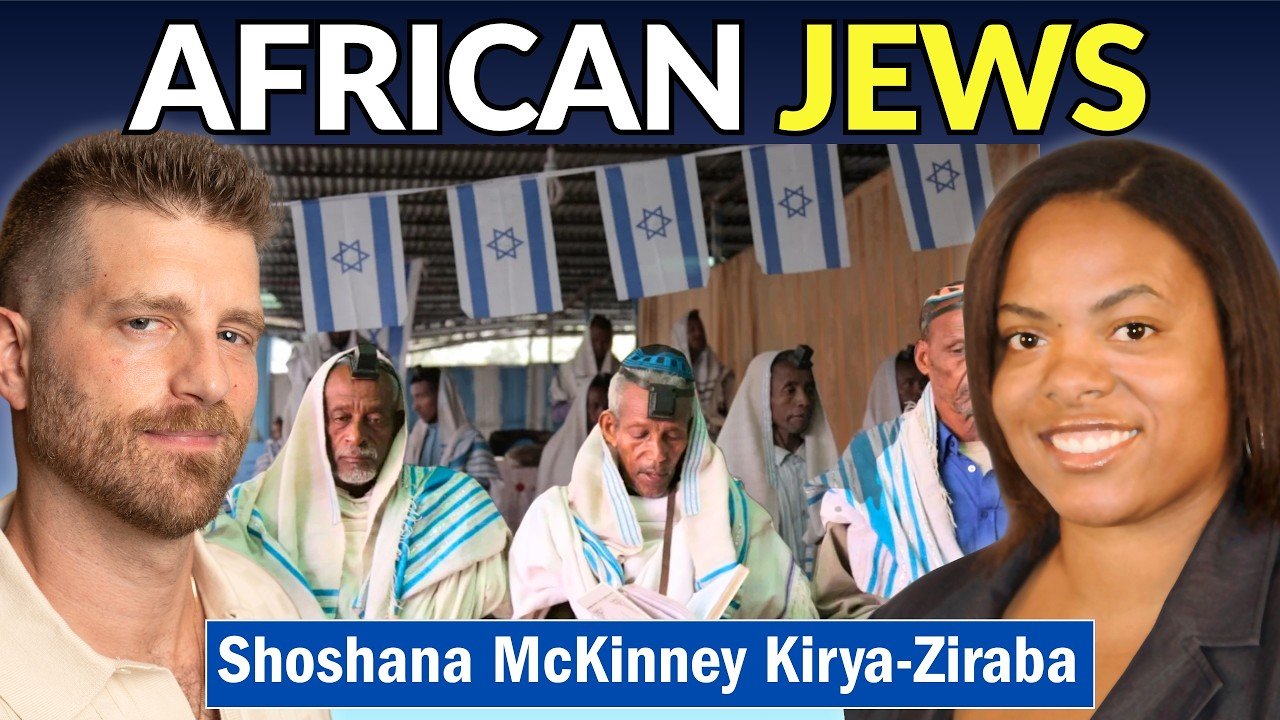
Jews of Uganda: After surviving Idi Amin terror, this African Jewish Abayudaya Community is THRIVING
Watch and Listen
Being a Black Jew in America, there is never any place where my identity is normalized.
This community was horribly persecuted.
When it comes to antisemitism in Uganda, it's much less than in America.
You are now among the majority and within your community of Jews in the majority there.
You're now like majority on majority after being minority on minority.
That's gotta feel good, right?
In Uganda, they know that I'm another Jew just like them A lot of people reach out to me every day to pitch themselves as guests for the show.
Not a lot of them live in Uganda, so when today's guest told me she runs a nonprofit serving the women and children of the Abayudaya Jewish community in eastern Uganda, I knew I had to have her on the show.
She was raised in SoCal, now she raises chickens.
Please welcome Shoshana McKinney Kirya Zerabah.
Hi, Jonah.
Thank you so much for that wonderful introduction.
My pleasure.
It's great to have you on the show.
I know that both myself and my audience are excited to learn from your experience and the work you're doing.
So I know obviously you're American, born in America, born in SoCal, but you now live in eastern Uganda among the Abayudaya Jewish community, which I had not heard about until researching this episode, which I'm certain is the case for, you know, 99% of people around the world.
So I know you're not, you know, born and raised there, but certainly as living among them, I'm, I, I, I feel I can call on you as a spokesperson.
Um, what do you want to tell me and my listeners about the Abayudaya community and what they're all about?
The Abayudaya community, um, is a very, um, close-knit, uh, inspired, uh, faithful Jewish community.
Uh, they're about 5,000 strong in eastern Uganda.
Wow.
Very traditional religious community.
Um, both, uh, conservative and Orthodox, uh, denominations of Judaism are practiced, uh, out there.
They are very committed to their Jewish identity.
Their origin story is a little bit different from many other Jewish communities that you might have heard of.
Yeah.
This community is the descendants of people who converted to Judaism around 100 years ago.
Right.
Which, you know, is a very different origin story.
The- they have no direct lineage to ancient Israel.
Right.
This is a, this is a self-started Jewish community.
That's, that's correct.
I think started by connection to Torah, really.
So what happened was, uh, when the British came to Uganda, they brought their version of the Hebrew scriptures, and there was one leader of the community, his name was Semei Kakungulu, and he said, "Hey, British, how come you're not celebrating these festivals?
How come you're eating any animal you wanna eat?
How come you're still working on Saturdays?" And the British told him, "Well, the only people that live this way are the Jews." So then he said, "Well, then we need to be Jews." That's when they started studying Judaism.
Thankfully, um, some, uh, Moroccan Jews Uh, came to Uganda and the formal study of Judaism took off.
The community grew from there, so there's a very heavy Sephardi influence on the community.
Uh, but since the community was somewhat isolated for many decades, there have been some traditions and practices, um, you know, songs that kind of developed in- independently of other Jewish communities.
Right.
So you mentioned songs.
I know music is super important to the community- Yeah … combining African rhythms and languages with- Yeah … Jewish songs and prayers.
Yeah.
I, I saw there was even a, a Grammy-nominated album from the community.
That's right.
It's fabulous.
A little bit more about this community.
Uh, in the, in the 1970s under Idi Amin, Judaism was completely outlawed in Uganda.
Yeah.
That's right.
And, and this community was horribly persecuted.
Yeah.
You know, synagogues destroyed, sacred texts burned.
Uh, the, the community shrunk by 90%, and really, uh, it seems only stayed alive because of a small group who continued to practice in secret and built it back up again.
How much of that legacy, of that, you know, acute persecution and resilience is alive within the community today, which has now gone from that small group of 300, you know, 40 years ago to 5,000?
There's definitely been, um, a, a resurgence, a, a renaissance of Jewish practice and Jewish identity.
There are many people who, you know, would, would come up to me and say, "Oh, you know, my, my grandparents were Jewish.
My, you know, my uncle was Jewish." And they're, they're willing to reconnect to the Jewish tradition.
There has, um, uh, been established a, uh, historical site.
There's a cave where the Jews used to hide to pray because no synagogues were allowed.
And so there's even, like, different burial plots, um, from that time of when Jews had to bury their loved ones in, you know, any land that they, they could have.
But now Jews are public and proud.
Uh, people wear a kippah wherever they want to.
They, whenever they can get their hands on a mezuzah, there's a mezuzah on the front door.
Jews will even decorate their, the outside of their houses, like the, the ironwork on the, the gate, with, uh, Stars of David and, uh, a b- shape of a menorah.
And so it's, it's n- it's night and day.
That's amazing.
In general, Uganda is a very philosemitic country.
As a matter of fact, right after October 7th, there was a huge Christian pro-Israel rally in the capital of U- uh, Uganda.
When it comes to antisemitism in Uganda, it's much less than in America In, in Uganda, no synagogues have armed guards.
Not one.
No one ever thought- Wow … to have an armed guard at a synagogue in Uganda.
Whereas in America, almost every synagogue wants to have an armed guard if they don't already.
How connected does the community feel to the global Jewish community?
Like, after October 7th, let's say, to be specific, like, how much did that feel like that happened to us?
I would say the community is very Zionist-ic.
Uh, the community definitely has, um, definitely has a strong sense of global Jewish solidarity, of connection to the homeland, and a sense of Jewish history and continuity, uh, as it relates to, you know, the connection with the Land of Israel and the Jewish diaspora.
We definitely want it to be more.
Um, you know, as I, as I go around America speaking to American Jews, I would say about two-thirds of American Jews still don't even know that there's a Jewish community in Uganda, still.
So I've s- got a lot of work to do.
Well, this show will hopefully help educate some of them.
Wonderful.
Thank you for having me on here.
Oh, yeah.
Of course.
What was the shift in how it felt when you go from America, where you are a racial minority, you're a religious ethnic minority- Yeah … and then you go to Africa, where you are now among the majority, and within your community of Jews in the majority there, you're now, like, majority on majority after being- minority on minority.
So, you know.
Yeah.
Yeah.
That, that's, that's gotta feel good, right?
I mean, h- what's that shift been like for you?
Yeah, yeah.
In America, being a, a Black Jew in America, there is never any place where my identity is normalized, where- Mm … people understand those large parts of, of who I am.
Uh, because b- both Black identity and Jewish identity are important to me.
And so sometimes in Jewish spaces, I'm asked to explain my Jewish identity or, or my family history, or, like, like, kind of qualify myself.
Um- Right … as a child I was even given the Jew quiz from other kids where they would quiz me, say, "How many candles do we light on Shabbat?" And what month do we celebrate Hanukkah?
Ugh.
And in Uganda, I go into a synagogue and everyone knows that I'm not there to clean it.
Right.
They know that I'm another Jew just like them, and they just, you know, scoot over, hand me a siddur, and keep it moving.
How does that feel?
What does that do to your, you know, sense of self and wellbeing?
Oh, it's, it's wonderful.
It's definitely… Living in Uganda has definitely been a healing experience.
To see African Judaism in an environment that is, uh, welcoming of Jews, that is als- where Black identity is normalized, it's been very, very much a healing experience.
You know, I see, like on Instagram or whatever, I'll see these, these different like racial healing workshops and, you know, it'll be in like Dallas, Texas for a weekend.
Like no, no, no, you, you need to go to Africa for a month.
Mm-hmm.
So I know you ended up in Uganda because your husband is from there.
Yes, that's right.
Where did you two meet, and how, how difficult of a conversation or easy was it of like, "Hey, let's, we're gonna go back to Uganda?" My, um, husband's rabbi, um, Rabbi Gershom Sizomu, uh, went to rabbinical school at the American Jewish University.
Oh, AJU?
Yeah.
He was or- ordained there.
I knew his rabbi, and thanks to, uh, uh, you know, shadchan on Facebook, we were able to get connected.
I was, uh, you know, 30, single, Black Jewish woman, so that meant that there was only five guys in America that I could date, 'cause I wanted someone who's Black and Jewish.
So by the time this Ugandan guy starts chatting me up, I said, "Oh, okay, let me take a look at this guy." How did that conversation come about of where we gonna live, it's gonna be Uganda?
Oh, well, you know, the, the pandemic and the governments, um, kind of made that decision for us.
After the wedding, I come back to America with the idea that, oh, he's gonna join me, 'cause he had this, you know, this visa that allowed multiple entries.
So okay, he's just gonna fly back and, and join me.
But then the pandemic came and he couldn't get back into America.
And then, plot twist, I was pregnant.
So we kept, we kept saying, "Okay, they're gonna reopen the border.
They're gonna reopen the border," 'cause Uganda had shut the borders.
They didn't reopen the border, so I had to give birth to our baby without him.
Ay.
You know, which is very, very stressful.
And then- Totally … and then once Uganda finally opened the border, then it was America that was, uh, uh, had canceled certain visa types, um, which was under the Biden administration, by the way.
Just saying.
You know, there, there's, there's this perception that Biden let all the immigrants in, which is not true.
So the only way for our family to be together, for my husband to even meet our son, was for us to pack up all our stuff, put everything in storage, and me, four suitcases, the stroller, the car seat, the baby on the plane.
I had to summon my courage.
And then once you got there- Yes, we loved it So then you're living in Uganda- Mm and you and your husband launch Tikvah Chadasha Uganda- Yeah … the nonprofit that you now run.
Yeah, that's right.
Tell me about that.
Tell me where it came from and, and what you're doing.
My husband has a nephew, um, that, that is, uh, has special needs.
He said, "You know, there's, there's no one really doing anything about this issue in our area." And so he said, "Okay, well we need to be the ones to do it then." And I said, "Okay, let's, let's do it." And, um, you know, I just kind of ran with it.
What kind of stuff are you doing?
What, what's your programming?
What are you focused on?
We have a program where we repair old wheelchairs and, uh, get them to kids who need them, so kids who live in deep mountain villages who need a wheelchair, uh, but also kids in our village.
We also work with, um, kids who, um, have other special needs.
For example, there's a wonderful gir- Jewish girl, uh, who, uh, has epilepsy, and she needed a special headgear to wear.
Mm-hmm.
So we made sure to bring that from America.
You know, she needed y- brain MRI surgeries, other medical things.
We also just recently got a scholarship for her.
The, um, Illuminate Jewish Women's Foundation, uh, helped us to, uh, create a scholarship for her so she could finally, at age of 10, has never been to school- Wow … because all the, the other schools don't wanna take her for the liability She can finally start school.
Amazing.
It's our commitment to make sure that she graduates from primary school.
We're also working on a project, uh, for glasses.
So the, with, in partnership with the Lions Club, uh, in, um, America, they have, um, well, they get these old, old prescription glasses.
And so they have, um, some kind of device that can backwards engineer the, the prescription, and so we can give those glasses a new life in Uganda.
Fantastic.
Now tell me about the work you're doing with women.
There's no public school in Uganda.
There's no tuition-free public school in Uganda like there is in America.
Mm.
And so with a lot of poor families, they won't pay to send their s- girl to school past, you know, age, age 15.
So the, a lot of these girls are never getting a chance to attend high school if they're from poor families.
Mm.
And so their opportunities are very limited.
Very, very limited.
Um, m- the women that we work with, their only means of income is to offer themselves as day laborers in the vegetable fields.
And for a whole day of work, which sometimes they have to walk an hour to reach this or that vegetable field, whoever's harve- harvesting their crops or whoever's planting, um, they will get $2 a day.
Jeez.
We started these chicken farms so that women can learn this as a trade, they can make money from home, and they can make that income every month.
And it's not seasonal.
It doesn't, if it m- rains good, it doesn't rain good, doesn't matter.
Right.
Right.
We also have a program where, um, we are selling challah covers and kippot knitted by women in a village called Namutumba.
Those women have a similar situation.
Do you sell the, the, the knitwear online?
Yes, we do.
You can go to our website, www.tikvah, T-I-K-V-A-H, tikvahuganda.org, and click on shop, and you can buy a challah cover.
That's awesome.
Or a kippah.
I love that.
I hope, I hope you get the, the Being Jewish bump and sell a bunch of, uh, kippot.
What, what do you, what is one thing that you wish the American Jewish community understood more about the Ugandan Jewish community, other than the fact that they exist at all?
One misconception that I have heard is that they have different beliefs- Hmm … than other Jews, which is completely not true.
They, uh, their, the rabbis attend the same rabbinical schools as your rabbis do.
The rabbi in, in my village attended Ohr Torah Stone in Efrat.
Ohr Torah Stone, uh, run by Rabbi Riskin- That's right … in Efrat.
That's right.
My wife Courtney was the first person to convert through their conversion program that they started a- about- Wow … a decade ago.
Wonderful.
And Rabbi Riskin co-officiated our wedding.
Oh, wow.
So we love Ohr Torah Stone.
Okay, yes.
Rabbi Riskin is definitely a, a gadol among, uh, the Ugandan Jews.
Another misconception is that Ugandan Jews are converts themselves, okay?
This is not true These are Jews that are descendants of people who converted to Judaism.
Whenever you hear about conversion ceremonies in, that are happening today or in recent years in the community, these are people whose grandparents' parents were living as Jews and observing Judaism.
Okay?
It's not conversion in the same way as, for example, my parents converted to Judaism, or like your wife converted to Judaism.
It's not conversion in the same way.
I would say it's more like when the Ethiopian Jews were coming to Israel and how they would do conversion ceremonies.
It was for legalistic Halakhic reasons, not, um, not joining a new nation that they were not a part of.
Right.
Right.
You know, it's, it's so interesting f- for this show, I, I interviewed a, a woman named Blanca Carrasco who runs the, uh, you know, Society for Crypto Jews, and her family was, are, are crypto Jews.
Uh, she's the descendant of Jews who, you know, were converted i- in Spain and, uh, hid their Jewish identity.
And it's, there's, there's such a, a connection to, to the Ugandan community.
I'm just, I'm curious if that's ever part of the conversation or if there's ever been, um, like a, a, a reach out to connect those communities.
You know, I'm, I'm not aware, but I, I'm definitely open to, to all kinds of cross-cultural connections.
She experienced the same thing.
You know, her ancestors were Jewish, but they sort of hid it and kind of lost it, and then she came back to it and converted to, like, make it official and to educate herself a little bit more.
But it's not like, as you said, it's a different kind of purpose behind the conversion.
Yeah.
Exactly.
Talking about Tikvah Hadashah, uh, how, how's it going?
I mean, are you guys, are, are you seeing the impact you hope to be having?
Are you trying to grow it?
Uh, what are the challenges?
We're definitely trying to grow it.
Um, we, we want to, um, increase our programs.
We also see different needs that we want to help.
Our ambitious goals that we have Um, a few villages over there is a maternity ward that, for example, needs a blood storage fridge, and that costs $5,000.
Um, that's one of the biggest, um, causes of death among, um, birthing mothers in Uganda is l- losing blood.
Mm.
And so the blood bank is there, but we need a blood storage fridge.
We have a, um, a, a water project that we wanna do at, um, at the school for disabled kids.
You know, that's another big project that we, that we would love to do.
Um, we do have some, some big projects in the pipeline.
Uh, thankfully the, the Illuminate, uh, Jewish Women's Foundation, um, helped, uh, sponsor a, a large chicken farm project that we're gonna be doing at a village, uh, next to us with the Orthodox community.
Uh, we're also going to be, um, really, uh, supporting the kids, the Jewish kids in our village as well when it comes to their education.
You know, we've got some good projects in the pipeline, but we really want to grow.
We, we have specific ambitions For specific needs.
We d- we don't wanna grow for growth's sake, you know?
Um, we're, we're a sm- a smaller operation.
We've got, we've got two ladies that help, help me in the, in the office.
Uh, it's, uh, one of the bedrooms of our house is turned into an office.
And then we've got, you know, uh, uh, s- you know, board members who are really hands-on, and then we have a part-time contractor.
We're a small nonprofit, but we get a lot of stuff done.
Like, one thing that we got done that I'm really, really proud of, we got, um, solar lights with the help of the, the Jewish Solar Foundation, which is a guy from LA is the leader of it.
We got, um, solar power to, um, a synagogue in our village, the Jewish school next door, the, the grounds, the access road, and solar-powered streetlights all through the main drag of our village.
Are you hooked into the larger Jewish organizational world?
Are you getting the support from the global Jewish community that you hope to be having?
There's no, like, Jewish federation, like, waiting to cut me a check every year.
No.
No.
Absolutely not.
As a matter of fact, um, that's one of the big structural challenges that many of the largest Jewish, uh, foundations have, and that, and that's, that goes for Jewish family foundations as well as, um, Jewish federations and, um, and others, is that they will say the project must be done in Israel or America.
We just don't fit that mold.
We're, we're in Uganda.
About 1/10 of the opportunities are even available to us just because of that, that structural issue where these foundations are not, are not open to us.
Like, where are you at with just where the Jewish community, the global Jewish community is today?
What's your day-to-day sense of that, and, and how are you feeling?
We have forgotten what it means to be an indigenous people Okay?
Now I, I, I'm Black too, so I, I, I, I understand how that happens.
But we have to use our imagination and understand what it means to be an indigenous people.
Okay?
Mm-hmm.
Hebrew culture is indigenous to the land of Israel, and understanding our connection, understanding our rights as indigenous people, and understanding also our responsibilities, our c- and our commitment to our values.
Not, not what that other group of people is gonna say, or what that other group of people is gonna think of us, or what we should do, or how we should look.
Who are we?
Yeah.
Okay?
That's what I think is missing from, from the Jewish people.
I love that.
Shoshana, if folks wanna learn more about you and your work and, and support, uh, Tikvah Chadashah Uganda, what, what do they do?
We, um, have a little YouTube channel, not as big as yours.
Uh, Tikvah Chadashah Uganda, T-I-K-V-A-H, uh, Chadashah, C-H-A-D-A-S-H-A, Uganda.
Um, we also have a website.
It's www.tikvahuganda.org.
And, um, and you know, invite me to speak at your synagogue.
You know?
I, I speak at synagogues, I speak at conferences, um, all kinds of, um, Jewish events and, you know, everything that you can help, uh, you know, to support us goes to the organization.
Right on.
And now you're, uh, you're also speaking on podcasts.
Yes.
So thank you, thank you so much for being here, for sharing your story, your community's story, and bringing healing to people who need it.
Thank you, Jonah.
All right.
She's a mensch.
It's been 30 minutes.
I'm Jonah Platt.
Tujagule bagana eeda.