
Episode Transcript
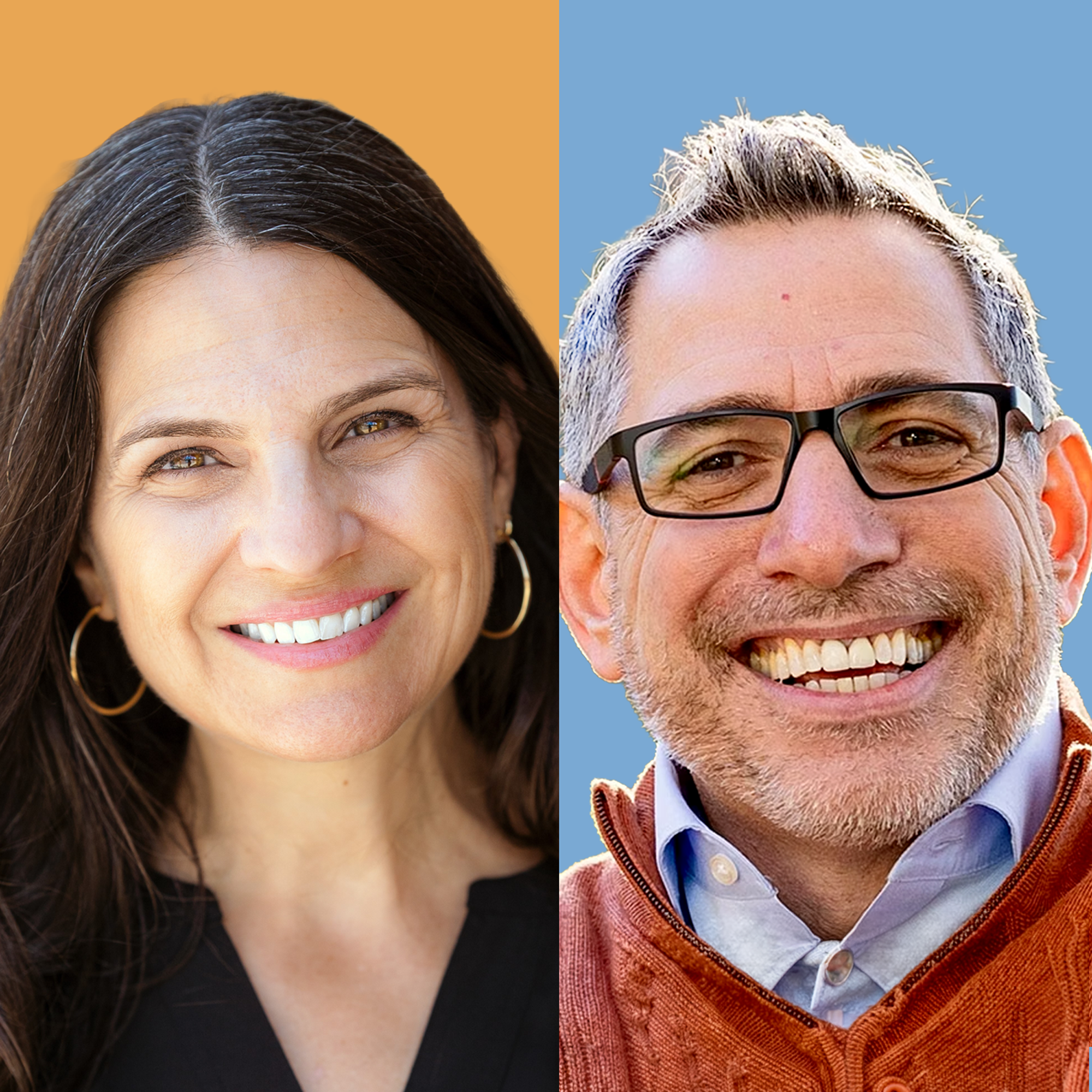
PART 2: Dueling Rabbis with Sharon Brous & David Ingber
We saw you crawling out of your chair with a desire to speak.
In that moment, we are seeing anti Zionism as a hate movement.
If you don't leave room for people to have a conversation about 67, they will throw themselves into the arms of people who are talking about 48.
We have young Jews who don't know their own history.
I think there's something very disingenuous about what you're saying, right?
But that is embedded in the law.
But David, there, there, okay.
You don't like the use of the word.
The hard part is both of you are right.
Shalom, welcome.
I hope you had a fantastic Passover spring break, Easter regular ass week, whatever it was.
I hope it was awesome, and I'm glad you're here with me now.
Today's episode is sponsored once again through the generosity of the Schusterman Family Philanthropies, crown Family Philanthropies, and the Jim Joseph Foundation.
I'm so grateful for your partnership in helping me bring part two of my conversation with Rabbi Sharon Brouse of Ecar and Rabbi David Ber of rmu To all of you, if you miss part one, have no fear, you can find it along with all our episodes at beingjewishpodcast.com.
But you can do that later because right now I'm joined by our illustrious spiritual leaders, rabbis brows in La Ber in New York.
Welcome to both of you, and thank you for being here within 24 hours of completing our live taping.
Both of you reached out to me to express your desire to continue the discussion, a sentiment that I certainly shared as well.
And here we are, not even two weeks later, which is miraculous and I think also speaks to how urgent this dialogue feels right now.
So many times we leave a conversation and we think, God, I wish I would've said this, and now you actually get the chance to say it.
So I wanna pick up right where we left off with Rabbi B Bro's.
Final response of the evening, and Rabbi Burg championing at the bit to jump in.
Let's take a look.
We can do better.
We must do better.
And so I don't wanna be told by anyone that we can't, you know, we can't talk about it because people hate Jews.
Well, I know that people hate Jews.
I'm gonna define myself based on my own set of values, not somebody else's.
So, um, what is gonna happen in the coming elections?
Hopefully there're gonna be some good, you know, solid, um, liberal Democrats who are gonna get elected, who share a vision of a multiracial democracy that includes Jews in it, and also is gonna be a corrective to some of the policies that we've seen in the last year and a half.
All right, rabbi er, we saw you crawling out of your chair with a desire to speak in that moment.
Um, I would love to give you the opportunity now to, to say what you didn't get the chance to say then, and then Rabbi Brows will kick it back to you to, to follow up your thoughts.
Well, first of all, it's, it's great to be back in conversation and I think that it's, it says a lot about the rabbinate where Sharon and I probably have had more direct conversation, uh, through these two dialogues than we usually have, bla are so stretched and being able to have really what's called ma, which is like a debate for the sake of, of heaven, is a really great thing.
I think that what was, what was really, um, animating me at that moment was like, again, like many other things that both, you know, Sharon says, and others colleagues of mine say, there's nothing in what Sharon was saying.
That's, that's problematic per se.
Of course, everything you're saying, Sharon is directly, is true.
I guess the question of course consistently is what do we center and, and what do we lift up in these conversations and what responsibility do I have as a, as a rabbi who has a platform or as a leader who has a platform to center in my sermons, in my conversations and in my communities, and I don't think it's fair.
For example, to say that, um, that one shouldn't take into account.
Uh, the, the reality of antisemitism on the ground or the reality of how words are weaponized from the pulpit and, and inflections and those emphases.
I think that's frankly, quite naive.
I think that if we learned anything about October 7th and then in its aftermath October 8th, it's that there were, in Israel scouts, there were women who were the titz patan at these scouts that were warning the establishment about the oncoming, uh, you know, Hamas attack.
And we ignored them.
And I think in the decades that preceded October 7th, there were also t and kind of scouts here in the diaspora that were also warning us about the, about that what was coming in terms of the progressive world.
And we ignored them, or even worse, we called them alarmist.
And we essentially labeled them with a kind of, oh, you're using the antisemitism canard and you're, or you're using it as a way to kind of avoid speaking about morality or, or progressive values.
And I think that we, those of us who identify as liberal and progressive, I think that the fact that we have to bend over backwards to say.
That we have to be able to name the atrocity or the kind of crimes of Israel as something we don't do is itself also, I think, erroneous.
And it's actually not fair at all.
I think, you know, take Bar Goldstein, the, the, the murderer who murdered 29 Muslims who were praying on Purim Day.
There wasn't one organization, there wasn't one Jewish institution that wasn't unanimously distancing himself and, and judging that, it's not a day of pride for Jews in.
You know, I'm talking about the majority, nine out of 10 or 9.999 number of Jews that we are familiar with have no problem actually admitting that there is extremism within the Jewish Israel, within the Jewish community, but it's if you compare in, in percentage, like the amount of.
Extremism that exists within the Jewish community and within the Israeli community.
And you compare it with the broader existential problems that Jews and Israelis are facing in the world.
It dwarfs it by an ordinary attitude that is so absurd.
It's so, like, again, as I said, you know, in our first conversation, if you were to take the number of times liberal progressive rabbis speak about Islamic jihadism and fundamentalism from the pulpit, or speak about antisemitism from the pulpit and compare it to the number of times that liberal, progressive Jews will speak about Jewish extremism as if it's they're in some way analogous or in some way, um, like in the same universe of discourse.
It's really, it's appalling.
And so I, I don't take issue, of course with what you were saying, Sharon, I just take issue with this kind of gen, reflective and reflexive, uh, need that we have in the industry community to say that we have to be able to call out that atrocity.
Of course we can, but where are my level progressive friends and colleagues throughout the years?
Calling out right?
Muslim fundamentalism and Muslim anti-Semitism and black anti-Semitism.
Right.
I think that we give, we give a double standard where we're overly critical of ourselves in public as a kind of reflexive ability to show that we're not tribal, which I think is the worst sin for a progressive Jew to commit, is to be quote unquote seen as tribal.
And we overcorrect in that direction.
And I think that it does have deleterious effects on, on the way that we're perceived in the world.
I think that the perception of Jews in the world and, and the cover that we as rabbis sometimes give, often give to anti-Semites is actually something that we have to be responsible for and own and be wary of.
Rabbi Brows, if you'd like to respond to Rabbi Burg, if you were telling me there was so much more important stuff you wanted to say, however you want to take it.
It's yours.
The floor is yours.
David, you just said so many things that are important for us to unpack.
So I'd like to address that if I can.
First of all, uh, you position it as though Jewish self-criticism is about, um, genuflecting and, uh, a kind of, um, political theater like we are putting at forward a position so that other people will look at us as though we're good Jews.
In fact, our tradition is rooted so deeply in the idea of CVA and hash nefe and the idea that we are responsible for an accounting of our own soul, of our own behavior.
That we are responsible for the behavior of those with whom we can in any way have an impact.
Those who fail to protest against wrongdoing among our own household, our own community, our own city, are held responsible for that behavior.
And so I think there's a, you're suggesting that there's a kind of disingenuous underlying.
Um, there that there's an underlying dis ingenuity to a criticism of extremism.
For example, violent religious extremism among, um, among some settlers in the West Bank.
I would offer to you that for me, when I speak out about what now has become normative in the West Bank and is no longer extraordinary, and you don't have to, we don't have to play a numbers game.
I mean, what we're seeing is multiple attacks from violent Jewish religious extremists, settlers on Palestinians in their homes and communities every day in the West Bank for the last month, every single day, what we would call pogroms.
Okay.
And what many people in Israel are calling pogroms because they are state supported, if they're not state sponsored.
When you see Jews engaging in that kind of behavior, and you as a Jewish leader.
Choose not to speak out about it because there are also ambulances that are being blown up in London, which is also horrific.
You are making a choice and when you suggest that a rabbi, not you, but when it is suggested in our Jewish world that a rabbi that does speak out about this spike in extremist violence from our own Jew Jewish community in the West Bank, when that, when we do speak out about it, it's only because we wanna position ourselves as good Jews out in the world.
It's attributing a kind of intention that does not resonate at all with my experience, and I think it is diminishing our capacity for, and our responsibility for self accounting and for engaging in the kind of rigorous self accounting that as Jews, we are certainly called to.
Again, I, I think that you said what you said is really perfectly accurate.
It is a choice, and I'm actually interrogating my 20 years, my own experience within the liberal progressive universe.
Being a leader in that community and, and starting my own synagogue, and having come from a, a decidedly more traditional, you know, place.
I think there are multiple values at play here.
I mean, we both know that within the tradition, Hashi and ish, or self accounting and self-criticism has held in tension also with j not just Rebuking, your friend and your neighbor, but like the sense of being able to, to see, you know, existential threats that are not coming from within your community to able to name those as well.
It wasn't like the prophets only railed against the Jewish people.
They also spoke about Assyria and they spoke about Babylonia.
I mean, prophetic wisdom isn't only unidirectional.
And, and I think that the point I was making is that you're right, there are choices that are made and by and large.
And I'm not impugning, I don't know what people's motivations are, but I am saying that I think, again, it's my theory that there's an, and my experience is that there's an internalized double standard that we as progressive Jews and progressive rabbis, I think it's anti-Semitic, frankly.
I think it might recede into the, you know, the back of the mind and you don't really know why you are.
But if you were to look at the numbers and follow the patterns, you will see that rabbis who are in the progressive universe that I have walked in and so have you are more likely to get people to come out for a protest.
For no Kings or against Trump, then they are to get them to come out for a protest against violent Muslim extremism that impacts their brothers and sisters in the Jewish world.
And I do think you're right, it doesn't have to be a zero sum game where we're only protesting against, you know, settlers or against the, the ambulances.
But when was the last time you and I went and really honestly went to a protest that was started by, or any of these other human rights organizations to, to protest against human rights abuses against the Jewish people and against Israelis.
And I think that, that, so, so your argument rings hollow to me.
I, it doesn't mean hollow in the sense that God forbid we shouldn't be calling out violent extremism, but, but by percentage and by ratio, we contribute to, to the perception in the world that yasir and bi.
Are actually in the same subset of leaders, and we both know that that's not true.
I think as a both, as a, as a parent and as a rabbi, I just, I, I, I wanna suggest that when I hear that a bunch of kids in my son's high school behave badly, I'm most concerned with my son's bad behavior, and I wanna make sure that he is acting like a mensch and doing what is just, and right now I'm also disappointed in all the other students, but I, my moral responsibility is to teach my son and to speak to my son, whom I have much greater influence over than over his friends.
We should have a disproportional, pay disproportional attention to what's going on in our own community because we are.
Spiritual leaders of this community, and I don't treat this at all as a zero sum game.
In fact, my argument, which you have heard me make many, many times, I believe even in our conversation with Jonah, um, initially in Encinitas, is that our hearts are capacious enough to hold all of it.
And we have to be honest about the threats that come to the Jewish community from the outside, and also the threats to the Jewish community that right now are coming from inside the Jewish community from a growing ultranationalist marriage.
To religion, to religious faith, which is manifesting in acts of violence, which I believe will undermine and ultimately have the potential to destroy the state of Israel.
And anybody who's concerned about the Jewish people and about the future of the state of Israel needs to use a, a, a very loud and clear moral voice right now to speak out about what's going on in our own community.
And if you are a rabbi that chooses to speak out aga about Islamic fundamentalism and violence that stems from Islam and from particular interpretations of Islam, but remains relatively tepid when it comes to speaking out against acts of extreme violence perpetrated by people wearing seat seats and kios who are learning in Bame rush during the day and then going out at night and burning villages, that is a total abdication of responsibility.
What this conversation is highlighting is what I, you know, this is a really tricky.
Situation.
And I know, you know, as somebody who is a Jewish leader of a different kind and has a platform, this exact calculus is something that I have to think about.
And the the hard part is both of you are right on the one hand.
Yes.
To not speak about this stuff can feel like a moral abdication.
And on the other hand, to speak about this stuff.
Can also have real world adverse effects that negatively affect our community.
So I, I'm curious, rabbi brows, like, does that enter your calculus at all?
The, the, not just, someone might not like us if I say this, but this might fuel the fire of real meaningful hatred against us if this plays an outsized role in our messaging.
I take great care when I speak, um, about all of these matters.
Um.
The last thing I wanna do, God forbid, is hurt somebody through my words, which create a permission structure for people to hold a view that will end up causing harm to any human being.
And I'm particularly cognizant of my brother and his family.
Who've spent the last month in a safe room the size of a bathroom.
And I believe that there is a grave danger to our Jewish people if we do not speak about it as well.
And so I'm constantly trying to navigate how to say the moral analysis that I believe our community desperately needs and also how to.
Um, do no harm.
How to minimize the possibility or the likelihood of doing harm.
And one could equally argue that not speaking out as a Jewish leader against, um, reckless and violent Jewish behavior is even more dangerous for Jews than speaking out about it in a measured, careful moral and Torah centered way.
And that's actually where I land.
We have to put the patient on the table and speak honestly and in a morally coherent way about where the cancer is because if that cancer has wrapped itself around the spine of the country or around the spine of our Jewish people, frankly a cancer of extremism.
Of violent extremism that in every way counters the deepest lessons of Torah that the three of us all know and love.
We have to do surgery, right?
We have to look at it with clear eyes.
We have to speak about it, and we have to save this patient before the patient, right?
It self, self-destruct.
But, but, uh, uh, but with all due respect, these analogies are, are inaccurate to the point of being.
It's almost.
It, it, it's hard to actually even hear this analogy as you said about your son.
Maybe you defending your son actually, or your interest in your son is actually inaccurate in terms of actually addressing your son's behavior because you are more ashamed of his behavior in ways that actually make it difficult for you to see the relative, like what he did, if it was really wrong or not, and whether there were other factors involved.
And I would say your primary responsibility towards your son is to actually make sure that you have one conversation with him privately and another one with him publicly.
And to the extent that that, that he's looking to you because he's got a larger issue at school to to work with.
That analogy breaks down.
It's just interesting the choices that we make as leaders.
Like why focus on one part of the Israeli conflict or the Israeli responsibility to be acting in a toic way and reduce it.
To religious extremism or settler violence as opposed to just saying it's a much bigger problem, which has to do with the occupation, which has to do with historical relationship between the Palestinians and the Israelis and Arabs and so on.
So I think that for us to choose our battles is always a tell.
That battles that we choose are always a tell on our priorities and what we think is most important.
And the fact that you gave that sermon, Sharon, right, two weeks before Hamas murdered our brothers and sisters, your brothers and sisters to me, is everything that I'm saying here, which is of course the sermon on its own merits, right?
Calling out settler violence.
I mean, who would've an argument with calling out violence in Israel?
Who would've an argument about calling out social ills in Israel?
But the fact that as you as a liberal progressive voice and with a large platform and moral clarity chose that while Hamas and Islamic fundamentalism was, was scheming, is to me exactly where we miss.
We're missing the ball, we're missing the mark.
Right?
We're, we should be advocating for rabbis from their platforms to be talking about much bigger issues than the shame that we feel that a couple of our brothers and sisters are acting in ways that are shameful to us.
There's a world that's acting shamefully to us.
There's a world that's acting shamefully towards American Jews and Jews into the Netherlands and Jews in London and Israelis.
Right?
And the world is, is morally confused.
The fact that it can even be confused about Iran and what Iran represents is itself a complete and total breakdown of moral, a moral atrophy of the highest order.
92 million people living under an Islamic jihadist regime, and we have progressive rabbis out who are fighting and calling out Israelis, go the Israeli government and deciding the thing that we have to put onto the world is that there is a group of religious extremists who are living in Israel, in, in contested territories in Israel.
I mean, that's.
That's what we're focusing on.
If I could sort of distill what I'm sort of hearing from taking a step back.
And again, it's like both of you are right in that Rabbi Browns you are committed to your morals and your beliefs in, in a way that I think is extremely admirable and is so true to you and true to your beliefs and, and true to your leadership.
And there is a game that's being played and Rabbi er, I think is rightfully suggesting that everyone else is playing it.
And if we aren't, uh, aware of that and engaging with that, we're gonna be the ones getting played and are getting played.
It's tricky.
I I, 'cause I, I completely see where both of you are coming from.
I wanna leave this.
Part of our conversation there.
I wanna move on to the next little bit.
Wait, can we say just one more thing, Jonah, about that?
'cause I just, I'm sorry, I can't leave it.
Sure.
Or we're gonna make you do a part three.
If you don't, let me get it.
If you don't get it, go for it.
Look, I mean, David, you start, I think there's something very disingenuous about what you're saying and I just wanna point it out because you literally started by saying how proud you were.
That the Jewish, every Jewish leader spoke out against Barak Goldstein.
That was one person.
That was one person, a gunman who went in and committed a massacre in the cave of ela.
Now we're talking about ministers in the government who are representative of not just a couple of bad apples, but we're talking about a growing and increasingly normative movement of Jewish religious extremists.
And yet you are now criticizing any public Jewish public leader who will even use our breath to criticize, let alone condemn them after just celebrating that Rabing and every other Jewish leader did it once they committed the massacre.
No, I agree with you.
If if that's what I'm saying then, then you're right.
So let me be clear and thank you for bringing that up so I can really clarify.
I'm not arguing and as I think, I'm pretty sure if we go back to the table, I'm not arguing that rabbis should not be saying what is happening is shameful.
I am, I'm saying that there's something bigger happening in the liberal progressive world and it's, it started well before October 7th.
It is a completely distorted perspective that is offered to the world that for the most part is looking to TikTok and to, you know, Instagram and Twitter, and looking to those sources of information.
Then looking to the rabbinic leaders who, as a Jew, to use Sarah Horowitz's term or as a rabbi, get up and say, here are the pressing issues that the Jewish community is concerned about.
And by and large in the liberal progressive universe in which I traffic and you traffic, we walk in, we, we put a greater emphasis on the.
On the ability to, to pound our chest when we make mistakes and to, to criticize our own over being willing to criticize our allies and criticize our enemies.
And I say that with absolute clarity.
There is no liberal progressive rabbi.
I know that we get up and say we are disappointed in the black community for their inability to speak out about anti Jew hatred within their churches, within their communities.
And we demand a symmetry between the way that liberal, progressive Jews have spoken about the need to eradicate racism.
Racism in our communities, in our synagogues.
And we demand the same thing from you.
You should be standing up from your pulpits and talking about anti Jew stereotypes and tropes and we demand it the way that you could demand it from us.
And I think that by and large, that is the asymmetry of Jewish progressive universe.
This is, this is great stuff.
I wanna get now to.
The, the Democratic party of it all, rabbi Brows, which I know you wanted to say more about, so I'm just gonna hand it over to you.
I think it's very clear that we are right now in the 11th hour for American democracy and the fact, uh, is that liberal, it is liberal democracy that has allowed for the flourishing of the Jewish people and, and many other minority communities that Jewish safety and thriving.
In this country is because of liberal democracy.
And I am very concerned that in this moment where we're seeing, um, a, a pretty dramatic and rapid shift toward authoritarianism and fascism in this country, that we have to recognize that our safety and our future depends on America being a liberal democracy.
And that has to be a very central part of our analysis about part partisan politics, about how we feel about the Democratic Party.
And what I heard from Rabbi Berg in our conversation was there was some discomfort.
I think you talked David about.
Newsom and his comments, which at the time had just come out, um, when he was speaking with the pod save guys about was it Israel's responsibility, did Israel essentially drag the United States into the war?
And that many Jews were uncomfortable with the way that Newsom framed this.
And I think what I, what I wanna say is that as much as we might be uncomfortable.
Or hurt by or concerned about some of the languages and hot takes that, um, that some democratic politicians are using to speak about a truly perplexing and complicated situation in Israel.
We have to be very clear about the need to fight to defend our democracy essential to, to the principles of the Democratic party are the principles of liberal democracy.
And right now what we're seeing is this administration really undermining those very foundational elements of liberal democracy that have protected and kept Jews safe, um, for the, for the last two centuries.
And that I think has to be the Dr a, a very significant factor when we're speaking about.
Our hurt or discomfort or concern about a growing, uh, antisemitism that we're seeing emerging from the left.
Um, many of the people on the left who are manifesting this antisemitism, by the way, also don't even associate themselves with the Democratic party anymore, decidedly did not vote for Kamala.
And so I think that the Democratic Party is taking a massive hit for this influx of antisemitism on the left in ways that the Republican party doesn't often have to pay the price for antisemitism on the, on the right, despite how present it is.
And we cannot downplay how central, um, how, how essential the need to protect and defend our democracy will be in the midterm elections.
And God willing, the present, uh, the, the future presidential elections.
Rabbi Enger, what do you think about that?
I think that we should be centering Jewish concerns and we should be centering Jewish, um, survival questions and fears.
And I agree wholeheartedly with what Sharon's saying about democracy.
Again, it's hard to argue.
I, I, of course, we liberal democracy is, has always been the stalwart to some extent against antisemitism, and we flourished in liberal democracy.
But I think that October 7th, liberal Jews and progressive Jews felt that we were completely abandoned, not only by by our allies, but also by the very institution of liberal democracy itself.
I is insufficient.
To protect us from antisemitism and that it's not fair to group antisemitism with other hates.
You often hear that kind of reflexive and knee jerk, you know, antisemitism and all other forms of hatred.
But there was a sense that there is a unique virus called antisemitism or Jew hatred.
And that even something as powerful as liberal democracy is not impervious and and sealed, you know, hermetically sealed from, from, you know, making it to the top of the mountain of liberalism and every, you know, equality for all except for the Jews, or except if you want sovereignty and self-determination if you're a Jew, right?
We're willing to fight for all of that, but somehow Jews are left out and I think that.
I don't think of this in terms of de Democrats versus Republicans.
I just think, right, I, I'm somebody who believes that the Republican party also had had a moderate wing at some point, or we would now consider to be a moderate wing.
And that in the center, right in the center of these extremes, there are most of us who want, right, who want a robust democracy, who want robust civil debate, who want leaders, who can acknowledge truth in wherever it is, who can work on behalf of the people and who can work on behalf of making this country and the world a better place.
So I, you know, I don't, I, I just think that it's legitimate for Jews to be concerned about the anti-Semitism on the left.
It's incredibly, uh, important and scary to see the antisemitism that's emerging from the right and to see this kind of, the horseshoe effect coming, you know, coming, uh, around.
And I think that Jews are legitimately concerned about their own safety.
I think a lot of Jews feel completely homeless politically at this moment.
We don't, you know.
It, you know, Trump, a lot of people say, well, Trump dropped the bombs in Iran, uh, on Iran, and he's also right.
He's also has, he's a fascist.
And so what do we do, like protecting our people?
But he would throw us under the bus in a second, and then others say, yeah, but I wouldn't vote for anybody in the left if the, is the party turning towards mom?
Donny is the, is the party turning towards kind of its left wing base?
Um, I think that Jews are legitimately confused right now and homeless, and I think that any conversation about, you know, the future of politics here in America has to, for Jews, has to center, uh, real concerns for Jews in terms of their own safety, their own standing and, and what it will look like going forward.
I wanna talk about the anti Jew hate on the left that both of you have alluded to.
You've both called it antisemitism, I would call it anti-Zionism, and have, and.
And sort of part of the movement to, to recognize hate on the left as anti-Zionism and as a specific thing.
So I wanna start by asking each of you to define for me what you think anti-Zionism is the way it manifests today in 2026.
Um, rabbi Brows, how would you define anti-Zionism?
Honestly, I stopped using the language of Zionism and anti-Zionism a couple of years ago because I feel there's certain words that mean completely different things depending on who's using those words and so, sure.
Um, and so when I would use the word Zionism, I meant it as, um, a movement for national liberation for a people with a long history and established connection to the land who for 2000 years in exile.
Um, have, have been persecuted and oppressed and harmed and need self-determination in order to truly flourish.
So I would use the word to mean that and other people would hear the word Zionism and think that that means, um, violent displacement of Palestinians who, whose grandparents planted the olive trees that are now being uprooted by people who call themselves Zionists.
So.
I, I found that the language, rather than fight about the language, we should talk about the ideas behind the language.
So, so similarly with anti-Zionist, I think some people use identify themselves as anti-Zionist.
And what that means is I want all the Jewish people to be pushed from the river to the sea or go back to Poland as people shouted at my kid and her friend at, you know, walking out of the hill all on a Friday night.
Which we know what happened to Jews in Poland.
Um, I think some people use that language, um, and identify that way because they really hold, they harbor a fantasy of the erasure of the Jews.
And some people use that language because they see Zionism as an oppressive force and an unequal force that has created a political reality that is fundamentally unfair.
And what they want is one state where everybody's gonna have equal rights or something like that.
So speaking out against anti-Zionism, it's like, what are you speaking out against?
So I'd rather talk about what a person actually believes, what views they hold and.
And you know that you have that be the beginning of the conversation rather than writing someone off.
Um, because they identify with a certain, um, with a certain ideology that I don't even understand 'cause I'm using the same word to mean something different.
Let's then maybe think about it more in practice as opposed to an idea in terms of, you know, what, what I'm curious is, you know, what would you call the group of people or the movement to other and ostracize Jewish people from, from the professional world, from cultural worlds, from the physical world based on this.
You know, idea of the quote unquote blood thirsty Zionist and using that as their excuse to do so.
That's what I see playing out in the world when I talk about anti-Zionism Rabbi Burg, what, what's your take on it?
I think that the current iteration, right, as Zionism, which I, I also agree, doesn't have a hyphen.
I think it's a completely.
A new expression of anti-Semitism, and it's kind of, it's congealing in the way that other hate movements, um, have, have kind of formed.
I think that its current features of it look very much like a, an ideology that seeks to erase Jewish self sovereignty and connection to the land as indigenous to this om to this collective that we are, this people that we are.
Um, I think that it, it acts to kind of label and put a z label and, and have associations of Z with a kind of rapacious, colonialist, uh, categories.
And it seeks to kind of seek to, it dehumanizes the entire, um, enterprise of Zionism or Jewish self-determination, self sovereignty.
So I see the way that it's currently morphed in the way that Rabbi Jonathan Sachs talked about.
Antisemitism is exactly like basically a virus that mutates, uh, whatever it is that you value the most.
It is what the Jews are doing.
And so at this moment, I agree with him wholeheartedly, um, that we are seeing anti Zionism as a hate movement.
As a, a racializing and a, and a labeling and libeling of the Jewish people, uh, tarring them with labels like genocide and, and apartheid and all other kind of borrowed terminology from other movements.
And the, the function of it is essentially to silence Jewish.
Cell sovereignty and Jewish and Jewish identity with that movement.
Call it, whatever you wanna call it.
And so I think we've moved out of the category of like, oh, once there were intellectuals and academics who didn't think that a state was a great idea or, I think that all of that is cover for the hate movement that we're seeing.
And I think to the extent that we continue to put it into old categories and refused and refuse to name it as such, we're, we're getting, we're behind already and we're gonna even, we're gonna fall even further behind.
And I would say that they've succeeded at this point to some extent.
I mean, I think Zionism has become, as Adam Sche has written the Z word, like it is the, the, the kind of scarlet z you know it, you know, the blue and white elephant in every room.
Why do you think we as a community, institutionally, publicly, you know what, why have we been so slow to do that?
Like what do you think is standing in the way.
You know, there are always gonna be excuses, right?
There's, there's the sense that, um, we were unprepared for the, the onslaught, which is shameful because it's been going on for quite a while.
But I think that we underestimated how pernicious it was, how insidious it was, how, you know, widespread you send your kids to, you know, liberal universities and they're being indoctrinated with, with ideas that are borrowed terms and applied to, to, to Israel.
And so I think we underestimated.
And so that's one we're slow to respond.
Two, I think that the Jewish community is so reticent, understandably, you know, to, to alienate any part of us.
We're such a small group and so we start alienating.
There are people who didn't agree with, with the idea of a state and so we don't wanna cut that piece off.
Uh, you know, we're also, we're also very, you know, very, um, wary of, of claiming another category of Jew hatred.
Like we always feel like how dare we center ourselves yet again?
And especially now with Israel having military, might we kind of think, we might sound like we're playing the victim.
And so I think there are a lot of these kind of thought forms that get in the way.
And I think that practically, um, let's just be honest, we're up against a huge Qatar and China and Russia.
I mean, the first anti-Zionist, you know, treatise was not written recently, or even 50 years ago.
It was a hundred years ago.
You know, the elders of the protocol of Zion was written by, by, by Ru, by the Russians to try to equate Zionism with racism.
And, and so, you know, we're behind already in some sense.
And, and most Israelis are thinking it doesn't matter because we're a fact on the ground.
And it really, you know, they can say whatever they want.
Here we are by brass.
Please.
I'll tell you a couple places where it's become very clear to me that anti-Zionism is anti-Semitic.
Um, in, I dunno if you, if you caught this, but in the immediate, um, aftermath of the capture of Maduro, the person who became the interim president, um.
Immediately se suggested that it was a, um, a Zionist operation.
Did you catch that?
Yeah.
And similarly, ev piece of evidence number two, um, a very prominent and, and I think very well respected left-wing commentator, um, when Renee Goode was shot, immediately posted on her Instagram.
This is the face of Zionism on American Streets now two.
Individual, um, actions operations that have, that literally have nothing to do with the Jews.
Um, nothing to do with the Zionists.
And in both cases are credited to this Zionist entity, which is the classically, the way that antisemitism functions, that there is suffering in the human community.
And if we can identify that the Jews are responsible for all of that suffering, then we can, then we have a target for our angst and our anguish and our anger.
And that also relieves the people who are actually responsible for it.
So you see, I started to mention this in our previous conversation together, there's much more passion and energy around anti-Zionist protests and anti-Israel protests than there are against anti-Trump protests.
I mean, Trump is the one who was responsible both for the ice actions in Minneapolis that killed Renee Goode and also for the Maduro operation.
But when they're credited to Zionism, there's something that feels like truth telling that is extremely seductive.
And I, that's, you can see in that, um, in those couple of examples and that those aren't, those aren't rare anymore.
I mean, the, now we see this kind of speech all the time.
This is when anti-Zionism is absolutely antisemitism.
The problem, of course, is that it's very difficult for us as a kind of PTSD, you know, post Holocaust generation to distinguish between legitimate criticism of actions that, um, that that, that the government of the state of Israel engages in and anti-Semitism.
And so we reject all of it.
And Jonah, I don't think, I mean, you said, I think you're, the way you framed your question to David was how do you understand why the Jewish community has been so slow to adopt this kind of clarity around anti-Zionism being antisemitism?
I don't think they've been slow at all.
I think that is the mainstream Jewish discourse.
I think the assumption in the established Jewish community is that anti-Zionism is anti-Semitism.
And I'll, I'll take it one level further.
Look, my kid was on a campus where literally they were chanting Burn Tel Aviv to the ground.
And we don't want no two states.
We'll take all of it and go back to Poland and you're lucky I don't kill all of you Zionists right now.
Okay?
I'm not talking about that.
Okay.
That is clearly antisemitic.
I'm talking about the Palestinian flag itself.
Some people perceive as a, as an expression of antisemitism, and even further, the watermelon is seen as an expression of antisemitism.
You know, the watermelon is used because it's red, green, black and white.
And so, um, and so it's used as a, as a symbol, uh, for of solidarity with Palestinians, meaning so many people in the Jewish world, um, are so afraid of antisemitism and so keyed in to antisemitism that any expression of solidarity with Palestinians is perceived as anti-Semitic, even when it's not, even, when it's literally solidarity with human beings who are in their own quest for self-determination.
So I think we have to get very clear about what is and what is not antisemitic, because when everything is antisemitic, we can't actually protect ourselves from the real threat of violent antisemitism.
Which is very real in our time, and which I'm particularly concerned about, if every expression of solidarity with Palestinians is considered antisemitic, if every person who uses the word apartheid is considered an antisemite, whether you like the word or not, people are searching for language to address a system that is unequal and unfair.
Right?
But, but that's also, that is embedded in the law.
That's also, but so, so, but David, there, there, okay.
You don't like the use of the word, but if somebody uses that word, because there are, there, there, there's a limitations in the English language and they're trying to find a word that can express this doesn't seem fair.
Right?
Why are these settlers allowed to come down from car, from Carmel into Umher and, and chop down Palestinian trees on their individual land and have no ramification?
So they're trying to find language and if we call that analysis necessarily antisemitic.
We are failing to protect ourselves from the real threat of real antisemitism today.
Well, I don't, I don't, again, it's not a zero sum game, and I think that it's, it's important for us to be able to call out different forms of antisemitism and, for example, a person, right?
We all know this all too well.
We can borrow this from DEI circles or from other marginalized communities.
Like it's possible for a person not to be an overt racist, but to be engaging in RA racist tropes.
In fact, I would say that we, liberal rabbis have become so finely attuned to kind of racial assumptions and gender assumptions and all manner of assumptions that we make that aren't overt, and that's exactly the whole movement of white fragility and Robin DeAngelo's work and all the other work was to name insidious.
Unseen, but really like, not overt, but ways in which we bring frames into our experience that then color our experience.
And so I think when someone says your adoption of apartheid, which is a completely different category and borrowed from South Africa without the historical context, and you step in to a conversation with John Stewart in front of millions of people and you employ this language without giving context, you actually are misleading millions and millions of people who need much greater depth to understand what's happening.
And when we flatten, we don't allow ourselves to flatten other complex issues.
But when we flatten for the purpose of framing our brothers and sisters, Jewish brothers and sisters who are in a much more complicated, I'm not condoning it, it's criminal.
I don't condone it on any level, but it isn't.
Apartheid in the way that that word has been used.
Much like whatever happened in this war is nothing like the use the libels that have been framed around it.
I don't agree with you.
That doesn't make us able to see, uh, unable to, to combat real antisemitism if this there is a real antisemitism and this is okay to countenance.
I think they're both bad and I think that we as liberals.
Progressives, whatever we might say.
We can't allow ourselves to have limited energy for fighting these tropes and these frames that come along.
I have never lived in a world in which, you know, in a liberal progressive world in which we weren't locking hands with Palestinians.
In fact, if anything came out of October 7th, it was, we felt the asymmetry of this work where Jews and Israelis were making partnerships with watermelon and with Palestinian flags and self-determination for Palestinians.
And then we discovered that lo and behold, it wasn't at all like that.
We were making our overtures and the majority of the world was seeing this not as a 67 conflict, but as a 48 conflict.
And we're waking up.
And so here we are back in the same tired tropes the Jewish community is, is, does not see.
The flag, by and large has a problem is the perception that Palestinians and their narrative are anti-Zionists.
They don't believe that there should be a state on any part of that land.
And so I just think that again, to center the, this conversation around Jews inability to hear criticism of their government is again to lose sight.
Of what is at stake here, Hamas, Hezbollah, open up Facebook or Twitter or Instagram and see the debates that are happening in the Knesset.
Look at Arab Israeli lawmakers in the Knesset screaming at bi netanya in front of the cameras in language that, frankly, I don't even know in the United States, that you know, where freedom of speech is, is, uh, one of our highest values.
We, we even allow that in our government and then to portray it on CNN or on any other large public, you know, platform that Israel is lacking the ability to hear criticism of its government.
It's just, it's erroneous, you know, at best and at worst, it actually is, is libelous about the Jewish people, I think.
I think we take, David, there's always been, there's always been a difference between Israel, which has a very robust media and a very robust, um, muscle for self-criticism and the way that people in the diaspora are allowed to speak about Israel, including in our own Jewish community.
And if you think, but who can blame them?
Look at what happened.
Look, look.
Who can blame?
Is it alarmist now to look back at, at how much, how much these, the internal American conversation centered on Bibb to look back now at the broader world reputation that we have and not say that maybe we centered it in the wrong way.
Maybe, you know, to have Thomas Friedman name Bibb and Smar in the same conversation as if they're equal morally is just.
Uh, it is just unfathomable to me that, that the world could think that Bebe is the kind of monster that, that, you know, that the monster of October 7th, you know, was if everybody could speak at the level of discourse that you two are able to, and that if the, the pervasive discourse was critiques of the government and discussions of the West Bank, et cetera, et cetera, I think that would be a different situation.
But I, I'm guessing I spend a lot more time on social media than the, the two of you do.
The conversation is being had by, you know, 99.9% of people who don't know anything about any of this stuff.
They're not even talking about the West Bank.
They're talking about Jews in America.
They're talking about Gaza.
And I, I, I have to disagree a little bit with Rabbi er in that I think a lot of people, I certainly, the kinds of people I would imagine.
Our, you know, around Rabbi bro do feel threatened just by the side of a Palestinian flag or by a watermelon.
But I, and I agree that we should question that because, uh, I'm sure they feel as threatened by an Israeli flag, and we would think that's crazy.
But on the same token, I feel like a lot of those people, the reason they have that solidarity comes from an understanding based entirely on libels and on false information.
And if pressed would express totally anti-Jewish bigoted.
Points of view that go hand in hand with why they've decided to show that solidarity.
It's not just sort of, um, coming from a place of, uh, magnanimous goodness.
And, and the, the conversation that is running rampant all over the place is essentially just Jews bad Israel, bad.
I don't need to say anything else.
You like killing kids.
You're an evil, terrible person.
Get outta my school, get outta my city, get outta my office, et cetera, et cetera.
Is there a limit or a boundary as, as institutional and religious leaders to the way that we include anti-Zionist Jews within the organized Jewish world?
And I know this is a really difficult question and something that we're all sort of grappling with in a lot of different places, and I'm curious how in your own congregations and institutions you've thought about this or dealt with it and, and what you are seeing.
In your world.
So Rabbi Brows, I'll, I'll let you take this one first.
It breaks my heart to go on social media, so I am trying to really, as a spiritual practice so that I can maintain my love of humanity and my hope for a, a just and peaceful future for all human beings.
I am.
Extremely limited in my exposure to those spaces.
I will engage in sit down conversations with many, many people from with all different perspectives that challenge me and make me think about things differently and whom I disagree with very much.
As you.
Can see here.
So, um, but I, you know, a lot more of what the discourse is showing than I do.
But the fact of miss and disinformation is a real problem today.
And I know you're right.
Um, and my kid whose campus exploded, as I've mentioned a couple of times, um, she kept saying to me, it's so strange.
The people who are some of the most passionate advocates for Palestine believe that before 1948, Palestine was run by Palestinians and they never heard about the British or the Ottomans.
And they, that the Jews came in and stole Palestine and you know, they kicked out the Palestinian government and put in a Jewish government, and now we need to get the Palestinian government.
Like, there's just so much, uh, that, you know, people always say, which river, which sea understood.
There are lots of people who don't understand what's going on, and that's part of the reason that we have to educate.
But I think there's another piece here that weaves together your question with something that Rabbi Ingber said earlier, which is, in my experience as a person who is fiercely.
Committed, um, to remaining in relationship with the state of Israel and with the people of Israel and I, I mean Israel.
Many times a year.
My family's there.
I read the Hebrew press, et cetera, et cetera, et cetera.
Any time over the last 22 years since my pulpit started, when I have offered very loving criticism, um, of Israel, I have gotten walloped by people in the established Jewish community with a tremendous amount of power.
I don't believe that we have a clear passage toward an open and self-critical.
Um, engagement with Israel that leads to healthy and robust debate and dialogue.
Um, I think what's actually happened, I know David, you don't agree with this, is that unlike in Israel where there is a free media and where you'll see people stand up and canes it and say all kinds of things, when those things are said from pulpits and from organizational heads in the United States, they are silenced, uh, very often.
And unless you start your own shul and you have, you know, a board that is in place, not because they agree with you completely, but because they want you to say things that you really believe from your heart, it is extremely difficult to speak honestly and openly about those concerns.
I believe that what we saw emerge in the last two and a half years, which is, um, a lot of Jews not a fringe mo, what started as a fringe movement, but has actually become a very robust movement of anti-Zionist Jews.
I believe that it impart.
Emerged because there was no room in the established Jewish communities, um, engagement with Israel for an honest moral analysis about what was actually going on in Israeli policy.
And if you don't leave room for people to have a conversation about 67, they will throw themselves into the arms of people who are talking about 48.
And I'm not supporting it.
I'm just telling you how I think so many Jews got there.
Meaning if you don't have a space where we as a Jewish community can say this is the reality of the occupation on the ground, and the fact is that two neighbors who live right next to each other in the West Bank have totally separate sets of rights.
This is what life looks like in Gaza.
If you can't have that conversation without getting fired or your donors storming out of the room, then what is happening is there's a whole generation of young Jews who are growing up saying, wait, you taught me about Tikun LA and you taught me about, you know, about how we have to like, you know, have to met Gere.
And so why am I not seeing that manifest in the Jewish community's conversation?
And now there's a whole population of Jew, of, of Jews who essentially consider themselves outside that established Jewish conversation.
Um, and, and linking arms with anti-Zionists, many of whom might also be anti-Semitic, rather than in the difficult conversations inside the Jewish community.
So what can we do about it?
These, I mean, a lot of these people are.
Our kids, right?
They're people who have a, a moral core, have a sense of Jewish connection and Jewish commitment, and are trying to find a way to manifest those commitments in a very complicated political reality.
I don't think the answer is to write them off.
I think the answer is to sit together and to engage each other and to talk about our shared sorrow.
I don't think the answer is to scream at Cory Booker and tell him that he's complicit in genocide.
I mean, nobody grows.
Nobody learns, and it's only disruptive and it's contributing to the, to the end of our democracy because it's making it so there are no spaces in which we can challenge and be challenged.
So that's not the answer.
And the answer is not to pretend that we have no differences, and, but we're going, I mean, we, we have to be able to see each other.
And to understand why it is that people ended up in a camp where they'll, they'll be there with people who are chanting Burn Tel Aviv to the ground.
They will be silent during that chant 'cause it feels a little bit off.
And they have a cousin in Tel Aviv, but they're still gonna stay there.
But they won't go into a shul where the rabbi's gonna say something that makes them equally uncomfortable.
We have to be in an embracing conversation with people who see the world in a very different way right now because we, I believe we made this mess.
We have to be responsible for helping clean up this mess.
Rabbi Berg, take it away.
What's happening in the part is also happening in the whole of this conversation.
We agree with like, you know, so much, but like to source the problem that's happening in the anti Zionist camp now with, within the Jewish community and establishment is again to blame ourselves for something that's a much bigger phenomenon that we should be, that we need to talk about.
Right?
The, you, you invoked synagogues and, and the difficulty of having a synagogue board, or if you don't start your own synagogue, then you don't have a voice.
Well, you and I both know, and you've, you're on the record, so am I on the record for criticizing synagogues and liberal movements in general for reducing, you know, Judaism to teola, to fixing the world and making it universalizing a very robust and very profound.
Prophetic and religious tradition, you know, so I would say that things, our educational system is broken.
We don't, we don't teach our, our young people from the beginning about the, the connection between Jews and the land and our indigeneity there and our self sovereignty that comes there.
Um, we don't imbue them with pride in the totality of the Jewish civilizational contribution to the world.
It's not just Tikun Olam and a couple of other things that you can put on tea bags and on the back of a, of a coffee mug.
It's a much bigger contribution that they have to be proud of, and we don't focus around and center around the profound gifts that the Jewish people have given to the world.
A, B, the connection between that and the land itself.
And c you know, what do you expect when you.
Put everything into the Birthright Israel basket, and then you come back and send them to colleges where they are met with different narratives but not narratives that are well-rounded.
And so our criticism need to be leveled against, against universities and other liberal institutions that have been ping a total distortion of the, of the bigger context in which, you know, Jews returned to the land.
And the miracle of that, as well as the political responsibilities for the quagmire that we're in, not just being in the Jewish camp, but a much broader, you know, a much bigger issue.
So I think that to, to source anti Zionism and the youth who are finding it as only what do you expect when, you know, when the Jewish community is not allowed for robust conversation?
And this is what happens when your, when your, your fantasies and your myths are kind of, this is what happens.
You, you thought Santa Santa Claus was real and then you wake up one day and Santa Claus isn't and you pedaled this kind of disneyfied version of Judaism.
And then now I don't think that that's.
Doing justice to, to the bigger issues that have been plaguing the Jewish community and the way that we've, we've played into them with our universalizing of Jewish pain, the universalizing of the Holocaust, the focus in institutions and universities on Holocaust education and Jewish studies as opposed to being in European studies like the, the lack of a larger context in terms of the, the, the absolute, um, Jew hatred in, in Sardi lands in, in Iberian lands, lands of, of baby, of Iraq and Iran and Yemen.
The complete, you know, loss of Jewish life and all of those lands.
We have young Jews who don't know their own history.
They don't know what has been done to them.
We have a liberal Jewish institution that downplays the reality of antisemitism, um, in the current moment saying that's a vestige of the past.
And now, you know, here we are, we're good Americans or we're, you know, whatever we are.
And I think that there are.
A, a, a broad number of variables that, that need to play out here.
I do think that we're moving inexorably towards a sectarian split in our community and it's already there between those who are Zionists and those who are not.
And, you know, I think there's a crisis in the Rabbinet.
I was just at a rabbinical retreat.
I think that, you know, some of the movements that we've been speaking about, uh, you know, have been ordaining anti-Zionist rabbis and rabbis who, who don't see, uh, Jewish self sovereignty as a, as a core and essential part of the Jewish story.
So I, I think that, that there's a, a lot of work to be done on many levels, but it has to begin with centering.
Um.
The concerns of, of the Jewish people now as anti-Zionism and anti-ISIS israelism and anti-Semitism rises.
And also pride in the contributions that we've given to the world and how, how much there is to be proud of in the Jewish story.
I think that's a good segue.
I wanna take us to sort of our last chapter here of, of part two.
I wanna talk about the Jewish future a little bit here, just.
Sort of very plainly, kind of broadly, but I'm sure it's something you both think about.
What are your key priorities for the community now, the things you're thinking about, the things we need to be investing in, not just financially, but energetically and, and with our brainpower and with our manpower.
What are the key priorities for the next 25 years of American Jewish life?
I'm on board with, with what Darrah Horn has been saying, that we need to really invest in the Jewish story.
We need to invest in education that centers around, um, or our, you know, who we are as a civilization.
That to give ourselves the broader picture of, of who Jews have always been.
Not just antisemitism, not just that we've been hated, and not just that we were, you know, that the Holocaust education and so on, but like really focusing on being able to, to deepen like Jewish.
Stories and Jewish pride and Jewish knowledge.
I think Jewish literacy should be the biggest question.
I, I, I completely agree.
You know, I, I mean, years ago I went to Michael Steiner who had started along with other funders, the Birthright Israel trip, and, and 20 years ago when I started ou I said, we should have Birthright Israel, but we should also have birthright Judaism, like you come back from Israel and you need to deepen that engagement with Jewish life because JCCs and synagogues are many sovereign seed, like they're many places of, of connection with, with kind of the body of the Jewish people and the body of Jewish, of Jewish history.
So I think that anything that deepens that is vital, obviously what everyone has said thus far about, you know, camps and immersive experiences and and day schools, those things are, are vital.
Rabbi Brass.
I think that it is investing in, uh, in learning, in ritual and in community, which will lead to the revitalization of, or rededication to, um, a, a Jewish moral imagination to hope for a better future, um, to, to communities of love and care and shared moral concern and to joy, all of which I think are essential to Jewish life.
And so I'm really thinking about, um, how, you know, in the climate world, you have to do both mitigation and adaptation at the same time.
How we are through engaging in learning ritual and community that will manifest in a revitalized moral imagination, hope, love, joy, connection.
We are also planting the seeds for what may only come to full fruition, a generation from now, or two generations from now.
But that in its own right, feels very Jewish to me.
Uh, kind of planting for a future that the three of us might never see, but hopefully maybe our grandkids will.
Rabbi bros.
What does that look like?
What you're talking about in, in real world practical terms, like I said, I got a blank check for you.
Where do you wanna put that money?
What, what?
What investment in community and ritual are you talking about?
What does that look like?
I would love for you to contribute to the Ecar Center, which we're trying to build right now, which is literally us putting a stake in the ground.
We're building the infrastructure, the seed vault that will hold, um, the, those things that are most precious to us and that have been most precious to Jews over the course of thousands of years.
Because, of course, throughout our history, we have rarely been able to fully manifest, uh, at the, the, at all of our core values in the public space to fully manifest our deepest, our, our, our, our greatest ingenuity in the public space.
And yet.
We, um, we held tight to those values.
We went into the, into the Batam rush, and we whispered words from the sacred text to each other over generations, over hundreds of years until the time would come that we'd be able to open, you know, a yeshiva where we could speak these words out loud.
And so I think this is, this is a moment where we invest in community, in learning, in ritual, in connection.
Not just for its own sake, but for the sake of reigniting our moral imagination as a people.
I think that the Jewish community often trying to have one big great idea, has been overlooking the, the, the reality that's already in front of us, which is these JCCs, these Jewish community centers, these synagogues, imu, you know, these places.
Um.
You know, often are left to their own devices to raise money from, from within its individual donors, whatever it might be.
And they're often strapped for cash and they're actually on the ground doing the hard work of, of week in and week out building spaces where kind of like many Israel, you walk in and you're immersed in Jewish experience and in Jewish life and in the full civilizational experience of our people and, and, and people.
So I just wanna, that, that would be one place for sure, where I think, and it's, you know, self-serving, but it's also, uh, you know, were I not working in a synagogue?
I, I was talking to others about this as well over the week.
It's really a, a, a huge opportunity for us to invest in communities and in local and national institutions that build, bring people together, teach them, bring them those seeds.
For me personally, I, I agree with you, Sharon.
You know, we have.
We always have hope.
We always have the ability to, to imagine a better future for ourselves, for our kids, and for the world.
That's really been a blessing to be in conversation with you, Sharon, as usual, even amongst the things that we disagree with, uh, strongly.
As I keep saying, we have so much more that we do agree with in trying to build a better world, and so thank you to you, Jonah, as well.
Thank you both.
I, I was gonna, uh, come back to you guys both after hearing that you would wanna spend all your blank check money on synagogues, which as we know, the, uh, enrollment is lower than ever and are seen by many US dying.
But we'll save that for part three, uh, after that Beautiful hopeful note both of you.
Thank you so much for, for being willing to have these conversations.
I think it's so important to even just to, to model having these, like we, there's no hope for us if we as a community.
Can't just talk about this stuff in a friendly, civil, passionate, dedicated way.
So thank you both for making the time to, for doing it twice.
Uh, I really enjoyed it.
I learned a lot.
I know the audience will too.
And, uh, I wish you both a Shabbat shalom and a PE and until we meet again, thank you.
Thank you.
Thank you, Jenna.
Thank you David.
Thank you Shannon.
Thank you Jenna.
Thanks again to rabbis, Inger, and Brows and their staff who helped this conversation come together so quickly.
Alright, we got no more weeks off until summer, so make sure you hit that subscribe button, set that DVR so you don't miss a minute of the good stuff.
All right, I'll see y'all back here for the next Hamish episode of being Jewish with me, Jonah Platt.