
Episode Transcript
Being Jewish LIVE! How 10/7 is Dividing Liberal Progressives
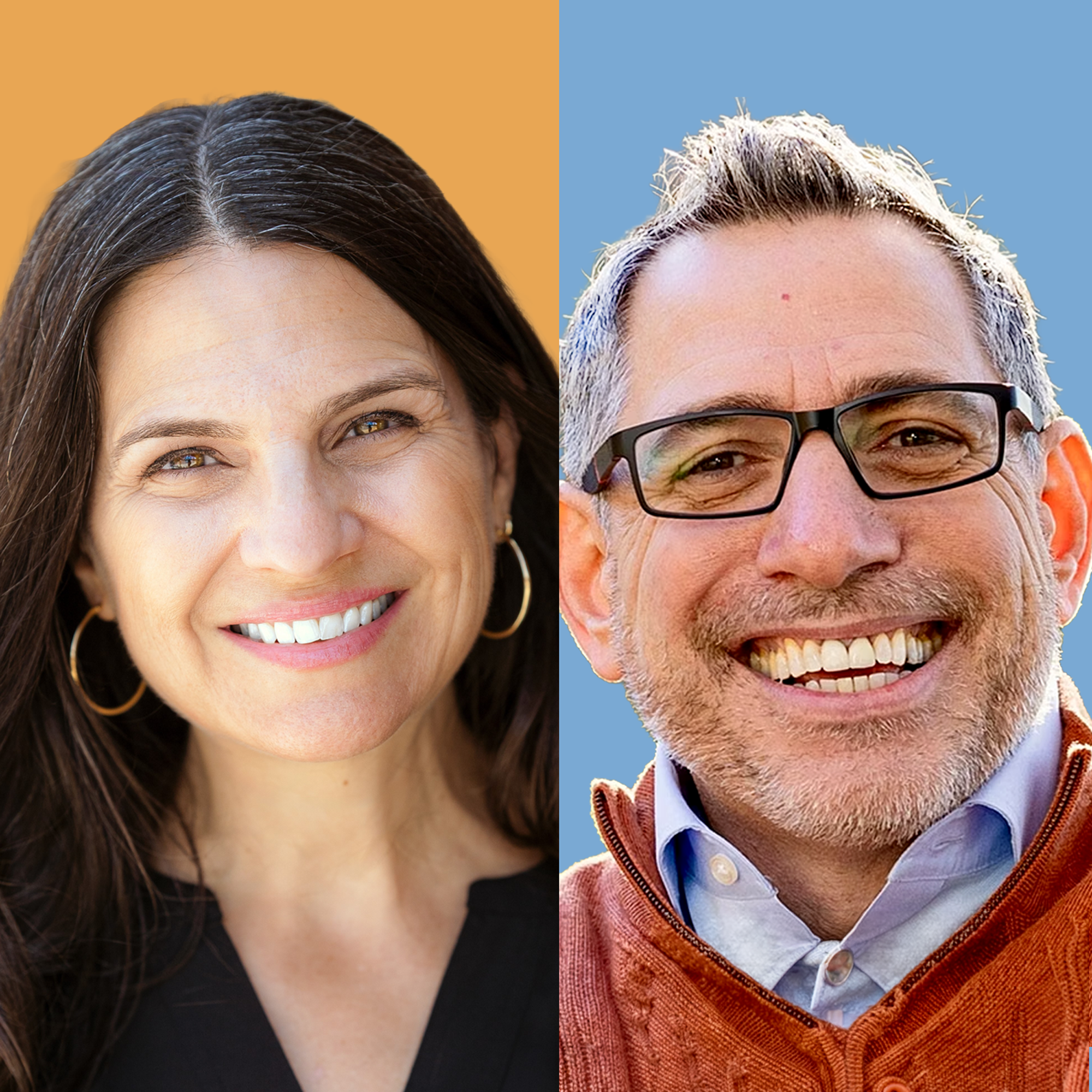
with Rabbis Sharon Brous & David Ingber
If you show a gun in the first act, somebody's gotta get shot in the second act.
I think that people have lost their minds, and we must not also lose our minds.
Five people got up to heckle me in the middle of a sermon and walked out.
How successful are you if the message is heard, but it doesn't lead to the action?
There is antisemitism underlying a lot of our politics.
Jews can become so universal that they're willing to fight for the rights of others, but when it comes to their own children, they're not.
This is a very special live episode of being Jewish with Jonah Pla.
Yeah.
Good.
That's, that's what we want from a live audience.
So glad, glad to know you're here and a live, awake, alert.
Enthusiastic.
Thanks entirely to the generosity of.
Schusterman Family Philanthropies, crown Family Philanthropies, and the Jim Joseph Foundation.
So thank you so much, truly, and a special shout out to the Schusterman events team for putting this together, this gorgeous night.
Beautiful.
Thank you.
And, uh, my ace in the whole David Rutberg.
Thank you for making this happen from soup to nuts.
Also, uh, a shout out to my aunt Wendy, who's here, who works for Crown.
It was her birthday on Sunday, so happy belated, and Wendy, I love you.
If you are here in the room with me tonight, Alto, you made it to the hottest ticket in San Diego.
Apparently we squeezed you in.
We got Jews up to the rafters in here.
Those of you listening are watching at home.
Thank you for being here as always with me tonight, and it is now my pleasure to introduce my two esteemed guests.
Jewish American rabbinic icons of the highest order who are at the vanguard of a generation of leaders reimagining what synagogue life can be in the 21st century.
They have built spiritual communities in their own images, taken their unique perspectives of what contemporary Judaism should be, and breathed it into life with their words, passion and tireless leadership.
And also drum circles.
One is the founding rabbi of Ecar and Egalitarian.
Oh yeah.
Ecar.
Some Angelinos in the house.
An egalitarian, non-denominational music forward community in Los Angeles.
Rooted in social justice with robust programming and children running wild through the aisles.
The other is the founding Rabbi of Romo, which is an egalitarian, non-denominational music forward community in New York City.
Rooted in a deeply embodied approach to Jewish spirituality with robust programming and children running wild through the aisles.
Together, they're helping to answer the question of what revitalized Judaism should look like.
And they're here with us tonight, so please welcome Rabbis Sharon Brouse and David Engberg.
Thank you.
Welcome, welcome.
All right, get cozy.
As I mentioned, your two incredible congregations, which obviously many people in this room know a lot about, but perhaps not everybody watching or listening to this at home knows about.
I'd like to ask each of you about the congregations that you have founded and.
What were the core assumptions about Judaism and, and Jewish communal life that you are challenging with your own vision of what that should look like?
So, rabbi Brass, let's start with you.
All right.
First of all, thank you.
It is, it's such a joy to be here.
It's absolutely stunning and, uh, both inside and outside this room.
So thank you and Jonah, happy to be with you and always with my friend, rabbi David icar was born at the intersection of two questions.
The first was, how can we mine our Jewish inheritance to live lives of meaning and purpose?
And the second was, who are we called to be as Jews and human beings?
In a time of moral crisis.
Those were the two questions that literally were keeping me up at night.
Um, and we launched the community because we sensed that there were other people who also weren't sleeping well, and we wanted to at least, if we're not sleeping, we should be together based on those two questions.
You can see there's kind of an internal and an external element.
Um, and we were really trying to address both what can we do to re to reinvigorate and reanimate Jewish ritual and tradition?
How can we.
Bring life back into mic notes.
You know, like, how can we make Yom ki Port No, no mic recipients here from a car.
Thank you.
So, um, I mean, I, I, for me, I wanted to feel spiritually alive.
I wanted to create an environment that people could come and dance and cry and sing, and feel deeply connected to each other and to our tradition.
And I wanted that sense of connection and togetherness to help fuel our commitment to building a more just and loving society.
Rabbi Enger, same question to you.
Core assumptions that you're, you're challenging.
Well, I just wanna start also where, where, where Sharon started, which is how beautiful it's to be here.
It's good.
Just to be sitting together itself is already a practice.
Like sitting together is amazing.
And to be in conversation with you, Sharon is always a really a privilege.
Thanks.
Um, OMA Mu in a world of seekers who were leaving or who had never discovered Judaism before, and its riches, someone like me who had been on a journey from orthodoxy, I grew up in an Orthodox home and then left it, but found, um, spirituality outside of Judaism compelling.
And when I returned to Judaism, I thought, oh.
These things are here in a way that I had not been taught.
And so I, I think Rome was, was born from a place of knowing how many Jews I met at Buddhist retreat centers.
Right.
And, and how many Jews were doing, you know, yoga, asana and all these kinds of things.
And I was like, oh.
W, where is that happening in New York and where is it happening?
In a way that would feed minus on my soul?
Like I always would say that RUM was a place where I didn't personally feel like parts of myself were left outside.
I wanted those parts to be brought into a sacred community and have a community that was strong enough to hold tradition with radically irreverent elements and things that would generally not be considered, you know, a part of the synagogue.
I grew up in Great Neck, New York, or when I was an Orthodox kid in High Berlin, those things were not there.
Silence and.
Movement and ecstasy and crying and fully embodied Jewish life.
In my family, God was a really important part of my spiritual world, and I wanted to be in a liberal progressive space where God wasn't like a, like a joke line, like, like there was, we were too sophisticated to talk about how God was a part of our lives and that we could open our, our hearts to, to the divine.
And so I thought that, you know, someone who had, what I used to call post-traumatic God disorder, like I had, I had a lot of.
Um, God pain and in scar tissue.
Yeah.
What would it be like to create a space where that would begin to heal?
And like Sharon was saying, it was, it really was about aliveness.
I love that you used that phrase, aliveness.
I think it was about creating a space that was, felt really alive.
When somebody comes to Roma Mu, who maybe has never been there before, and they, they bump against it and it's not for them, what is it that they're bumping against?
Like, what have you found to be sort of the, the chief obstacle to somebody feeling like this is for them?
Wow.
I love that question.
Um, that's like asking somebody what you think the date went wrong.
Why didn't it out?
Wow.
Um, depending on when you came to Roma Mu, um.
You know, maybe in the beginning it might have been too lacked institutional gravitas, potentially.
Um, it could have been that it was a little bit too, the hippie dippy would be the phrase a little bit too out there.
A little bit too, you know.
Um, weird.
I think that those, in the beginning it was like that Rome itself has changed over time, but I think that, you know, it can be a bit strange for people who are used to, to performative Judaism to walk into a place where people close their eyes.
Hmm.
And feel real devotion and it can feel a little bit scary to them.
Or people get up and dance like, what are you doing?
Same question for you, rabbi Brows about ecar.
Nobody's ever walked into ecar and not loved it.
Oh, okay.
Perfect.
Exactly.
That's why she's here 22 years later.
Exactly.
I, I think the kids are very loud.
That might be one thing.
Um, because we built this playground in the sanctuary.
We, we got this from the Christians.
We did not invent this on our own, but there was some church in the Midwest that had a playground and they had like soft toys and on a little area, and I thought that's exactly right because you don't want the kids out of the room when, when like the spirit is happening in the room, you can get a little chaotic.
So we're working on that.
You know, there is something about.
About the combination of really good music and speaking a moral message that really speaks to some people and does not speak to other people.
And I understand it and I, I honor it.
And I sometimes think, you know, thank God we're in a city with a hundred synagogues.
So if this isn't what you're looking for, you'll probably find what you're looking for.
In the last two years, um, or two and a half years, I should say, there are people who left for other reasons, people wanted or needed their rabbi to be the avatar of exactly.
Their perspective on whatever had happened that day in Gaza or whatever had happened that day, um, on, at Columbia, um, university.
And if, if I didn't say exactly what they needed exactly the way they needed it, they left.
And I, again, I think, thank God there are a hundred synagogues in this city and the chairs are much more comfortable in most of them.
So I hope God bless you.
But I, I really tried to communicate.
Again and again.
Um, and this is so with like real tenderness that, um, you don't actually want your rabbi to be your mouthpiece.
You want your rabbi to be a person who is lives deeply in an ancient tradition.
Then works to translate that tradition into our times with love so that we can figure out how to live better lives and how to find hope in really dark times.
And so that means I'm gonna have different views than some people in the community will have sometimes.
And that's actually a good thing and maybe something we'll talk a little bit more about this evening.
But I mean, I, I know, I mean, surely I will say we lost a few people at the outer edges of our medium tent in the last two and a half years, and it's okay.
Actually it's okay because we, I always say we don't wanna be a small tent where everybody thinks exactly the same way, because that would be incredibly boring.
And we really don't need to be a big tent because there are certain views and perspectives that are anathema to our core values.
Like people who think that publicly shaming and blaming other people is the way to advance a social good.
That's not really our vibe.
You know, people who advocate violence against innocence, like that's not something we're gonna be supportive of in our environment, but, but we're a medium tent and sometimes in the medium tent, it's uncomfortable when you're the people who are at the outer edge over here in the outer edge over here.
And yet the beauty of the medium tent is those people are having Shabbas lunch together.
And so we really try to advocate for a space in which people are able to be uncomfortable.
It's a little much for some people, they don't wanna be uncomfortable.
So those are the, the, the two people that have walked out of Ecar in the last 22 years.
That's why I, I actually can relate to what you're articulating, is that that avatar piece.
I, I don't think that's specific just to rabbis.
I mean, I've had people, like the one day that I say the one thing that is not on their checklist of 50 things, now they're out.
Right?
It has to be all 50 at all times.
Or you don't say, you know, you don't say something, you say it.
You don't say it.
You sign the letter.
You don't sign the letter.
And so I think it's because of people feel so powerless in this time and so full of sorrow and they're looking, they want people who have a microphone in front of them to say the thing that needs to be said, and I understand it, but that's not our job.
We have to do our own moral discernment and speak from a place of truth, which might not make everybody happy all the time.
With the social justice pillar of, of what you and and icar are doing, how do you, how do you.
Translate the inspiration that you're giving at the pulpit or on YouTube, uh, to going out and doing the thing?
Or, and, and how important is that?
Is it enough just to change the mindset?
You've, it's mission accomplished, or, okay, great.
You're thinking, but you actually have to get up and go.
Do, do you need both?
When we started the community in 2004, I felt we were living through a time of moral crisis.
You know, like I really meant it.
I really meant it in 2004 because I just thought, I mean.
Disease and poverty and war and violence and like, who are we called to be?
And now you look at that and you're like, I'll take 2004 any day.
But in fact, I feel, I, I feel the fierce urgency of now and my work is not to put my body, not only to put my body in the right place, but to help move the spirits of the people who are listening.
Whether they're, you know, in, in their, like their s or in the root in the gym and shall have it.
Or they're listening online to, to ask themselves to do their own discernment work and say, where should I be putting my voice right now?
What should I be writing?
Where should I be going?
Do I go to Minneapolis?
Do I, you know, do like, do I stand up?
Do I speak out?
Do I quietly heal?
We saw the heroic images of Minneapolis, but.
Some of the bravest people built a diaper brigade where they were just making sure that people who were scared to leave their homes could take care of their children.
And it's really quiet, humble work, but they ha you have to be awakened to your responsibility for your neighbor to do that.
And so I see the work not as you know, preaching the sermon that people are gonna be talking about, but as kind of awakening each one of us in our own way to step into the labor in this time of where, where it really does matter.
To drill down a little bit on the initial question, how successful are you if the message is heard, but it doesn't lead to the action.
Has the message landed?
I mean, I'm hoping the message is landing.
Yeah, look, I will tell you sometimes it, because it looks really different for each person.
So, you know the famous story in ma in ma of of k Barza, we study this often on, uh, Tisha, but it's a story of a guy's throwing a party.
The Schustermans are throwing a party and they send out invitations and the servant goes out and he accidentally gives an invite.
To Bar Kasa instead of Comsa.
It's like a, a mistake anybody could make.
And um, and Bar Kasa shows up, but he and the host have a terrible rift and the host sees him and it's a beautiful party, and the host says, get out, leave in front of everybody, and.
And the guy says, please don't make me leave.
I'll pay for what I eat.
Just let me stay.
And, and, uh, and the host says, no, you have to leave.
He says, I'll pay for half the party.
No, you have to leave.
I'll pay for the whole entire party.
No, you must leave.
And the rabbis say it was because the rabbis were in the room and witness this humiliation and didn't do anything about it.
That then that led to the destruction of Jerusalem.
Right.
It's such a profound teaching and I always thought that what they were saying was that one of those rabbis needed to stand up in the moment and say to the host, no, let him stay.
And I just started realizing in the last few months that no, there's so many things that the rabbis could have done.
They could have quietly walked over to the host and tapped him on the shoulder and said like, Hey, come with me.
You know, by the way, like maybe quietly let him stay.
They could have gone out after.
Barza and said to him like, Hey, this guy, he's still hurt from the thing that happened to you, but I'm really sorry.
That shouldn't have happened.
Right?
Like they, they could have, they could have invited him over to their house, they didn't do anything.
But there are all these different roles that each of us can play.
And when the world is on fire, we need people who have hoses.
You know, to put out the fire and we need people to sound the alarm and we need people to warn the neighbors there.
There's all different kinds of work that we need to do, and so I don't think we can necessarily, it's not about how many people show up at the protest on the corner.
This is about fundamentally changing.
The, the culture that we're living in so that people feel responsible for building a just and loving society, worthy of an image of God.
And that is the most, the holiest and most important work that I, that I think we can do in this time.
I love that.
Rabbi Berg, same question.
What, how do you, you know, you know, if you remember what the question was?
So much of what you all are doing is about what happens in the space when you're all there together, what you're doing internally and physically in the body.
How important is that to carry outside the space and, and you know, how do you try to make sure that's happening?
I grew up going to an Orthodox Day school and I spent seven years in climb Berlin and other ultra orthodox Shiva contexts.
And so just so people don't walk out her thinking Ramu.
Is a yoga studio.
We actually use a Ur and Lane C Torah on shabas morning and have Kabbala Shabbat.
So it's not about the same, it's the same question because I'm a rabbi of, of a pretty standard community that does some neo Hasidic things.
So I think it's a big question.
I I, I think that I love, you know, I always love Sharon's certainty because it's really feels great.
I, I think that as someone who's been in the rabbit at rum was now 20 years old.
And now I'm at the 92nd Street y, uh, a pretty venerated liberal bastion, uh, on the Upper East Side.
I, I'm not altogether sure that anything that I've done over the last 20 years really has made as big a mark as I wish it would've.
The uphill battle is almost the Ian struggle as a liberal progressive rabbi, is that we live in a deeply consumerist world in which we commodify Jewish life.
Really good Jewish institutions generally have to have really good programs and good products, and we fall prey unless we're lucky enough to, you know, if you built your own synagogue to some extent, you have less of the market forces working against you because you, you went from nothing and you built it and it failed at various moments.
But if you stayed true to who you were, you could, you could work that way.
But working within a larger Jewish universe, like.
Let's just be honest.
Rabbis, you know, what rabbis say behind closed doors is, you know, how long will they remember that sermon for?
Like, how long will that last?
Or what can we say to, to have our communities as serious about Jewish life as we are?
Because we dedicate our lives to it, right?
We, we take it deeply, seriously.
You know, it's the same as what Sharon said, like trying my best to move the needle.
Trying my best to say, to speak.
Into a space and know that I'm gonna make those who are comfortable, uncomfortable, and those who are uncomfortable, hopefully I'll comfort them.
The model still persists amongst my community members, like I've lost.
I was also hoping that that question was only for you about members that were lost, but I lost many, many members if my community over the last couple of years who had signed onto RMU as a spiritual oasis.
That's one of the ways they used to talk about it.
It's like I come to rmu and it's like.
The way I go to yoga class and then I leave and I'm a different person.
I go to Romo and I'm a different person.
In the years proceeding October 7th, and then from October 7th till today, I waited in very, very strongly in in, in a particular direction in the community.
The community was not expecting, and I lost many, many members of the community because of the stances that I took in the ways that I spoke into that space, and even to the point where I would sit with somebody like I did a couple weeks ago.
A member of the community who's debating coming back or not.
And we met for coffee and the person said to me, you know, I've been coming with my wife, you know, X number of years, and we always leave and we're in a, you know, certain place.
And you know, we come to services now and after you speak and we're like, we're not enjoying it.
And I looked at this person, I said, oh, you're not enjoying, oh, I'm sorry.
I, I, I didn't know that that was part of what I was supposed to be doing is, you know, wisdom attainment or, and, you know, I, I thought I was trying to speak after a, a confrontation between my own heart and the text and Jewish history and trying to make sense of the moment and.
You thought that you were coming for me to make you walk home with a really, a doggy bag of entertainment.
Like, oh, that was great, and let's go forward.
So I think that a, a large part of the impact possibility is not only whether or not you have a great product, not only whether or not you wow people, you and you, you have sources and you peak passionately.
But like we're working at almost all moments counter culturally against the momentum of a consumerist world, which almost it, it, it, it corrodes.
What it means to be a part of an obligated community.
It corrodes what it means to show up even when you don't really care, show up, or even, God forbid, when the rabbi is not as entertaining as you would like them to be, you're still gonna be there.
And so that's kind of like, I guess how I would set it up for age.
Yeah.
Thank you.
Yeah, I appreciate that.
Appreciate that.
So we're, we're sort of.
Dancing around a little bit, the idea of what is the role of a rabbi?
Mm-hmm.
Like what?
And, and that's obviously gonna be different for every individual person.
Rabbi ber you, you just sort of spoke about how you went off.
What is your typical path or might have been expected from you?
Can you articulate?
What that was and perhaps what the calculus for you was in deciding to, to go on this new path.
I am so thankful that Sharon brought that story from Gittin, the Compend Bar Comsa story.
'cause it's, it, I have a Compend bar Comsa story that really was the catalyst for where I am today.
For those of you remember, 2019, kinda the end of the year, there was, uh, the women's march the, the second women's march was going to happen, and there was quite a bit of stir because of one of the leaders of the women's March.
Uh, a woman named Tamika Mallory, um, had tweeted a picture of herself with Louis Farrakhan and had called him the greatest of all time.
Those four letters, the goat became, you know, became quite controversial and, and the Jewish community was quite hurt and angry, and it led to rifts within the, within the leadership of, of the women's, uh, March.
And certain parts of the, of the march were gonna split off and so on and have their own march.
Their Progressive Rabbi, New York brought some back through some backdoor conversations, brought together many of the liberal rabbis, leading liberal rabbis of New York to to gather in a private meeting with Tamika Mallory and her team, and essentially over the course of.
An hour or so, uh, maybe longer.
Things that were said in that room were, were very, very difficult to hear and things that were said that were very offensive to, to, to Jews and should be, should have been offensive to Jews.
And I stood up in one moment and I asked this Tamika Mallory to, to apologize.
For what she had posted, just a simple apology and a retraction.
This led to even, even more churn, and by the end of the conversation, one of the rabbis who was there stood up and pointed a finger at me and said, rabbi ber, I am so embarrassed to call you a colleague because you are, you are calling out our ally.
None of the rabbis that were there stood up to say a word.
Even the rabbis who had gone home with me in a car.
At the first meeting, this is the second meeting.
In the first meeting, we had all left and all of those rabbis had said to me privately they could not believe what they had heard in that room privately and in public.
They were not willing to stand up.
In the intervening weeks between that event and the sermon, I had heard about my, my niece had been bullied for being a Zionist on her campus.
This is 2009 20, early 2020, and so I gave a sermon about how we have to raise our flawed flags.
Our full Jewish identities should not be erased and Jews can't participate in erasing themselves in in any space in which we show up.
We have the willing to put our flawed flags forward.
They're not perfect.
Our Torah isn't, even though we call it perfect, we liberal progressives believe the Torah is up for interpretation, and it was based on that sermon.
That was the first time I experienced people in my community leaving.
Five people got up to, to heckle me in the middle of a sermon and walked out.
It led to a huge town hall meeting at Roma.
Mu 200 people came and we found out things about members of our community that we had never known before about their positions around Israel.
That was the beginning of an awakening to me of the, about the ways in which I started to identify my fawning mechanism in spaces where Jews were showing up with allies.
Where Jews were not showing in their fullest way and not expecting reciprocated or symmetrical reciprocation from our allies.
And that all of it was done with great strategic interest.
Of course, because allyship was so important and we have shared interests and it this mirrored for me a lot of what I saw in the October 8th universe, that in the post-OC October 7th universe, there was a period of deep progressive.
Um, shame, I think about, or, or first rage, disappointment, confusion, you know, shattering, fracturing.
But in the ensuing months.
Um, I, I began to feel more and more like I didn't belong in the same spaces that I had lived in for 20 years.
I felt the more and more I doubled down on Jewish power as a legitimate expression of Jewishness on the right, that Jews had to be not only a Zionist, but also to, to be, um, defending, you know, going to war against or expecting others to call out.
Those who had taken hostages and so on.
I started to notice more and more that I didn't feel myself in those spaces, um, and that my voice in the pulpit became more and more strident.
I gave one sermon and then I'll, I'll pass it back.
I gave one sermon, I think early on in, in, in the war.
It was on the par where generally we, we imagine that Abraham speaks truth to power with, uh, Doura essentially in chapter 18 of the book of Genesis.
Classically, Abraham is willing to fight God for the sake of these innocence.
And the great question of course that's often asked is, why does Abraham, who fights with God in chapter 18 not fight with God in chapter 22 when God asks him to sacrifice Isaac in the aah?
And I said, because I think sometimes Jews can become so universal that they're willing to fight for the rights of others.
But when it comes to their own children.
They're not, and I feel that way very strongly still to some extent in this space, but we can discuss that.
We can, that's just, we can stop there.
Continuing down this, this path, the, the role of the rabbi, let's talk a little bit about.
And we're sort of there already, you know, politically what the role of a rabbi should be or shouldn't be.
Rabbi Brows, you've been a very public faith leader involved in a number of democratic administrations and inaugurations.
Why is that important to you as a leader?
And also, what is your attempt check on where the party is now?
But that's fair.
Gabe.
First, thank you for sharing all of this.
David and I, I mean, I, I responded to this same period in a very different way, and so I think putting this into the discourse is, is important.
And hopefully we can continue to talk more about that.
Well then do you wanna respond, respond to that first?
Sure.
Great.
Um, which is easier, the temp check on the Democratic party, or we can get back to that after.
My first sermon after October 7th was my anguish, horror, and sense of betrayal.
Um.
We had two board members in our, um, of, of, of the Ecar community who had, um, family members who were ab among those abducted and taken into Gaza.
My brother and his family live there.
Um, we are very closely entwined.
It is a, as I say to people outside the Jewish world, like this is, is a really small family and half of our family lives in one place and the other half lives in another.
Um, and the betrayal was, um.
My version of what you described and what you experienced, which was just the silence, um.
Silence was the most, I think the the most was one of the hardest parts for me from people whom I have been in the work with for 20 years.
Like we would fly across the country to get arrested together.
Kind of work.
Yeah.
And one of my very close colleagues in the work wrote me after a week and said, I don't know what to say, but I love you.
And at first I thought, oh, that's nice 'cause I haven't heard from anyone else.
And then I thought, why do you not know what to say?
Why can't you say it's obviously never okay to rape, abduct and murder innocent people, and we have to continue to work toward a just future for Israelis and Palestinians alike.
Why couldn't you just say that?
And that was really shocking for me that that language was not in the discourse and, but the sermon was about both of those first two pieces and then the third, which is we weren't abandoned by everyone.
In fact, there were lots of people in the world who cared deeply about what had happened.
But we were, the silence was so deafening that we couldn't even hear the voices of people who are reaching out with love.
So I said, this was not the sermon I wrote, but the sermon I gave in the moment in the, like one of the most emotional Shabbat experiences, you know, that just one week after the this horror show started was, we've lost so much, let's not lose our damn minds.
When I look back now, I think, oh yeah, that was right.
That was right.
Like we, because when you feel.
Just like shattered from grief and trauma and you feel betrayed.
You are not your most generous or empathic or careful self.
And I didn't wanna fall into a trap where I would start to generalize others the way I felt that many Jews were being generalized.
And, um, and so I tried through the course.
I'm not suggesting you're doing that, by the way.
What I, what I, I wanted to make sure that I wouldn't do that over the course of the.
You know, the en ensuing period.
And so what I've tried to do, um, over the LA the last two and a half years is instead of avoiding saying the hard thing, saying all the hard things, like always, and so people don't always leave feeling entertained.
They might leave feeling like, oh, I just did the hard work.
But I did have beloveds in the community who basically stopped coming for months or even a year because they said, I just.
Can't hear you say the words Palestinian civilian until every one of our hostages is home.
I can't hear you say those words.
And I was like, I understand, but I'm going to keep saying those words.
And I have people who left the community because they said, I can't hear you.
Talk about the hostages.
The hostages are being used as an excuse.
For genocide, and I was like, I hope you find the community you're looking for, because I will never stop talking about the hostages until every single one of them is home.
And so what I like, I decided that I was going to lean into this core belief that I hold, which is that God gave us capacious hearts that are big enough to hold it all.
We have this.
Na, very natural human instinct to narrow our frame of concern.
And I understand it and I sometimes myself feel pulled into it, but God gave us capacious hearts and so what if every single week when you come to this one place like.
You're not gonna get this on Instagram, you're not going to get this on the news, but you're not gonna get this on the protests on campus.
But what if there's one place where you go and you're just reminded that you have a big heart and that you can actually hold all of that because it's because it is true.
It's all true.
It like the human suffering is there and the human suffering is there.
And this is our family and this is our human family.
And what are we gonna do?
Can we, can we allow ourselves to feel?
Should I, so you wanna say something for me personally?
I think that one of the questions that kept animating me throughout my, the last almost three years, there were a group of people who wanted us at Romo to be, to pray for Palestinian civilians.
And that was something that years ago I would've done in a heartbeat.
In fact, I even before I started saying the prayer for the state of Israel, which now we do every single Shabbat and we always pray for the, for the IDF.
And we also said a broader prayer for, for peace as well.
And I, I would've named Palestinian suffering of course, but the assumption that there was a group of people that came along and said, well, why aren't you praying for the Palestinians?
Like there's another synagogue in New York.
They do, they wrote one.
And I started to think into that question and, and I began to interrogate the assumptions of that question.
And I found it after a while to be exposing something about their assumptions about prayer and about what prayer looks like.
Like there are probably every night in New York City, thousands of people go to sleep on the streets of New York City.
Many, many go to sleep hungry.
There are in our cities around America, children dying every single day of hunger and from, from silly systems and from our own lack of generosity.
And never once in the last 20 years had any congregant ever come over and ask me if we would say a prayer.
For all of the homeless in New York explicitly and ever say a prayer for any of those who are dying of starvation in our, in our country.
No one ever asked me to say a prayer for those who are dying at the hands of, uh, Sudanese genocide or any other explicit mention.
So what could it possibly mean for them to ask me explicitly and what is their assumption about my own prayer life is my prayer life.
So judged to be part like I am not capacious enough unless I make the gesture publicly.
So it must be a public statement for those people.
And what is that public statement?
And the public statement, for me it came down to was them saying, if you don't show me you care.
Then I don't believe you when you say you do, and if you're not willing to pray for it.
And I'll say to them, do you pray for all these other things immaterial to me?
If you don't pray for the Palestinians, it means that you are complicit somehow and you agree with what's going on.
And I thought to myself, that's a lot of assumptions about Jewish prayer and the role it's supposed to play in the synagogue and in my heart.
And I, I sort of wonder about that.
And it, it made me question a lot of these.
These gestures or these, you know, some of the things that have to happen in a pastoral moment, um, in our communities.
And so I just wonder in Jewish spaces are, are we allowed, are we allowed in Jewish spaces to care, uh, to use our prayer to care about our people when our people, um, and put them at the center?
Because I want, I started asking myself, do I have these expectations of my Muslim brothers and sisters?
Do I have expectations of my Hindu brothers and sisters?
Will I not sit down at a Deus with somebody in an interfaith dialogue who refuses to pray for Israelis and for Jews?
So I, I kind of look, I don't know where you stand with that or those questions and, and how you would respond to those.
My question sort of fits nicely into that, which is not even in, in the Jewish space, zooming out as human beings as, as big as our hearts are.
We can't fit all the worlds suffering into it, uh, no matter how much it was.
So there, there is.
By nature, a natural narrowing that must occur, right?
I mean, nobody can think about all things everywhere, all at once.
You can't be everything to everyone all at once.
So what is then, for you, the, the line, you know, how do you determine what feels morally enough that we're using as much hard as we can?
I don't know how many of you read, um, rabbi Schaal's book, which came out, um, in the course of the last, I guess it came out about a year and a half ago, called Judaism is About Love, and he writes about the verse in Leviticus that you should love your neighbor as yourself.
And he says that something along the lines of, you know.
Progressive Jews like to think that that means you should love the whole world like yourself.
But in fact, if you look at the commentary over the course of 2000 years, almost nobody reads it that broadly.
Most people read it as actually saying you should love your fellow Jew as yourself.
Meaning that Jews have a particular responsibility to our Jewish family.
Again, we're a small family.
Right.
If we don't take care of each other, no one will.
But he says, that's not the only verse that calls us to love in the Torah.
In fact, 36 times in the terror we're told how to treat the gere, the stranger, the other.
In Deuteronomy for example, it says, ti at at it's rhyme that you should love the stranger, you know the heart of the stranger because you are strangers in the land of Mitra, in land of Egypt.
And so what that means.
Is that we actually have to do both.
And people always wanna know which one, like who are you gonna care for first?
And I'm telling you that again, like my family, right as we speak are, are huddled in a bomb shelter in their, in their home, in Rena.
And I like, they're always top of mind for me.
My family is always top of mind.
I love all children.
I love my children the most.
Right.
Like I, I, I am sure your kids are amazing and yours probably are too.
It's funny, I love your kids more than I'm getting, like of course.
That's true.
That's very human.
And also I will not allow myself to draw, to fortify my heart against the second call, which is the call to love.
Each other beyond just our family.
And again, I know that we can do both.
And I understand the brain science.
I've been reading a lot about the brain science behind why we engage in this kind of reductive thinking.
And because I'm trying to understand these protests and counter protests, I'm trying to understand how people got so quickly from Israel being attacked to, to it being Israel's fault, like imm, I mean the IMT.
C of the accusation of genocide on October 7th, eighth, ninth.
I'm trying to understand it, like what led to before.
Okay.
Yes.
And 10 years before, but like I, I wanna understand why does the human mind yearn for an for hard answers, yeses and nos, blacks and whites.
And I, look, I want to understand that, and I get that we have a kind of spiritual and cognitive overload.
That happens to our systems when things are too complicated, when we're asked to hold too much, there's so much sorrow.
I can barely contain my own family's sorrow.
Why do I have to contain the whole world sorrow, let alone the Palestinians whose neighbors are the ones who are responsible for my families?
Like it's too much.
So we want to shut down and we engage in a kind of brain freeze and it limits the the vision, what we can see, and then we get this relief.
To the system because I don't have to worry about you.
I can only worry about my team, my tribe.
But the fact is, if you take faith seriously, it does not say that all Jewish people are created in God's own image.
Male and female.
God created the Jews.
It says that God created every human being in God's own image.
So I just, I just challenge myself and I, I challenge all of us to think about what it means to really take that seriously.
And it doesn't mean that I'm gonna like cry that, you know, and with the same fervor every night or every day, I, we, I wouldn't be able to move, but it means that I understand that aspirationally, that that's what I'm called.
That's how I'm called to live in the world.
I, I, I, I think that that's true, but I'll just say like, I agree.
I mean, everything you said is, it's hard to argue with anything that you're saying.
And, and as someone who was a mystic, you know, I, I, two weeks ago I was teaching a group of people the Torah that, you know, that one of the great Hasidic rabbis said that, uh, at Mount Sinai, we didn't hear the full, I am the Lord, dear God.
And we only heard the first.
Letter of the first word, not just the i, the ani, but the olive of the Ani.
And there was one rabbi who said that the olive of the, the first olive of the I am can be found.
Actually, it can be framed on your face.
It's the two eyes and the nose that kinda look like an olive.
If you kind of turn, if you.
And it's kind of an interesting meditation it, but it's, it's pre staging Le Nas, right?
Le Nas who said that in the naked nudity of the face, the, the decent nudity of the face is all of ethics is grounded in the face.
And so I remember teaching that text and then the next day going down to city hall to testify, uh, in front of city council about the buffer bill.
And the buffer bill in New York City is to try to create a 10, a perimeter of a hundred feet around synagogues because of the protestors now who are, who are, who actually.
Harassing people are trying to get in.
It happened to Park East Synagogue on the, on the upper east side of Manhattan.
And we had a very big, uh, you know, a big to-do about it.
And I was sitting there in a gallery with a guy who was sitting next to me with the Kafi.
We were all sitting in the gallery, kafis, and they were all, uh, either Jewish, uh, you know, pro Palestinians.
I don't even know what that word means anymore in terms of like, I'm pro-Palestinian.
I'm not, certainly not like these guys.
And, and I'm looking at them and going, oh, there's God's, there's the olive right there.
There's the olive.
And, and as I was looking at one of them, he walked in front of another activist, an Israeli activist, and leaned over and said, I hate your guts.
Uh, we can find examples of that everywhere.
It's not unique to, we aren't the only recipients of, of that, and I'm sure it exists in some form or another, but the question is not whether or not we can love them intrinsically as God's children, which we shouldn't always do.
But when, when push comes to shove, right?
I know that when I lived in the progressive circles for 20 years, and I still work in those spaces still, and I identify as a, as a progressive, I never heard anybody ever give a sermon about the danger of Islamic fundamentalism.
Never once.
Never once in the 20 years in the liberal progressive world did I ever hear anybody ape what Sam Harris has said.
Not from a place of love, a place of I love all human beings are creating God's image, but the ideology of hate that is there is much more dangerous than any of the other forms of hatred that we're now maybe white supremacy, maybe in some form or another.
Who knows?
They're all hatreds, but like.
And if you ask the liberal progressive, I'm not saying Sharon, I'm not saying you, but I'm saying if I ask colleagues, the general prevailing sentiment was we wouldn't want to contribute towards Islamophobia or or towards hatred towards Muslims.
We wouldn't wanna cast a wide aspersion about that ideology.
And yet, in progressive circles, since 2000, since October 7th, people rail against Jewish extremists without any thought whatsoever about the kind of hate that that fawns in the world as if all Jews.
Are those are Smo rich and Bevere are these others.
And we, and we often, we often are maximalist when it comes to universality and minimalist when it comes to the loving of our, of our more, you know, our different Jewish friends, right?
I've never walked into a synagogue in New York City, in a liberal progressive space where someone said, love your neighbors.
You love yourself, includes the settlers that you don't like.
I, I did a, a talk, a conversation a couple of years ago with a really fascinating organization called Roots.
Anybody ever Hear Roots?
Hannan Schlesinger is a rabbi in the, in the, in the, in the, uh, territory, you know, I guess in the occupied territories, whatever you wanna call it.
And he has a, he has a Palestinian, uh, partner.
And they came to New York and people showed up in mosques from Omo and from other synagogues at River, west Side.
And we were sitting in the room and I, and I asked just a random question, I said.
How many of you are finding it more difficult to be in the room with, with the, with the Jewish settler and how versus the Palestinian?
And of course you all know the answer, right?
It was like they had greater, um, apo, a greater antipathy towards Hannan than they did towards, towards his, his Palestinian partner.
And so I kind of feel like I'm all for these very grand.
Uh, uh, universal statements and every human being, every child.
There isn't a moment where I don't think about the children who are caught in all of this craziness, right?
There's not a moment where I don't think about it, and it, it doesn't yet answer the question for me in the bigger question about in, in what way can we show up for Jewish?
To center Jewish concerns and Jewish survival and, and, and our family's fears and our family's longings versus those of of others.
We could obviously have this conversation a lot longer than we have been allotted, but we, we are getting towards the end here, unfortunately, clarity is so important in a leader, even if it's, it's shifting, but being, knowing what you're trying to communicate and committing to that.
Is tough and is important.
So I'm curious, how do you check in on that?
What are your check-ins?
What are the mirrors that you're holding up?
How are you testing your own assumptions as you go through to make sure, do I still believe this is this right?
Have I safeguarded what I I think is true?
Or do you do that?
Are, I mean, is that even something you think about?
That and the Democratic party, I'm trying to, um, one thing that I have learned to do is, um, just slow down because there's this expectation or assumption in the, in the time that we're living in right now, that when something happens, you need to respond immediately to it.
There's this like, urgency and why didn't you post yet about that thing?
And I've been feeling like we're.
Almost like we're, we're breaking news networks or something.
Like every single individual, you know, leader, person running an organization, clergy podcast, we're all expected to say something right away.
And I, it takes me a little bit more time.
I wanna, or Hashem, I wanna think a little bit before I start mouthing off about something, I'll mouth off about it on Shabbas, but like, I need a couple days or I need a moment to.
To pro, like, to actually process and to think.
And um, I will say, I mean I have a little kitchen cabinet of people who I really trust who do not all see things the same way.
People who push me from this side and who push me from this side, a very small group.
And when I'm giving a really important talk, um, like a high Holy Day sermon.
I will, I will, um, absolutely share that and, and, you know, and hear where it lands.
It doesn't mean I'm gonna change it to make them happy.
It means I wanna know because there might be something that I'm, that I didn't see, or something that I hadn't thought of, or an article I hadn't read, or a way that it's gonna land that I didn't think of, and it would cause, cause pain.
I never wanna cause someone pain, I mean.
You don't go into the raven it if you take joy of causing people pain.
And so I think about that a lot because we do hurt people with our words and um, and yet we never want to.
And it breaks my heart when I do.
And I always also work from the text.
I sat down on Friday at noon, pulled out my homage and started to learn.
And, um, you know, this past week, and this is what happens every week.
Of course, there's so much anguish this week and there's so much confusion, and I mean, it's a hard and strange time to be alive right now.
But I had no idea what I was gonna do with all of it.
And so I, I drew it from the text.
And so for me, I'm not trying to find the verse that's gonna validate the idea I have.
I'm trying to figure out how to be a vessel for a deeper kind of truth.
And that, that also slows me down because learning text is, it's a slow practice.
It's not a quick instant gratification practice.
Mm-hmm.
Um, so that's.
I hope that's a sufficient answer.
Of course.
Of course.
The party's in crisis.
Okay.
Yeah.
The party is, I mean, obviously to state the obvious.
Yeah.
That was my, that was my line.
I was about to say that.
The Democrat, so I, I'll just say as, as you were speaking, I just thinking to myself, and you know this so well.
You know, we often, we often, whenever we do the ami, we do this staling prayer.
We say, God, open my lips so that I can speak your praise.
And I almost wanted to start tonight by saying this, a similar in, in intention, which is like, may the words that we, that we use tonight.
Open hearts and also minds, but also model what it is to like, you know, you didn't ask us really tough questions between the two of us, but there we have important differences.
But mostly we're, we share, you know, exactly the same values about the way we, we want the world to look.
And I had this experience more than once recently, where I started posting some things more frequently on social media.
And people that I love and care, and care about and admire, um, would see it and they would kind of publicly say something on the, on the same, you know, thread.
And then I, and then I would privately, you know, text them like, and I, and I'd say, Hey, you know, like if you, if you didn't like what I said, like, and you really upset, like.
I'm sorry, I didn't mean to, you know, talk to me here.
Let's have a private conversation, then let's go back into the public.
But let's remind ourselves that that m is so if we're having an argument for the sake of heaven, it will endure and, and our friendship will endure.
And I think that, you know, I think that's an important moment now in, in our conversations and, and it's, it's something that happens also in person that might not be available in some of the mediums in which we actually.
More often than not find ourselves like in person like you, you remember how much you care about somebody, even if you, you like disagree vehemently about something important that you want for their, you know, they want for, for their happiness and for their family's wellbeing and so on.
I think that, that I, you know, I just make so many mistakes in my life that my wife is very quick to point out.
Um.
And so, you know, I have really, you know, great mirrors in my life who are consistently letting me know when, uh, you know, I'm, when I'm off by a couple of degrees.
And so I also have my small core group of people.
And, and certainly leadership, um, is better when, as you said, there's more space and it's slower and we're not as reactive in that space between stimulus and reaction.
There is our great freedom and, and leaders.
Who know how to be, um, not reactive, but responsive is really something we need more of.
And so try my best.
We've teased it enough, so I feel like we have to get a couple more words about it.
Let's talk about the Democratic Party and then we'll wrap it up.
It's, it's, you know, it's like the, the theater adage, like if you show a gun in the first act, somebody's gotta get shot in the second act.
Yeah.
I would love to hear a little bit about, obviously it's in crisis, but sort of how do you find yourself in it as somebody who, again, has been so, uh, a public part of, of the party up until this point.
Um, are you assuming I'm in the party also?
I'm just gonna say I'm, was I invited to the party?
That was, that was specifically Rabbi Brown.
Wanna go first?
I also, no, I don't wanna go first.
I'm just making sure.
I don't know.
I, I, I watched the inauguration.
I didn't see you at it.
You're right.
So I I I certainly don't have any political leanings.
You're right.
And I don't have.
Um, I'm very concerned for the party.
I'll just, just like, yeah.
You know, I, you know, I think if, if New York City is a bellwether for, for what we're looking at coming down the pike, it's, it's not, it's not looking good.
As I showed you before we started tonight, uh, me Ramani came out, uh, today when asked whether or not he thought he believed in the United Ireland said, I haven't really given that much thought.
Let me think about that.
That was his, his latest today.
So I think that if, if, if it's okay to see Israel.
Through the lens of colonialism and if Israel is an issue that should be important to Jews.
And again, it's only one issue.
I'm, I'm, I'm not speaking about the broader issues.
I think, I personally feel that many Jews like me feel homeless.
We're not gonna vote, we're not Republican.
We're not, can't imagine ourselves ever voting in any way, shape, or form for that mons, for what I consider to be a monstrosity, um, on every level to Jewish values and to human dignity and so on.
And like the, the Horseshoe Effect is now becoming more and more scary.
The more you know, the more things move forward.
You know, seeing someone like Gavin Newsom tra, you know, trafficking in things that I find very problematic again, so I think I'm deeply concerned about the place for.
Proudly Zionist, Israel centered, proudly Jewish folk in the Democratic party going forward.
Um, and I think a lot of people are like me in that sense.
I, and so, I dunno, over to you, I will say, and for many years I, I would get called by press whenever something would happen.
Um.
You know, is this, are Jews gonna start fleeing the Democratic party?
And I would say, of course not.
Jews are not going anywhere.
It's not because of party loyalty, it's because the values of the Democratic party largely align with progressive Jewish values and taking care of those who are most vulnerable in our society.
And having the lobby just and equitably, just and equitable, and creating opportunity for everybody and holding the dream of a multiracial democracy.
These are all things that very much align with some of the principles that we've spoken about tonight, and some of which are at the very core of our, of our Jewish values.
And I think now there we are gonna see a shift in terms of, um, voting patterns in the American Jewish community.
Um, I, I will say, I, I don't even know how to def, I, I don't know personally how to define myself anymore.
I'm not saying Democrat or non Democrat, I'm saying.
I'm saying like progressive liberal, like I don't, I think everything's changed in the last two and a half years.
I don't know if others have felt this way too, but it feels to me that, um, the labels themselves are not helpful and the core values are helpful and they are still largely in alignment with, um, the exception, uh, that there is a very deeply entrenched.
S transgressive, seductive, sexy, um, affinity for like real.
Antisemitism that is underlying a lot of our politics today, and I think people are drunk on it.
I think that there's some that I'm using the language of seductive and transgressive because, because there's something sexy about being able to say out loud the truth.
About, about Zionism and the truth about Israel.
The lie, the lie, the truth.
That's a lie.
So, and I look, I think what, what, where, what, I'm going back to where I started now, which is I think that people have lost their minds and we must not also lose our minds.
And the fact that people put a a certain lens on us doesn't mean that we should not constantly be doing hash neish, be having conversations about what.
The world has happened to religious Zionism about what is happening in the West Bank and how every one of us who says that we love Israel can and should be using our voice to speak out against the horrific settler violence that is now a daily occurrence.
Um, I, I mean that we have to build our.
We have to build our political and spiritual realities rooted in our own knowledge of what's right and wrong.
And at the same time, we have to be honest about where other people are in the world.
And I am very concerned about the horseshoe effect.
I'm concerned about the both subterranean and.
Overt, um, antisemitism.
I think we have to keep talking about it.
I'm concerned about how many people say, like, roll their eyes whenever you say the word antisemitism now, because it is real and it's something that we must be talking about and we have to live into our values and we have to not be afraid to say that what happened to the od def family in the West Bank two days ago is an atrocity.
And the fact that that happened at Jewish hands in the Jewish state.
It's something I that is deeply shameful for us and we can do better.
We must do better.
And so I don't wanna be told by anyone that we can't, you know, we can't talk about it because people hate Jews.
Well, I know that people hate Jews.
I'm gonna define myself based on my own set of values, not somebody else's.
So, um, what is gonna happen in the coming elections?
Hopefully.
There are gonna be some good, you know, solid, um, liberal Democrats who are gonna get elected, who share a vision of a multiracial democracy that includes Jews in it, and also is gonna be a corrective to some of the policies that we've seen in the last year and a half.
I know you wanna jump in, but we don't have the time for it.
Unfortunately.
I wish we did.
Mm.
Just when it was getting good.
If only we had more time.
Well.
Lucky for you.
We do.
I'm joined right now by rabbis, Inger, and browse, both of whom immediately agreed to sign up for part two of dueling rabbis.
And we're gonna start it right now.
But you'll have to tune in next time to see it.
And because we're taking off for Peoc, you're gonna have to wait an extra week.
Don't you Just love a cliffhanger.
Alright, I'll see y'all back here for the next double dose of being Jewish with me, Jonah Platt.
Ha.