
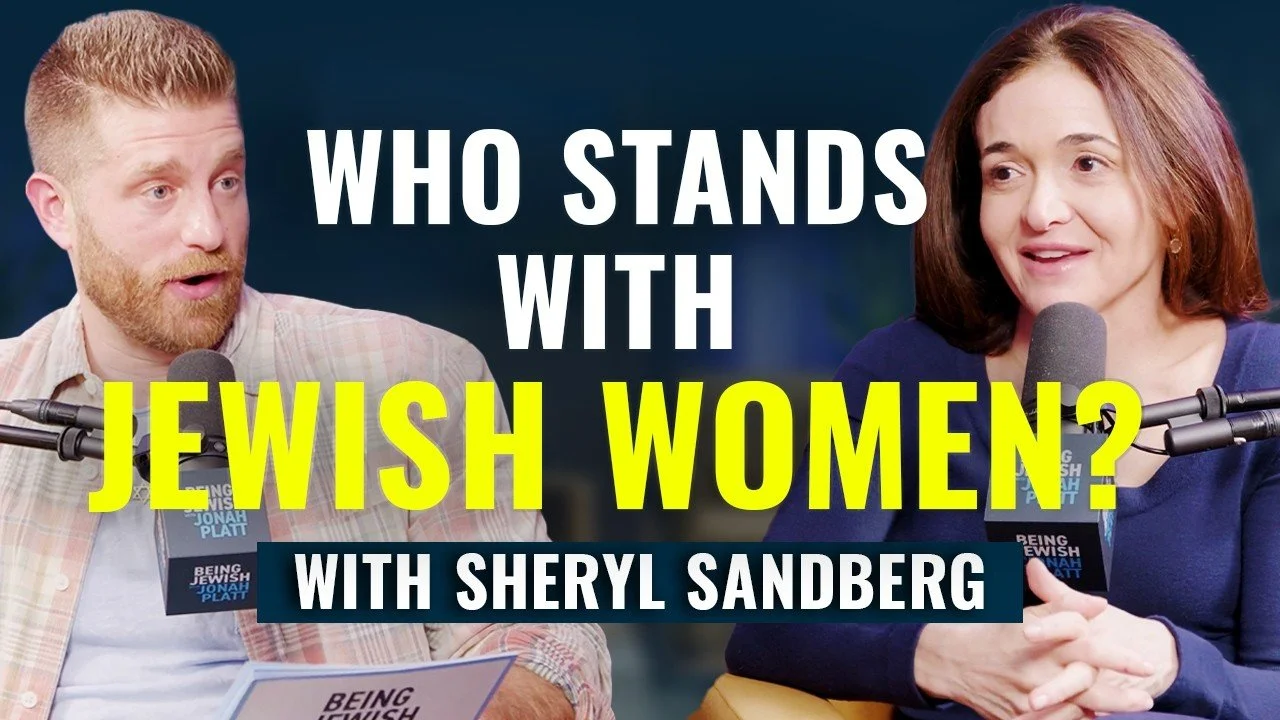
Interview Transcript
Zionism in Tech: Facebook Exec Sheryl Sandberg on post-Oct 7th Jewish Advocacy in Silicon Valley
When I dropped him off, there was a big sign and it said safety and security for Jewish students.
That would have never happened when I was in school.
Do you feel like the leaders in the tech world have said or done enough in response to what's happened on October 7th?
What came out of my mouth is I said to her, Will you hide me?
Crying.
She had no idea what I was talking about.
When life throws adversity in our path, we're faced with a choice.
Quit, push through, conquer it, ask for help.
But the greatest among us exhibit not only resilience in those moments, but use them as opportunities to become leaders and show the rest of us the path forward, whether it's grappling with grief, the power of women to achieve, or the dignity of the Jewish people.
My guest today has always chosen to be out in front.
Using her own life and public platform to light the way she's a devoted mother Silicon Valley legend an innovative thinker and a publicly avowed fan of this podcast ladies and gentlemen, please welcome the mighty Sheryl Sandberg Thank you.
That was a way too generous introduction, but all true very much.
Thank you for being here.
I really appreciate it I'm so glad to be here with you.
Awesome So I want to start back in the early days of Sheryl Sandberg, uh back in Miami beach where you were growing up What did being Jewish mean to you then?
I grew up in North Miami Beach, Florida, where, and this is not an exaggeration, had the largest per capita Jewish population outside of Tel Aviv.
Unbelievable!
Yeah, I had a childhood where, you know, I went to two Bar Mitzvahs every single weekend because a lot of the kids I grew up with were Jewish.
Sure.
And being Jewish was a big part of our family identity.
My parents were very politically active.
Trying to help get what were then called refuseniks, Soviet Jews who were trying to be Jewish and also political prisoners out of the Then Soviet Union.
Yeah, I grew up in kind of a weird home.
We belong to a reformed synagogue, but kept kosher We studied Torah for one year every Saturday morning with my father My parents also belong to an Orthodox synagogue, even though we didn't really really go That's part of the beauty of Judaism is that you sort of get to make it your own thing Go to the Orthodox Temple the Reformed Temple this tradition that tradition.
It's Very individualist, which is part of what this show is about, is showcasing that individuality.
I read that your mother, who you mentioned, got her bat mitzvah at age 70, after not being able to get it when she was younger.
Did you have a bat mitzvah?
I did.
I had a bat mitzvah, and I had a twin, a girl named Kira Volvulski, who was then In the Soviet Union and a refuse neck, they had a thing then where you would dedicate your bat mitzvah or bar mitzvah to someone who wasn't able to have one in the then Soviet Union.
And yes, my mother had hers much later in life.
She had two brothers.
They both had bar mitzvahs in her era.
Women, girls did not have bat mitzvahs.
And so she did it when she was older.
What are some of your warmest Early Jewish memories.
Shabbat, we celebrated Shabbat every week.
My parents were pretty healthy eaters even then.
So Shabbat meant challah and wine and grape juice and cake.
It was like a big cake for dessert every Friday night, which we didn't have the rest of the week.
Nice.
All of the Jewish holidays, my mother was a very good cook and cooked a lot of, like, traditional, traditional Jewish foods.
But it was always tied in my family to political freedom, to the ability to speak out, the ability to practice your religion, to the American history of people coming here, not just for political freedom, but for religious freedom, which I think is historically accurate.
Mm hmm.
And the Jews coming here.
Religious freedom and to not be persecuted.
Sure.
What's your parents background that they were so deeply connected to this idea?
I think they just believed very deeply that United States our country America was founded on people escaping persecution people looking for freedom people looking to be able to Speak with their own voice and find, find their own way, both politically and religiously.
And I think because in their era, there was this persecution happening in what was then the Soviet Union.
Those things were very tightly tied together for my parents and for me.
So then, little older, you go to Harvard, Harvard Business School.
Was there Jewish life there that you were involved with?
Or were you, you know, very focused on your studies?
I was pretty focused on my studies.
You know, it's very, very different time.
I had lots of Jewish friends in school.
I don't remember.
I wasn't particularly religious.
I did have have some more religious friends, but I think a lot and I'm sure we'll get there about the difference between going to college then and going to college now.
Yeah, I mean, what's your relationship to Harvard now?
How do you feel as an alum seeing what's gone on there recently?
When I dropped my son off last year, he's at Harvard now, he's not at Harvard.
He's at, he's at a different school.
But when I dropped him off, there was a big sign booth.
Like, you know, they have the boots for all the parents and it said safety and security for Jewish students.
That would have never happened when I was in school and you're much younger than I am or even I would never have imagined that in and I was in school in the early 2000s.
That's right, but I think that was that has been, you know, a real issue parents and students are facing since October 7th.
We weren't facing and so I think of the time I went to college and maybe the time you went to college as kind of a golden era totally for American Jews and.
I think a lot of people have said our vacation from history is over.
I haven't heard it put that way, but I like that.
I think our vacation from history is over.
Yeah.
And I think that's unfortunate because that vacation from history was pretty wonderful.
It was great.
Most of us thought it was the real deal.
Correct.
Permanently over.
Yeah.
Okay, so after college, in a move that will surprise no one, you begin a career in public service, working at the World Bank, the Treasury Department.
Did you ever get crap for being a Jew working with money?
Like, did that ever come up?
Well, I wasn't a banker.
The World Bank says, you know, I worked on leprosy and malaria, and HIV AIDS in India.
Okay, so that's totally different.
There were jokes.
There were those jokes.
Yeah.
You know, the offensive, like, money jokes.
I didn't come from a particularly family that was particularly wealthy or particularly focused on money.
At the Treasury Department, you know, I worked for Bob Rubin, who was Jewish.
Larry Summers, who was Jewish.
At the time, Alan Greenspan was chair of the Fed.
He was Jewish.
I mainly remember religion.
Because we were very trying to focus on not all being at work together on Yom Kippur.
That wasn't a particularly good thing as representatives of the Jewish, of the Jewish people.
But I don't remember religion being particularly relevant or important.
That's a good thing.
I think that is a good thing.
Yeah.
2002, you basically teach Google how to make money.
Google and Meta, where you've worked, you know, famously, both, both founded by Jews.
Do you, did you feel that in the culture at all?
Yeah, not really.
I mean, and this is such an interesting conversation because I think being Jewish was a real part of my childhood and a real part of my family, but it didn't feel relevant as a student in college or anywhere in the business world.
At all.
It was just.
I was Jewish in my personal life, and sometimes I, I thought about lessons I learned as part of my religion, but I, I didn't see any relevance to this.
And then October 7th happened, and now it is relevant, I think, on college campuses.
I don't know how relevant it is in the business world.
I hope still not relevant because it shouldn't be.
Religion should be something that we can take lessons from to bring to work.
I think Judaism shares a lot of wonderful lessons.
So does Christianity.
So does Islam.
I think all religions have.
Some of their wonderful moments and some of their tough moments, but it shouldn't be relevant to work at all, but it's definitely relevant to me and my work now.
It's changed a lot.
We're going to certainly get into 2004.
You marry your late husband of blessed memory, Dave Goldberg.
How important was it to you to marry Jewish?
Was that a consideration and what role did Judaism play in your married life?
I wanted Jewish children.
I wanted boys.
To have breasts.
I wanted girls and boys to have but are about mitzvahs I fell in love with Dave and I feel lucky.
My my current husband is also Jewish.
So I think that is Obviously I revealed preference as economists would say but I think what really mattered to me was having Jewish Jewish children and passing on passing on my faith now in our religion as you know as a mother my children would be Jewish Right, no matter what but I think having a partner who shared my values was very very important to me Would you attribute that more to the idea of?
Continuing the Jewish story or as you say like having someone with common values or is it both?
I think both I mean the famous stories of my grandmother My grandmother saying to my father that if he didn't marry Someone Jewish, she would put her head in the oven.
She was very clear that there was no other path forward.
But I was raised with the fact we're not a proselytizing religion.
And we're a small group and we're not getting bigger.
And so I was definitely raised with one of the responsibilities I have as a Jew is to continue our faith.
And one of the ways to do that is to have children who are being raised in that faith.
And that's important to me.
I have five children.
I want them.
They're very young.
They range from age, uh, 12 to, you know, age 20.
So no one's, no one's getting married.
Well, no one's getting married right about, right about now.
Certainly not our 12 year old, even though we are preparing for his, his bar mitzvah.
Oh, that's exciting.
I want them to marry for love.
I do hope they raise their children in our, in our religion, in our faith.
That's a tough, you know, thing to, as a parent to navigate, because you want them to marry who they love and makes them happy.
And you also want them to care about what you care about and to continue that line.
How do you, how do you balance that?
I mean, like you said, you're not, it's not knocking on the door yet, but is that something you think about?
I mean, we certainly joke about it in the family.
I think they know how important religion is.
And I actually think it's interesting because I think it's changed a lot since October.
Seventh.
What has?
Even my children's affiliation with their religion.
And I think it's gone many different ways for many different, different parents.
I have friends whose kids were kind of marching in what I, they would consider, you know, against the interests of Israel.
Yeah.
And I think that's been one form of a challenge.
In my family, our family, it's been pretty beautiful.
My eldest daughter, for her, I asked her what she wanted for her birthday a year ago and she said she wanted a Jewish star.
She had never worn before and I got her one and then I got the other two daughter, three daughters one and then a matching one for myself and all four of us were matching Jewish stars every day.
It's amazing.
Something we hadn't before.
My two sons are wearing Jewish stars.
I wasn't wearing one before October 7th.
And they are wearing them and they weren't wearing them.
One was, one wasn't.
It's become more a part of our family.
My kids have definitely swung more towards affiliation.
Pride helping people understand what they think is really going on and you know, I put this on every morning I'm not someone who sleeps in jewelry.
So I take it off I put it back on and is a moment of connecting to who I am and who I want to be every single day It's awesome.
I think it's a pretty beautiful thing.
And I think my daughter's And my sons are doing it, doing that as well.
You keep referring to Judaism and, and like your connection as religion, as faith.
How much of it do you feel as like the personhood versus the, the ritual and the religion?
In Christianity, I mean, I think I'm not an expert, but I think I could sit here and say, I accept Jesus Christ as my Savior.
And I'm Christian.
Right.
You can pick it up, you can put it down.
Pick it up, put it down, but that's all I would have to do.
There's no conversion ceremony.
There's no studying.
Jews make it hard.
Yeah.
On the other hand, we think it passes or our religion says it passes matrilineally.
And so if you are born to a Jewish mother, you are Jewish, whether or not you want to be anything else.
You know, plenty of Jews are Buddhists, right?
Judists or Christian or Muslim or any other religion they, they, they choose to be or none at all.
But.
Our religion would still consider, consider them Jewish.
Yeah.
I don't think I'm particularly religious in terms of, uh, you know, I don't say the Shema every morning.
Observance.
Observance.
Right.
So it does, for me, seem more about who I am.
I would almost say you could say more culture or more identity, even then religion.
And I do think that's really interesting because you have this religion that is so important to me and obviously so important to you.
Here we are in the Being Jewish podcast with, with Jonah Platt, right?
It's obviously important to you, but for so many people, it is identity.
It is culture.
It is religion.
It is a mix and match of those things.
But for so many Jews, they're actually not that observant and I'm not that observant.
They actually.
Believe in God, aren't sure they believe in God, faith comes in and out.
But what we are as a people continues.
We get all kinds of Jews on this show from all, you know, all across the spectrum of identity.
And, you know, I started this show to showcase that.
For me, since October 7th, and actually before, the last few years, the personhood aspect of being a Jew has become much more important to me.
That it was growing up where it was for me, it was like values and rituals and traditions, but not so much like a member of a tribe.
We would call, you know, you hear, Oh, we're members of the tribe, but I didn't feel that.
And I feel that so much more now.
One of the questions that was asked of me many, many times throughout the years on a business front is, am I a business leader or a female business leader?
Right?
Like, what's first, business identity?
Or gender.
And what I would have said going into my career is I'm a business person and then I became a business leader being a woman is Not as important and then as the years went on and I realized the challenges women were up against I would have proud and I Did I proudly put that title on the third female business leader and being a woman was every bit as important a part of my Identity as what I did and I think that's what's happened For me, at least, and for a lot of Jews, as we've put on these Jewish stars after October 7th.
If you had asked me, there's the old, when I went to BBY, I was in BBYO in high school.
Nice.
Are you an American Jew or a Jewish American?
Right.
What is paramount?
Mm hmm.
You know, is your core identity that you're American?
Is your core identity that you're Jewish?
And I didn't have a good answer to that.
But now I sit here today, knowing that just like being female is just as important.
Being Jewish is just as important to me as any other part of my identity as being female as working in business as being American I'm proud of all of those things and they're core to who I am But definitely being Jewish has been elevated since October 7th, and I do think it's interesting I have friends that grew up I grew up as I said in a place where like lots of people were Jewish tons of bar mitzvahs I have friends who grew up where there were very few Jews, and they faced more discrimination, or they faced more lack of understanding.
And for those people, I think that identity was more core.
Sure.
And then we kind of circle around and we have to think to ourselves, but wait a second, we don't want that identity to be based on being other.
Right.
Or being persecuted.
We want that identity to be based in being in our faith.
Yeah.
Celebration.
Yes.
Obviously, there's a reason.
That post october 7th, we're having this Jewish renaissance and it has a little bit to do with that, that othering that feeling of, oh wait, I'm, you know, whether I like it or not, I'm part of this.
This tribe that I feel connected to all around the world And then it can lead to the celebration and the rediscovery, but I you know, there's a little bit of both I think I think That's exactly right.
Okay, so 2008 you move over to facebook now meta you teach them how to make money What do you think about the way you have approached your work has made you so successful at each stop?
So the answer I want to give Is that I got really lucky.
I was given great opportunities From larry and sergey and eric schmidt at google and then mark And I worked hard which are both hugely important to become a successful in life in any field, but there's more to it than that They're all true but I also wrote a book that says Lean in that says that of course when women succeed we the woman and other people around that ascribe that success to Getting lucky working hard and help from others and when men succeed We ascribe that to their own core skills.
Interesting.
That's not my experience.
I feel like as someone who's been, you know, in the entertainment industry, I've seen firsthand that like you gotta have luck.
You gotta have a good situation or you're not doesn't matter how talented you are.
You're not going anywhere.
That's true.
That's true.
And we we all we all need that.
Um, but I'd like to think that some of the values I was raised with, I was raised by a father who worked hard.
You're not feeling well, get out of bed and go to school.
This before COVID and people, you know, didn't go to school to take a mother you're hung over in college.
If you, if you run, you're going to feel better.
Oh boy.
Get on the exercise bike, go for a run in the, in, in the hot Miami heat values of study.
It goes deeply, I think, to our identity that we're the people of the book.
For sure.
Right?
That we study, we work hard, and I like to think that some of that was part of some of the things I was lucky enough to get to work on as well.
I feel like you're being modest.
There's got to be more to it.
I mean, you, there's a lot of hard working people in good situations who don't achieve your level of success.
There must be a I mean, I would give my kind of self the same advice I'd give others if you're trying to trying to be successful, which is kind of a combination of being analytically rigorous and very aware of people's feelings.
I remember talking to someone, uh, someone came to me, they were a manager of a person who was having a hard time at work early on when I was at Google and I was a young manager and I looked at them.
I said, well, what's going on with them personally?
The person said, well, I, I don't know.
That's not relevant.
I said, Oh, it's completely relevant because whatever is going on with them personally.
And I think there are people who can pay a lot of attention to emotions.
There are people who can pay a lot of attention to the raw analytics of any business situation.
And if you can pay attention to both.
You usually have an ability to really understand a situation strategically, but also motivate people.
That's what I was looking for.
Glad I gave it to you.
Perfect.
Okay, so you mentioned this.
You write Lean In in 2013.
You are a global leader on women in the workplace.
Had you faced adversity as a woman that you wanted to communicate, or were you observing it in other women who were trying to get to the level that you were at and were unable to do so because of their gender?
I mean, I came into the workforce, and I looked above me, and they were all men.
In fact, to this day, sitting here with you, I've still never worked for a woman.
I've only had male bosses.
But I thought, My generation will fix it by the time I get more senior.
There'll be equal men and women because I look to the side of me and there were plenty of women.
I had lots of, you know, female classmates who are doing great things and going into the workforce in very ambitious ways.
Uh, what happened was my generation didn't fix it.
And year after year after year, I started noticing that we weren't getting our share of leadership roles.
Women got more than 50%.
Of the college degrees in this country, more than 40 years ago, we've now get 59 percent of the college degrees.
When I wrote lean in, we got 5 percent of the fortune 500 CEO jobs today.
It's 11%.
It's, it's still really small.
And so what I noticed when I wrote lean in, you know, over a decade ago is that something had to be going on.
You'd have to believe.
That women are, you know, 58, 9 today, you've got to believe 59 percent of the college degrees, 11 percent of the top jobs.
You got to believe that men are 12 times more talented than women for that to be pure meritocracy and it's not.
And I think it's pretty simple.
I think it's cultural.
What else would it be?
And so what I tried to do is write a book and I started a foundation to support women in being ambitious and having ambition be something that we are proud of.
So then, 2015, you write a second book.
Option B after your husband's tragic death, you use your grief journey as a teachable moment for the rest of us, which is pretty exceptional in the book.
You talk a lot about the Jewish grief process that you went through, which another thing weekly shout out to Courtney.
She and I talk a lot about how Judaism has, like, totally nailed.
How to support people in grief.
Were you already familiar with that process?
Did you have to be guided through it?
How did that unfold for you?
I think there were two inflection points in my life on religion.
And one was October 7th, but before that was the loss of my husband.
If you had asked me if I believed in God before I lost Dave, I would have said, I don't know.
Now I would say, Yes, I'm not exactly sure what God is if he's got a gender.
I think he's a woman He's certainly not sitting on a cloud with a big a big gray beard or she yeah, as I should say But like a lot of people when I went through something truly hard, I learned a lot I had never known what shallow sheen was I had I had not experienced grief But the way our religion has people coming together our process of sitting Shiva, I think is great Quite powerful and quite beautiful.
I also learned a lot about supporting people.
I did write a book, you mentioned, Option B, about this process of losing my husband.
And when Adam Grant, my brilliant co author, Who's a great friend to this podcast, by the way, so shout out to Adam.
He said is that there's so many self help books out there, but he wanted our book to be on the not help yourself, but help others section.
And there's no help others section of a bookstore, and there should be.
But what we tried to explore coming from religion, but also coming from research and then coming from some of the experiences I had and he had is what are those moments and how do we show up for other people?
And I do think Judaism has a pretty unique approach to that through the grief process.
I want to go back to what you said about God.
How did you discover God in this, in this crisis time?
I've never told this story.
When we went to the grave, my children, who were very young, they were 7 and 10, kind of fell down crying, and uh, it's hard to talk about, sorry, and uh, I started singing, not, I'm not you, I'm not a particularly good singer, but I'm, I can carry a tiny little tune.
I started singing Oseh Shalom.
That was just what came out of my mouth.
I don't think I'd ever sang that song before on my own.
And then I realized, like later, that those are lines from the Kaddish, which is the Jewish prayer for mourning.
And I don't think I knew that.
I don't think I ever knew that.
And I felt like that moment, that was God.
That had to have been a higher deity connecting me to something that could lift up my kids.
Some spark of the divine.
It had to be.
Cause I didn't know that.
Thank you for sharing that.
Yeah.
Have you ever gotten feedback from non jewish readers of the book about the the jewish grief process and how It affected them.
I've gotten a lot of feedback from anyone who's shown up for shiva, right?
such an unusual process of seven days of You know day after day after day of people showing up to have a moment in prayer together eating Um being there Marking the end of shallow shame with family and friends, which is the end of that 30 day first first month of grief, which is actually the end of grieving of grieving for a spouse.
It's very, very interesting.
Is that interesting?
Something you don't continue like for a year to say cottage or anything.
I'm not an expert.
I'm sure you've had my rabbis and people have more Jewish understanding than I am on this podcast.
But I believe that in our religion morning for a spouse is 30 days.
Mourning for a parent, sibling, or child is a year.
Interesting.
I didn't know that.
But that also speaks to like a beautiful value of Judaism because it probably, they want you to continue on.
They want you to continue on.
The rabbis want you to remarry and date and have more babies.
I love that.
A lot of Jewish wisdom.
A lot of Jewish wisdom.
And permission.
One of the things that's hardest when you lose a spouse is Is permission to date.
I've had this conversation over and over again with people who've lost spouses.
I will often be the first person to say early, not, not day one, but soon you should find love again.
And they're like, my kids will be upset.
I'll be upset.
I don't want to not honor my, my husband or wife's memory.
And you know, our religion encourages people to move on and find joy and find love.
And I know for me, you know, it's.
Almost 10 years since I lost Dave.
I've been married for two and a half years now.
I feel so lucky.
I found love again I think that is part of our religion.
Yeah, and I think we do need to encourage people to do that No judgments, right hard enough to lose a spouse.
Can you articulate what it is in you that goes?
I need to make a book about this terribly difficult personal process to help other people.
I wrote a Facebook post At the end of Shell Ashame, the end of 30 Days that went, I, I didn't even mean it to go viral, I just posted publicly because I was trying to, I was trying to speak to the people who weren't speaking to me, I mean, before Dave died, I could walk in and drop our kids off at school and everyone would say hello, after Dave died, no one spoke to me, they didn't mean to, they just, they didn't know what to say, they didn't want to say the wrong thing, yeah, they didn't know what to say, to say the wrong thing, they would freeze, I said to Mark Zuckerberg at Ben Facebook now Meta, I can silence any room by just walking in, people don't know what to say to me, he said, they just don't want to say the wrong thing, and so, I wrote publicly and that went, that went very viral and I think when you face tragedy, you try to find meaning.
And so I started reading a lot of the books on grief and they were terrible.
I had friends who lost spouses who had said, you'll never feel okay again.
And I, Adam really helped me, Adam Grant say that, no, you're going to recover and you're going to find joy and you're going to find love.
And I think in order to honor Dave's death and find some good from it, I wanted to help other people move on and I'm sure you've helped many, many people.
So 2022, we're going, you know, year at a time here, big year for you.
You marry your current husband, Tom, which I heard was a beautiful wedding.
Blackberry farms want to go there one day.
How do we, did we go at the wedding?
I mean, we had a traditional ceremony.
We broke glass.
We said the.
The blessings, um, we were married by a rabbi that was really important to me as well as kind of co married by a rabbi, but also co officiated by my brother in law, Dave's late, Dave, my late husband, Dave's brother.
That's special.
Rob.
Yeah.
He had fixed us up.
So having him be part of blessing us under the chuppah was very, very meaningful for us.
I love that.
And then also in 2022, you leave Metta, was it like, I have other stuff I want to go do, or was it okay.
I've been doing this long enough.
I'm ready to, to hang it up.
I had said I was 14 years into a 10 year job and 14 years of that job was a lot of years, a lot of years, but it turned out to be really important because when October 7th happened, I had my time.
That I needed, and I wanted to really focus on what was happening for Jews, for Israel, and I would not have been able to do that, do the things I've done since then, and I still had another full time job.
It is a perfect segue for me, because I want to get into talking about that stuff now.
You said that you were shocked by October 7th, but even more shocked by what happened on October 8th and since so what were those first few days like for you?
I found out about the attack on Israel from a friend on the East Coast woke me up early in the morning, even though it had obviously been hours before that.
And she said Israel's at war.
And I watched the same thing.
Other people watch some of the kidnappings, um, the kidnapping of.
Of Namah, who I eventually interviewed, interviewed her, her beautiful mother.
And I think I was in shock, but it was, I mean, any terrorist attack is shocking.
That was a particularly brutal and a particularly kind of felt like it was out of nowhere.
Cause I think we all, I felt at least Israel was secure, but then what happened on the other side with people praising, saying it was glorious people on college campuses.
Supporting terrorists, people not speaking out in horror at what happened.
I think that was even more surprising.
And as it unfolded, I mean, I was in, I was stunned and I think you've said you were stunned as well.
Everybody was not.
I mean, nobody expected we anti semitism in this country had been growing already at an exponential rate, unfortunately, leading up to that.
But even knowing that data and, and, and where things were, the.
Ubiquity of the anti Israel sentiment, I think, caught everybody by surprise.
Obviously, your professional connection is mostly in the tech world.
Do you feel like the leaders in the tech world have said or done enough in response to what's happened on October 7th?
We have to recognize that what happened on October 7th was a obviously direct attack on Israel, but it is also a direct attack on our democratic values.
It is something that was perpetrated by a terrorist organization named Hamas, backed by other terrorist organizations, and backed by regimes that want to destroy not just Jews and Israel, but Americans in our way of life.
Yeah.
And they're not subtle about it.
I mean, they say.
Believe them when they tell you.
River to the sea.
Death to Jews, death to America.
And I think we have been slow to recognize that and internalize that and slow to accept that.
And I think that's one of the real challenges we face.
What do you think that's about?
Like why, why is what is so clear to those who see it so difficult for others to comprehend?
Well, if you'd asked me about antisemitism on October 6, I would have told you there's real antisemitism in our history.
There's obviously real antisemitism in the world, but I've really not experienced very much of it in my life.
Right.
And it was kind of a thing of my father's generation.
Well, I was wrong.
It is deep and it is real.
And it had been increasing over the last decade and lots of people were paying a lot of attention.
I just think I wasn't as much as I should have been.
And I also think we lost focus on our educational system.
That there were forces in our educational system from outside our country and from within inside our country.
That we're systematically teaching a history.
That was not true.
Not fair Systematically making people Potentially not on purpose or potentially on purpose very deeply anti semitic in ways that I think are are not true and something We really need to focus on your mom who stayed so active.
It's been so active at the University of Pennsylvania You know, I've heard people say well, how can you stay active there?
And she quotes Ann Richards and says, if you don't have a seat at the table, you're on the menu.
You're on the menu for lunch.
We need our seat at the table.
And I think we need to keep our eye on the ball of the curriculum on college campuses.
The K through 12 curriculum in our schools.
How are we teaching?
In my children's school, there's one religious class, and in that religious class, they showed a video called Zionism Explained.
Produced by Turkish state media, which starts with, and it's an incredible video starts with the Jews aren't supposed to have a state till the Messiah comes.
So really they don't even have, shouldn't have a state.
And then it goes on to say, but you know, in 1948, the Jews declared themselves a state and then attacked all their neighbors, just up and attacked all their neighbors.
No.
declaration of war.
I mean, it absolutely misses the history of Israel and it was taught and shown as fact.
That is crazy.
You know, you ask how many people are still setting the Holocaust?
Is it part of the curriculum?
Are we really understanding what is the true history of the, of the Middle East?
And I think we have to keep our eye on the ball of all of that because I know my eye was off the ball.
I think we've lost, we've lost our focus.
Do you have any plans?
Or ideas to get involved when it comes to education.
I've been working on what have you been working on some with your mom?
Good, we've been talking about what we what we can do together power couple trying to focus on on a little bit on k 12 Education and what we can do but also On college campuses and I think she's she is super involved I'm getting more involved in the college campuses where my kids are going.
I also think we have to bolster our children Oh, yeah, you know a lot of people say do I want to send my kids?
To these mainstream universities, shouldn't I send my kids?
I say we have to, you know, our kids have to have voices.
We need to teach them the history so that they can stand up for themselves, teach their classmates, their voices are going to be so critical to the future.
You became involved with a documentary screams before silence.
Tell us how you came to be a part of that, why that was important to you.
And then I really want to know how you prepared.
Or that, you know, unbelievably difficult.
Task ahead of you to talk to these people and unearth these horrific stories after October 7th happened Reports started coming out about sexual violence about bodies found naked and mutilated we all saw the videos of people that looked like there was sexual assault happening as part of the Kidnapping.
Mm hmm.
Jake Tapper Distinguished himself by speaking out often on this but for the most part there was just silence And so I wrote an op ed and I did a video right around like a month later in November where I said we have to look at what happened here and recognize that rape should never be used as a tool of war.
And no matter what else you believe, no matter what flag you're flying, and in my video, I actually showed both flags, Israel flags, Palestinian flags, saying, no matter what you believe, we have to be united, that rape should never be used as a tool of war, ever.
And then people, the usual voices.
That spoke out.
We're not there.
Yeah.
The ones who had spoken out on the other conflicts, and I really thought about and talked about how rape is unfortunately a historical part of war.
You got the gold, you got the land, and you got the women's bodies.
It was just part of the spoils of war.
And it was only really 30 years ago.
You think about the DR, former DRC, the DRC, Rwanda, the former Yugoslavia, people came together, human rights organizations, women's organizations, and came together and said rape is not going to be used as a tool of war.
And for the first time, the world started prosecuting rape.
Along with other war crimes and crimes against humanity, and it's kind of weird to think about, but there are rules of war like wars about killing people, but no chemical weapons, no biological weapons and only 30 years ago, no rape.
So my belief was that if in this moment we let rape go by and we didn't speak out, that was huge, huge, huge problem.
Not just for the Israeli women who were raped as part of this attack, but for the rest of the places where it's still, it's happening right now today as we sit here.
Ukraine, Ethiopia, Sudan, all around the world, many other places.
Rape is still happening.
So I spoke out, and I expected to be joined by the people who normally spoke out.
And again, the silence was just deafening.
And so then I got a phone call to help make, I'm not in your family or your life.
I'm not a documentary.
I'm not a Hollywood person to help make this documentary and be the interviewer for it.
And I really wanted to do it because I thought it would give people a chance to hear directly from eyewitnesses.
Either one person who bravely was a released hostage, Amit Susanna, spoke out.
With her own experience, but a lot of the victims here had been murdered.
So we had the people, the eyewitnesses to people who saw bodies with their own eyes, naked, bloody, showed me pictures, um, give anyone a chance to bear witness.
How did you prepare for that to, I mean, was there any sort of like training?
Because I'm watching the documentary.
I'm like, you're, you're, you're so calm.
You're empathetic.
You're asking the right questions.
Were you helped in that regard?
You were just sort of.
You know, line with your instinct.
My friend Davis Guggenheim, obviously a legendary documentary maker.
Most important preparation I had was with him.
He said, just listen, talk as little as possible.
So I just kept my questions really short.
I also worked with just our director.
Uh, meet our producer, many people who generously supported the documentary and, and paid for it to be made.
Uh, Joey and Carol Lowe, I had great support around me, but really it was just a question of showing up and listening because these stories are so compelling and so devastating that you just had to listen.
We also in many ways find our humanity in those moments.
I met people that I think are the biggest heroes ever.
I yell at Nama's mother, thank God, Nama has now been released in the latest round of hostages after over a year in captivity, back home with her mother.
I remember her saying, I just want her back.
I want her back so I can rub her hair, take care of her again.
You know, this man named Rami, ginormous man.
I stand next to him.
He like towers above me crying and showing me these trees where he came across bodies of women were bloodied, naked, tied to trees, clearly sexually assaulted, raped as part of the attacks they faced.
He himself saved hundreds of people.
And also was able to cover these bodies and show them the respect they deserve.
Well, it's one thing to make this movie.
It's another to make people watch it.
How's that gone?
Yeah, I mean, we've been blown away by the response.
So the movie movie has been viewed across all the different platforms because it was funded by Joey and Carol Lowe.
We were able to make it available for free on YouTube and other platforms.
I saw it on YouTube.
I think it only had a million views on YouTube.
I think if you add up all of them from all the different platforms, we're at about 2.
4 million views.
Mm hmm.
And the trailer has actually been viewed 46 million times.
And if you ask people, if you survey people and say, do you believe rape happened?
Or what do you think of a mosque?
Mm hmm.
Before and after watching just the trailer, just the trailer itself.
Helps show them the truth and show them that Hamas is what it is, which is like a, just a terrorist organization.
We've also had over a hundred screenings on college campuses.
Hillel has done a bunch, and this is something I find so inspiring, A Pi, a Jewish fraternity.
There's something about Jewish college men hosting screenings that I think is so.
It's the next generation of men saying, this is something we need, we need to face and this is something we need people to see that's empowering, really empowering.
I mentioned in my intro to this show that you were, you know, a publicly avowed fan of the podcast.
I heard you gave me a shout out at a, at a federation event where you and my mother share the stage other than singing the praises of this show.
What more important things did you guys get into, especially when it comes to strategy of how to deal with what we as a Jewish community are facing now?
Oh, it's such a good question, Jonah.
And I think we do have to Be really smart and really strategic in how we approach this.
We've been way too dormant for too long.
That's right.
And so we have to understand what makes people believe something.
And what's really interesting about doing this in this moment in time is you ask yourself the question, what makes people change their mind?
So if they're marching and they're saying things like the river to the sea, which they hopefully don't even realize are anti Semitic, which is a death call to Jews, right?
How do you convince them that that's not the right message?
And we just had one of the largest social experiments ever in how people change their mind, which was COVID.
People believe what they think people like them believe.
Psychologists call it social proof.
And so if you look at COVID, there was a huge swath of people that didn't want to get vaccinated.
And then they did.
What happened?
They believed people like them were getting vaccinated.
And so one thing that's really tricky for us as Jews right now is we are watching the rise of antisemitism and we want to scream that this is real and big and scary.
And it is, but we also have to be smart and remember that it's still small.
It's still unacceptable and it's still a minority.
Because when we say that anti semitism is completely pervasive, which it's not, we will make it pervasive.
We will cause the problem that we seek to prevent.
And so the good news for us is anti semitism, well the bad news is it's growing, but the good news is it is still small, it is still fringe, it is still not what the majority think.
And as we speak about, you know, preparing ourselves to take on anti semitism, we also have to remind ourselves and others that That this is still unacceptable.
When I hear Jewish voices and other voices out there saying everyone's anti Semitic, I want to say, no, they're not.
And this is a really dangerous message.
What about that message converts people into becoming anti Semites?
You said, you know, talking about this is going to make it even more true.
People will follow the majority, and people will follow people like them.
Mm hmm.
So if you tell people, oh, everyone's anti Semitic, you are actually inadvertently You're giving them a suggestion.
And permission.
People often go with the group.
I mean, it makes a lot of sense.
It's been part of human history.
But if we say what's true, which is anti Semitism is wrong, anti Semitism is growing, but it is wrong, small, and it is still fringe, fringe on the right fringe on the left, unacceptable.
You don't want to follow that.
You don't want to be in that group.
I think the other thing and I've spent a lot of time talking to Van Jones about this, who's been on the pot himself.
Yes, I know.
Is that we need to be comfortable asking for help and that is a new muscle for our generation of Jews.
Oh yeah.
We never needed it before.
We never needed it.
And in fact, a lot of us were social activists, still am, we were the social activists helping other causes, fighting, fighting on the front lines against racism, against sexism, against gender based.
All forms of discrimination, but saying we need help.
And I realized this.
I gave a speech at a San Francisco unity march against anti Semitism and all forms of hate.
Cool.
And I was preparing and I went to the line.
We often say, which is, you know, if they come for the Jews pretty soon, they're going to come after you.
And I realized that I was going to that to convince people, but I needed to be able to say, actually.
It's not just that they're going to come after you.
We need you to stand with us, because anti Semitism is not just a problem because they're then going to come from the next group.
Yeah.
Anti Semitism is a problem in and of itself.
That is a new muscle for us, and I think it's never been more important.
I actually don't like that quote, the one that, that you, that they're going to come for us, not just because of why you mention, which is a great reason to not love that quote, but also, It's it's not the same for every and it hasn't been historically and I don't think it is now and as you say, it's it shouldn't matter whether they're coming for three other groups after this one or not.
They're coming for this one and we got to deal with that.
Well, it's also because we're not comfortable asking for help.
Yeah, and we need to be comfortable asking for help.
I, uh, after October 7th, I was taking a walk.
With my friend, Katie, we take walks all the time.
And what came out of my mouth was like a month afterwards, as I said to her, will you hide me?
Crying.
She had no idea what I was talking about.
You and every Jew listening to this knows exactly what I'm talking about.
Which is there were righteous people who hid Jews.
Some of them died in the Holocaust.
Some of them were killed, right?
The Anne Frank was hidden by a non Jewish family.
That family was hidden on until, you know, dangerously were so sadly, tragically, very close to the end.
And she said, I'm not going to hide you because you're not going to need to be hidden.
And I don't really think Jews of the United States are going into hiding, but that was real enough for me.
And she came over the next day with a big thing of apples and said one.
You're not going to need me to hide you, but two, I would do it in a second.
The apples were just a nice treat.
And kind of beautiful, right?
I thought there was going to be like a specific thing with the apples.
Someone put it to me once.
It's like, are you, are you going to hide me?
Are you going to hunt me?
Which one are you?
Are you a hunter or a hider?
Wow.
Yeah.
Because it's one or the other.
Yeah, it really is.
Kind of.
It's like, are you going to be the one that's going to turn me in?
Are you going to be the one that's going to save my life?
And, um, I think we've all been surprised about who falls on which side of that line.
So you went to Israel, obviously to, to make the documentary.
Had you been before?
Yes.
Okay.
And do you have plans to go back?
Yes.
I'm going back in May for a conference, but making that documentary was one of the honors of my life.
I totally understand that.
Just having a chance to sit there with these eyewitnesses.
Having a chance to talk to people on the ground, my friend Adi, who's there, I said, how are you?
Like, how are you?
And she said, we're more broken than a people can be, and we are stronger than a people can be.
And I do think that in this moment on this beautiful podcast with you, my beautiful friend from such a beautiful family, that this is the challenge of our lifetime, but also the opportunity of our lifetimes.
We are both sitting here.
Wearing Jewish stars that we weren't wearing before doing a podcast on being Jewish that you did not do before I think more in touch with our vulnerability, but also more in touch with our identity And our beliefs than ever before.
And that's a pretty beautiful thing.
That's a very beautiful thing.
And I don't want to ask you any more questions after that.
So we're going to go right to the lightning round, which is how I like to end the show.
Any special Jewish traditions in the Bernberg home?
Lots of Jewish food.
Just like around all the time?
Always.
Invite me over.
Favorite Jewish holiday?
Uh, Rosh Hashanah.
My answer is Rosh Hashanah.
Why is your answer Rosh Hashanah?
A sweet new year, apples and honey.
Prayers for the world such a positive lovely happy one.
Mm hmm.
It's like no one was trying to kill us It's just a new year and I get to make resolutions twice a year I do it on the Jewish count and Jewish year on the calendar year totally favorite Israeli food Mm, falafel.
It's pretty delicious.
Is it even Israeli?
It wasn't invented, let's say, in Israel, but it's, it's an Israeli food.
Definitely my favorite.
Have you ever dressed up for Purim?
As a child.
As a child.
Any, any favorite Purim costumes?
Yeah, I was a, I was a hamantashen.
I'm guessing that was a homemade costume.
Two boards, I put string on it, attached it together.
I was proud that it stayed on.
What was the filling?
Just like the prune, you know, the dark stuff.
They didn't have like, now they've got the cherry and the chocolate and it's gotten much better.
What's on your Jew to do list?
Ormits for my son this year.
That's exciting.
How's his prep going?
It's going great.
And it's the last of our five kids to be.
Are you going to, like, pull out all the stops, or is it going to be the same as the other ones were?
Uh, we're working on some special touches.
There we go.
Nice.
Are you friends with your kids on social media?
Um, sometimes.
Do you have a favorite Hebrew or Yiddish word that you like to say that pops into your mouth a lot?
Mensch.
Mensch.
Mensch is the best word.
Mensch is a great word.
Okay, we're going to leave it there.
Cheryl, thank you so much.
It's been so insightful, and Thank you for sharing your wisdom and experience.
And so happy to have you.
Well, I'm sitting with a real mensch.
I am grateful to you, Jonah, for your voice, for doing this podcast, for how much you are speaking out.
Uh, for so much of the posting I've seen you do, I said this, I've said this before, not on the podcast, but I'll say it on your podcast.
You're making a really big difference and I really deeply appreciate that.
It's very kind.
Thank you so much.
Another enormous thank you to Sheryl Sandberg for being a champion of Jews and Israelis and of this show.
I'm so happy you could be here today.
I also want to give a quick shout out to another friend of the show, journalist Kate Mishkin, who just released her limited series podcast, Shofar So Good, all about Kate's quest to discover what it means to be Jewish and human through big questions about life, death, God, all the heavy hitters.
It's available now, and I'm going to be a guest on it soon, so make sure to subscribe so you don't miss it.
That's it for me, folks.
I'll see y'all back here on the next magnificent episode of Being Jewish with me, Jonah Platt.