
Monologue Transcript
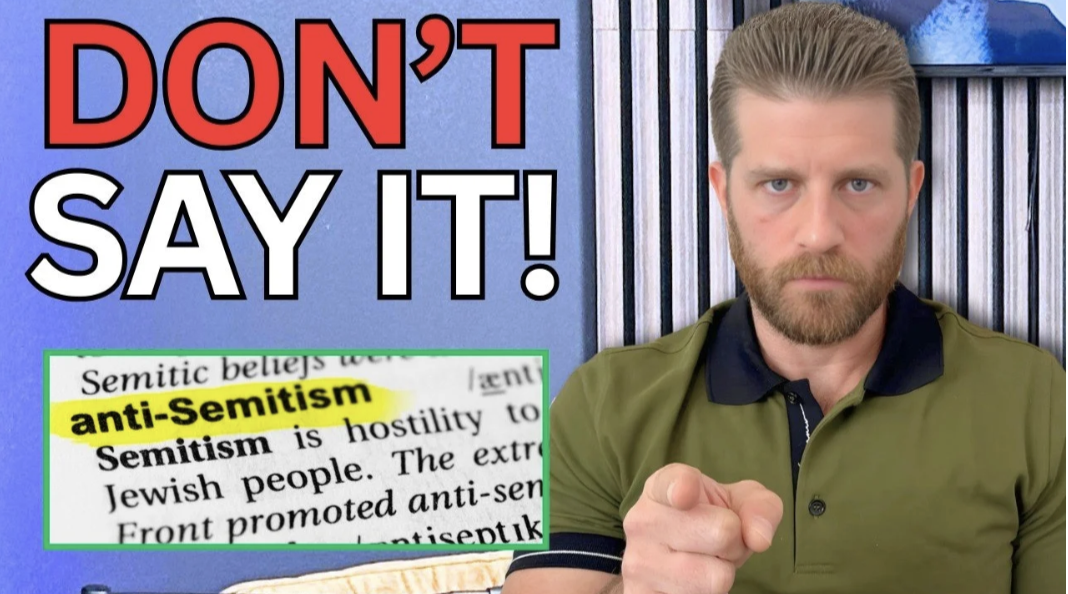
Stop Saying “Antisemitism!” Jonah Platt Urges You to Fight Anti-Jewish Racism
Can we all try something?
Can we all please try to stop using the word
anti-semitism
which is opaque as historical and
political context and obfiscates the
true meaning of how the word is
understood today? Instead, can we please
start saying anti-Jew hate or
anti-Jewish racism or anti-Jew bigotry?
Let's start calling it like it is and
not allowing antiquated, more polite
terms to lessen the blow. I promise
it'll be a lot more arresting for
someone to be called a Jew hater or
anti-Jew or anti-Jewish racist than an
anti-semite.
So went the text of an infographic I
posted on Instagram back in May of this
year. The idea had been lodged in my
mind after too many frustrating
interactions with folks online where
instead of having the black and white
conversation of is this anti-Jew hate or
not, we'd get lost in some pseudo
academic nonsense about the term
anti-semitism itself. And you'll notice
I often prefer to say anti-Jew as
opposed to anti-Jewish because hate
against us is never about the religion.
No one hates us because of our theology.
It's not the Judaism they hate. It's the
person. It's the Jew. So, in the words
of MTV's Real World, I wanted the Jewish
community to stop being polite and start
getting real. So, I reached out to a few
of the legacy Jewish organizations to
ask if they would consider changing
their official language moving forward.
One disagreed with my assertion and
said, "We have bigger fish to fry,"
which although true, I felt to be a
little short-sighted, and the other said
it was an interesting concept, but
wasn't confident it would pan out. It
was around this time that by a stroke of
luck, my mother, Julie, who as some of
you may know is the current chairwoman
of Jewish Federations of North America,
reached out to connect me with a woman
named Gretchen Barton, who is the
founder and principal of Worthy Strategy
Group, a research and behavioral science
consulting group, which basically means
they get hard data and deep
understanding about how people think and
feel about a whole host of issues.
Gretchen had been presenting JFNA with
some of her findings surrounding
anti-Jewish hate, including what
messaging about Jews is successfully
reaching people online and what's
actually shutting people down. Gretchen
is amazing. She's warm and intelligent
and very passionate about this work.
We'll definitely have her on the show at
some point. And also, by the way, not
Jewish.
So anyway, I told Gretchen my idea about
ditching the word anti-semitism, and she
agreed to try it out in her research.
This manifested in three ways. First,
she and her team had already built a
library of memes and gifts with
different messaging to test the response
on social media. Their post got
something like 60 million views, so a
lot of data. What she observed was that
whenever the meme labeled something as
anti-semitism, the majority of the
comments would say no, it isn't. Or if
the message was don't be anti-semitic,
the comments would be but this isn't
anti-semitic. So that was the first
indication that this term is
ineffective. It's too illdefined, too
misunderstood, too often misused.
Second, she convened an ethnography,
which is a word I learned today, and
basically means she gathered an online
panel of 15,000 diverse Americans. And
the results were stark. While the vast
majority of American Jews believe that
anti-ionism equals anti-semitism, which
spoiler alert, it totally does, but
that's for another episode, only 13% of
these panelists agreed. So again,
something about the term anti-semitism
is leaving too much room for
interpretation and rendering it
ineffective as a tool for calling out
hate and changing minds. Lastly, and
most pointedly, she showed the panel
images and clips of anti-Jewish things
and asked, "What do you most strongly
feel you are seeing? Is it
anti-semitism, anti-Jew,
anti-Jewish racism, etc." with a litany
of terms. And the most popular response
to these prompts was that they were
witnessing racism.
Racism, anti-Jewish hate, anti-Jewish
bigotry, anti-Jewish racism. All these
terms were much more easily identifiable
and relatable for people than
anti-semitism.
So to recap, we got to start telling it
like it is. The people of planet Earth
are not all working from the same
definition of what anti-semitism is. I
mean, even saying the word out loud,
it's a bit ridiculous. Like, why do we
acquies to the use of this cryptic
scholarly word to describe what is in
reality simply anti-Jewish hate? Why are
we making it harder and more complicated
for ourselves? I mean, what other
minority group is consistently lobbying
institutions to simply agree on a
preferred definition of what hate
against them consists of? It's madness.
And we now know scientifically and
anecdotally that people are much more
sensitive to overt racism and bigotry
than to this obscure and ambiguous term.
Now that you're aware of this mission
I'm on, you'll notice I almost never use
the word anti-semitism on this podcast,
in my speeches, or online. It's always
anti-Jew hate or anti-Jewish racism or
anti-Jew bigotry for me. So my challenge
to you, dear audience, is to pick
whichever alternate term you like best
and start using it in your
conversations, your group chats, your
workplaces, your public dispatches.
Calling out this hate in terms that
everyone can understand is a critical
step towards fighting it. And now that
you know better, my mission is your mission,