
Monologue Transcript
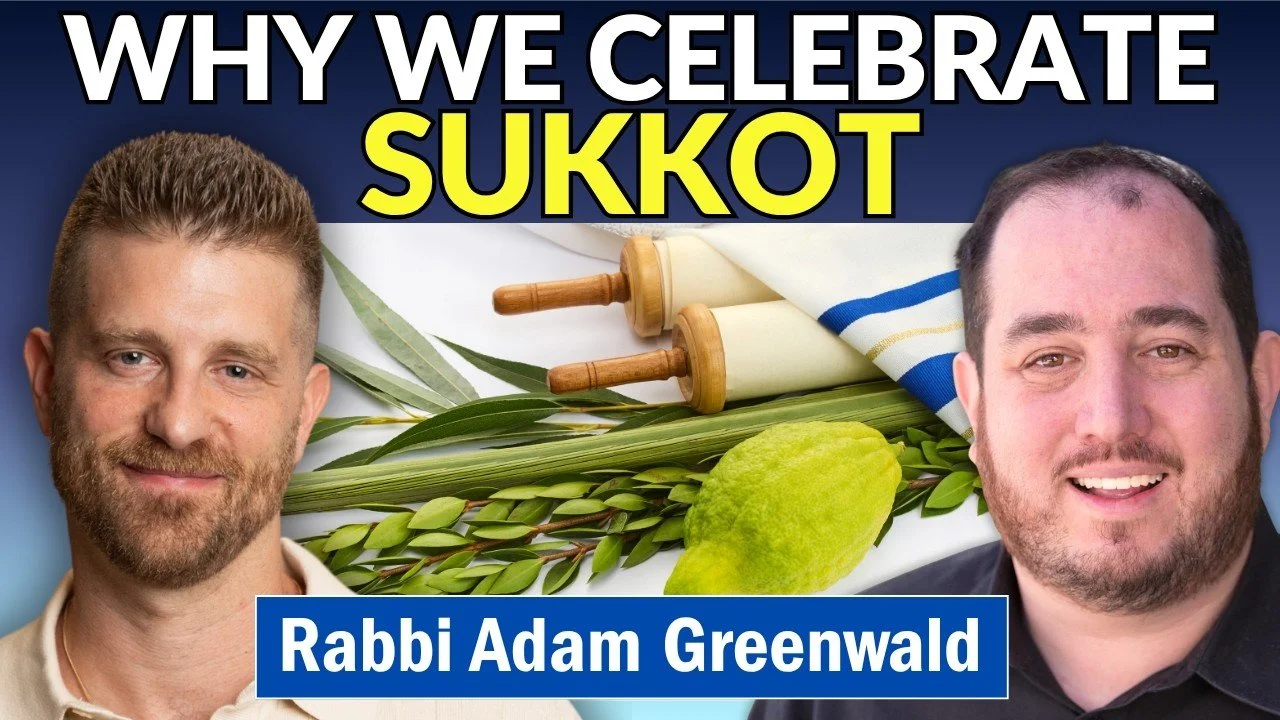
Sukkot 101: Why Are A Bunch Of Jews Sitting In Huts This Week? Jonah Platt and Rabbi Adam Greenwald
Shalom, my friends, and welcome to a special holiday installment of Being Jewish with me, Jonah Platt
The last time we celebrated together on the show was Shàuot when I invited my friend and BJJP fave Rabbi David Ing to help us make sense of that awesome and important holiday
Today we're going to shed a little light on Sukkot, aka the Feast of the Tabernacles, or if you're an Ashkenazi, Sukkus
We're shaking plants
We're sleeping under the stars
We're eating in huts with no doors
It's basically Burning Man, except your temple has one in the parking lot to learn what sukus is really all about
I've invited another very special rabbi friend of mine to join us today
We first met back in 2018 when my wife and I, weekly shout-out to Courtney, went on an amazing trip to the Holy Land with Honeymoon Israel
Incredible program
And we were spiritually guided throughout by this man
He also officiated my son's bris
He brought me on to the advisory board of the Miller intro to Judaism program at AJU which I am still on and we've discussed several times on this program and I once celebrated a very special Sukkot in his suka
So it felt like this was the one to bring him on for
We're always being Jewish but today we're doing Jewish
Folks, please welcome the Rabbi of Congregation Benet Israel in Tustin, California, Rabbi Adam Greenwald
Rabbi, welcome to the show
>> Jonah, it's so good to be with you
Thank you so much for having me
>> My pleasure
All right
So, I I mentioned in my intro that I I experienced a fantastic Sukkot at your house
What really struck me from your suka that was different than anything I'd been in was the the comfort inside cuz you guys had all these rugs and pillows
It was like so warm and cozy and it just like popped
When I was thinking of who am I going to bring on for Sukot? I was like I got to bring on the the warm and cozy Suka guy
Well, I am so glad to be on, though truthfully, you probably should have brought my wife
I love that you give a weekly shout out to Courtney
I'll give on my chance on your podcast a shout out to my wife an who is an art curator with a focus in Jewish art and has a gift for making ritual spaces really beautiful
And so the suka that we built back in that house with rugs and hangings and it really felt like the coolest blend between a bed of intent and burning man
>> Totally
>> We loved that suka and it was so nice having you
That night was really memorable
>> Yeah
And it, you know, just another thing that goes to show you there's no one correct way to do any of these things
It's all about bringing yourself into them
>> You know, it's something I would often tell my introduction to Judaism students who wondered what they could do with their Christmas ornaments
You know, they had emotional attachment to all of these incredible objects that were supposed to hang from greenery and they wondered if in becoming Jewish they were supposed to put those away
I said, "One use you could have for them is hang all of your ornaments in your suka
Hangs right on the greenery and makes it totally Jewish
" And I will go out on a limb and say there is nothing tra about having a suka even with some hanging Santa Claus and reindeer
>> I love that
All right, so let's talk about Sukkot
what it's all about
Something that will be familiar to some and not others is the idea that Sukkot is one of the shalos regalim as we call them
Regalim being Hebrew for feet
It's one of these three pilgrimage festivals where people would go in ancient Israel to the holy temple which if you're familiar with the Western Wall is is the outer sort of retention wall of what that temple used to be
Why was Sukkot one of these three such important days? Like what is the big deal? If you go back to the very earliest and most ancient core of Judaism, we celebrated three major harvest festivals at the three harvest seasons of the year
There was a spring harvest festival, a summer harvest festival, and the biggest harvest festival corresponded to the biggest harvest of the year, which is in the fall
Passover was before it was anything else, a spring harvest festival
Shàuot in the summertime, a summer harvest festival for bringing in the grain crops
And Sukkot was the festival celebrating the fall harvest that had to get you through the winter
And so everybody when they finished their harvest would then take a portion of the bounty that they had reaped from their fields and bring a portion of it to the temple as a way of saying thank you for another successful season of life
Sukkot has this really ancient core that evokes a sense of abundance and of bounty and of gratitude that goes back to thanksgiving for all of the blessings of another successful harvest
>> I would be remiss if I didn't note, you know, to me it's a very clear example for for folks who would argue in some way that the connection to Israel is not intrinsic to being Jewish
The fact that this festival, this holiday that is so widely celebrated, it is so such a core pillar of the calendar is expressly linked to the agricultural seasons of the Jews in Israel, of going to the temple in Israel, just completely inextricably a part of that DNA
This is a landbased ritual
This is a ritual that is about celebrating the connection with holy earth with the gifts that come from cultivating the land that is deeply tied to the seasons and to the agricultural cycle and to the particular produce of the land of Israel
>> Let's get into that now
So there's a lot of fun words associated with sukkot, not just the word sukkot, but we've got this thing called alulv
And we've got this thing called an etrogue
Tell me about those two things
And we shake them all around like we're doing the hokeyp pokei
>> That's something I used to say in my introduction to Judaism class all the time
I would say, I am going to teach you an ancient Jewish folk dance
Everybody stand
You know, the rabbi says, "Let the congregation please rise
" And I'd have them stand in a circle
And I'd say, you know, put your arm in and take it out and put your arm in and do a gentle wave
And eventually they'd start to smile and get that it was the hokeyp pokei, which is actually a really nice way of remembering what this holiday is about
This is the one where you put your whole self in
You go into the suka and then you shake it all about
And what we're shaking is this collection of three different kinds of branches specifically from trees that are native to the land of Israel
Palm, uh, willow, and myrtle branches in a bundle
That's the Lulov
And then an etrog, which is like an oversized lemon
I think it's called a citroron in English
Another tree totally associated with the land of Israel
And we take this bundle of branches and of fruit symbolic of the land, symbolic of the land of Israel, and we shake them in the four cardinal directions as well as up and down
And there is so much symbolism associated with the different understandings of what it is to shake it in all of the directions
I like the idea that we are indicating that God and holiness is all around us
But I also really like thinking about maybe a earlier anthropological origin of this ritual that feels an awful lot like it's connected to other rain rituals
>> You know, if we were Native Americans and we were taking a essentially a stick and shaking it in a circle in the fall time, we might call that rain dance or a rain celebration
Again, this theme of tying us really deeply to the land, to the agricultural cycle, celebrating our way of being connected with the earth and with uh and our dependence on the blessings that come from God in the form of rain
>> So now I mean we we've talked about sort of the agricultural piece, but then we've got the suka piece itself, which is even precedes the the harvest piece
So tell me what is a suka? Why do we sit in it and eat in it and for some sleep in it? >> Whatever you do, do it in the suka
It's a wonderful um opportunity to do one of my favorite things from when I was a kid, which is to go camping in the backyard to build a structure and to go spend as much of our time in a temporary outdoor sort of a hut
The requirements of which is that it has some degree of openness to it, particularly openness through the roof such that you could look up and see the stars
So you know that you're in a structure, but you're also you're also outside
You're also connected back to nature, back to the sky, back to the soil
Sukas can be big or small
They can come in kits that you can purchase online
They could be really elaborate structures that you build
Um, but what they what they all have in common is this sense of a temporary outdoor dwelling place that links us back in our historical memory to being out in the fields harvesting our crops
That links us back maybe even further in our historical memory to being wanderers in the desert on the way to a promised land
Um, and that ultimately uh asks us to get out of our indoor space and to go out into into God's world and to dwell there for the course of of the week following the high holy days
>> Another one of the really fun words uh connected to the suka is sk
>> So uh tell me what uh skak is all about and why we uh use that
>> Is absolutely one of the best Jewish words
It is an excellent way of clearing your throat
Um, is natural plant material that we use as the roof for the suka
A lot of people use palm frrons
Sometimes people will use those reed mats that you can get at at Home Depot or at Lowe's
Um, we ask our gardener um, starting around now to just save all of the clippings he's got so we can heap them on top of the suka
It has to be natural material and it has to in addition to providing shade provide enough openness that you can look up through the cracks and crevices and and see the stars
For years and years um I have gathered up friends or managed to talk my wife into getting in the car at least once a year and just driving out a couple hours past the city lights so we can see what our ancestors saw in the sky every night
There's something so spiritually important about being able to look up at the sky and see the stars
So through my suka, I can't see that much
Um but it is a reminder to um to look up and to recognize that we are part of this this big glorious universe
>> Another word that that comes into play here is us peine
>> Tell me who and what the pisine are and what they have to do with this holiday
You are just giving your listeners all of the most challenging words to say of the year, right? >> But they're so fun
Like these are some of the best ones
>> These are great
But you know, Hanukkah manora drrele easy >> easy and yeah
Yeah
Yeah
These is this is level two
>> Sukus
>> Sukus
The Ushbisin ritual is connected with Cababala with Jewish mysticism
And this idea that our suka is meant to be a place to not only welcome our family and friends in body, but to welcome guests in spirit
And we um do a ritual some of us at the start of the meal in the suka of spiritually inviting ancestors to come and be with us
The traditional Ushbine is a set of biblical characters like Abraham and Sarah and Moses and King David
U but I like to and many people do put up photos in the suka of ancestors of people from our family of people from history who we admire
um a way of inviting all of those who we feel connection to to come and be with us in this this holiday that's about dwelling together
>> What does the word ushine mean? >> It liter means guests
>> I didn't realize that that's what the ritual was
Um I'm actually hosting for the second time an event around Dia delas Muertos here in LA
It's uh on October 18th in LA this year uh to bring together LA's Latino, Jewish, and Jutino communities around our shared values of family and remembrance
I didn't realize there was such a clear overlap between Dia delos Muertos and Sukkot
So definitely next year for for round three, we're we're going to draw down on that hard
That's such great information
>> Another shout out to my incredible wife at our wedding
We just celebrated our 10th anniversary this week at our wedding
Oh, me too
>> Thank you
Uh yeah
Yeah
With the same day
You know that that we that we got married on the same day
September 4th
>> There we go
>> September 4th
We actually competed over a couple of guests
Um >> that's right
>> My my wife was always interested in this idea of a hoopa as a little mini personal suka
And um what would it look like to do an ritual connected to the hoopa and connected to the ancestors that we wish had been there to be able to celebrate our wedding with us? Mhm
>> And so at the start of our wedding, everybody received a flower and as part of the opening ritual, um, Rabbi Artson, um, who officiated our wedding together with Rabbi Sharon Browse, um, invited everybody to think about that concept of us and who you wish was here to come and be part of the celebration and then to hold up flowers
And so when we looked out from the hoopa, it was like this field of flowers inviting all of our ancestors and loved ones to come and walk in and be with us
And it was one of the most gorgeous moments
I have never seen or heard of anything like that before
But shout out to my brilliant wife who knows how to craft a ritual moment
>> Wow
Shout out to Ann
That sounds so beautiful
Let's say I don't have a yard
I I don't know how to build a suka
How do I participate in this and feel like it's still for me? I think you said in your introduction um it's like Burning Man, but your synagogue has one
Almost every Jewish communal space puts up a suka that people are invited to come and use and sit in
At my synagogue, we put up a big suka and it's lovely just walking out there and seeing synagogue members and families dropping by with picnic lunches and sitting there
Um, if you go to any synagogue, any JCC, any big Jewish gathering space, chances are there's a suka that you can borrow
It's also a great opportunity to get together and plan with friends and to think about who from your friend group might be the right person to host and everybody can come together and help contribute to putting up the suka
I think the Amish do something called like a barn raising where everybody gets together and puts up the barn
like I'm imagining a whole community coming together and putting a a suka um together so we share the work around and then be able to use that communally and then even if you've got you know just a minimal small space even if you've got a patio that you can designate as your suka space I am a big believer that in a choice in Judaism or in life between doing all or nothing almost all of us are going to choose to do nothing like if it has to be perfect or you can't do it, >> then most of us are just going to get so paralyzed that we're not going to be able to do it
So, the ideal is to build a suka with, you know, a certain height and with the plant material on top and being able to see the stars
And if you can't do that, better that at very least you try to spend as much time during this time outdoors connecting with nature, getting outside of your house, gathering up friends, and then, you know, hope for the day when you've got a backyard that's big enough to put a sucker in
>> I think that's beautiful and so important
Is there anything else that you feel like I haven't asked you about that's critical for us to connect to for this wonderful holiday? One of the things that I love during Sukkot is a ritual that happens in synagogue, which is the reading of the book of Cohellet or Ecclesiastes
That's one of the later books of the Bible
Um, and people know it best from chapter 3, which is to everything there is a season and a time for every purpose under heaven
The words turn, turn, turn added by Pete Seager and then made famous by the birds um and by Bob Dylan
But these words go all the way back to the Bible
And the theme of Ecclesiastes really is if we can't hang on to anything forever, then how do we live knowing that we're finite? Right? Ecclesiastes is this aging king
And he says, "I realize that pretty soon my power is going to go away
My fame is going to go away
my money is not going to be able to buy me out of the doghouse of mortality
Do I just despair and go and become a toll cynic or do I learn to live present in the moment and to take joy and feel gratitude for what I have? And we read that book on the holiday of Sukkot because we are going into this fragile structure
This structure that the wind could easily blow down in order to really recognize that all of our structures are fragile
That all of the things that we build are temporary
And we have to learn how to dwell in gratitude for what we have when we have it
and to gather up our friends, to gather up our family, to share food, to do a hoke pokey dance, to celebrate
Um because life is can turn on a dime
Um certainly the last few years have emphasized that for all of us in such profound ways that since we don't know what's coming around the next corner, it is all the more important to live each day with a sense of meaning and purpose
And I really feel like that is so behind the reason that you've gathered us all around the world through this podcast, Jonah
Like you you've really invited thousands and thousands and thousands of people to join you in this conversation that's all about how do we find meaning and purpose through these spiritual technologies through this sense of being part of a global and ancient people
How do we how do we ground ourselves in a world where the ground feels really really unstable? And so Sukkot is a deeply relevant holiday for the moment
I think there's never a time when there isn't uncertainty, but boy does this feel like an uncertain moment and a time to lean into how do we learn how to live in such uncertain moments
>> Amen
Amen
Rabbi Adam, that was absolutely fantastic
I know I learned so much
I'm sure everybody else listening and watching did too
You've still got plenty of time to get your butt in a hut
If not, bookmark this baby for next year
Rabbi Adam, thank you again
And to all of you, happy holiday and may this be a bountiful harvest for you in each and every way
It's so nice to be with you, Jenna
Sukus