
Monologue Transcript
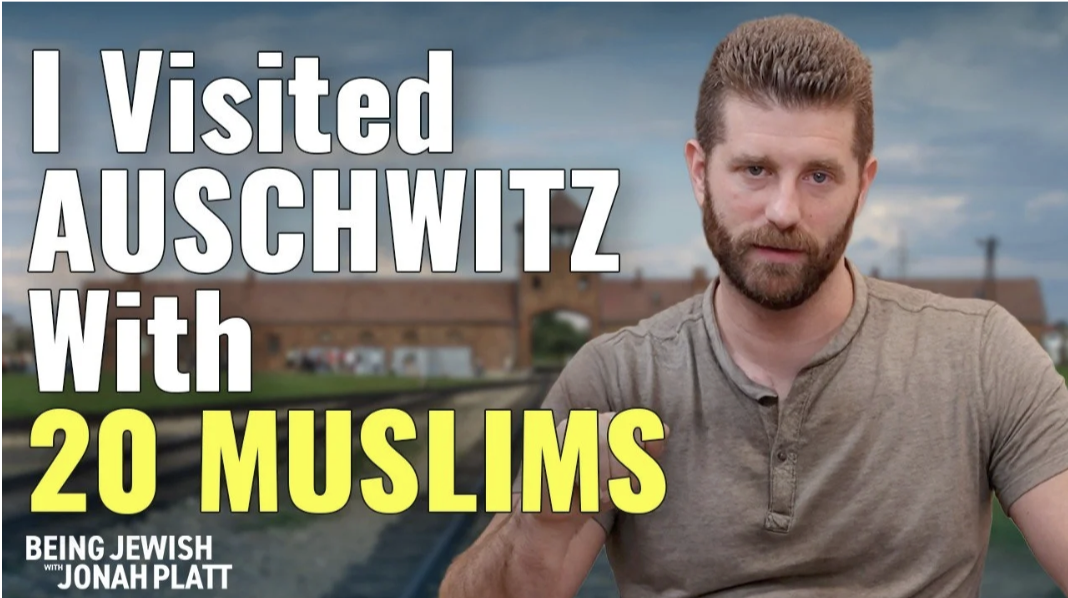
This Jew Visited Auschwitz with 20 Muslims… and Now They’re Friends for Life!
A few months ago, I got a call from the head
of Holocaust education at an organization
called Shaka, founded after the signing of the Abraham Accords
Shaka, which means partnership in Arabic creates person to person opportunities
for moderate Muslims from around the world to come to Israel and Poland to
connect with Israelis and gain a better understanding of Jews and our story.
It is an incredible organization doing work no one else is doing, creating
bonds that transcend borders and beliefs.
So when Shara invited me to join their delegation to this year's
March of the Living, I was delighted.
For those who don't know, March of the Living takes place every year on Yom
HaShoah Israel's official Holocaust Remembrance Day that aligns with
the anniversary of the Warsaw Ghetto uprising, an historic and tragic
moment of Jewish bravery and defiance.
This is not to be confused with International Holocaust Remembrance
Day, which takes place in January on the anniversary of the Liberation
of Auschwitz, a historic moment in which an army of non-Jews
came upon 7,000 barely alive.
Jews who happened to be left in an empty death camp the Soviets
didn't know anything about.
So you can tell which holiday was planned by the Jews and which by the go, but.
I digress.
March of the Living brings thousands of people from all over the world to
walk the 1.2 miles from Auschwitz, which is mostly administrative and
staff buildings to Birkenau, also known as Auschwitz two, which was the main
extermination site where Jews were either gassed to death or enslaved.
The March mirrors, the death marches, the Nazis forced prisoners to walk in the
freezing snow from Birkin out to Auschwitz as the Soviet army closed in so they could
destroy the evidence of their crimes and kill more Jews while they were at it.
But again, I digress.
I was touched and excited that Shaka wanted me to join them for such a
meaningful delegation and for what would be my first time in Germany or Poland.
Already having a major international trip planned to Azerbaijan, which I've
already told you about on this show.
I thought it was probably too much time away from my family.
But when I told my wife about the trip, she told me that not only should I go,
I had to go, she would hold down the fort with two young kiddos yet again so
that I could fly thousands of miles away to participate in this important work.
Get you a partner like that.
Major weekly.
Shout out to Courtney.
Fast forward to the 27th of Nissan, the day of the Jewish calendar on
which we celebrate Yom HaShoah after so many years and movies and stories
and books and photos, I was finally standing at the gates of Auschwitz.
The two things that struck me most about this epicenter of
death were its size and its color.
So many buildings, so much ground, just a massive operation.
I especially felt this in Birkenau, which was shockingly vast.
I. It was also really something to see the place in color and experience.
My friend Amy had alerted me to shout out to Amy.
We only see Auschwitz in black and white photos, but to be there and see its green
fields, its deep red brick buildings.
The brown of the dirt and mud and wooden train tracks slats.
It jolted the past into the present.
This is where it happened, where real atrocities happened to real people.
To be honest, I didn't find the march itself particularly impactful to me.
It felt similar to a charity walk.
We're all there for a very good and important reason, but the actual activity
of the thing is basically chitchatting with whoever's around you as you walk.
Now, imagine it's very different for survivors and their
families, of which I am neither.
But simply being there in the place, I actually felt the same way I had
when I visited the Nova site in lame during my trip to Israel last October.
In both places, I felt a sense of connection of almost familial belonging.
These are Jewish graveyards, and though the way these people were murdered was
horrific and unfair and unthinkably sad, I felt like I was there to honor them.
To remember them to ensure the endurance of their legacy.
I felt like I was on hallowed ground, our ground, and there
was a sense of comfort in that.
But I wanna return to the shaka of it all because really this trip
afforded me two parallel experiences.
One was my first time visiting Germany and Poland, and the other was my
first time spending four days on a bus through Europe with 20 Muslims.
And what surprised me was how much more eye-opening the latter
experience was for me than the former.
Our delegation was truly eclectic and I tried to engage with every single
person in the short time we had together.
I thought I had come to teach them about Jews, and I did through many
different conversations and connections.
But by the end of our time together, I realized what I'd really come
to do was learn about them.
And as I did, I could see assumptions I didn't even know I was harboring
turn to dust and float away.
There was a large contingent of Moroccan on the trip, most of whom were in
their twenties or early thirties, other than the fact that they're Muslim and
smoke an insane amount of cigarettes.
There was nothing different between us, nothing.
They could have been any of my friends from home.
Thoughtful, compassionate, educated, connected to their
religion, but not ruled by it.
Generous, funny, a great hang.
I was especially taken by 21-year-old Sheikh Ris.
She the youngest Sufi Sheikh in the world, a descendant of
the prophet Muhammad himself.
He and I made a special connection right away, and he made it very clear
to me that Sufi is about the heart and soul and spirit, whether one is
Jewish, Muslim, or anything else.
He gave me a sort of mantra to pray on all seeing, and when we parted,
he promised to be with me in my soul.
We also use WhatsApp.
One of my favorite moments from the trip was when the Sheikh led the
other Moroccans in a spontaneous Muslim singing session on the bus.
I swear it was like being at Jewish summer camp.
Again.
Arabic and Hebrew are incredibly similar languages, not just in how they sound
and are spoken, but historically and literally in the words themselves.
I mean, s and Sha, that's about as close as it gets, right?
And also the energy, the joy, the laughter, the clapping, the, it couldn't
have sounded or felt more familiar.
There were a number of really smart and interesting folks from Pakistan,
Afghanistan, Jordan, and Syria, none of whom I can tell you about,
because simply going on such a trip is legitimately dangerous for them.
Think about that.
People who care so much about connecting to Jews who want to understand the
truth about us and Israel and our history so badly, they are willing
to do so at great personal risk.
Could you see yourself doing that?
I spent a lot of time in conversation with Lui Ahmed, a Yemeni ex Jew hater,
who after a lifetime of indoctrination became de radicalized when he saw
the shocking lack of condemnation for the atrocities of October 7th.
And realized everything he'd been taught was upside down.
He's now an outspoken advocate for Jews in Israel on social media, and
he told me that as a liberal Arab, he feels more at home in Israel
than just about anywhere else.
I. I also love meeting Jonathan Elko, a Lebanese Christian who lives in Israel
and defends his home proudly also as an online advocate, and I so enjoyed
spending time with Marzuk Abdul Jami, a gentle and loving 82-year-old African
American Imam from Texas, who has devoted his life to traveling the world
to bring people of all faiths together.
My most meaningful conversation was with the group's youngest
participant, a 20-year-old French Moroccan student named Mia.
I look up to Mia.
Here's why.
At her boarding school in Paris, Mia had a single book of Hebrew on her shelf
because she's taken it upon herself to learn Hebrew because that's who Mia is.
She has many Jewish friends in Morocco and Paris, and feels a real
deep connection to our community.
When another student saw this Hebrew book in Mia's room, she started getting
all kinds of hate as people assumed she was Jewish, including somebody
carving a swastika into her bedpost.
Did Mia explain to these kids that they were mistaken that she wasn't a Jew?
No, she didn't say a word because she didn't want them to apologize
and be nice to her just because they learned she wasn't Jewish.
She'd rather them think she was a Jew and dislike her.
That's why I look up to Mia.
Who I think has a Jewish soul and cried when I told her.
So in America, in the Jewish community, in whatever social or political group
you are a part of, there are moderates and extremists, and the former
usually greatly outnumber the ladder.
The extremists are just louder.
We all know this to be true, and yet for some reason we are slow to apply
this idea to groups outside of our own.
We think I'm a moderate American.
Don't judge me by the far left radicals you see on the news or the far right
neo-Nazi, bad guys in the movies.
And then we turn around and look at the Muslim world and judge all 2 billion of
them by the extremists we see on the news and the bad guys we see in the movies.
Not only is it morally wrong to paint every member of a group with the same
brush, but we're also making the world a darker place for ourselves when we
paint over the many kindred spirits out there just waiting to connect with us.
Now, maybe you're one of those folks who thinks, well, if there are so many Muslim
allies, why don't I ever hear from them?
I want to answer this in five ways.
Number one, like I said on the show last week, there's the whole
algorithm thing the same way.
You have no idea what life is like for moderate Muslims and say Pakistan
because you don't personally know or follow anyone from Pakistan.
The same holds true in reverse.
They don't see on their feed what you see on yours.
They're not ignoring us.
They have nothing to ignore.
Number two, as I mentioned, for Muslims and more extremist countries, there
can be actual physical danger for openly associating with Jews or Israel,
especially right now because of the war.
These moderate folks are eager to engage privately and wish they
could be more supportive publicly.
They just can't.
Number three.
Again, as I mentioned, my new friends like Lu, Jonathan, and Mia,
are showing up for Jews in Israel.
As are many other Arab and Muslim influencers and
individuals, these voices exist.
If you wanna be hearing them, go find them.
Just because you haven't yet doesn't mean they aren't out there.
And that's true in the real world too.
Don't go where all the Muslims, if you've never ventured outside
your community to seek them out.
Why is it only their responsibility to appear at our side in a moment of need
if we never did anything whatsoever to build the relationship first?
Number four.
Do you take time out of your life to go online and speak about issues affecting
moderate Muslim communities abroad?
I'm guessing most of you don't.
So why is it fair to assume Muslims are just gonna do the same for you?
Number five, you would never want to be judged by the most extreme elements
of your society, so why would you turn around and do that to somebody else?
There is so much more that connects us than divides us.
Let this be a comfort to you.
We have friends, many friends who want to understand and love and support us.
Certainly not everybody, but enough great moments of change have never
required everybody that just require the best of us and the best of them
to work together, and that's always been enough to push humanity forward.
There's a reason they call it building bridges and not walking across
bridges that magically appear for you.
I have these amazing new relationships now because I traveled
thousands of miles to go get them.
Building takes effort, but doing so in Shaka,
in partnership makes the rewards.
Oh, so sweet.
And I hope one day, if you haven't already,
you'll get to experience them for yourself in Shaah.
This is the 32nd episode of being Jewish with me, Jonah Platt.