
Monologue Transcript
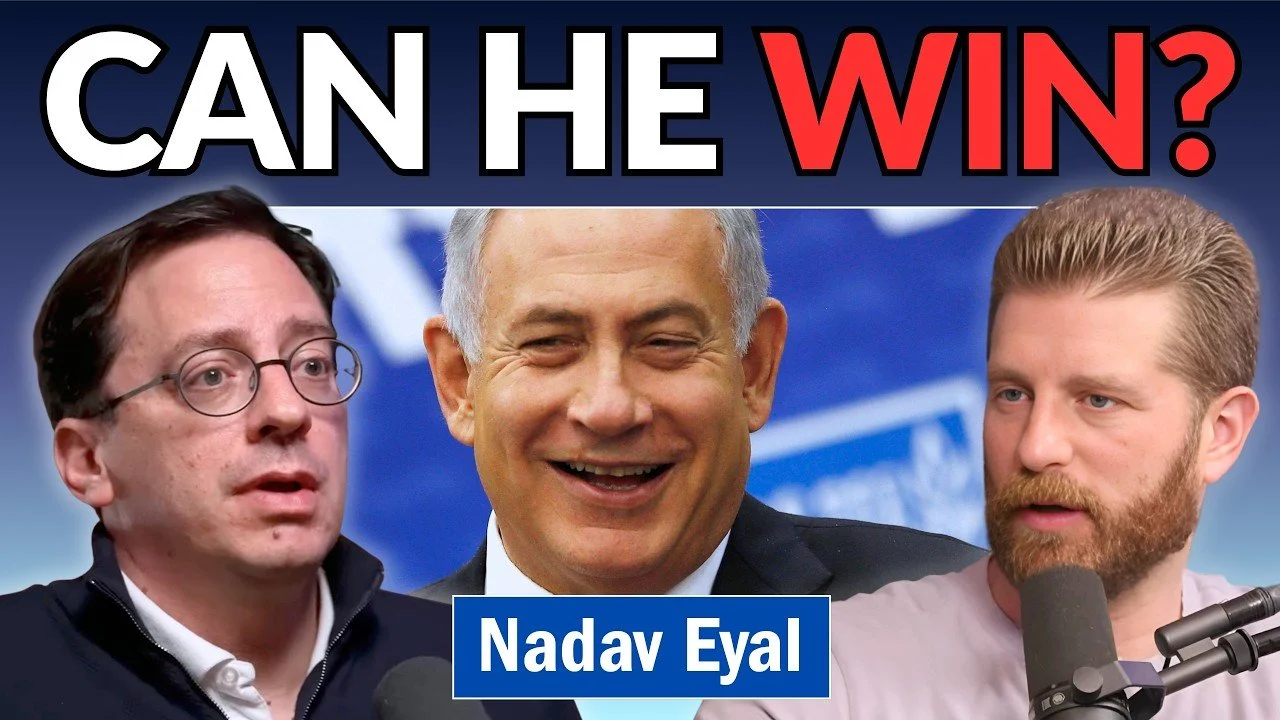
Israel's Next Election: What Happens if Bibi Wins, What Happens If He Loses? | Journalist Nadav Eyal
Watch and Listen
With Israel's parliamentary elections only months away, the stakes for the world's only Jewish country couldn't be higher.
Prime Minister Benjamin Netanyahu, the longest serving in Israel's history, revered by some, reviled by others, will attempt to renew his power over Israeli society.
Whether he's successful or not will play an immense part in determining the next chapter of the Jewish people, both within Israel itself as well as the diaspora.
What does it mean if he wins, and what will it mean if he loses?
Find out right now on Being Jewish with me, Jonah Platt.
Welcome to Being Jewish, your home for deep conversations on Jewish identity, culture, and current events.
I'm your host, Jonah Platt, and joining me today is renowned Israeli journalist, author, and Inside Call Me Back with Dan Senor regular contributor, Mr.
Nadav Eyal.
Nadav, welcome to the show.
Thanks for having me, Jonah.
Nadav, I want to look at both scenarios in terms of the upcoming Israeli election.
What happens if Bibi wins, and what happens if he loses?
So let's start with if he wins.
What would a win reveal about where Israeli society is at?
What would it mean for Israel's sort of biggest domestic and foreign issues, and, and what would it mean for Jews in the diaspora?
Wow.
Uh, this is a really big question.
Yeah.
First of all, Jonah, thanks, uh, so much for having me.
I, I follow your work, and I follow this podcast, and I think what you're doing is, is so important in these days specifically.
So a win for Netanyahu, first of all, uh, uh, he's, right now he's playing the underdog, right?
Netanyahu is probably the one person alive who has won more elections in a democracy than anyone else.
Yeah.
But he is still losing every poll in the last three years, and that, that's a lot, even for, for Netanyahu.
Now, after saying that, he can absolutely win.
Even if he doesn't manage to get a coalition going He can win these, uh, this election simply by the other side, the bloc against him, not forming a coalition.
Mm.
And we have seen this before, right, Jonah?
We, we've seen this, uh, beginning 2019, Israel was in a political crisis.
He couldn't form a coalition.
He didn't get 61 out of 120 members of Knesset, which he needs to get.
But the other bloc didn't manage to get that, so he remained the prime minister with what we call an interim government.
And for him, this is a clear victory.
Now, to your strategic question, what it, does it mean to Israel?
I think that if Netanyahu wins, it's gonna be a significant crisis, maybe a final crisis, for many segments of the Israeli society, who are very clearly saying that another coalition like this led by Netanyahu will mean that they will need to reconsider their place in the Israeli society.
So people are very clearly talking about the possibility of, uh, migrating.
What kind of people are you speaking of here who, who have this on the table should, uh, uh, this come to pass?
If you look at the Israeli society just as the facts, there was a migration out of the country during the war.
It was significant.
And if you look at the demographics of those leaving, these are people who are highly educated, young families, exactly the kind of people that you would want to see staying in the country.
By the way, for instance, people with PhDs were three times the relative part of, of those who left in comparison to their relative part of the Israeli society.
How do we know to attribute that to, there's a war going on and I gotta get out of here, versus I don't wanna be part of the direction this country's going in politically?
We can't.
Yeah.
We can't, and it's absolutely a fair point to make.
People were not leaving because of politics.
They were leaving because they were fearing security, because they were thinking maybe about their, their kids, because they were post-traumatic.
There are many, many reasons.
But let me tell you something anecdotal, uh, and that's my impression.
When I speak with people who are leaving, their explanation is always political.
It's not about security.
You have lived in Israel your entire life.
You understand that in terms of security, this is part of the deal.
It's not about that.
It's about the other side of the deal.
The other side of the deal is what the government is doing.
It's about this society in which there is a value of solidarity.
It's about a society that was based on some principles of idealism that relate to what was once secular Zionism, liberal Zionism, the sort of Zionism that you don't really see in the Israeli government anymore.
Your question was much wider than that.
Yeah.
It's not only about that.
It means that nothing has changed.
It means that a government in Israel can have a failure like October 7, and Netanyahu can remain there.
It means internationally that Netanyahu today, and let's face it, is extremely toxic in many countries around the world.
Netanyahu is not delivering a dividend in terms of public relations to Israel, to say the least.
If Netanyahu wins again, that really means that the Israeli political system is really in a direction that resembles more countries like Hungary and Viktor Orbán, who's just lost an election.
Yeah.
Although one could argue that if Netanyahu wins again, he would try to form a wide government or maybe a national unity government of sorts that will re-legitimize him, if not internationally, at least within the Israeli society.
Take the temperature for me.
How popular or unpopular is he within society at the moment?
'Cause, I mean, I've seen some of the polls, and obviously his numbers are down, or more people say they would prefer he not run than, than do run, but not by enormous margins.
It's not like 80 to 20 or something.
Yeah.
So about six out of 10 Israelis think he shouldn't be running again.
But if you measure who is more fitting to be prime minister, usually he's losing by a single digit- Mm … sometimes within the, the error of margin.
So for instance, Gadi Eizenkot, who's right now the front runner of the bloc who's trying to replace him, Eizenkot is a former chief of staff.
He'll poll, just as an example, 36% as fitting to be prime minister, and Netanyahu will poll 34%, and the rest would say, "We didn't decide yet." If you look at his, his general popularity, it's, it's mostly entrenched within his own bloc and with specific elements of his own bloc.
For instance, Netanyahu today is much more popular within the ultra-Orthodox community or within the far right than he is popular in the Likud.
Mm.
his own party.
Right.
So these elements that are really keeping Netanyahu in power more than the Likud, that is now splintering to all kinds of groups, factions.
There are new parties that are formed by former Likud officials who are withdrawing from the Likud, because the Likud is a much more of a mainstream party in Israel.
What do you think it says about Israeli political culture that there haven't been more galvanizing, exciting, stronger opposition candidates when you think, you know, there's a vacuum here for somebody to walk into, and there just hasn't been that person?
That's a question that keeps, uh, popping up when you speak about the opposition against Netanyahu.
They had so many leaders since Netanyahu came to power.
They did manage to replace Netanyahu, I remind the people listening, back in 2022, so there was a year in which Naftali Bennett was the prime minister, Yai- Yair Lapid was the prime minister, but that government, that coalition, was, uh, shaky to begin with, and it collapsed quite quickly.
If you look at Netanyahu in power, he's been basically in power continuously since 2009, beside that one year.
At the end of the day, this is a bloc that has, to a certain degree, lost a historical debate as to what can happen in Eretz Yisrael, Palestine, and that debate is about the possibility of peace.
Uh, that bloc for many years maintained that two-state solution and a peace agreement with the Palestinians is possible, and then the Oslo Accords collapsed, and then the Second Intifada happened, and now October 7 happened.
So if you look at Israeli politics today, Jonah, it's 50 shades of right wing.
Mm.
And even those running, like Bennett or Eisenkot, will never, ever describe themselves as, as center left.
Bennett would say he's, he's more right wing to the prime minister, and he's actually right.
Normally speaking, he was the chairman of the settler lobby in Israel.
He never agreed to a Palestinian state.
Netanyahu agreed several times to a Palestinian state.
Uh, Eisenkot is doing all he can to stay away from being described as left.
The, the attack line of the Netanyahu people against Eisenkot, the front runner right now, is that he's a radical leftist.
Because it's so toxic in Israel today, and that's part of the crisis.
Now, another part is that this bloc- That is completely divided between people who are right wing, like Bennett, and don't like Netanyahu.
They are really right wing.
On the other hand, they have this uneasy alliance with the classic lefties who, uh, you meet in Tel Aviv to go to the philosophy department in the Tel Aviv University.
And they all need to live together and agree on one candidate, and maybe play this charade that this candidate is not really center or not really center left because the electorate is not gonna love it.
And that creates a lot of friction and crisis, and at the end of the day, gives Netanyahu a lot to work with, and that's exactly what he's doing.
Okay, so now let's look at the flip side.
Let's see sort of the same setup.
What happens if he loses?
What does that mean for where Israel is as a society, what they're gonna try to accomplish domestically, foreign-wise, and, uh, what does it mean for the diaspora?
So first of all, I, I owe you an answer about the diaspora.
From my experience, if Netanyahu wins, what I'm hearing is a lot of distress as to the possibility of another Netanyahu victory.
I'm sure that they are out there, many people who support Netanyahu.
Mm-hmm.
But I'm not meeting a lot, a whole lot of it, to say the least.
Yeah.
Including in shuls that are the most Zionist, you would say right wing, Orthodox shuls, uh, in this country.
What I'm hearing is people come to me, like whispering sometimes, and say, "This government cannot stay." They usually don't say Netanyahu.
They say- Right … «This government is, is a, a tragedy», but this is what I'm hearing from the diaspora.
I think that people don't blame Netanyahu for anti-Semitism, and they … I don't think they should.
Me neither.
But they do think that there's something to be said about wisdom and about how you conduct yourself in the world with responsibility to your Jewish brothers and sisters abroad, and specifically the way that Netanyahu is leading the government with the far right, which is morally embarrassing for Jews everywhere.
Mm-hmm.
And they want him out because of that.
As to your question, now what happens if Netanyahu loses, if Netanyahu loses, it's really an earth-shattering moment for Israeli history.
First of all, he's not gonna come back.
Now, I'm saying that knowing that he, he always did come back- Right.
… Jonah.
But he's not gonna come back this time.
He's, he's, um … It's about his age.
It's about his health.
It's about the way that the Likud is built, and I'm willing to, to take this wild bet that if he loses, really loses this time, that's the end for Net- the Netanyahu career, to the extent that some people in Israel, Jonah, are saying that if he sees the polls that he sees today, just before the elections, he's not gonna even run because he doesn't wanna lose.
Interesting.
Netanyahu can play the leverage of not running, and for that, have his criminal case over in a plea deal or through an amnesty from the president.
Only before the elections, before he loses.
After he loses, he loses leverage.
Right.
And that's a really important point.
So if he thinks he's gonna lose, he should go for a plea deal, close his criminal case as part of him withdrawing from the race, not waiting for the results, because then he's not gonna get a plea deal.
Wow.
Intrigue.
If he loses, uh, everything needs to change.
For some people around the world, it's about what's happening in the West Bank, right?
So you need to fight Jewish terror in the West Bank.
You have the ultra-Orthodox issue of conscription, which is a major, major issue after three years of war for the Israelis.
Mm-hmm.
Reserve soldiers in Israel serve hundreds of days Hundreds of days, uh, putting their lives at stake, and, and you have the ultra-Orthodox community that doesn't serve, and there is a growing demand that really hurts the Likud to have some sort of a conscription or for at least national service for the ultra-Orthodox, which they absolutely resist.
There are demonstrations in Israel.
This is a huge issue- Sure … for the, this election.
You just spoke about sort of how, for example, Naftali Bennett is even to the right of Netanyahu on some of these things.
Is there necessarily even a guarantee that those issues will shift in some other government?
There is no guarantee, but they're gonna try.
This new government, if indeed elected, is gonna be a reform government, not because of the promises they made, but because they have no other choice.
If you look at Israeli economy right now, if you look at conscription, if you look at Israel's status on the world stage- Yeah … there are, there's so much that they need to do, and they are promising to do.
And one of the interesting things about this election campaign is actually that people who are running for the prime minister, like Bennett or Eisenkot, are really publishing highly detailed plans of what they intend to do.
For instance, how are they gonna get back the Israelis who left the country?
How are they gonna get back those academics that left the country?
What are they gonna do with conscription specifically?
And, and this is really important, never covered internationally or by podcasts in the diaspora, it's the crisis within the Israeli education system.
If you speak with Israelis, what really troubles them, they understand that security can be, pardon my language, crap.
This is, again, part of this project of trying to live in the Middle East.
They understand that.
However, it's the civil issues like education or healthcare that people say, "W- we expect more." The education, uh, system is, is practically collapsing.
I know that people often complain on public education, but what we're seeing in Israel is, is things that parents have never seen.
When I grew up, schools won't pu- wou- wouldn't be publishing on Facebook pages that they need a science teacher to begin teaching in two months.
Hmm.
And they don't care if he has any qualification as a teacher as long as he has any academic degree.
Wow.
This is where we are at, and people are completely ignorant as to that, and I understand, in Israel.
And in Israel, I remind the people listening, it's mostly public education.
Right.
And it's that public education system that has led us to really incredible achievements in our history.
Now, you have the entire far right issues, uh, what Smotrich has been doing.
To your question, can they undo everything?
Can they reform?
Can they really change?
They will probably underdeliver if you compare it to the expectations because expectations are so high.
What specifically, in terms of Smotrich, are you referring to in sort of things he has done?
That would be hard to undo The biggest project that Smotrich and his party have been doing is changing the territory of, in the West Bank in ways that were unimagined before that, be- before this government.
After October 7, they used the sentiment within the Israeli public, but also the focus on the war in Gaza and the war in the north.
They changed the legal status in the West Bank in ways that we have not seen before.
They basically took over most of the C te- C area, according to the Oslo Accords.
Right.
Through what they call agricultural farms.
They now control an area that is more than i- the entire settlement area, and they created a, a series of constructs, legal constructs, that really changed the possibility to get any sort of a political solution or compromise between Israel and the Palest- Palestinians.
So let's look at the diaspora now In terms of this, do you think actually if there were a change in government, it would mean meaningful change that could be felt outside of the country?
I absolutely think that if there would be a change of government, it would be felt outside of the country, first and foremost because let's have a prime minister that nobody knows his name.
Right.
Let's begin with that.
Yeah.
Now, I understand it's very difficult.
I, I'm not being naive.
Israel is fighting for its life.
Is- Israel is fighting against fundamentalist forces in the region.
Hezbollah, Hamas, and Iran really want to destroy us.
It's not a fantasy.
It's, it's not a Zionist expansionist narrative.
I'm very much aware to what's really happening.
And after saying that, let's get off the news cycle.
That means that when our government convenes, one of the strategic elements there is that we don't want to be the story anymore because this only helps our enemies.
Yeah.
The second thing is that any new government, Jonah, is gonna have some sort of a positive initiative in the region, a political initiative to the future of the region.
I fully understand why Israel needed to fight in Gaza.
I supported the war in Gaza.
However, I don't think, uh, Israel would have been hurt at all if it had a prime minister that would give a speech, one speech in English, about a positive future for the region and for Palestinians.
Yeah.
And about having them as neighbors.
Now, again, I understand that the Palestinian society was committed and enlisted, and I covered October 7th, and I was there in the south.
However, we're gonna live next to them, and this is just a fact of life.
Now, you need to have some sort of a positive vision for the region, and Israel never supplied one.
Yeah.
It never gave an excuse to people who were, like, on the sidelines to say, "Maybe the Israelis have a point." What's your prediction?
I know we're months out.
I'm not gonna hold you to it, but what do you think's gonna happen?
Jonah, I'm not gonna make predictions as to the Israeli politics, as to Israeli politics for tomorrow morning.
I'm just gonna state where we are right now.
Netanyahu has been losing in every reliable poll since March of 2023, not since October of '23.
Uh, I have not seen any piece of data right now to demonstrate to me that he can actually win this elections.
I have seen points of data that show that he might be able to drag it on and maybe block the formation of another government.
Hmm.
But right now, he's losing, and he's losing big.
And this has not changed for a few years now.
I've never seen anything like it in Israeli politics.
I'm not saying he can't stage a comeback, but right now he's on his way, uh, as we say in Hebrew, habayta, back home.
I know I gave to some of your listeners a lot of hope right now.
And I need to dilute it with pinch of salt of, of realism.
After saying all that, Israeli elections, winning or losing, is not only about getting a majority.
It's about the fine and sometimes corrupt art of forming a coalition.
Yeah.
In that dark art, Netanyahu is king.
Nadav, this has been so enlightening.
I, I so enjoyed having you on.
We're gonna have to do it again sometime, for sure.
Thank you so much.
Wishing you all the best, and best of luck to us all.
Thank you so much, Jon.
It was a pleasure.