
Monologue Transcript
When Did Jews BECOME Jews? The Most Important Jewish Holiday You've Never Heard of!
Did you know there's a Jewish holiday that's basically the anniversary of the moment Jews actually became the Jews?
Ah.
And that some people celebrate it by staying up all night studying, and others by eating lots of ice cream and cheesecake?
No cap.
By the end of this video, you might not be a rabbi, but you'll know an H-E double hockey sticks of a lot more about one of Judaism's most important and beautiful unknown holidays.
This is Being Jewish: Shavuot.
Today we're talking Shavuot, or if you're an older Ashkenazi Jew, Shavuos.
And to help us understand more, I've invited back a new friend who you may have seen on the show recently, not once, but twice, and now he's about to become our first three-time guest.
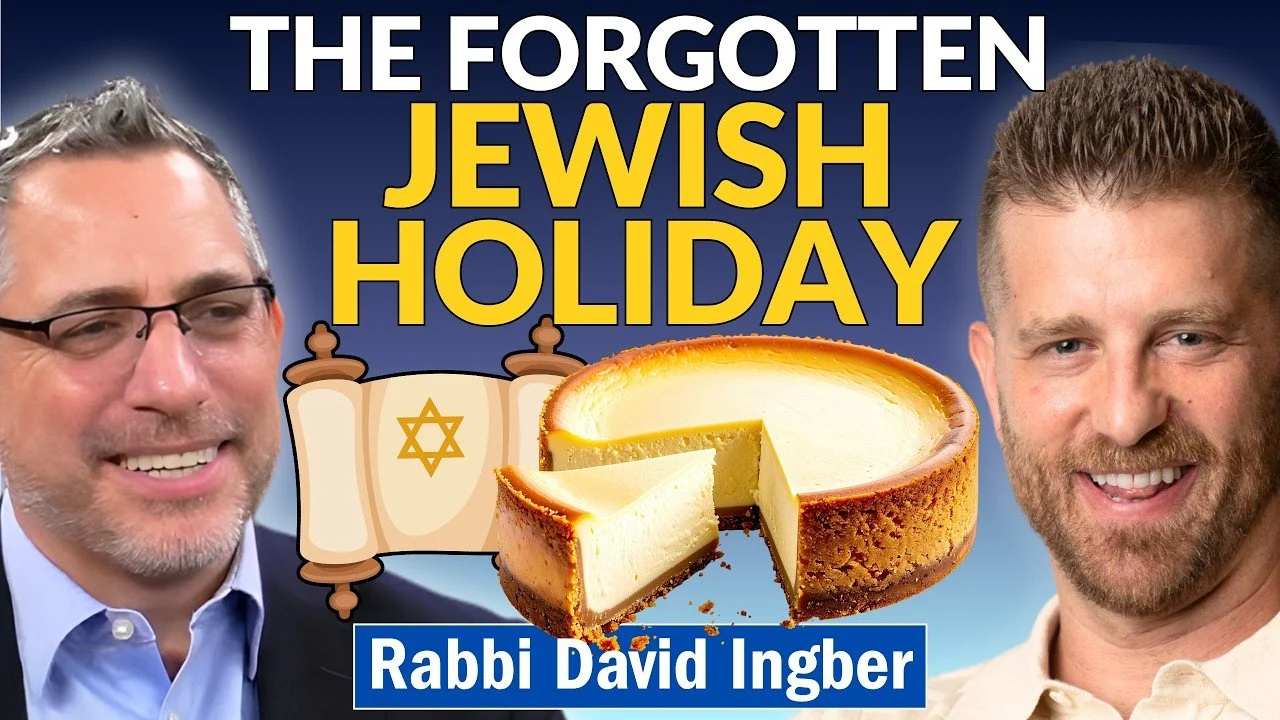
Live from New York, it's the Senior Director of Jewish Life at the 92nd Street Y, Rabbi David Ingber.
Rabbi, Baruch haba, welcome back to the show.
Why, thank you.
Live from New York.
It felt like Saturday Night Live with Rabbi Ingber.
That's awesome.
Doing my best Don Pardo there.
As I just told the listeners, we're trying something new here.
I want to talk about Shavuot, the, the holiday that is upon us.
It's a super important, significant holiday that I think, like, doesn't get its due.
So let's start with, if you would, just sort of tell us all what is Shavuot, what's it about, and sort of traditionally what it's looked like and how folks have celebrated, and then we'll dig a little bit deeper.
As you said, it's an important holiday.
It's kind of, uh, one of the three basic pilgrimage festivals that the, the Bible or the Torah describes, uh, along with Passover and Sukkot.
It's one of those Shalosh Regalim, or the three leg festivals.
Literally it means legs.
They would, pilgrimages, you know, people would walk up to the temple in Jerusalem.
And it's basically the most important holiday in the Jewish calendar that no one has ever heard of.
I think the reason why no one knows about it is because it has nothing...
There's actually nothing related to it that is, like, a, a thing to do.
Right.
It's missing the big ritual.
Exactly.
Sukkot has the hut.
Passover has, like, the Seder and the matzah.
Hanukkah has the candles, right?
But, like, Shavuot is lacking that and, and basically it has, like, cheesecake.
Right, cheesecake and studying.
And staying up all night, exactly.
Exactly.
Right.
Everyone's favorite thing to do is eat- ...
cheesecake and, and stay up all night, right?
But the thing about it that's most interesting and, and sad a little bit w- is that it celebrates maybe the most important moment in Western civilization, which is the revelation of Torah, right?
The revelation of, of the Five Books of Moses or whatever it is.
So I guess, like, the pitch about Shavuot is that it's where we got the Torah.
It's the holiday of Torah.
And so if Passover represents the escape from bondage, the escape from slavery, which everybody can kinda get on board with, and Shavuot then would become the whole reason why you wanted to leave, right?
So one philosopher called it, like, escape from to escape- Two.
In other words, Shavuot is our mission statement.
It's our why.
You leave Egypt, you wander around, and it's not just so you can, like, like, I don't know, build a falafel stand or something.
It's kind of actually the reason why you leave Egypt is because there's gonna be a revelation for you at the other end of the desert.
So we count seven weeks from the second day of Passover, and on the 50th day, we arrive at, at, uh, Mount Sinai and receive the Torah, and those seven weeks are the name of the holiday comes from those seven weeks.
The name Shavuot means weeks, right?
So it's basically this, like a spiritual advent calendar.
Like, except instead of, like, chocolate- We count wheat.
Right.
Exactly.
It's like, why- We count- It's so, it's so much lamer than the other ones, man.
We don't get a chocolate- I know ...
calendar.
We get wheat counting.
Exactly.
We count wheat.
But it has that inner core, which is the idea that you're gonna get this big payoff at the end, cheesecake.
Right.
Exactly.
So clarify this one thing for me.
The, the moment that's being honored, the, the anniversary, is it distinctly one of the three things I'm about to say, or is it all three?
Is it getting the Ten Commandments?
Is it getting the five books of Moses, or is it the beginning, like, the, the agreement to the covenant with God of you are the Jewish people, and I'm God, you're the chosen people, and, like, we're gonna do this thing together?
Check, check, check.
It is all three.
All three of those.
Okay.
All three of those.
So we don't really know, like, what happened at Sinai, whatever it is, but the Torah describes this moment as the Decalogue or the Ten Commandments, or if you're Mel Brooks, I have 15, oy, Ten Commandments.
And then all of these other pieces that you just said are kind of part of the eventual story of the Jewish people, which is Sinai revelation covenant, which is like a contract between us and God to keep the Torah and to learn it and, and to, you know, and to love it.
That seems like not just an important holiday.
To me, that seems like the holiday.
That is literally the anniversary of the Jews becoming the Jews, and, like, we don't even talk about it.
I, I, I keep being surprised the more I learn about Shavuot to be like, "Whoa, this is, this is massive." Shavuot as a kind of, like, holiday of the, of the Torah is, like, everywhere, right?
It's like almost like the Constitution of the United States.
There's no one day when we celebrate that, but it's everywhere.
It's in all the things that we do, but of course, you're right.
Like, it should be a much bigger deal, and that's why the whole custom of staying up all night, that becomes, like, a really special, like, you know, up all night kind of thing.
To, like, bring back your, your Constitution analogy, I would argue, you know, we do celebrate that specially sort of one day a year on 4th of July.
It's like we are gonna celebrate the anniversary of the day that we became this nation, and that's our sort of founding document.
Is it just- In modernity, that sort of Shavuot's gotten lost in the shuffle, or like within sort of the, the rabbinic tradition, has it always been this sort of, you know, forgotten little brother holiday, or did, you know, did we lose it somewhere along the way?
It's such a good question.
I, I, I, I think tracking, you know, tracking it, Shavuot probably, um, was not nearly as big as the other two just because it's only a, a, you know, a one or two-day holiday and the other ones are seven, eight, they're longer.
If modern Jews were to, to relate to one holiday the least, it might be Shavuot because the whole question of whether or not God gave the Torah and the, and the authority of the Torah is something that, like, modernity to some extent tossed out the window.
Like, I think a lot of liberal- liberalism itself was kind of like a, a, a movement away from the divine authority of, of revealed or, you know, received traditions, right?
So there's, there's a, there's something about Shavuot that feels anti-modernist in a way.
Like, you know, Passover you can get behind because even if you don't believe that Jews left Egypt, like, who can't get behind the holiday that celebrates the freedom of slavery?
I actually think of all the holidays, um, it's the one that would probably, if people knew it and understood it, speak most to Jews today because, you know, people are really re-engaging with their Jewish personhood in a way that they haven't in a long time, and this is very literally s- you know, the, the anniversary of the beginning of that personhood, the day the tribe officially became the tribe.
And I think it's so important and also, like, the, the, the, the notion that we were all there together, you know, that belief that sort of every soul was at Sinai, and I know when we talk about Jews who have converted, like, they were there too.
It makes me think of, uh, did you ever watch the show Lost?
Yeah.
Yeah.
If you remember at the, like, at the end, end, end, series finale, spoiler alert, you know, they all finally, like, meet up again before they go to heaven.
They're all, like, waiting for each other.
Like, I ha- I, I picture that image, obviously not everybody's dead, but, like, of everybody kinda just waiting for everybody to show up, like we're all there together.
There is a tradition that says that the children of Israel received Torah at Sinai, "Am echad b'lev echad," like one nation with one heart, and they actually stood, "Vayichan Yisrael," that they stood at the mountain, and something about that mountain or something about what was being received actually created this kind of unity within the Jewish people, and that is sorely needed now.
I mean, the sense that we have, uh, some document or some, some principle that can unite us from all of our different fragmented places would be incredible, both in this country, right, in the world, the Jewish community for sure, and, uh, that we could kind of gather together around a shared understanding would be awesome.
I love that you brought in the whole soul at Sinai.
There was once You know, when I was much younger, there was like a Saw You at Sinai, this kind of like a dating app that like said every soul was at Sinai.
So like that would be like the pickup line.
You'd be like, "Hey, saw you at Sinai." So there is a Kabbalistic or mystical idea that all of the 600,000 archetypal or kind of general souls were all at Sinai together, and that each and every Jew or each and every person that becomes connected to the Jewish tradition, whether they come from afar, um, like a convert or someone who is Jewishly adjacent, or as my teacher would say, psychosemitic, somebody who's connected to the Semitic people, they have a spark of that.
And that what draws them like a magnet to the Jewish people is like this primal, cellular experience of having stood together at Sinai that has been passed down from one generation to another, um, transmitted, like this openness to receive wisdom and revelation that is beyond us or beyond, you know, human minds.
Even that word revelation, you know, it's not a word that I think a lot of people associate with Judaism.
Obviously, like you hear that word, you think more of Christianity.
But like you said, like people, w- we want that sort of experience, too.
Just, you know, I think h- humans want to feel that, that presence of the divine.
They want to feel plugged into something.
They want to feel awakened.
And again, like this holiday seems like it's serving it up there to like connect into something of that experience.
A lot of the experience of Torah is connected to light and the idea that something that was in the dark is now illuminated.
And so the Torah is known as, and the Aramaic word for Torah is Oritah, from the word or, which is light.
The idea that, that we go to the mountain and there is revelation, meaning there's something that, there's something that we need to help us see the world more clearly.
And Torah, for the Jewish people, represents that body of wisdom that helps illuminate what can often be a very dark world, a world that feels confusing or, um, that where things that should be seen are not visible.
And so Torah becomes like a great teacher in that way.
And so to think about this day as a day to honor the wisdom of our tradition that teaches us how to live a moral, ethical, connected life, that's kind of like, that's Shavuot.
When we say, you know, we received the Torah at Sinai, when you're talking about the Torah, are we talking about The stories that we read?
Are we talking about the laws?
Are we talking about...
Like, what are we talking about?
Any part of the vast library of Jewish wisdom and Jewish learning is considered Torah, right?
With the, my air quotes.
We're using it as like a catch-all for, like, all of Jewish wisdom and idea and thought and law and all of it.
Right.
In, in the custom now today, this all-night learning, it, it's not like s- people are sitting around and just only learning Torah, right?
Like, there's a lot of other activities.
Tell me about that.
Like, I was, that's where I was gonna go is, you know, we've, we've sort of hinted at it, but, like, that's sort of the big tradition is people study all night.
So what does that look like?
What does that mean?
There's an early rabbinic story, a Midrash, that says that when the Jewish people were waiting, you know, at the foot of Sinai, like, it was getting late and they, and they, um, this shouldn't have happened, but, like, you know, they were cramming all night trying to stay up, trying to stay up, and they couldn't stay up, and they fell asleep.
Because they fell asleep in anticipation of this most important revelation, the tikkun, which means to fix it, the word tikkun in Hebrew means to fix something.
The fixing, the tikkun for that egregious, you know, how could you fall asleep?
You're waiting up for your beloved.
It's gonna be...
It's your, it's your wedding night.
You should be on shmalkoz, you should be waiting.
The tikkun was to stay up all night as a kind of corrective, which is a very Jewish thing.
Like, you know, we're so sorry we fell asleep, but we'll stay up every night, you know, for the next- Forever.
Right ...
forever, exactly.
So, you know, but there is something extremely electric about the custom.
You're up at 3:00 in the morning, um, you know, and the walls between you and the text begin to thin, and you're eating tons of sugar and, and coffee and, and having cheesecake, and then revelations are happening.
Are people doing it at home?
Are they doing it in community?
Are they doing it at shul?
And, and, like, is it being led?
What are we reading?
What are we studying?
JCCs or synagogues will have a, a small tikkun or a big tikkun.
You can learn something in Hebrew and English.
It could mean that you could, uh, dedicate yourself to learn something that is meaningful in terms of the wisdom tradition.
That could be staying up to read Ruth, which is another custom on Shavuot, um, is to read one of the five scrolls called the Five Megillot.
And so the scroll that is read on Shavuot is about Ruth, the Moabite, who's, the tradition considers her to be, like, the first convert, who basically told her mother-in-law that, you know, "I'll go where you go.
Where you go, I will go.
Where you lie, I will lie." And she kind of was dedicated to the Jewish people and, and converted, and she's considered to be, like, the, the, the, uh, patron saint of con- of con- of converts of sorts.
Why do we read that on Shavuot?
At first glance, it doesn't make a lot of sense, right?
Why would we read a book about, um, a convert on Shavuot?
Becau- It's, isn't just about Jews.
But it's essentially that is the point, which is the, the Jewish people are not an ethnic inheritance.
Like, it's a choice.
Like, it is part of us is to be a part of a tribe, but we're a joinable tribe, as Dara Horn says.
So the Torah that is only for us is a selfish Torah, but the Torah that is, like, all who want to come To come and take of it.
It's the, the ultimate democratization of wisdom was that the Jewish culture believed that the more you educated people and the more you opened up that education to others, the better Torah becomes.
And so the idea that Ruth is actually the ancestor of King David and the Messianic lineage, there's that tradition, and it's a beautiful expression of this, of this idea that Torah is not only for us, Torah is, right, for the world.
We want more and more illumination, more and more light, and we want Ruth and, uh, the Messianic line to come from that place, from the outside to go in.
Judaism is known as the people of the book, and that's true, and Shavuot honors our connection to, to learning and to education.
But more importantly, we're a people of the door.
We're a people who were forged at the door in Egypt, and forever we become a people who hold the door open for those who wanna join us.
We hold the door open for those who, um, who need connection, for those who are on the outside who want to come in.
And so Ruth becomes the ultimate expression of that people of the door and the people of the book, right?
She comes in, she joins our people, and she then, not only is she a part of our people, but she becomes royalty, right?
She becomes royalty, and that's a really beautiful message.
All right, we've teased it long enough.
Let's get back to the cheesecake.
Why, why are we talking about cheesecake?
What does that have to do with anything?
Do you have a favorite cheesecake, by the way?
Is there, like, a particular style of cheesecake that you like?
You know, there is this-- I love Basque cheesecake.
Ooh.
It's almost liquid, the, the texture.
It's unbelievable.
Some people hate it.
Some people are like, "What is this?" I think it's magnificent.
The simple answer for cheesecake is basically they were just at Sinai, they just got all the kosher rules, and, like, they were unsure about what to do with, uh, you know, meat and all that, so they just DoorDashed, you know, cheesecake, and that was it.
Like, you know- Right ...
and GoPuffed it, and, and cheesecake came, and that kind of made things much simpler for them.
The deeper reasons are that often Torah was connected to the sweetness of milk, so dairy itself becomes, like, part of the Shavuot experience.
There's a verse in the, in the, in Psalms that says, "D'vash v'chalav tachas l'shonech," that let it be like honey, sweet like honey and like milk under your tongue.
And so Torah becomes analogized to, to sweetness, and so all dairy products become a part of that.
All right, before we wrap things up, any final bits I didn't cover that you wanna make sure that we check off as we discuss, uh, what we've discovered is the most important holiday that people aren't celebrating?
I would want to invite listeners not just to think of Shavuot as going to the sy- like, going to temple or going to the synagogue or going to the JCC.
Like, you can stay up and learn, and learning doesn't have to be, like, opening up what I would open up, but just like learn a little bit about Judaism, learn a little bit about our customs, learn a little bit about the traditions, you know, read a verse or two and, or read someone who talks about Torah or talks about Jewish wisdom at whatever level you want to engage it.
I think it's the most important thing is to learn, um, to learn some of the tradition because the Torah kept us for so long.
And why not?
There's Torah for everybody.
Sundown on May 21st, get some cheesecake, get a friend, crack open a book or find Torah that speaks to you and stay up a little bit and, and connect to that.
I love that.
I think it's just, you know, approaching with, with some intention this year, and it doesn't have to, you don't have to stay up all night.
You don't have to go crazy, but pick something to learn, something dairy to eat, stay up a little later than usual, and start there and see how it feels and, and, you know, build on that.
Like spiritual cross-training, start with one thing and then we'll, you know, we'll get going.
And, uh, before you know it, you'll be the rabbi on the Jonah Black show talking about, you know, holidays.
Baruch Hashem.
Baruch Hashem.
Rabbi Imber, thank you so much for popping in.
We'll do it again sometime soon, and, uh, wishing everybody out there a Chag Shavuot Sameach.
Amen.
Chag Shavuot Sameach to you and to everybody.