
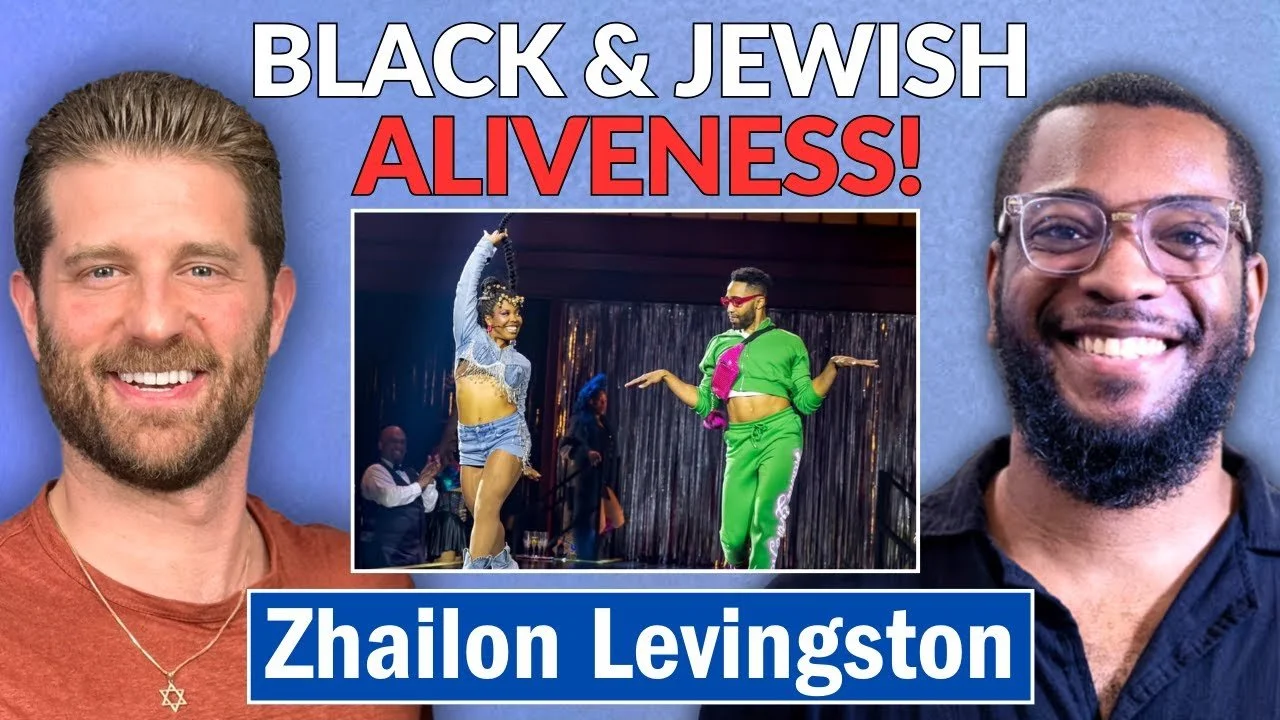
Interview Transcript
Challenging Black & Jewish Identity on Broadway with Director & Activist Zhailon Levingston
recently I had someone reach out to me for some advice this person let's call them Rifka identifies as a member of both the Jewish and queer communities and wanted my input on how to deal with some conflicting feelings she was experiencing around the realm of politics now this was the day after president-elect Trump posted his threat that there would be all held to pay if Hamas did not release the hostages before his inauguration and rifka's Jewish friends were taking to social media to celebrate this strong non-nonsense language personally I'm more of an action speak louder than words kind of guy and the truly meaningful test still Waits ahead but I can certainly understand that after not having someone of authority speak this directly and aggressively towards Kamas in quite a while just posting these words was in many ways an action in itself and something to be celebrated so Rifka on the one hand she saw her Jewish friends admiring Trump in this moment and on the other hand as a queer identifying person she remained extremely worried about how his administration might seek to roll back lgbtq plus rights which is unfortunately a valid concern and in certain respects is already in motion totally reasonable that someone like Rifka might be torn in this moment and so she wanted to know what do we do with these conflicting ideas do we celebrate Trump standing up for Jews or do we oppose him for the threat he represents to the queer community and others what I told her was that the answer of course was both which may sound obvious and so simplistic as to almost sound condescending but it's actually not the default way contemporary Society has been teaching us to reconcile discordant Notions we live in an aggressively polarized country in an aggressively polarized world over the past several decades we have been slowly pushed into this more tribalistic model by a number of factors our politicians who demonize their opponents our news media who denigrate those who don't agree with their point of view are social media that creates Echo Chambers and promotes incendiary rhetoric elements of modern social justice movements that have framed our society as an oversimplified binary of oppressors versus the oppressed and of course all these ideas are often reinforced in our schools and universities the notion that polarization is just the way the world is is so ubiquitous it may as well be in the Water by Design our brains all already love to categorize and put things in neat little boxes our minds absorb so much data every single second mental shortcuts are necessity for our brains to be able to handle all the vital tasks required of them so when you add this innate process to the culture's constant Whisper of choose a side the impulse for many is to do just that sort everything into one of two boxes it's either or black or white good or bad life and its intricacies are far more complex than a simple binary can explain we know this and yet we seem to have forgotten how capable we are of processing that complexity without having to pick a team or smush everything into a box that doesn't quite fit the notion that we must choose sides is a false Paradigm we don't actually have to do that no matter what our peers on social media or in real life may think and in fact we shouldn't do that if we want to have a more communicative cooperative and stable Society there is no shame or controversy in acknowledging two competing truths any negative response to an accurate grasp of reality is due to the small-mindedness of the Observer not any shortcoming in the person who's actually getting things right so bringing it back to Rifka there is nothing wrong with saying I applaud Trump standing up against terrorists and I worry about his agenda towards the queer Community I mean we could do this all day on any subject right you love your kids the most and they annoy you the most non-gender conforming people deserve dignity in the workplace and changing all shared restrooms to gender neutral can be extremely uncomfortable to gendered men and women who have no desire to poop next to someone of the opposite sex which is something that happened to me in the middle of a show I was working on Republican attitudes towards climate change are catastrophically self-centered and we can't afford to just abandon fossil fuels without endangering our economy and stability Israel is one of the most amazing Democratic and Innovative places in the world and its prime minister is an untrustworthy power hungry stain on liberal values trans people deserve respect and dignity and student athletes deserve respect and consideration when they're forced into an uncomfortable or unfair competition with someone whose biology is objectively different than their own life is hard and life is beautiful now perhaps you may disagree with me on one or more of the specific points I addressed and that's totally fine but the simple fact that there are competing equally valid truths to each situation is undebatable anyone who would take these statements and label one side as evil or anti or even biased is being disingenuously defensive because they are so invested in their own position they struggle to even allow a Counterpoint to be introduced to the conversation but that doesn't make it any less true or valid it just makes that person unreasonable ask yourself what's more reasonable acknowledging the complexity of life's challenges or asserting that everything has only a single right answer and it's yours holding two truths simultaneously like much of what I discuss on this show is just another muscle you have to exercise the more you do it the easier it gets because it's actually a much more natural and logical way of approaching the world than binary tunnel vision in closing I will leave you with a final double truth you enjoyed this monologue and you're ready for it to be over now totally with you this is the 14th episode of being Jewish with me Jonah plat [Music] [Music] my guest today is a quickly rising star of the New York theater scene his work as a director however is about much more than just entertainment through his activism and advocacy he has used art as a vehicle to Foster dialogue provide education and Bridge gaps between communities in fragmented World he's involved with several Arts advocacy organizations including one for which I am a board member he's also the youngest black director to ever have a show on Broadway which maybe he's getting sick of hearing about I don't know I'll ask him please welcome the very talented and very humble jayen Livingston hey what's up you know just doing a little interview show how are you doing podcast it's all good yeah I'm good I'm so grateful to be here thank you for being I'm grateful to have you so I want to start with the obvious what is this not Jewish the theater maker doing on a show called being Jewish because of your work as artistic director uh of an organization called The Inheritance theater project which I'm a board member I wanted to bring you on so we could explore that work and that can be our entree into the rest of the conversation so first why don't you tell us what inheritance theater project is and what it's all about sure so the inheritance theater project is a national nonprofit founded by John Adam Ross who is our executive director shout out to J shout out to jar very close collaborator colleague and friend and I started with the organization maybe around 2017 just as an associate artist um and uh last year became the artistic director and what the inheritance theater project does is we go around to different communities in the country and we ask a set of questions one of being what is the history of this place what are the stories of the people who live in the place today and then what does it mean to bring an inherited text to this community as a kind of orienting foundational conversation starter what do you mean when you say inherited text so we think of inherited text as these kind of foundational stories or narratives that multiple Generations have had some kind of relationship to and so uh a great example within our work of an inherited text or an inherited narrative or story would be like the story of Exodus right um it's cross generational obviously but also cross-denominational Christians know the story Jewish people know the story people who watch cartoons know the story right and so this story of a people being freed from bondage and making a kind of Voyage to a Promised Land is a narrative that has been inherited and what do we do with those inherited narratives why are they still around today how do we wrestle with them and how do they actually help reflect and refract back to us the narratives that are emerging in our society today that was an awesome recap I feel like that was a really good hopefully John would be proud yeah it's It's tricky to to give the elevator pitch because it's so unique and it's so involved it's not like a here's a thing we do in a week it's a 9 Monon really involved process uh which I got to actually experience we'll get into that a little bit later I want to talk more about that it isn't a Jewish organization but it has a very Jewish soul to it it was founded by Jews it's supported a lot by Jews uh very Jewish ethos of social justice and tun Alam and sacredness of text do you feel that like do you feel a a a connection to what Judaism is about through the work I totally do I I feel like sometimes and I identify as a Christian but I feel like some times I want to lean into the Judaism of the organization sometimes even more than the Jews involved because I think sometimes as an outsider you just has have a certain objective view of the technology you know where I didn't grow up doing seder right I didn't grow up really knowing any Jewish people you're fromport Louisiana and I knew one Jewish boy in elementary school named Rond de badet I don't know where he is now shout out to Ron shout out to Ron and he would eat a bagel every lunch and he would put cream cheese on the bagel a bagel every day we can do better but then he would put Cheetos on the bagel and I was like that's so dope Ron with the Cheetos in the and I remember one time I tried it and I was like no that's really just for Ron but that I don't know if that sounds wasn't great I really knew nothing about judism outside of what like maybe questionable education might have told me right which then left me with lots of like big broad questions I think a lot of people have who don't grow up around Jewish people and so I didn't really like interface intimately with Jewish people at all until a little bit in college but I went to college in Los Angeles and I lived in Hollywood and so there was more there but really wasn't until I moved to New York and was actually like collaborating professionally that I was able to have intimate relationships with Jewish people which is to say see the ways in which their cultural technology and religious technology could be used to create spaces that I was interested in so there's always going to be a kind of inherent jewishness to The Inheritance theater project and I think that's a gift and I think that just like I bring everything that I love about my cultural background and also religious background to my work um without it having to be overtly labeled anywhere you know it just is what it is if it's a real culture it finds its way into the room I want to dial in on your use of the word technology you've said that word a lot how do you define technology because you're using it in places that I haven't typically heard it used yeah I mean I I think of Technology as something that helps you achieve something you couldn't do by yourself M and you know Arts is a kind of Technology right and I also use the word technology because it's active you know technology is powered by the human but it's an assist you know and so it still takes you coming to the table and using this thing and then creating a different reality that you would have had without it and so when I think of you know one of my my I always make John laugh cuz when I learn a new Jewish word I'm like I've learned this word and this will now be my hyperfixation for a while now but uh me and Rebecca who is our dramaturgical scholar and residency for The Inheritance theater Project work very close to create workshops and methodologies um within our spaces and we are in haruta together and like learning about haruta it's like that that is that's my jam like longterm study with another overtime you know like it's like I love that stuff well Define it for us because not all my audience is going to know what Kut means and I'm GNA probably like not give give your understand my understanding of it is like rigorous long-term wrestling with another person yeah over a long period of time wrestling over what wrestling over an idea wrestling over text were those conversations between you and Rebecca about devising the methodology or you're saying you two were debating the text yourselves it was a little bit of both I mean in trying to create a space where people could wrestle with text we're also wrestling with the text um and trying to negotiate it and figure it out and what I kind of uh what emerged out of that work was maybe an answer to our divided times isn't necessarily a mass quantity of people agreeing to anything at once but maybe more intimate small intense and rigorous long-term relationships being built and then tasking those relationships with creating something for multiple people or or a large group of people to experience I'm a southern black queer male Christian Rebecca is a Jewish academic in her 60s not from the south it felt like the perfect structure to hold people who have um who come from different backgrounds yeah um and so that's a long way of saying like that's how I see part of the Jewish technology being used to um impact the work that I pretty ancient technology very ancient technology um so specifically about these salons that you did over the past year I don't know if this was the sole text or one of the texts but it was there was a James Baldwin text you were working with said the Negro is anti-Semitic because the Negro is anti-white how did that go discussing that I mean that's did that go an interesting an interesting certainly ripe for discussion yeah well we were trying to find a text that people could wrestle with that didn't feel like it was necessarily being dactic about the times we're in in terms of like telling you what to think about anything but also kind of diving you into a rich um tradition of of conversation and what I had been told was that you know black people and Jewish people had a certain kind of solidarity with each other in the 60s and over time that solidarity had started to fracture for however many reasons you know that could happen um there's multiple reasons and in finding that text what I realized is it was published in 1968 which is right in the center of when this narrative was being kind of like passed down that like this was the good times and now we're living in this bad time and I found that complicated because there was a lot of Jewish and black solidarity in the 60s and also there were real complications about what does it mean for us to hold these identities and live in the Empire that is America what does that do to us what does that do to our relationships and so we felt like that could be a really ripe text to bring Jewish storytelling and black storytellers together around and after our first Salon what we were really kind of rocked by was the realization that the chances that James Baldwin titled that text himself very slim most likely he was commissioned and then a white power base said this is what this article is called interesting and so that changes the relationship to like the overt provocativeness of the title which is not found anywhere in the text itself is what I the the quote I read is the title of the piece the title of the piece not titled by James Bal interesting and not appearing itself within the piece and not appearing itself within the piece and so there's already this outside kind of thing trying to frame how you enter and so it was interesting to be like oh well then we need to figure out a different way to enter the text um and a lot of the black storytellers in the room were like either I've read this before and I've heard this before and I really don't want to be in a room trying to explain something that James Baldwin was asked to explain 50 odd years ago it feels like his legacy to us is not to continue to labor in this way MH and so that was like my ego being like oh did I bring the wrong text in oh no what does this mean and then the Jewish people in the room particularly what I would consider white Jewish people in the room because I think it's important to say in this particular Salon there were no black Jews and that has changed as we've gone along but there was a lot of silence and I was just like this is not my experience of wrestling M with Jewish people my experience is like deep conversation and challenging and Pull and tug and learning and capacity building and that that felt Central to the cultural identity right and there was something about that framing of that text that conversation what it meant to be in a room with other black people that actually turned the room white as opposed to Jewish and what I mean by that is I see a kind of like silence to difficult conversation or a kind of overt performance of politeness as a non-jewish uh characteristic and so what felt like it was coming up in the room were all the ways in which America shapes us as identities to be together that if I'm in the room with these black people I am white not Jewish and if I'm in the room with these Jewish people I'm a black person who has an answer to an existential question and it's up to me to to build the capacity and what you know me and Rebecca found this other great text by a writer named Kevin quashi it's from a book called the black aliveness and Poetics of being and basically what it posits is that we read text with read black texts with the kind of racist framework that says if this is a black writer it is either exposing or a trauma that um we all need to look at or it is trying to teach me something or if I don't understand it I'm constantly in a state of hoping to be taught or or to understand and that actually an alternative to that is just to be in a black world and in a black world there's room for everyone in a black world my color is not just my color Blackness is a way of being together and that to me elevated the condition of Blackness in the way that I have seen the condition of jewishness be elevated as a real cultural practice and a real way of being in the world differently and what came out of our conversations was how can we create a space wherein black people are expressing from a place of aliveness to Jewish people expressing from a place of aliveness and that cultural whiteness is decentered not forgotten about not not accounted for but not the given not the norm that actually how do we put each other in relationships with our most infinite beings and infinite selves as opposed to our most politically reductive selves I I love that I love everything you just said so something you and I worked on on together uh through the inheritance project was a project bringing together black Jewish and black Jewish communities in Los Angeles my hometown around the idea of a juneenth Seder y so first you know what and why a juneenth Seder well I mean both juneth as in holiday and the SATA tradition is rooted around uh a kind of Exodus narrative and so they are cousins in terms of their relevancy to each other the idea of trying to understand a people trapped in Empire back in that time and what does it mean to be people who were trying to free themselves in America obviously clear links yeah and so it felt like a natural merging of cultural stories and traditions and felt like a way in which both Jewish folk and black folk could come together around a common theme of Liberation that wasn't simple but possible what was this process like and what did you learn from this experience well we really come to these cities to really hear what the community wants to say what's emerging but because we've done this work a while we kind of know when certain things aren't being said in a room what does that mean and when certain things are said in a room what does that mean and so part of what we do is we build these workshops with communities and we have kind of prompt-based approach to generating work with them and Rebecca was there to kind of use the tenants of the Seder ritual to like lead people through talking about themes around their own city um and so we would hold different workshops which I got to participate in a couple yeah yeah and eventually those workshops go from kind of common identities to identities that start to get more mixed and we call that going from a kind of like um home home base or safe space to a braver space and then by the time we start to make art together we're trying to create a mergent space together something we haven't seen together before um and so it was really fascinating in Los Angeles to hear from Jewish citizens who also consider themselves lifelong Los angelinos um and the stories of anti-Semitism that they experienced as people who have been in La for a very long time what my grandmother experienced or and you know it's not always I think centered the ways in which maybe anti-Semitism might have found its way on the west coast and so it was interesting to to to be in multi-generational rooms hear some of those stories and then see younger participants be like whoa that happened here that was going on here what does that mean what we were surprised to find was maybe commonality between these communities that you hadn't realized existed just how much voyage and journey is still so Central to the existential questions still driving both communities you know what does it mean to really have a relationship to the promised land today what is that mean and the ways in which both communities have never forgotten about a certain kind of promise but also kind of have come to a really kind of radical piece with the ways in which the idea of a final destination where all your problems will be solved is not attainable right doesn't quite exist doesn't quite exist turns out did you learn anything surprising about juice that you didn't know through that process just like no one Jewish person is the same right you know what I mean just in the way that no one black person is the same yeah um and so continuing to understand the tapestry the Spectrum I don't know if it's like surprising in that like if I thought about it I would probably come to that conclusion but to just be around it um I think was really humanizing that's cool that's I mean that's literally one of the main reasons this show exists is to to show off that Spectrum I like the word tapestry though I haven't used that one yet so I'm going to I'm going that way what is something that you feel like maybe Jews don't understand about black folks I think still a lot of Jewish people especially Jewish people who identify as culturally Jewish um ethnically Jewish religiously Jewish who have the Traditions pass down to them who keep the Traditions I think it's really hard for them to understand just how white they can be to a black person how white they can be meaning they're acting in a way that is white or how white seem to a black person sometimes both I mean it depends on what your relationship is your proximity to Jewish people obviously to use technology in a much darker sense the kind of Technology of racism that America invented for it to be so purely based on the color of your skin means that without you even trying with all the best intentions in the world you can walk into a room and a set of conditions start to unlock that have nothing to do with anything you might have said or might have done but that things start to move differently and I think that that can still be a challenge especially for people who understand how ridiculous phace can be as a concept in this country that despite that it's still a real sociopolitical reality and there are still things that a white passing Jewish person can do in ways of being in the world that they can be that are still really hard for a 15-year-old boy in Compton to do and be yeah I think that's a good way to frame that how has exposure to the Jewish community and Jewish ways of thinking through inheritance theater project if at all change the way you think about certain things or move through the non-jewish world my mind has been so validated by Jewish people what do you mean like I said I wasn't around Jewish people a lot growing up and what I'm going to say is not because of something I didn't get from my family or from my culture but in hindsight understanding that I'm a person who part of my day job is wrestling with ideas as a director as an artist that that's so Central to the work of the rabbi you know and that was always my way into my own faith is actually really trying to wrestle with it um and not always being in a where it was safe to wrestle with I was going to say I mean generally that's not that sort it's very associated with Judaism you question everything not so associated with Christianity often the opposite right and I just knew that like whatever that opposite was was not my relationship to God my relationship to God was someone or some being that actually allowed me to wrestle allowed me to ask questions that really scared me that the questions that I was asking at 15 16 16 17 I actually only felt safe asking God even though they were about God um and so as I started to get older and work with Jewish people and they would kind of like sniff out the kind of like I don't even know what you call it the sense that I had to want to to to wrestle with ideas and to really never have the question be answered they validated me as smart um and I grew up with undiagnosed ADHD you and me both my man and that's a whole another podcast um but because of that I told myself many different kinds of narratives about my worth and my value and what I could what kind of space I could be in and not be in um and so it was much later when uh um you know a 60-year-old Jewish woman was like come co- te this class at Columbia Law School school with me I was like colia L I barely got out of high school what do you mean you know that was the beginning of me understanding there are multiple ways of being smart and just because you're not a person who was born to being an assembly line doesn't mean that you don't have great intellectual value oh yeah in some of our biggest institutions amazing you know in regards to the response to the war going on in the Middle East many in the theater community in the black community the queer community have have used this response to express some pretty virent anti-jewish bigotry I mean is that something that you've seen I think I've seen a lot of ignorance yeah what I mean by ignorance is a need to respond that is greater than your need to learn yeah our phones social media television kind of like the mad media landscape that we live in every Force both good and bad filters itself there and there's no way to turn it off I mean yeah you get rid of your phone but it's not like when you were growing up you could watch TV and then the commercial would come on and you would go run outside and then is back no you can turn on the television and have a constant stream that never stops of information and ination and then to feel like well what do I do with that and to only feel like you have the tools to go on your phone and I think that like for a certain generation that is actually a real place and I think where a lot of cross talk and miscommunication happens is cross generationally wherein older Generations don't see social media or the platforms on which young people are trying to just Express their ideas as a real place they see I think the darker sides of it the ways in which it's been used as a weapon the way in which other forces have used social media to brainwash and inate but conversely because of sometimes only seeing it from that point of view it's really hard to see the ways in which social media is literally providing a space for people to find a vocabulary to find a a way of being and talking to each other and so I think there's just so many confluences that end up happening in one space and we're only given like or dislike share or delete but we're supposed to talk about one of the more complex issues of our time through that funnel and so what I actually really see is you know I I see a lot of great advocacy happening in the world I tend to look at advocacy through kind of my own lens of someone who is anti-war just in general I tend to believe if we're in a war then we've already failed that the war is not the problem it is a solution to a problem it's the wrong solution and so I can I think with that framework I kind of can be in multiple spaces in terms of where people fall on any one issue but what I think I see the most especially coming out of my generation is a desire to indict this place and not being given the space platform tool ability understanding knowledge to to do it and so a lot gets projected onto the Israel Gaza conflict when really what's underneath it is we don't like that this is the solution to this problem we don't like it right and I don't think that is the most unusual response no in the the you know many years of of conflict that has happened who would who would like it you know but we're contending with this brand new way of expressing it and with this brand new way of expressing it it's much harder for people who maybe shouldn't be talking to feel like they shouldn't be talking yeah so there's just so much more noise what the media chooses to pick up and and to not pick up is is goes constantly unchallenged yeah in ways that I think are really really detrimental and I used to say this about Millennials and I think it's even more so about Jin Z is that like Millennials were taught that like all these divisions were settled and welcome to the world wherein the divisions were settled and then what I felt growing up is that like you slowly realize wait no this stuff is still going on and then there's a rage that comes from that j z I think just has no patience for it no patience for the world that they see that doesn't make any sense what do you mean we're fighting over X Y and Z what is the value of even fighting over that why is this happen all I see on my phone is that there's a dead baby in front of me yeah and I need to respond so what's the alternative where is the alternative for a 17year old in their bed on their phone Doom scrolling a war what is the actual alternative in terms of expression there has to be more Outlets if not then the same kind of algorithmic poisoning that happens through social media is happening now through the context of a real International conflict and it only benefits those who are invested in war on either side you're a smart dude jayen I don't know let's get into your theater work a little bit on the commercial side of things um you have had a very fruitful partnership with playwright Douglas Lions yeah shout out to Doug um famously chicken and biscuits and table 17 most recently both of these shows are what might be considered kind of old school you know that one is sort of a broader family comedy one is sort of a classic romcom uh you guys are kind of zigging while a lot of theater is zagging you know it's not not overtly political or psychologically challenging or agenda driven uh it's got hard it's entertaining it's it's nostalgic in a way what makes you guys want to create theater like that well one I this that's just how Douglas writes that is his natural pen he has a kind of broad commercial sensibility about how he writes and the kind of rooms he wants to be in and I think actually there are things that are deeply political about the theatrical event of Douglas's work and and and me working with him that aren't squarely situated on the play itself to be able to hold so he's able to tell these kind of like heartfelt comedic uh stories of black life that are accessible to all different kinds of communities without ever not being what they are which are black stories yeah but what we're doing with the audience and their orientation to the story and what and the way we're asking them to participate in the world um I think is actually something that's quite political we did chicken and biscuits in the middle of the pandemic yeah and so to do a comedy in the middle of a pandemic wherein the centerpiece of the comedy is a funeral and wherein people are coming into the space wearing masks we're like What does it mean to do a comedy where you may not even be able to see people laughing yeah that there's a lot that's working on the audience subconsciously you know for us to be making comedy in a deeply divided time I think actually drives home the deeply Democratic nature of theater theater is the first democracy so if you can get a room of people to laugh together in the first five minutes you've proven something about us that the mass media doesn't want you to know which is what which is that we are more spiritually connected than someone might suggest right and so if that is true what else can we hold together what else can we hold to that we we may be able to hold conflict tonight together so in table 17 the story of this couple that had a a breakup and come to together after a certain amount of time to see each other at a a restaurant we put all the audience at the restaurant and we make you ease droppers on a conversation at restaurant but then we have these two characters actually talk to the audience like they're in a comedy club right and because you've already laughed with these people because you've seen certain tropes you think you are ahead of then when it's up to you to make certain kind of judgments you respond in a way that then the play actually actually reflects you back to you and so there is a moment where the male character says something that the audience really doesn't like he reveals something about something he has done and some nights we get everyone going boo boo boo but we know that's going to happen so then he has a monologue where he's explaining himself and because we allowed you to express your judgment you then have to express your empathy so now we've we we've begun to to really pull at you know what the fabric of society is in this moment it's so interesting like being being able to take the sort of macro view of your body of work over the last few years and see so clearly like such a Common Thread through such different things through the advocacy Arts work through cat's Jellico ball to chicken and biscuits it's all you sort of have your lane like your mission and what you're trying to do and you're doing it in all these different ways it's cool to see yeah I think I want the shows to feel quite different but I want you as an audience to feel like there something familiar about what I've been charged to do in the space considering you know chicken and biscuits and table 17 I I felt a little bit of a similarity to how I feel and like the kind of narratives I want to see in Jewish representation where I I'm kind of I've seen a lot of Holocaust shows I've seen a lot of shows about bigotry or whatever and I'm looking for more just sort of contemporary Jewish stories of just people are Jewish and um I was just curious is that is that a piece of all at all of of the shows that you you guys are doing thist desire to just tell these black stories that don't have to be about slavery they don't have to be about it it feels like what I hear is that you want to see a Jewish World in a show yeah that is not burdened by having to be exclusively your condition and I think when that happens we actually are able to hold things that are more complex than our conditions um that are more Universal than our conditions and I think it's definitely a part of the work that I choose to do because people who are much smarter than me have written about racism people who are much more courageous than me have died over it and so if I am to wear the crowns of my ancestors part of honoring that is to not put myself in a situation where I am made to do the work that they did so eloquently I need to be figuring out what is distinctive about the work I'm here to do and how can I continue to push the the the ball forward in terms of when we say representation what do we really mean um and you know to I I remember when Empire came out the TV show obviously a black show not explicitly about the black condition um but also had major queer representation on that show and I kind of Mark it as a very pivotal moment in kind of middle of America where people had a relationship to a queer person on television that could get them to understand maybe their own queer family member better particularly in the black community um and you can go you could go oh yeah they're not all like one way or the other way like this is a very specific kind of character I'm really rooting for him and you know I can see how you could desire to have something that explains not even explains but shows um the Jewish context and way that is driven purely by empathy and the the questions we are all asking as humans yeah it's all about humanizing yeah yeah so chicken and biscuits are you sick of hearing that you're the youngest director black director on Broadway or is it's still like fun to hear every time because I'm sure it's like now it's like the thing that follows you around everywhere I'm not sick of hearing it okay good there's a Jewish character in the show yes uh the partner of the son of the main family H how how did you guys guys you know work to authentically present this character do you guys feel like you nailed it what were considerations around fleshing him out oh I don't think we nailed it at all I'm I'm sure there have been other Productions around the country that have been able to be even more culturally specific about the Jewish character in that show primarily because I think that he's really function in in a very particular way he's really feeling a particular kind of archetype of Outsider and so I think kind of the some of the more comedic tropes of what it means to be a Jewish Outsider in a world that is not your World shows up in that character and show showed up in that performance but I definitely don't think we nailed a kind of sense of like holding both identities in a way that was even remotely um what we were trying to do with with the black bodies on stage do you feel like that's a problem I think that there's definitely room for deepening and and also room for critique of that representation because I think the truth is you know there was nothing identifiably Jewish about the character outside of the fact that the script says he is Jewish um because we don't go into his backstory that much we don't go into his kind of specific cultural lens on where he is there are a couple of of of references that that help suggest that but it's just like not what he's there to do and so yeah I think if I felt like I was watching a play and the black character I wanted his particular cultural context to come out into the piece more yeah I would be like yeah there's room for growth there but it it it's hard to say in hindsight what that would have done or not done to the play so I don't know if I like regret it outside of the fact that like if someone gave the prompt is there more of this person's Jewish identity to be found in this role heck yeah mhm is is it the most produced play America the year it was um licensed and went out it was the number one most produced pretty sure it was the number either one or two but I'm pretty sure it was the most produced I mean that's amazing it was incredible congratulations Ma on that first of all what do you attribute that to there's a need like there are really really really talented black women all around this country who are of a certain age who aren't given an opportunity to be fun and funny and heartfelt on stage um and so you had all these theater companies that were like finally I can ask this person and that person and that person to be in one play together finally that can happen I also think it gets produced a lot because it's hilarious and it's really really funny and it's really surprising and you really end up feeling for these characters I think even if you walk away even with the um Jewish character Logan even if you walk away not feeling like you knew that much about his jewishness outside of what it means for him to show up in his white skin in front of his black family as a gay person you still are rooting for a character in a certain social context that is unusual for the audiences that come around chicken and biscuits and so there is a kind of like I said work that Douglas's plays are doing ever so gently to just kind of Force you through joy into relationship and then from there I think people are changed in really unique ways and so I think people sense that in the in the play when you're doing it what are some stage pieces of content that you feel have moved the needle in terms of creating understanding or or bridge building the first play that actually came to mind was the normal heart so powerful and it really changed me in terms of what what the event of theater could do and be and I was I went by myself it was the first time I my mom let me go to a play by myself without her and I sat in between two different generations of men who were there watching the play and so I started to understand something about generational identity that there's something we can share even at different ages George C wolf in between the trends musicians would project the names of people who had died from AIDS right and there would be times in the audience where you would hear someone gasp in seeing someone's name that they knew and so I started to understand that the power of theater really is about what floods out from the prenium and not just what you get projecting onto the prum or onto the fourth wall and then after the show everyone like quietly got up and walked out into the noisy like Times Square Street and I was like what this is still on me yeah yeah like I felt it and so I knew that theater had the impact or the ability to impact you in ways you couldn't see but you could feel and so I stopped you know I think about that when I when I my ego wants to know the way in which this play is working on a person or is it changing the world or what's going to happen you know it's like it it's things can move people in ways that your desire to see the mood will never account for right as an ally to the Jewish Community what's something you want my Jewish audience to hear and what's something you want my non-jewish audience to take away that everyone is wrestling with the same questions and if you're not wrestling you're not alive and so if you're so comfortable that someone else's wrestling makes you uncomfortable then it's a mirror to how dead you are and I think so often we can feel as if the debates that we're having the arguments we're having the fights that we're having is somehow shutting us down it's because that this the powers that be don't want us to know the truth about us which is that we can withstand uncomfortable conversation we can withstand you as a Jewish person building my capacity me as a black person building Your Capacity and that that can sometimes be really joyful and sometimes be really really hard but that if you're a person who is open to the ways in which we are all connected then you will see everything as your business and whether or not you understand a thing or agree with a thing has nothing to do with your responsibility as an alive human to be paying attention and I think that it is not our political affiliations that that divide us the most we are divided among people who choose to be alive and people who do not I like that distinction was that message for the Jews or the non-jews both um okay I want to finish off something a little more lighthearted we do a little lightning round have you ever been to shabbat yes what was the first Shabbat you ever went to John Adam Ross oh makes sense uh yeah what's your go-to bagel order I think it's probably a crime my go-to bagel order let's hear it it's a blueberry Bagel it's nothing wrong with the blueberry it's it's unusual to be a favorite really blueberry raisin blue I I didn't know that's pretty specific it's a thing I like it with what on it I'll do a just a regular cream cheese I mean cream cheese and blueberries that's a natural fit yeah um but you know I also mess with everything bagel yeah very good have you ever celebrated other than Shabbat a Jewish holiday no not celebrated all right we got to get you an invite somewhere in the next year which one though which there's so many you see there's so many so you have a lot of options someone's going to get you over for Hanukkah that's coming up right I've never been over for Hanah yeah that's what I'm saying you gotta be over for for Hanukkah is a good one porum have you heard of porm porum you basically wear costumes and get drunk it's like a big party oh and there's like just literally people have parties and go wild it's like wild night for the Jews that's a good one you should get someone should invite you to a Sader I mean clearly well I have been in I have been to multiple saders I did not count that as holiday unfortunately I know that is the holiday but I was thinking about how many holidays that Jewish people have that have no like understanding relationship I'm if I'm celebrating one in New York you'll get a call Great and to end on a high what's the best advice you've ever received I don't even know if it's advice but I I'll tell this story when I was contemplating going to New York my move from Angeles to New York after college um I was really like struggling to figure out how to make it make sense and I had a teacher who was like well let's flip a coin heads you move to New York tails you stay in La I was like okay and so we flipped the coin he caught it and he was like what did you want when the coin was in the air and I was like well I wanted it to be head so I could go to New York and he's like well then this doesn't matter and he never showed me what flip and I think that that's so like indicative of how I move um and so just really trusting that the jump that your intuition is asking you to take is the right jump love that let's end on that Jay thank you so much for all the insight and for the being so candid about everything and it's really been a pleasure chatting with you thank you thank you thank you to jayen for sitting down with me today and for all the work you do for so many different communities you're definitely doing your your part for tikun repairing the world thanks to everyone here at Hoff Studios and of course thanks to all of you watching or listening to this podcast right now you know I love you I'll see you back in La for the next Sensational episode of being Jewish with me Jonah plat [Music]